Getro vs Zintlr 2026: Talent Network vs Sales Intelligence
Getro and Zintlr get compared constantly, but they solve opposite problems. One runs talent networks and job boards; the other finds B2B contacts and reads buyer personality. Here is which one your team actually needs.
TL;DR
- Getro and Zintlr are not competitors. Getro runs talent networks and job boards for VC firms, accelerators, and communities. Zintlr is a B2B sales-intelligence platform that surfaces contact data plus personality signals on prospects.
- If your job is "help our portfolio companies hire," Getro is the category fit. If your job is "book meetings with strangers," Zintlr is closer to what you need.
- Pricing models are opposite: Getro sells annual, quote-based platform subscriptions; Zintlr sells per-seat plans with a free entry tier. Always confirm current numbers on each vendor's page.
- Neither is a strong standalone contact-data layer. Getro barely touches it; Zintlr's coverage varies sharply by region and seniority.
- Most teams that seriously evaluated both ended up buying one of them plus a dedicated email finder and verifier for the contact layer.
What are Getro and Zintlr, actually?#
Start here, because the comparison only makes sense once you accept that these two products share almost no surface area.
Getro is talent infrastructure. It powers the job boards you see on venture capital firm websites — the "Careers at our portfolio" pages — and the talent-network side of that same coin, where a fund collects candidate profiles and matches them to portfolio company openings. Its buyers are platform leads at VC funds, accelerator program managers, and community operators. Its success metric is placements and portfolio hiring velocity. You can see the product framing directly on Getro's site.
Zintlr is a prospecting and sales-intelligence platform. It gives you a searchable B2B contact database, company filters, and its differentiator: personality profiling on individual prospects, so a rep can adjust tone before sending an email or picking up the phone. Its buyers are SDR managers, founders doing their own outbound, and small sales teams. Its success metric is meetings booked. Their positioning is on Zintlr's site.
So why do people search "Getro vs Zintlr" at all? Three reasons, in my experience reviewing tool stacks:
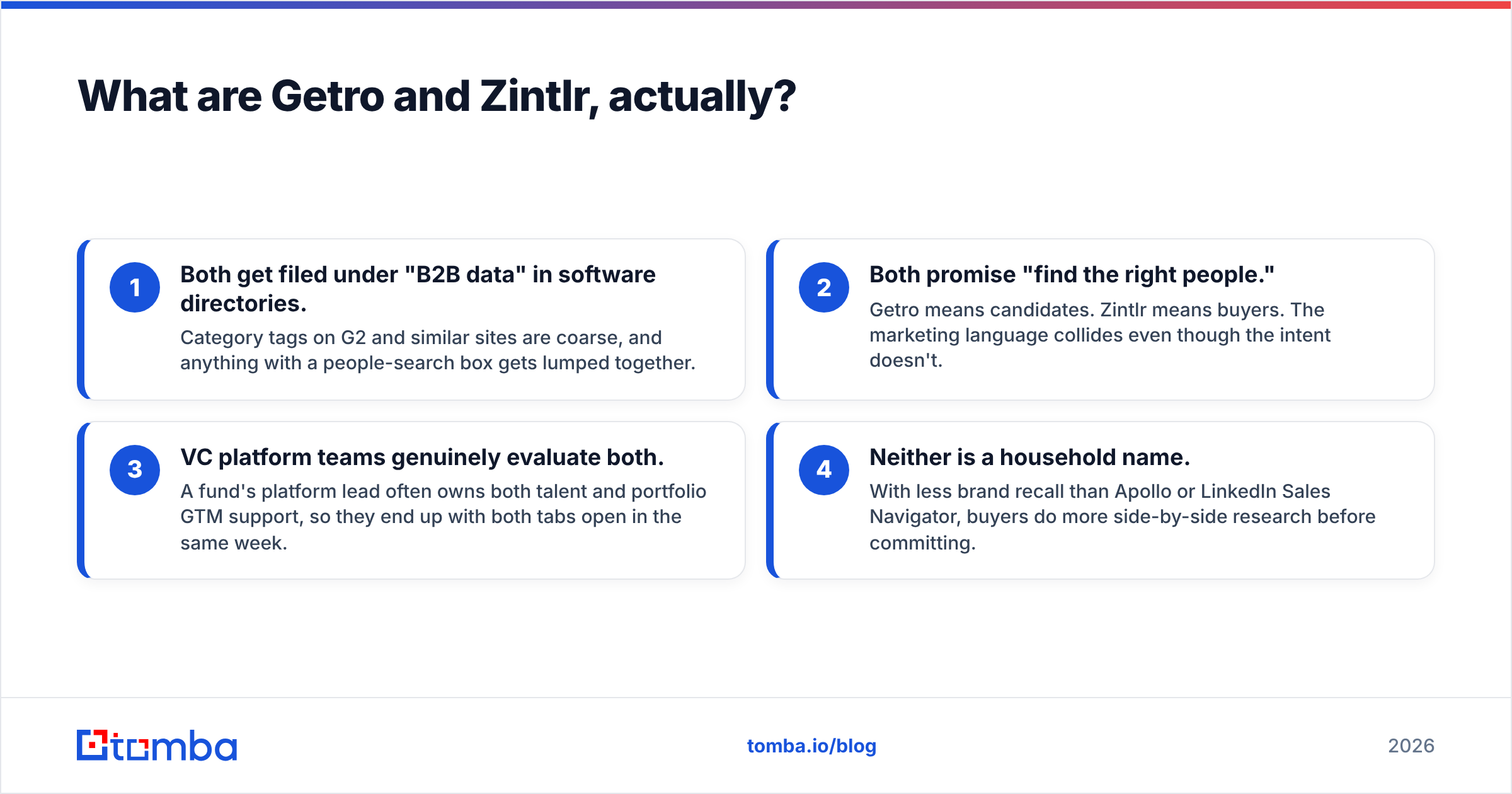
- Both get filed under "B2B data" in software directories. Category tags on G2 and similar sites are coarse, and anything with a people-search box gets lumped together.
- Both promise "find the right people." Getro means candidates. Zintlr means buyers. The marketing language collides even though the intent doesn't.
- VC platform teams genuinely evaluate both. A fund's platform lead often owns both talent and portfolio GTM support, so they end up with both tabs open in the same week.
- Neither is a household name. With less brand recall than Apollo or LinkedIn Sales Navigator, buyers do more side-by-side research before committing.
If you're in bucket 3, keep reading — the rest of this post is written for you. If you already know which problem you're solving, jump to the comparison table and then to the section on contact-data gaps, which applies either way.
How do Getro and Zintlr compare head-to-head?#
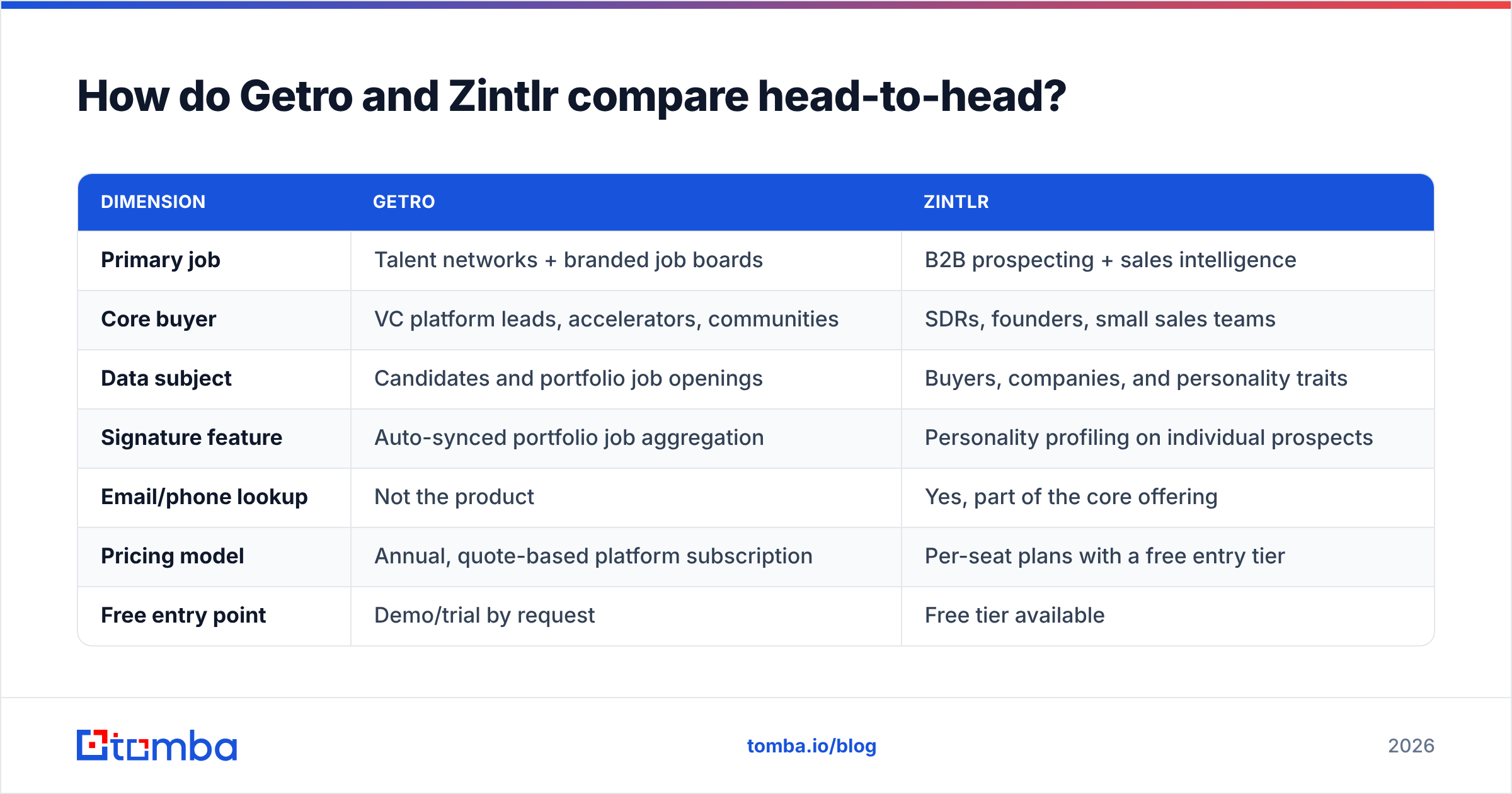
Here's the honest side-by-side. Treat pricing rows as directional and confirm on the vendor pages before you sign anything — both companies have repackaged plans more than once.
| Dimension | Getro | Zintlr |
|---|---|---|
| Primary job | Talent networks + branded job boards | B2B prospecting + sales intelligence |
| Core buyer | VC platform leads, accelerators, communities | SDRs, founders, small sales teams |
| Data subject | Candidates and portfolio job openings | Buyers, companies, and personality traits |
| Signature feature | Auto-synced portfolio job aggregation | Personality profiling on individual prospects |
| Email/phone lookup | Not the product | Yes, part of the core offering |
| Pricing model | Annual, quote-based platform subscription | Per-seat plans with a free entry tier |
| Free entry point | Demo/trial by request | Free tier available |
| Fits a CRM workflow | Loosely (ATS/community side) | Directly (export, enrich, sequence) |
| Wrong choice when | You need outbound contact data | You need to run a hiring network |
Read that table as a routing decision, not a scorecard. Getro losing the "email lookup" row is not a weakness — email lookup isn't in its job description. Likewise, Zintlr not aggregating portfolio job posts isn't a flaw.

What does Getro do well?#
Four things stand out when you actually use it rather than read the landing page.
- Job aggregation that maintains itself. Getro pulls openings from portfolio company career pages and ATS feeds so the fund's board stays current without a human refreshing spreadsheets. This is the feature that sells it. Manual portfolio job boards rot within weeks.
- Talent network capture. Candidates opt into a fund's network once, and portfolio hiring managers search that pool. For a fund with 60 portfolio companies, this converts "we know good people" from a claim into an asset.
- Branded, embeddable surfaces. The board lives on your domain and looks like your brand, which matters when the board is a recruiting pitch for the fund itself.
- Reporting that platform leads can show an LP. Placements sourced, network growth, board traffic — the metrics a fund uses to justify the platform function's budget.
Where it gets weak: Getro is a narrow tool with a wide price tag if you don't run a real talent network. It also doesn't help you sell anything. If your fund wanted one system for both portfolio hiring and portfolio GTM support, Getro solves exactly half of that and leaves the other half untouched.
What does Zintlr do well?#
Zintlr's pitch is that raw contact data is commoditized, so the differentiation has to come from context.
- Personality intelligence. Zintlr profiles prospects along behavioral traits and suggests how to pitch — analytical buyers get data, expressive buyers get story. Whether you find this rigorous or directionally useful depends on your tolerance for inferred psychographics, but reps do report that it changes their opening lines.
- Search-first prospecting. Filter by title, industry, geography, company size, and pull a list. Standard, but competently executed.
- Contact reveal built in. Emails and phone numbers surface inside the same workflow instead of requiring a second vendor for the reveal step.
- A free tier that's actually testable. You can validate coverage on your own ICP before spending, which is the only sane way to evaluate any database.
Where it gets weak: coverage depth. Zintlr's data is noticeably stronger in some regions and mid-market segments than in others, and enterprise-level European contacts are thinner than what you'd get from a specialist provider. Personality inference is also only as good as the public footprint behind it — for a prospect with three LinkedIn posts and no other presence, you're getting a guess dressed as an insight.
Which one should you pick for your use case?#
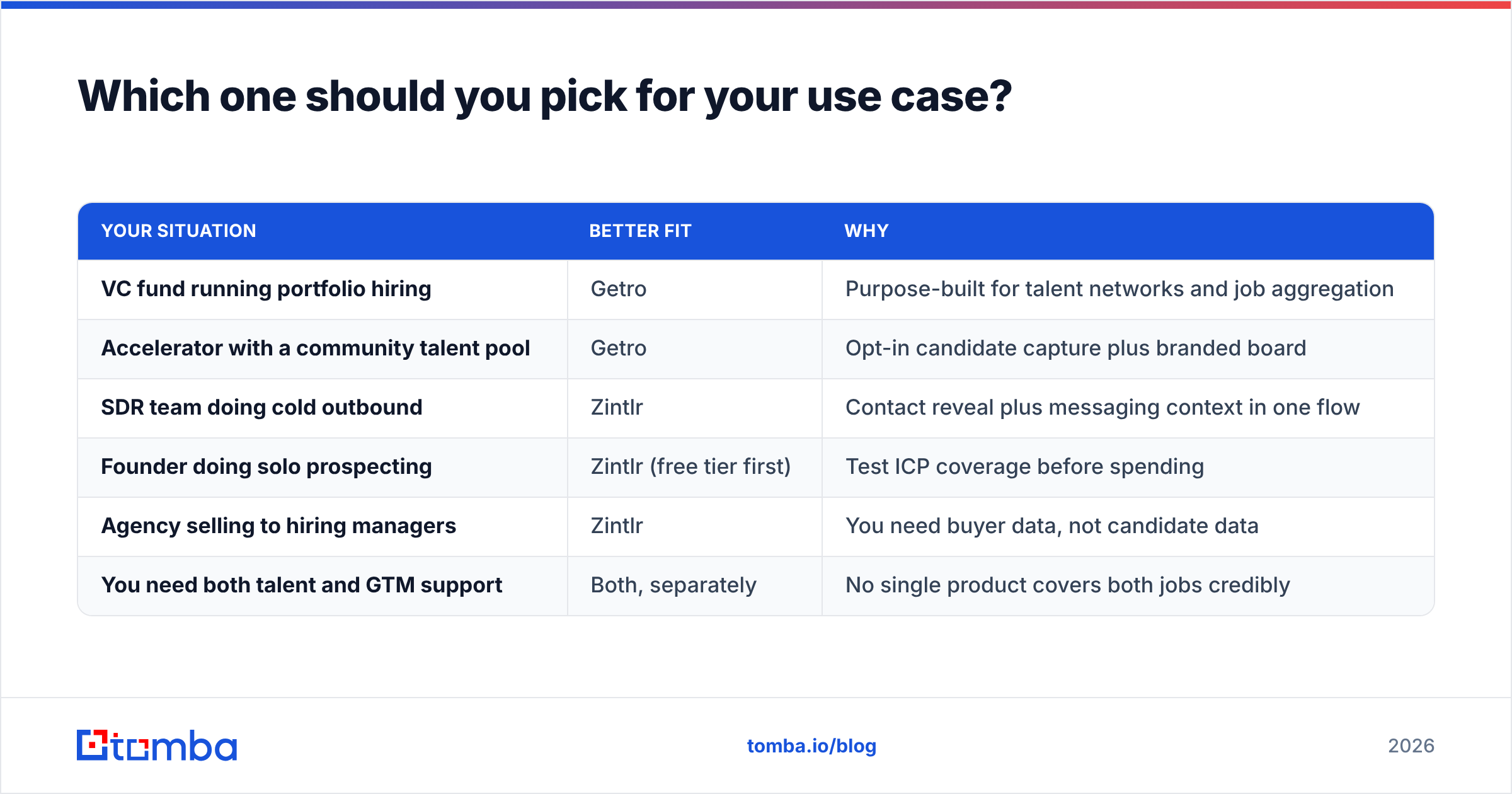
| Your situation | Better fit | Why |
|---|---|---|
| VC fund running portfolio hiring | Getro | Purpose-built for talent networks and job aggregation |
| Accelerator with a community talent pool | Getro | Opt-in candidate capture plus branded board |
| SDR team doing cold outbound | Zintlr | Contact reveal plus messaging context in one flow |
| Founder doing solo prospecting | Zintlr (free tier first) | Test ICP coverage before spending |
| Agency selling to hiring managers | Zintlr | You need buyer data, not candidate data |
| You need both talent and GTM support | Both, separately | No single product covers both jobs credibly |
That last row deserves emphasis. Platform teams sometimes try to force one tool to cover both, usually by exporting from Getro and treating hiring managers as sales leads. Don't. The data models are different, consent expectations are different, and you'll degrade both workflows.

Where do both tools fall short on contact data?#
This is the part most Getro vs Zintlr comparisons skip, and it's the part that costs money.
Getro has essentially no outbound contact layer. That's by design. But if you're a platform lead who also supports portfolio companies with their GTM motion, you'll immediately need a separate way to find and verify business emails — and Getro won't help.
Zintlr does have a contact layer, but a bundled database is rarely the best database. Bundled data has to be good enough across every segment the vendor sells into, which means it's rarely excellent in yours. In practice, teams running Zintlr for personality context still run a dedicated email finder for the accounts that matter most, because a missed decision-maker on a target account costs more than the tool.
The failure mode looks like this: you export 800 contacts, send to all of them, and 18% bounce. Your domain reputation drops, your inbox placement drops on the next campaign, and now the problem compounds. That's why the verification step is not optional. Running exports through an email verifier before they touch a sequence is the cheapest insurance in outbound. When a domain returns catch-all responses — common with mid-market European companies — you need a catch-all verifier rather than a simple SMTP ping, or you'll either discard good addresses or ship bad ones.
A practical hybrid stack for a fund's platform team looks like:
- Getro for the talent network and portfolio job board.
- Zintlr (or another intelligence tool) for buyer context on target accounts.
- A dedicated finder and verifier for the contact layer, so coverage doesn't depend on whichever vendor happens to bundle it.
- A CRM as the system of record, with everything writing into it.
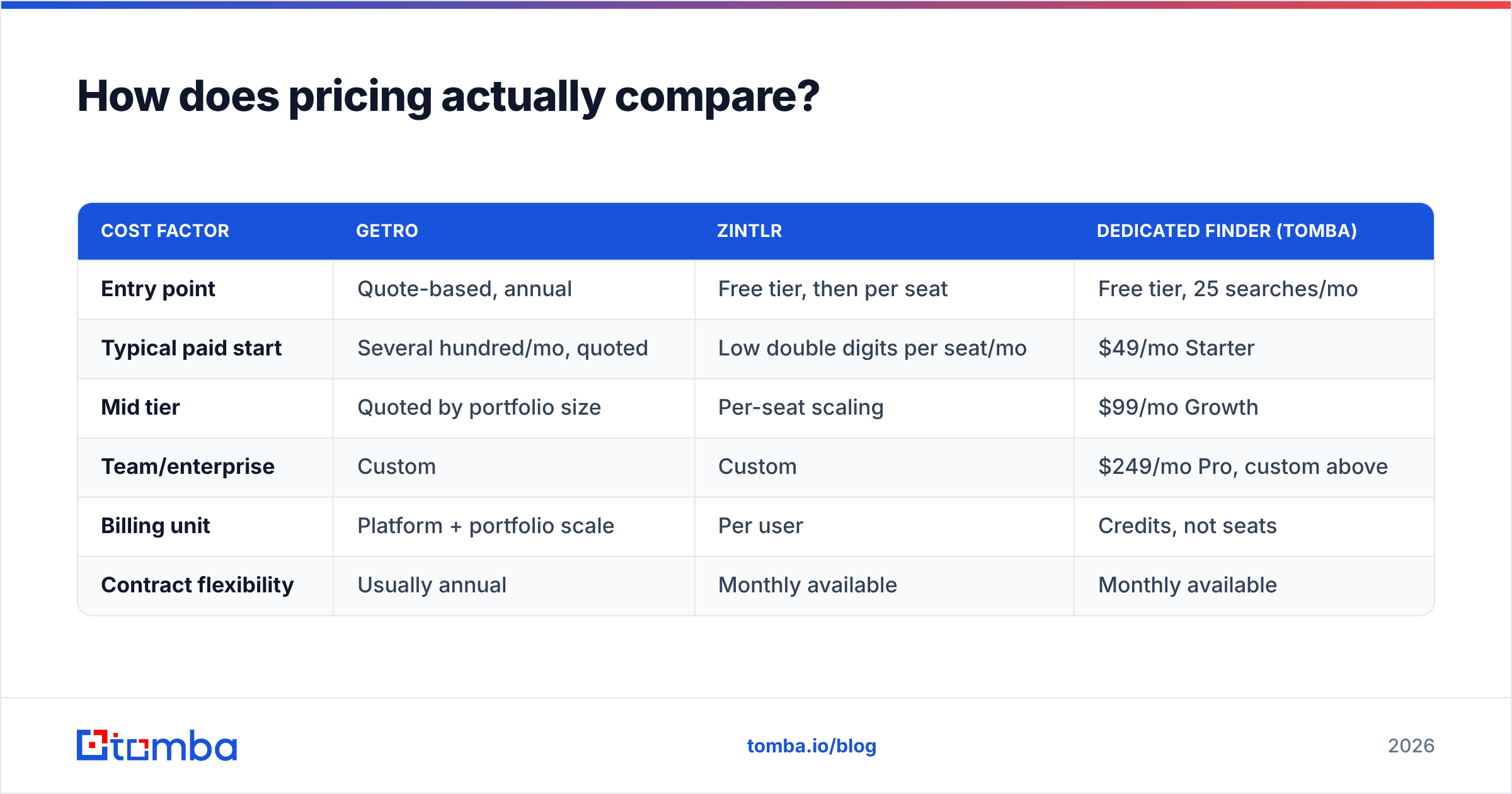
How does pricing actually compare?#
| Cost factor | Getro | Zintlr | Dedicated finder (Tomba) |
|---|---|---|---|
| Entry point | Quote-based, annual | Free tier, then per seat | Free tier, 25 searches/mo |
| Typical paid start | Several hundred/mo, quoted | Low double digits per seat/mo | $49/mo Starter |
| Mid tier | Quoted by portfolio size | Per-seat scaling | $99/mo Growth |
| Team/enterprise | Custom | Custom | $249/mo Pro, custom above |
| Billing unit | Platform + portfolio scale | Per user | Credits, not seats |
| Contract flexibility | Usually annual | Monthly available | Monthly available |
Two structural notes. First, Getro's quote scales with the size of the network you're running, which is fair but means the price is unknowable from the outside — get a quote before you build a business case. Second, per-seat pricing punishes teams that want everyone to have occasional access. Credit-based pricing (the model behind Tomba pricing) fits the "five people who each look up twenty contacts a month" pattern better than five full seats do.
If you're comparing across a broader field, it's worth also looking at what specialist vendors like BookYourData offer for prebuilt list purchase — a different motion again, and a reasonable option when you want a static list rather than an ongoing search tool.
Can you use Getro and Zintlr together?#
Yes, and for a specific profile of buyer it's the right answer.
A VC platform lead supporting 40 portfolio companies has two distinct mandates: help them hire, and help them sell. Getro covers the first. Zintlr — or any prospecting intelligence tool — covers the second. They don't integrate with each other in any meaningful way, and they don't need to. They serve different teams inside the same organization.
What they do share is a dependency on clean contact data. Getro needs valid candidate emails to keep a talent network alive. Zintlr needs valid buyer emails to keep sequences deliverable. Both degrade with stale data, and neither treats data hygiene as its core competency.
That's the argument for keeping the finder-and-verifier layer separate and portable. When you swap prospecting tools next year — and you probably will — your contact pipeline shouldn't have to be rebuilt. Feeding both workflows from a domain search plus verification pipeline, wired through an API or your existing integrations, keeps the data layer independent of whichever front-end tool is in favor.
Frequently asked questions#
Is Getro a sales tool? No. It's talent infrastructure. If a comparison site lists it as sales software, that's a taxonomy error.
Does Zintlr replace LinkedIn Sales Navigator? Not fully. Navigator's strength is real-time relationship and account signals inside LinkedIn. Zintlr's strength is exportable contacts plus personality context. Different jobs.
Which has better data accuracy? Comparing them on accuracy is a category error, since they hold different kinds of data. For buyer contact accuracy specifically, test any vendor against 100 of your own known-good contacts before you commit — including Zintlr, and including us.
Can I just use one tool for everything? Not credibly. Talent networks and outbound prospecting have different data models, consent expectations, and success metrics.
The verdict#
Pick by job, not by feature count. Getro if you run a talent network or a portfolio job board. Zintlr if you run outbound and want messaging context alongside contact data. Both if you're a platform team wearing both hats.
Whichever front-end you choose, don't let it own your contact layer. Run your target accounts through the Tomba Email Finder to get verified business emails by domain, name, or company — free tier includes 25 searches a month, Starter is $49/mo, and it plugs into your CRM, Sheets, or API without a per-seat tax. Test it against your own ICP list this week and see how much of your existing database is actually deliverable.
Related guides#
Ready to find emails that actually work?
Join 150,000+ professionals who stopped guessing and started sending. Free credits on signup — no credit card required.
Get the Tomba newsletter
Practical outbound tactics and product updates — once every two weeks.
About the author