Gigasheet vs Apollo.io: Which B2B Data Tool Wins in 2026?
Gigasheet analyzes million-row files in a browser. Apollo.io sells you the contacts in the first place. Here's the honest head-to-head on pricing, data quality, and which one your GTM stack actually needs.
TL;DR
- Gigasheet and Apollo.io are not really competitors. Gigasheet is a browser-based spreadsheet that opens files too big for Excel. Apollo.io is a contact database plus a sales engagement platform. One analyzes data you already have; the other sells you data you don't.
- Pick Gigasheet if your bottleneck is processing — you have 4M-row exports, messy CRM dumps, or enrichment files that crash Excel and you need joins, filters, and dedupe without SQL.
- Pick Apollo.io if your bottleneck is sourcing — you need contacts, a sequencer, and a dialer in one seat, and you're fine paying per user.
- Neither one is a great email accuracy layer. Apollo's coverage is enormous but bounce rates on mid-market and EU contacts are inconsistent; Gigasheet doesn't find or verify emails at all.
- The common 2026 stack: source and verify with a dedicated finder (Tomba, per-domain not per-seat), sequence in Apollo or Instantly, and use Gigasheet only when a file exceeds a million rows.
What is Gigasheet, and what does it actually do?#
Gigasheet is a spreadsheet interface bolted onto a columnar analytics engine. You upload a CSV, TSV, JSON, or Parquet file — up to billions of rows depending on plan — and it opens in a browser grid that behaves like Excel but never chokes. Sort, filter, pivot, group, join two files on a key, dedupe, split columns, run regex replacements. No SQL required, no data engineer required.
It exists because of a specific, boring pain: exporting 2.3 million rows from Salesforce or a data vendor and watching Excel truncate at 1,048,576 rows. Gigasheet's whole pitch is "the spreadsheet that doesn't die."
What it does not do:
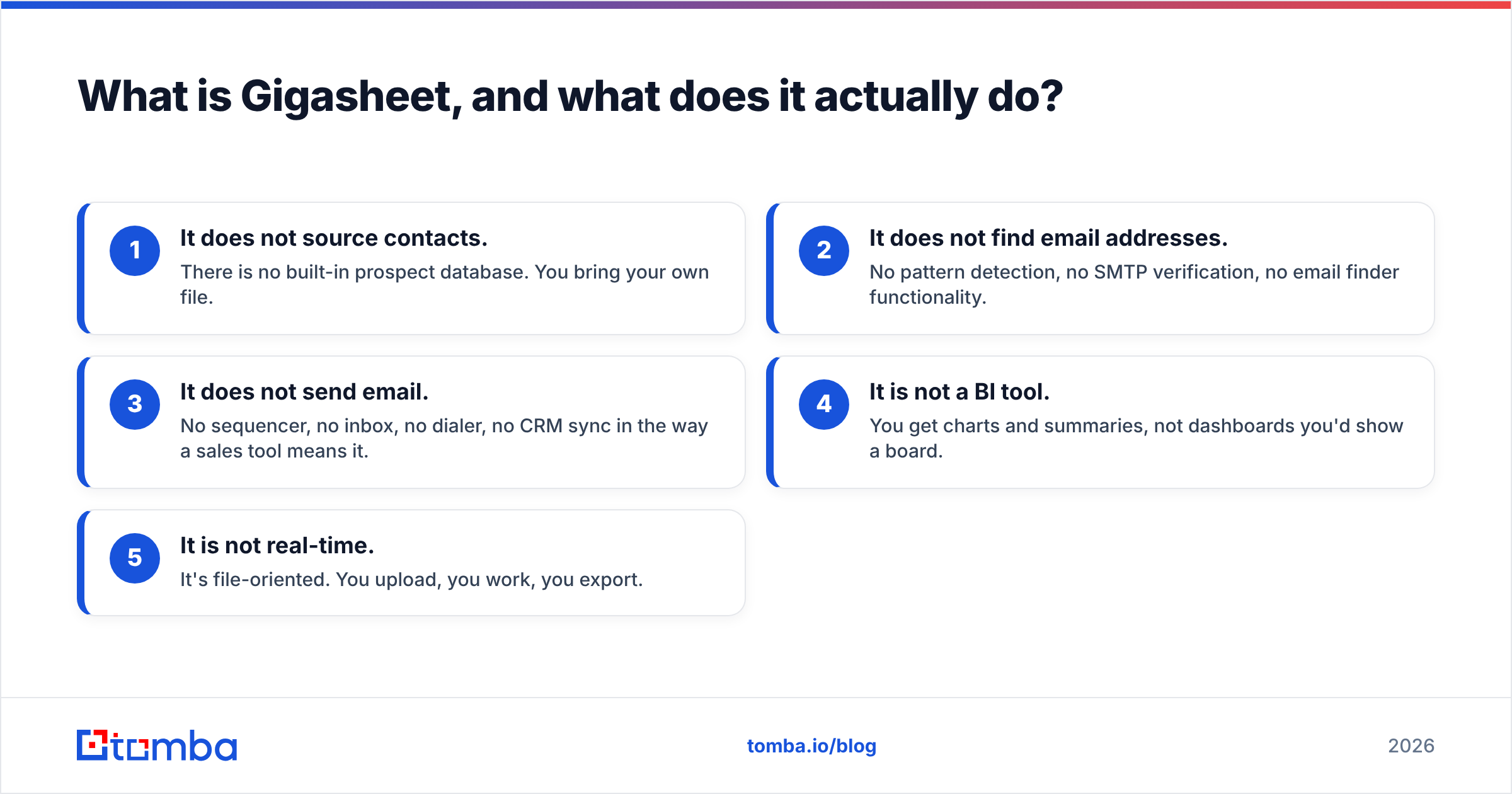
- It does not source contacts. There is no built-in prospect database. You bring your own file.
- It does not find email addresses. No pattern detection, no SMTP verification, no email finder functionality.
- It does not send email. No sequencer, no inbox, no dialer, no CRM sync in the way a sales tool means it.
- It is not a BI tool. You get charts and summaries, not dashboards you'd show a board.
- It is not real-time. It's file-oriented. You upload, you work, you export.
Read those five points again, because they're the entire reason "Gigasheet vs Apollo.io" is a slightly strange query. People land on it because both tools show up when you search "B2B data tool," and both get used by RevOps teams — but they solve opposite halves of the problem.
What is Apollo.io, and who is it built for?#
Apollo.io is a go-to-market platform built around a contact database of roughly 275 million contacts and 70 million companies (Apollo's own published figure). On top of that database sit sequences, a dialer, meeting scheduling, conversation intelligence, and a Chrome extension that pulls contacts off LinkedIn.
The buyer is usually an SDR manager or a founder running outbound who wants one tool instead of five. You filter for "VP Marketing, SaaS, 50–200 employees, United States," get 4,000 contacts, push them into a sequence, and start sending — all inside one interface.
Apollo's strengths are real: breadth of coverage, an actually usable free tier, and a genuinely good all-in-one workflow for teams under 20 reps. Its weaknesses are equally real and well documented in G2 reviews — per-seat pricing that scales badly, export credit limits that gate the data you thought you paid for, and email accuracy that varies sharply by region and company size. Contacts at 5,000-person US tech firms are usually fine. Contacts at 40-person German manufacturers are frequently stale.

Gigasheet vs Apollo.io: how do they compare head-to-head?#
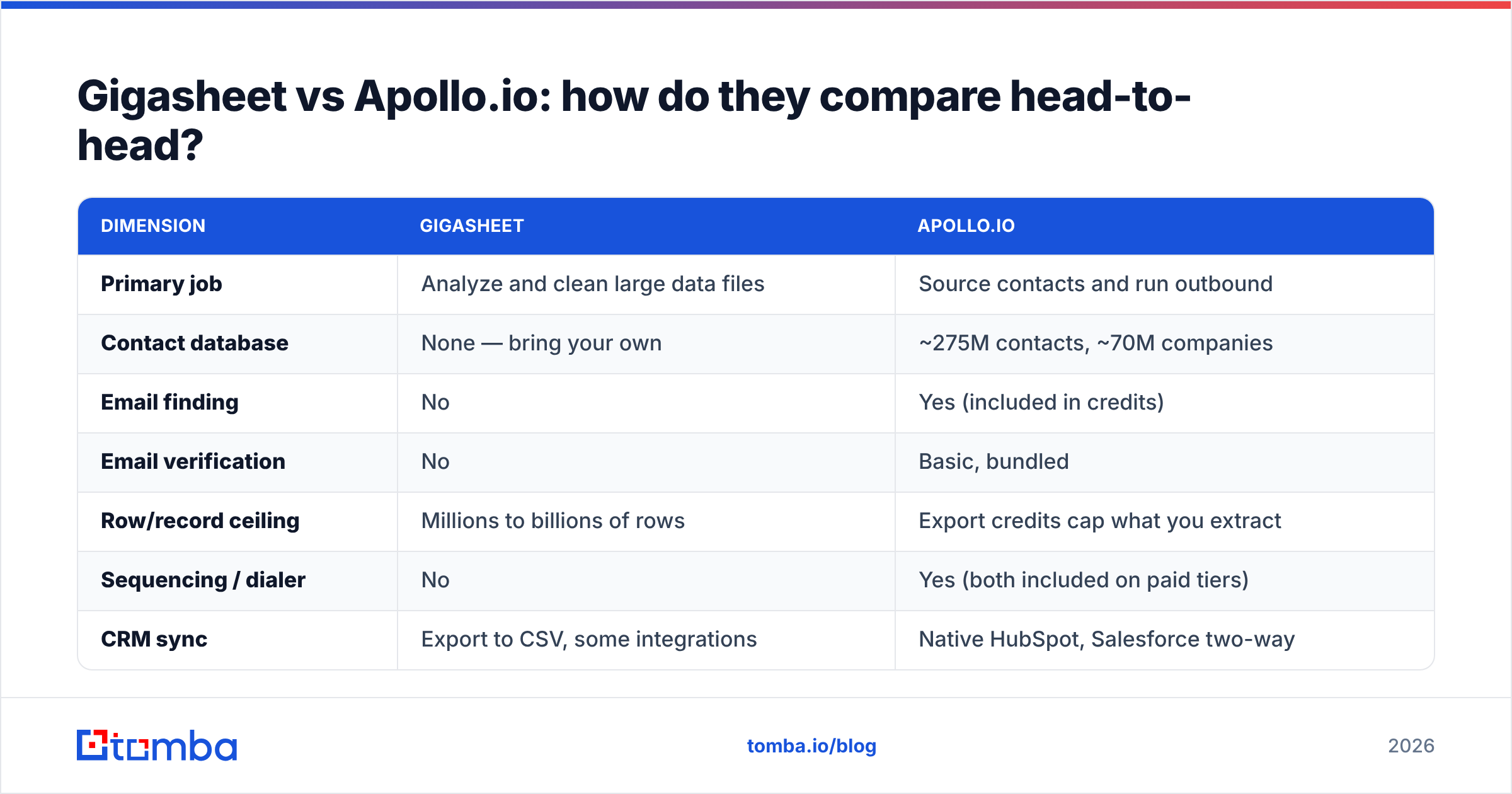
| Dimension | Gigasheet | Apollo.io |
|---|---|---|
| Primary job | Analyze and clean large data files | Source contacts and run outbound |
| Contact database | None — bring your own | ~275M contacts, ~70M companies |
| Email finding | No | Yes (included in credits) |
| Email verification | No | Basic, bundled |
| Row/record ceiling | Millions to billions of rows | Export credits cap what you extract |
| Sequencing / dialer | No | Yes (both included on paid tiers) |
| CRM sync | Export to CSV, some integrations | Native HubSpot, Salesforce two-way |
| Pricing model | Per workspace / data volume | Per user, per month |
| Free tier | Yes, limited file size | Yes, limited credits |
| Learning curve | Low if you know Excel | Medium — many modules |
| Best for | RevOps, data ops, analysts | SDRs, founders, small sales teams |
The table makes the split obvious. If you're comparing these two seriously, you're probably asking one of two different questions and haven't separated them yet:
- "How do I work with the giant contact file I already have?" → Gigasheet.
- "Where do I get contacts and how do I email them?" → Apollo.io, or a finder plus a sender.
How does pricing compare in 2026?#
Both vendors adjust list pricing regularly, so treat these as directional and confirm on their pricing pages before you buy.
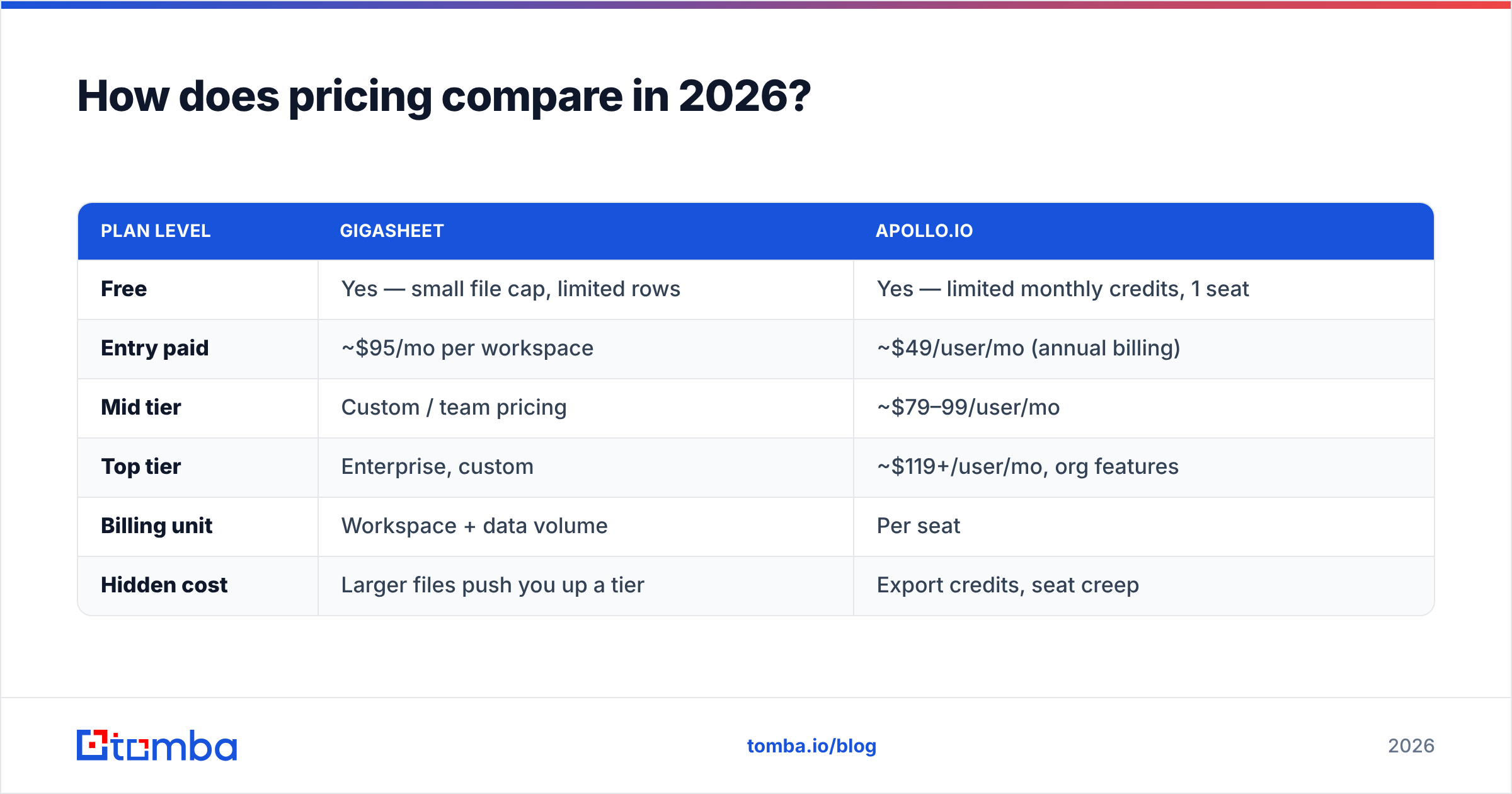
| Plan level | Gigasheet | Apollo.io |
|---|---|---|
| Free | Yes — small file cap, limited rows | Yes — limited monthly credits, 1 seat |
| Entry paid | ~$95/mo per workspace | ~$49/user/mo (annual billing) |
| Mid tier | Custom / team pricing | ~$79–99/user/mo |
| Top tier | Enterprise, custom | ~$119+/user/mo, org features |
| Billing unit | Workspace + data volume | Per seat |
| Hidden cost | Larger files push you up a tier | Export credits, seat creep |
The structural difference matters more than the numbers. Gigasheet's cost scales with how much data you process. Apollo's cost scales with how many humans touch it. A five-person team on Apollo Professional is roughly $400–500/month before anyone exports a single extra credit. A five-person team on Gigasheet pays for the workspace, not the headcount.
That's also the reason a lot of teams end up unbundling. Contact sourcing priced per domain rather than per seat — which is how Tomba pricing works, with a free tier at 25 searches/mo, Starter at $49/mo, Growth at $99/mo, and Pro at $249/mo — doesn't get more expensive when you hire a second SDR. If you're specifically evaluating that swap, the Apollo alternative breakdown covers where the seat math flips.
Which one handles data quality better?#
Neither, honestly — and that's the finding most comparison posts skip.
Gigasheet is a cleaner, not a validator. It will happily dedupe 400,000 rows, normalize casing, split full_name into first and last, and flag rows where the email column doesn't match a regex. What it cannot tell you is whether sarah.chen@acme.com still exists. A syntactically perfect address at a person who left 14 months ago passes every Gigasheet check and bounces on send.
Apollo bundles verification, but it's a byproduct. Verification is part of the database maintenance loop, not a service you control. You can't tune the SMTP timeout, you can't decide how catch-all domains are scored, and you can't re-verify a two-month-old export without spending credits again. Users routinely report bounce rates in the 5–12% range on Apollo exports that were marked verified — fine for a warmed-up domain, dangerous for a new one.
This gap is why the standard 2026 workflow puts a dedicated verification step between sourcing and sending. Running exports through an email verifier before they hit a sequence catches the two failure modes that both tools miss: addresses that were valid at export time but aren't anymore, and catch-all domains that accept everything and tell you nothing. For that second case specifically, a catch-all verifier is the only thing that produces a usable signal — standard SMTP checks return "valid" on every address at a catch-all domain, including asdfgh@company.com.
If your bounce rate is above 3%, the problem is almost never your copy. It's the layer neither Gigasheet nor Apollo owns properly.

Do you actually have to choose between them?#
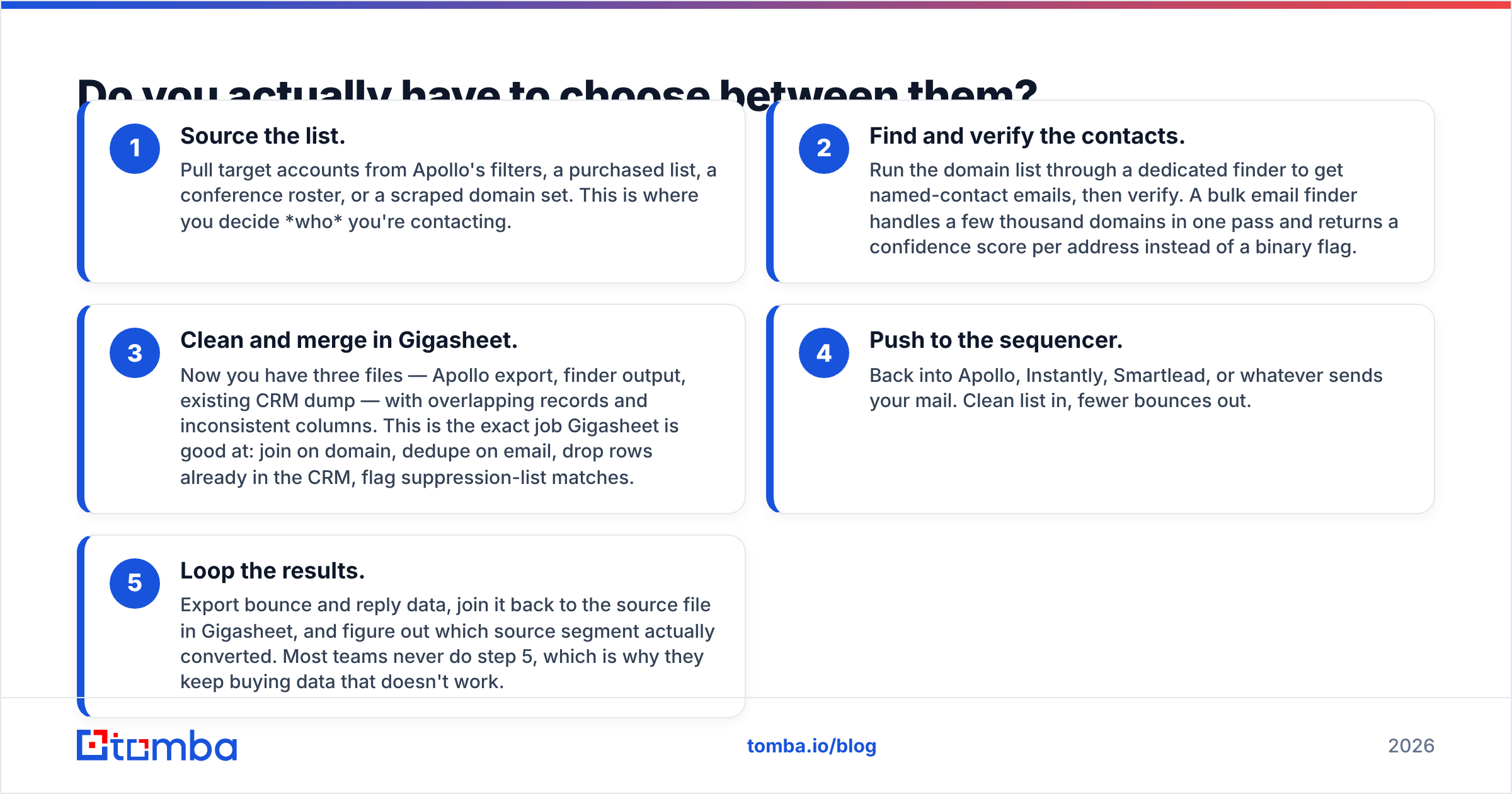
No, and most teams that use both don't think of them as alternatives at all. Here's the sequence that shows up repeatedly in mid-market GTM stacks:
- Source the list. Pull target accounts from Apollo's filters, a purchased list, a conference roster, or a scraped domain set. This is where you decide who you're contacting.
- Find and verify the contacts. Run the domain list through a dedicated finder to get named-contact emails, then verify. A bulk email finder handles a few thousand domains in one pass and returns a confidence score per address instead of a binary flag.
- Clean and merge in Gigasheet. Now you have three files — Apollo export, finder output, existing CRM dump — with overlapping records and inconsistent columns. This is the exact job Gigasheet is good at: join on domain, dedupe on email, drop rows already in the CRM, flag suppression-list matches.
- Push to the sequencer. Back into Apollo, Instantly, Smartlead, or whatever sends your mail. Clean list in, fewer bounces out.
- Loop the results. Export bounce and reply data, join it back to the source file in Gigasheet, and figure out which source segment actually converted. Most teams never do step 5, which is why they keep buying data that doesn't work.
Steps 1 and 4 are Apollo. Step 3 is Gigasheet. Step 2 is neither — and it's the step that determines whether the other four were worth doing.
Which should you pick for your situation?#
Pick Gigasheet if:
- Your files regularly exceed Excel's row limit and you don't want to write SQL
- You're in RevOps or data ops, not front-line selling
- You need to join, dedupe, and reconcile lists from multiple vendors
- You want per-workspace pricing that doesn't punish team growth
Pick Apollo.io if:
- You need contacts and a sending motion in one purchase
- Your team is under ~20 reps and per-seat pricing still pencils out
- You sell primarily into US mid-market and enterprise, where its coverage is strongest
- You value one login over a best-of-breed stack
Pick neither as your primary data source if:
- You sell into Europe, LATAM, or APAC, where Apollo's coverage thins out noticeably
- Your domain reputation can't absorb 8% bounces
- You need data enrichment on accounts you already know, rather than discovery of accounts you don't
- Your volume is spiky — 500 lookups one month, 15,000 the next — and seat licenses sit idle in between
What's the honest verdict?#
Gigasheet wins on data processing. Apollo.io wins on data sourcing plus outreach. There is no scenario where one replaces the other, and any post telling you otherwise is padding a comparison that doesn't exist.
The more useful question is what sits between them. Apollo gets you volume; Gigasheet gets you order. Neither gets you accuracy, and accuracy is what decides whether your sequence lands in the inbox or the spam folder. Teams that fix the middle layer — find the right address, verify it properly, then clean and sequence — routinely cut bounce rates from double digits to under 2% without changing a single line of copy.
If contact accuracy is the weak link in your stack, start there rather than switching platforms. The Tomba Email Finder works by domain, name, or company, returns a confidence score with every result, and prices per lookup volume instead of per seat — so it slots in front of Apollo, behind Gigasheet, or entirely on its own. The free tier gives you 25 searches a month to test it against a list you already know the answers to, which is the only benchmark that matters.
Related guides#
Ready to find emails that actually work?
Join 150,000+ professionals who stopped guessing and started sending. Free credits on signup — no credit card required.
Get the Tomba newsletter
Practical outbound tactics and product updates — once every two weeks.
About the author