Gigasheet vs GrowMeOrganic: Which B2B Data Tool Wins in 2026?
Gigasheet analyzes huge datasets in a browser spreadsheet. GrowMeOrganic finds leads and sends sequences. They solve opposite halves of the same pipeline problem — here's which one your team actually needs.
TL;DR
- They are not competitors. Gigasheet is a browser-based big-data spreadsheet for analyzing files too large for Excel. GrowMeOrganic is a lead-scraping plus cold-email sequencing platform. Comparing them is comparing a forklift to a delivery van.
- Pick Gigasheet if your bottleneck is a 40M-row CSV, messy exports from three CRMs, or an enrichment file nobody can open. It starts free and scales to enterprise data work.
- Pick GrowMeOrganic if your bottleneck is "we need 5,000 contacts and a sequence by Friday." Its lifetime-deal history and unlimited-ish credits make it cheap for volume outreach.
- Neither is a great email-accuracy layer. Gigasheet doesn't verify emails at all; GrowMeOrganic's scraped data quality varies by geography and seniority. That gap is where a dedicated email verifier belongs.
- The realistic 2026 stack is all three: source and verify with a specialist API, analyze at scale in Gigasheet, and send from whatever sequencer your team already pays for.
What problem does each tool actually solve?#
Start with the honest framing, because most "Gigasheet vs GrowMeOrganic" comparisons pretend these are alternatives. They aren't.
Gigasheet is what you reach for when Excel throws in the towel. Excel caps at 1,048,576 rows. Google Sheets caps at 10 million cells. Gigasheet handles files in the billions of rows in a browser tab, with a spreadsheet UI on top of a columnar backend. Think of it as a database that dresses like a spreadsheet so your ops analyst doesn't have to learn SQL.
GrowMeOrganic is an outbound suite: a LinkedIn/Sales Navigator scraper, a B2B contact database, an email finder, a verifier, and a drip-campaign sender bundled into one subscription. Think of it as a budget Apollo — it produces the list and mails it.
Here's the practical split by job-to-be-done:
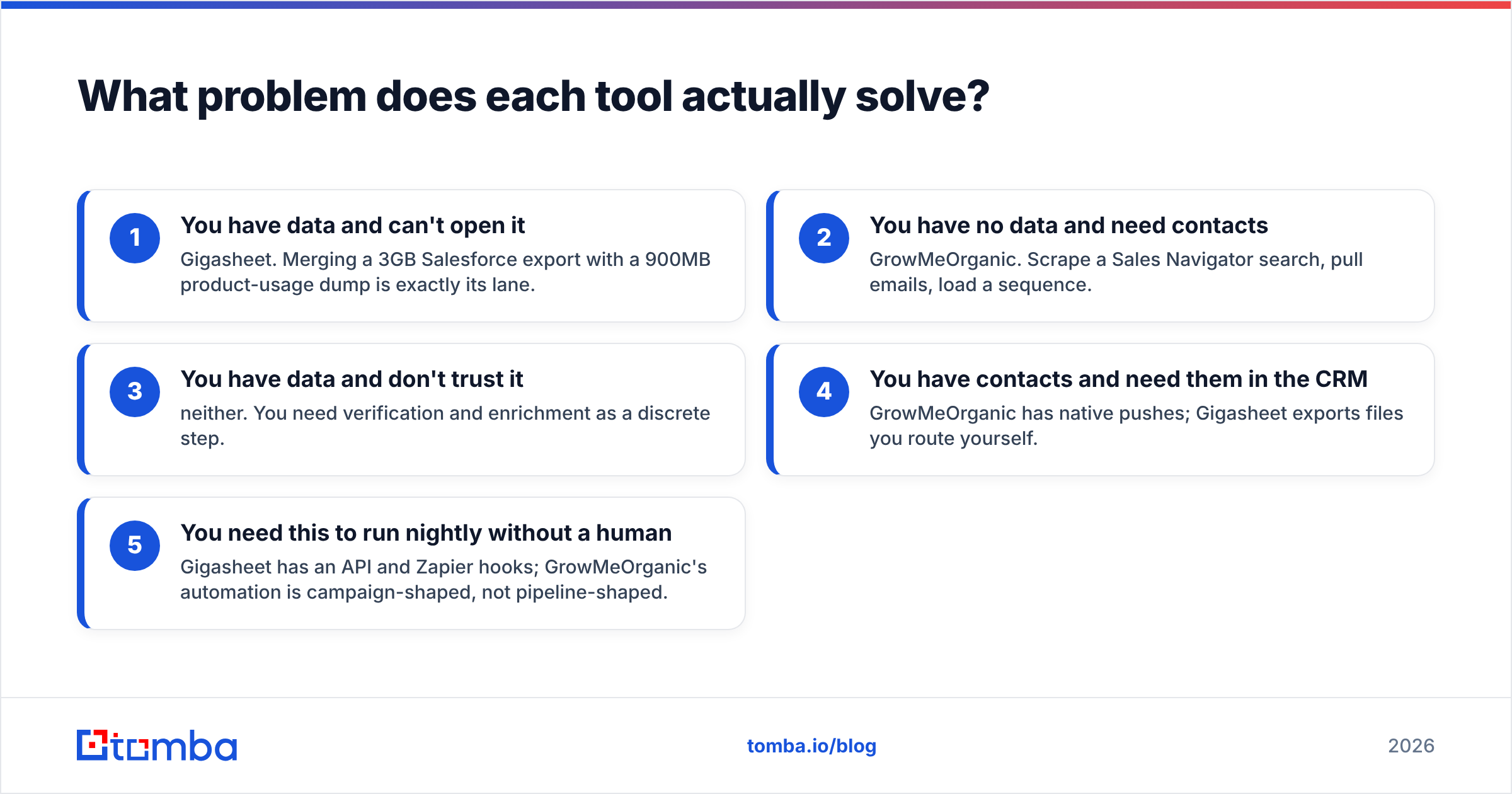
- You have data and can't open it — Gigasheet. Merging a 3GB Salesforce export with a 900MB product-usage dump is exactly its lane.
- You have no data and need contacts — GrowMeOrganic. Scrape a Sales Navigator search, pull emails, load a sequence.
- You have data and don't trust it — neither. You need verification and enrichment as a discrete step.
- You have contacts and need them in the CRM — GrowMeOrganic has native pushes; Gigasheet exports files you route yourself.
- You need this to run nightly without a human — Gigasheet has an API and Zapier hooks; GrowMeOrganic's automation is campaign-shaped, not pipeline-shaped.
Screenshot placeholder: Gigasheet grid view showing a multi-million-row file with column-level filters applied.

How do Gigasheet and GrowMeOrganic compare head to head?#
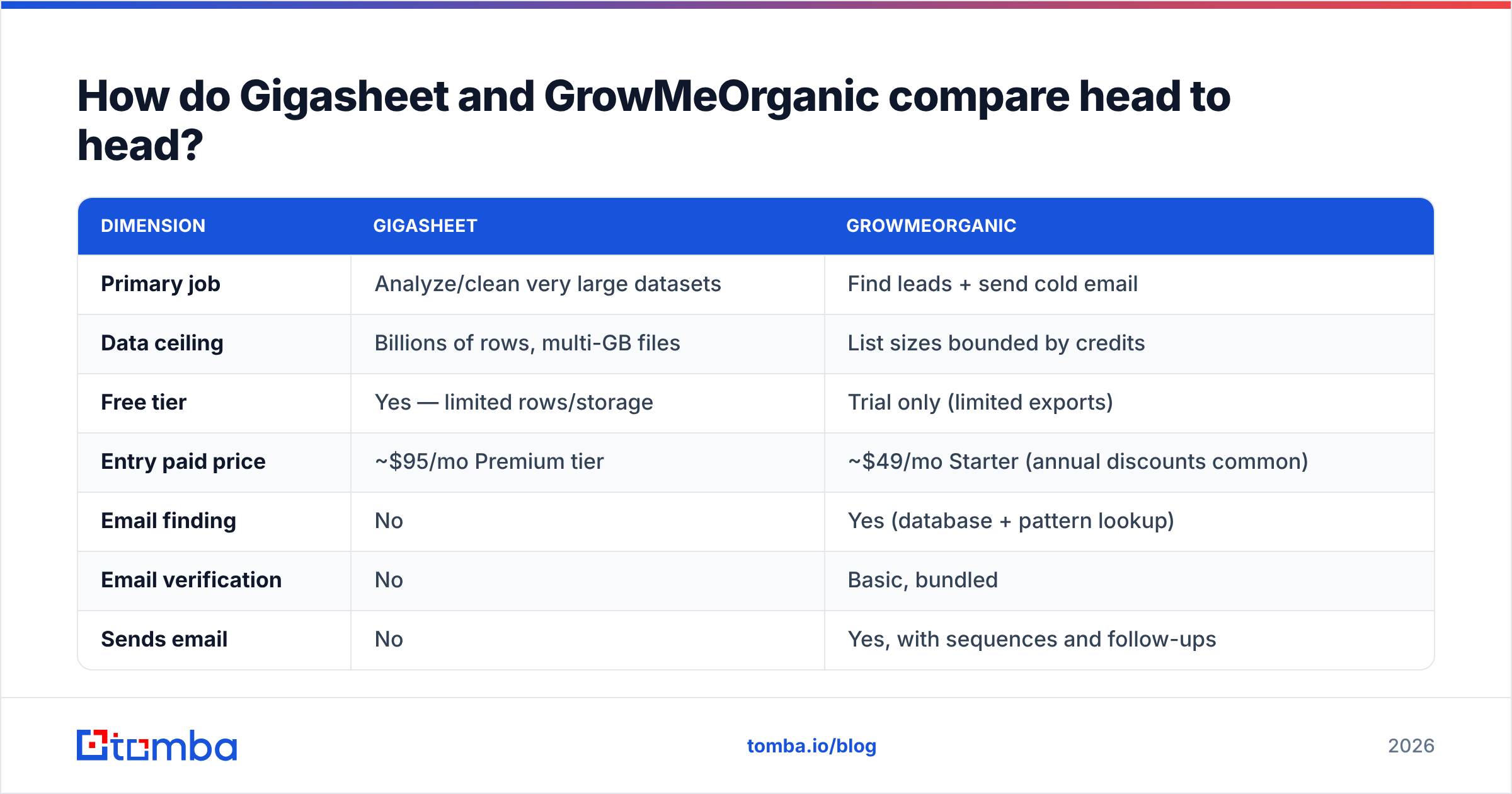
| Dimension | Gigasheet | GrowMeOrganic |
|---|---|---|
| Primary job | Analyze/clean very large datasets | Find leads + send cold email |
| Data ceiling | Billions of rows, multi-GB files | List sizes bounded by credits |
| Free tier | Yes — limited rows/storage | Trial only (limited exports) |
| Entry paid price | ~$95/mo Premium tier | ~$49/mo Starter (annual discounts common) |
| Email finding | No | Yes (database + pattern lookup) |
| Email verification | No | Basic, bundled |
| Sends email | No | Yes, with sequences and follow-ups |
| LinkedIn scraping | No | Yes (Chrome extension) |
| CRM push | Via export/API | Native HubSpot, Pipedrive, Zoho |
| Deduplication at scale | Strong — its core competence | Basic list-level dedupe |
| API | Yes | Limited |
| Best for | RevOps, data teams, analysts | SDRs, agencies, founders |
| Learning curve | Spreadsheet-familiar, some function syntax | Low, campaign-wizard driven |
Two things stand out. First, the price comparison is misleading: Gigasheet's paid tiers buy compute and storage, GrowMeOrganic's buy credits and mailboxes. Second, there is exactly one overlapping capability — GrowMeOrganic does light list cleanup, Gigasheet does heavy list cleanup — and it's the least important feature in either product.
Is Gigasheet worth it for a sales team?#
Yes, but only for a specific kind of sales team: one with data debt.
The signals that you need it:
- Exports that won't open. If someone on your team has ever said "the CSV crashed Excel," that's a $95/month problem being solved with two hours of manual splitting.
- Multi-source merges. Joining a webinar list, a CRM export, and an enrichment vendor's file on fuzzy company names is genuinely hard in a spreadsheet and trivial in a columnar grid.
- Deduplication before spend. Paying to enrich 200,000 rows when 60,000 are duplicates is a straight cash burn. Gigasheet's dedupe pays for itself on one project.
- No SQL on the team. This is the real value proposition. Gigasheet is for the ops person who is excellent at spreadsheets and has never written a
GROUP BY.
Where it disappoints: it's a workbench, not a source. You bring data to it. It won't tell you who the VP of Engineering at a target account is, and it won't tell you whether j.smith@target.com bounces. That last point matters more than people expect — a clean, deduped list of dead mailboxes is still a dead list.
For that layer, most teams bolt on an email finder API or run their cleaned Gigasheet export through bulk verification before it ever reaches a sequencer.
Is GrowMeOrganic good enough to replace Apollo or Lusha?#
Partially — and the honest answer depends on your geography and target seniority.
GrowMeOrganic's pitch is unlimited-feeling volume at a low price, backed by an aggressive lifetime-deal history on AppSumo-style marketplaces. For a two-person agency mailing SMB prospects in North America and India, that math works well. Reviews on G2 consistently praise the price-to-volume ratio and the all-in-one convenience of scrape → find → send in one tab.
Where users push back:
- Data freshness on senior EU/APAC contacts. Enterprise C-suite records skew stale, which is a common trait of scrape-heavy databases rather than a GrowMeOrganic-specific flaw.
- Deliverability sits on you. The platform sends, but SPF/DKIM/DMARC, warmup, and domain rotation are your responsibility. Run an SPF checker before your first campaign, not after your first spam complaint.
- Verification is table stakes, not best-in-class. Bundled verifiers optimize for "good enough to send." Catch-all domains — which are now a majority of mid-market B2B domains — need a dedicated catch-all verifier to resolve properly.
- Reporting depth. Campaign stats are serviceable; cohort-level attribution isn't there.
None of this makes it a bad product. It makes it a volume product. If your ACV is $2,000 and you need 400 conversations a month, volume products are correct. If your ACV is $80,000 and you're mailing 60 named accounts, precision beats volume and you should spend your budget on data quality instead.
What does a 2026 stack that uses both look like?#
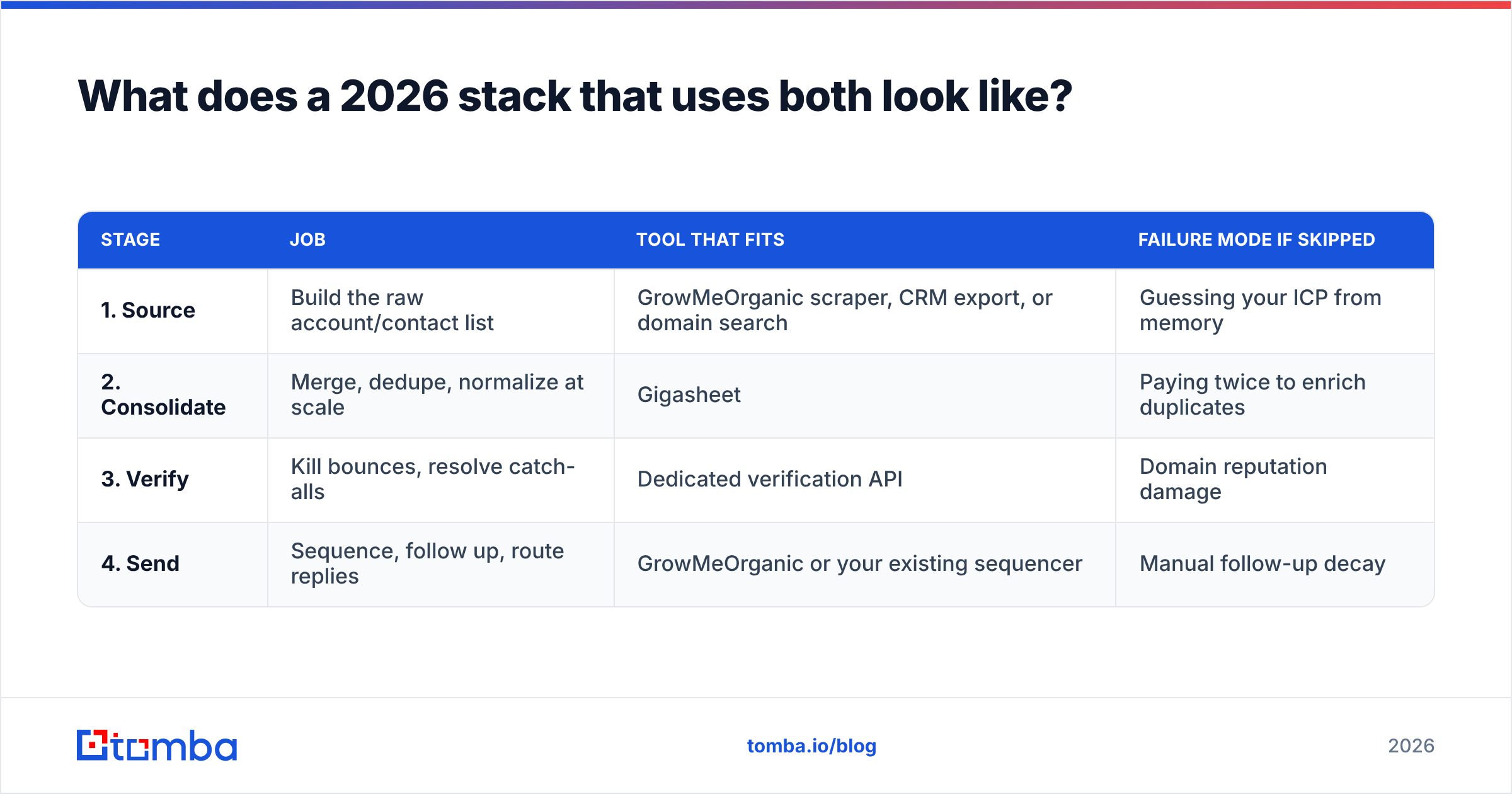
The pattern that works isn't "choose one." It's a four-stage pipeline where each tool does the one thing it's best at.
| Stage | Job | Tool that fits | Failure mode if skipped |
|---|---|---|---|
| 1. Source | Build the raw account/contact list | GrowMeOrganic scraper, CRM export, or domain search | Guessing your ICP from memory |
| 2. Consolidate | Merge, dedupe, normalize at scale | Gigasheet | Paying twice to enrich duplicates |
| 3. Verify | Kill bounces, resolve catch-alls | Dedicated verification API | Domain reputation damage |
| 4. Send | Sequence, follow up, route replies | GrowMeOrganic or your existing sequencer | Manual follow-up decay |

Stage 3 is the one teams skip, and it's the expensive one. A 12% bounce rate on a 5,000-contact send doesn't just waste 600 emails — it depresses sender reputation for every legitimate email leaving that domain for weeks afterward. Mailbox providers tightened bulk-sender requirements through 2024–2025, and the tolerance for sloppy lists in 2026 is lower than most SDR playbooks assume.
Screenshot placeholder: Google Postmaster Tools domain reputation graph showing a drop after a high-bounce campaign.
Practically, that means your Gigasheet-cleaned export should hit a verification step before it touches GrowMeOrganic's sender. Route it through an email verification API as a scheduled job, or drop the file into a bulk verifier and re-import only the deliverable rows.
Which one should you buy first?#
Answer three questions in order.
1. Do you have a list problem or a data problem?
No list at all → GrowMeOrganic first. A list you can't process → Gigasheet first. If you have neither, you have a targeting problem, and no tool fixes that.
2. What's your monthly send volume?
Under 1,000 emails/month: skip GrowMeOrganic entirely. A finder plus your existing mailbox is cheaper and cleaner. Over 10,000: you need real sequencing infrastructure, and GrowMeOrganic's price point is hard to beat — but budget separately for warmup and verification.
3. How big is your biggest file?
Under 500,000 rows: Google Sheets or a local Python script covers it, and Gigasheet is a convenience purchase. Over 5 million rows or over 1GB: Gigasheet is the cheapest thing that works without engineering time.
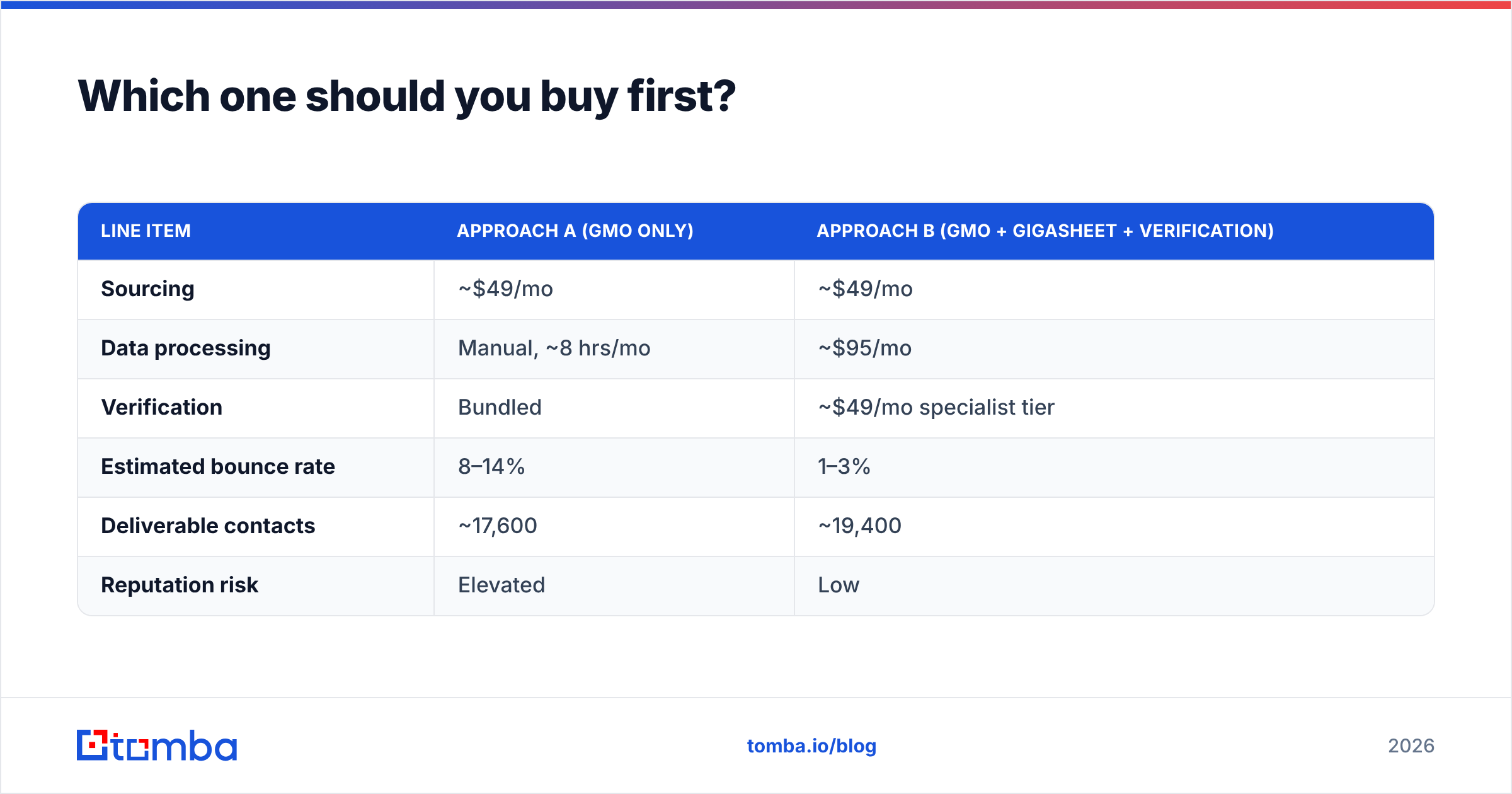
A quick sanity check on cost. Suppose you're running 20,000 outbound contacts a quarter:
| Line item | Approach A (GMO only) | Approach B (GMO + Gigasheet + verification) |
|---|---|---|
| Sourcing | ~$49/mo | ~$49/mo |
| Data processing | Manual, ~8 hrs/mo | ~$95/mo |
| Verification | Bundled | ~$49/mo specialist tier |
| Estimated bounce rate | 8–14% | 1–3% |
| Deliverable contacts | ~17,600 | ~19,400 |
| Reputation risk | Elevated | Low |
Approach B costs roughly $144/month more and buys back ~1,800 deliverable contacts per quarter plus a domain that still works in month six. For most teams that's not close.
What are the honest downsides of each?#
Gigasheet's weak spots:
- No data of its own. It's a processor, not a provider.
- Pricing scales with storage and compute, so a few large projects can push you up a tier faster than expected.
- Collaboration is lighter than Google Sheets — it's a workbench, not a shared doc.
- Advanced transforms still expect some function fluency, even though no SQL is required.
GrowMeOrganic's weak spots:
- All-in-one means every component is decent rather than excellent.
- Scraping-based sourcing carries compliance considerations — check GDPR posture for EU contacts before you scale.
- Deliverability infrastructure (warmup, rotation, inbox placement monitoring) is not included.
- Data coverage thins out for senior roles outside its strongest markets.
If you're evaluating a third path, look at how peers in the category structure their offer. Purpose-built B2B list vendors such as BookYourData sell verified, download-once lists with a bounce guarantee — a genuinely different model from both scrape-and-send and analyze-in-browser, and a good fit when you want a clean list without operating a pipeline. Comparing all three models honestly beats comparing two tools that were never in the same category.
How do you keep the whole pipeline clean?#
Four habits do most of the work:
- Verify at the point of entry, not the point of send. Verifying 10,000 contacts the night before a campaign is a fire drill. Verifying on import is a checkbox.
- Dedupe before you enrich. Every enrichment vendor bills per lookup. Duplicates are the single easiest line item to delete.
- Segment catch-all domains separately. Don't treat "unknown" as "valid." Route catch-alls to a lower-volume, higher-personalization track.
- Re-verify quarterly. B2B email data decays roughly 2–3% per month through job changes alone. A list that was clean in January is meaningfully stale by June.
- Track bounce rate per source. If GrowMeOrganic-scraped rows bounce at 3× your CRM rows, that's a sourcing decision, not a bad-luck month.
The bottom line#
Gigasheet and GrowMeOrganic don't compete — they occupy opposite ends of the same pipeline. Buy Gigasheet when your data won't fit in a spreadsheet. Buy GrowMeOrganic when you need contacts and campaigns cheaply and fast. Buy both when you're running enough volume that manual CSV surgery has become someone's actual job.
What neither one solves well is the accuracy layer in the middle — the difference between a list that looks right and a list that lands. If you want a verified, deliverable contact from a name and a domain rather than a guess, the Tomba Email Finder does exactly that one job, with a free tier at 25 searches/month and paid plans starting at $49/month. Run your Gigasheet-cleaned export through it before it ever hits a sequencer, and check Tomba pricing to see which tier matches your monthly volume. Clean input is the cheapest deliverability fix you'll ever buy.
Related guides#
Ready to find emails that actually work?
Join 150,000+ professionals who stopped guessing and started sending. Free credits on signup — no credit card required.
Get the Tomba newsletter
Practical outbound tactics and product updates — once every two weeks.
About the author