Gigasheet vs Leadzenai: Which B2B Data Tool Wins in 2026?
One is a spreadsheet that swallows 100-million-row files. The other is a lead database that hands you contacts. Here is where each earns its keep, and where a dedicated email finder beats both.
Gigasheet vs Leadzenai is the wrong fight to pick. One tool cleans huge files. The other sells you contacts. Here is how to choose, in plain words.
TL;DR
- They are not competitors. Gigasheet is a browser-based big-data spreadsheet for files too large for Excel. Leadzen.ai is a B2B lead-intelligence database. It sells you contacts. The two only meet because both end up in the same outbound workflow.
- Pick Gigasheet if your bottleneck is processing. Think deduping a 20-million-row export, joining two CRM dumps, or cleaning a scraped list before it hits your sequencer.
- Pick Leadzen.ai if your bottleneck is sourcing. You need names, companies, emails and phone numbers you do not have yet, especially across India and APAC.
The rest of the Gigasheet vs Leadzenai debate turns on one layer most teams skip:
- Neither is a precision email finder. Gigasheet does not originate contact data at all. Database-first tools decay fast between refresh cycles. That gap is where a verification-first tool like Tomba belongs.
- The cheapest working stack is usually all three layers: source, verify, then process. Buy one tool and hope it covers the other two, and you end up with 18% bounce rates.
What are Gigasheet and Leadzen.ai, actually?#
Start here, because the naming does not help you.
Gigasheet is a spreadsheet that runs in your browser. It does not fall over at a million rows. Think of it as Excel's much stronger cousin, the one who works at a data warehouse. Same familiar grid, same filters and pivot tables — but the file behind it can be gigabytes.
You upload a CSV, Parquet, or JSON export. You get sorting, grouping, joins, dedupe, and column-level enrichment. No SQL. No Python notebook. It also offers enrichment integrations that call third-party data providers to append company or contact fields to rows you already have.
That last clause is the important one. Gigasheet is a processing layer. It makes the list you have better. It does not conjure a list you do not have.
Leadzen.ai is the opposite shape. It is a B2B lead-intelligence platform built around a contact database. Search filters — industry, geography, headcount, job title, technology — return people with emails and phone numbers attached. Coverage leans heavily toward India and the wider APAC region, where many US-first databases thin out badly. A Chrome extension and light outreach features let you move from search to first touch without exporting.
So: Gigasheet answers "how do I clean and combine what I already have?" Leadzen.ai answers "where do I get people to email in the first place?"
Compare them head to head on features and you get a scorecard that means nothing. Compare them on which bottleneck you actually have, and the choice takes about ninety seconds.
Gigasheet vs Leadzenai: how do they compare feature by feature?#
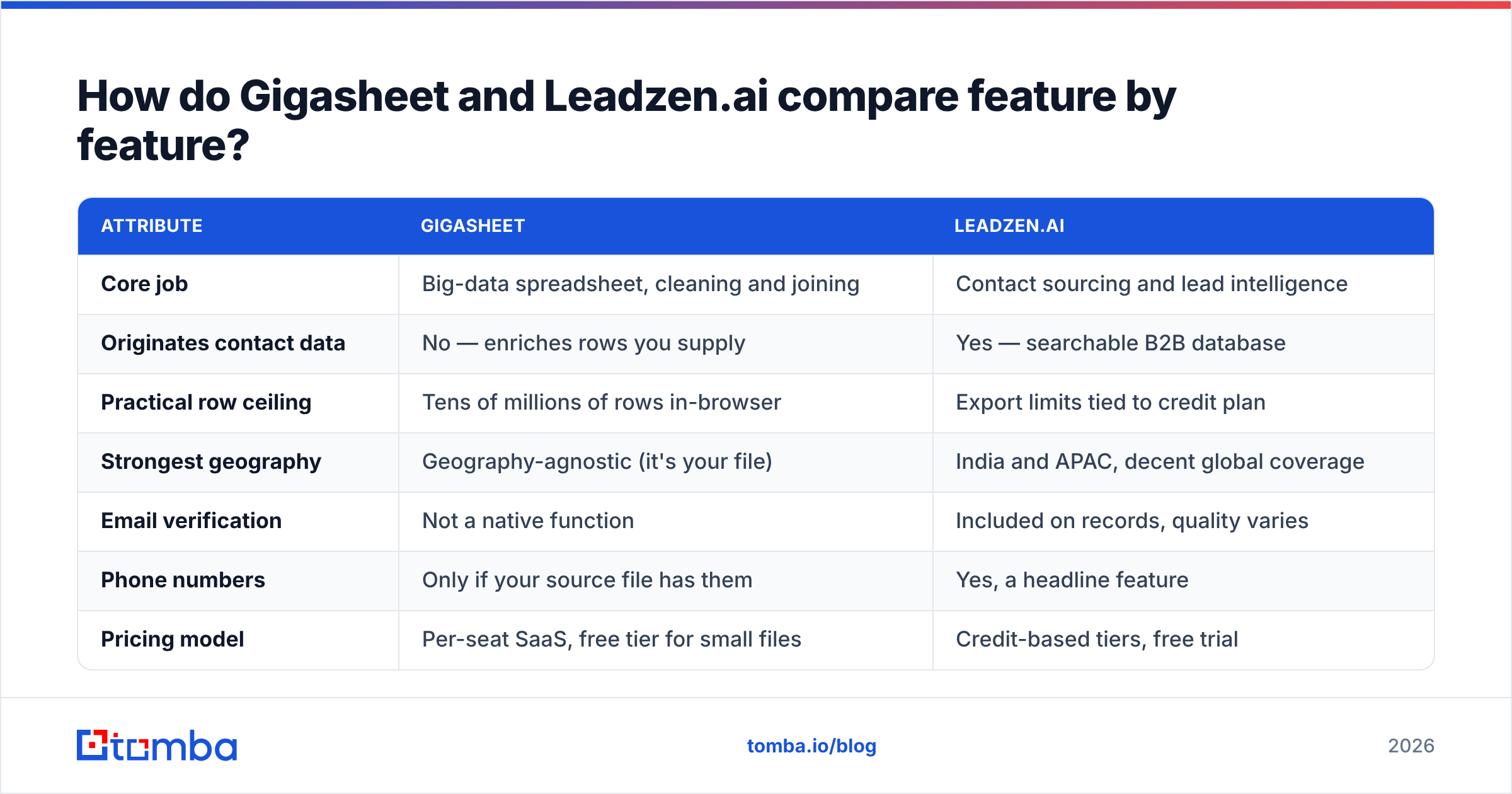
Here is the short version of Gigasheet vs Leadzenai, side by side.
| Attribute | Gigasheet | Leadzen.ai |
|---|---|---|
| Core job | Big-data spreadsheet, cleaning and joining | Contact sourcing and lead intelligence |
| Originates contact data | No — enriches rows you supply | Yes — searchable B2B database |
| Practical row ceiling | Tens of millions of rows in-browser | Export limits tied to credit plan |
| Strongest geography | Geography-agnostic (it's your file) | India and APAC, decent global coverage |
| Email verification | Not a native function | Included on records, quality varies |
| Phone numbers | Only if your source file has them | Yes, a headline feature |
| Pricing model | Per-seat SaaS, free tier for small files | Credit-based tiers, free trial |
| Learning curve | Low if you know Excel filters | Low — it's search filters |
| API access | Yes, on paid tiers | Yes, on higher tiers |
| Who it replaces | Python/pandas, Excel, a junior analyst | Apollo, Lusha, ZoomInfo (regionally) |
| Who it does not replace | A data provider | A data cleaning environment |
Pricing on both moves more often than either vendor's marketing page suggests. Treat published figures as directional. Confirm on the live pricing page before you commit budget.
What does not move is the structural difference. Gigasheet charges you for seats and file size. Leadzen.ai charges you for records revealed. Those two meters punish different habits. Seat pricing punishes team sprawl. Credit pricing punishes sloppy searching — every over-broad filter burns budget on contacts you will never email.

What is Gigasheet genuinely best at?#
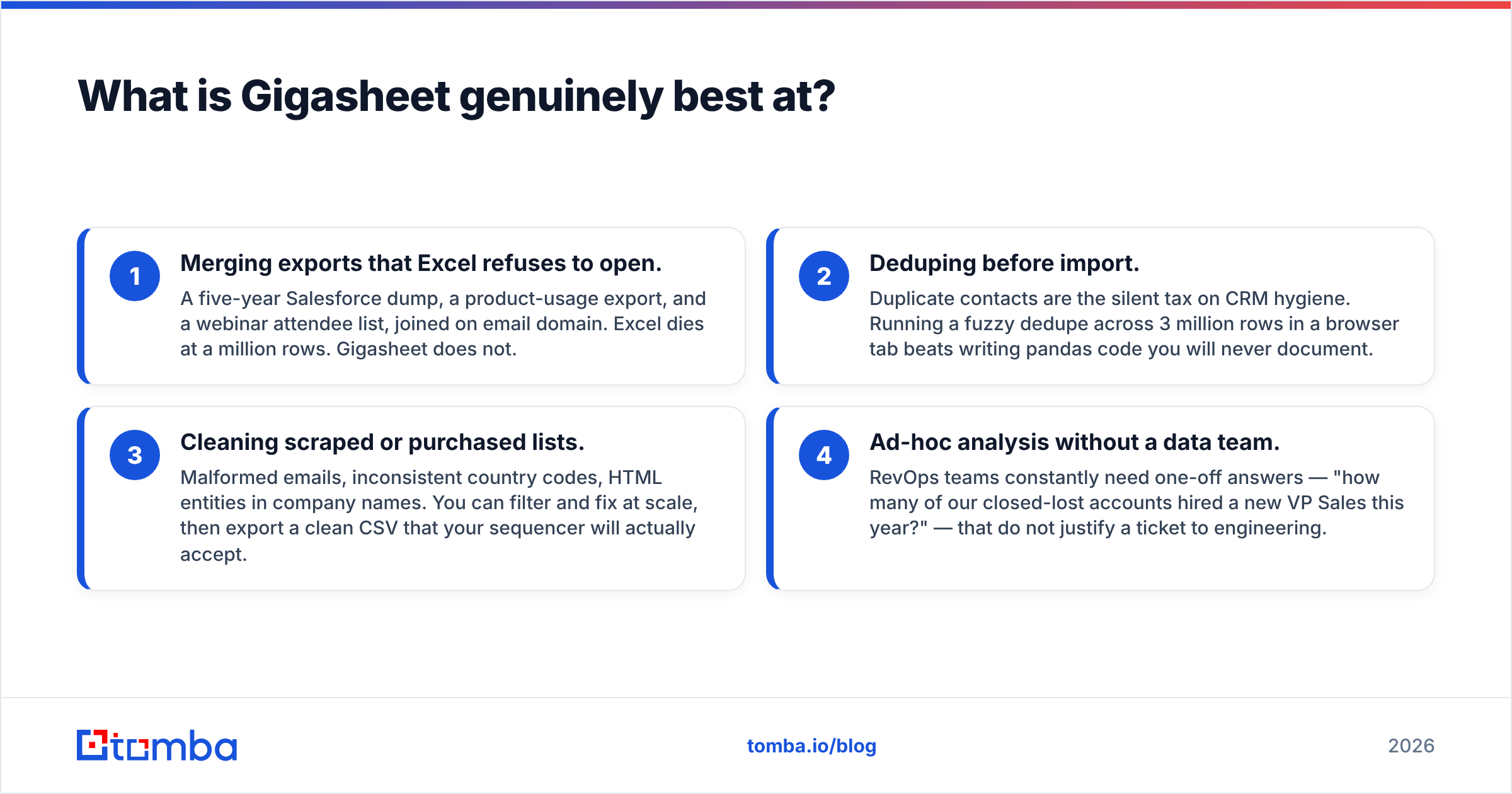
Four jobs where nothing else in the average GTM stack comes close:
- Merging exports that Excel refuses to open. A five-year Salesforce dump, a product-usage export, and a webinar attendee list, joined on email domain. Excel dies at a million rows. Gigasheet does not.
- Deduping before import. Duplicate contacts are the silent tax on CRM hygiene. A fuzzy dedupe across 3 million rows in a browser tab beats writing pandas code you will never document.
- Cleaning scraped or purchased lists. Malformed emails, odd country codes, HTML entities in company names. Filter and fix at scale, then export a clean CSV your sequencer will actually accept.
- Ad-hoc analysis without a data team. RevOps teams need one-off answers all the time — "how many closed-lost accounts hired a new VP Sales this year?" — that do not justify a ticket to engineering.
What Gigasheet cannot do is tell you the email address of a VP of Engineering at a company you have never touched. For that you need a source. If your rows are missing contact fields, you still need data enrichment or a finder to fill them.
What is Leadzen.ai genuinely best at?#
Leadzen.ai earns its place on three specific strengths:
- Regional coverage most US databases fumble. If your ICP includes Indian SMBs, manufacturing, or fast-growing APAC SaaS, the big global providers often return nothing. Density there is the real moat.
- Phone-first prospecting. In some markets cold calling still beats cold email, and India is very much one of them. A database that reliably attaches mobile numbers is worth more than one with prettier email data.
- Speed from search to list. Filter, select, export, sequence. For a small team without a data engineer, that loop is the entire prospecting process.
The catch is the one every database-first tool shares: records decay. B2B contact data goes stale at roughly 2-3% per month. People change jobs, teams restructure, domains migrate. Compound that over a year and a third of a list you bought in January is wrong by December. No vendor is immune. No vendor's marketing page says so.
So the sensible pattern is not "trust the database." It is "trust the database, then verify at send time." Run exports through an email verifier right before a campaign. That catches the decay that happened after the record was written.
Gigasheet vs Leadzenai: how do they handle data accuracy?#
Differently enough that it changes your process.
Gigasheet has no opinion about accuracy. It is a grid. Upload 400,000 rows of garbage and you get a very fast, very tidy view of garbage. Its enrichment integrations inherit whatever accuracy the underlying provider offers. So your accuracy question is really about that provider, not about Gigasheet.
Leadzen.ai does have an opinion, because it originates the record. Like every database vendor, it publishes confidence indicators. Treat published accuracy claims in this category with healthy skepticism, whatever the logo. They are usually measured on the records the vendor is most sure about, not on the export you actually pull. Independent reviews on G2 give a more honest read than any vendor benchmark. The theme across the whole lead-data category is simple: coverage and accuracy trade off. Broad filters give you more records and worse ones.
The practical rule that survives every tool change:
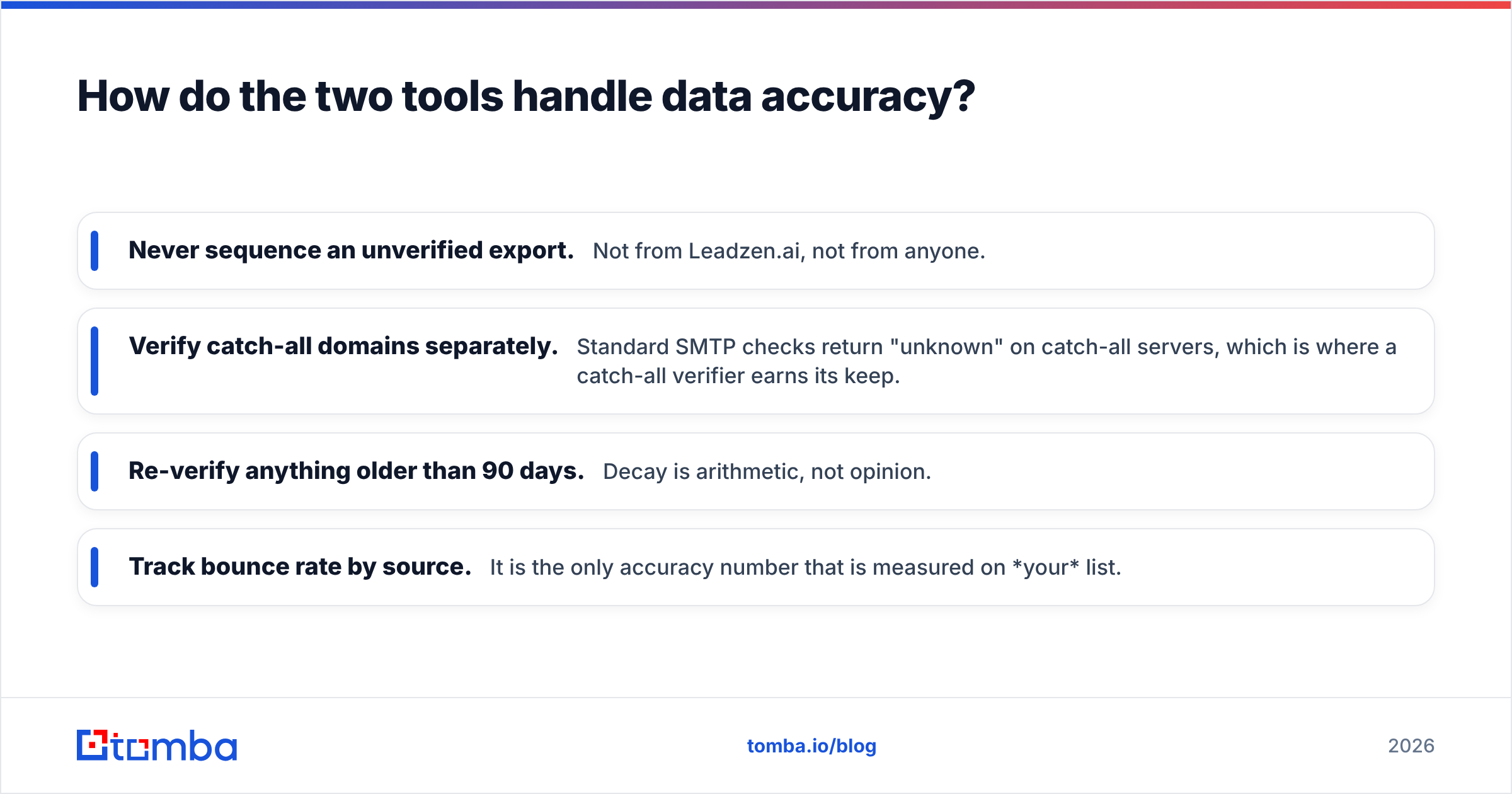
- Never sequence an unverified export. Not from Leadzen.ai, not from anyone.
- Verify catch-all domains separately. Standard SMTP checks return "unknown" on catch-all servers, which is where a catch-all verifier earns its keep.
- Re-verify anything older than 90 days. Decay is arithmetic, not opinion.
- Track bounce rate by source. It is the only accuracy number measured on your list.
Which should you choose for your use case?#
Most Gigasheet vs Leadzenai decisions land in one of these buckets.
- Outbound SDR team, US/EU ICP, needs new contacts: Neither is your first purchase. You need a finder and verifier that covers your geography. Leadzen.ai is a strong second buy if you expand into APAC.
- Outbound team targeting India or APAC: Leadzen.ai first. Its regional density is the actual differentiator, and nothing in Gigasheet replaces it.
- RevOps cleaning up years of CRM debt: Gigasheet, unambiguously. This is the job it was built for. No lead database will help.
Smaller teams and agencies split a little differently:
- Growth team running scraped-list campaigns: Both, in sequence. Gigasheet to clean and dedupe, then a verification pass before send.
- Solo founder doing 50 emails a week: Neither. A free email checker and a finder on a starter plan will cover you for months at a fraction of the cost.
- Agency running campaigns for 12 clients: Gigasheet for list ops, a per-credit finder for sourcing, and hard verification gates between the two. Seat-based pricing gets expensive fast when everyone needs access.
Where does a dedicated email finder fit alongside them?#
Here is the layer diagram most stacks are missing. Gigasheet vs Leadzenai is an argument about two layers. It skips the one in between.
Gigasheet is the workbench. Leadzen.ai is one supplier. Between "I know which company I want" and "I have a deliverable address for the right person there," you need a tool whose only job is finding and confirming that address — from a domain, a name, a LinkedIn profile, or a byline.
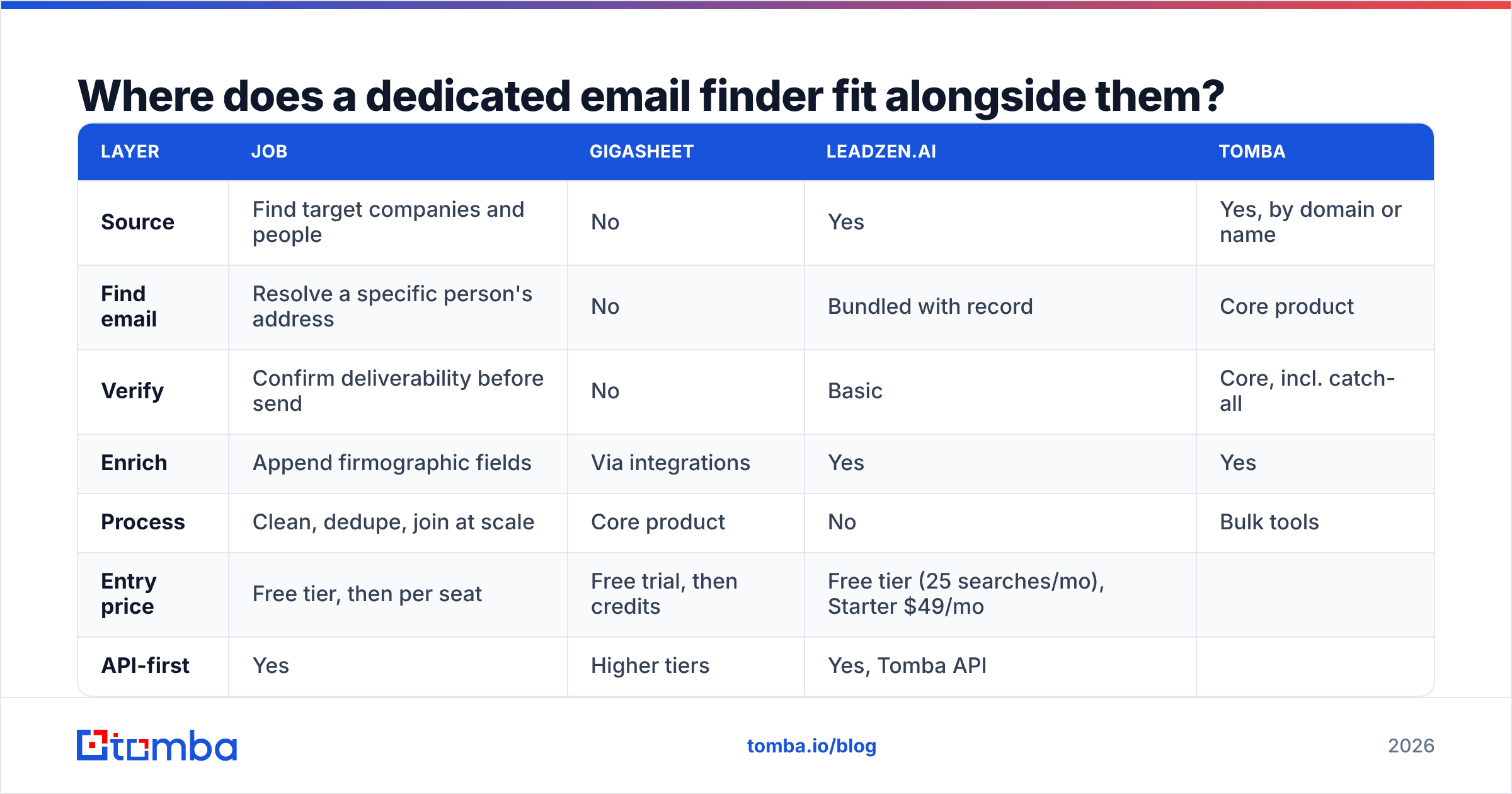
| Layer | Job | Gigasheet | Leadzen.ai | Tomba |
|---|---|---|---|---|
| Source | Find target companies and people | No | Yes | Yes, by domain or name |
| Find email | Resolve a specific person's address | No | Bundled with record | Core product |
| Verify | Confirm deliverability before send | No | Basic | Core, incl. catch-all |
| Enrich | Append firmographic fields | Via integrations | Yes | Yes |
| Process | Clean, dedupe, join at scale | Core product | No | Bulk tools |
| Entry price | Free tier, then per seat | Free trial, then credits | Free tier (25 searches/mo), Starter $49/mo | |
| API-first | Yes | Higher tiers | Yes, Tomba API |
Tomba sits in the middle three rows. Its domain search takes a company domain and returns the people at it, with confidence scores and sources. The verifier confirms deliverability, including on catch-all servers. Bulk email finder handles the list-scale version of both.
Paid plans run Starter $49/mo, Growth $99/mo, and Pro $249/mo, with a free tier at 25 searches per month. Full Tomba pricing is on the site. The credit model means you are not paying per seat for a teammate who logs in twice a quarter.
The honest framing: Tomba does not replace Gigasheet. If you have a 40-million-row file to join, use Gigasheet. And in APAC-heavy markets, a regional database like Leadzen.ai will surface companies a finder-first approach would never see. What Tomba replaces is the assumption that any address attached to a database record is safe to send to.
What are the common mistakes when combining these tools?#
Plenty of teams get the Gigasheet vs Leadzenai call right and still stall here.
Buying a database and calling it a strategy. Records are inputs. Without segmentation, verification, and message relevance, a bigger list just means more bounces at higher speed.
Skipping verification because the vendor already verified. Vendor verification happened when the record was written. Yours happens today. Different dates, different answers.
Processing before sourcing. Teams buy Gigasheet, clean their existing list beautifully, and find that the clean list is 800 contacts. The processing layer amplifies whatever you feed it, including scarcity.
Ignoring per-seat math. Three analysts on a seat-priced tool can cost more per year than an entire finder-plus-verifier stack. Count seats before you sign.
Treating deliverability as a data problem only. Clean data prevents hard bounces. It does not fix a missing SPF record or a cold domain. Both matter, and they fail independently.
The bottom line#
Gigasheet vs Leadzenai is a false binary dressed up as a comparison. One is a processing layer. One is a sourcing layer. Most teams that struggle with outbound are missing the third layer between them: reliable, freshly verified contact discovery.
Buy Gigasheet when your files are too big. Buy Leadzen.ai when you are prospecting into India or APAC and the usual databases return nothing. Whichever you choose, put a verification gate in front of your sequencer.
Want to see that middle layer before committing budget anywhere? Start with the Tomba Email Finder free tier — 25 searches a month, no card. Run twenty contacts you already have through it. Compare the results to what your current source told you, and let the bounce rate settle the argument.
Related guides#
Ready to find emails that actually work?
Join 150,000+ professionals who stopped guessing and started sending. Free credits on signup — no credit card required.
Get the Tomba newsletter
Practical outbound tactics and product updates — once every two weeks.
About the author