Gigasheet vs Warpleads: Which B2B Data Tool Wins in 2026?
Gigasheet cleans and analyzes massive lead files in the browser. Warpleads exports B2B leads in bulk. They solve opposite halves of the same problem — here's which one your outbound stack actually needs, and what both leave you missing.
TL;DR
- They are not really competitors. Gigasheet is a browser-based spreadsheet built for files too big for Excel. Warpleads is a lead database that sells bulk B2B exports. One cleans data, the other supplies it.
- Pick Gigasheet if you already own large messy lists — scraped exports, CRM dumps, 5M-row enrichment files — and your bottleneck is processing, not sourcing.
- Pick Warpleads if your bottleneck is volume and you want unlimited-style exports without paying per credit.
- Neither is a verification layer. Bulk exports and spreadsheet filters do not tell you whether an inbox accepts mail. That gap is what burns domains.
- Realistic 2026 stack: source in bulk → verify with a dedicated tool → analyze at scale. Missing the middle step is the most common reason outbound bounces above 5%.
What are Gigasheet and Warpleads, exactly?#
Think of it like a restaurant. Warpleads is the wholesale supplier that drops a pallet of ingredients at your door. Gigasheet is the industrial prep kitchen where you sort, trim, and portion them. Neither one tastes the food before it goes out — that is a third job entirely.
Gigasheet is a no-code data platform that opens files with hundreds of millions of rows in a browser tab. Excel taps out around a million rows and Google Sheets chokes well before that. Gigasheet's pitch is that you get spreadsheet ergonomics — filters, group-by, pivots, joins, dedupe — over datasets that would normally require a data engineer and a warehouse. It also ships enrichment integrations, so you can append company or contact fields to a list you already have.
Warpleads sits on the opposite end. It is an outbound lead-generation platform whose headline feature is bulk export volume: pull large B2B contact lists by filters (industry, headcount, title, geography) plus on-demand scraping for niches the static database misses. The selling point is that you are not rationing credits every time you build a segment.
So the honest framing of gigasheet vs warpleads is not "which tool is better." It is "which half of my pipeline is actually broken?"

How do Gigasheet and Warpleads compare feature by feature?#
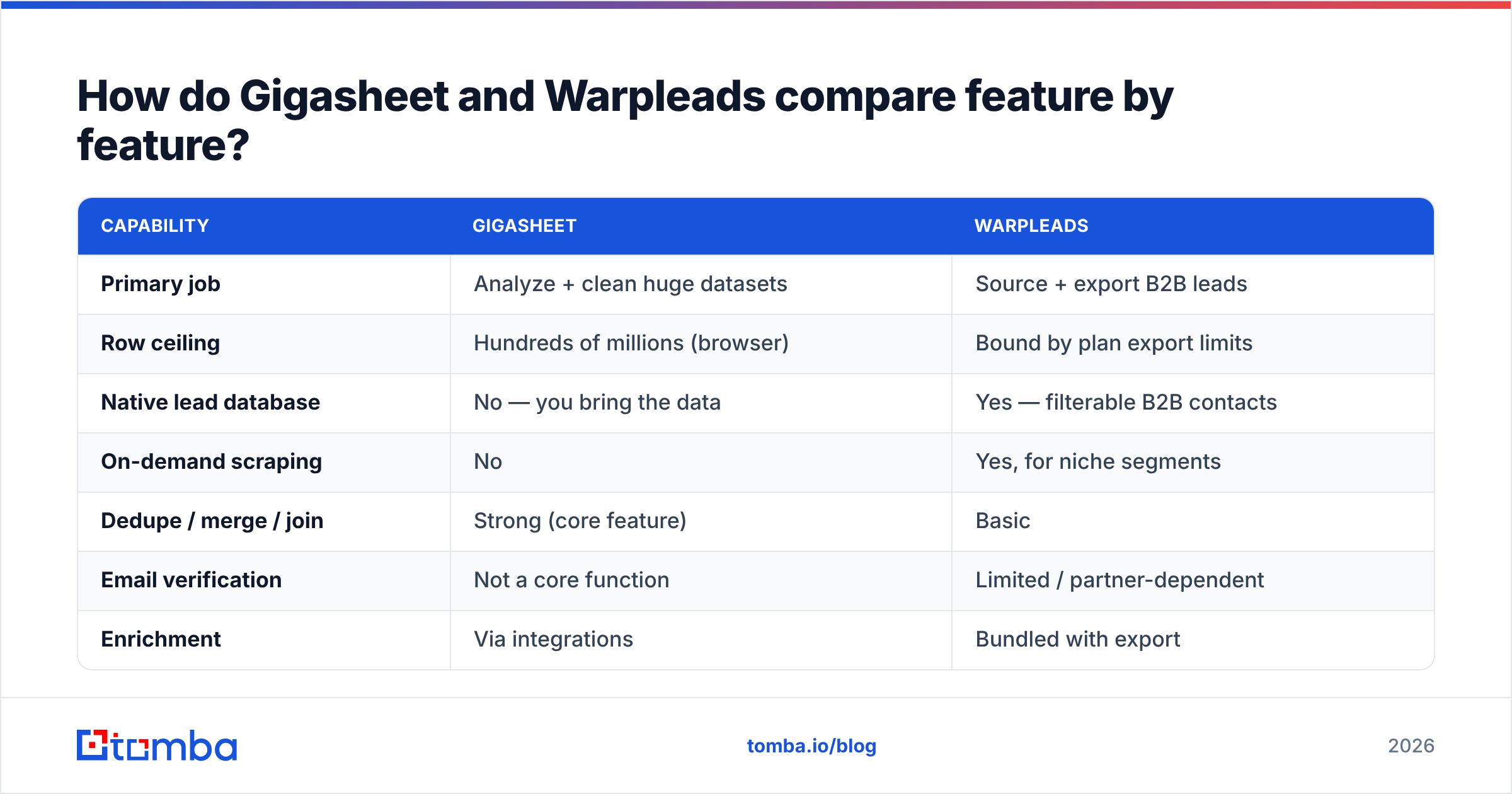
| Capability | Gigasheet | Warpleads |
|---|---|---|
| Primary job | Analyze + clean huge datasets | Source + export B2B leads |
| Row ceiling | Hundreds of millions (browser) | Bound by plan export limits |
| Native lead database | No — you bring the data | Yes — filterable B2B contacts |
| On-demand scraping | No | Yes, for niche segments |
| Dedupe / merge / join | Strong (core feature) | Basic |
| Email verification | Not a core function | Limited / partner-dependent |
| Enrichment | Via integrations | Bundled with export |
| Learning curve | Spreadsheet-familiar | Filter-builder simple |
| Best-fit user | RevOps, data ops, analysts | SDR teams, agencies, high-volume outbound |
| Output | Cleaned file, API, integrations | CSV export into your sequencer |
The table makes the split obvious. Gigasheet has zero opinions about where your leads came from. Warpleads has zero opinions about what you do with them after download. If you buy one expecting the other's job, you will be disappointed in about four days.
What does each one cost in 2026?#
Pricing on both platforms moves, and both publish tiers publicly — always confirm on the vendor page before you budget. As a directional comparison:
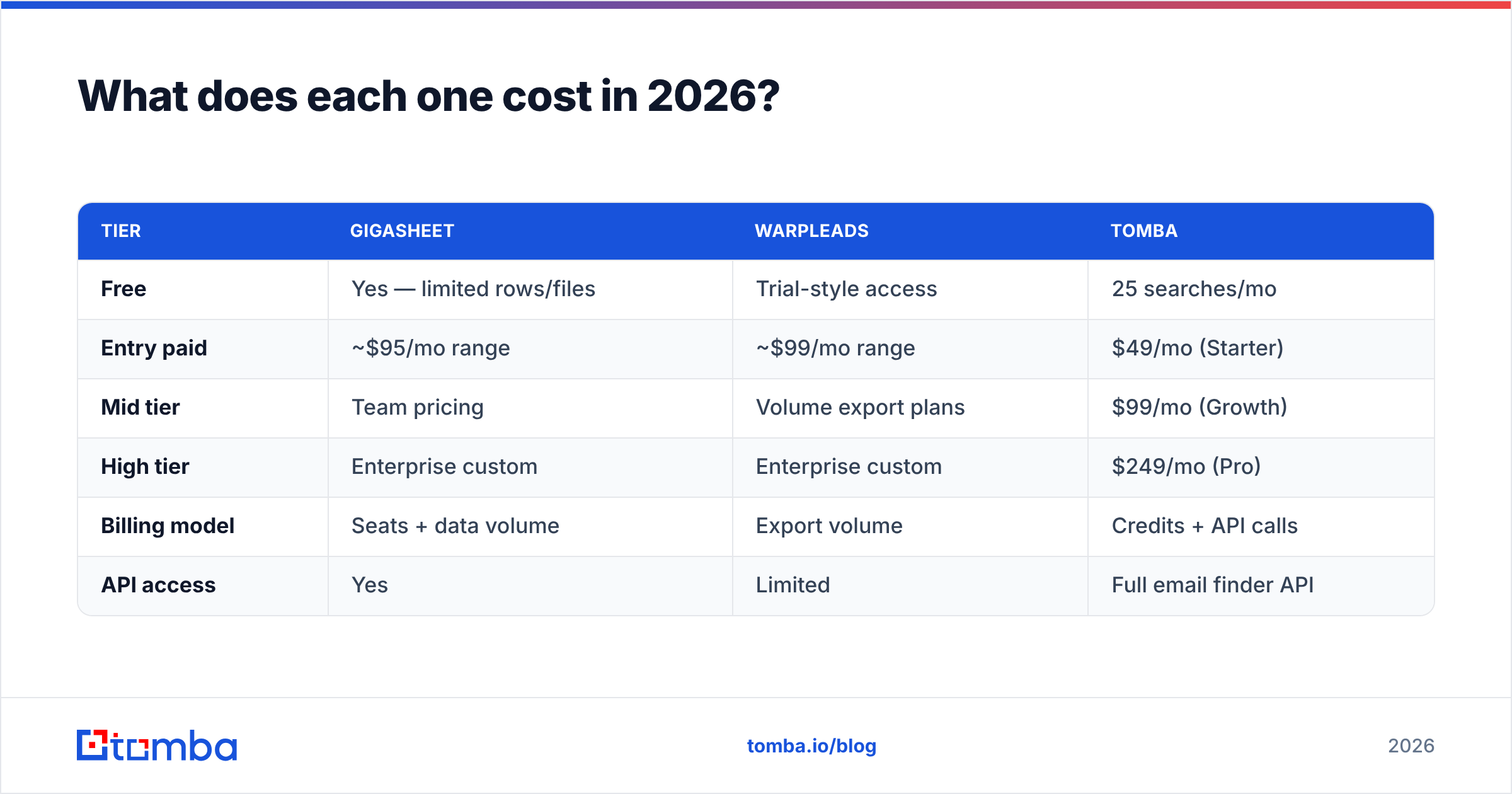
| Tier | Gigasheet | Warpleads | Tomba |
|---|---|---|---|
| Free | Yes — limited rows/files | Trial-style access | 25 searches/mo |
| Entry paid | ~$95/mo range | ~$99/mo range | $49/mo (Starter) |
| Mid tier | Team pricing | Volume export plans | $99/mo (Growth) |
| High tier | Enterprise custom | Enterprise custom | $249/mo (Pro) |
| Billing model | Seats + data volume | Export volume | Credits + API calls |
| API access | Yes | Limited | Full email finder API |
Two things matter more than the sticker price.
First, billing model beats headline number. A $99 "unlimited export" plan that hands you 40% stale records costs more than a $49 plan with verified data, because every bounce taxes your sending domain and every wrong contact taxes an SDR's hour. Cheap bad data is the most expensive line item in outbound.
Second, seat-based versus volume-based pricing scales differently. Gigasheet's model punishes wide teams; Warpleads' model punishes narrow-but-deep usage patterns. Map your team shape before you compare monthly totals. If you want a like-for-like reference point, the Tomba pricing page shows a credit model that scales with usage rather than headcount.
Which one has better data quality?#
Wrong question — but the real answer is uncomfortable, so let's be direct.
Gigasheet does not have data quality, because Gigasheet does not have data. It inherits whatever you upload. If you drop a 2M-row scrape of dead addresses into it, you now have a beautifully filtered, elegantly pivoted 2M-row scrape of dead addresses.
Warpleads does have data quality, and like every bulk-export database, it trades freshness for volume. That is not a knock — it is physics. Static B2B databases decay at roughly 2–2.5% per month as people change jobs, which compounds to about 25–30% annual rot. Vendors that promise unlimited export are optimizing for coverage; nobody re-verifies a hundred million records daily.
Here is what actually determines whether your list performs:
- Source recency — was this record confirmed this quarter, or scraped in 2023 and never touched? Ask the vendor directly.
- Pattern confidence vs. confirmation — a guessed
first.last@domain.comis not the same as a confirmed address. Good tools tell you which one you got and publish their data sources. - SMTP-level validation — does the receiving server actually accept mail for this mailbox right now?
- Catch-all handling — accept-all domains return "valid" for everything. Without a catch-all verifier, those records silently poison your bounce rate.
- Role-account filtering —
info@,sales@,support@inflate list size and depress reply rates. - Duplicate collapse across sources — the same human appears three times with three formats when you merge two exports.
Points 1–5 are sourcing and verification problems. Point 6 is exactly where Gigasheet shines. That split is the whole article in one list.
When should you pick Gigasheet?#
Buy Gigasheet when your problem is a file, not a shortage.
- You inherited a 4M-row CRM export and need to find the 60k accounts that match ICP.
- You are merging three vendor lists and need a real join, not VLOOKUP roulette.
- Your ops team keeps crashing Sheets and has started emailing each other
final_v7_REAL.csv. - You need to hand a non-technical marketer the ability to slice a dataset that would otherwise sit in Snowflake behind a ticket queue.
- You need auditability — who filtered what, and when.
Gigasheet is genuinely good at this, and it is one of the few tools in the category that non-engineers can actually operate. Its reviews on G2 consistently praise the "Excel but it doesn't die" experience. What it will not do is fill your pipeline.
When should you pick Warpleads?#
Buy Warpleads when your problem is supply.
- You run an agency and build fresh segments for a new client every week.
- Your SDR team burns credits faster than any per-credit vendor makes affordable.
- You target niches that static databases cover poorly and need on-demand scraping to fill gaps.
- You care more about total addressable contacts than about per-record confidence, because you plan to verify downstream anyway.
That last bullet is the mature way to use any bulk-export vendor. Treat the export as raw material, not as a finished list. Which brings us to the part both tools leave to you.

What do both tools leave you missing?#
Verification. Specifically, the layer between "I have addresses" and "I can safely send to them."
Mailbox providers in 2026 enforce bulk-sender rules that were guidelines a few years ago: authenticated domains, one-click unsubscribe, and complaint rates under 0.3%. Google and Yahoo both publish these thresholds, and neither grades on a curve. A bounce rate above 3–5% on a cold domain is a reputation event, not a rounding error — see the mechanics in this breakdown of email deliverability.
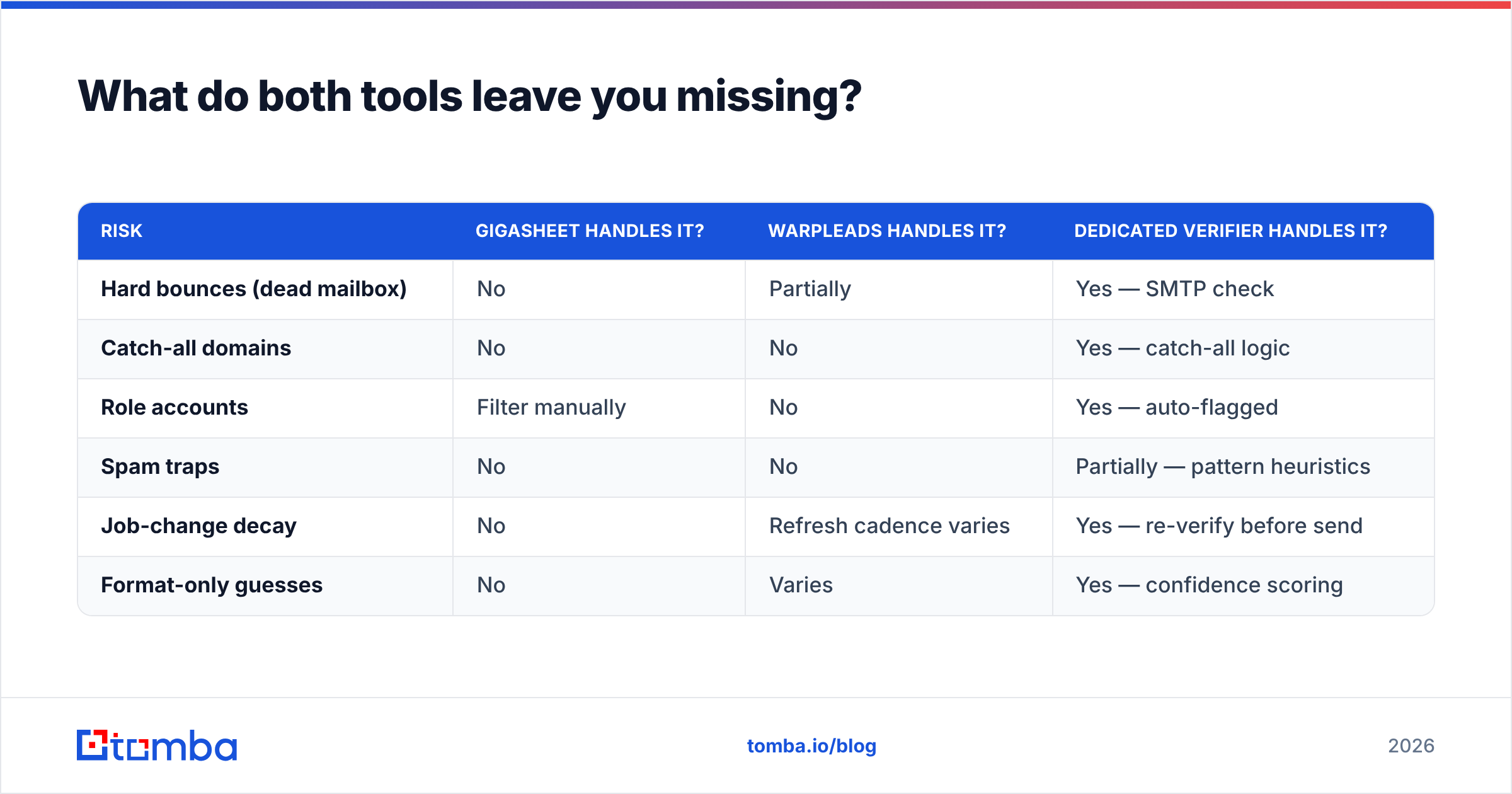
Neither a spreadsheet tool nor a bulk exporter protects you here:
| Risk | Gigasheet handles it? | Warpleads handles it? | Dedicated verifier handles it? |
|---|---|---|---|
| Hard bounces (dead mailbox) | No | Partially | Yes — SMTP check |
| Catch-all domains | No | No | Yes — catch-all logic |
| Role accounts | Filter manually | No | Yes — auto-flagged |
| Spam traps | No | No | Partially — pattern heuristics |
| Job-change decay | No | Refresh cadence varies | Yes — re-verify before send |
| Format-only guesses | No | Varies | Yes — confidence scoring |
The practical fix is a three-step sequence, not a fourth all-in-one tool:
- Source — pull volume from Warpleads, a scraper, LinkedIn exports, or a database like the Tomba database.
- Verify — run every address through an email verifier before it touches a sequencer. This is the step people skip.
- Analyze and dedupe — Gigasheet if the file is enormous, plain Sheets if it is not.
- Enrich the survivors — append firmographics and job titles only to records that passed verification, so you are not paying to enrich dead rows.
Doing step 4 before step 2 is the most common and most expensive ordering mistake in outbound ops.
Is there a single tool that replaces both?#
No, and be suspicious of anyone selling that. But you can collapse three vendors into two.
If your list volumes are in the tens of thousands rather than the tens of millions, you probably do not need a big-data spreadsheet at all. A bulk email finder that sources, verifies, and returns a clean file handles both the supply and the hygiene steps, and normal spreadsheets handle the rest. Gigasheet earns its price at genuinely massive scale — hundreds of millions of rows — and most sales teams never get there.
The decision tree is short:
- Files over ~5M rows, data already owned → Gigasheet, plus a verifier.
- Need volume, no sourcing tool yet → Warpleads or a database with verification built in.
- Need accuracy above volume → sourcing plus dedicated verification, and skip the big-data spreadsheet entirely.
- Need both, tight budget → one sourcing/verification platform plus Sheets, then add Gigasheet only when Sheets actually breaks.
What is the verdict on Gigasheet vs Warpleads?#
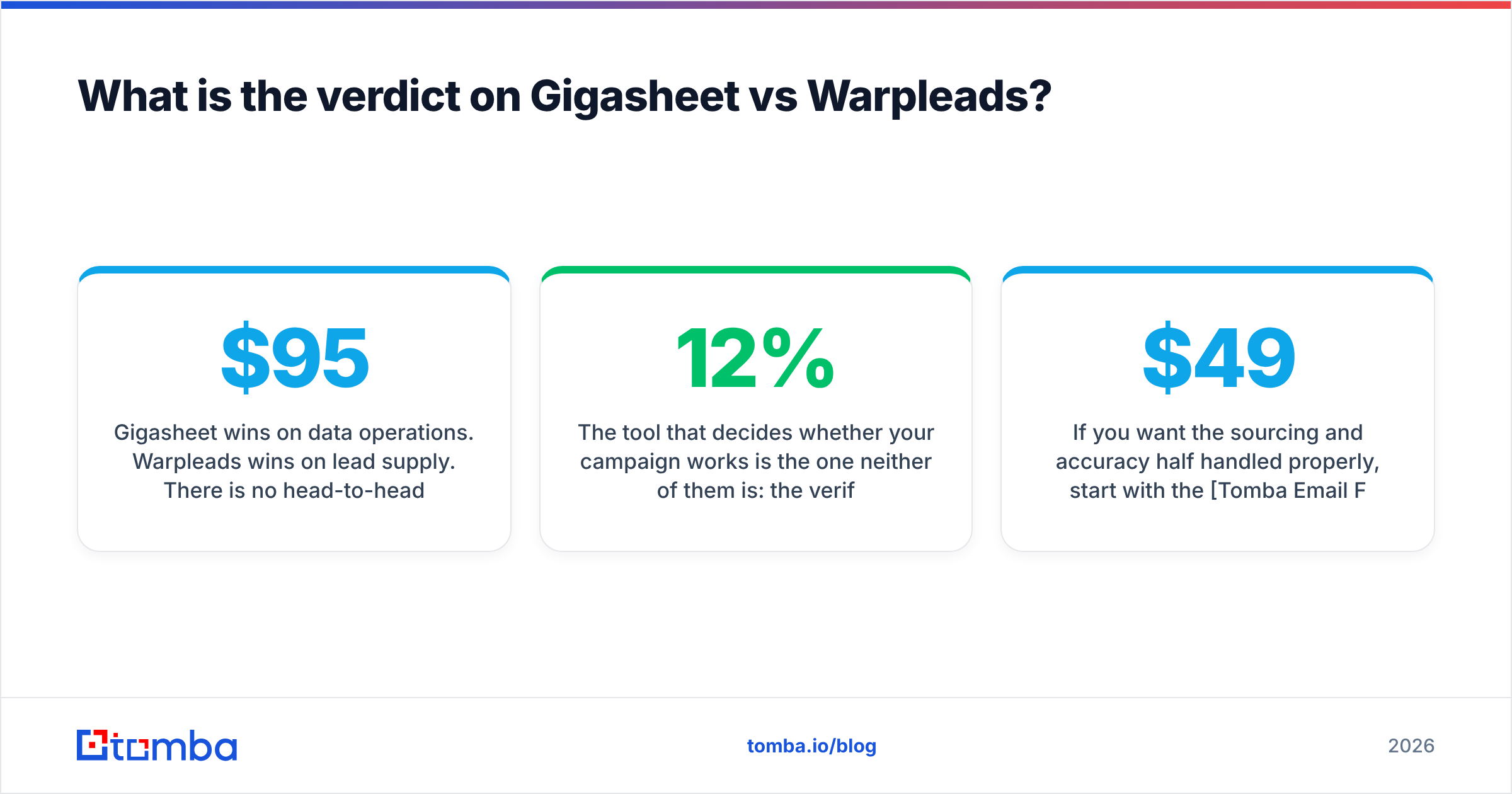
Gigasheet wins on data operations. Warpleads wins on lead supply. There is no head-to-head winner because they barely overlap — the only real overlap is that both sit somewhere in a prospecting workflow and both charge around $95–$99 to get started.
The tool that decides whether your campaign works is the one neither of them is: the verification and finding layer in between. You can survive a mediocre spreadsheet. You can survive a mediocre database. You cannot survive a 12% bounce rate, because that ends with your domain in a filter and no amount of clean pivot tables fixes it.
If you want the sourcing and accuracy half handled properly, start with the Tomba Email Finder. It finds professional addresses by domain, name, or company, scores every result with a confidence level instead of a shrug, and runs SMTP verification before the address ever reaches your sequencer. The free tier gives you 25 searches a month to test against contacts you can independently confirm, Starter is $49/mo, and the API drops the same data straight into whatever stack you have already built — Gigasheet, Warpleads, or both.
Source in volume. Verify before you send. Analyze what survives. In that order.
Related guides#
Ready to find emails that actually work?
Join 150,000+ professionals who stopped guessing and started sending. Free credits on signup — no credit card required.
Get the Tomba newsletter
Practical outbound tactics and product updates — once every two weeks.
About the author