Global Business Directory: How to Choose the Right One in 2026
Global business directories promise every company on earth in one search box. Here is what those coverage numbers actually mean, where the records decay, and how to turn a listing into a contact you can email.
TL;DR
- A global business directory is a searchable index of company records — name, address, industry, size, sometimes contacts. It is a firmographic source, not a contact source.
- Coverage counts ("400M+ companies") are marketing numbers. What matters is coverage in your target region and segment, plus how recently each record was touched.
- Free directories (Google Business Profile, national registries, Crunchbase's free tier) are fine for research. They fall apart the moment you need exportable, emailable contacts at scale.
- Directory data decays fast — B2B contact data is widely estimated to go stale at roughly 25–30% per year, and job-change churn hits decision-maker records hardest.
- The workable pattern in 2026: use a directory to build the company list, then use a domain-level email finder plus verification to build the contact list.
What is a global business directory?#
A global business directory is a database that indexes companies across many countries and makes them searchable by attributes — country, industry code, employee count, revenue band, technology used, sometimes funding stage. Think of it as the phone book's grandchild: the phone book listed everyone in one city and never changed between printings; a modern directory tries to list everyone everywhere and re-crawl continuously.
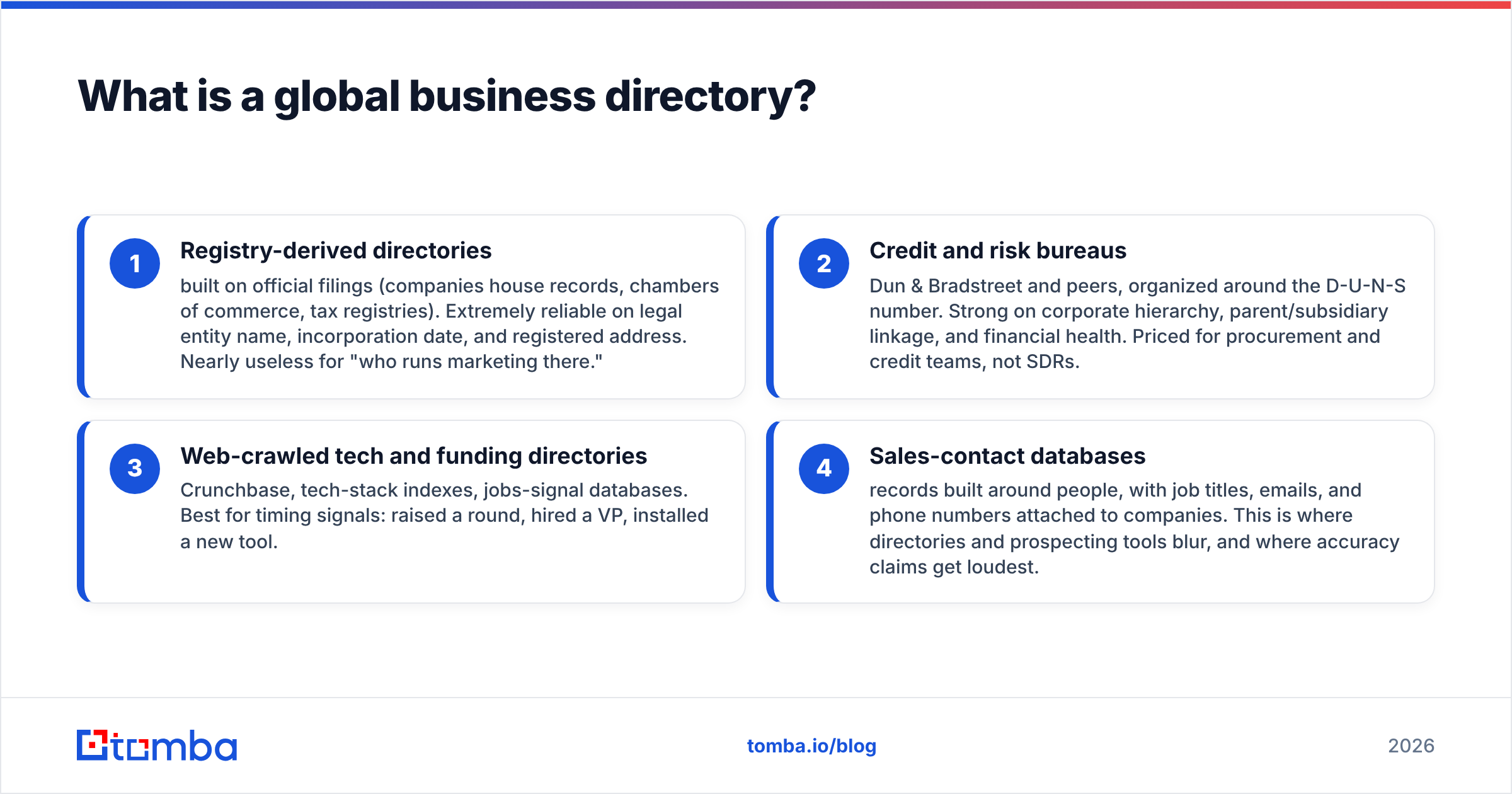
The category has split into four distinct shapes, and most buying mistakes come from confusing them:
- Registry-derived directories — built on official filings (companies house records, chambers of commerce, tax registries). Extremely reliable on legal entity name, incorporation date, and registered address. Nearly useless for "who runs marketing there."
- Credit and risk bureaus — Dun & Bradstreet and peers, organized around the D-U-N-S number. Strong on corporate hierarchy, parent/subsidiary linkage, and financial health. Priced for procurement and credit teams, not SDRs.
- Web-crawled tech and funding directories — Crunchbase, tech-stack indexes, jobs-signal databases. Best for timing signals: raised a round, hired a VP, installed a new tool.
- Sales-contact databases — records built around people, with job titles, emails, and phone numbers attached to companies. This is where directories and prospecting tools blur, and where accuracy claims get loudest.
A single vendor rarely does all four well. Registry data is deep but shallow on people. Contact databases are rich on people but often thin on the 400-person manufacturer in Lyon that has no LinkedIn presence.
Why do "global" coverage numbers mislead you?#
Because coverage is counted, not weighted. A vendor claiming 200 million companies is usually counting every sole trader, dormant shell, and duplicate legal entity it ever ingested. Your actual question is narrower: how many companies matching my ICP, in my target countries, have a current record with a reachable contact?
Run this sanity check before you sign anything:
- Pick 25 known accounts you already sell to — not household names, your real mid-market customers. Search each one. Note hits, misses, and wrong-entity matches.
- Check the freshness stamp. If a record does not expose a "last verified" or "last updated" date, treat the whole database as undated.
- Test one hard region. Japan, Brazil, Germany, and the Gulf states are where thin directories collapse. English-language crawlers systematically under-index non-Latin-script and privacy-strict markets.
- Count usable contacts, not records. A company row with no email, no phone, and no named person is a research artifact, not a lead.
- Check the export terms. Some directories allow browsing but restrict bulk export or CRM sync in the contract, which quietly makes the data unusable for outbound.

Which global business directories matter in 2026?#
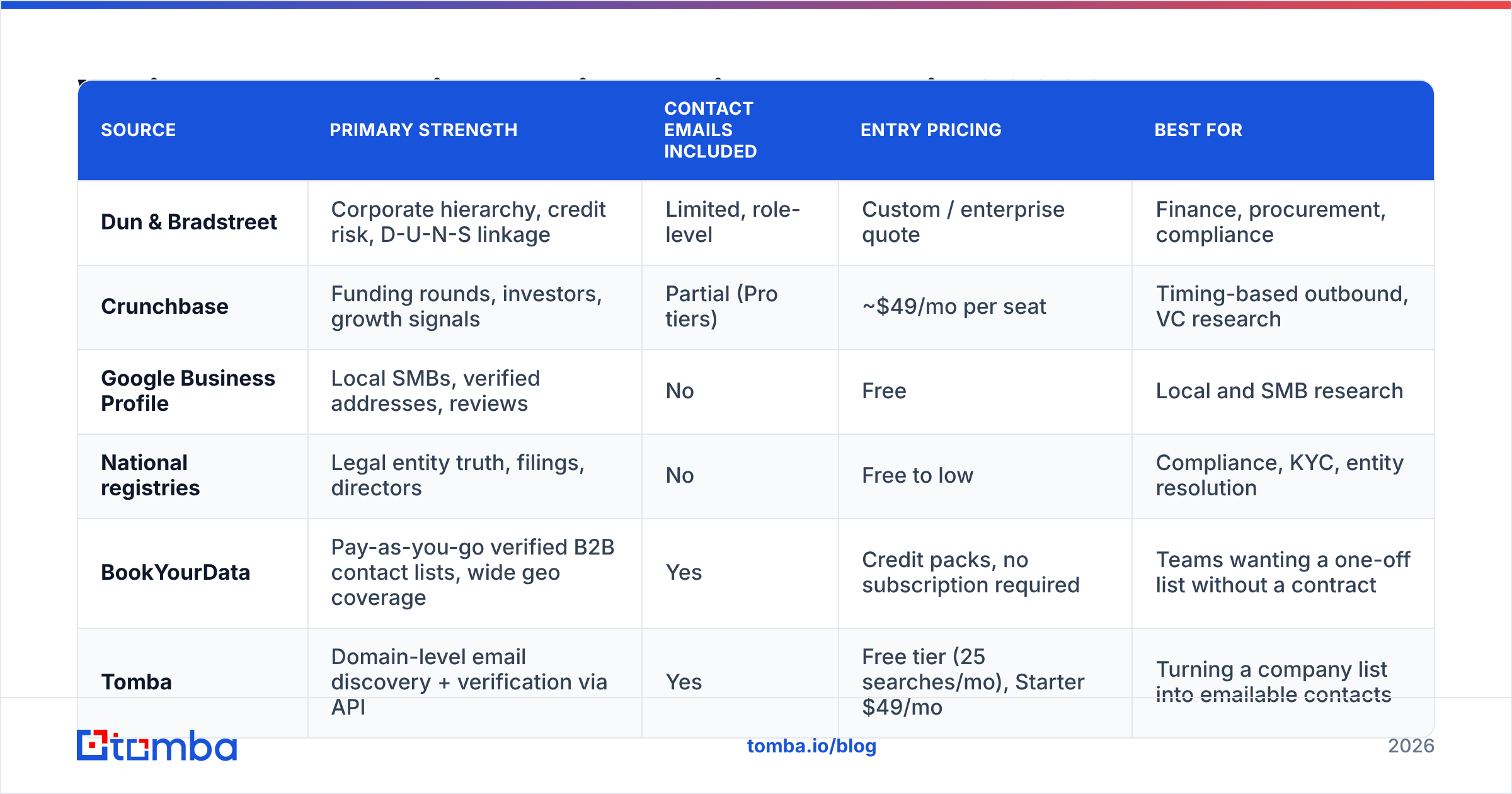
Here is how the main options compare on the attributes that actually decide the purchase. Pricing reflects publicly listed entry tiers at time of writing and changes often — always confirm on the vendor's own page.
| Source | Primary strength | Contact emails included | Entry pricing | Best for |
|---|---|---|---|---|
| Dun & Bradstreet | Corporate hierarchy, credit risk, D-U-N-S linkage | Limited, role-level | Custom / enterprise quote | Finance, procurement, compliance |
| Crunchbase | Funding rounds, investors, growth signals | Partial (Pro tiers) | ~$49/mo per seat | Timing-based outbound, VC research |
| Google Business Profile | Local SMBs, verified addresses, reviews | No | Free | Local and SMB research |
| National registries | Legal entity truth, filings, directors | No | Free to low | Compliance, KYC, entity resolution |
| BookYourData | Pay-as-you-go verified B2B contact lists, wide geo coverage | Yes | Credit packs, no subscription required | Teams wanting a one-off list without a contract |
| Tomba | Domain-level email discovery + verification via API | Yes | Free tier (25 searches/mo), Starter $49/mo | Turning a company list into emailable contacts |
Notice that none of these is a strict superset of the others. The teams that get this right treat directories as a stack, not a single purchase: registry or bureau data for entity truth, a signals directory for timing, and a contact layer for reachability.
How do global business directories get their data?#
Understanding sourcing tells you where the errors will be. Every large directory blends four pipelines:
- Public filings and registries. Government-mandated, high truth value, slow to update. A company that moved offices in March may show the old registered address until the next annual filing.
- Web crawling. Company sites, careers pages, press releases, structured markup. Fast and broad, but it inherits whatever the website says — including the "About" page nobody has edited since 2021.
- Partner and licensed feeds. Bought from other data vendors. This is why two "independent" directories often show the identical wrong phone number: they share an upstream.
- Contributed and community data. User submissions, extension-captured records, opt-in networks. Highest recency, highest variance in quality, and the biggest source of compliance questions in GDPR jurisdictions.
The practical consequence: firmographics (industry, size, HQ) age slowly and are usually safe. Contact-level fields (email, direct dial, job title) age fast and must be re-checked at send time, not at import time. That is why a standalone email verifier sits in almost every mature outbound stack regardless of which directory feeds it.
Are free global business directories good enough?#
For research, yes. For outbound, almost never — and the reason is structural, not stingy.
Free directories optimize for being found, not for being exported. Google Business Profile exists so customers can find a bakery; it deliberately does not hand you 5,000 bakery owner emails. National registries exist for legal transparency; most publish a registered address and a director name, and stop there. You can absolutely build a target list from free sources — many strong campaigns start with a scraped list of 300 companies from an industry association page — but you will finish with domains, not inboxes.
That gap is where the workflow splits. Once you have domains, a domain search returns the email addresses and detected patterns associated with each company, which is a fundamentally different operation from browsing a listing page. Free-source list building plus paid contact discovery is usually cheaper than a full-fat enterprise directory subscription, and you keep control of the ICP definition.
The honest exception: if you need a ready-made list once, for a single campaign, and you do not want a platform subscription at all, a pay-as-you-go vendor like BookYourData is a reasonable fit — you buy the credits, you get the file, there is no seat contract to manage. Match the commercial model to the frequency of the need.
How fast does directory data actually decay?#
Fast enough that "when was this collected" beats "how many records do you have" as a buying criterion.
Three decay forces run simultaneously:
- Job churn. Decision makers change roles constantly; each change orphans an email, a title, and often a direct dial at once.
- Corporate churn. Acquisitions, rebrands, and domain migrations break the join between company and contact. The person is still employed; the address bounces.
- Infrastructure churn. Mail providers change, catch-all policies get turned on or off, and previously deliverable addresses start silently discarding mail.
That third one is underrated. A catch-all domain accepts everything at the SMTP layer and then throws away what it does not recognise, so a naive verifier marks the address "valid" and your campaign quietly disappears. If a meaningful slice of your list sits on catch-all domains — common in enterprise and in European mid-market — you need explicit catch-all verification rather than a simple syntax-plus-MX check.

Directory-first or contact-first: which workflow wins?#
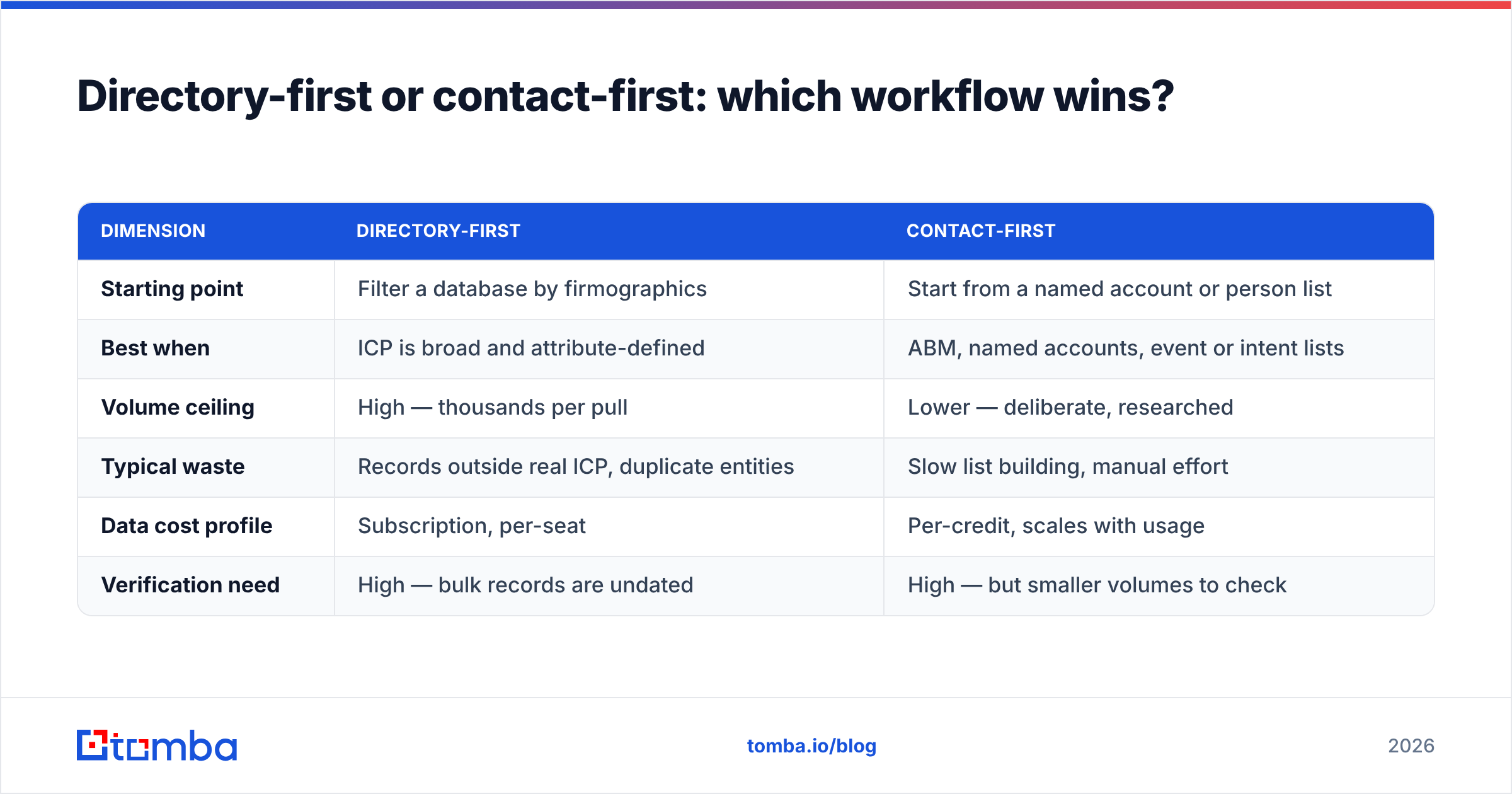
Both work. They fail in different ways, and the choice depends on how tightly defined your ICP is.
| Dimension | Directory-first | Contact-first |
|---|---|---|
| Starting point | Filter a database by firmographics | Start from a named account or person list |
| Best when | ICP is broad and attribute-defined | ABM, named accounts, event or intent lists |
| Volume ceiling | High — thousands per pull | Lower — deliberate, researched |
| Typical waste | Records outside real ICP, duplicate entities | Slow list building, manual effort |
| Data cost profile | Subscription, per-seat | Per-credit, scales with usage |
| Verification need | High — bulk records are undated | High — but smaller volumes to check |
The hybrid that most teams converge on: pull companies from a directory, deduplicate by primary domain (not by company name — name matching creates duplicate entities across languages and legal suffixes), then run contact discovery domain by domain. Handling that at scale means batch processing, which is what a bulk email finder is for, or an email finder API call inside your own enrichment job if you would rather keep the pipeline in code.
What should a 2026 directory-to-pipeline workflow look like?#
Here is the sequence that survives a deliverability audit:
- Define the ICP in filterable terms. Country, industry code, employee band, and one qualifying signal (hiring, funding, tech installed). If you cannot express it as filters, you cannot evaluate a directory against it.
- Pull companies, not contacts, first. Cheaper, more stable, and it lets you sanity-check the segment before spending contact credits.
- Resolve to a canonical domain. One company, one primary domain. Kill duplicates here or they multiply through every later stage.
- Discover contacts per domain. Target roles, not individuals you hope exist. Capture the source and the confidence score with each address.
- Verify immediately before send, not at import. A verification run from six weeks ago is a historical document.
- Enrich only what survives. Adding firmographic and technographic fields via data enrichment is worth doing on verified rows, and wasted on rows that will bounce.
- Feed bounce data back. Every hard bounce is a correction to your directory's accuracy score for that region. After two campaigns you will know exactly which vendor is weak where — better than any G2 review can tell you.
Should you list your own business in global directories?#
Yes, but with a narrow objective: consistency, not volume.
The old SEO tactic of blasting your business into 300 directories is dead and mildly harmful. What still works is keeping your name, address, phone, and domain identical across the handful of directories that actually get crawled and cited — Google Business Profile, your national registry entry, your industry association listing, and the two or three vertical directories buyers in your market genuinely use. Inconsistent entity data is what confuses both search engines and the data vendors that later resell your record.
Practical tip: whatever email you publish in those listings will be scraped and will receive cold outreach. Publish a role address you actually monitor, and make sure your SPF record and authentication are correct on the domain you list — a surprising number of companies discover their own authentication gaps only after they show up in someone else's directory.
What questions should you ask before buying?#
Send these to the vendor in writing before the demo, and compare the answers side by side:
- What percentage of your records in [my top three countries] include a verified, deliverable email?
- How do you define "verified," and how recently was the median record in that segment re-checked?
- What is your documented lawful basis for processing personal data in the EU and UK, and do you honour deletion requests upstream?
- Do credits expire, and do failed or unverifiable lookups consume credits?
- Can I export to CSV and push to my CRM without an add-on, and is that in the contract or just in the UI?
- What happens to my exported data if I cancel?
The credit-consumption question catches more budget overruns than any other. Some platforms charge for a lookup regardless of result; others only charge on a successful, verified return. Across 50,000 lookups that difference is the whole line item. Tomba's own tiers — free at 25 searches/mo, Starter at $49/mo, Growth at $99/mo, Pro at $249/mo — are laid out on the pricing page so you can model it against your monthly volume before committing.
The verdict#
A global business directory is worth paying for when your ICP is genuinely broad, multi-country, and attribute-defined — that is exactly the search problem directories solve and manual research cannot. It is a bad purchase when what you really needed was reachable contacts at 500 known accounts, because you will pay enterprise directory prices for firmographics you could have gotten free and still have to source the emails separately.
Decide which problem you have first. If it is coverage, buy coverage. If it is reachability, buy reachability — and check the freshness stamp either way.
Ready to turn a company list into contacts you can actually email? Drop your domains into the Tomba Email Finder and get verified, source-attributed addresses with confidence scores — start on the free tier with 25 searches a month, no card required, and upgrade only when your volume justifies it.
Related guides#
Ready to find emails that actually work?
Join 150,000+ professionals who stopped guessing and started sending. Free credits on signup — no credit card required.
Get the Tomba newsletter
Practical outbound tactics and product updates — once every two weeks.
About the author