Global Database Alternatives: 9 B2B Data Tools Compared
Global Database bundles company financials, tech data and contacts behind an annual quote. Here are 9 alternatives compared on coverage, contact accuracy, API access and real cost — plus which one fits which team.
TL;DR
- Global Database is strongest at company-level intelligence — financials, filings, tech stack, ownership. It is weakest at cheap, verified, per-contact email data at scale.
- Most global database alternatives on this list cover the contact half of the job for a fraction of an annual enterprise quote. Tomba, BookYourData, Cognism and Apollo all do.
- Quote-based pricing is the top reason teams leave. Clear tiers start at $49/mo (Tomba). BookYourData sells pay-as-you-go credits with no annual deal.
- Verify before you send. A "verified" flag is a claim, not a promise. Run the list through your own verifier and you will usually cut bounce risk by half.
- The best pick depends on the job: firmographics + credit → Dun & Bradstreet; EU/UK phone-verified contacts → Cognism; developer-first email at volume → Tomba.
What is Global Database, and who is it actually for?#
Global Database is a UK-based B2B intelligence platform. Think of it as a company records office with a contact directory bolted on. It pulls registry filings, credit and financial data, tech-install signals, trade records and staff contacts into one search box. Coverage is claimed across 190+ countries.
That mix is useful for a specific buyer. A credit team checking risk. An analyst sizing a market. An ABM lead building a target list from tech-install data. It is an account-first product.
It strains on the job most people arrive with: give me 3,000 verified email addresses for marketing directors at 40–200 employee SaaS companies in Germany, by Thursday. That is a contact-data job. Contact-data tools do it faster and cheaper, which is why buyers start hunting for global database alternatives.
Why do teams look for Global Database alternatives?#
Five reasons come up again and again in reviews on G2 and in migration calls:
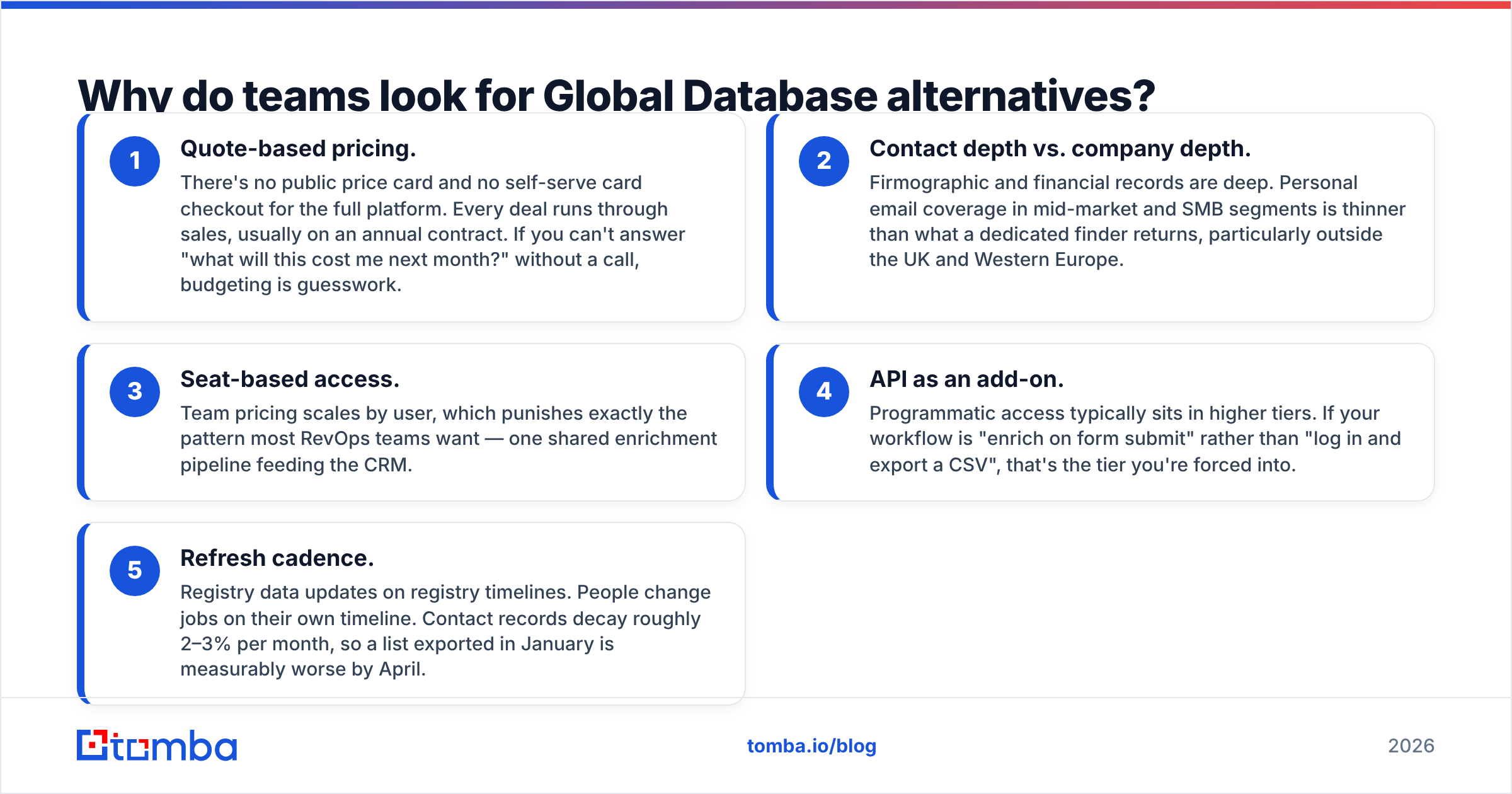
- Quote-based pricing. There is no public price card and no self-serve checkout for the full platform. Every deal runs through sales, usually on an annual contract. If you cannot answer "what will this cost me next month?" without a call, budgeting is guesswork.
- Contact depth vs. company depth. Firmographic and financial records run deep. Personal email coverage in mid-market and SMB is thinner than a dedicated finder returns, especially outside the UK and Western Europe.
The next three reasons are the ones that push RevOps teams to shortlist global database alternatives.
- Seat-based access. Team pricing scales by user. That punishes the pattern most teams want: one shared enrichment pipeline feeding the CRM.
- API as an add-on. API access usually sits in higher tiers. If your workflow is "enrich on form submit" rather than "log in and export a CSV", that is the tier you are pushed into.
- Refresh cadence. Registry data updates on registry timelines. People change jobs on their own. Contact records decay by 2–3% a month, so a list exported in January is measurably worse by April.

What should you compare before switching?#
Do not compare logos. Compare global database alternatives on these six points, against your real workflow.
- Coverage where you sell — a 400M-contact headline number means nothing if only 3% sit in your ICP geography. Test on 100 of your target accounts, never the vendor's demo list.
- Verified vs. guessed emails — some vendors return pattern-guessed addresses with no SMTP check. Ask what "valid" means. Ask whether catch-all domains are flagged on their own. A good catch-all verifier tells you when a domain accepts everything and the check is not conclusive.
- Credit model — per-seat, per-credit, or per-record? Do failed lookups burn credits? Do unused credits roll over? This is where the real cost hides.
Score every shortlist the same way and the field sorts itself quickly.
- API and automation — REST API, rate limits, native CRM sync, Sheets/Excel add-ons, MCP or CLI access. A database you have to log into is a database that will not scale.
- Compliance posture — GDPR/CCPA handling, notified sourcing for EU personal data, DNC screening for phone. Non-negotiable if you prospect in Europe.
- Exit cost — can you export what you paid for? Or does the data live only inside their UI?
Which Global Database alternatives are worth testing in 2026?#
The nine global database alternatives below are ranked by the job they do best, not by dataset size.
1. Tomba — best for verified email at developer-friendly pricing#
Tomba is a contact-data specialist, not a company-intelligence suite. The email finder turns a name plus a domain into a work email. Domain search returns every known address at a company, plus the email pattern it detected. Around that sit a verifier, a catch-all checker, a phone finder and enrichment endpoints.
Two things make it the default swap for the contact half of the job. First, clear pricing: a free tier at 25 searches/mo, Starter $49/mo, Growth $99/mo, Pro $249/mo. Second, API access on every paid plan, plus a CLI, an MCP server, a Chrome extension and Sheets/Excel add-ins. The same credits work wherever your workflow lives.
Weakness: no company financials, credit scores or filings. If you need registry data, Tomba adds to Global Database rather than replacing it.
2. BookYourData — best for pay-as-you-go, no-subscription list building#
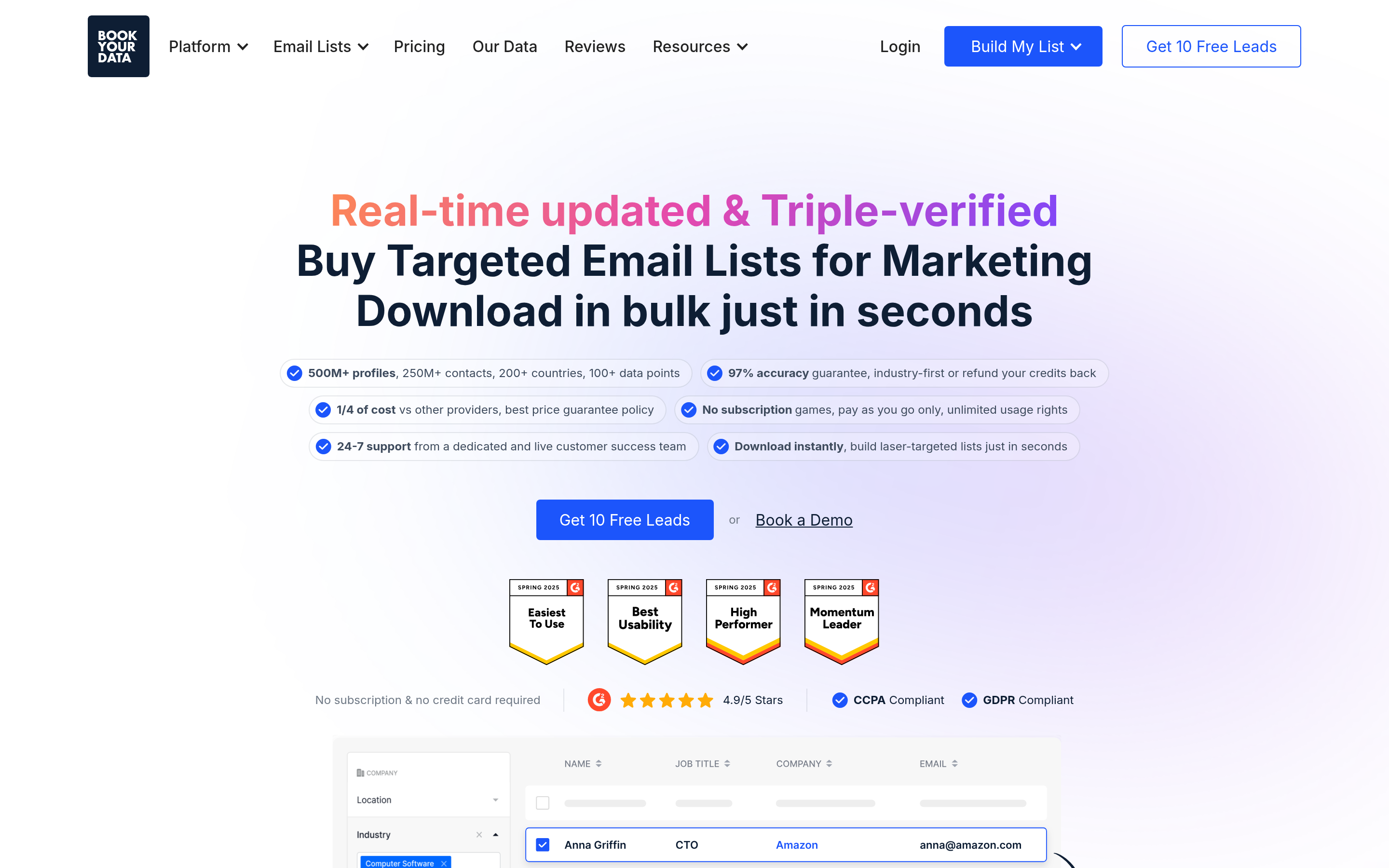
BookYourData sells prospect lists as credit packs, with no monthly commitment. It backs them with a 97%+ accuracy guarantee and refunds credits for bounces. You build a list with filters (industry, title, geography, tech), preview the count, then pay for what you download.
That is a very different buying motion from an annual enterprise quote. It suits agencies and seasonal campaigns: you spend when a campaign runs and nothing when it does not. Coverage is strongest in North American and EMEA business contacts.
Weakness: it is a list-building product first. Ongoing enrichment pipelines want an API-native tool.
3. Cognism — best for EU/UK phone-verified outbound#
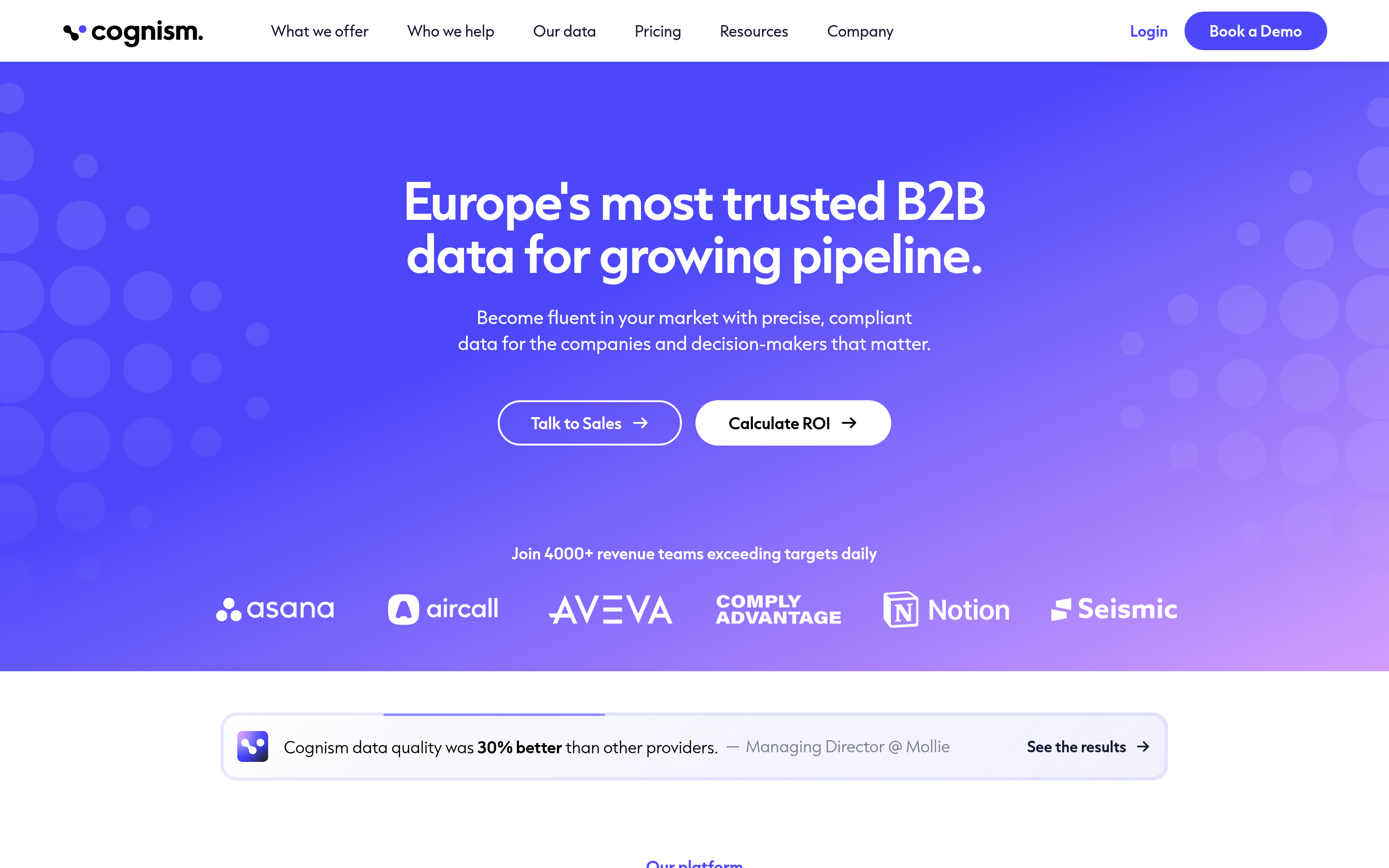
Cognism's edge is Diamond Data: mobile numbers checked by humans. Add notified GDPR sourcing and DNC screening across Europe. If you cold call the UK, DACH or the Nordics, it is the safest default on compliance. Pricing is quote-based and often lands in five figures a year, so it trades one Global Database problem for the same one.
4. ZoomInfo — best for enterprise breadth and intent#

The widest dataset here, with intent signals, org charts, scoops and deep CRM links. It is the option most likely to clear a large procurement checklist. It is also the priciest, with multi-year contracts and seat minimums that fit badly below ~20 reps.
5. Apollo.io — best all-in-one for small sales teams#
Apollo bundles a contact database with sequencing, a dialer and a light CRM. Self-serve tiers start around $49–$99/user/mo, and the free plan is fine for testing. Data quality is decent in US tech and weaker in European mid-market. Read an Apollo alternative breakdown if you only need the data layer and already own a sequencer.
6. Lusha — best browser-extension workflow for AEs#
Fast, simple, strong on the LinkedIn-to-CRM path. Reps like it because it takes two clicks. RevOps teams like it less, because per-seat credits get costly across a team and bulk enrichment is not its strength.
7. RocketReach — best cheap individual lookup tool#
Low entry price, a large index, and better personal-email coverage than most. Accuracy varies and there is no real company-intelligence layer. For a solo founder doing 200 lookups a month, it is still hard to beat on cost.
8. Clearbit (HubSpot Breeze Intelligence) — best if you live in HubSpot#
Now part of HubSpot, Clearbit writes firmographic and technographic fields straight onto CRM records. It can also enrich inbound form fills in real time. Excellent inside HubSpot, awkward outside it. Personal-email coverage was cut back after the deal.
9. Dun & Bradstreet — best for credit, risk and firmographics#
Did you value Global Database mainly for financial and risk data, not for contacts? Then D&B is the heavyweight, with DUNS numbers as a universal company key. Contact data is secondary and pricing is enterprise-grade.

How do these alternatives compare on price and access?#
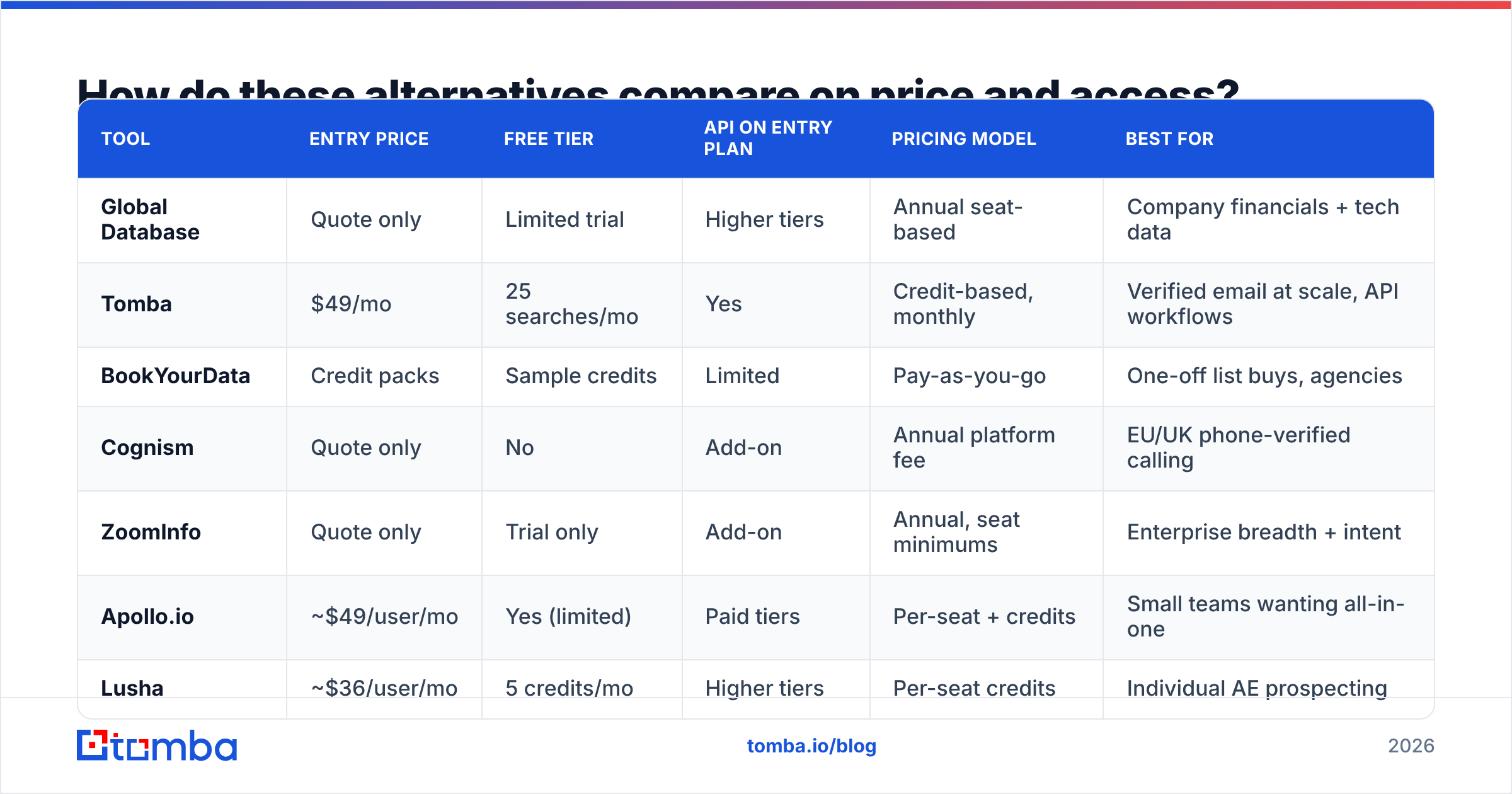
Prices below are the publicly listed entry tiers at the time of writing. Enterprise quotes vary and vendors change plans without notice. Check before you buy. The table is the fastest way to rank global database alternatives on cost and API access.
| Tool | Entry price | Free tier | API on entry plan | Pricing model | Best for |
|---|---|---|---|---|---|
| Global Database | Quote only | Limited trial | Higher tiers | Annual seat-based | Company financials + tech data |
| Tomba | $49/mo | 25 searches/mo | Yes | Credit-based, monthly | Verified email at scale, API workflows |
| BookYourData | Credit packs | Sample credits | Limited | Pay-as-you-go | One-off list buys, agencies |
| Cognism | Quote only | No | Add-on | Annual platform fee | EU/UK phone-verified calling |
| ZoomInfo | Quote only | Trial only | Add-on | Annual, seat minimums | Enterprise breadth + intent |
| Apollo.io | ~$49/user/mo | Yes (limited) | Paid tiers | Per-seat + credits | Small teams wanting all-in-one |
| Lusha | ~$36/user/mo | 5 credits/mo | Higher tiers | Per-seat credits | Individual AE prospecting |
| RocketReach | ~$39/mo | Trial lookups | Higher tiers | Per-lookup tiers | Solo/low-volume lookups |
| Clearbit (Breeze) | HubSpot add-on | With HubSpot | Via HubSpot | Credit-based | HubSpot-native enrichment |

How accurate is the data, really?#
Every one of these global database alternatives publishes an accuracy number. Treat them all as marketing until you run your own test. Here is the protocol that settles it:
- Take 100 real target accounts from your CRM. Not a curated sample. Not the vendor's demo account.
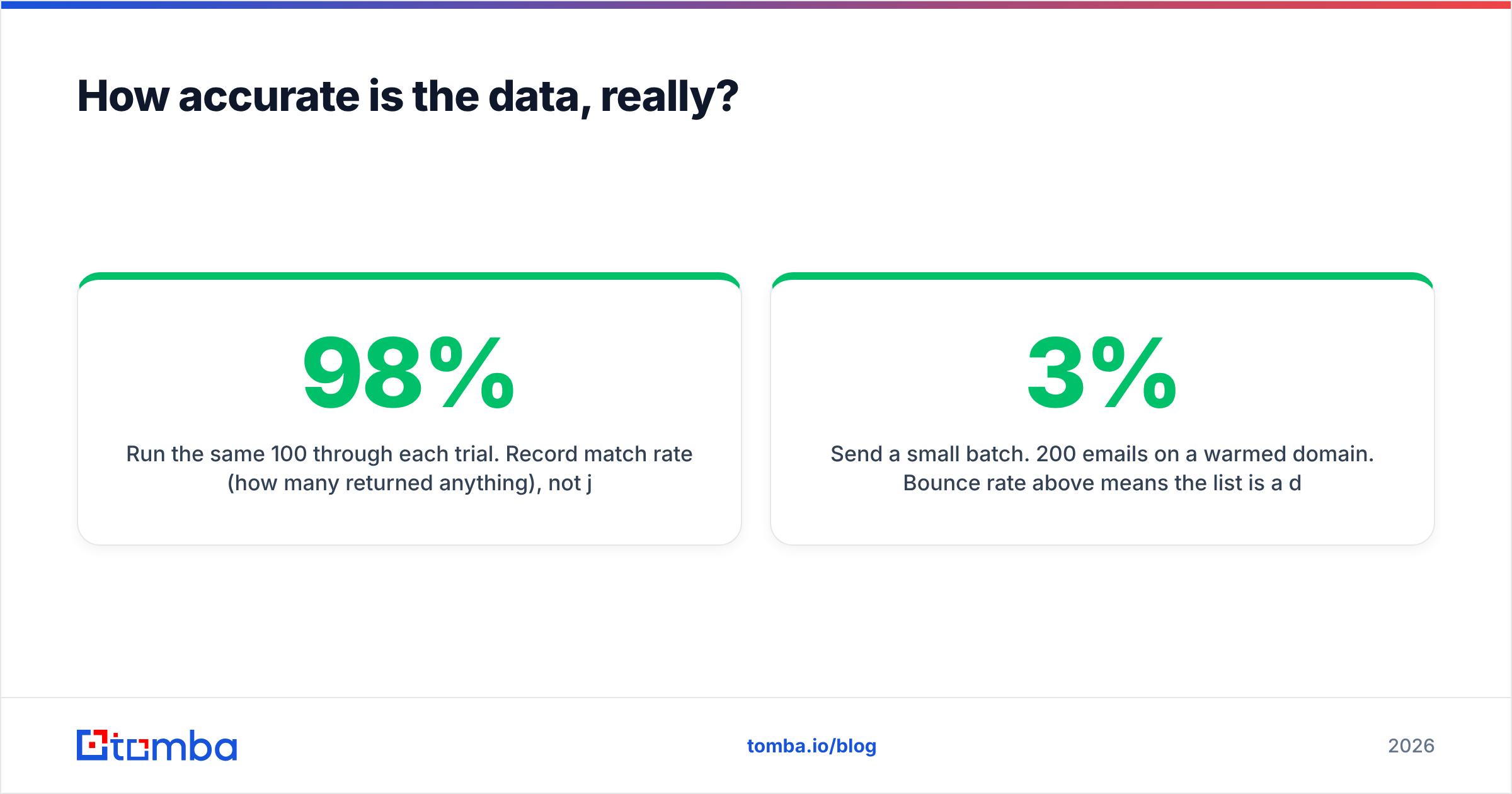
- Run the same 100 through each trial. Record match rate, not just accuracy on what came back. A tool that is 98% accurate but matches 30% of your list is worse than one that is 92% accurate and matches 80%.
- Verify on your own. Push every returned address through a neutral email verifier. Count how many come back valid, invalid, or catch-all. The gap between the vendor's "verified" label and that verdict is your real quality signal.
- Send a small batch. 200 emails on a warmed domain. A bounce rate above 3% means the list is a deliverability risk, whatever the dashboard claimed.
That last step matters more than any headline stat. Mailbox providers judge you on bounces and complaints, not on your vendor's press release. One bad import can cost weeks of sender reputation repair.

Which alternative fits your use case?#
Match the tool to the job, not to the feature count. Here is how the global database alternatives above map to common jobs:
- You mainly needed contacts, not filings → Tomba or BookYourData. Both replace the contact half for a fraction of an annual quote, with no procurement cycle.
- You mainly needed company financials and risk → Dun & Bradstreet or Creditsafe. Keep a cheap contact tool beside it.
- You cold call into Europe → Cognism, for DNC screening and verified mobiles.
- You have 3 reps and no ops person → Apollo. Bundling beats integrating when nobody owns integrations.
- You want an automated enrichment pipeline → an API-first tool with credits you can predict. Wire it to your CRM through native integrations or Zapier and stop exporting CSVs.
A split often works best. Keep one company-intelligence source for accounts. Run a cheaper, faster contact layer for people. The two datasets refresh at different speeds and carry different price ceilings. Paying enterprise rates for both is how data budgets quietly triple.
What does switching actually cost you?#
Switching between global database alternatives costs less than most teams assume, if you sequence it:
- Export everything you are entitled to before the contract lapses. Company records, notes, custom fields.
- Run a 30-day overlap. New tool and old tool side by side on live campaigns. Compare bounce rate and reply rate on matched segments.
- Deduplicate on import. Merge on company domain plus email, not on company name. Name matching creates duplicates at scale.
- Re-verify the legacy list. Anything older than six months should be re-checked before it touches a sequence. Bulk checks cost a fraction of a cent per record. A blacklisting costs weeks.
- Track the credit burn for the first month. Then you size the right tier instead of over-buying on a sales rep's advice.
The bottom line#
Global Database earns its place when you need company intelligence: financials, filings, technographics, trade data. If you pay enterprise rates mainly to get email addresses, you are overspending on the wrong half of the product.
The good news is that the best global database alternatives are cheap to test. Run your 100 real target accounts through the Tomba Email Finder on the free tier. Verify the results. Compare the match rate against whatever you pay today. If the numbers hold, Starter at $49/mo covers most small teams — see Tomba pricing for the full credit breakdown. Every plan ships with API, CLI and Sheets access, so the data lands where your workflow already runs.
Related guides#
Ready to find emails that actually work?
Join 150,000+ professionals who stopped guessing and started sending. Free credits on signup — no credit card required.
Get the Tomba newsletter
Practical outbound tactics and product updates — once every two weeks.
About the author