Global Database Pricing in 2026: Real Costs, Limits & Alternatives
Global Database sells company data, credit reports and contacts on quote-based annual contracts. Here's how the pricing is really built, where the hidden costs sit, and when a cheaper stack wins.
TL;DR
- Global Database does not publish a self-serve price list. Every real number comes out of a sales call, which means your cost depends on your negotiating position, not a public tier.
- Reported entry points sit in the low hundreds of dollars per user per month for single-market access, with multi-market and credit-report bundles pushing annual contracts into four and five figures. Treat any number you read online — including here — as a starting estimate, not a quote.
- The expensive part is rarely the licence. It's seat minimums, annual-only terms, credit expiry, and export caps that make the effective cost per usable contact much higher than the headline.
- If you need company firmographics, credit risk data and technographics in one place, Global Database earns its price. If you mostly need verified work emails and phone numbers, you are overpaying by a wide margin.
- A transparent per-credit stack — a dedicated email finder plus verification — typically lands the same contactable records for a fraction of an enterprise data contract.
What is Global Database, and who actually buys it?#
Global Database is a UK-headquartered B2B data platform that sells company intelligence rather than just contact records. Think of it less like a phone book and more like a credit bureau that also happens to hold contact details: registered company filings, directors, financial statements, credit scores, technographics, and contact data layered on top.
That mix explains the buyer profile. Global Database tends to land with:
- Credit and risk teams who need company financials and credit scores for onboarding or supplier vetting.
- Enterprise sales teams in the UK and EU where Companies House-style registry data matters more than US-heavy contact volume.
- Compliance and procurement functions running supplier due diligence at scale.
- ABM marketers who want technographic filters to build install-base target lists.
If you are a five-person outbound team that just needs verified emails for a prospect list, you are not the intended buyer — and the pricing model will make that obvious fast.
How does Global Database pricing actually work?#
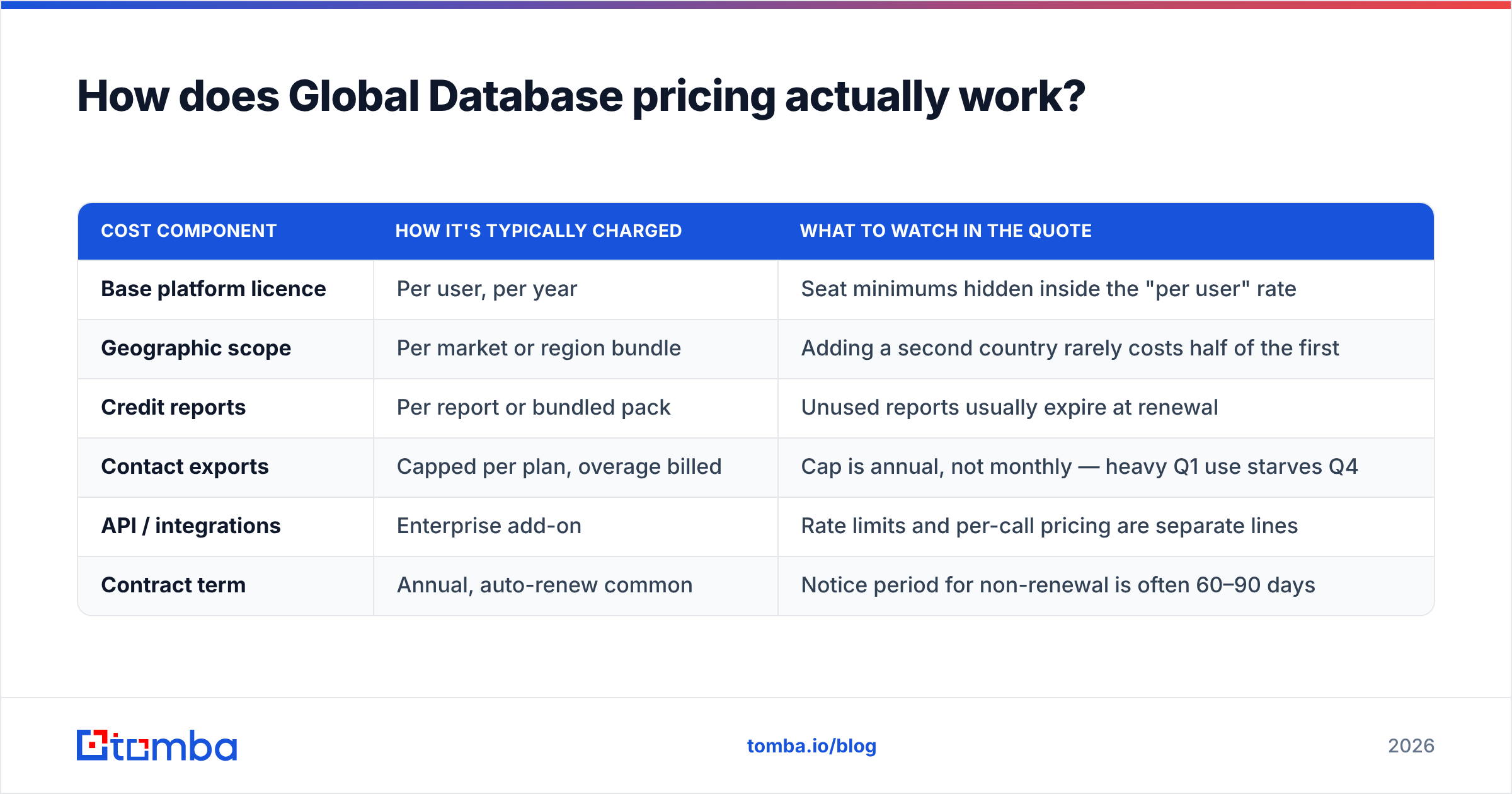
Global Database prices like an enterprise data vendor, not a SaaS tool. There is no "sign up and see the bill" flow. The quote is assembled from separate components, and understanding those components is the only way to compare offers honestly.
- Module selection. Company data, contact data, credit reports, and technographics are priced as separate modules. Buying "the database" usually means buying two or three of these, and each one moves the number.
- Geographic scope. Access is scoped by market. One country is the cheapest configuration; adding the US, EU-wide coverage, or global access multiplies the base licence rather than adding a flat fee.
- Seats. Pricing is per user, with a practical floor. Small teams frequently discover the quoted "per-user" rate assumes a minimum seat count they did not ask for.
- Credits and export limits. Viewing a record and exporting it are not the same action. Export volume is capped per plan, and overages are billed or negotiated mid-term.
- Contract term. Annual commitment is the norm. Monthly billing, where available, carries a premium and often strips the export allowance.
- API access. Programmatic access is generally an enterprise-tier add-on, not part of a standard seat.
That structure is normal for risk-data vendors. It's also why two companies can pay wildly different amounts for what looks like the same product.
| Cost component | How it's typically charged | What to watch in the quote |
|---|---|---|
| Base platform licence | Per user, per year | Seat minimums hidden inside the "per user" rate |
| Geographic scope | Per market or region bundle | Adding a second country rarely costs half of the first |
| Credit reports | Per report or bundled pack | Unused reports usually expire at renewal |
| Contact exports | Capped per plan, overage billed | Cap is annual, not monthly — heavy Q1 use starves Q4 |
| API / integrations | Enterprise add-on | Rate limits and per-call pricing are separate lines |
| Contract term | Annual, auto-renew common | Notice period for non-renewal is often 60–90 days |
What do Global Database plans cost in 2026?#
Here is the honest answer: nobody outside the company can quote you exact, current list pricing, because there is no published list. What exists publicly are reported ranges from buyer reviews on sites like G2 and Capterra, plus historical figures repeated across comparison posts.
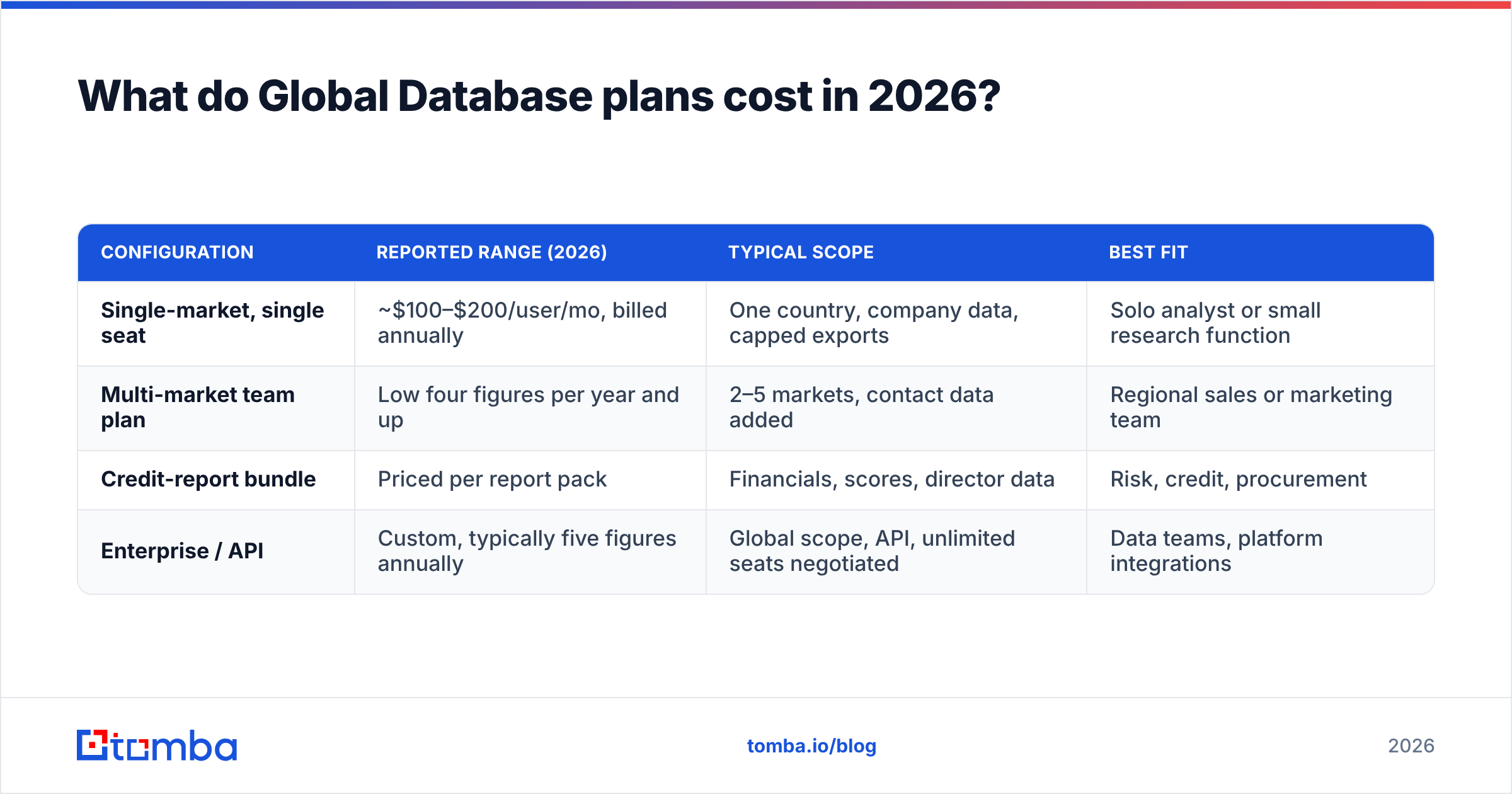
Based on those reported ranges, the shape of the pricing looks roughly like this. Use it to set expectations before a sales call, not as a quote.
| Configuration | Reported range (2026) | Typical scope | Best fit |
|---|---|---|---|
| Single-market, single seat | ~$100–$200/user/mo, billed annually | One country, company data, capped exports | Solo analyst or small research function |
| Multi-market team plan | Low four figures per year and up | 2–5 markets, contact data added | Regional sales or marketing team |
| Credit-report bundle | Priced per report pack | Financials, scores, director data | Risk, credit, procurement |
| Enterprise / API | Custom, typically five figures annually | Global scope, API, unlimited seats negotiated | Data teams, platform integrations |
Two caveats that matter more than the numbers. First, ranges drift — always confirm directly with the vendor. Second, the reported entry price almost never includes the contact-export volume an outbound team actually consumes, which is the line item that decides whether this platform is cheap or ruinous for your use case.

What are the hidden costs in a Global Database contract?#
Every quote-based data contract has the same four pressure points. Check all of them before you sign.
Annual commitment with a notice window. You are buying twelve months. If your outbound programme changes in month four, you still pay. Ask for the exact non-renewal notice period in writing — 90 days is common and easy to miss.
Export caps that don't match your workflow. Platforms like this are built for research-heavy, low-volume users: look up a company, read the filing, make a decision. Outbound teams do the opposite — they export thousands of rows. When the cap is annual, a single big campaign can consume most of your allowance in one quarter.
Seat minimums. A "per-user" rate is only honest if you can buy one user. Confirm the floor before you model cost per rep.
Coverage gaps you pay for anyway. Registry-derived data is excellent for company identity and financials. It's weaker for personal work emails and direct dials, which change every time someone switches jobs. You may end up buying a second tool for the exact records you thought you were paying for — the classic double-spend.
There's also the soft cost nobody puts in the spreadsheet: procurement time. A quote-based vendor means a demo, a proposal, a security review, and a legal pass. That's four to eight weeks before your first export. A self-serve tool with a transparent price page gets you data the same afternoon.
How does Global Database pricing compare to the alternatives?#
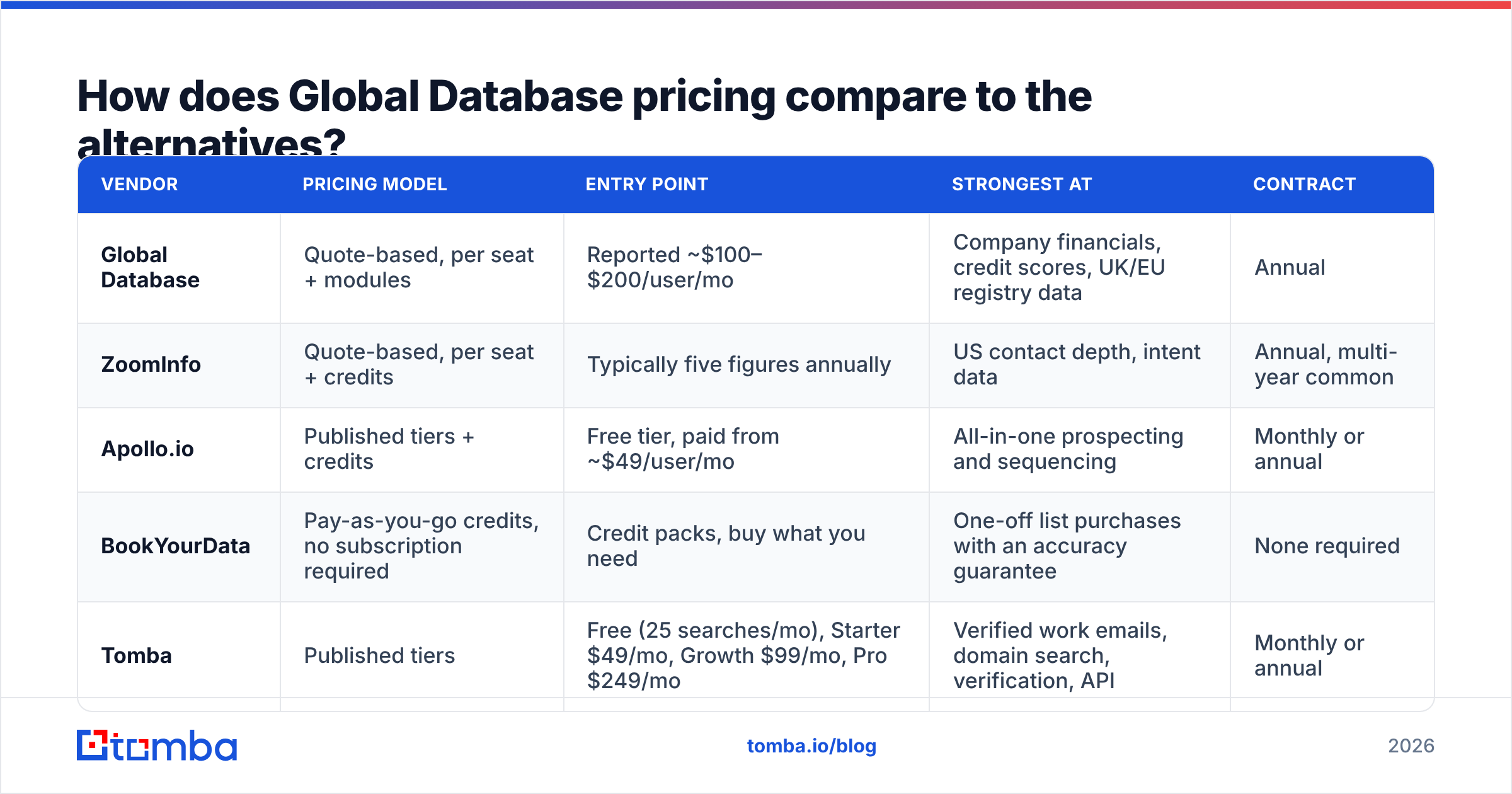
The comparison only makes sense if you split it by job to be done. Company intelligence and contact sourcing are different purchases that vendors like to bundle.
| Vendor | Pricing model | Entry point | Strongest at | Contract |
|---|---|---|---|---|
| Global Database | Quote-based, per seat + modules | Reported ~$100–$200/user/mo | Company financials, credit scores, UK/EU registry data | Annual |
| ZoomInfo | Quote-based, per seat + credits | Typically five figures annually | US contact depth, intent data | Annual, multi-year common |
| Apollo.io | Published tiers + credits | Free tier, paid from ~$49/user/mo | All-in-one prospecting and sequencing | Monthly or annual |
| BookYourData | Pay-as-you-go credits, no subscription required | Credit packs, buy what you need | One-off list purchases with an accuracy guarantee | None required |
| Tomba | Published tiers | Free (25 searches/mo), Starter $49/mo, Growth $99/mo, Pro $249/mo | Verified work emails, domain search, verification, API | Monthly or annual |
Two of these deserve a specific note.
BookYourData is the cleanest answer when you want a defined list and no ongoing commitment. Its pay-as-you-go credit model and accuracy guarantee mean you can buy 2,000 records for a campaign, spend nothing next month, and never sit in a renewal conversation. For teams that run outbound in bursts, that's a genuinely better fit than any annual licence — including an annual licence from a cheaper vendor.
Tomba sits at the other end: a subscription, but a published one. You know the price before the call, the email finder and verification run on the same credit pool, and the free tier lets you test accuracy against your own domain list before spending anything. What it deliberately does not do is sell credit reports or company financials — so it replaces the contact half of a Global Database contract, not the risk half.
Is Global Database worth it for your team?#
Yes, if company-level truth is the product you're buying. Registry-backed financials, credit scores, director records and technographics in one query is a real capability, and assembling it from three vendors costs more than one contract. Risk teams, procurement, and enterprise ABM programmes in the UK and EU get their money's worth.
No, if your definition of "data" is a name, a title, a work email and a phone number. In that scenario you are paying enterprise rates for a research platform and using maybe fifteen percent of it. The economics get worse the more you export, because export is exactly what the pricing model discourages.
Maybe, if you sit in between — say, a mid-market team that needs firmographic filtering for account selection but sources contacts elsewhere. In that case, negotiate the smallest possible scope (one market, company module only) and pair it with a per-credit contact tool. That hybrid usually beats a full-scope contract on both cost and freshness.
How do you cut B2B data spend without losing coverage?#
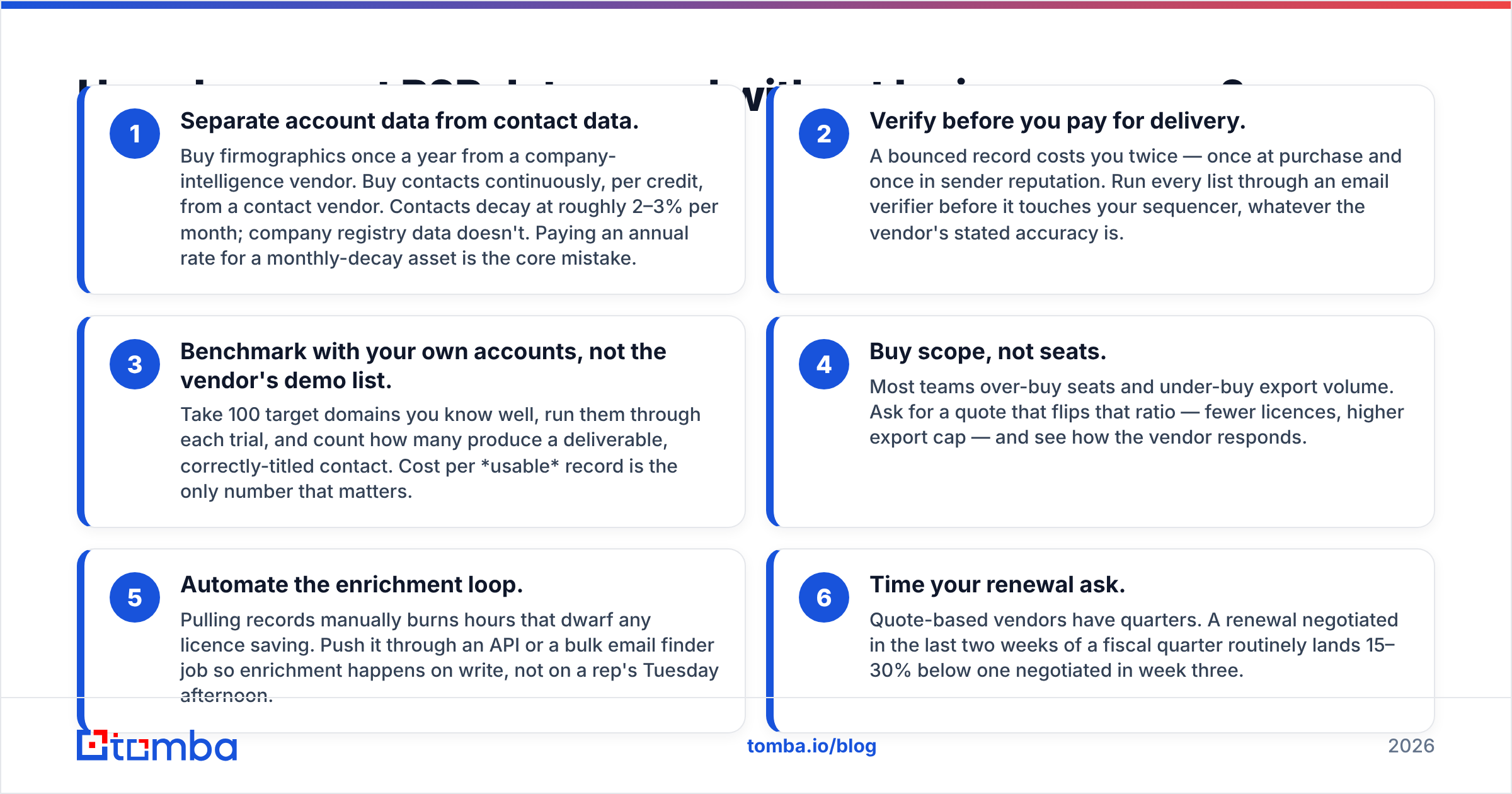
Five moves that consistently reduce cost per contactable record, regardless of which vendor you land on.
- Separate account data from contact data. Buy firmographics once a year from a company-intelligence vendor. Buy contacts continuously, per credit, from a contact vendor. Contacts decay at roughly 2–3% per month; company registry data doesn't. Paying an annual rate for a monthly-decay asset is the core mistake.
- Verify before you pay for delivery. A bounced record costs you twice — once at purchase and once in sender reputation. Run every list through an email verifier before it touches your sequencer, whatever the vendor's stated accuracy is.
- Benchmark with your own accounts, not the vendor's demo list. Take 100 target domains you know well, run them through each trial, and count how many produce a deliverable, correctly-titled contact. Cost per usable record is the only number that matters.
- Buy scope, not seats. Most teams over-buy seats and under-buy export volume. Ask for a quote that flips that ratio — fewer licences, higher export cap — and see how the vendor responds.
- Automate the enrichment loop. Pulling records manually burns hours that dwarf any licence saving. Push it through an API or a bulk email finder job so enrichment happens on write, not on a rep's Tuesday afternoon.
- Time your renewal ask. Quote-based vendors have quarters. A renewal negotiated in the last two weeks of a fiscal quarter routinely lands 15–30% below one negotiated in week three.
What should you ask on the sales call?#
Bring these six questions and write the answers down. They convert a vague quote into a comparable number.
- What is the minimum seat count at the quoted per-user rate?
- Is the export cap monthly or annual, and what is the overage rate?
- Which modules are included, and what does adding contact data cost specifically?
- Do credits or report packs roll over at renewal?
- What is the notice period for non-renewal, and is there an auto-renew clause?
- What is the documented match rate for direct-dial phone numbers and personal work emails in my target market?
That last question is the one that most often ends the conversation early — and saves you a year of paying for records you'll end up sourcing somewhere else anyway.
Where does that leave you?#
Global Database is a legitimate, well-scoped product being sold in a pricing model that punishes the wrong buyer. If you need credit reports and registry-grade company data, get the quote and negotiate scope aggressively. If you need contactable humans at named accounts, that's a different purchase and a much cheaper one.
If it's the second job, start with the tool built for it. Tomba Email Finder finds verified professional email addresses by name, domain, or company, with verification and data enrichment drawing on the same credit pool — no quote call, no annual lock-in, published pricing from a free tier through $49/mo Starter and $99/mo Growth. Run 25 free searches against your own target list this week and compare the cost per usable contact to whatever number lands in your inbox after the demo. That comparison, not a pricing page, is what should decide the contract.
Related guides#
Ready to find emails that actually work?
Join 150,000+ professionals who stopped guessing and started sending. Free credits on signup — no credit card required.
Get the Tomba newsletter
Practical outbound tactics and product updates — once every two weeks.
About the author