Global Database vs Seamless.AI: Which B2B Data Tool Wins?
One is a company-first European business database. The other is an AI contact engine built for volume. Here is how Global Database and Seamless.AI actually compare on coverage, accuracy, pricing, and export limits.
Global Database vs Seamless.AI is a common shortlist, and the two tools do not do the same job. One maps companies. The other finds people. Here is how they compare on coverage, accuracy, pricing, and export limits, plus when a focused email finder beats both.
TL;DR
- Global Database is company-first. It is strongest on firmographics, credit and financial data, and European (especially UK) business registries. Contacts are a layer on top, not the main event.
- Seamless.AI is contact-first. It generates and validates person-level emails and phone numbers at high volume, heavily weighted toward US B2B.
- Neither publishes transparent self-serve pricing. Both run through sales calls and annual contracts, which makes them awkward for small teams that just need verified emails this week.
- Export limits are the hidden cost. Credit caps, per-seat contracts, and non-transferable data terms hurt more than the sticker price in both cases.
- If your real job is "find and verify work emails for a target list," a focused tool like Tomba at $49/mo (or a free tier of 25 searches) will beat both on cost per usable contact.
What is Global Database and who is it for?#
Global Database is a B2B business intelligence platform built around company records rather than individual contacts. Its core asset is a registry-linked database of businesses with firmographics, filed accounts, credit scores, shareholder structures, technology stacks, and compliance flags. If you want to know which UK manufacturing companies with £5m to £20m turnover changed directors in the last quarter, this is the shape of question it was designed to answer.
That origin story matters. Global Database grew out of company-data and credit-risk use cases, so the contact layer (names, titles, emails, direct dials) sits on top of the company record. You start from an account, then drill into people. Sales teams use it, but so do risk, procurement, and market research teams.
Its strongest regions are the UK and Western Europe, where public filings are rich and machine-readable. US coverage exists but is not where the product is deepest.
What is Seamless.AI and who is it for?#
Seamless.AI sits at the opposite end. It is a contact search engine for sellers: type in a title, industry, and geography, and it returns people with emails and phone numbers, validated in real time against multiple sources. The pitch is volume and speed for outbound SDR teams.
Its Chrome extension pulls contacts while you browse LinkedIn or company sites, and its "AI search" claims to build and verify records on demand rather than serving a static file. That is genuinely different from a purchased list, and it is the reason coverage of mid-market US companies is decent.
The trade-offs show up in three places: data noise on smaller or non-US companies, aggressive credit consumption, and a contract model that reviewers on G2 repeatedly flag as hard to exit. Read the terms before you sign anything annual.
Global Database vs Seamless.AI: the head-to-head comparison#
Here is the honest side-by-side, with Tomba included as the focused third option since most people evaluating these two are really asking "what is the cheapest reliable way to get verified work emails?"
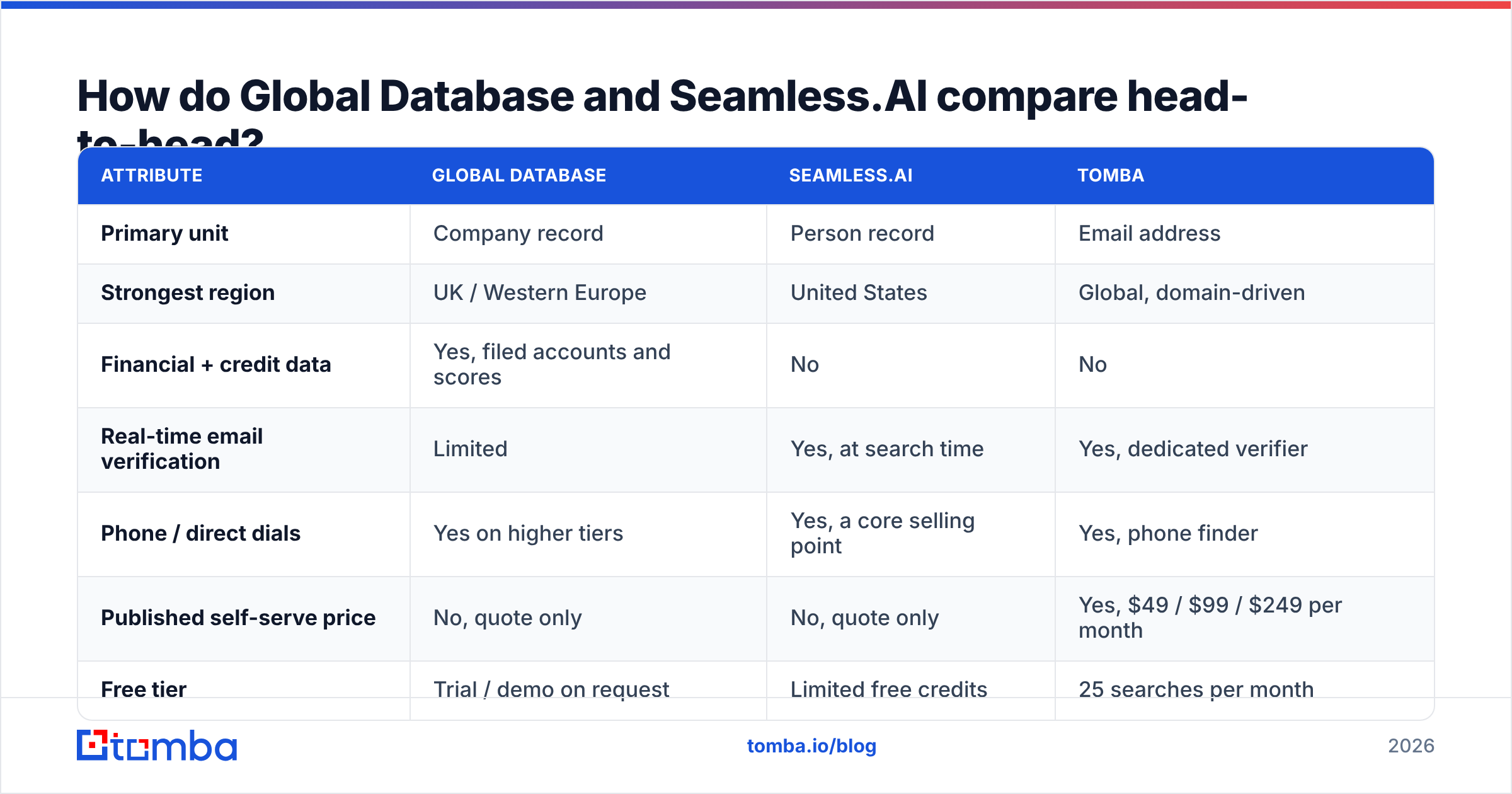
| Attribute | Global Database | Seamless.AI | Tomba |
|---|---|---|---|
| Primary unit | Company record | Person record | Email address |
| Strongest region | UK / Western Europe | United States | Global, domain-driven |
| Financial + credit data | Yes, filed accounts and scores | No | No |
| Real-time email verification | Limited | Yes, at search time | Yes, dedicated verifier |
| Phone / direct dials | Yes on higher tiers | Yes, a core selling point | Yes, phone finder |
| Published self-serve price | No, quote only | No, quote only | Yes, $49 / $99 / $249 per month |
| Free tier | Trial / demo on request | Limited free credits | 25 searches per month |
| API access | Yes, enterprise tiers | Yes, on higher plans | Yes, on all paid plans |
| Typical contract | Annual | Annual, per seat | Monthly, cancel anytime |
| Best for | Account research, risk, ABM targeting | High-volume US outbound | Verified email discovery at scale |

The table makes the split obvious. These two tools are not really competitors in the way "Salesforce vs HubSpot" are competitors. They overlap in the middle (both can hand you a contact record) but they were built to answer different questions.
Which one has better data coverage?#
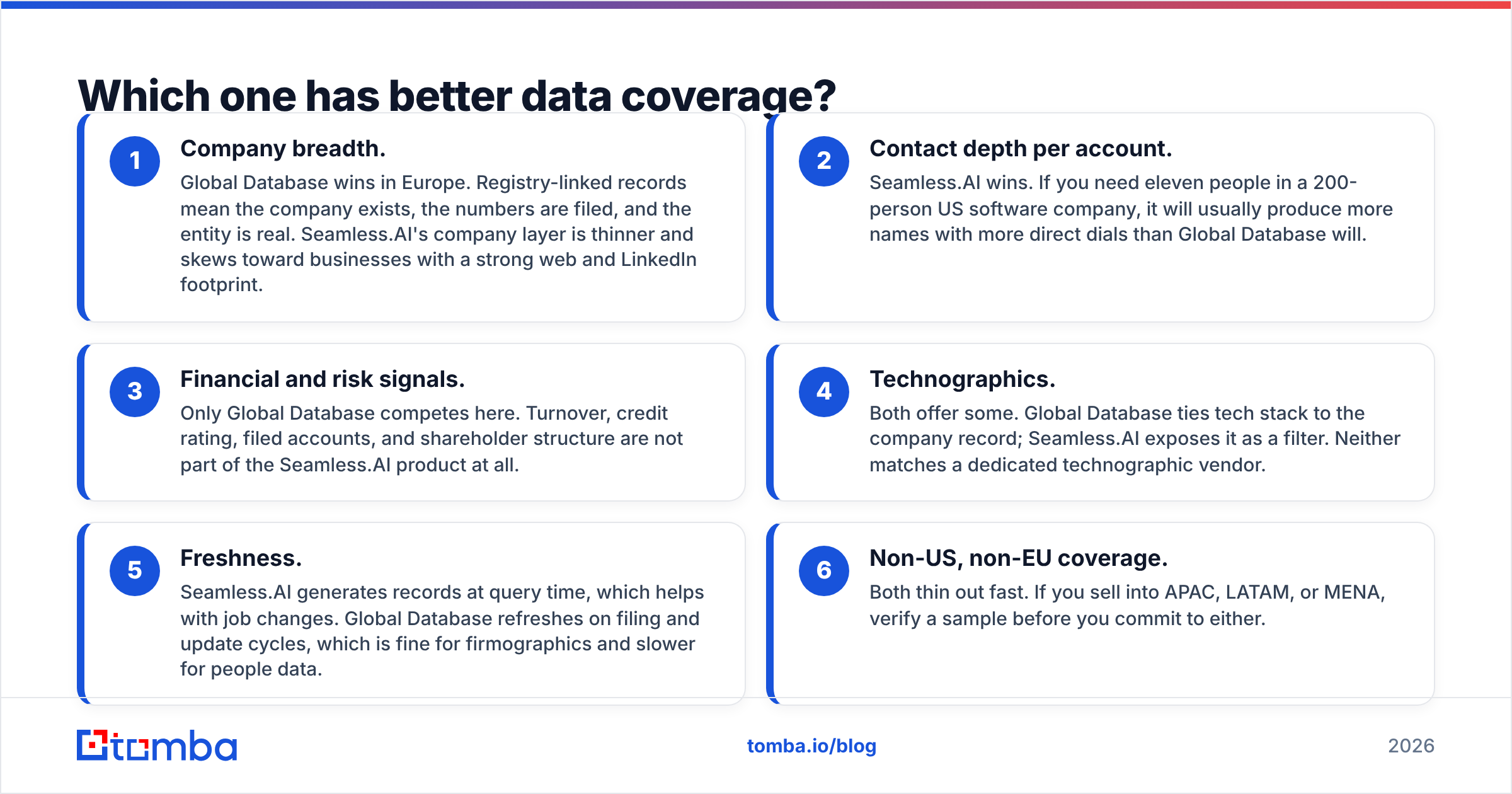
Coverage is not one number. Break it into the dimensions that actually change your pipeline:
- Company breadth. Global Database wins in Europe. Registry-linked records mean the company exists, the numbers are filed, and the entity is real. Seamless.AI's company layer is thinner and skews toward businesses with a strong web and LinkedIn footprint.
- Contact depth per account. Seamless.AI wins. If you need eleven people in a 200-person US software company, it will usually produce more names with more direct dials than Global Database will.
- Financial and risk signals. Only Global Database competes here. Turnover, credit rating, filed accounts, and shareholder structure are not part of the Seamless.AI product at all.
Those three cover the account layer. The next three decide how the data holds up day to day:
- Technographics. Both offer some. Global Database ties tech stack to the company record; Seamless.AI exposes it as a filter. Neither matches a dedicated technographic vendor.
- Freshness. Seamless.AI generates records at query time, which helps with job changes. Global Database refreshes on filing and update cycles, which is fine for firmographics and slower for people data.
- Non-US, non-EU coverage. Both thin out fast. If you sell into APAC, LATAM, or MENA, verify a sample before you commit to either.
The practical takeaway: if your ICP is "UK companies of a certain size and financial profile," Global Database gives you a targeting layer nothing else on this list matches. If your ICP is "VP Marketing at US SaaS companies, 50 to 500 employees," Seamless.AI will fill a sequence faster.
How accurate is the contact data in practice?#
This is where both tools get criticised, and where you should run your own test rather than trusting anyone's marketing page (including this one).
Seamless.AI's real-time validation cuts out the obvious junk. Users still report two issues. Emails pass a syntax and MX check, then bounce on send. Phone numbers ring a switchboard instead of the person. The AI model also guesses: it builds an address from a common pattern, even when that person's real address breaks the pattern.
Global Database's contact data is generally more conservative. Fewer records, but the ones it has are tied to a verified company entity. The weakness is staleness at the person level, since people change jobs faster than companies file accounts.

Whatever you buy, run everything through a separate verification pass before it touches your sending domain. A dedicated email verifier checks SMTP response, catch-all status, role accounts, and disposable domains. It catches what a vendor's inline validation misses. Bounce rate above 3 percent is a deliverability problem, not a data problem you can shrug off.
Here is the test protocol that settles the argument in an afternoon:
- Pull 100 contacts from each tool matching the same ICP filters.
- Deduplicate and strip anything you already have in your CRM.
- Run both lists through the same third-party verifier.
- Compare three numbers: match rate (how many of your 100 target people were found at all), valid rate (how many passed verification), and cost per valid contact.
- Send to a small sample and record the actual bounce rate against the predicted one.
Vendors quote match rate because it flatters them. Cost per valid contact is the number that hits your budget.
What does each one actually cost?#
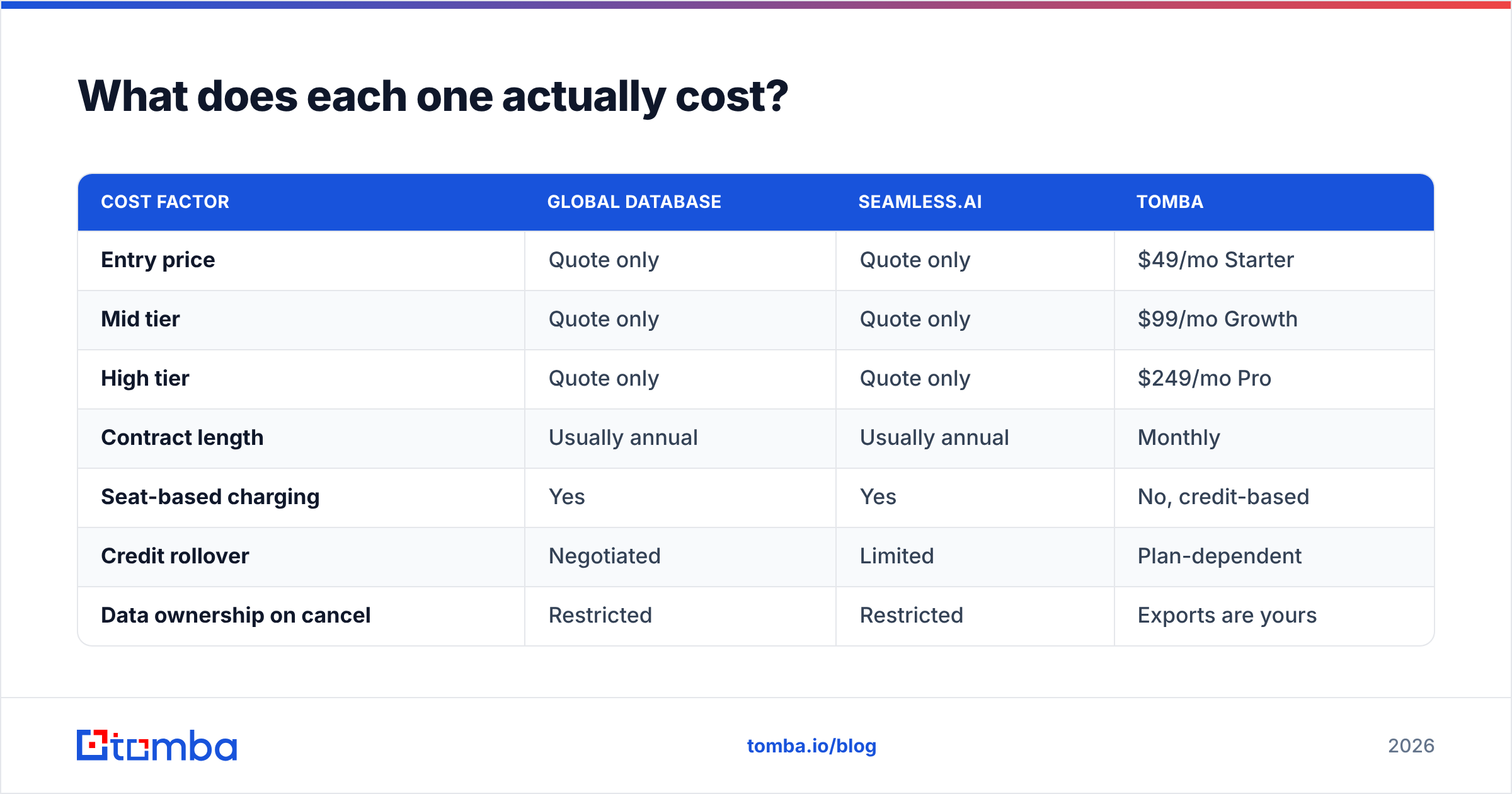
Neither Global Database nor Seamless.AI publishes a public price list. Both route you through a demo and a quote. Both are typically sold as annual contracts, with per-seat pricing and credit allocations.
User reviews put Seamless.AI in the low-to-mid four figures per seat per year for its paid tiers. Global Database's enterprise packages run higher again once financial data modules are included. Treat any specific number you read online as a data point, not a rate card.
| Cost factor | Global Database | Seamless.AI | Tomba |
|---|---|---|---|
| Entry price | Quote only | Quote only | $49/mo Starter |
| Mid tier | Quote only | Quote only | $99/mo Growth |
| High tier | Quote only | Quote only | $249/mo Pro |
| Contract length | Usually annual | Usually annual | Monthly |
| Seat-based charging | Yes | Yes | No, credit-based |
| Credit rollover | Negotiated | Limited | Plan-dependent |
| Data ownership on cancel | Restricted | Restricted | Exports are yours |
The pattern is the same with most enterprise data vendors: the sticker price is negotiable, the export limits are not. Ask three questions before signing either contract. Can you keep exported data after cancellation? Do unused credits roll over? What happens to your price at renewal if you do not expand seats?
If that whole model feels heavy for what you need, transparent Tomba pricing exists precisely because a lot of teams do not want to run a procurement cycle to get 5,000 verified emails.

Which should you choose for outbound sales?#
Match the tool to the job rather than to the feature list.
Choose Global Database if: you sell into UK or European mid-market, you qualify accounts on financial health or company structure, you need compliance-grade company records, or your motion is account-based with a small number of high-value targets. The contact layer is a bonus, not the reason to buy.
Choose Seamless.AI if: you run a US-focused SDR team, you need direct dials as much as emails, volume matters more than precision, and you have the budget and the process to absorb an annual per-seat contract. Pair it with a verification step and it performs.
Choose neither if: your actual requirement is "here are 400 target companies, find me the right person's work email." That job is narrower than either platform is priced for. It is also the exact job a dedicated email finder does better and cheaper. A domain search returns every published address at a company, filtered by department and seniority. One call, no seat license.
What are the biggest limitations of each?#
Global Database limitations. Contact-level data goes stale faster than the company data around it. US coverage is not its strength. Pricing opacity makes it hard to benchmark. The interface is built for researchers rather than for reps living in a sequencer, and the sales cycle to get started is slow relative to how quickly outbound teams want to move.
Seamless.AI limitations. Credit burn is the number one complaint: searches consume credits whether or not the record turns out to be useful. Data quality on smaller companies and non-US regions is inconsistent. Contract and renewal terms come up repeatedly in reviews, so read them carefully and get any cancellation terms in writing. If the contract friction is the dealbreaker rather than the data, a monthly-billed Seamless.AI alternative removes that variable entirely.
Shared limitation. Both are closed ecosystems. Getting data out programmatically and into your own enrichment pipeline is gated behind higher tiers. If you are building automated workflows, check API rate limits and per-call pricing before you assume it will scale.
How do you build a stack that beats either one alone?#
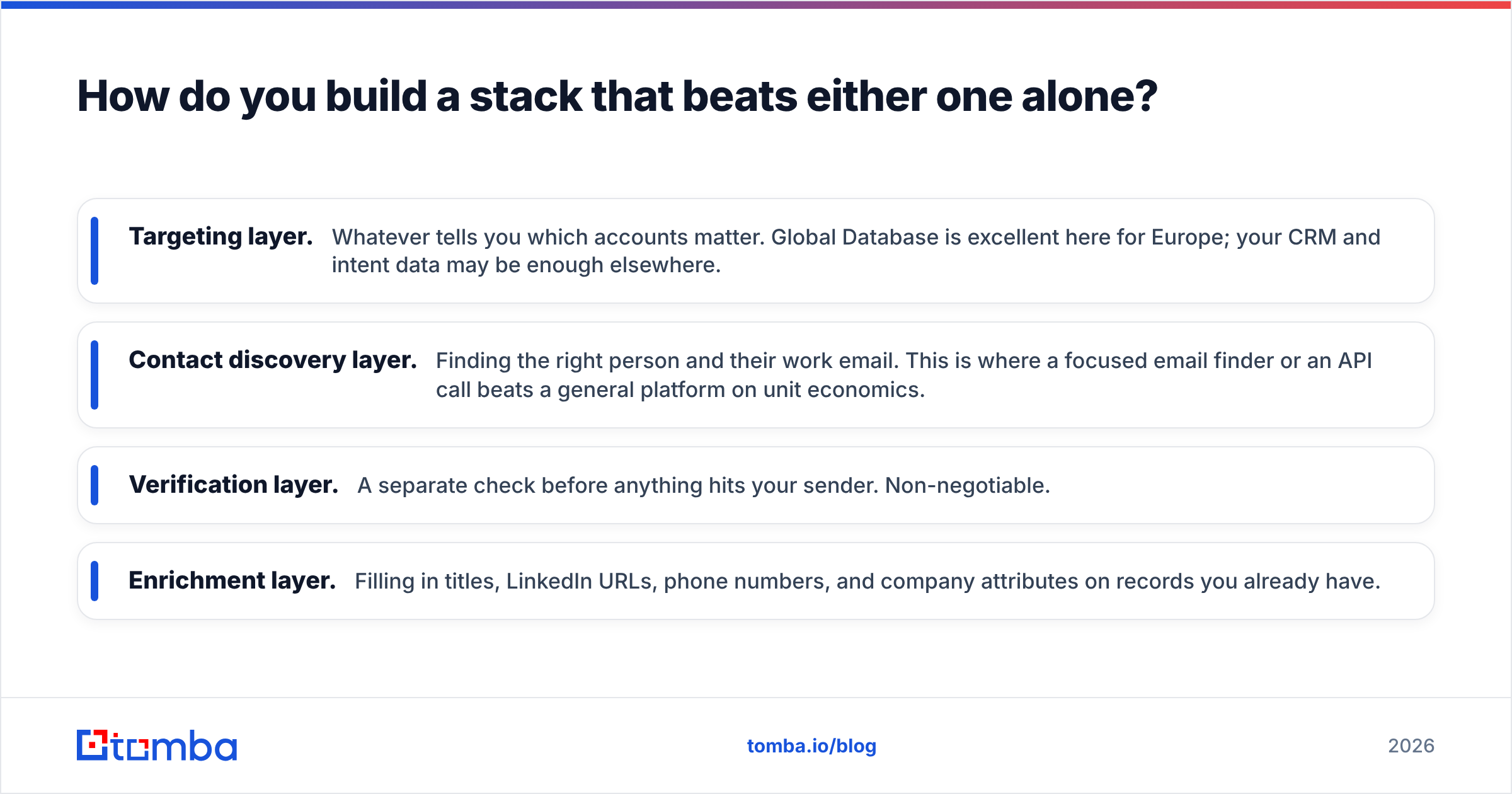
The teams getting the best cost per meeting rarely buy one platform and stop. They layer:
- Targeting layer. Whatever tells you which accounts matter. Global Database is excellent here for Europe; your CRM and intent data may be enough elsewhere.
- Contact discovery layer. Finding the right person and their work email. This is where a focused email finder or an API call beats a general platform on unit economics.
- Verification layer. A separate check before anything hits your sender. Non-negotiable.
- Enrichment layer. Filling in titles, LinkedIn URLs, phone numbers, and company attributes on records you already have.
Split that way, you buy each layer from whoever is genuinely best at it, and you stop paying enterprise seat prices for a function that costs a fraction of a cent per lookup. It also means no single vendor renewal can hold your pipeline hostage.
Final verdict#
Global Database vs Seamless.AI is not a one-winner question. Both are defensible purchases for the right team, and neither is a scam or a dud. Global Database wins on European company intelligence and financial depth. Seamless.AI wins on US contact volume and direct dials. Both lose on pricing transparency, contract flexibility, and cost per verified email.
If your evaluation started because you needed reliable work emails without a procurement cycle, start with the narrow tool and expand only when a real gap appears. Run 25 free searches through the Tomba Email Finder, verify the results against whatever you get from a Seamless.AI trial or a Global Database demo, and compare cost per valid contact rather than cost per record. That single number will make the decision for you faster than any feature matrix, including this one.
Related guides#
Ready to find emails that actually work?
Join 150,000+ professionals who stopped guessing and started sending. Free credits on signup — no credit card required.
Get the Tomba newsletter
Practical outbound tactics and product updates — once every two weeks.
About the author