Gmail Open Tracking Changes in 2026: What Still Works
Gmail proxies images, Apple pre-fetches them, and privacy defaults keep tightening. Here is what Gmail open tracking changes actually broke, what still reports honestly, and how to rebuild pipeline metrics that survive 2026.
TL;DR
- Gmail has proxied and cached every remote image since 2013, which means an "open" is often Google's server fetching a pixel — not a human reading your email.
- Apple Mail Privacy Protection (2021) pre-fetches images for a large share of consumer inboxes, and Gmail's own privacy and smart-feature defaults have kept moving in the same direction through 2026.
- The practical result: open rate is now a directional signal at best and a fabricated one at worst. Anything you automate off it — lead scoring, follow-up triggers, A/B winners — inherits that noise.
- Reply rate, click-to-reply ratio, meeting-booked rate, and bounce/spam-complaint rate are the metrics that survived. Google's own bulk sender requirements are enforced on complaints and authentication, not opens.
- The highest-leverage fix is upstream: clean, verified contact data. Bad addresses inflate bounces, tank sender reputation, and make every downstream metric — including opens — meaningless.
What are the Gmail open tracking changes, exactly?#
Short version: there was never a single "Gmail kills open tracking" announcement. What happened is a decade of layered changes that each stripped a bit more signal out of the tracking pixel, until the number in your dashboard stopped describing human behavior.
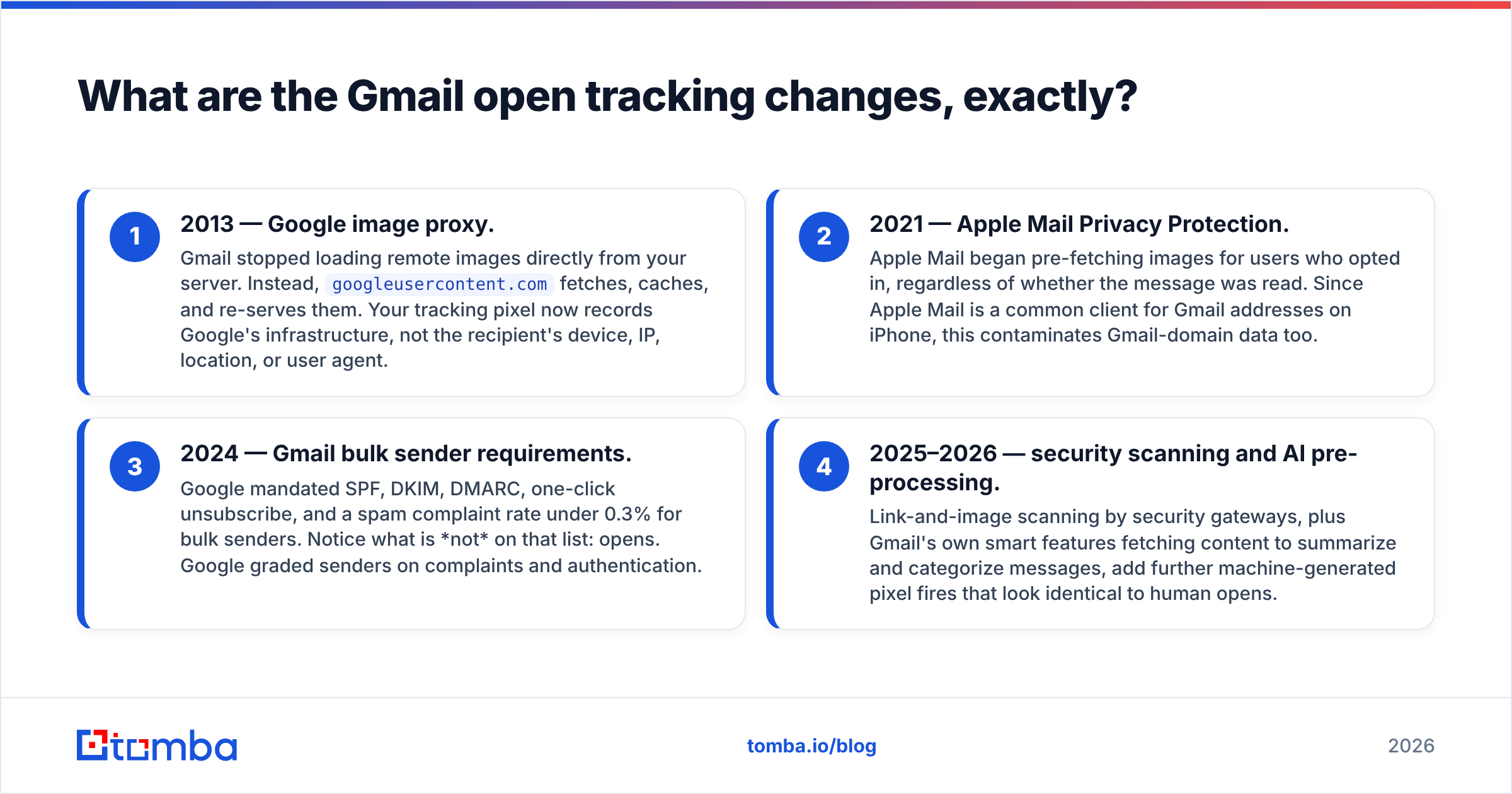
Here is the actual timeline of what broke, in order:
- 2013 — Google image proxy. Gmail stopped loading remote images directly from your server. Instead,
googleusercontent.comfetches, caches, and re-serves them. Your tracking pixel now records Google's infrastructure, not the recipient's device, IP, location, or user agent. - 2021 — Apple Mail Privacy Protection. Apple Mail began pre-fetching images for users who opted in, regardless of whether the message was read. Since Apple Mail is a common client for Gmail addresses on iPhone, this contaminates Gmail-domain data too.
- 2024 — Gmail bulk sender requirements. Google mandated SPF, DKIM, DMARC, one-click unsubscribe, and a spam complaint rate under 0.3% for bulk senders. Notice what is not on that list: opens. Google graded senders on complaints and authentication.
- 2025–2026 — security scanning and AI pre-processing. Link-and-image scanning by security gateways, plus Gmail's own smart features fetching content to summarize and categorize messages, add further machine-generated pixel fires that look identical to human opens.
Every one of those steps was defensible on privacy or security grounds. Collectively, they turned the open pixel into a sensor that mostly detects other software.
Wait — that image should read: a marketer at a folding table defending the claim that open rates are real. The point stands.

Why did open rates stop meaning anything?#
Because a tracking pixel measures an image request, and an image request is no longer a proxy for attention.
Think of it like a doorbell camera that also triggers when the mail carrier walks past, when a leaf falls, and when your neighbor's cat crosses the driveway. The camera still works perfectly. It just doesn't answer the question you're asking, which is "did a person come to my door?"
Three specific distortions show up in real Gmail-heavy sending data:
- Inflated absolute numbers. Reported opens climb without any corresponding change in replies or meetings. Teams celebrate a 62% open rate on a campaign that generated four replies from 900 sends.
- Compressed variance. Because machine opens fire near-uniformly across your list, subject-line A/B tests converge. Two subject lines that would have differed by 15 points in 2018 now differ by 2 points, and that gap is noise.
- Timestamp corruption. "They opened it at 9:14 a.m." is often the proxy or scanner caching the image within seconds of delivery. Any "strike while it's hot" automation built on open timestamps is firing on a server clock.
If you have ever seen a contact "open" an email eleven times in ninety seconds, you have already watched this happen. That is caching and re-fetch behavior, not enthusiasm.
Which email metrics still report honestly in 2026?#
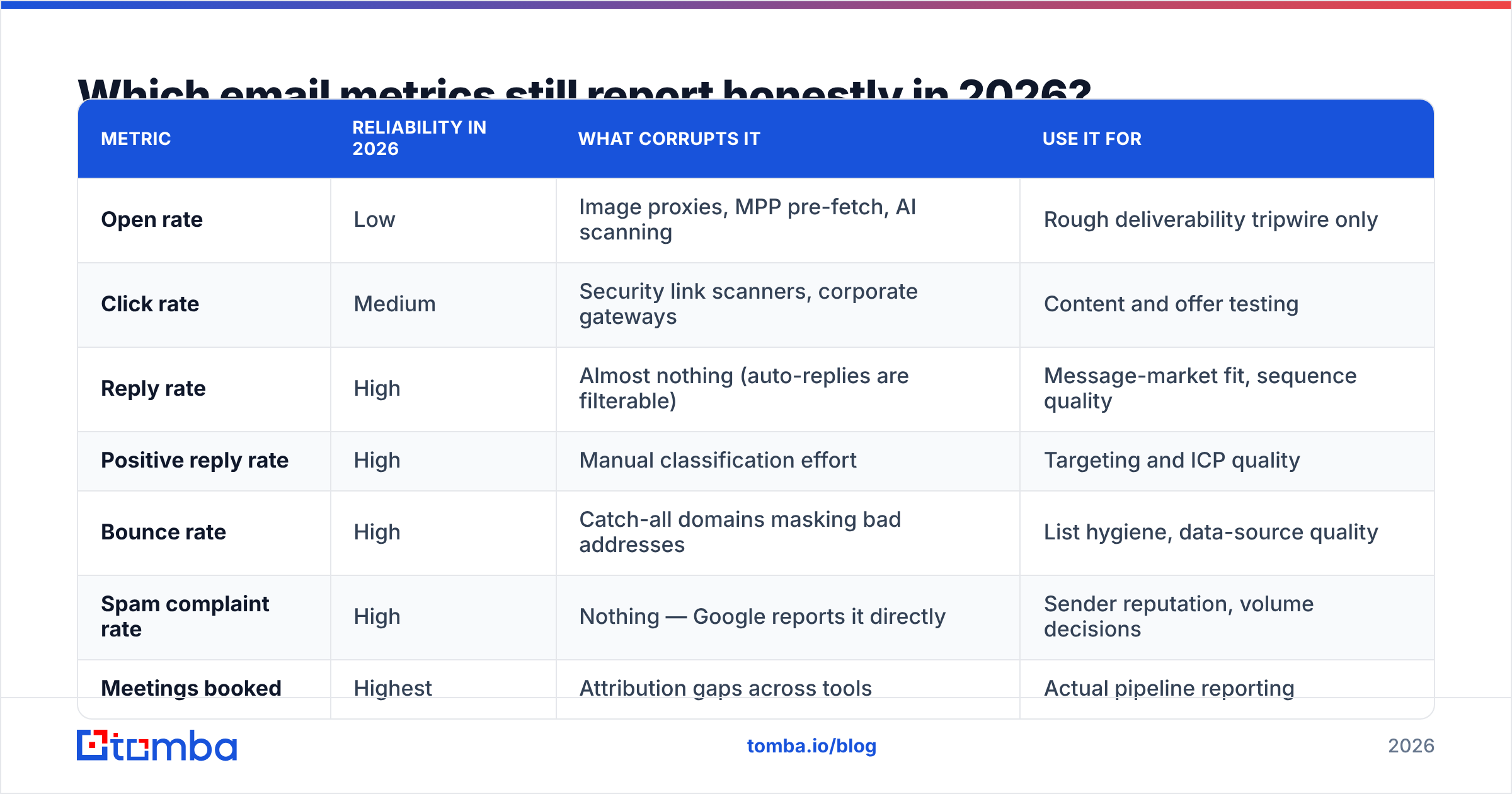
Not all tracking is equally broken. Clicks degraded less than opens because a click requires a deliberate action — though link-scanning security gateways do generate false clicks, so treat single clicks with suspicion and repeat clicks from the same contact as more credible.
| Metric | Reliability in 2026 | What corrupts it | Use it for |
|---|---|---|---|
| Open rate | Low | Image proxies, MPP pre-fetch, AI scanning | Rough deliverability tripwire only |
| Click rate | Medium | Security link scanners, corporate gateways | Content and offer testing |
| Reply rate | High | Almost nothing (auto-replies are filterable) | Message-market fit, sequence quality |
| Positive reply rate | High | Manual classification effort | Targeting and ICP quality |
| Bounce rate | High | Catch-all domains masking bad addresses | List hygiene, data-source quality |
| Spam complaint rate | High | Nothing — Google reports it directly | Sender reputation, volume decisions |
| Meetings booked | Highest | Attribution gaps across tools | Actual pipeline reporting |
The pattern is obvious once you lay it out: metrics that require a human decision survived. Metrics that require a machine fetch did not.
Is the open pixel now completely useless?#
No — and this is where a lot of "opens are dead" takes overcorrect.
An open rate that collapses from 55% to 8% overnight is still telling you something urgent: your mail probably stopped reaching inboxes at all. Machine opens produce a fairly stable baseline, so a sudden drop below that baseline is a legitimate alarm, even though the absolute number is meaningless.
Treat it like the oil light on a dashboard. It won't tell you how much oil you have. It will tell you when something has gone badly wrong.
Three defensible uses remain:
- Anomaly detection. Week-over-week baseline shifts by domain (gmail.com vs. outlook.com vs. corporate domains) flag placement problems early.
- Domain-level comparison. If Gmail opens hold steady while Outlook opens crater, the problem is Microsoft-specific filtering, not your copy.
- Deliverability triage during warmup. When you're ramping a new sending domain, a directional open signal plus a spam-placement test is better than flying blind.
What you should stop doing: scoring leads on opens, triggering follow-ups on opens, declaring subject-line winners on opens, and reporting opens to your board.
How should you rebuild reporting after the Gmail open tracking changes?#
Start from the bottom of the funnel and work up. If a metric can't be traced to revenue in two steps, it's a diagnostic, not a KPI.
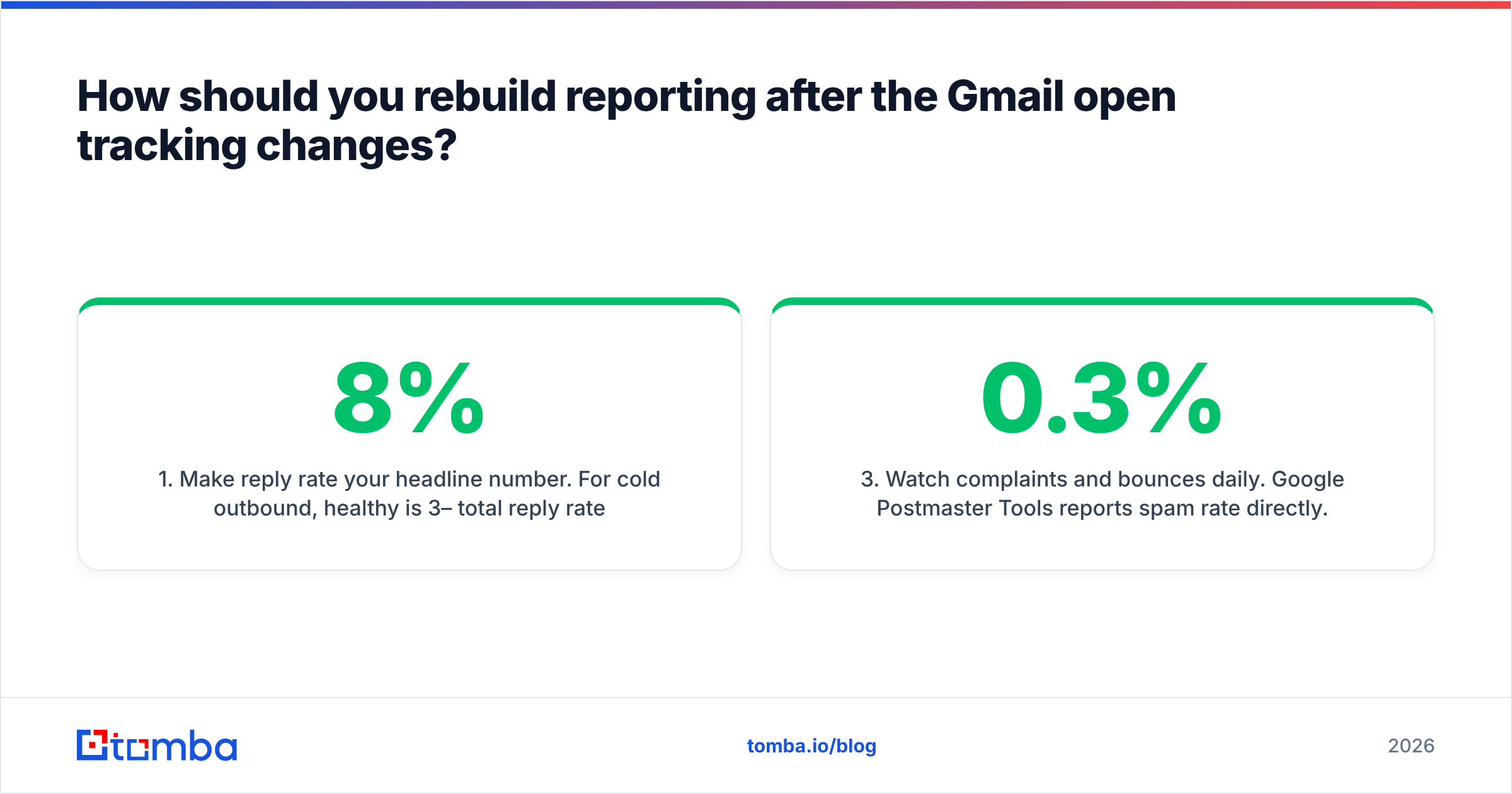
- Make reply rate your headline number. For cold outbound, healthy is 3–8% total reply rate with 30–40% of those replies positive or neutral. If reply rate is fine and opens look terrible, ignore the opens.
- Classify replies, don't just count them. Split into positive, referral, not-now, and hard no. "Not now" volume tells you your timing model is wrong; hard-no volume tells you your targeting is wrong. Track your response rate by segment, not in aggregate.
- Watch complaints and bounces daily. Google Postmaster Tools reports spam rate directly. Anything trending toward 0.3% requires you to cut volume that day, not next sprint.
- Instrument the landing step. A unique tracked link per contact plus server-side page analytics gives you a click signal that link scanners can't fully fake, because scanners rarely execute page JavaScript or scroll.
- Report meetings, not activity. Sends → replies → meetings → opportunities. Four numbers. Everything else is a debugging tool for one of those four.
What does this mean for cold email and outbound teams?#
It shifts the leverage from measurement to input quality — which, honestly, is where it always should have been.
When opens were trustworthy, a sloppy list could still look productive. You'd send 5,000 emails to a scraped list, watch a 40% open rate, and feel like the machine was working. Now that the vanity layer is gone, the underlying math is exposed: a list with 18% invalid addresses will bounce hard, drag your sender reputation down, get more of your mail filtered, and produce replies from a fraction of the people you thought you reached.
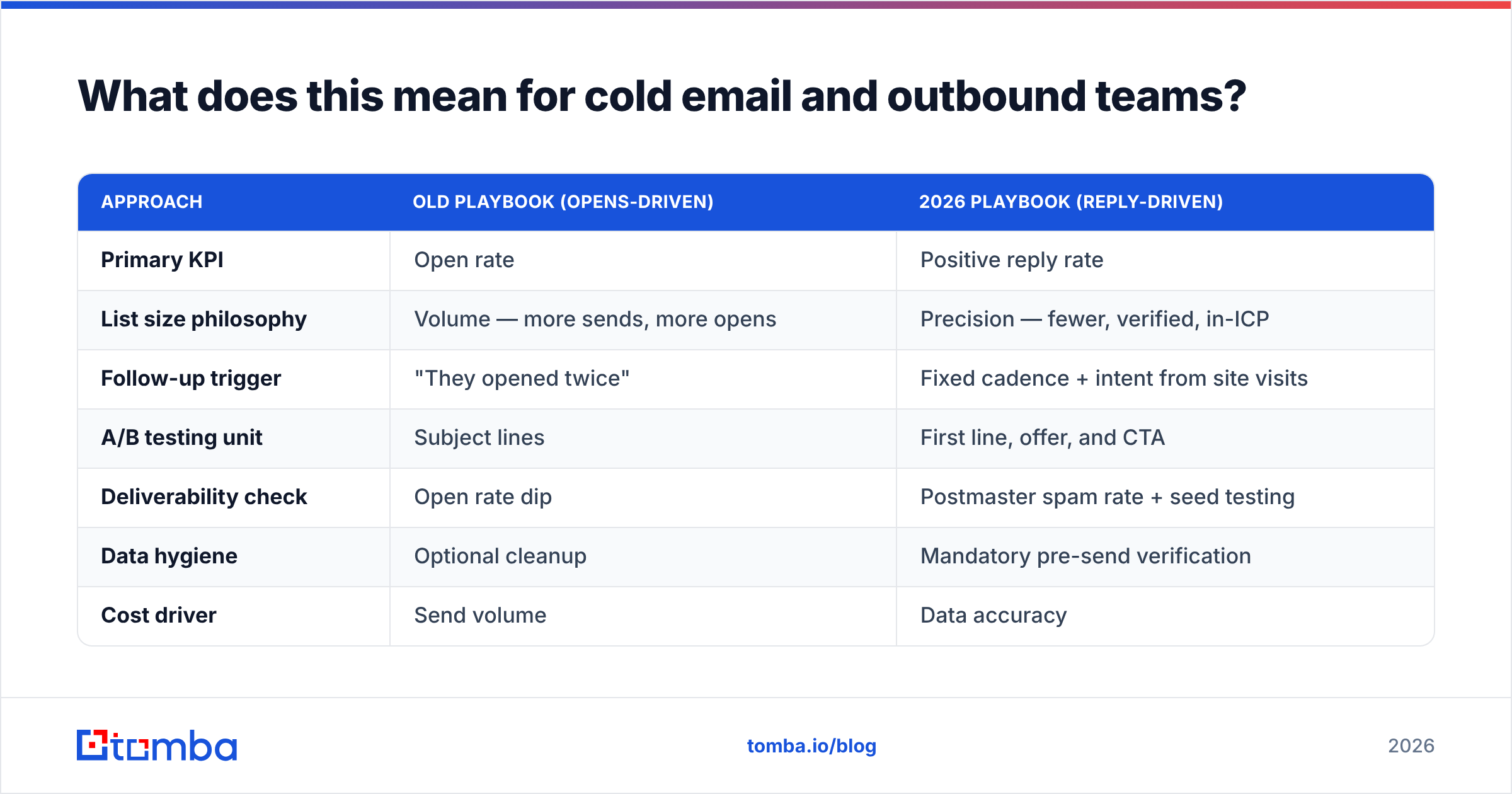
Here's the comparison that actually matters for an outbound team in 2026:
| Approach | Old playbook (opens-driven) | 2026 playbook (reply-driven) |
|---|---|---|
| Primary KPI | Open rate | Positive reply rate |
| List size philosophy | Volume — more sends, more opens | Precision — fewer, verified, in-ICP |
| Follow-up trigger | "They opened twice" | Fixed cadence + intent from site visits |
| A/B testing unit | Subject lines | First line, offer, and CTA |
| Deliverability check | Open rate dip | Postmaster spam rate + seed testing |
| Data hygiene | Optional cleanup | Mandatory pre-send verification |
| Cost driver | Send volume | Data accuracy |
The teams that adapted fastest did one unglamorous thing first: they fixed their data pipeline. Verifying every address before it enters a sequence removes the largest source of noise from every metric downstream. If you want the mechanics, run addresses through an email verifier before import, and handle catch-all domains explicitly with a catch-all verifier rather than guessing.
How do you keep Gmail delivering at all in 2026?#
Placement is the prerequisite for every metric in this article. Google's requirements are public and non-negotiable for anyone sending at volume:
- Authenticate everything. SPF, DKIM, and DMARC on every sending domain. Check your records with an SPF checker before you assume they're correct — misconfigured records are extremely common after a domain migration.
- Keep spam complaints under 0.3%. Google publishes this threshold in its sender guidelines. Treat 0.1% as your internal ceiling so you have headroom.
- Honor unsubscribes in one click, within two days. One-click list-unsubscribe headers are required for bulk mail and are a good idea for outbound too.
- Monitor with Postmaster Tools. Google Postmaster Tools gives you domain reputation, spam rate, and authentication pass rates straight from the source. It is free and it is the only Gmail-side data that isn't inferred.
- Warm sending domains properly. New domains need ramped volume and genuine engagement. Model the ramp before you start rather than improvising it.
- Send fewer, better emails. Every deliverability lever ultimately reduces to relevance. Google is measuring whether recipients want your mail. Complaint rate is that measurement.
For a broader primer on how placement decisions get made, the email deliverability fundamentals haven't changed — only the observability layer has.
What about privacy and consent — is pixel tracking still acceptable?#
This is worth stating plainly, because it drives where the platforms are heading next.
Tracking pixels sit in an uncomfortable position under GDPR and similar regimes. Consent requirements for non-essential tracking apply to email pixels in most European interpretations, and several regulators have signaled that pixel tracking without disclosure is problematic. Independent B2B research communities and review platforms like G2 increasingly surface privacy posture in buyer evaluations, which means your tracking choices are now part of how prospects assess you.
The practical read: the direction of travel is one-way. Mailbox providers have consistently chosen the recipient's privacy over the sender's analytics, and there is no scenario in 2026 where that reverses. Build your reporting on signals you'd be comfortable explaining to the recipient — replies, clicks on links they chose to click, meetings they chose to book.
What should you do this week?#
A short, concrete sequence:
- Pull last quarter's campaign data and re-rank it by reply rate. You will find campaigns you killed for "low opens" that actually converted, and campaigns you scaled on high opens that produced nothing.
- Turn off every automation triggered by an open event. Replace open-triggered follow-ups with a fixed cadence. Your reply rate will not drop; your list burn will.
- Verify your entire active list. Anything older than 90 days needs re-verification. Job changes alone invalidate roughly 2–3% of B2B contacts per month.
- Set up Postmaster Tools for every sending domain, and check spam rate weekly.
- Rewrite your reporting template to lead with sends → replies → positive replies → meetings. Put opens in an appendix labeled "diagnostic only."
Step three is the one most teams skip and the one that pays back fastest. Reporting can't be fixed while the input data is unreliable — you'll just be measuring the wrong people more precisely.
Where does Tomba fit?#
If the Gmail open tracking changes taught outbound teams anything, it's that measurement quality is capped by data quality. You cannot analyze your way out of a list full of guessed addresses.
Start at the source. The Tomba Email Finder returns verified, source-attributed business email addresses with a confidence score, so the contacts entering your sequences are real people at real companies — not permutations you're hoping will land. Combine it with pre-send verification and you remove the single largest distortion from every metric in this article. The free tier includes 25 searches a month, and paid plans start at $49/mo; full Tomba pricing is public if you want to compare cost per verified contact against what you're currently paying for bounces.
Stop optimizing a number that reports on Google's servers. Optimize the list, then read the replies.
Related guides#
Ready to find emails that actually work?
Join 150,000+ professionals who stopped guessing and started sending. Free credits on signup — no credit card required.
Get the Tomba newsletter
Practical outbound tactics and product updates — once every two weeks.
About the author