GMass vs GrowMeOrganic (2026): Which Tool Actually Wins?
GMass lives inside Gmail. GrowMeOrganic scrapes leads and sends sequences from its own dashboard. We break down pricing, deliverability, data quality, and who each one is actually built for.
TL;DR
- GMass is a Gmail sending engine. It bolts onto your inbox, turns Google Sheets into mail merges, and handles follow-ups. It does not find leads for you.
- GrowMeOrganic is an all-in-one prospecting suite. LinkedIn scraping, a claimed 575M-contact database, drip campaigns, and a CRM-lite layer in one dashboard.
- Price gap is real but narrower than it looks. GMass starts around $25/mo per inbox; GrowMeOrganic's entry plan runs roughly $49/mo but bundles data you'd otherwise buy separately.
- Both share the same ceiling: Google's ~2,000 recipients/day cap. Neither tool escapes it, so "unlimited emails" marketing on either side deserves a squint.
- The honest answer is usually neither alone. Most teams get better results pairing a dedicated data source with a sender they trust — and verifying every address before it hits a sequence.
What is GMass, exactly?#
GMass is a Chrome extension and Gmail add-on that turns your regular Gmail or Google Workspace inbox into a cold-email and mail-merge platform. You compose in the normal Gmail window, pull recipients from a Google Sheet, insert {FirstName}-style merge tags, and hit a GMass button instead of Send.
The pitch is familiar territory: no new UI to learn, no separate sending domain, emails arrive from the same address people already reply to. Follow-up sequences, open and click tracking, list-building from search results inside your own mailbox, and a built-in verifier round out the feature set. You can read the specifics on gmass.co.
What GMass deliberately does not do is source contacts. There's no B2B database, no LinkedIn scraper, no company firmographics. It assumes you already have a list. That's a design choice, not an oversight — and it's the single biggest fork in this comparison.
Where GMass gets genuinely interesting is deliverability tooling. Automatic follow-up stops when someone replies, sending is spread across the day to mimic human behavior, and there's a spam-solution wizard that audits your setup. If you've ever had a domain torched by a badly configured blast, that matters more than any feature list.
What is GrowMeOrganic, and how is it different?#
GrowMeOrganic sits on the other side of the fork. It's a full prospecting platform: find the leads, enrich them, sequence them, track them. The company advertises a database in the hundreds of millions of contacts, a LinkedIn/Sales Navigator extension for pulling profiles into lists, email finding and verification, and a drip-campaign builder with unlimited email accounts on paid plans. Details live at growmeorganic.com.
The practical difference: with GMass you open a Google Sheet you built somewhere else. With GrowMeOrganic you build the sheet inside the tool. For a solo founder or a two-person agency without a separate data budget, that consolidation is the entire value proposition.
The trade-off is depth. A platform doing six jobs rarely does any one of them as well as a specialist. GrowMeOrganic's sending layer isn't as deliverability-obsessed as GMass's, and its data — like every bulk B2B database — has coverage that swings hard by region and company size. European mid-market and non-English markets are where scraped databases typically thin out.

How do GMass and GrowMeOrganic compare head-to-head?#
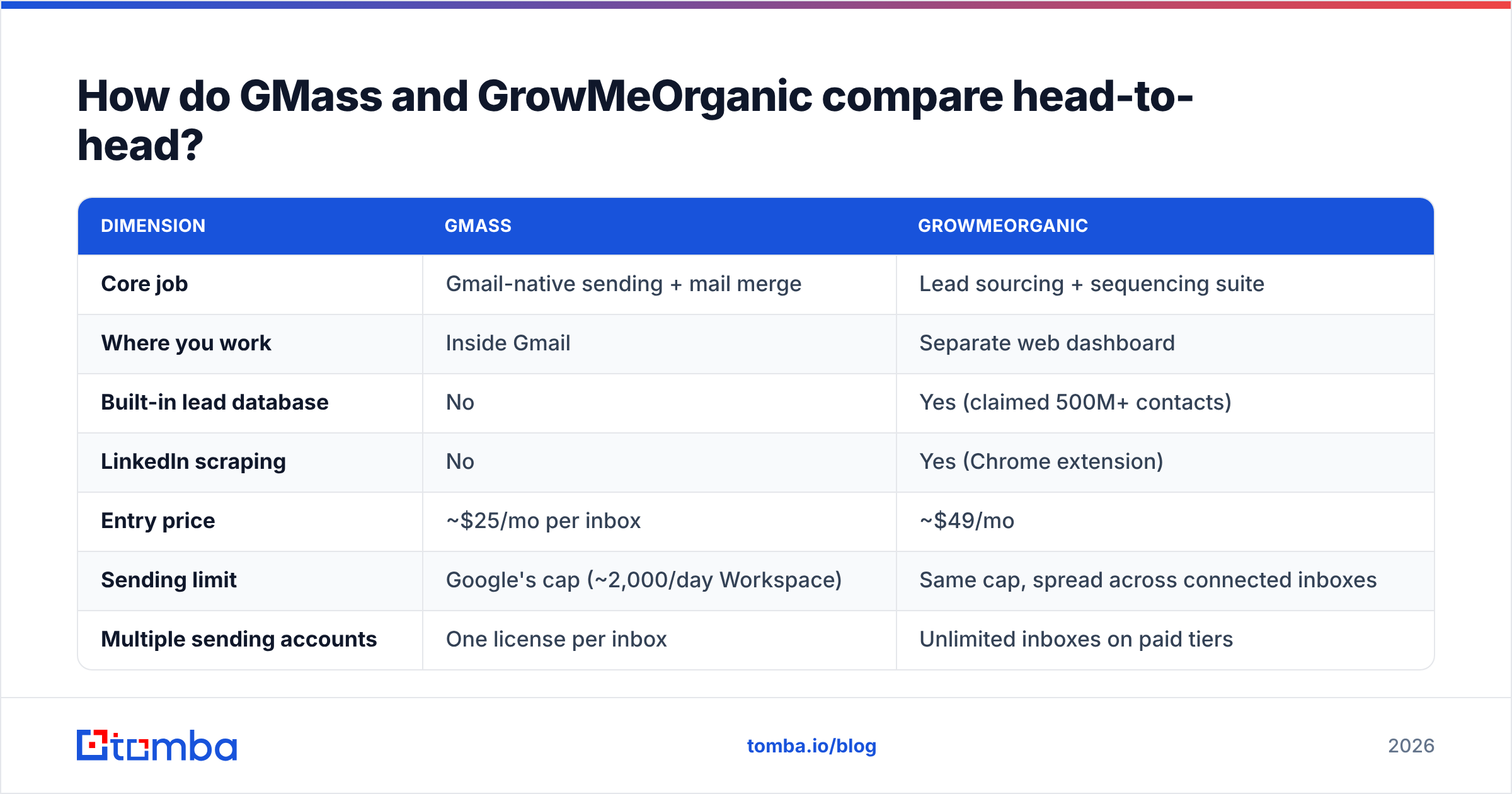
Here's the side-by-side on the dimensions that actually change your decision.
| Dimension | GMass | GrowMeOrganic |
|---|---|---|
| Core job | Gmail-native sending + mail merge | Lead sourcing + sequencing suite |
| Where you work | Inside Gmail | Separate web dashboard |
| Built-in lead database | No | Yes (claimed 500M+ contacts) |
| LinkedIn scraping | No | Yes (Chrome extension) |
| Entry price | ~$25/mo per inbox | ~$49/mo |
| Sending limit | Google's cap (~2,000/day Workspace) | Same cap, spread across connected inboxes |
| Multiple sending accounts | One license per inbox | Unlimited inboxes on paid tiers |
| Email verification | Built-in verifier | Built-in verifier |
| Learning curve | Near zero if you use Gmail | Moderate — full platform |
| Best for | Consultants, agencies, Gmail loyalists | Solo founders needing data + sending in one bill |
Read that table twice before you look at price. The row that decides most purchases isn't cost — it's "built-in lead database." If you already buy data elsewhere, half of GrowMeOrganic's price is redundant. If you don't, GMass leaves you with an empty spreadsheet and no plan.
Which one has better deliverability?#
GMass wins on deliverability architecture, and it isn't especially close.
Sending from your real Gmail address through Google's own infrastructure means you inherit Google's sending reputation and your domain's existing history. There's no intermediary SMTP relay whose IP pool you share with strangers. GMass adds throttling, reply detection, and unsubscribe handling on top of that.
GrowMeOrganic connects your SMTP accounts too, so the underlying path can be similar — but the tooling around it is thinner. You get warmup and rotation across inboxes, which helps volume, but fewer diagnostic controls when things go sideways.
That said, no sending tool saves a bad list. The dominant variable in whether your cold email lands is address quality. A 12% bounce rate will destroy your sender reputation regardless of which of these two you're paying. Google and Yahoo's bulk-sender requirements — documented by Google here — put hard thresholds on spam complaints and authentication, and both tools expect you to have SPF, DKIM, and DMARC configured yourself.
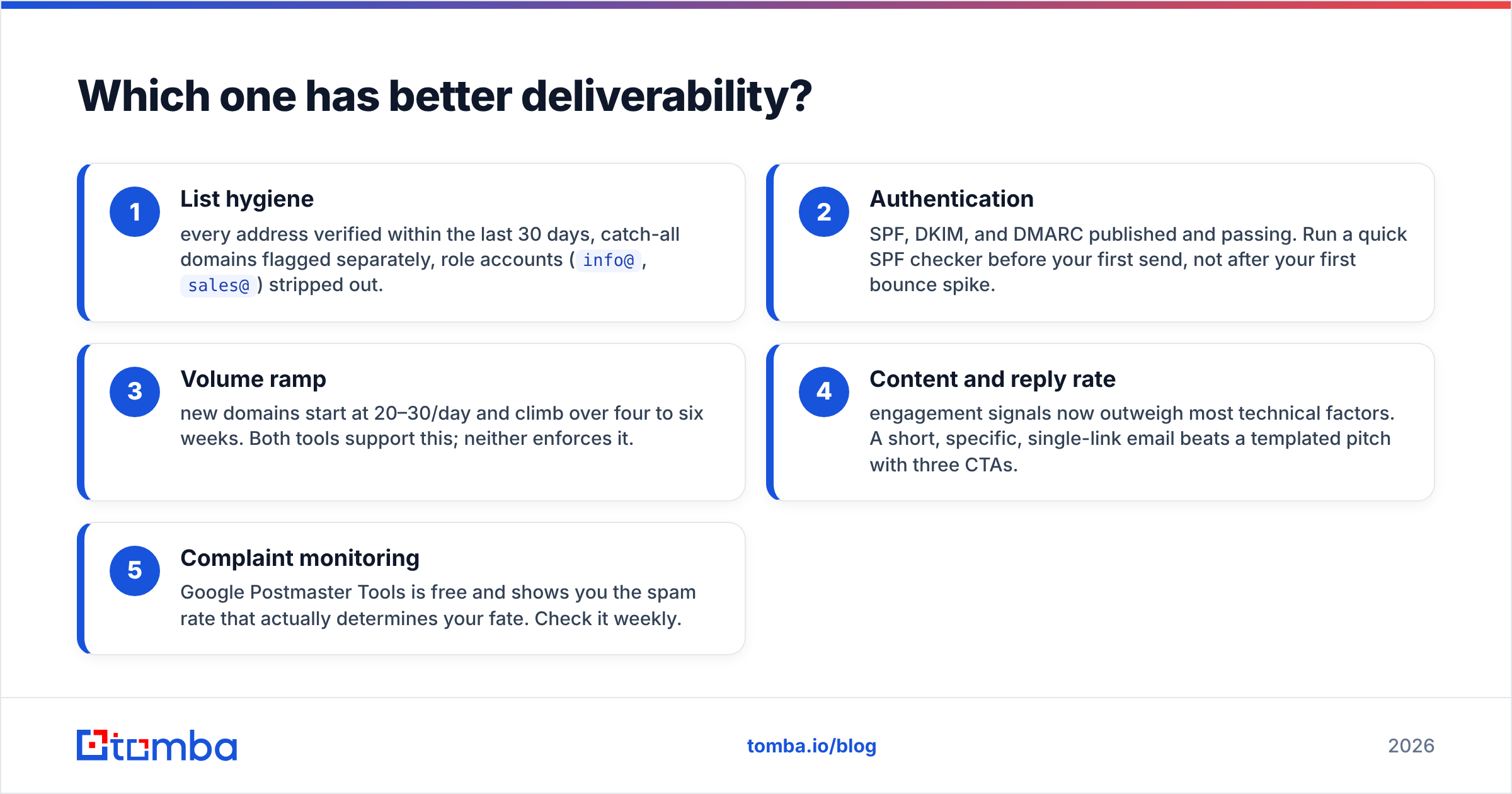
Four things determine whether your campaign lands, roughly in order of impact:
- List hygiene — every address verified within the last 30 days, catch-all domains flagged separately, role accounts (
info@,sales@) stripped out. - Authentication — SPF, DKIM, and DMARC published and passing. Run a quick SPF checker before your first send, not after your first bounce spike.
- Volume ramp — new domains start at 20–30/day and climb over four to six weeks. Both tools support this; neither enforces it.
- Content and reply rate — engagement signals now outweigh most technical factors. A short, specific, single-link email beats a templated pitch with three CTAs.
- Complaint monitoring — Google Postmaster Tools is free and shows you the spam rate that actually determines your fate. Check it weekly.
Notice that only item 3 is really a "tool feature." The rest is process, and process is where teams lose.
What does GMass vs GrowMeOrganic pricing actually look like?#
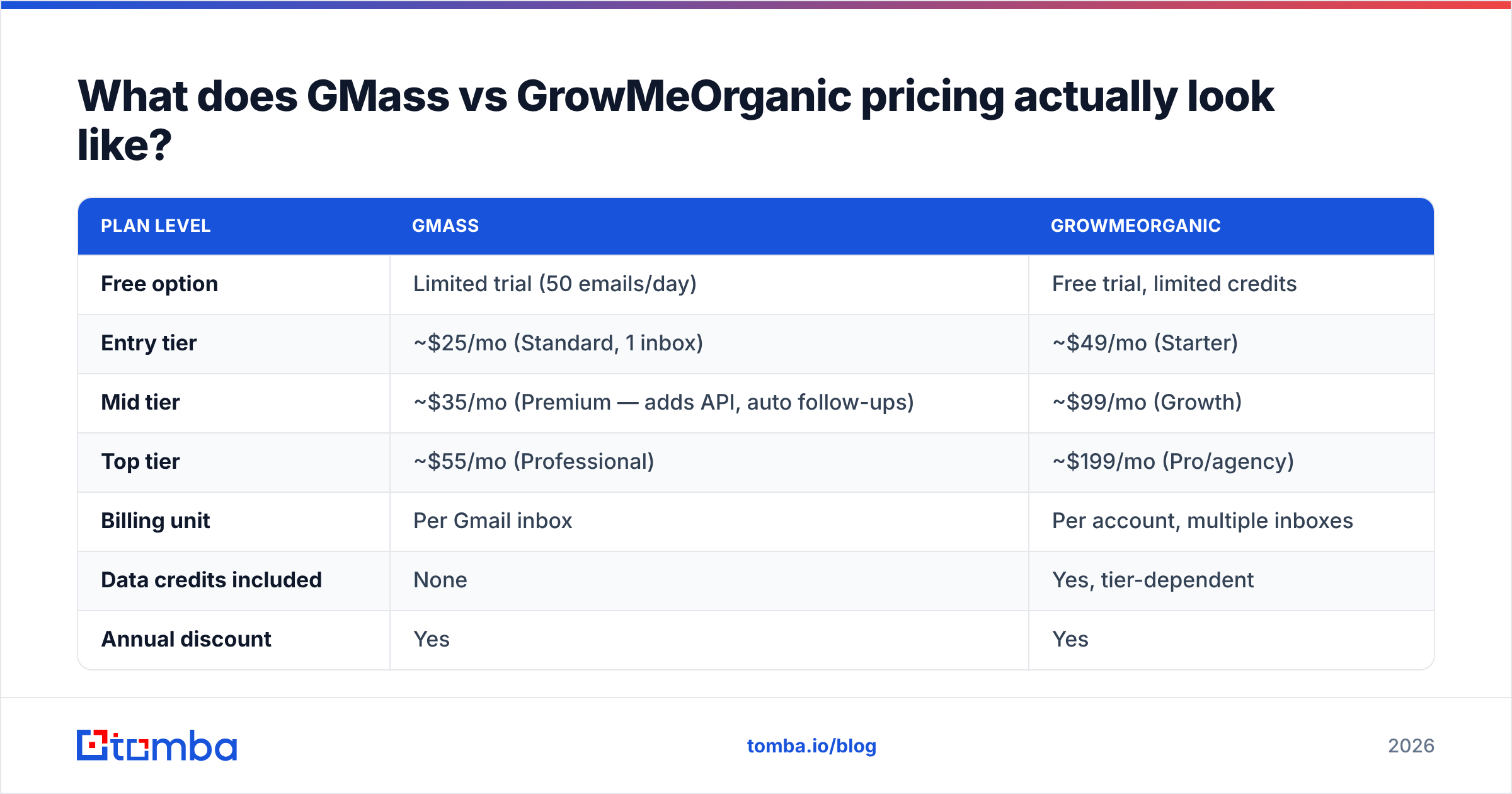
Both vendors adjust tiers regularly, so treat these as directional and confirm on their pricing pages before you commit.
| Plan level | GMass | GrowMeOrganic |
|---|---|---|
| Free option | Limited trial (50 emails/day) | Free trial, limited credits |
| Entry tier | ~$25/mo (Standard, 1 inbox) | ~$49/mo (Starter) |
| Mid tier | ~$35/mo (Premium — adds API, auto follow-ups) | ~$99/mo (Growth) |
| Top tier | ~$55/mo (Professional) | ~$199/mo (Pro/agency) |
| Billing unit | Per Gmail inbox | Per account, multiple inboxes |
| Data credits included | None | Yes, tier-dependent |
| Annual discount | Yes | Yes |
The math that matters: if you run five sending inboxes, GMass costs five licenses. GrowMeOrganic bundles unlimited inboxes into one subscription. At that scale the price gap inverts, and GrowMeOrganic becomes the cheaper option even before you count the data.
If you run one inbox and buy data separately, GMass at $25 plus a dedicated data provider will beat GrowMeOrganic on both cost and quality. That's the split.
Where does the lead data actually come from?#
This is the question most comparison posts skip, and it's the one that determines whether your campaign works.
GrowMeOrganic's database, like most bulk B2B datasets, is assembled from public web sources, LinkedIn profile scraping, and third-party aggregation. That produces enormous volume and highly variable accuracy. You'll get strong coverage on US tech companies with 50+ employees and noticeably weaker coverage on European SMBs, agencies, and anything outside English-speaking markets.
GMass sidesteps the question by not having data — which means you own the sourcing decision.
Either way, verification is not optional. Scraped records decay at roughly 25–30% per year as people change jobs, and a database snapshot from six months ago is already meaningfully stale. Running a list through an independent email verifier before it enters a sequence is the cheapest insurance in outbound. For domains that accept everything, a dedicated catch-all verifier is the only way to separate real mailboxes from black holes.
If you'd rather source contacts yourself with a specialist tool, a domain search that returns every public address at a target company — with confidence scores and sources attached — gives you a list you can defend. That's a different posture than trusting a black-box database dump.
Is GMass better than GrowMeOrganic for cold email?#
For pure cold email, GMass is the safer sending engine — but it only solves half the problem.
Pick GMass if:
- You already have a reliable source of verified contacts.
- You live in Gmail and don't want another dashboard.
- Deliverability diagnostics matter more to you than feature breadth.
- You send from one or two inboxes, not ten.
- You want mail-merge for warm lists (customers, event attendees, newsletter) as much as cold outreach.
Pick GrowMeOrganic if:
- You have no data budget and need sourcing plus sending on one invoice.
- You run several sending inboxes and want them under one subscription.
- Your ICP skews US, tech, 50+ employees — where scraped data holds up best.
- You want LinkedIn prospecting built into the same workflow.
- You're a solo operator who values consolidation over best-in-class components.
Pick neither as a complete stack if you're running outbound as a real revenue channel. At that point the pattern that works is: a specialist data source, an independent verification step, and a sending tool chosen purely on deliverability. Three tools, three jobs, no compromises baked in by a vendor trying to do everything.
What are the main alternatives to both?#
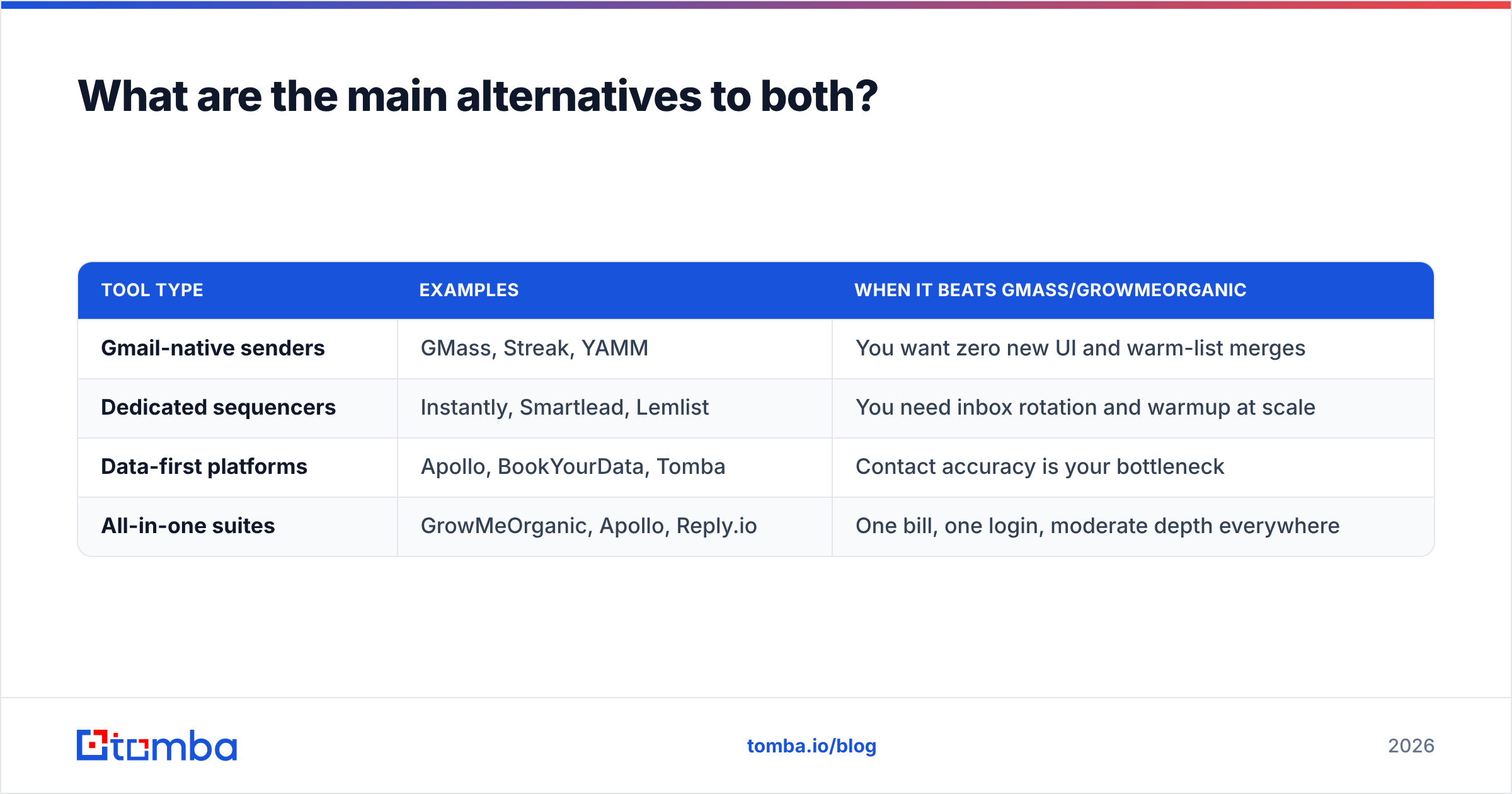
The category is crowded, and the right comparison depends on which half of the problem you're solving.
| Tool type | Examples | When it beats GMass/GrowMeOrganic |
|---|---|---|
| Gmail-native senders | GMass, Streak, YAMM | You want zero new UI and warm-list merges |
| Dedicated sequencers | Instantly, Smartlead, Lemlist | You need inbox rotation and warmup at scale |
| Data-first platforms | Apollo, BookYourData, Tomba | Contact accuracy is your bottleneck |
| All-in-one suites | GrowMeOrganic, Apollo, Reply.io | One bill, one login, moderate depth everywhere |
Two worth naming specifically. BookYourData is a solid choice when you want verified, pay-as-you-go B2B lists without a subscription commitment — useful if your outbound is campaign-based rather than always-on. And if your existing platform is the constraint rather than the sender, an Instantly alternative or a Reply.io alternative may be a shorter path than switching your whole stack.
Independent review data is worth a look before you commit either way — G2's cold-email software category shows how buyers of each rate support, ease of setup, and data accuracy, and the gaps between marketing claims and review scores are usually informative.
How should you decide in the next 20 minutes?#
Run this sequence:
- Count your inboxes. One or two → GMass is cheaper. Five or more → GrowMeOrganic's flat pricing wins.
- Check your data situation. If you have a source, you're paying GrowMeOrganic twice for the same thing.
- Test data quality on 100 records before you subscribe. Pull 100 contacts from GrowMeOrganic's trial in your exact ICP, run them through an independent verifier, and count how many come back valid. Under 85% and the database isn't fit for your market.
- Send 50 emails, not 5,000. Whichever you pick, validate reply rate on a small batch before scaling. Tool choice rarely explains a bad first campaign — targeting does.
- Set up authentication first. SPF, DKIM, DMARC, and a warmed domain. No tool compensates for skipping this.
Step 3 is the one people skip and regret. A trial that hands you a thousand contacts tells you nothing until you know what percentage of them are real.
The bottom line#
GMass and GrowMeOrganic aren't really competitors — they're two different answers to two different questions. GMass answers "how do I send well from Gmail?" GrowMeOrganic answers "how do I do outbound with one subscription?" Neither answers "how do I get contact data I can trust," which is the question that determines whether any of it works.
If your outbound stalls at the data layer, fix that before you switch senders. Tomba's email finder returns verified professional addresses by name and domain with confidence scores and public sources attached, so you know why an address is trustworthy before you send to it. It starts free at 25 searches a month, with paid plans from $49/mo, and plugs into whichever sending tool you land on via Tomba's integrations, Google Sheets, or the API. Build the list you can defend first — the sender is the easy part.
Related guides#
Ready to find emails that actually work?
Join 150,000+ professionals who stopped guessing and started sending. Free credits on signup — no credit card required.
Get the Tomba newsletter
Practical outbound tactics and product updates — once every two weeks.
About the author