GMass vs Lemlist (2026): Full Comparison and Our Pick
GMass is a Gmail mail merge that lives in your inbox. Lemlist is a full multichannel sequencer with its own sending infrastructure. Here is where each one wins, where each one breaks, and which fits your outbound motion.

TL;DR
- GMass is a Gmail extension. It turns your existing mailbox into a mail-merge machine, sends from your own Gmail/Workspace account, and costs roughly a quarter of what a full sequencer costs.
- Lemlist is a standalone outbound platform. Multichannel steps (email, LinkedIn, calls), a shared inbox, warmup, and its own sending pool — priced per seat per month.
- Pick GMass if you send from one or two mailboxes, live inside Gmail, and want reporting plus follow-ups without a new tool to learn.
- Pick Lemlist if you run a team, need LinkedIn touches in the same sequence, or want reply management and warmup bundled.
- Neither one fixes your list. Both send whatever you upload. Bounce rate is a data problem, not a sender problem — verify before you import.
What are GMass and Lemlist, actually?#
They are not the same category of product, which is why the comparison keeps coming up.
GMass is a Chrome extension bolted onto Gmail. You install it, a few extra buttons appear in your compose window, and you can now mail-merge a Google Sheet, schedule follow-up stages, and pull open/click/reply reports — all without leaving the Gmail interface. Sending happens through your own Google account, which means Google's own daily caps apply (roughly 2,000 recipients/day on paid Workspace, far fewer on free Gmail). GMass also offers its own SMTP relay on higher tiers for people who want to break past those caps.
Lemlist is a separate web app. You connect mailboxes to it, build sequences in a visual editor, and the platform handles sending, throttling, reply detection, and — on the higher plans — LinkedIn steps and call tasks in the same flow. It ships with a warmup product (lemwarm) and a shared inbox for handling replies as a team.
So the honest framing of GMass vs Lemlist is: a power tool for your inbox versus a system of record for outbound. One is a wrench, the other is a workshop.
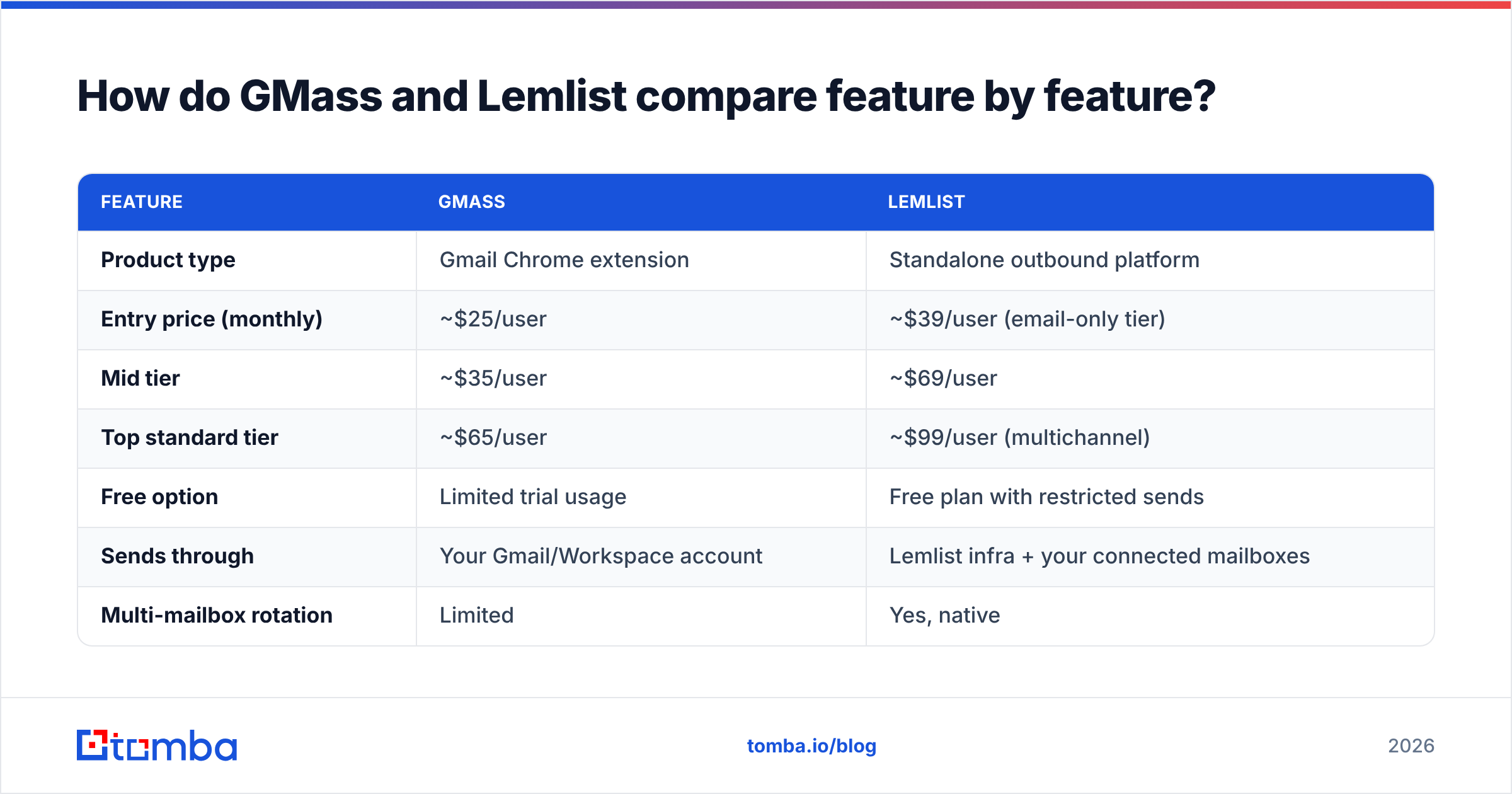
How do GMass and Lemlist compare feature by feature?#
Prices below reflect published list rates at the time of writing; both vendors change tiers regularly, so confirm on their pricing pages before you commit.
| Feature | GMass | Lemlist |
|---|---|---|
| Product type | Gmail Chrome extension | Standalone outbound platform |
| Entry price (monthly) | ~$25/user | ~$39/user (email-only tier) |
| Mid tier | ~$35/user | ~$69/user |
| Top standard tier | ~$65/user | ~$99/user (multichannel) |
| Free option | Limited trial usage | Free plan with restricted sends |
| Sends through | Your Gmail/Workspace account | Lemlist infra + your connected mailboxes |
| Multi-mailbox rotation | Limited | Yes, native |
| LinkedIn steps | No | Yes (higher tiers) |
| Cold call tasks | No | Yes (higher tiers) |
| Built-in warmup | No (third-party needed) | Yes (lemwarm) |
| Shared team inbox | No | Yes |
| Built-in lead database | No | Yes (credit-based, higher tiers) |
| A/B testing | Basic | Native, multi-variant |
| Learning curve | Under an hour | A day or two |
| Best for | Solo senders, founders, agencies with light volume | SDR teams running structured sequences |
The pattern is consistent: GMass wins on price, speed to first send, and simplicity. Lemlist wins on everything that involves more than one person or more than one channel.
Which is cheaper once you account for real volume?#
Cheaper on the price page and cheaper in production are different numbers.
GMass charges per Gmail account. If you run one mailbox, you pay once. If your deliverability strategy involves five secondary domains with three mailboxes each — the standard playbook for anything above light volume — you are now paying GMass fifteen times, or you are paying for their SMTP relay tier, or you are stitching together a workaround.
Lemlist also charges per seat, but a seat can connect multiple mailboxes on most plans. For a three-person SDR team running twelve inboxes, Lemlist's per-seat math often ends up cheaper than fifteen GMass licenses, even though its sticker price is roughly double.
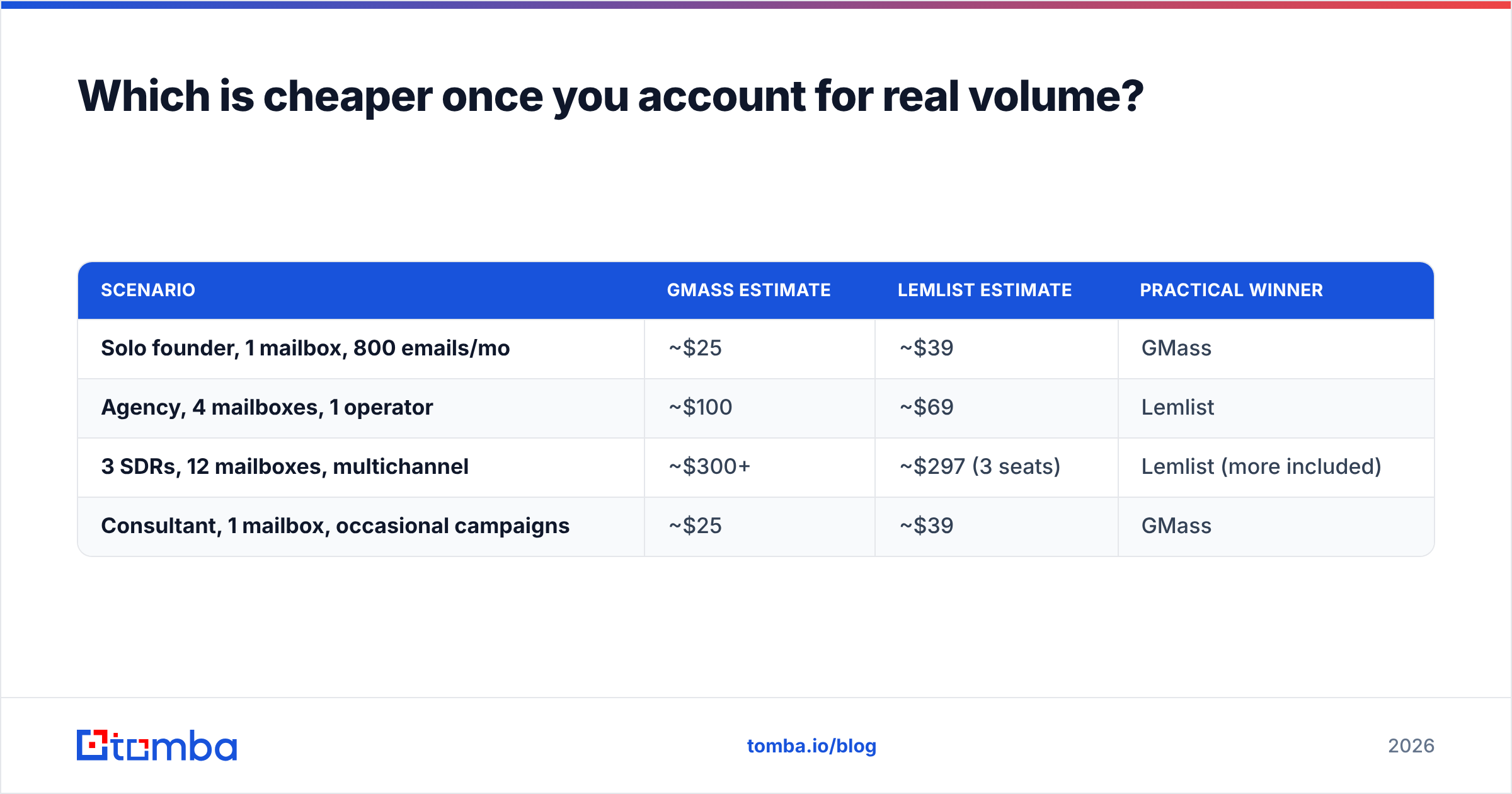
Rough monthly comparison at three common shapes:
| Scenario | GMass estimate | Lemlist estimate | Practical winner |
|---|---|---|---|
| Solo founder, 1 mailbox, 800 emails/mo | ~$25 | ~$39 | GMass |
| Agency, 4 mailboxes, 1 operator | ~$100 | ~$69 | Lemlist |
| 3 SDRs, 12 mailboxes, multichannel | ~$300+ | ~$297 (3 seats) | Lemlist (more included) |
| Consultant, 1 mailbox, occasional campaigns | ~$25 | ~$39 | GMass |
Add the hidden line items before you decide. GMass has no warmup, so budget another $30–$50/month for a warmup service if you are spinning up new domains. Lemlist bundles warmup but meters its lead database in credits that run out faster than most people expect.

Is GMass good enough to run a real outbound sequence?#
Yes, with two caveats.
The first is scale. Google's sending limits are a hard ceiling, not a suggestion, and pushing against them is how mailboxes get flagged. GMass gives you throttling and distribution controls, but it cannot manufacture reputation you have not earned. If your plan requires 3,000 emails a day across rotating domains, you have outgrown the extension.
The second is process. GMass reporting lives in Gmail labels and a Google Sheet. That works beautifully for one person and falls apart the moment two people need to know who already contacted a prospect. There is no shared inbox, no deal-stage view, no team-level analytics. It is not a CRM and does not pretend to be.
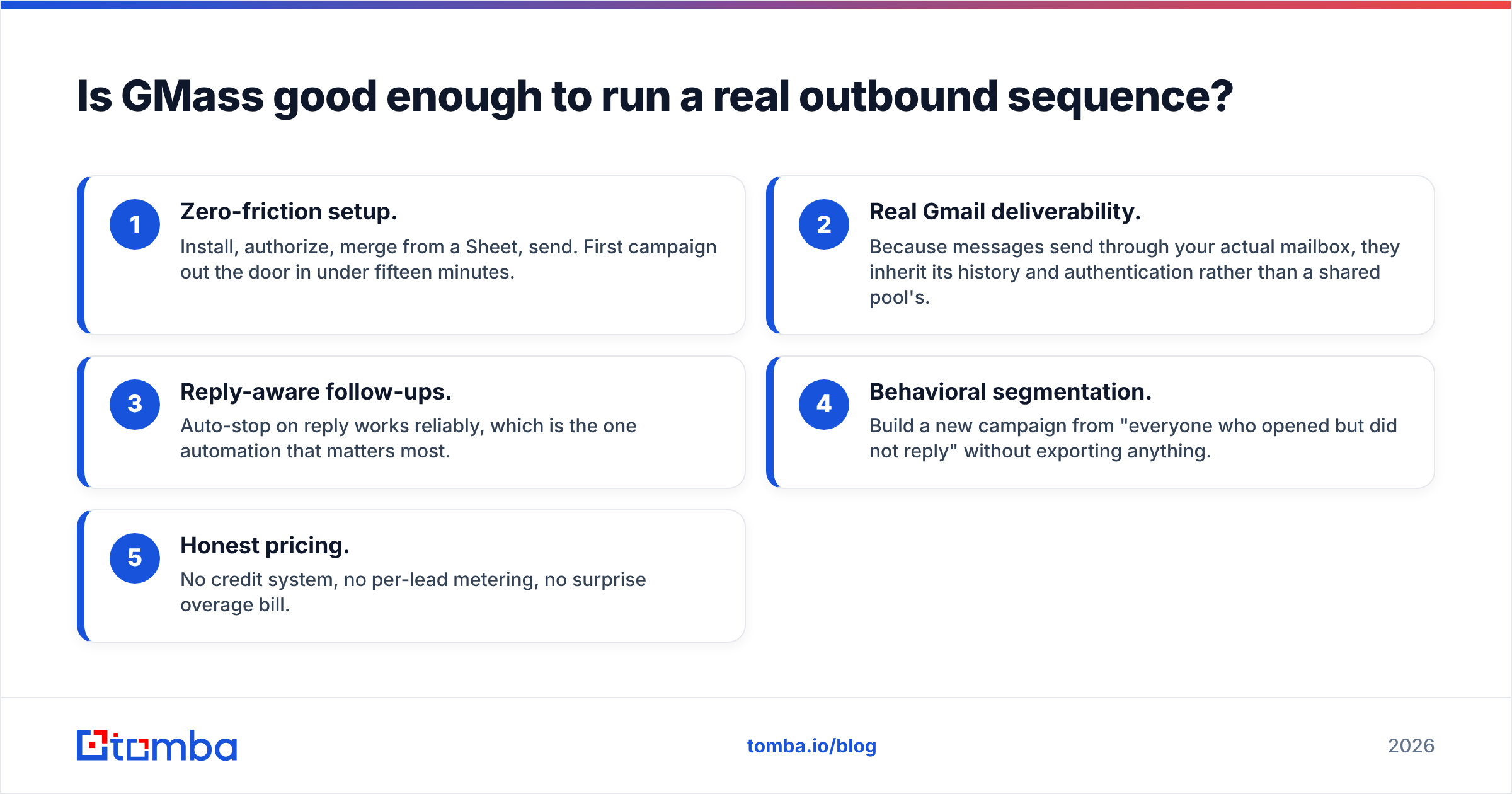
What GMass does exceptionally well:
- Zero-friction setup. Install, authorize, merge from a Sheet, send. First campaign out the door in under fifteen minutes.
- Real Gmail deliverability. Because messages send through your actual mailbox, they inherit its history and authentication rather than a shared pool's.
- Reply-aware follow-ups. Auto-stop on reply works reliably, which is the one automation that matters most.
- Behavioral segmentation. Build a new campaign from "everyone who opened but did not reply" without exporting anything.
- Honest pricing. No credit system, no per-lead metering, no surprise overage bill.
For a founder doing 200 highly targeted emails a month, GMass is arguably the better buy — the extra capability in Lemlist would sit unused.
Where does Lemlist actually earn its price?#
Three places.
Multichannel sequencing. A step that says "if no reply by day four, send a LinkedIn connection request, then a voice note on day seven" is not a gimmick — it lifts reply rates in crowded segments where inbox-only outreach has been beaten to death. GMass has no equivalent. If LinkedIn outreach is part of your motion, this is the deciding factor and the comparison ends here.
Team operations. Shared inbox, seat-level permissions, campaign-level reporting rolled up across reps, and a lead-status model that prevents two SDRs from emailing the same VP of Engineering in the same week. That coordination layer is most of what you are paying for.
Bundled warmup. lemwarm runs continuously in the background, building inbox placement on new domains. It is not magic — no warmup service is — but having it in the same tool means one fewer subscription and one fewer thing to forget.
Where Lemlist is weaker: the interface has accumulated a lot of surface area, and new users routinely spend the first week fighting the sequence builder rather than writing copy. Reviews on G2 reflect this consistently — high marks for capability, mixed marks for onboarding.
Which one has better deliverability?#
Neither, and the question is slightly wrong.
Deliverability is determined by four things, in descending order of weight: list quality, sending reputation, message content, and authentication. Your sending tool touches the last three only indirectly.
- List quality is entirely yours. A 12% bounce rate will torch a domain regardless of whether GMass or Lemlist pushed the send button.
- Reputation comes from your domain's history, your warmup discipline, and your complaint rate. Lemlist helps here by bundling warmup; GMass leaves it to you.
- Content is your copy. Both tools offer spam-word checks; neither will save weak writing.
- Authentication is DNS. Check your SPF record, DKIM, and DMARC before blaming either platform.
The trap in cold email is assuming the sender is the variable. It rarely is. Google and Microsoft both weight recipient-side engagement and hard-bounce rate heavily, and both signals are set by your list before the tool is ever involved. If your email deliverability is degrading, audit the list first — the fix is almost always upstream.

What do neither GMass nor Lemlist solve?#
Contact data.
Both platforms are execution layers. They assume you arrive with a clean CSV of verified, correctly-attributed business emails. Neither will tell you that first.last@ is the wrong pattern at a company that uses flast@, that a contact left eight months ago, or that a domain is catch-all and will silently accept every address you throw at it.
That gap is where most cold email programs actually fail. Teams spend weeks A/B testing subject lines while sending to a list with a 15% invalid rate — and the invalid rate is doing ten times more damage than the subject line ever could.
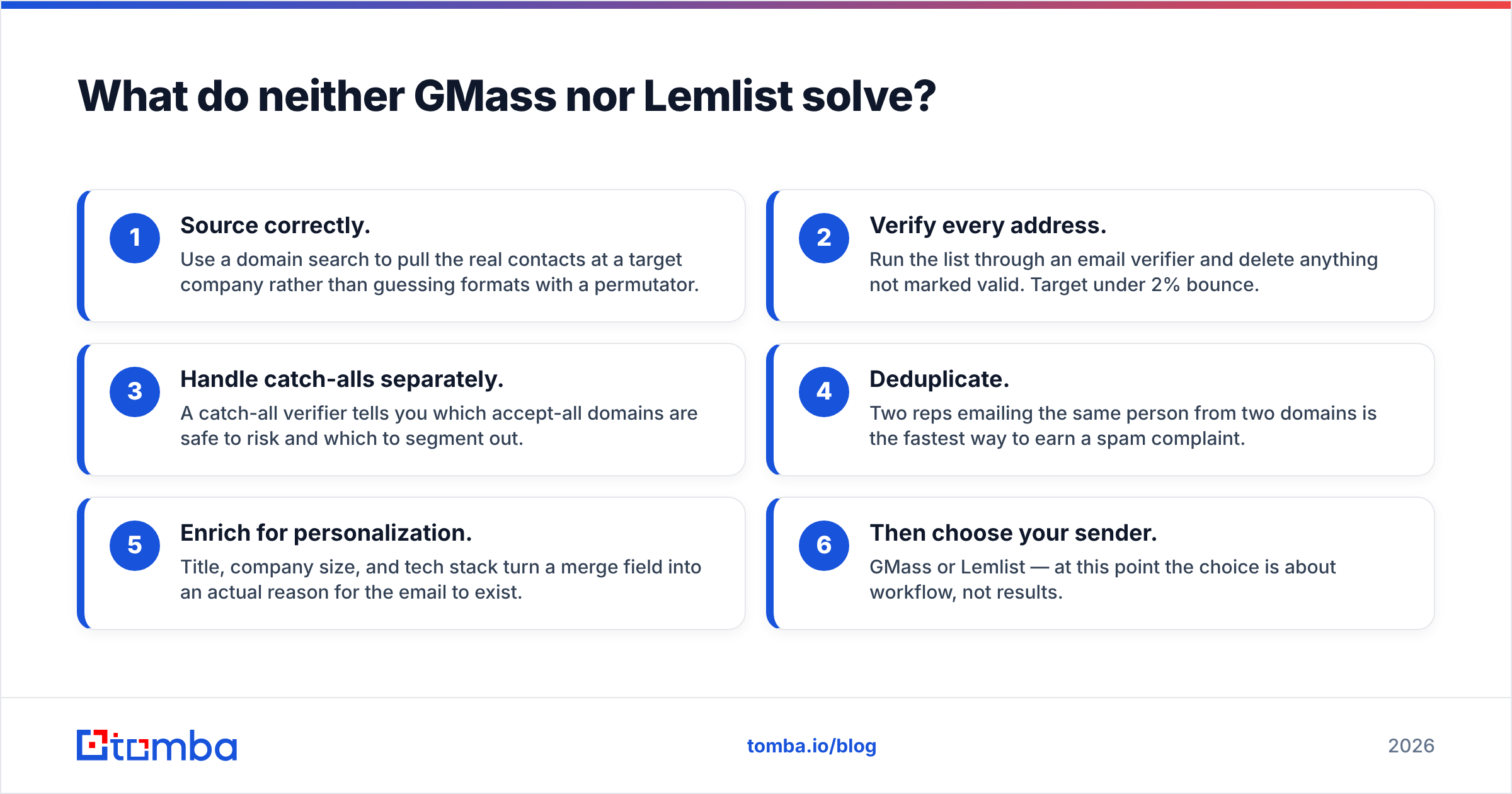
A practical pre-send checklist:
- Source correctly. Use a domain search to pull the real contacts at a target company rather than guessing formats with a permutator.
- Verify every address. Run the list through an email verifier and delete anything not marked valid. Target under 2% bounce.
- Handle catch-alls separately. A catch-all verifier tells you which accept-all domains are safe to risk and which to segment out.
- Deduplicate. Two reps emailing the same person from two domains is the fastest way to earn a spam complaint.
- Enrich for personalization. Title, company size, and tech stack turn a merge field into an actual reason for the email to exist.
- Then choose your sender. GMass or Lemlist — at this point the choice is about workflow, not results.
Doing steps one through five well matters more than the GMass vs Lemlist decision. That is not a comfortable conclusion for a comparison post, but it is the accurate one.
Which should you pick?#
Choose GMass if:
- You send from one or two mailboxes and volume stays under Gmail's caps.
- You already live in Gmail and do not want a second app to check.
- Budget is the binding constraint and $25/month vs $69/month is a real difference.
- Your outreach is email-only.
- You are technical enough to bolt on your own warmup and verification.
Choose Lemlist if:
- Two or more people run outbound and need shared visibility.
- LinkedIn or calling steps belong in the same sequence as email.
- You are rotating mailboxes across secondary domains.
- You want warmup, sending, and reply management under one subscription.
- Onboarding time is worth less to you than long-term capability.
Choose neither if your list is unverified. Fix that first; the sender is the smaller problem.
One more consideration: exit cost. GMass is trivially easy to leave — your data was always in Google Sheets and Gmail. Lemlist accumulates sequence history, reply threads, and lead statuses inside its own system, which is genuinely useful and genuinely sticky. Weigh that if you are early and still likely to change your mind.
Frequently asked questions#
Can I use both together? Technically yes — some agencies run Lemlist for structured client campaigns and GMass for one-off internal blasts. Practically, paying for two sending tools is hard to justify unless the use cases are genuinely separate.
Does GMass work with Outlook? It is built for Gmail and Google Workspace. Outlook users should look elsewhere; Lemlist connects Microsoft mailboxes natively.
Is Lemlist's built-in lead database good enough to skip a dedicated finder? It covers common segments, but coverage thins out on smaller companies and non-US regions, and credits deplete quickly. Most teams still run a dedicated finder alongside it. If you want to compare, our Instantly alternative breakdown covers the same trade-off across the sequencer category.
Which is better for agencies? Lemlist, by a wide margin — multi-client workspaces, per-seat permissions, and mailbox rotation are built for that shape of work.
Fix the input before you argue about the tool#
The GMass vs Lemlist debate is worth having, but it decides maybe 20% of your results. The list decides the rest.
Before your next campaign goes out in either platform, build it from verified data: use the Tomba Email Finder to source real, pattern-correct business addresses by name or domain, then verify the full list before import. The free tier gives you 25 searches a month to test coverage on your own target accounts, and paid plans start at $49/month — see Tomba pricing for the full breakdown. Get the list right and both GMass and Lemlist start looking like much better products.
Related guides#
Ready to find emails that actually work?
Join 150,000+ professionals who stopped guessing and started sending. Free credits on signup — no credit card required.
Get the Tomba newsletter
Practical outbound tactics and product updates — once every two weeks.
About the author