GMB Scraper Pricing 2026: Reviews, Pros and Cons Compared
Most GMB scrapers advertise a low monthly price and bill you per result. Here is what Google Maps scraping actually costs in 2026, which tools reviewers rate highest, and where the data quietly falls apart.
TL;DR
- GMB scraper pricing is almost never the sticker price. Most tools bill per extracted result on top of a platform fee, so a "$39/mo" plan can turn into a $220 month the first time you pull a whole metro area.
- Expect roughly $1.50–$5 per 1,000 places across the main platforms, plus compute or credit overages on some of them.
- Reviewers consistently praise scrapers for speed and coverage, and consistently complain about the same three things: missing emails, stale listings, and support that goes quiet at renewal time.
- Google Business Profile listings rarely expose a decision-maker email. Scraped rows are company records, not contact records — that gap is where most local-lead campaigns die.
- The cheapest workable stack is usually: scrape listings for firmographics, then run the domains through an email finder and a verifier before a single send.
What is a GMB scraper, and what does it actually pull?#
A GMB scraper is a tool that extracts Google Business Profile (formerly Google My Business) listings from Google Maps search results at volume. You give it a query — "dentists in Austin, TX", "HVAC contractors within 25 miles of Manchester" — and it returns a spreadsheet instead of a map.
Think of it like photographing every storefront sign on a street. You get the name, the address, the phone on the window, and the hours. You do not get the owner's inbox.
A typical scraped row contains:
- Business name, category, and Place ID — the stable identifiers you should dedupe on. Names collide across franchises; Place IDs do not.
- Address, coordinates, and service area — reliable, and the reason local-lead teams scrape in the first place.
- Phone number — usually a main line or reception, not a mobile or direct dial.
- Website URL — present on roughly 55–75% of listings depending on vertical, and the single most valuable field for B2B outreach because it unlocks domain-level enrichment.
- Ratings, review count, and review text — the strongest intent signal in the dataset. A 3.2-star plumber with 400 reviews has a problem worth selling into.
- Hours, photos, attributes, "claimed" status — useful for qualification, near-useless for contact.
Notice what is missing: a named human and an email address. Google does not publish owner emails on business profiles, and no scraper can extract a field that was never rendered. Tools that claim to "scrape emails from Google Maps" are actually crawling the linked website afterward and pulling whatever mailto: strings they find — usually info@, contact@, or hello@.

How does GMB scraper pricing actually work in 2026?#
Four billing models dominate, and mixing them up is how budgets blow.
Pay-as-you-go per result. You are charged per extracted place, often with a small monthly free allowance. Clean, predictable, and the easiest to model: rows × unit price. Outscraper popularized this shape.
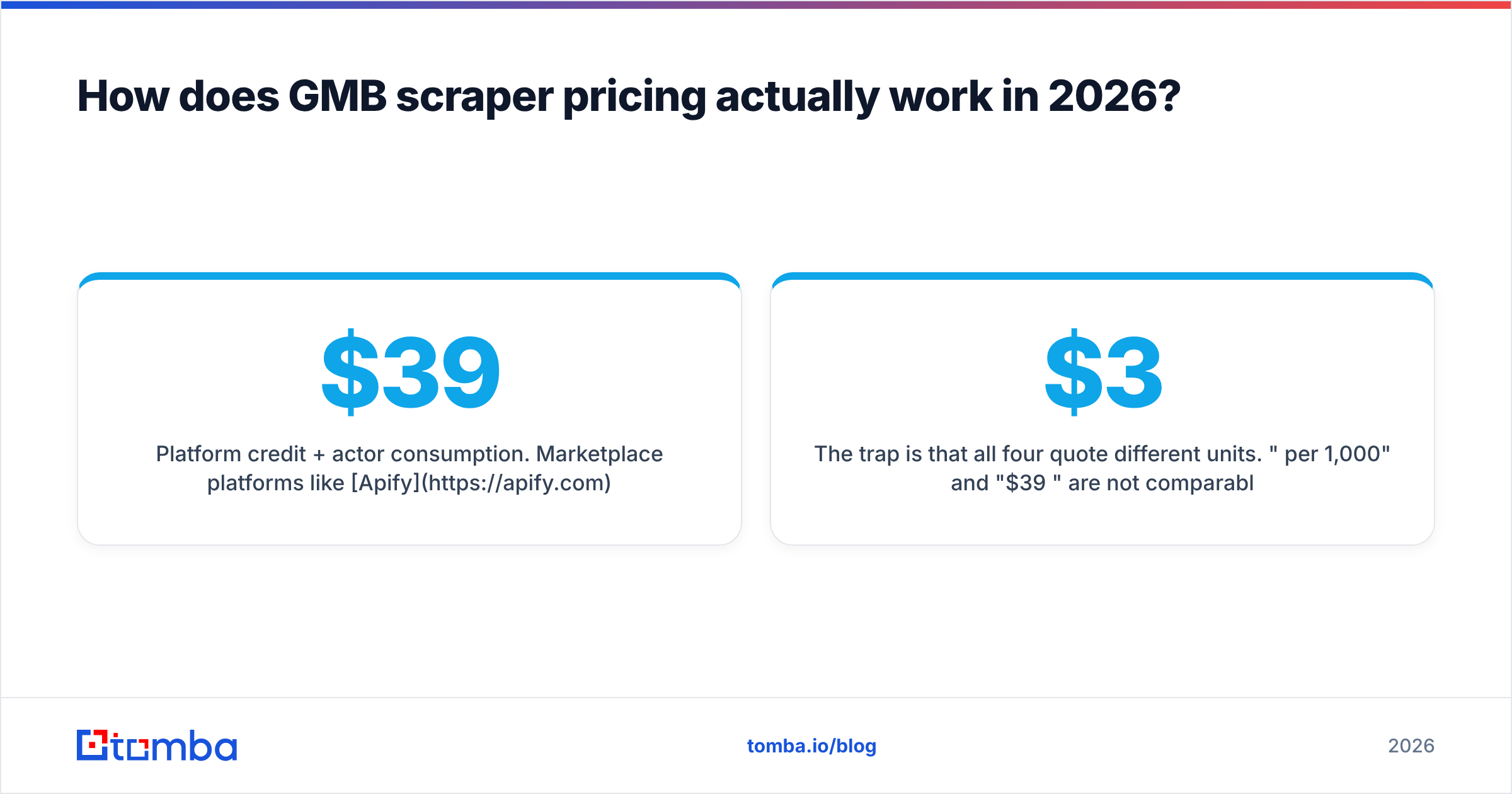
Platform credit + actor consumption. Marketplace platforms like Apify sell you a monthly credit balance that gets burned by compute time and per-result charges from the specific scraper you run. Two people on the same $39 plan can get wildly different output depending on which actor they picked.
Flat seat subscription with execution limits. Automation suites price by seat and cap you on execution minutes or slots per day. Great when your volume is steady, punishing when it spikes.
Managed data delivery. You do not run anything; you buy the finished, deduped dataset. Higher unit price, zero infrastructure, and no proxy bans at 2 a.m.
The trap is that all four quote different units. "$3 per 1,000" and "$39/month" are not comparable numbers until you convert both to cost per usable contacted lead — which means dividing by your website-URL fill rate and then by your email-find rate. A pull of 10,000 places where 65% have websites and 70% of those yield a valid email is 4,550 contactable rows, not 10,000.
What do GMB scrapers cost side by side?#
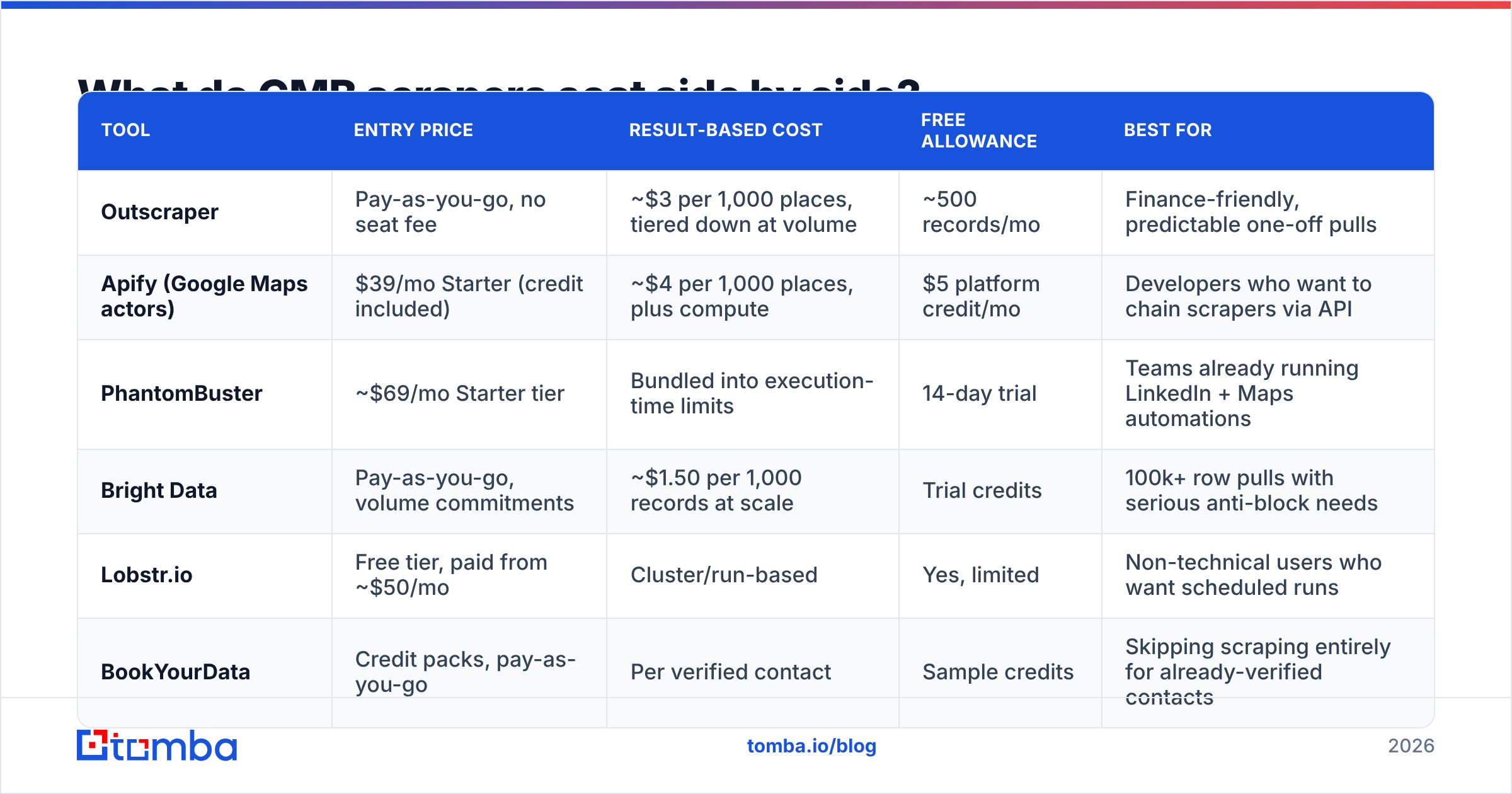
Prices below reflect publicly listed rates at the time of writing and change often — always confirm on the vendor's own pricing page before you commit budget.
| Tool | Entry price | Result-based cost | Free allowance | Best for |
|---|---|---|---|---|
| Outscraper | Pay-as-you-go, no seat fee | ~$3 per 1,000 places, tiered down at volume | ~500 records/mo | Finance-friendly, predictable one-off pulls |
| Apify (Google Maps actors) | $39/mo Starter (credit included) | ~$4 per 1,000 places, plus compute | $5 platform credit/mo | Developers who want to chain scrapers via API |
| PhantomBuster | ~$69/mo Starter tier | Bundled into execution-time limits | 14-day trial | Teams already running LinkedIn + Maps automations |
| Bright Data | Pay-as-you-go, volume commitments | ~$1.50 per 1,000 records at scale | Trial credits | 100k+ row pulls with serious anti-block needs |
| Lobstr.io | Free tier, paid from ~$50/mo | Cluster/run-based | Yes, limited | Non-technical users who want scheduled runs |
| BookYourData | Credit packs, pay-as-you-go | Per verified contact | Sample credits | Skipping scraping entirely for already-verified contacts |
Two honest observations from this table.
First, the scraping is cheap. Ten thousand places for $30 is not a budget line worth optimizing. The expensive part is everything downstream — enrichment, verification, and the deliverability damage from emailing a list you never cleaned.
Second, per-result pricing rewards precision. A tightly scoped query ("orthodontists, 3 cities, rating < 4.0, has website") costs a tenth of a statewide sweep and converts better. If you find yourself scraping a whole state, your ICP is not defined yet.
Where do the hidden costs show up?#
- Website fill rate. Between 25% and 45% of listings in many local verticals have no website at all. Those rows are phone-only leads. If your motion is email, you paid for dead weight.
- Email discovery gap. Scraping the linked site yields a generic inbox at best. Generic inboxes reply at a fraction of the rate of a named decision-maker, so your cost per reply is far above your cost per row.
- Duplicate and closed listings. Franchises, service-area businesses, and "permanently closed" entries inflate row counts. Dedupe on Place ID and domain before you pay for enrichment on the same company twice.
- Proxy and block overhead. On self-managed platforms, blocked runs still consume compute. Reviewers on G2 routinely mention re-running jobs — you pay for the retry.
- Compliance time. GDPR, CCPA, and Google's own Maps Platform terms all shape what you may store and for how long. Legal review is a real, recurring cost that no pricing page lists.
- Deliverability cost. Sending to unverified scraped addresses is the fastest route to a burned domain. Repairing sender reputation costs weeks, not dollars.
What are the real pros of scraping GMB data?#
Coverage no static database matches. Google Maps is the most complete local business index in existence. For a niche like "mobile dog groomers in Ohio", a scraper will out-cover any prebuilt B2B database, because nobody is maintaining a curated list of that segment.
Intent signals baked in. Review counts, review recency, star ratings, photo counts, and "claimed" status let you build a qualification score before you ever write an email. A business with 8 reviews and no website is a different pitch than one with 900 reviews and a booking widget.
Speed and cost per row. Ten thousand qualified local businesses in under an hour for the price of a team lunch is genuinely hard to beat.
Full field control. You choose the geography, the radius, the category, and the filters. No vendor's segment definition sits between you and your ICP.
What are the cons — and the honest limits?#
No people, only places. This is the structural limitation. GMB data answers "which companies exist here?" It never answers "who do I talk to?"
Freshness decay. Local listings churn hard — hours change, businesses close, phone numbers get reassigned. A six-month-old scrape is a liability, not an asset. Re-scrape, don't archive.
Blocking and instability. Google actively rate-limits automated access. Self-managed scrapers break when layouts change, and marketplace actors sometimes lag a fix by days. Managed providers absorb this for you, which is a chunk of what their premium buys.
Legal ambiguity. Scraping publicly displayed data sits in a grey zone that varies by jurisdiction and by how you collect it. Automated collection from Google Maps may conflict with Google's terms even where the data itself is public. Get counsel; do not get your legal opinion from a vendor's marketing page.
Review sentiment is mixed for a reason. Across review sites the pattern is stable: 4–5 stars for extraction speed and coverage, 2–3 stars for email accuracy and support responsiveness. Buy for the former, plan around the latter.
How do you turn scraped listings into contactable leads?#
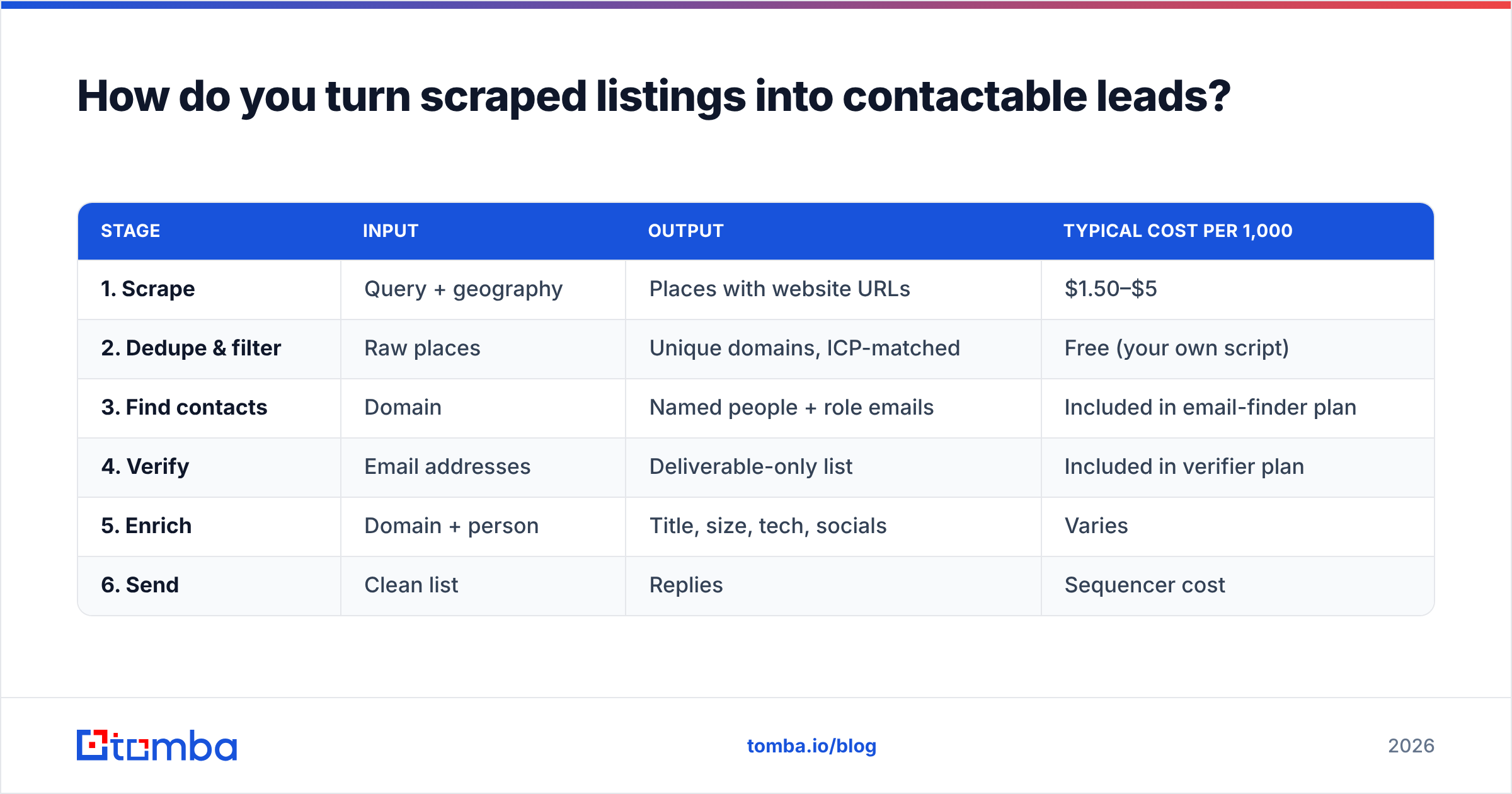
Here is the pipeline that actually works, and where each dollar goes.
| Stage | Input | Output | Typical cost per 1,000 |
|---|---|---|---|
| 1. Scrape | Query + geography | Places with website URLs | $1.50–$5 |
| 2. Dedupe & filter | Raw places | Unique domains, ICP-matched | Free (your own script) |
| 3. Find contacts | Domain | Named people + role emails | Included in email-finder plan |
| 4. Verify | Email addresses | Deliverable-only list | Included in verifier plan |
| 5. Enrich | Domain + person | Title, size, tech, socials | Varies |
| 6. Send | Clean list | Replies | Sequencer cost |
Stage 3 is where the value inverts. A scraped domain like austinsmilesdental.com is worth almost nothing on its own. Run it through a domain search and you get the practice manager, the owner, and the office coordinator — with patterns, sources, and confidence scores attached. That is a contact record, and it is what your sequencer actually needs.
Stage 4 is non-negotiable. Generic inboxes scraped off websites are stale at a much higher rate than discovered emails, and catch-all domains are common among small businesses on shared hosting. Push every address through an email verifier before it touches a sequencer. If a chunk of your list comes back as catch-all, a dedicated catch-all verifier will separate the salvageable from the risky instead of forcing you to guess.

For volume work, do stages 3 and 4 together. Upload the deduped domain list to a bulk email finder, get finds and verification status in one pass, and export only the rows marked deliverable. Skipping this step is the single most common reason a technically successful scrape produces a technically catastrophic campaign.
Which option fits your situation?#
You need 500 leads in one city, once. Pay-as-you-go scraping. Do not buy a subscription. Total spend should be under $20 for the scrape, plus enrichment.
You need continuous local lead flow across many metros. A scheduled marketplace actor or a flat-rate suite, plus an enrichment API called on every new row. Budget for the enrichment tier, not the scraper tier — it will be the bigger line.
You need 100k+ rows with uptime guarantees. Managed infrastructure with proxy handling. The unit price is lower at scale and you stop paying engineers to babysit runs.
You want verified contacts and no infrastructure at all. Prebuilt contact data from a provider like BookYourData is a legitimate shortcut — higher cost per record, but the records arrive verified and role-tagged, which removes two pipeline stages. It is the right trade when your team's time is worth more than the delta.
You are technical and want it all in one flow. Scrape, then hit the Tomba API directly from the same script. One pass from Place ID to verified inbox, no CSV shuffling.
Frequently asked questions#
Can a GMB scraper get me email addresses directly? No. Google Business Profiles do not display owner emails. Any tool showing emails is crawling the linked website or joining against a third-party database. Treat those addresses as unverified until you check them.
Is scraping Google Maps legal? Public data collection is broadly permitted in many jurisdictions, but Google's terms restrict automated access, and privacy law governs what you store about identifiable people. Consult counsel for your specific use case and region.
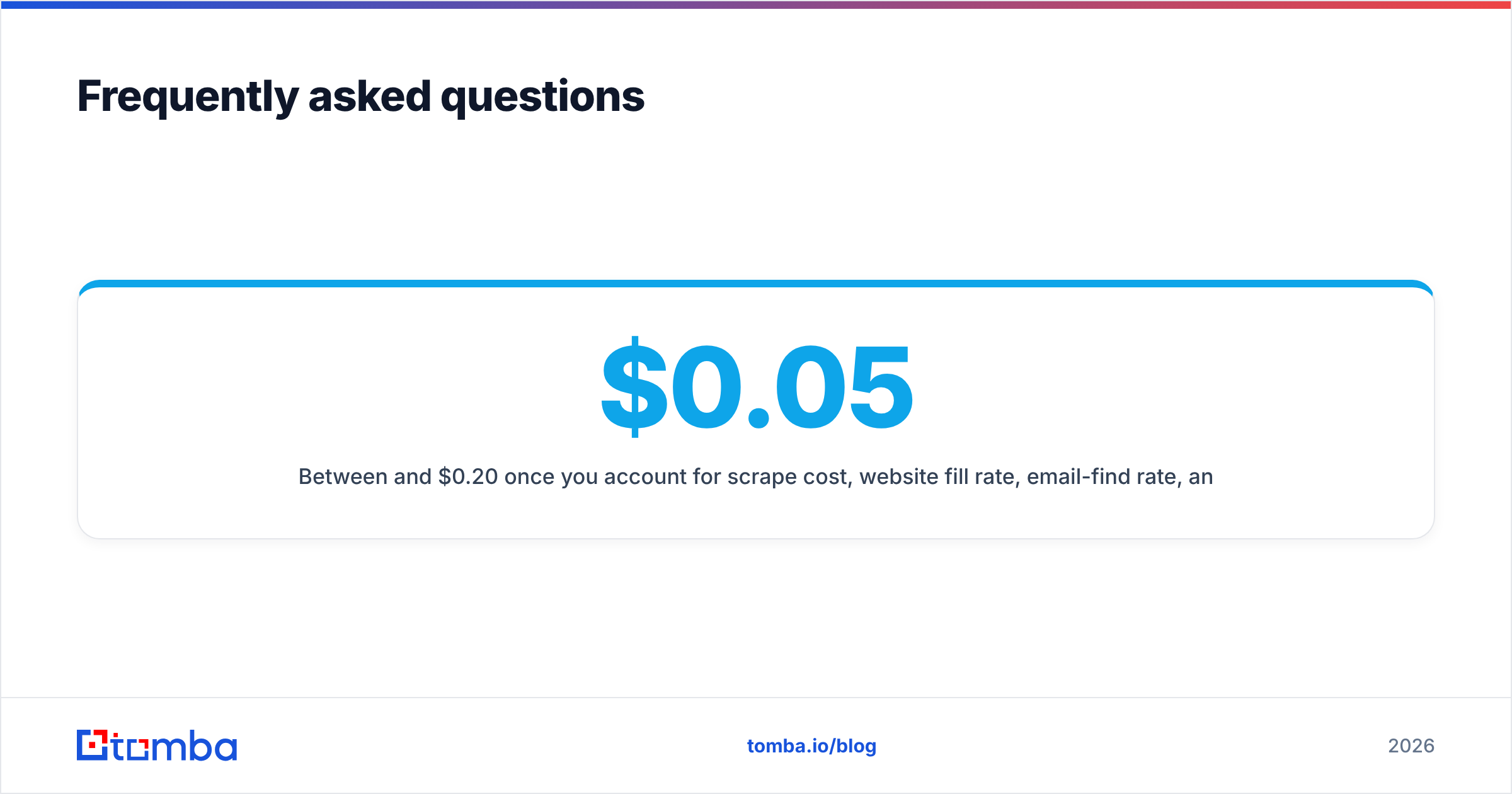
What is a realistic all-in cost per contactable local lead? Between $0.05 and $0.20 once you account for scrape cost, website fill rate, email-find rate, and verification. Anyone quoting you $0.005 is quoting raw rows, not leads.
How often should I re-scrape? Every 60–90 days for active campaigns. Local listing data decays fast enough that anything older introduces meaningful bounce risk.
Do I still need a verifier if the scraper claims verified emails? Yes. "Verified" means different things to different vendors, and the check may be months old. Verification is cheap; a burned sending domain is not.
The bottom line on GMB scraper pricing#
Scraping is the cheap half of local lead generation and the half everyone benchmarks. The expensive half — turning a place record into a named, verified, deliverable contact — is the half that determines whether the campaign works. Price the whole pipeline, not the scraper.
Once your listings are pulled and deduped, run the domains through the Tomba Email Finder to get named decision-makers with confidence scores and sources, then verify before you send. The free tier covers 25 searches a month so you can test the fill rate on a sample of your own scrape before committing, and paid plans start at $49/mo — see Tomba pricing for the full breakdown. Scrape the map, then find the people.
Related guides#
Ready to find emails that actually work?
Join 150,000+ professionals who stopped guessing and started sending. Free credits on signup — no credit card required.
Get the Tomba newsletter
Practical outbound tactics and product updates — once every two weeks.
About the author