Gmelius vs Streak (2026): Which Gmail CRM Actually Wins?
Gmelius and Streak both live inside Gmail, but they solve different problems: one is a shared-inbox collaboration layer, the other is a pipeline CRM in a spreadsheet coat. Here is which one fits your team, and what neither of them does.
TL;DR
- Streak is a CRM that lives in Gmail. Pipelines, stages, boxes, mail merge. If you think in deals and stages, Streak is the closer match.
- Gmelius is a collaboration layer on Gmail. Shared inboxes, email notes, assignment, SLA-style workflows, Trello-style boards. If your pain is "three people replying to the same support@ thread," Gmelius wins.
- Pricing splits along the same line. Gmelius tends to sit lower per seat for collaboration features; Streak's CRM-grade tiers cost more per user, and both jump sharply at the top plan.
- Neither tool fills your pipeline. Both organise email you already have. Sourcing verified contacts is a separate job, handled by a dedicated email finder.
- Quick rule: shared team inbox → Gmelius. Deal pipeline inside Gmail → Streak. Both, at scale → you have probably outgrown Gmail-native tooling and should look at a real CRM.
What are Gmelius and Streak, actually?#
Both products answer the same complaint — "our whole business runs out of Gmail and it is chaos" — with two very different fixes.
Streak turns your inbox into a spreadsheet. You create pipelines (Sales, Hiring, Fundraising, Support), each row is a "box," and every box holds the email threads, notes, files and custom fields tied to that deal. It is a CRM whose UI happens to be Gmail. Streak also ships mail merge, send-later, view tracking and snippets, so a solo founder can run outbound without buying a sequencer.
Gmelius treats Gmail as a team workspace. It converts a Google Group or shared alias into a genuine shared inbox with assignment, internal notes that never leak into the reply chain, collision detection, and automation rules. It layers on kanban boards, shared labels, and two-way sync with Slack and Trello. There are light CRM affordances, but the centre of gravity is collaboration and workflow, not deal value.
That distinction drives every other difference. Think of it like a restaurant: Streak is the reservations book that tracks each party from booking to bill. Gmelius is the kitchen pass — making sure two cooks do not plate the same order twice.

How do Gmelius and Streak compare feature by feature?#
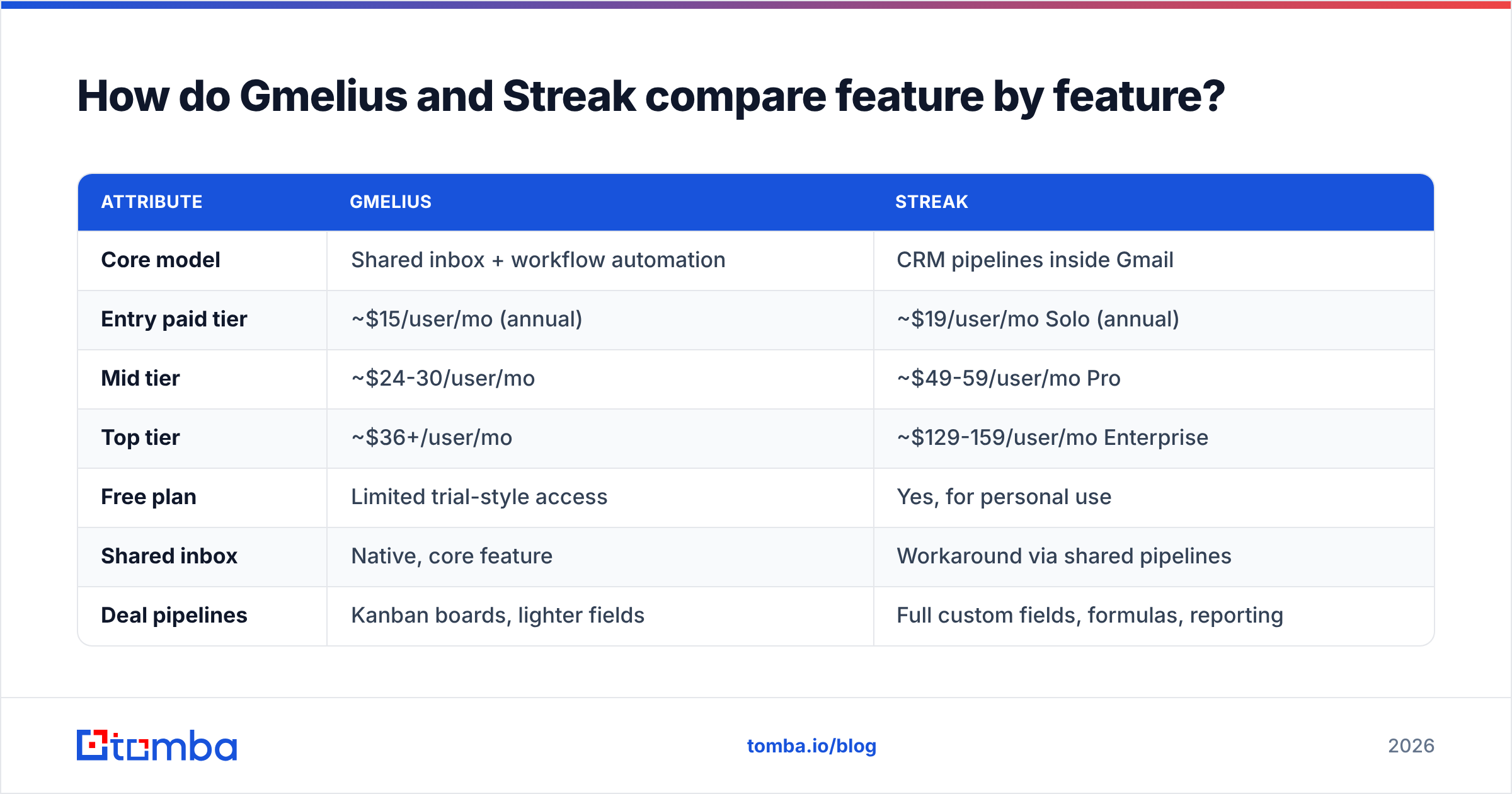
Here is the head-to-head on the attributes that actually change your workflow. Pricing figures are list prices observed at the time of writing — both vendors adjust tiers, so confirm on their pricing pages before you buy.
| Attribute | Gmelius | Streak |
|---|---|---|
| Core model | Shared inbox + workflow automation | CRM pipelines inside Gmail |
| Entry paid tier | ~$15/user/mo (annual) | ~$19/user/mo Solo (annual) |
| Mid tier | ~$24-30/user/mo | ~$49-59/user/mo Pro |
| Top tier | ~$36+/user/mo | ~$129-159/user/mo Enterprise |
| Free plan | Limited trial-style access | Yes, for personal use |
| Shared inbox | Native, core feature | Workaround via shared pipelines |
| Deal pipelines | Kanban boards, lighter fields | Full custom fields, formulas, reporting |
| Mail merge | Yes, basic sequences | Yes, with tracking and snippets |
| Automation rules | Strong (assignment, SLA, triggers) | Moderate (stage-based, Zapier) |
| Mobile app | iOS + Android | iOS + Android |
| Slack / Trello sync | Two-way, native | Via Zapier |
| Reporting | Team performance, response times | Pipeline reports, revenue forecasting |
| Best for | Support, ops, agencies, CS teams | Founders, small sales teams, recruiters |
Two lines in that table matter more than the rest. If "shared inbox" is your reason for shopping, Streak's pipeline-as-inbox workaround will annoy you within a week. If "forecast next quarter" is your reason, Gmelius's boards will feel thin.
Which one should you pick for your use case?#
Use these five profiles to place yourself. Each one maps to a clear winner, not a shrug.
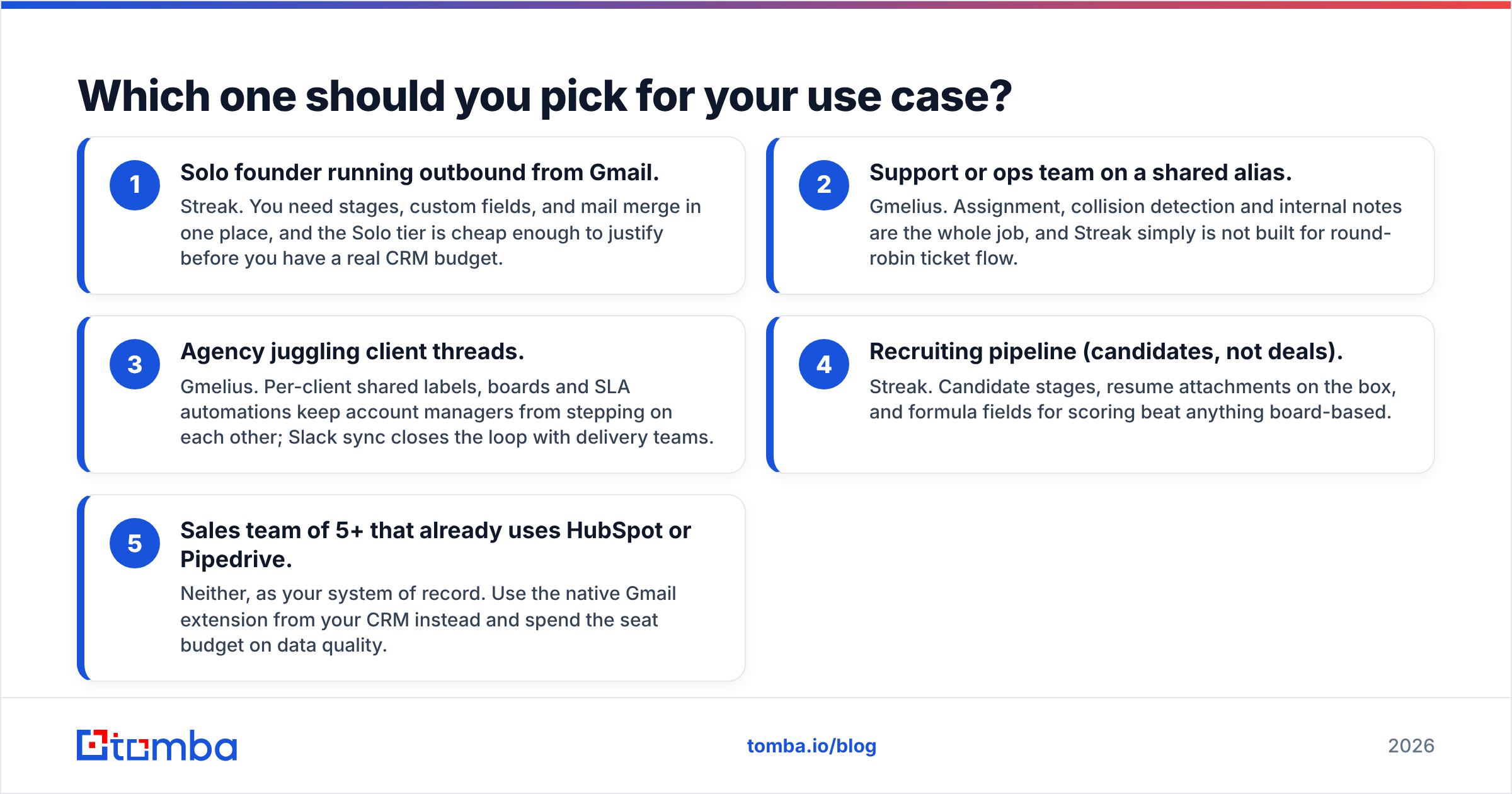
- Solo founder running outbound from Gmail. Streak. You need stages, custom fields, and mail merge in one place, and the Solo tier is cheap enough to justify before you have a real CRM budget.
- Support or ops team on a shared alias. Gmelius. Assignment, collision detection and internal notes are the whole job, and Streak simply is not built for round-robin ticket flow.
- Agency juggling client threads. Gmelius. Per-client shared labels, boards and SLA automations keep account managers from stepping on each other; Slack sync closes the loop with delivery teams.
- Recruiting pipeline (candidates, not deals). Streak. Candidate stages, resume attachments on the box, and formula fields for scoring beat anything board-based.
- Sales team of 5+ that already uses HubSpot or Pipedrive. Neither, as your system of record. Use the native Gmail extension from your CRM instead and spend the seat budget on data quality.
That fifth case is the one teams get wrong most often. A Gmail-native CRM is a great first CRM and a poor second one. Once you have deal reporting requirements, cross-object relationships, and a revenue operations function, Gmail is the wrong container.
Is Gmelius or Streak better value for the money?#
Value depends on how many of the features you actually touch.
Gmelius prices like a collaboration tool: lower entry seats, features gated by automation depth and integration count. Because you often deploy it to a whole support or ops team, the seat count runs higher but per-seat cost stays modest. Watch the tier where automation rules unlock — that is usually the plan that makes the product worth having, not the cheapest one.
Streak prices like a CRM: the Solo plan is genuinely inexpensive, the Pro plan roughly triples it, and Enterprise more than doubles again. The jump from Pro to Pro+ typically buys you reporting, validation rules and better sharing controls. Small teams often sit on Pro for years, which is a reasonable outcome. But per-seat cost at Streak Pro can exceed what mid-market CRMs charge, and that comparison gets uncomfortable at ten seats.
A practical budgeting rule: multiply the mid tier by your seat count, then add 20-30% for the data layer you will inevitably need (enrichment, verification, phone numbers). Teams that skip that second line item end up with a beautifully organised pipeline full of bounced addresses.
Cross-check current list prices on both vendor pages and read the recent reviews on G2 before committing to annual billing — Gmail-extension tooling is a category where feature gating shifts often.
What do both tools fail to do?#
Both organise email. Neither creates it.
That sounds obvious until you watch a team spend six weeks configuring pipelines and then run outbound against a list scraped from LinkedIn with 40% invalid addresses. The tooling was never the bottleneck. The contact data was.
Specifically, here is what sits outside the scope of both products:
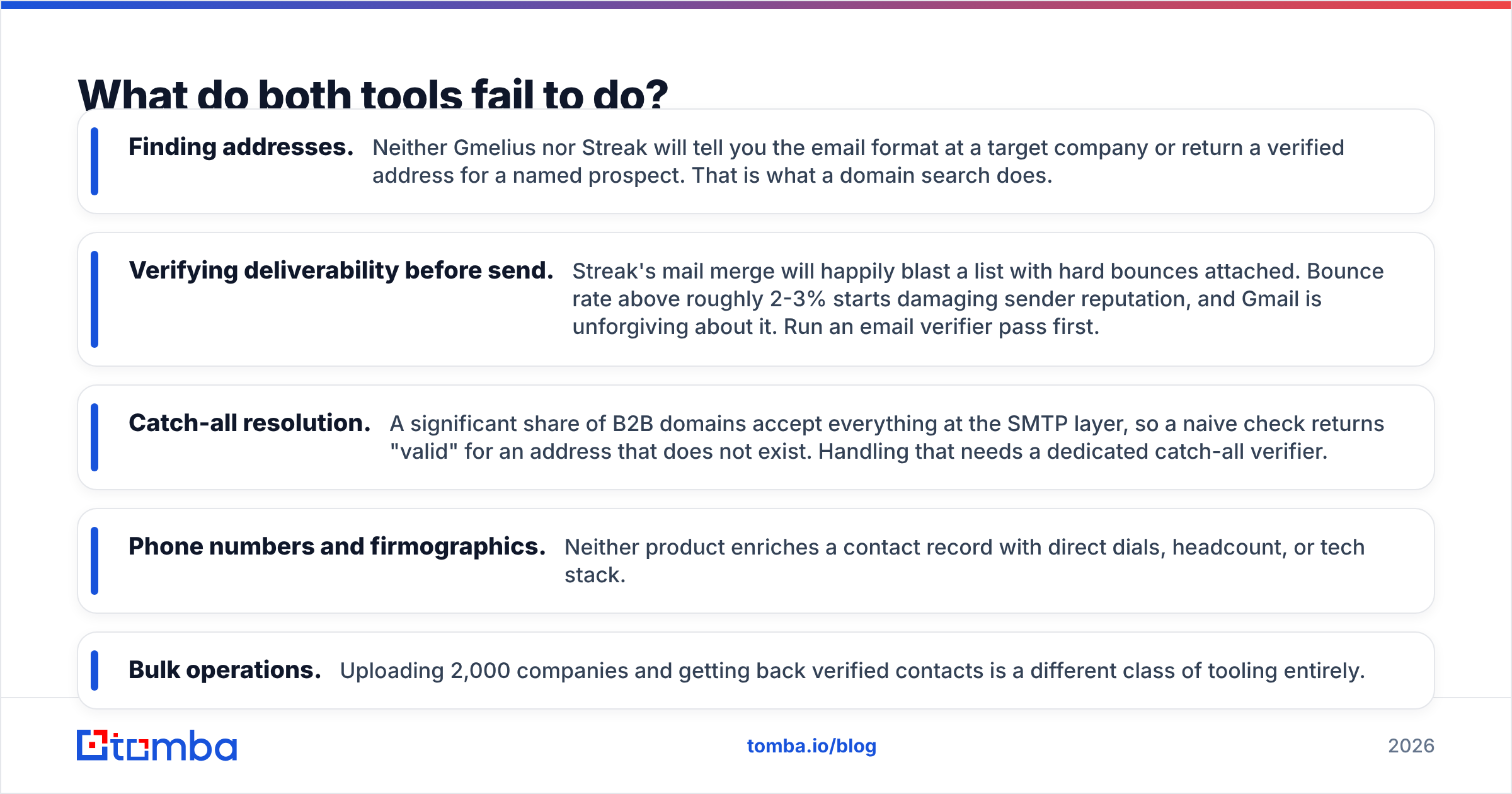
- Finding addresses. Neither Gmelius nor Streak will tell you the email format at a target company or return a verified address for a named prospect. That is what a domain search does.
- Verifying deliverability before send. Streak's mail merge will happily blast a list with hard bounces attached. Bounce rate above roughly 2-3% starts damaging sender reputation, and Gmail is unforgiving about it. Run an email verifier pass first.
- Catch-all resolution. A significant share of B2B domains accept everything at the SMTP layer, so a naive check returns "valid" for an address that does not exist. Handling that needs a dedicated catch-all verifier.
- Phone numbers and firmographics. Neither product enriches a contact record with direct dials, headcount, or tech stack.
- Bulk operations. Uploading 2,000 companies and getting back verified contacts is a different class of tooling entirely.

How should you combine a Gmail CRM with a data layer?#
The stack that works looks like this, and it takes about an hour to wire up.
Step one — build the list outside your inbox. Start from a company list, not a contact list. Run domain search across those companies to pull the people in the roles you sell to, along with the confidence score on each address.
Step two — verify before anything touches Gmail. Split results into valid, risky and catch-all. Send only to valid on new domains. Route catch-all addresses through a second check, or hold them for a LinkedIn touch instead.
Step three — push clean records into the tool you chose. In Streak, that means a CSV import mapped to your pipeline's custom fields. In Gmelius, it means creating the board cards or letting inbound replies land in the shared inbox with the right label. Either way, only verified contacts cross the boundary.
Step four — automate the refresh. B2B contact data decays fast; a meaningful slice of your list goes stale every year through job changes alone. Re-verify quarterly. If you have engineering time, the Tomba API handles this on a schedule so nobody exports a CSV by hand again.
Step five — measure replies, not sends. Whichever tool you pick, the metric that matters is response rate per verified contact. Volume flatters vanity dashboards and destroys domains.
This is also why the Gmelius-vs-Streak argument is smaller than it looks. Both are competent at their jobs. The variable that swings pipeline outcomes by an order of magnitude is whether the addresses are real.
Are there alternatives worth considering instead?#
Yes, and three are worth a look before you commit.
Front is the mature answer to Gmelius's use case — a proper shared-inbox platform with strong routing and analytics, at a higher price point and outside Gmail's UI. If your support volume justifies it, Front usually wins on reliability.
HubSpot's free CRM plus the Gmail extension covers a surprising amount of what Streak does, at zero cost for the CRM itself, with a far larger ecosystem behind it. The tradeoff is context switching: you leave Gmail more often. Their sales tooling docs are worth twenty minutes of reading before you pay for anything.
Pipedrive or Close if you want a real sales CRM without enterprise weight. Both have solid Gmail sync, and both will still be the right tool at 20 reps — which is not true of a Gmail extension.
And if the real problem is that your reps spend more time hunting addresses than selling, the fix is not a different inbox skin. Look at what a bulk email finder does to a morning's work: a list of 500 companies in, verified contacts out, before the first coffee.
What is the verdict on Gmelius vs Streak?#
Pick Gmelius if multiple people work the same mailbox and your failure mode is duplicated or dropped replies. Shared inbox, assignment, internal notes and automation rules are its core competence, and it does them better than Streak ever will.
Pick Streak if you think in pipelines, want custom fields and forecasting inside Gmail, and are the primary owner of your own inbox. It is the stronger CRM of the two by a wide margin.
Pick neither if you have more than a handful of reps, need cross-object reporting, or are already paying for a CRM that ships a Gmail extension. At that point a Gmail-native tool is an extra subscription that duplicates capability you own.
Whichever way you go, budget for the data layer separately. A shared inbox with no leads in it is a very tidy empty room.
Start with contacts that actually exist. Before you configure a single pipeline stage or automation rule, run your target account list through Tomba's Email Finder and see how many of your current contacts survive verification. The free tier gives you 25 searches a month to test against your own list; paid plans start at $49/mo for Starter, $99/mo for Growth, and $249/mo for Pro, with full pricing details on site. Fix the data first, then argue about the inbox.
Related guides#
Ready to find emails that actually work?
Join 150,000+ professionals who stopped guessing and started sending. Free credits on signup — no credit card required.
Get the Tomba newsletter
Practical outbound tactics and product updates — once every two weeks.
About the author