Go Skylevel Pricing, Reviews, Pros and Cons: 2026 Analysis
Skylevel sells a candidate Fit Score built from referral input — but the price is quote-only. Here's how the pricing model actually works, what reviewers praise and complain about, and when a cheaper stack beats it.
TL;DR
- Skylevel (goskylevel.com) is a talent-intelligence tool built around a candidate Fit Score assembled from structured referral input — people who actually worked with the candidate rate them, and the platform ranks your shortlist.
- Pricing is quote-only. There is no public per-seat or per-hire price card at the time of writing, which means every number you see quoted secondhand is someone else's negotiated deal, not a list price.
- Reviewers consistently praise the speed of shortlisting and the referral-based signal; the recurring complaints are low reviewer volume, opaque pricing, and thin ATS integration depth compared with incumbent suites.
- Skylevel solves evaluation. It does not solve sourcing — you still need contact data to reach the people you want to score.
- If your bottleneck is "we can't reach enough qualified people," a contact-data layer like Tomba's email finder at $49/mo is a cheaper first fix than a quote-only evaluation platform.
What is Go Skylevel?#
Skylevel is a hiring-intelligence platform that tries to answer one question earlier than a traditional process can: which of these candidates is actually good?
The mechanic is referral-based scoring. Instead of parsing a resume with a keyword model and hoping the signal is real, Skylevel asks the candidate to nominate people who have worked with them — managers, peers, direct reports — and collects structured ratings from those references up front. Those ratings roll into a Fit Score that sorts your applicant pool before a recruiter reads a single CV.
Think of it like restaurant reviews versus the menu. A resume is the menu: written by the establishment, formatted to flatter, and silent on whether the kitchen actually delivers. Skylevel is trying to be the review section — third-party voices, collected in a structured format, attached to the listing.
That's a genuinely different bet from the rest of the category. Most modern hiring tools score documents; Skylevel scores reputation. Whether that's worth the price depends entirely on how much resume-screening waste you currently carry — which is exactly what the pricing conversation comes down to.
For the vendor's own framing, see goskylevel.com.
How does Go Skylevel pricing actually work?#
Here's the honest answer up front: Skylevel does not publish a full public price card. Pricing is handled through a demo-and-quote motion, which is normal for HR tech sold to mid-market and enterprise buyers, and frustrating for anyone trying to budget before booking a call.
That means the useful thing isn't a fake number — it's understanding the variables your quote will be built from. In this category, quotes are almost always assembled from some combination of the following:
- Number of open roles or job slots. The most common unit in referral- and assessment-based hiring tools. You pay for concurrent active requisitions, not for headcount of recruiters. Budget by your peak month, not your average — this is where annual contracts get expensive.
- Candidate or scoring volume. How many candidates get run through Fit Scoring per period. High-volume hiring (support, sales, retail, seasonal) blows through allowances that feel generous when you're hiring five engineers a year.
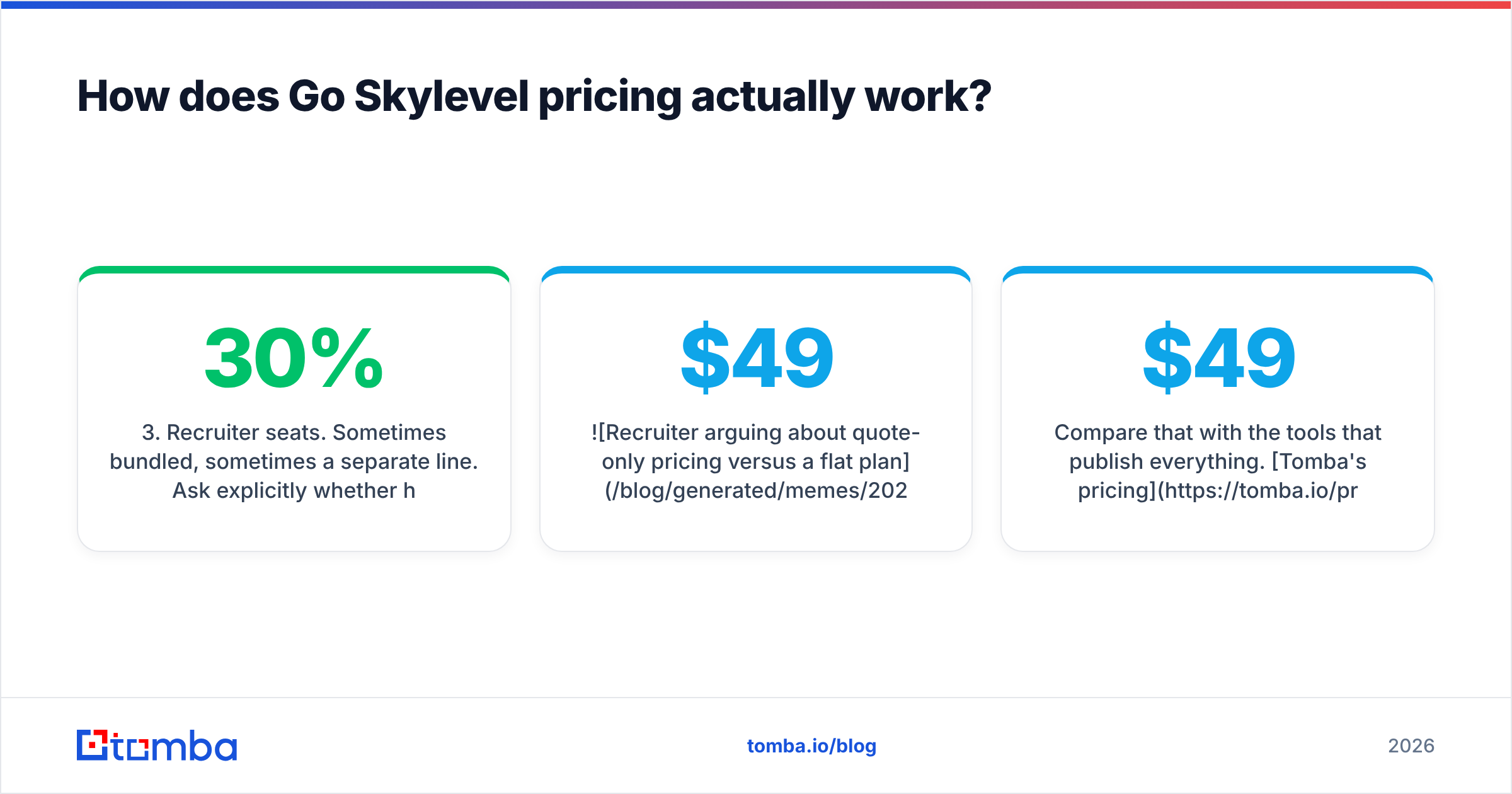
- Recruiter seats. Sometimes bundled, sometimes a separate line. Ask explicitly whether hiring managers who only view scores count as seats — that single clarification can move a quote 20–30%.
- Contract length and term. Annual prepay is the default discount lever. Monthly is usually available but priced at a meaningful premium, and month-to-month is where you want to start if this is a pilot.
- Integrations and onboarding. ATS connectors, SSO, custom scorecards, and implementation support are frequently line items rather than inclusions. Ask for them in writing.
What to do about it: ask for the quote broken into these five components, not as a single annual figure. A vendor that will itemize is a vendor you can renegotiate with at renewal. A vendor that will only give you a bundled number is one whose renewal you cannot model.

Compare that with the tools that publish everything. Tomba's pricing runs a free tier at 25 searches/month, Starter at $49/mo, Growth at $99/mo, and Pro at $249/mo — you can model your annual cost in thirty seconds without talking to anyone. That's not a knock on Skylevel's category so much as a real difference in buying friction, and friction is a cost.
What do Go Skylevel reviews say?#
Public review volume for Skylevel is thin — you'll find scattered listings on G2 and Capterra, but not the hundreds-of-reviews depth you get for Greenhouse or Lever. Treat anything you read as directional, not statistical, and weight your own pilot far more heavily than a five-review average.
That caveat aside, the themes that recur in reviews and buyer conversations are consistent:
What reviewers like
- Shortlist speed. The most common positive is time-to-shortlist. When the Fit Score works, recruiters skip a large chunk of resume triage entirely.
- Signal quality over keyword matching. Buyers who've been burned by keyword-stuffed resumes rate the referral input as materially more predictive than parsing.
- Candidate experience. The referral flow is generally described as light for the candidate — nominating three people is less friction than a two-hour assessment.
- Responsive team. Small-vendor advantage: support and onboarding get praised more often than at large suites.
What reviewers complain about
- Pricing opacity. The number-one friction in every buyer thread. You cannot self-serve, and you cannot compare without a call.
- Referral response dependency. The Fit Score is only as good as the response rate from the candidate's nominated references. Slow or non-responsive referrers mean incomplete scores and stalled pipelines.
- Integration depth. Connectors exist, but reviewers coming from mature ATS stacks describe the integration as functional rather than deep. Check your specific ATS before you sign.
- Small-vendor risk. Thin public review volume, smaller ecosystem, fewer third-party consultants. Real for enterprise procurement teams.
- It doesn't source. Skylevel ranks people who already applied or who you already found. Empty top-of-funnel stays empty.
That last point is the one buyers underestimate most, and it's worth its own section.
What are the pros and cons of Skylevel in one view?#
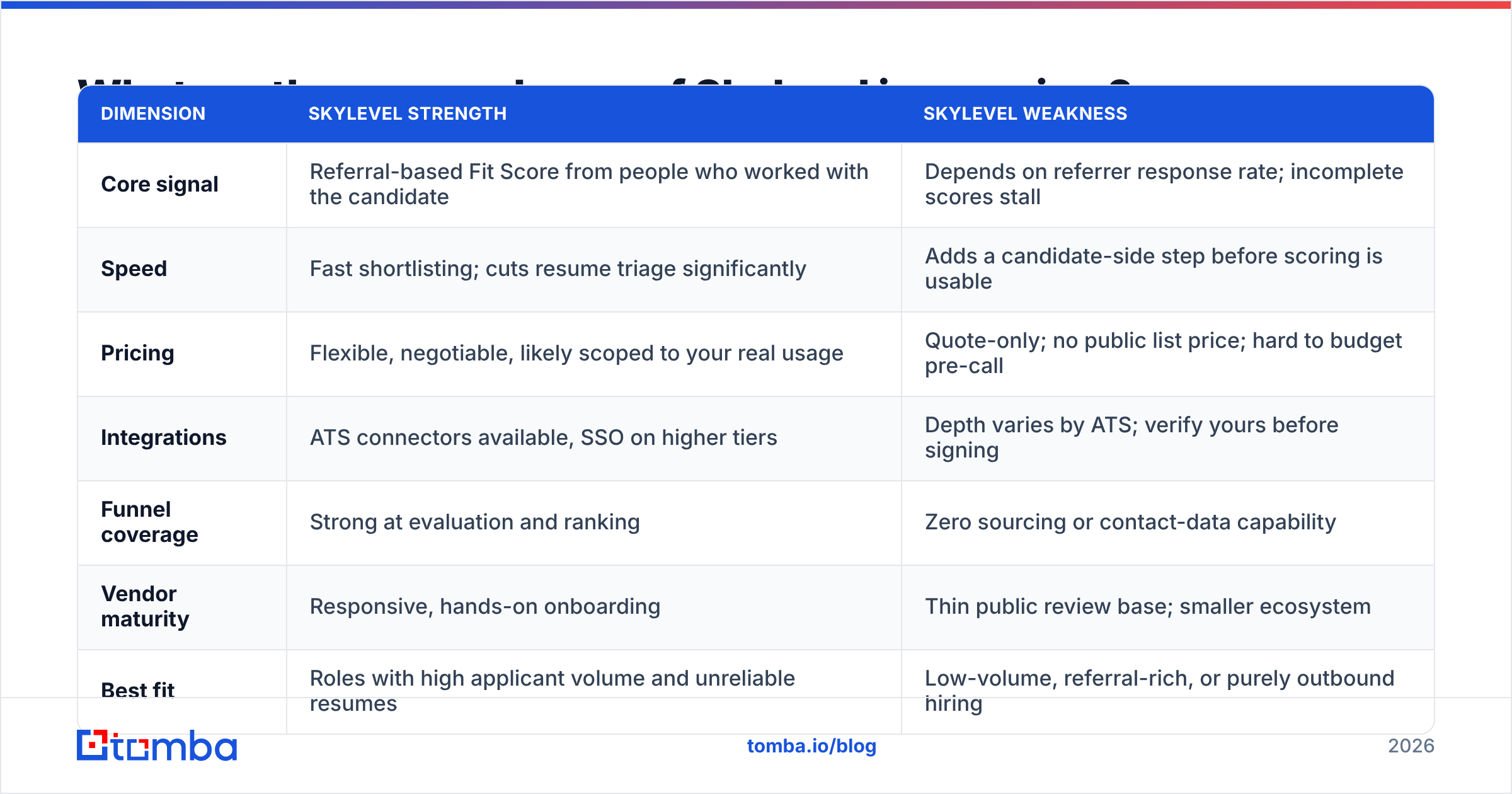
| Dimension | Skylevel strength | Skylevel weakness |
|---|---|---|
| Core signal | Referral-based Fit Score from people who worked with the candidate | Depends on referrer response rate; incomplete scores stall |
| Speed | Fast shortlisting; cuts resume triage significantly | Adds a candidate-side step before scoring is usable |
| Pricing | Flexible, negotiable, likely scoped to your real usage | Quote-only; no public list price; hard to budget pre-call |
| Integrations | ATS connectors available, SSO on higher tiers | Depth varies by ATS; verify yours before signing |
| Funnel coverage | Strong at evaluation and ranking | Zero sourcing or contact-data capability |
| Vendor maturity | Responsive, hands-on onboarding | Thin public review base; smaller ecosystem |
| Best fit | Roles with high applicant volume and unreliable resumes | Low-volume, referral-rich, or purely outbound hiring |
How does Skylevel compare to the alternatives?#
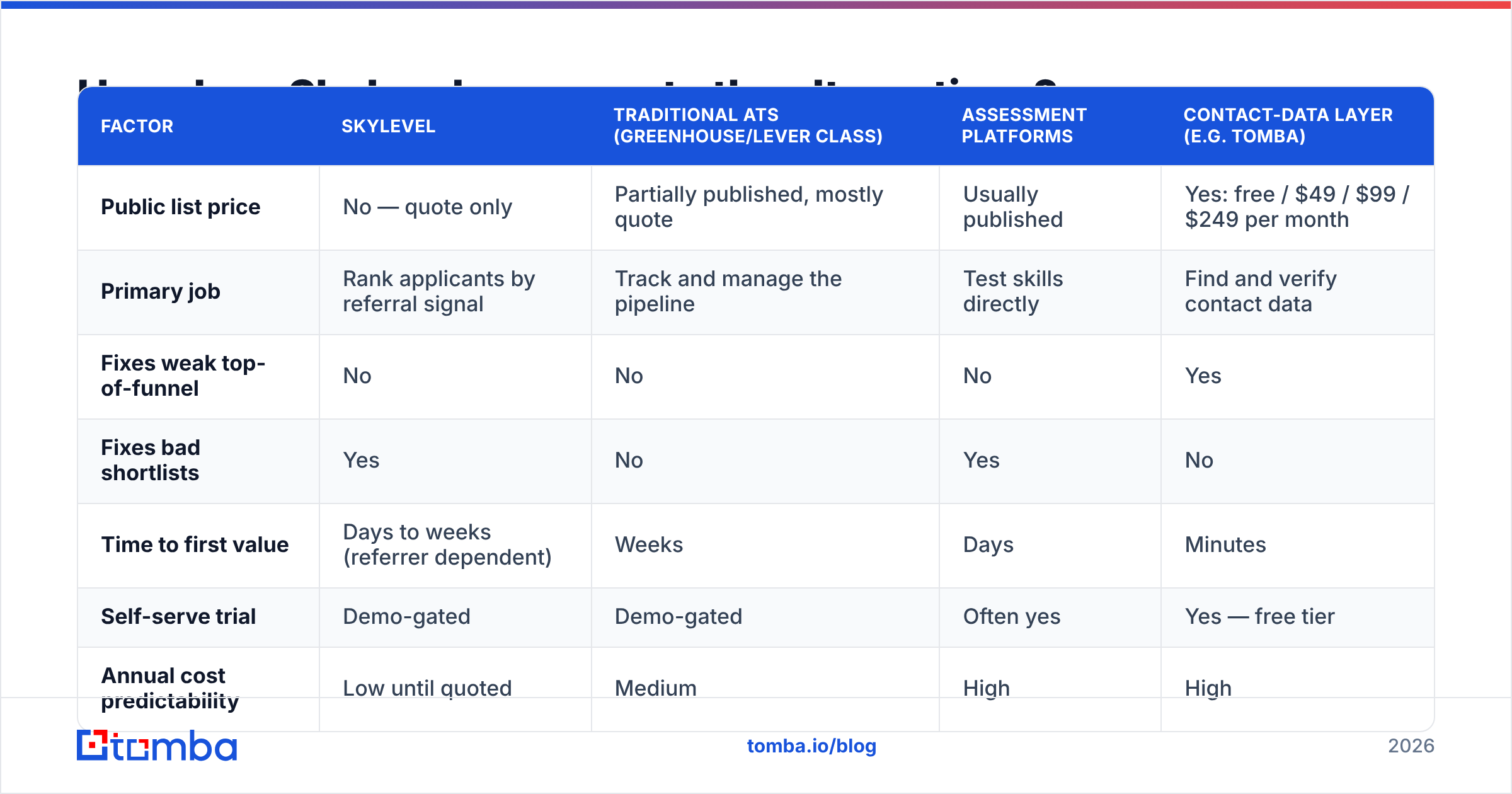
The honest comparison isn't Skylevel versus another Fit-Score tool — there aren't many. It's Skylevel versus the other places you could spend the same budget to fix hiring throughput.
| Factor | Skylevel | Traditional ATS (Greenhouse/Lever class) | Assessment platforms | Contact-data layer (e.g. Tomba) |
|---|---|---|---|---|
| Public list price | No — quote only | Partially published, mostly quote | Usually published | Yes: free / $49 / $99 / $249 per month |
| Primary job | Rank applicants by referral signal | Track and manage the pipeline | Test skills directly | Find and verify contact data |
| Fixes weak top-of-funnel | No | No | No | Yes |
| Fixes bad shortlists | Yes | No | Yes | No |
| Time to first value | Days to weeks (referrer dependent) | Weeks | Days | Minutes |
| Self-serve trial | Demo-gated | Demo-gated | Often yes | Yes — free tier |
| Annual cost predictability | Low until quoted | Medium | High | High |
Read that table honestly and a decision rule falls out. If your problem is that too many unqualified people apply, Skylevel is aimed directly at you. If your problem is that not enough qualified people ever enter the funnel, no amount of Fit Scoring helps — you're optimizing the sort order of an empty list.
What hidden costs should you budget for?#
Quote-based pricing hides cost in four predictable places. Ask about all four before signing.
- Overage on candidate volume. Find out the per-candidate rate above your allowance, in writing. Seasonal hiring spikes are where annual contracts turn into surprise invoices.
- Implementation and ATS connector fees. One-time, often four figures, and almost never mentioned on the first call.
- Renewal uplift. Ask for a capped renewal increase in the first contract. Uncapped renewals on a tool your recruiters now depend on is the single most expensive clause in HR tech.
- The sourcing gap. This is the real one. If Skylevel improves your shortlist quality but your funnel is starved, you'll end up buying a second tool anyway — and that second budget line should have been in the original business case.
For the fourth item, the fix is cheap and measurable. A domain search run against your target companies produces a list of reachable contacts; an email verifier pass keeps bounce rates low so your outreach domain stays healthy. That's a sub-$100/month line item against a quote-only platform decision, and it's the one you can pilot this afternoon.
Is Go Skylevel worth it in 2026?#
Yes, if all three of these are true:
- You get more applicants than you can meaningfully screen — 50+ per role, not 8.
- Your current screen is resume-first and you have evidence it produces bad shortlists (high interview-to-offer ratios, early attrition, hiring-manager complaints about candidate quality).
- Your candidates are the kind of people who have referrers willing to respond — mid-career professionals in stable industries, not first-job applicants or contractors with fragmented histories.
No, if any of these are true:
- Your funnel is thin. Fit Scoring an empty pipeline changes nothing.
- You hire fewer than roughly 15–20 people a year. Quote-based platforms rarely price well at that volume, and manual screening is still cheaper than a contract.
- Your ATS is the center of your process and the connector is shallow. Recruiters will not tab between two systems for long — they'll quietly stop using the second one.
- Procurement requires published pricing or a public reference base. That's a hard stop, and it's not a criticism of the product.
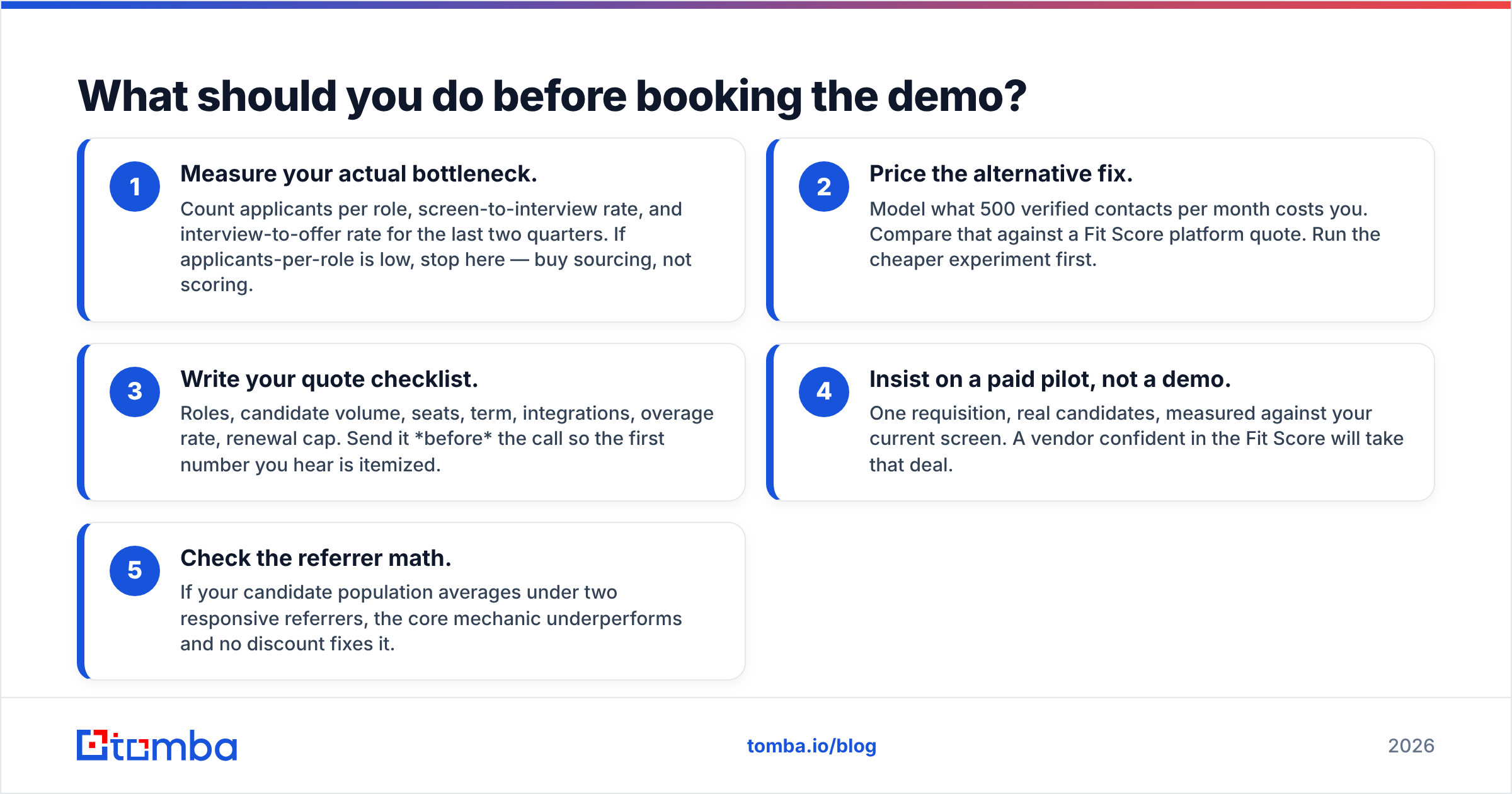
What should you do before booking the demo?#
Do this in order. It takes about an hour and saves a quarter.
- Measure your actual bottleneck. Count applicants per role, screen-to-interview rate, and interview-to-offer rate for the last two quarters. If applicants-per-role is low, stop here — buy sourcing, not scoring.
- Price the alternative fix. Model what 500 verified contacts per month costs you. Compare that against a Fit Score platform quote. Run the cheaper experiment first.
- Write your quote checklist. Roles, candidate volume, seats, term, integrations, overage rate, renewal cap. Send it before the call so the first number you hear is itemized.
- Insist on a paid pilot, not a demo. One requisition, real candidates, measured against your current screen. A vendor confident in the Fit Score will take that deal.
- Check the referrer math. If your candidate population averages under two responsive referrers, the core mechanic underperforms and no discount fixes it.
FAQ#
Does Skylevel publish its pricing? No. As of 2026, pricing is handled through a demo-and-quote process. Any specific figure you find quoted online is someone else's negotiated deal — treat it as a data point, not a list price.
Is Skylevel an ATS replacement? No. It's a scoring and ranking layer that sits alongside your applicant tracking system. Budget for both.
Can Skylevel find candidates for me? No. It evaluates candidates you already have. Sourcing and contact data are a separate problem — and a separate, much cheaper line item.
How accurate is the Fit Score? Accuracy is a function of referrer response rate and honesty. It outperforms keyword resume parsing in most reported cases, but it degrades sharply when candidates nominate unresponsive or uncritical referrers. Pilot before you commit.
The cheaper experiment to run first#
Before you sign a quote-only contract to sort your funnel better, make sure the funnel is full. Most hiring teams that think they have a screening problem actually have a reach problem — the good people never applied, so the Fit Score never had a chance to find them.
Start with the Tomba Email Finder. Give it a name and a company domain and it returns a verified professional email, so your recruiters can reach the passive candidates and hiring partners who never touched your job board. The free tier covers 25 searches a month, Starter is $49/mo, and there's no demo call between you and the answer. Fill the top of the funnel first — then decide whether you need to pay someone to sort it.
Related guides#
Ready to find emails that actually work?
Join 150,000+ professionals who stopped guessing and started sending. Free credits on signup — no credit card required.
Get the Tomba newsletter
Practical outbound tactics and product updates — once every two weeks.
About the author