Go-To-Market Approach: How to Build One That Actually Ships
Most go-to-market plans die in a slide deck. This guide breaks down the four GTM motions, when each one works, and the data layer that decides whether your launch reaches real buyers.

TL;DR
- A go to market approach is a decision about motion — how buyers find you, evaluate you, and pay you — not a launch checklist or a deck.
- There are four durable motions: product-led, sales-led, account-based, and channel/partner. Most companies under $10M ARR should run one primary and at most one secondary.
- Motion fit is dictated by three numbers: annual contract value, buyer count per deal, and time-to-value. Get those wrong and no amount of execution saves the plan.
- Your GTM plan is only as good as the contact data underneath it. Sales-led and ABM motions die on bad emails long before they die on bad messaging.
- Measure the approach with leading indicators (meetings per rep, activation rate, account coverage) for the first two quarters. Revenue lags too much to steer by.
What is a go to market approach?#
A go to market approach is the specific way you connect a product to the people who will pay for it — which buyers you target, which motion reaches them, what you charge, and who does the reaching.
Think of it like choosing how to get a restaurant its first hundred customers. You can open the doors and let foot traffic decide (product-led). You can hire someone to work the phones and book tables (sales-led). You can pick fifty local companies and court their office managers personally (account-based). Or you can pay a hotel concierge to send guests your way (channel). All four fill seats. They cost wildly different amounts, require different staff, and break in different ways.
The mistake most teams make is treating GTM as a launch event — a date, a press release, a Product Hunt post. That is a launch plan. A go to market approach is the ongoing system that keeps producing pipeline after launch week ends, and it has five components:
- Target segment — the narrowest group of accounts where your product is obviously the right answer, defined by firmographics, tech stack, or trigger events.
- Value proposition — the specific outcome the buyer gets, stated in their language and tied to a metric they already report on.
- Motion — product-led, sales-led, account-based, or channel. This is the load-bearing choice.
- Pricing and packaging — the model that makes the motion economically viable (self-serve tiers, seat pricing, usage, annual contracts).
- Data and tooling layer — the contact data, CRM, and automation that let the motion actually run at volume.
Skip any one of these and the plan becomes a slide. Skip number five and it becomes a slide with a very expensive sales team attached.
Which GTM motion fits your product?#
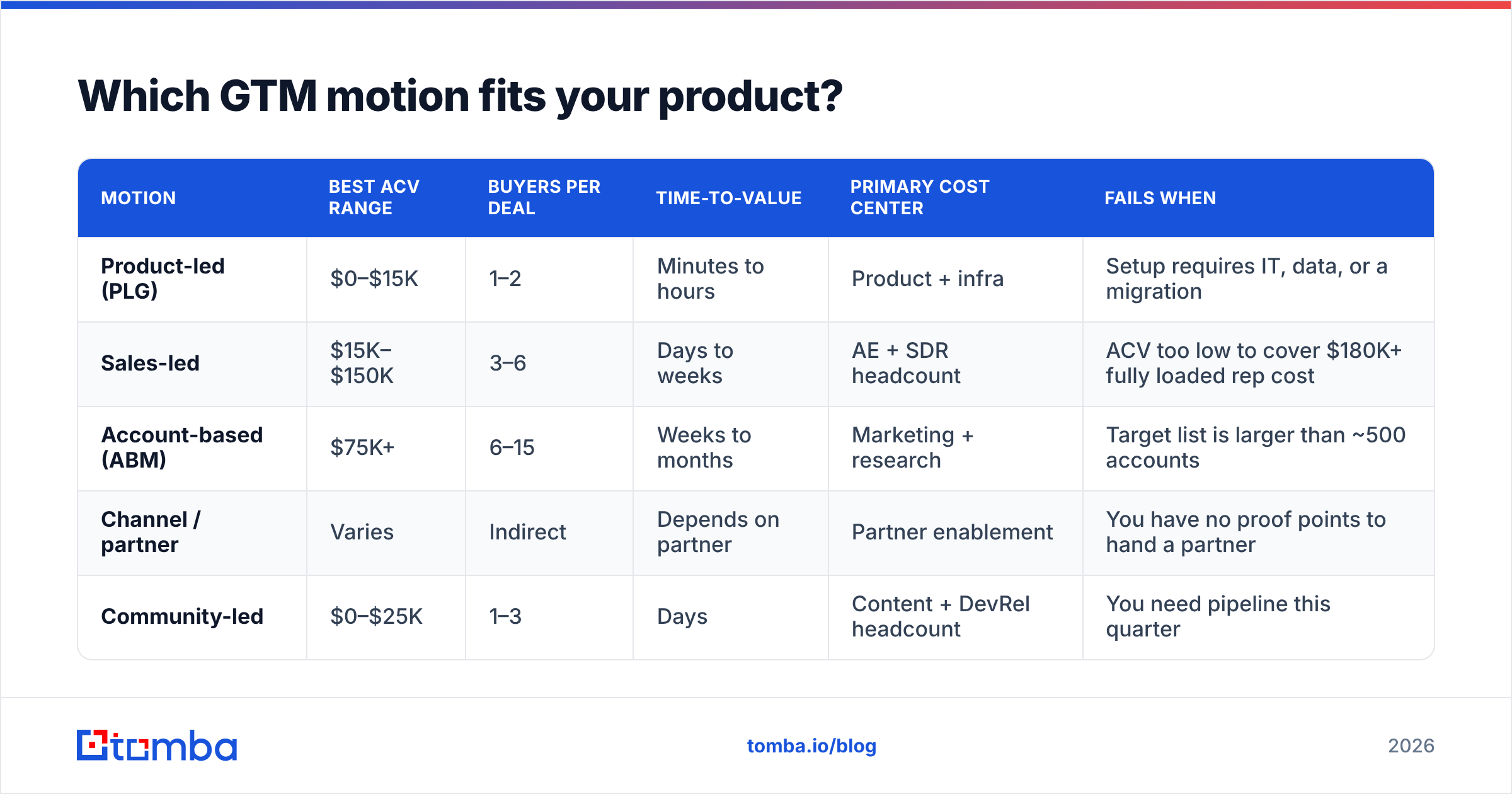
Motion selection comes down to three numbers you can pull today: average contract value, number of humans involved in a purchase decision, and how long it takes a new user to feel value.
| Motion | Best ACV range | Buyers per deal | Time-to-value | Primary cost center | Fails when |
|---|---|---|---|---|---|
| Product-led (PLG) | $0–$15K | 1–2 | Minutes to hours | Product + infra | Setup requires IT, data, or a migration |
| Sales-led | $15K–$150K | 3–6 | Days to weeks | AE + SDR headcount | ACV too low to cover $180K+ fully loaded rep cost |
| Account-based (ABM) | $75K+ | 6–15 | Weeks to months | Marketing + research | Target list is larger than ~500 accounts |
| Channel / partner | Varies | Indirect | Depends on partner | Partner enablement | You have no proof points to hand a partner |
| Community-led | $0–$25K | 1–3 | Days | Content + DevRel headcount | You need pipeline this quarter |
The rows are not mutually exclusive, but they are sequentially dependent. Channel motions almost never work before you have a repeatable direct motion, because partners resell certainty, not potential. And ABM before product-market fit is just expensive guessing at scale.
Two practical tests:
- The $2,000 test. If your annual contract value is under roughly $2,000, a human cannot profitably touch the deal. You need self-serve. A fully loaded SDR plus AE costs more per closed deal than the deal is worth.
- The demo test. If a motivated prospect cannot get to a genuine "oh, that's useful" moment without a human walking them through it, PLG will leak users faster than you can acquire them. Fix onboarding first or accept a sales-led motion.
How is a GTM approach different from a marketing plan?#
A marketing plan is a subset. It answers how we generate awareness and demand. A go to market approach answers how the whole company converts a product into revenue, and it makes commitments that marketing alone cannot honor.
The clearest separator is ownership of the handoff points. In a real GTM plan, someone owns what happens when a free user hits a usage limit, when an inbound lead scores above threshold, when a target account's VP of Engineering changes jobs, and when a partner-sourced deal needs technical validation. A marketing plan usually stops at "MQL delivered."
That handoff design is where most GTM approaches quietly fail. You can have excellent demand generation and still lose 40% of qualified interest to routing delays, unassigned accounts, or a marketing qualified lead definition that sales openly ignores. This is the domain of revenue operations — and if nobody at your company owns it, the answer is that nobody owns your GTM approach either.
What does a go to market approach cost to run?#
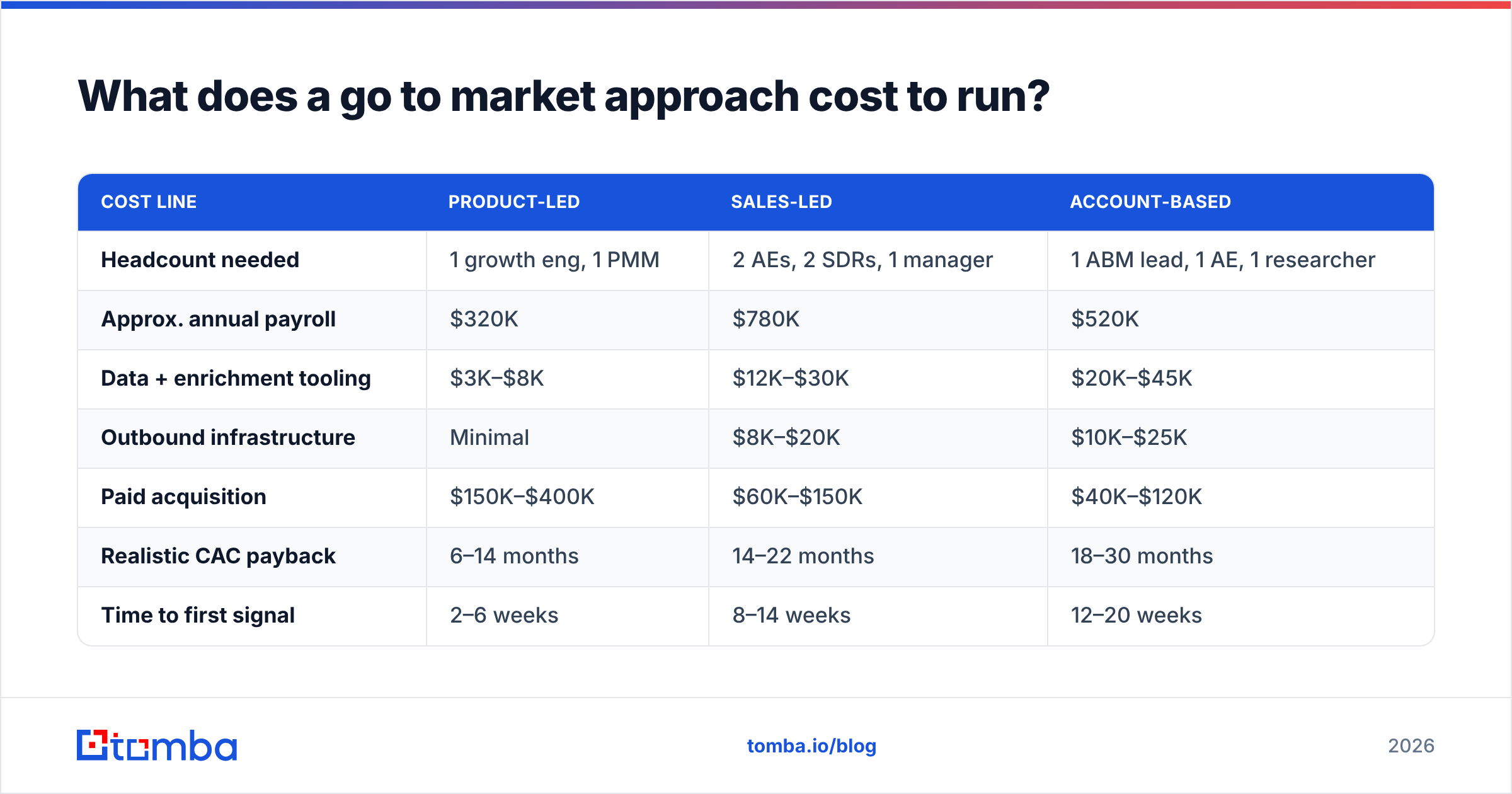
Cost per motion diverges more than most founders expect. Here is a realistic annual view for a company targeting $2M in new ARR, using US-market fully loaded costs.
| Cost line | Product-led | Sales-led | Account-based |
|---|---|---|---|
| Headcount needed | 1 growth eng, 1 PMM | 2 AEs, 2 SDRs, 1 manager | 1 ABM lead, 1 AE, 1 researcher |
| Approx. annual payroll | $320K | $780K | $520K |
| Data + enrichment tooling | $3K–$8K | $12K–$30K | $20K–$45K |
| Outbound infrastructure | Minimal | $8K–$20K | $10K–$25K |
| Paid acquisition | $150K–$400K | $60K–$150K | $40K–$120K |
| Realistic CAC payback | 6–14 months | 14–22 months | 18–30 months |
| Time to first signal | 2–6 weeks | 8–14 weeks | 12–20 weeks |
Two things stand out. First, sales-led is the most expensive to start and the slowest to give you a clean read — you need roughly two quarters before rep performance separates from ramp noise. Second, the data and tooling line is small in absolute terms but disproportionately determines whether the payroll line produces anything. A $780K sales team running on a list with 35% bounce-prone addresses is a $780K team operating at roughly two-thirds capacity.
Benchmarks from G2's software buyer behavior research and Gartner's B2B buying journey work consistently show buying groups of six to ten people for enterprise software. That number is the single best predictor of which column you belong in.
Why does contact data decide whether your GTM approach works?#
Because every motion except pure PLG requires reaching a specific named human, and the cost of reaching the wrong one compounds.
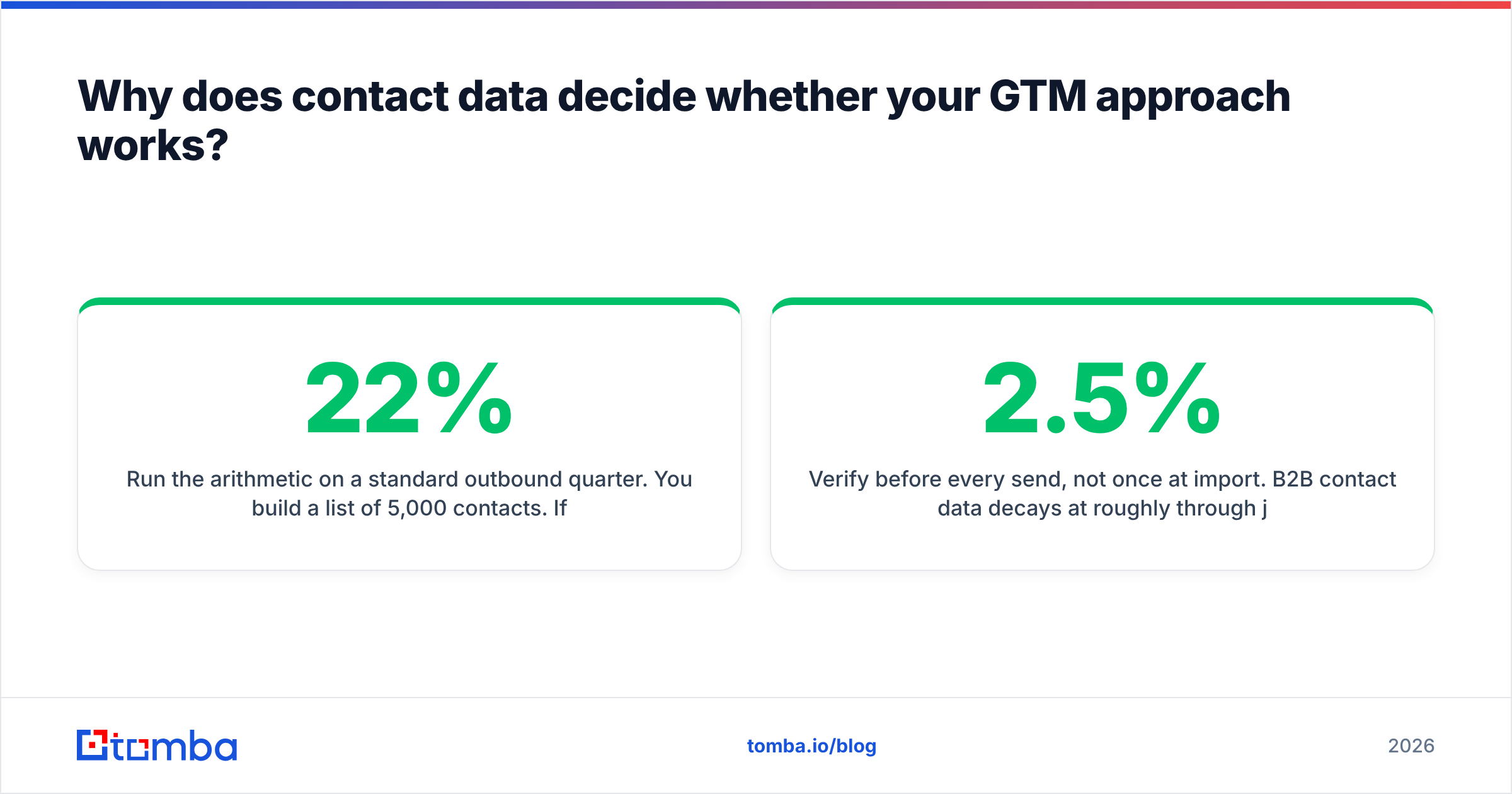
Run the arithmetic on a standard outbound quarter. You build a list of 5,000 contacts. If 22% of the addresses are invalid — a normal figure for scraped or aging list data — you send 1,100 emails into the void. Those bounces do not just waste sends. They damage sender reputation, which suppresses inbox placement for the 3,900 valid addresses too. A bad list does not cost you 22% of your results. It routinely costs 50% or more, because deliverability degradation is nonlinear.
The same problem shows up differently in ABM. When your target list is 200 accounts and you need six contacts inside each, missing coverage on two or three roles per account means you are running account-based marketing against half an account. Coverage gaps are invisible in dashboards — the campaign reports fine, it just never reaches the economic buyer.
Practical hygiene that pays for itself in one quarter:
- Verify before every send, not once at import. B2B contact data decays at roughly 2.5% per month through job changes alone. A list verified in January is meaningfully worse by April. Run it through an email verifier as a pre-send step.
- Handle catch-all domains explicitly. A large share of enterprise domains accept everything at the SMTP layer, so a standard verify returns "unknown." Route those through a catch-all verifier rather than guessing or discarding them wholesale.
- Enrich for role, not just email. Knowing the address is worthless if you cannot tell whether that person signs contracts. Data enrichment that returns seniority and department is what makes account coverage measurable.
- Build lists by account, not by persona blast. Use domain search to map who actually works at a target company, then filter to your buying committee — the reverse of buying a persona list and hoping the accounts overlap with your ICP.

How do you sequence a GTM launch over 90 days?#
Sequencing matters more than completeness. A partially built motion running against real buyers teaches you more in three weeks than a fully built motion designed in a conference room.
Days 1–30: narrow and instrument. Pick one segment — one industry, one company size band, one use case. Write the ICP as a filter someone else could apply without asking you questions. Instrument the funnel before you fill it: if you cannot see where prospects drop, you will misattribute every failure to messaging. Build a target list of 150–300 accounts, not 3,000.
Days 31–60: run the motion manually. Founders should personally do the first fifty outreach sequences, demos, or onboarding calls. Not because it scales — it does not — but because the objections you hear in week five become the positioning you ship in week nine. Track reply reasons, not just response rate. "Not now" and "we already use X" require completely different fixes.
Days 61–90: find the one repeatable thing and automate around it. By now one channel, one message, or one segment is outperforming. Do not diversify. Pour resources into the thing that works and cut the rest, even if it feels premature. This is where you wire the Tomba API or your enrichment layer into the CRM so list building stops being a person's weekly chore.
A note on what not to do in the first 90 days: do not hire a VP of Sales to figure out your motion for you. Motion discovery is a founder job. VPs scale motions that already convert; they rarely invent them from zero, and the mismatch is the most common expensive GTM mistake at Series A.
What metrics tell you the approach is working?#
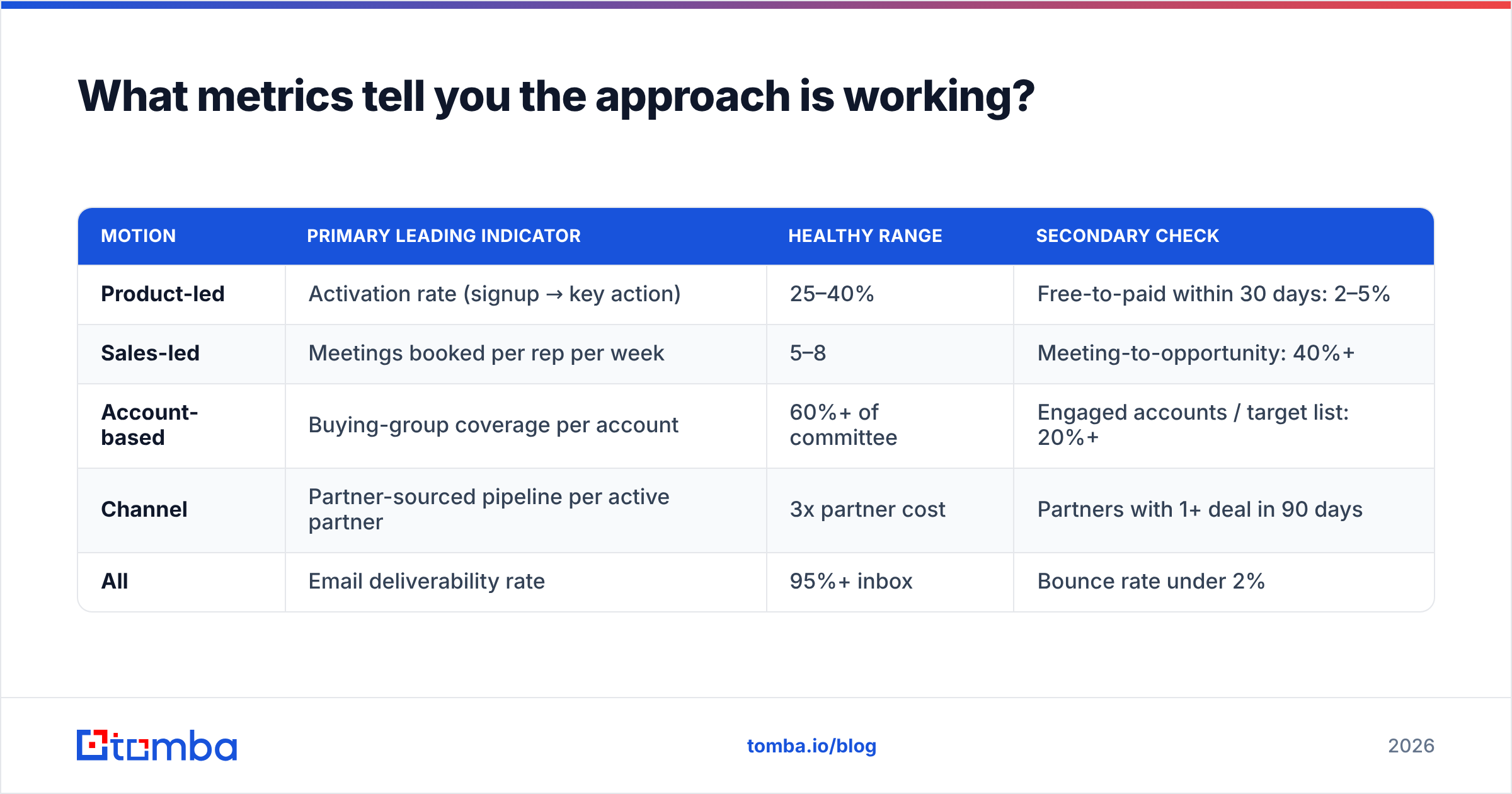
Revenue is a lagging indicator with a two-quarter delay. Steer by leading indicators instead, and pick the ones matched to your motion.
| Motion | Primary leading indicator | Healthy range | Secondary check |
|---|---|---|---|
| Product-led | Activation rate (signup → key action) | 25–40% | Free-to-paid within 30 days: 2–5% |
| Sales-led | Meetings booked per rep per week | 5–8 | Meeting-to-opportunity: 40%+ |
| Account-based | Buying-group coverage per account | 60%+ of committee | Engaged accounts / target list: 20%+ |
| Channel | Partner-sourced pipeline per active partner | 3x partner cost | Partners with 1+ deal in 90 days |
| All | Email deliverability rate | 95%+ inbox | Bounce rate under 2% |
That last row applies regardless of motion, and it is the one most teams never put on a dashboard. If you are running any outbound component, email deliverability is upstream of every other number in the table. A 6% bounce rate does not show up as a deliverability problem in your reporting. It shows up as a messaging problem, a rep performance problem, or a "the market isn't ready" problem — and you will spend a quarter fixing the wrong thing.
Set a review cadence of four weeks for leading indicators and one quarter for the motion decision itself. Changing motions monthly is how companies end up with three half-built GTM approaches and no pipeline.
When should you change your go to market approach?#
Change the motion when the economics break, not when the quarter is disappointing. Three specific signals justify a rethink:
- CAC payback exceeds 24 months for two consecutive quarters. Something structural is wrong — usually ACV too low for the motion, or a segment that requires more touches than modeled.
- Win rates diverge sharply by segment. If you close 35% in one vertical and 8% everywhere else, you do not have a GTM problem, you have a targeting problem. Narrow before you rebuild.
- Your buyer changed. Procurement getting involved, security reviews appearing, or a new title showing up on calls all mean you have moved upmarket whether you planned to or not. The motion has to follow the buyer.
What does not justify a change: one bad month, a competitor's funding announcement, or a board member's anecdote. Motion changes cost roughly two quarters of momentum. Make them rarely and deliberately.
Putting the approach into practice#
The honest summary: your go to market approach is a small number of hard choices — one segment, one motion, one pricing model — followed by a lot of unglamorous execution against a clean data layer. Teams overinvest in the choices and underinvest in the data that makes them executable.
If your approach involves reaching named humans at named companies — and every motion except pure self-serve does — start by fixing the list. Use the Tomba Email Finder to build target-account contact lists from a domain and a name, verify them before every send, and enrich for role so you can actually measure buying-group coverage. The free tier gives you 25 searches a month to test the workflow; paid plans start at $49/mo on Starter and $99/mo on Growth, with full Tomba pricing laid out if you need bulk volume or API access. Get the data layer right and the motion you picked finally gets a fair test.
Related guides#
Ready to find emails that actually work?
Join 150,000+ professionals who stopped guessing and started sending. Free credits on signup — no credit card required.
Get the Tomba newsletter
Practical outbound tactics and product updates — once every two weeks.
About the author