Go To Market Best Practices for Startups: 2026 Playbook
Most startup GTM failures are not marketing problems — they are sequencing problems. Here is the motion-by-motion playbook, with the numbers that tell you when to switch.
The go to market best practices for startups are easy to list and hard to follow. Pick one motion. Prove it converts. Then add a second. Most teams do the reverse and scale before they have proof.
TL;DR
- GTM failure at seed and Series A is rarely a creative problem. It is a sequencing problem. Founders scale a motion before they have proof it converts.
- Pick one primary motion for your first 50 customers: founder-led sales, product-led growth, or outbound. Running two at once halves the learning rate of both.
- Your ICP is a filter, not a persona doc. Use 5 to 7 criteria a prospect either passes or fails, checked before anyone writes an email.
- Data quality caps your whole GTM. A 40% bounce list wastes sends, damages domain reputation, and corrupts every metric you use to decide.
- Track four numbers weekly: qualified meetings per rep, ICP-fit rate of closed-won, CAC payback, and reply rate.
What does "go-to-market" actually mean for a startup?#
Go-to-market is the repeatable sequence a specific buyer follows to find your product, judge it, and pay for it. That is the whole definition. It is not a launch date, not a positioning deck, and not a Notion page called "GTM Strategy Q3."
The useful test: can you write down, in one sentence, who buys, what triggers them to buy, how they find you, and who talks to them? If any of those four slots is blank or reads "everyone," you do not have a go-to-market motion. You have a hope.
Startups get this wrong in a predictable way. They treat GTM as a set of parallel channels to switch on — content, ads, outbound, partnerships, community — and staff each one thinly. Six months later every channel shows weak, ambiguous data. Nobody can tell whether the channel failed or the execution did. The alternative is boring and it works: one motion, run hard enough to produce a clear verdict, then a second.
Bessemer's State of the Cloud research and repeated Gartner buyer surveys point the same direction. B2B buyers now finish most of their evaluation before they speak to a vendor. So your GTM has to place useful signal where they already are, not chase them once they raise a hand.
Go to market best practices for startups: pick one motion first#
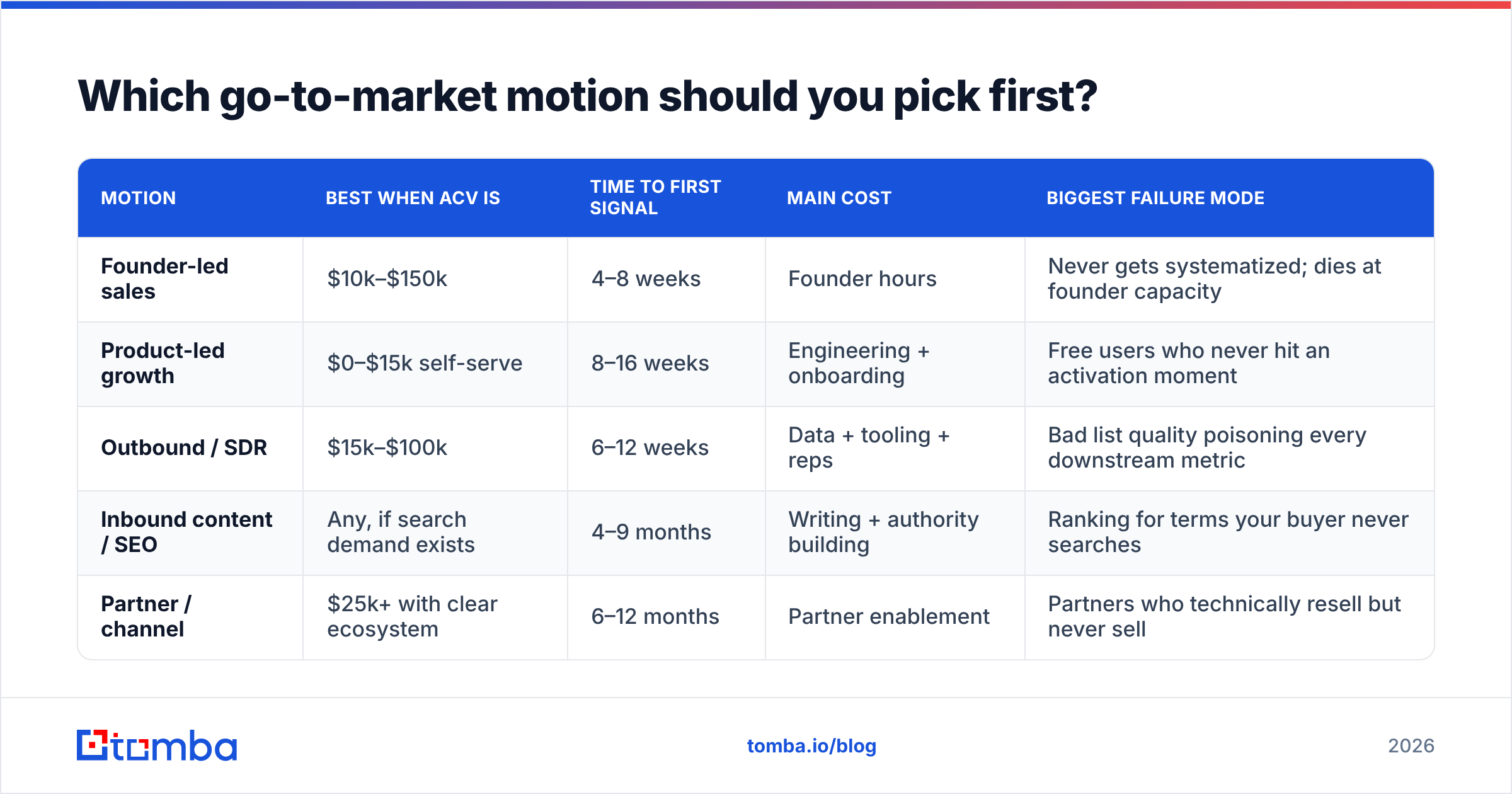
Choose based on your deal size and how self-evident your product is, not on what worked for a company you admire.
| Motion | Best when ACV is | Time to first signal | Main cost | Biggest failure mode |
|---|---|---|---|---|
| Founder-led sales | $10k–$150k | 4–8 weeks | Founder hours | Never gets systematized; dies at founder capacity |
| Product-led growth | $0–$15k self-serve | 8–16 weeks | Engineering + onboarding | Free users who never hit an activation moment |
| Outbound / SDR | $15k–$100k | 6–12 weeks | Data + tooling + reps | Bad list quality poisoning every downstream metric |
| Inbound content / SEO | Any, if search demand exists | 4–9 months | Writing + authority building | Ranking for terms your buyer never searches |
| Partner / channel | $25k+ with clear ecosystem | 6–12 months | Partner enablement | Partners who technically resell but never sell |
A blunt heuristic: below roughly $5k annual contract value, a human sales conversation cannot pay for itself. PLG or self-serve is close to mandatory there. Above $25k, buyers expect a person, and pure self-serve leaves money on the table. Between those numbers you are in the awkward middle. Founder-led sales is your research instrument — you sell by hand not because it scales, but because it teaches you what to automate.
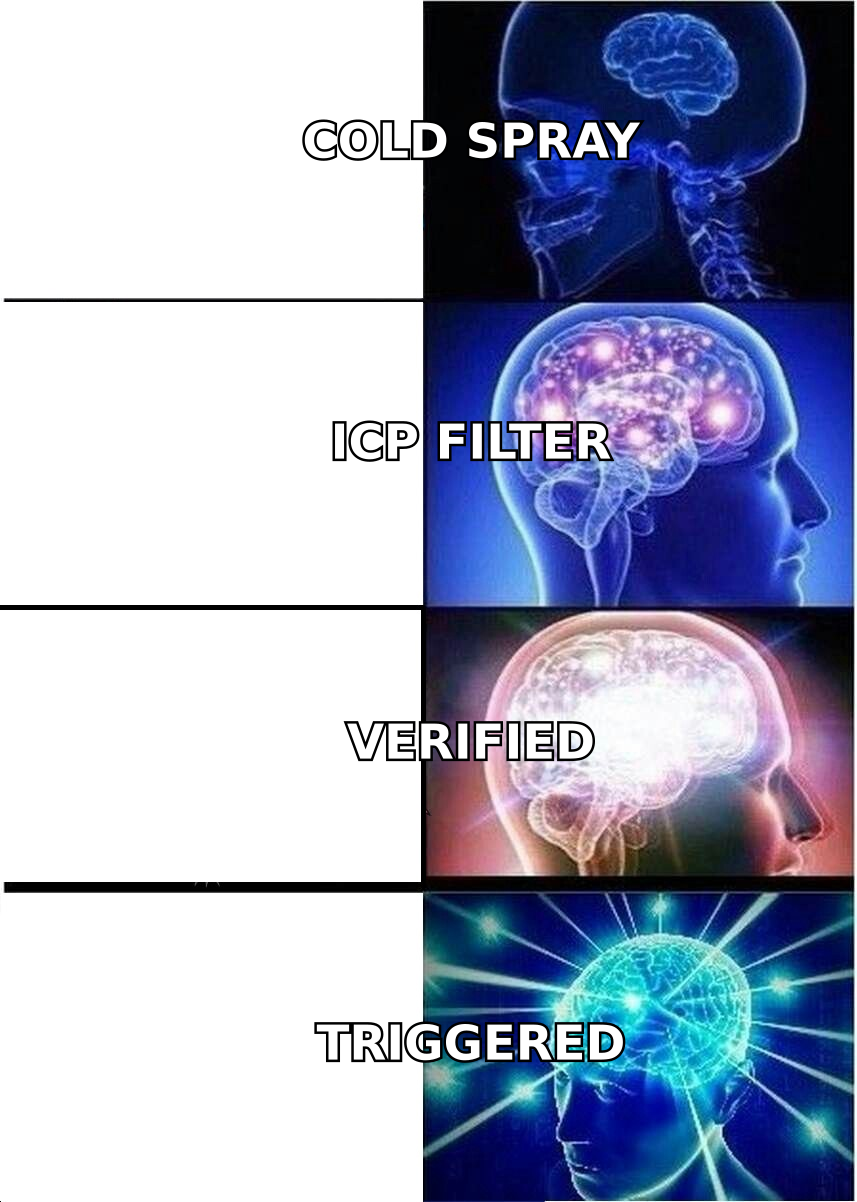
The rule most founders break: do not add motion two until motion one has produced at least 20 closed-won customers who look like each other. Similarity is the signal. Twenty wins scattered across seven industries means you have found nothing repeatable. You have found twenty separate one-off sales.
How do you define an ICP you can actually operate?#
An ideal customer profile is only useful if it produces a yes/no answer on a specific company in under 30 seconds. Build it as a filter, not a narrative.
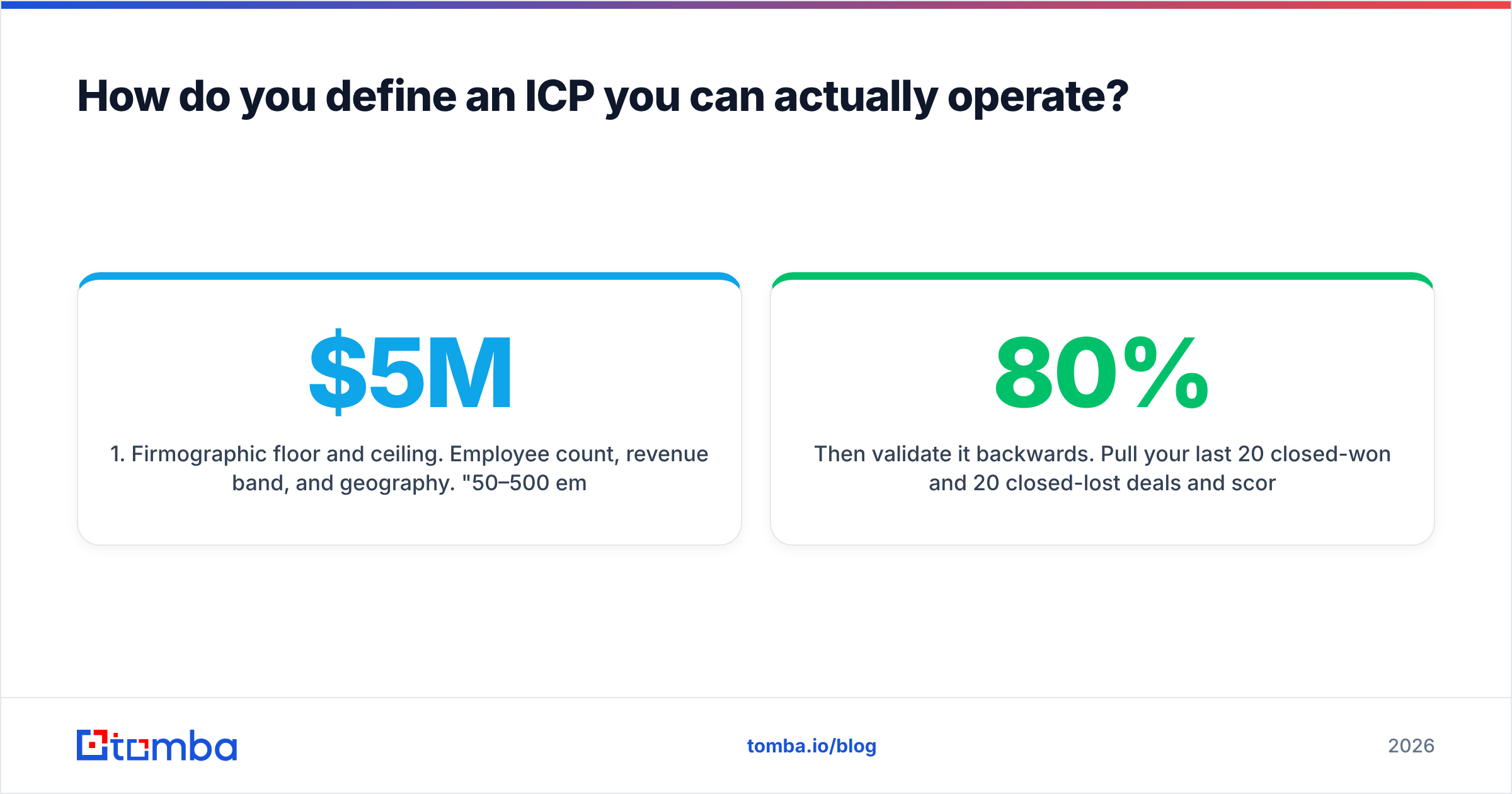
- Firmographic floor and ceiling. Employee count, revenue band, and geography. "50–500 employees, US/EU, $5M–$100M revenue" is operable. "Mid-market" is not.
- Technographic trigger. What must already be in their stack for you to matter? If you integrate with HubSpot, HubSpot usage is a hard filter, not a nice-to-have.
- Structural signal. Does a specific role exist there? A company with no RevOps hire will not buy a RevOps tool no matter how good your demo is.
- Event trigger. Funding round, new VP hire, office expansion, competitor churn, a job posting that names your problem. Events beat static attributes because they carry timing.
- Disqualifiers. Write these down explicitly. Regulated industries you cannot serve, sub-10-person teams, companies locked into a competitor on a 3-year contract. Disqualifiers save more time than qualifiers do.
Then validate it backwards. Pull your last 20 closed-won and 20 closed-lost deals and score each against the filter. If closed-won accounts pass at 80%+ and closed-lost pass at under 40%, the filter is real. If both groups score alike, your ICP is decoration. Rewrite it.
This is where most GTM plans quietly break. The ICP lives in a doc, but the prospecting list gets built from whatever export was easiest. Close the gap. Make the filter a literal step in list building, with a named owner who rejects lists that fail it.
What data infrastructure does a startup GTM actually need?#
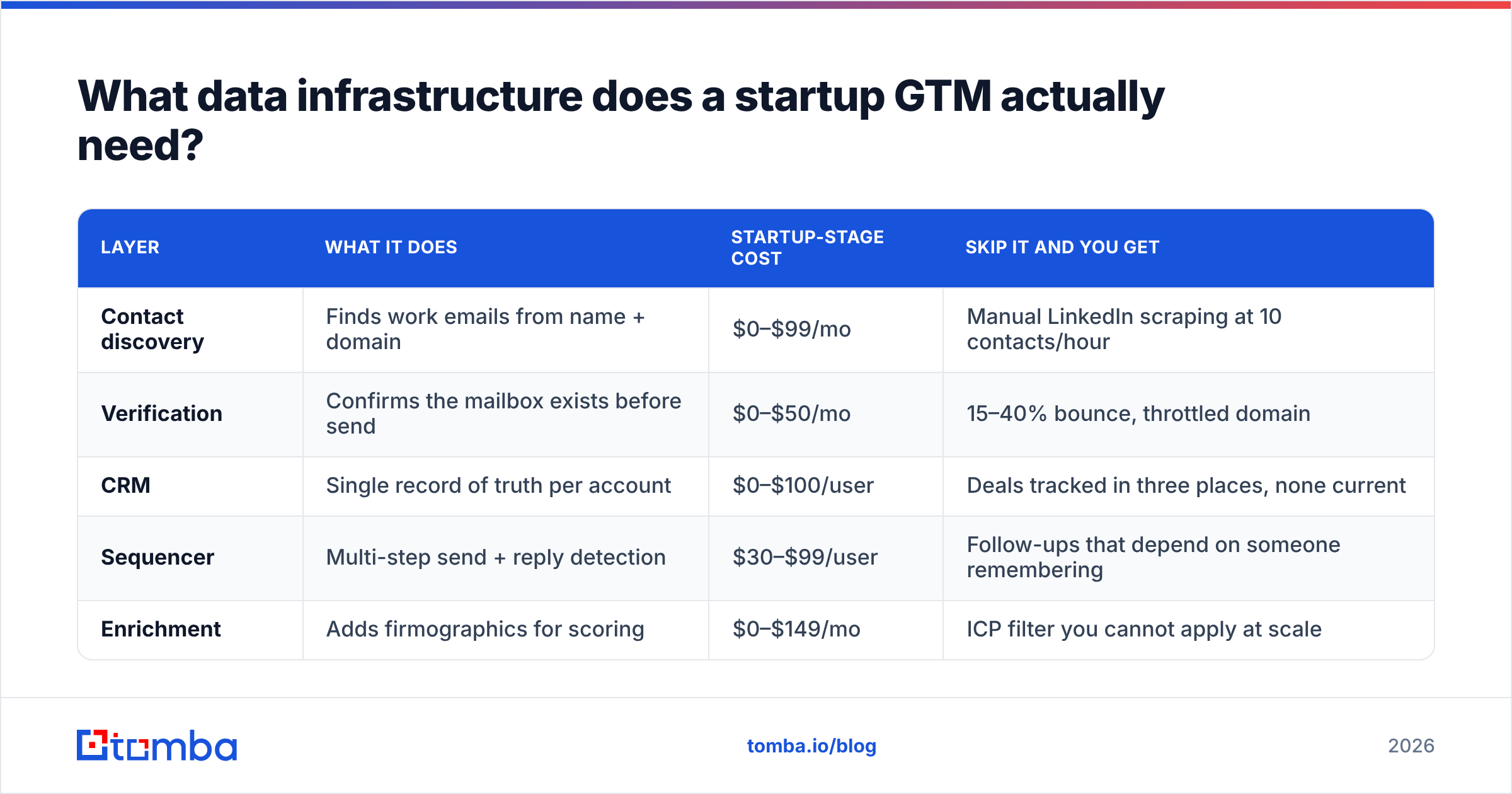
Less than vendors want to sell you, more than a spreadsheet. The minimum viable stack is a source of contact data, a verification layer, a CRM, and a sequencer. That is four tools, and three of them are cheap.
The verification layer is the one founders skip, and it is the one that compounds. Contact data decays fast. B2B records go stale at roughly 22–30% per year as people change jobs, so a list you bought in January is measurably worse by June.
Send to an unverified list and three things happen at once. Your bounce rate climbs past the 2% mark where mailbox providers start throttling you. Your sender reputation degrades. And your reply-rate data becomes useless, because you cannot tell a bad message from a dead inbox.
| Layer | What it does | Startup-stage cost | Skip it and you get |
|---|---|---|---|
| Contact discovery | Finds work emails from name + domain | $0–$99/mo | Manual LinkedIn scraping at 10 contacts/hour |
| Verification | Confirms the mailbox exists before send | $0–$50/mo | 15–40% bounce, throttled domain |
| CRM | Single record of truth per account | $0–$100/user | Deals tracked in three places, none current |
| Sequencer | Multi-step send + reply detection | $30–$99/user | Follow-ups that depend on someone remembering |
| Enrichment | Adds firmographics for scoring | $0–$149/mo | ICP filter you cannot apply at scale |
Practically: use a domain search to map every reachable contact at a target account rather than guessing at one name. Run the output through an email verifier before it touches your sequencer. Push only verified records into the CRM. Tomba's free tier covers 25 searches a month, which is enough to test the workflow on a sample list; paid plans start at $49/mo on Tomba pricing when you need volume. Whatever tool you choose, verification has to happen before the send, not as cleanup after Google and Microsoft have already logged your bounce rate.
For lists you buy rather than build, treat the source as an input to verification, not a replacement for it. Providers like BookYourData offer pay-as-you-go B2B contact lists with their own accuracy guarantees, which suits startups that need a cold-start list without an annual commitment. Any purchased list still deserves a verification pass against your own sending domain before the first send. Deliverability is a function of your domain's history, not the vendor's.
How should you sequence the first 12 months?#
Time-box each phase and define the exit criterion before you start it. Phases without exit criteria run forever. Most go to market best practices for startups fail here, not at the idea stage.
Months 0–3: manual proof. The founder sells. No SDRs, no automation, no paid ads. Target 30–50 conversations. The exit criterion is 10 paying customers and a written answer to three questions: what problem did they name, what did they compare us to, what nearly killed the deal. Record every call.
Months 3–6: pattern extraction. Same motion, but now you instrument it. Build the ICP filter from the wins. Write the objection-handling doc from the losses. Standardize a demo. The exit criterion is a process another person could follow. Hand your notes to a new hire and see if they can run a first call.
Months 6–9: first scaled hire. One AE or one SDR, not a team. A single hire ramping to 60–70% of founder productivity proves the motion is transferable. Two hires at once means you cannot tell whether a failure was the process or the person. The exit criterion is that new hire hitting quota-equivalent output.
Months 9–12: second channel. Only now. Layer inbound content on top of outbound, or add self-serve alongside sales-led. You are adding a channel to a working machine, not searching for a machine.
The most common deviation is hiring a VP of Sales at month four to "build the GTM." A VP of Sales scales a motion that already exists. They do not discover one. Hiring that role before product-market fit is the most expensive sequencing mistake in early-stage B2B. It usually costs 9 to 12 months plus the runway burned.

Which metrics tell you the motion is working?#
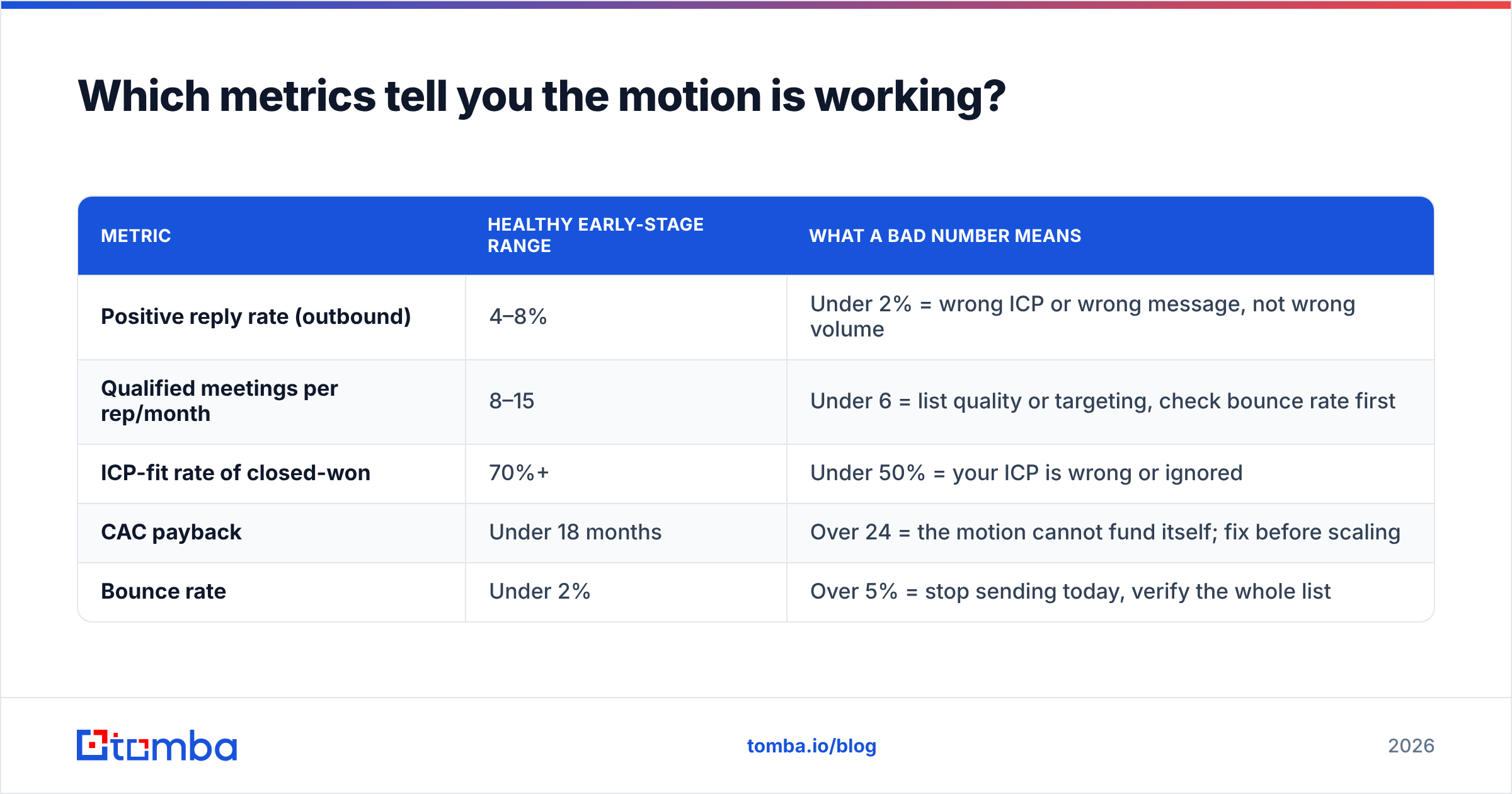
Four numbers, reviewed weekly. Add more only when these are stable.
| Metric | Healthy early-stage range | What a bad number means |
|---|---|---|
| Positive reply rate (outbound) | 4–8% | Under 2% = wrong ICP or wrong message, not wrong volume |
| Qualified meetings per rep/month | 8–15 | Under 6 = list quality or targeting, check bounce rate first |
| ICP-fit rate of closed-won | 70%+ | Under 50% = your ICP is wrong or ignored |
| CAC payback | Under 18 months | Over 24 = the motion cannot fund itself; fix before scaling |
| Bounce rate | Under 2% | Over 5% = stop sending today, verify the whole list |
The diagnostic order matters. When outbound underperforms, founders rewrite copy first because it is the most visible variable. Wrong order. Check bounce rate, then ICP-fit of the list, then targeting seniority, and only then the message. Copy is the fourth thing to fix, not the first. A perfect email to the wrong person at a dead address fails in a way no rewrite repairs.
Watch response rate as a leading indicator and CAC payback as the lagging one. A rising reply rate with flat payback usually means you are attracting curiosity, not budget. You are talking to the right industry but the wrong seniority.
What are the most common GTM mistakes at seed stage?#
- Scaling before proof. Hiring three SDRs against an unvalidated ICP burns about $300k. The data it produces is too noisy to learn from. Add one rep at a time.
- Weighting every channel the same. Attention is the scarce resource. One channel at full effort beats two at half.
- Positioning against a category. Buyers do not compare you to "legacy solutions." They compare you to a named competitor or to a spreadsheet. Name the real alternative.
- Ignoring email deliverability until it breaks. Set up SPF, DKIM, and DMARC before your first campaign. Warm new domains for two to three weeks.
- Confusing pipeline with progress. A pipeline full of non-ICP accounts is worse than an empty one. It justifies headcount a real forecast would not.
- No disqualification discipline. Reps who never say no produce a forecast nobody trusts. Make "disqualified" a good outcome in pipeline review.
G2's buyer behavior research and Gartner's B2B buying studies land on the same uncomfortable point. Buyers spend most of the purchase cycle without you in the room. Your GTM has to work when you are absent, which means clear positioning, findable proof, and contacts who actually receive what you send.
How do you know when to change the motion?#
Change when the data is unambiguous, not when it is uncomfortable. Three signals justify a pivot in motion:
Cost signal. CAC payback exceeds 24 months for two straight quarters with no improving trend. The motion cannot fund its own growth.
Conversion signal. Meeting-to-opportunity conversion sits under 20% after you have fixed list quality and targeting. The buyer you reach cannot actually buy. That is usually a seniority or budget-authority mismatch.
Demand signal. Inbound requests keep coming from a segment your outbound ignores. That is the market telling you where the pull is. Follow it rather than arguing with it.
What does not justify a pivot: one bad month, a competitor's funding announcement, or a board member's anecdote. Give any motion one full sales cycle plus 30 days before you judge it. Judge it against pre-written criteria, so you are not grading your own homework after the fact.
Go to market best practices for startups: build the list first#
The cheapest GTM improvement available to most startups is not a new channel or a new hire. It is making sure the people you already decided to contact actually receive your message. Verified contacts fix bounce rates, protect domain reputation, and make every other metric in your funnel readable.
Start there. Use the Tomba Email Finder to build a clean, ICP-filtered contact list from your target domains. Verify every address before it enters a sequence. Then run your first motion against data you can trust. The free tier covers 25 searches a month, which is enough to validate the workflow on a real segment before you commit a dollar to headcount.
Sequencing beats spending. Get the first motion right, prove it with 20 similar customers, then scale the thing that already works.
Related guides#
Ready to find emails that actually work?
Join 150,000+ professionals who stopped guessing and started sending. Free credits on signup — no credit card required.
Get the Tomba newsletter
Practical outbound tactics and product updates — once every two weeks.
About the author