Go To Market Campaign: The 2026 Playbook That Actually Ships
Most go to market campaigns die in the handoff between marketing lists and sales inboxes. Here is the 2026 framework — segment, data, channel mix, and the metrics that tell you to kill or scale.
TL;DR
- A go to market campaign is a time-boxed, cross-functional push to sell one offer to one segment through a defined channel mix — not a permanent "GTM strategy" document.
- The failure point is almost never creative. It's the list: 20-35% of B2B contact data decays annually, so a campaign built on a stale export burns budget before the first reply.
- Build in this order: segment → offer → data → channel mix → measurement. Reversing that order is why most campaigns produce activity but no pipeline.
- Set kill criteria before launch. A 4-week campaign with no meetings by week 3 is a data or offer problem, and no amount of extra sends fixes either.
- Budget realistically: a 2,000-contact outbound-led campaign runs roughly $1,200-$4,000/month all-in on tooling, and data is the cheapest line item that determines the other three.
What is a go to market campaign, exactly?#
A go to market campaign is a bounded commercial push: one offer, one segment, one window, one measurable outcome. It sits underneath your GTM strategy the way a sprint sits underneath a roadmap.
Think of it like a restaurant launching a seasonal menu. The GTM strategy is "we are a modern bistro serving professionals downtown." The campaign is "for six weeks, we push the autumn tasting menu to office managers within a mile, through email, LinkedIn, and a partnership with three coworking spaces." Same restaurant, specific bet, clear scoreboard.
The distinction matters because teams conflate the two and end up with a 40-slide deck nobody executes. A campaign has a start date, an end date, an owner, a target account list, and a number it must hit.
Four things separate a campaign from general marketing noise:
- A named segment. Not "SMBs" — "Series A-B fintech companies in the US with 50-200 employees who just hired a Head of Compliance."
- A single offer. One reason to reply. Multiple offers in one campaign make attribution impossible and dilute the message.
- A finite window. Typically 4-12 weeks. Long enough for multi-touch sequences, short enough to learn.
- A pre-declared metric. Qualified meetings booked, pipeline created, or activations — pick one primary and two secondary.
Why do most go to market campaigns fail before week three?#
They fail on inputs, not execution. Here is the honest ranking of causes I see across B2B teams, roughly in order of frequency.
Bad or stale contact data. You export 3,000 contacts from a database, load them into a sequence, and 22% bounce. Your domain reputation tanks, deliverability collapses, and by week two your emails land in spam for the contacts who were valid. HubSpot's research on database decay puts B2B data degradation at roughly 22-30% per year — job changes, company changes, domain migrations. A list built nine months ago is meaningfully broken today.
Segment too broad. If your message could be sent to a 20-person agency and a 5,000-person enterprise without editing, it's not a segment — it's a mailing list.
No offer, just a meeting request. "Do you have 15 minutes?" is not an offer. An offer is a benchmark report on their vertical, a teardown of their current setup, a pilot with defined success criteria.
Sales and marketing on different scoreboards. Marketing counts MRQs, sales counts opportunities, and nobody owns the handoff. This is the classic revenue operations gap, and it kills more campaigns than bad copy.
No kill criteria. Teams keep pouring send volume into a campaign that has already told them the answer.

How do you build the target segment and account list?#
Start from your closed-won data, not from a TAM slide. Pull your last 20-50 wins and look for what actually correlates: company size band, tech stack, funding stage, trigger event, buying role.
Then build the list in three layers.
Layer 1 — Account selection. Firmographics plus at least one behavioral or trigger signal. Funding round, new executive hire, job posting for a role your product supports, technology added or removed from their stack. A trigger raises reply rates substantially over pure firmographic targeting because timing carries the message.
Layer 2 — Contact discovery. For each account, identify 2-4 people: the economic buyer, the practitioner who feels the pain, and one influencer. Single-threading a campaign into one contact per account is how you lose to a job change.
Layer 3 — Contact data. This is where a domain search beats a static database dump. Instead of trusting a pre-built list, you resolve emails against the company's live domain at campaign build time, which means the data is hours old, not months old.

Whatever source you use, verify before you send. A pre-send verification pass against an email verifier should get your bounce rate under 2%. Above 3% and mailbox providers start throttling you; above 5% and you are actively damaging your sending domain.
What channel mix should a 2026 campaign use?#
Email-only campaigns are getting harder every year. Google and Yahoo's bulk-sender requirements — authenticated sending, one-click unsubscribe, and a spam-complaint rate under 0.3% — mean volume without list quality is now technically penalized, not just ineffective. You can read the current requirements in Google's Postmaster guidelines.
The mix that works now is narrower and deeper:
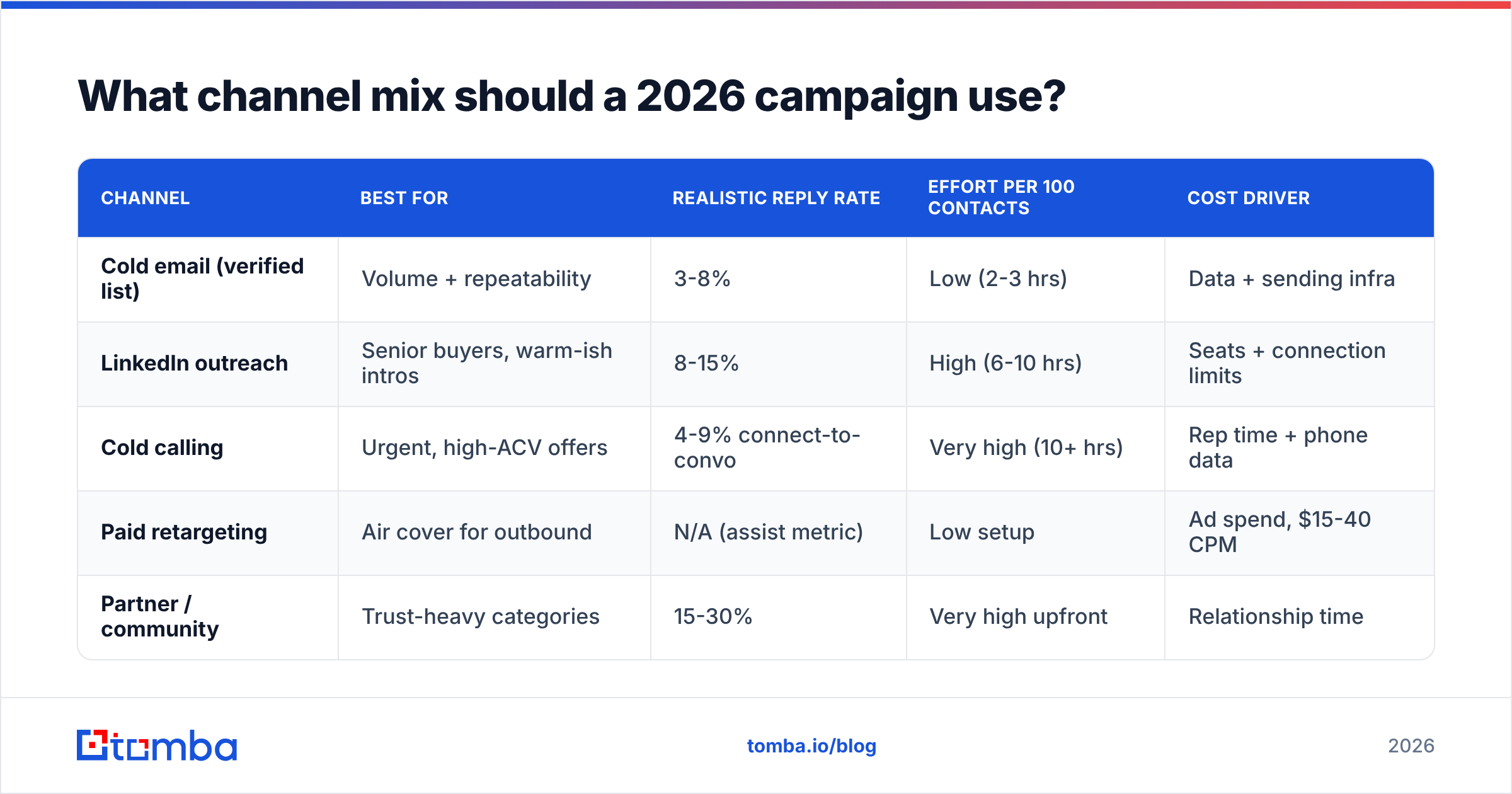
| Channel | Best for | Realistic reply rate | Effort per 100 contacts | Cost driver |
|---|---|---|---|---|
| Cold email (verified list) | Volume + repeatability | 3-8% | Low (2-3 hrs) | Data + sending infra |
| LinkedIn outreach | Senior buyers, warm-ish intros | 8-15% | High (6-10 hrs) | Seats + connection limits |
| Cold calling | Urgent, high-ACV offers | 4-9% connect-to-convo | Very high (10+ hrs) | Rep time + phone data |
| Paid retargeting | Air cover for outbound | N/A (assist metric) | Low setup | Ad spend, $15-40 CPM |
| Partner / community | Trust-heavy categories | 15-30% | Very high upfront | Relationship time |
The practical answer for most B2B teams: email as the volume engine, LinkedIn as the second touch on non-responders, calls reserved for accounts that showed a signal (opened three times, visited pricing, replied ambiguously). Layer paid retargeting only on accounts already in the sequence — it makes the cold email feel less cold.
If your ACV is above roughly $25,000, add phone numbers to the top 20% of accounts and call them. Below $10,000 ACV, calling rarely clears its own cost.
How much does a go to market campaign cost to run?#
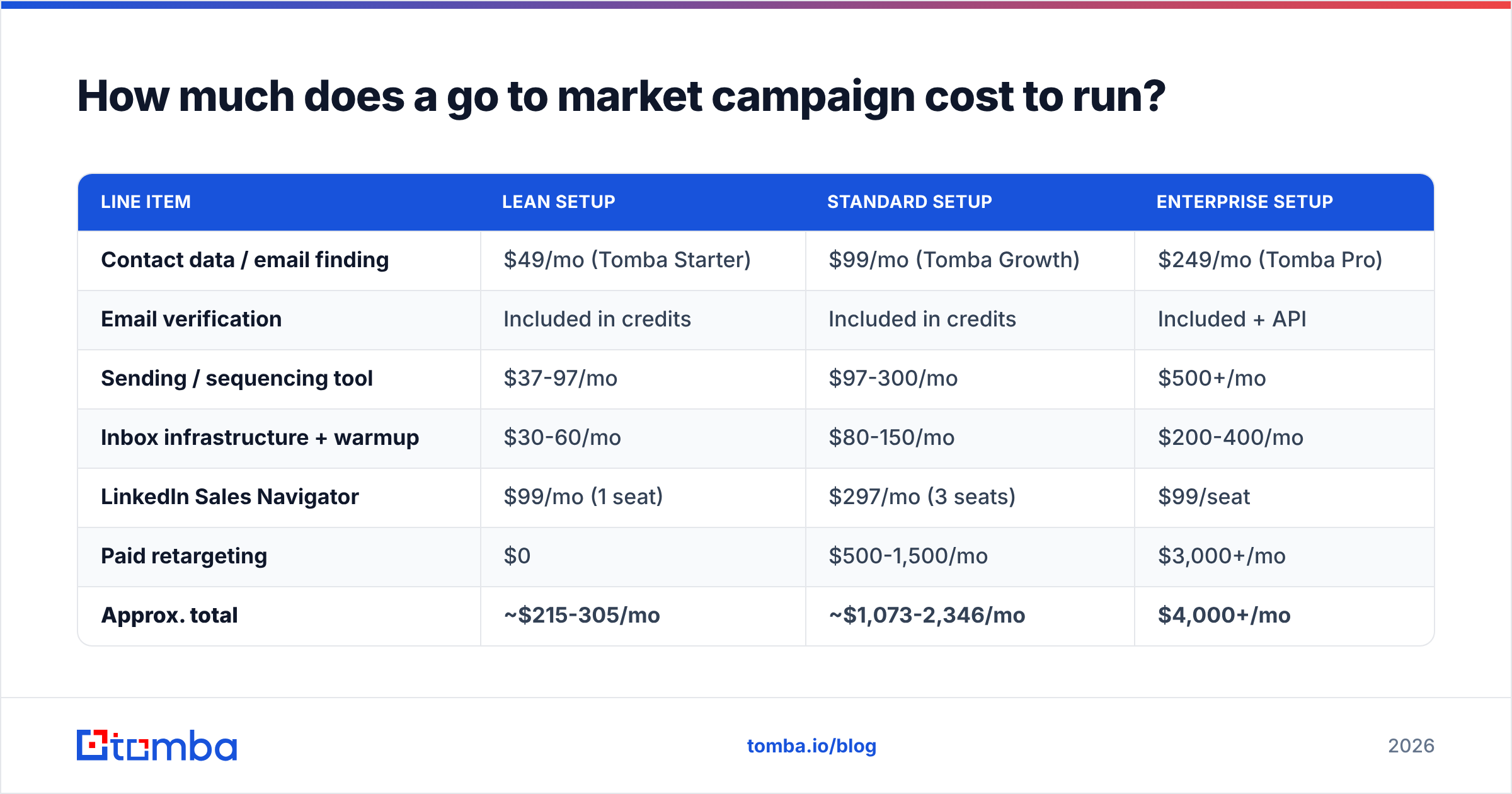
Here is a realistic monthly stack for a campaign targeting ~2,000 contacts, showing where teams actually spend.
| Line item | Lean setup | Standard setup | Enterprise setup |
|---|---|---|---|
| Contact data / email finding | $49/mo (Tomba Starter) | $99/mo (Tomba Growth) | $249/mo (Tomba Pro) |
| Email verification | Included in credits | Included in credits | Included + API |
| Sending / sequencing tool | $37-97/mo | $97-300/mo | $500+/mo |
| Inbox infrastructure + warmup | $30-60/mo | $80-150/mo | $200-400/mo |
| LinkedIn Sales Navigator | $99/mo (1 seat) | $297/mo (3 seats) | $99/seat |
| Paid retargeting | $0 | $500-1,500/mo | $3,000+/mo |
| Approx. total | ~$215-305/mo | ~$1,073-2,346/mo | $4,000+/mo |
Two observations. First, data is the smallest line item and the one that determines whether the other four produce anything — underspending here to save $50/month while burning $1,500 on ad spend against undeliverable contacts is the most common budget error in B2B. Second, tool sprawl is real: teams routinely pay for three overlapping enrichment products because nobody audited the stack.
If you are comparing providers, check Tomba pricing against the credit model of whatever you use today. Credit-based pricing varies wildly in what counts as a "credit" — a search, a verified result, or a returned record — and that single definition changes effective cost by 3-5x. Databases like BookYourData take a different approach with pay-as-you-go verified records, which suits teams that run infrequent, large one-off campaigns rather than continuous outbound.

What does the campaign timeline actually look like?#
A 6-week campaign, week by week. Compress or extend, but keep the sequence.
Week -2 to 0 — Build. Define segment and offer. Build the account list. Run bulk email finding and verification on all contacts. Warm the sending domains if they are new (2-3 weeks minimum for a fresh domain — do not skip this). Write the sequence: 4-6 touches across 21 days.
Week 1 — Soft launch. Send to 10-15% of the list. You are testing deliverability and message-market fit, not scaling. Watch bounce rate, spam-complaint rate, and reply sentiment. If bounces exceed 3%, stop and re-verify the list.
Week 2 — Scale sends. Ramp to full volume if week 1 metrics are clean. Start LinkedIn touches on non-responders from week 1.
Week 3 — First read. You now have enough data to judge. Positive reply rate should be visible. If you have zero meetings from ~600 contacts touched, the offer or the segment is wrong — not the subject line.
Week 4 — Iterate one variable. Change the offer or the segment or the opening line. One at a time, or you learn nothing.
Week 5 — Multi-thread. Add second and third contacts at engaged accounts. Accounts that opened repeatedly without replying get a call or a different persona.
Week 6 — Close out and document. Log what worked into your CRM as reusable segments and sequences. The campaign's real output is a repeatable play, not just the meetings.
Which metrics tell you to scale or kill?#
Track a short list. Long dashboards hide the signal.
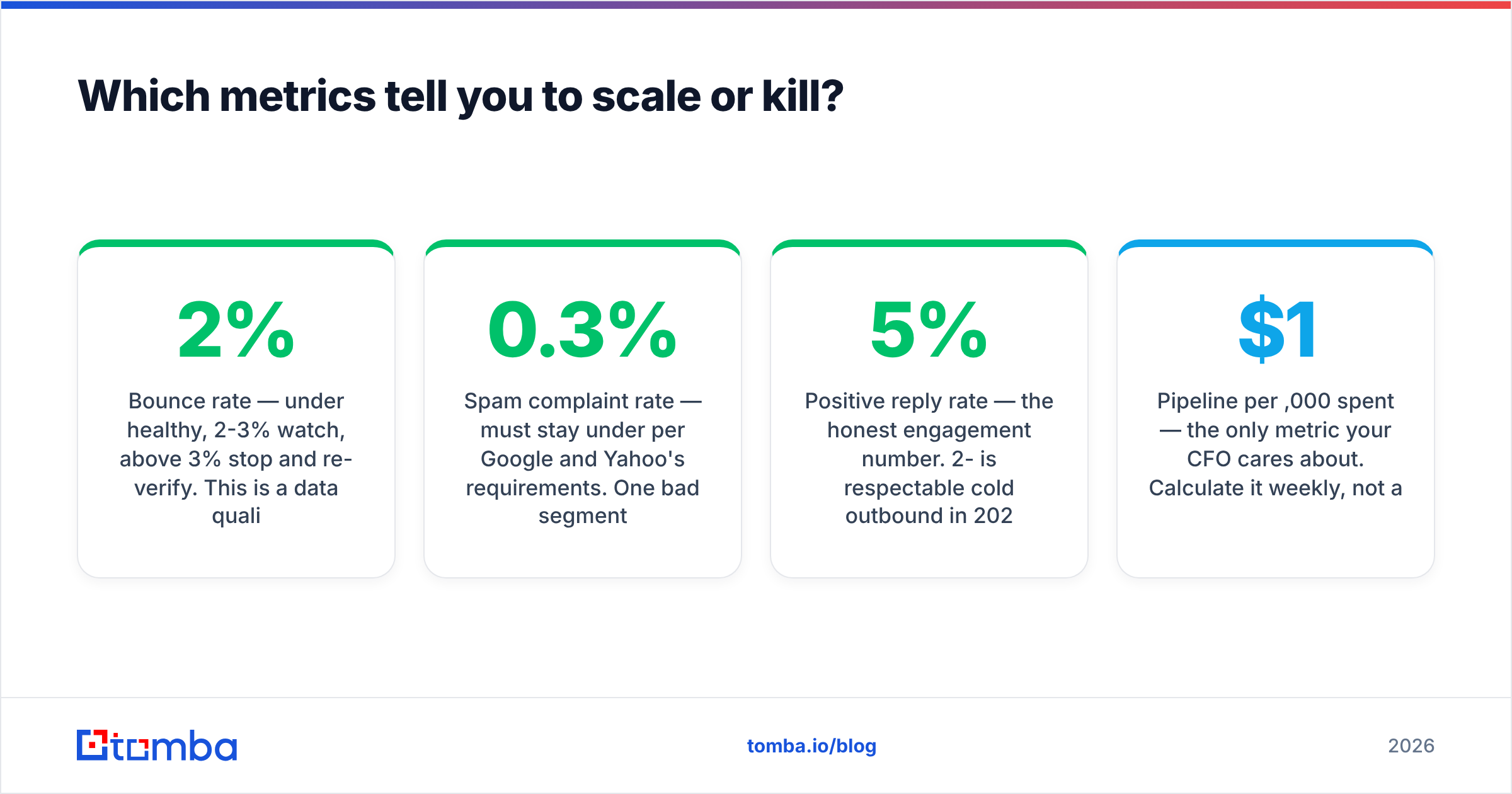
- Bounce rate — under 2% healthy, 2-3% watch, above 3% stop and re-verify. This is a data quality metric, not a campaign performance metric, and it gates everything else.
- Spam complaint rate — must stay under 0.3% per Google and Yahoo's requirements. One bad segment can push you over and take weeks to recover from.
- Positive reply rate — the honest engagement number. 2-5% is respectable cold outbound in 2026; above 8% means you found a real trigger and should scale volume immediately.
- Meeting-to-contact ratio — expect roughly 1 meeting per 100-150 well-targeted contacts on a strong offer. Below 1 per 400, something upstream is broken.
- Pipeline per $1,000 spent — the only metric your CFO cares about. Calculate it weekly, not at campaign end.
- Sequence completion rate — if reps are abandoning sequences at touch 2, the campaign is dying from execution, not targeting.
Kill criteria should be written before launch and be uncomfortable to trigger. Something like: "If we have fewer than 3 qualified meetings from 800 touched contacts by end of week 3, we pause and rebuild the segment." Committing to that in advance is what stops sunk-cost momentum.
For benchmarks against your peer set, G2's sales software category data and vendor-published reports give directional ranges, but treat all published reply-rate benchmarks skeptically — they skew high because vendors report their best customers.
How do you make the campaign repeatable?#
The difference between a team that runs one good campaign and a team that compounds is documentation discipline.
Codify the segment as a saved filter, not a spreadsheet. A CSV is a snapshot; a filter is a living definition you can re-run next quarter. Use data enrichment to keep account records refreshed rather than re-buying lists.
Store the winning offer with its context. "Free security audit" worked — but for whom, at what company size, after what trigger? An offer without its segment context is not reusable.
Automate list hygiene on a schedule. Re-verify your active contact base quarterly. If you're running continuous outbound, wire verification into your workflow through the Tomba API or a HubSpot integration so contacts are validated at the moment they enter a sequence, not months later.
Run a written retro. What was the actual constraint — data, offer, channel, or capacity? Teams that name the constraint honestly improve campaign-over-campaign. Teams that blame "the market" run the same campaign four times.
Common questions#
How long should a go to market campaign run? Four to twelve weeks. Under four, you don't get through a multi-touch sequence. Over twelve, learning slows and the team loses focus.
Should marketing or sales own the campaign? One named owner, regardless of function, with a shared metric. Split ownership produces split accountability.
Can you run a GTM campaign without paid budget? Yes. Outbound email plus LinkedIn plus a verified list is a functioning campaign at under $300/month. Paid is amplification, not foundation.
How many contacts do you need? For a meaningful read on a 6-week campaign, roughly 600-1,000 well-verified contacts. Fewer than 300 and your results are noise.
Where to start#
Pick one segment from your closed-won data. Write one offer for it. Build a list of 500 accounts with 2-3 contacts each, and verify every address before the first send. That single sequence — segment, offer, verified data — is 80% of what separates campaigns that produce pipeline from campaigns that produce activity reports.
If your bottleneck is the data layer, start there. The Tomba Email Finder resolves professional emails by domain, name, or company against live sources rather than a static dump, with verification built into the same credit pool — so the list you launch with is the list that actually lands. The free tier gives you 25 searches a month to test accuracy against contacts you already know before you commit budget to a campaign.
Related guides#
Ready to find emails that actually work?
Join 150,000+ professionals who stopped guessing and started sending. Free credits on signup — no credit card required.
Get the Tomba newsletter
Practical outbound tactics and product updates — once every two weeks.
About the author