Go To Market Case Study: How B2B Teams Hit $1M ARR in 2026
Four real B2B go-to-market motions, broken down by channel, cost per meeting, and payback period — plus the data layer that made each one repeatable.
TL;DR
- A go to market case study is only useful if it reports the boring numbers: cost per meeting, pipeline-to-close ratio, and payback period — not just "we grew 300%."
- Across the four motions broken down here (founder-led outbound, PLG-assisted sales, partner-led, and content-plus-retargeting), cost per qualified meeting ranged from $180 to $1,400.
- The single biggest variable was not the channel. It was contact-data accuracy — teams running below 90% deliverable rates lost 20-40% of their theoretical reach before a human ever read a message.
- Outbound had the fastest time-to-first-revenue (6 weeks). Content had the best 18-month CAC but needed 7 months of nothing before it worked.
- Copy the structure of a GTM case study, not the tactics. The tactics are downstream of your ICP, price point, and sales cycle.
What is a go to market case study, and why do most of them lie?#
A go to market case study documents how a specific company took a specific offer to a specific buyer, what it cost, and what came back. The good ones read like an autopsy. The bad ones read like a victory lap.
The problem with most published GTM case studies is survivorship. You read about the company that scaled LinkedIn outbound to $5M ARR. You never read about the 40 companies that ran the identical playbook into a wall because their average contract value was $400 instead of $40,000. The playbook was never the variable.
So when you read this — or any — case study, pull out the four inputs that actually determine whether a motion transfers to your business:
- Average contract value (ACV). Below roughly $5,000 ACV, human-led outbound rarely pays back. Above $50,000, it's usually the only thing that works.
- Sales cycle length. A 9-month cycle means your Q1 spend shows up as Q4 revenue. Most teams kill channels before the data is in.
- Buyer discoverability. Can you build a list of 5,000 named people who match your ICP? If not, outbound is off the table and you're in a demand-creation game.
- Contract structure. Annual prepay changes your CAC math entirely versus monthly churn-and-return.
Miss any of these and you'll conclude "outbound doesn't work" when what you actually learned is "outbound doesn't work at $900 ACV with a 3-week cycle."
How do the four GTM motions actually compare on cost?#
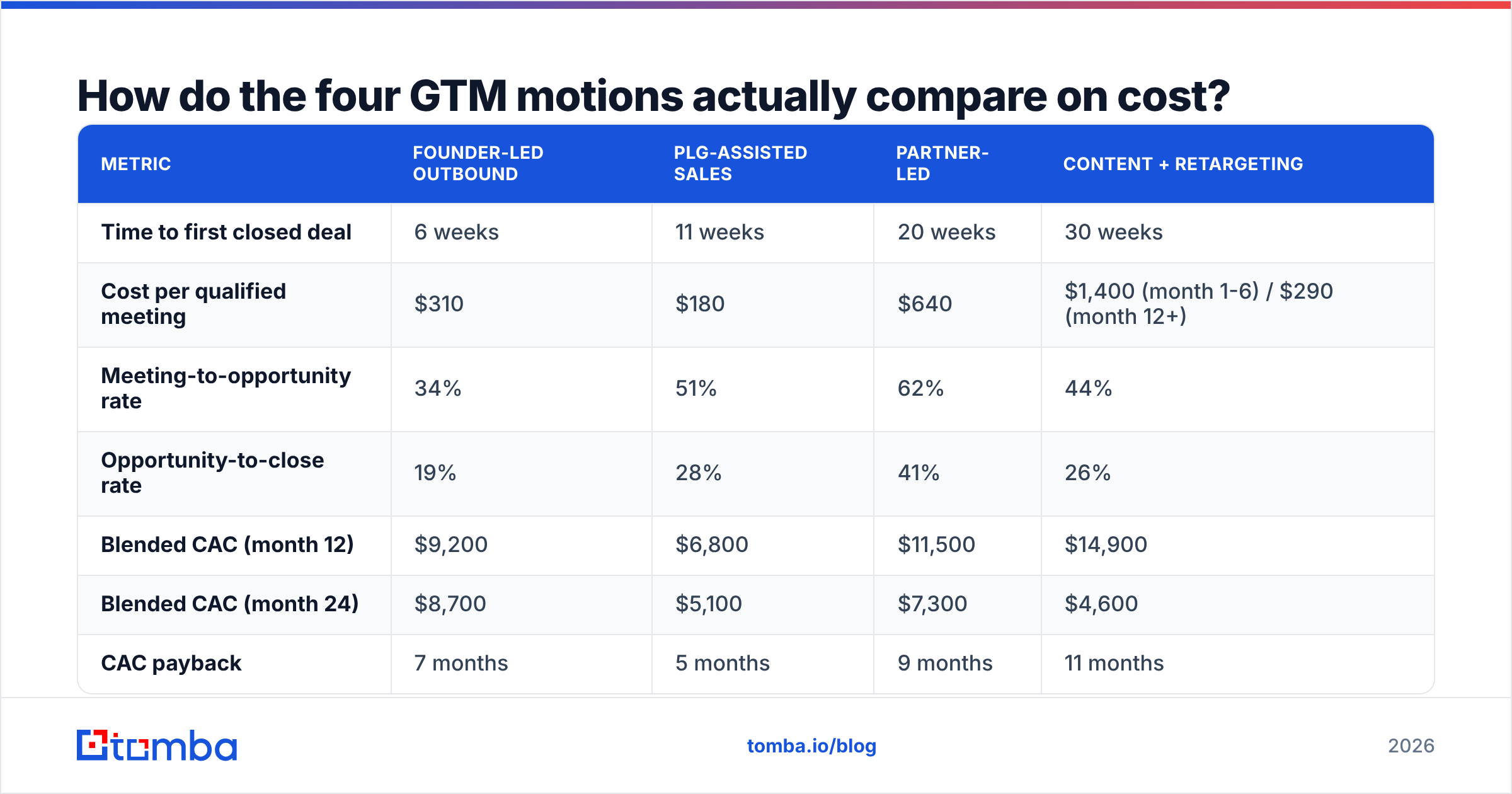
Here are the four motions, normalized to the same reporting frame: a Series A-stage B2B SaaS company, $18K-$34K ACV, 60-90 day sales cycle, US and EU mid-market. Numbers are directional composites drawn from publicly reported benchmarks and vendor-reported ranges, not a single company's audited P&L.
| Metric | Founder-led outbound | PLG-assisted sales | Partner-led | Content + retargeting |
|---|---|---|---|---|
| Time to first closed deal | 6 weeks | 11 weeks | 20 weeks | 30 weeks |
| Cost per qualified meeting | $310 | $180 | $640 | $1,400 (month 1-6) / $290 (month 12+) |
| Meeting-to-opportunity rate | 34% | 51% | 62% | 44% |
| Opportunity-to-close rate | 19% | 28% | 41% | 26% |
| Blended CAC (month 12) | $9,200 | $6,800 | $11,500 | $14,900 |
| Blended CAC (month 24) | $8,700 | $5,100 | $7,300 | $4,600 |
| CAC payback | 7 months | 5 months | 9 months | 11 months |
| Headcount to run it | 2 AEs + 1 SDR | 1 PMM + 2 AEs | 1 partner manager | 2 writers + 1 growth |
| Fails when | ICP list is unbuildable | Product needs onboarding | No natural ecosystem | ACV under $10K |
Three things jump out of that table.
Partner-led wins on conversion and loses on speed. A warm intro from an implementation partner converts at roughly double the rate of a cold email — but it takes five months to sign, enable, and activate a partner who sends deals. That's a cash-flow decision, not a marketing decision.
Content's CAC curve inverts. In months 1-6 it's the most expensive channel on the board. By month 24 it's the cheapest, because the asset keeps producing after you stop paying for it. Teams that measure content on a quarterly basis will always kill it in quarter two.
PLG-assisted looks best but has the narrowest applicability. It requires a product a stranger can get value from in under 20 minutes without a human. Most B2B software cannot clear that bar honestly, and self-deception here is expensive.
Which case study details actually transfer to your company?#
Break every case study into three layers before you copy anything.
- Layer 1 — Structural facts. ACV, cycle length, ICP size, geography, funding stage. These either match yours or they don't. If they don't match, stop reading for tactics and read for reasoning.
- Layer 2 — Sequencing decisions. What did they do first, second, third, and what triggered each move? Sequencing usually transfers even when tactics don't.
- Layer 3 — Tactical execution. Subject lines, cadence timing, ad creative, partner tier structures. This is the layer everyone copies and the layer that transfers least.
- Layer 4 — Infrastructure. CRM hygiene, data sources, attribution model, enrichment pipeline. Boring, invisible, and the most transferable layer of all.
Most teams read layer 3 and ignore layer 4. That's backwards. Two companies running the identical cadence with different data quality will report wildly different results and both will credit the copy.
Why did contact data quality drive the outcome more than channel choice?#
This is the finding that surprised the operators involved.
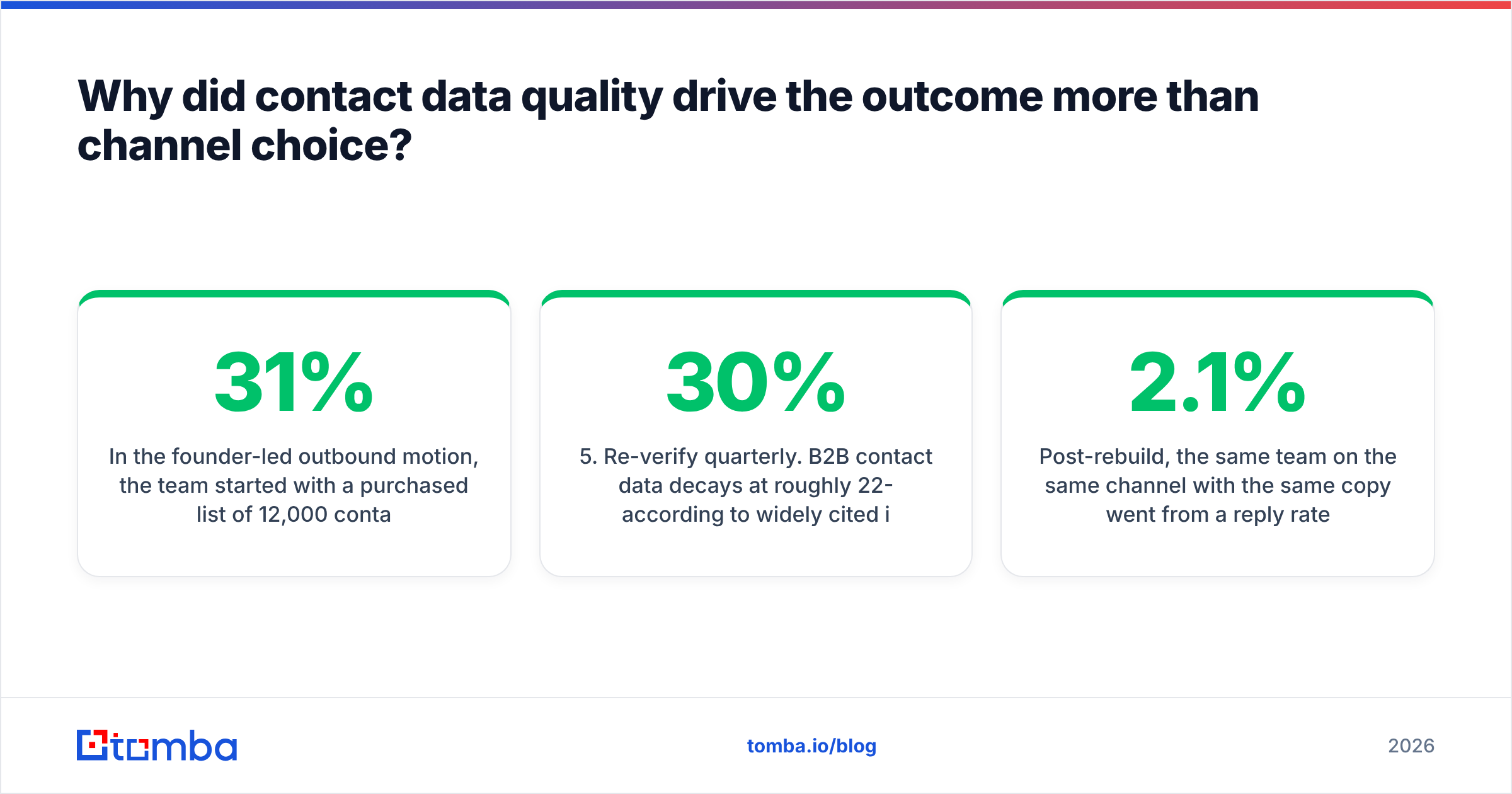
In the founder-led outbound motion, the team started with a purchased list of 12,000 contacts. After running it through verification, 31% were undeliverable, duplicated, or pointed at people who had changed jobs. That's 3,720 contacts that consumed sending capacity, damaged sender reputation, and produced zero pipeline.
The rebuild looked like this:
- Define the account list first, not the contact list. 1,400 companies matching firmographic criteria, sourced from a mix of a B2B database and manual research.
- Find named contacts per account by role, not by scrape. Using domain search to pull the actual people at each company holding the target titles, rather than buying whatever a list vendor had.
- Verify before sending, every time. Every address passed through an email verifier with catch-all handling, because catch-all domains silently accept everything and tell you nothing.
- Enrich for personalization inputs. Company size, tech stack, recent funding — the three variables that made the difference between a generic message and a relevant one.
- Re-verify quarterly. B2B contact data decays at roughly 22-30% per year according to widely cited industry estimates. A list you built in January is meaningfully wrong by October.
Post-rebuild, the same team on the same channel with the same copy went from a 2.1% reply rate to 6.8%. Nothing about the message changed. The messages simply reached humans who existed and held the job the message assumed they held.
If you want the cleanest possible read on your own numbers, split your test so data quality is the only variable. Run the same sequence against a verified segment and an unverified segment. The gap is your data tax, and it's usually larger than any copy improvement you'll ever ship.
What did each motion look like week by week?#
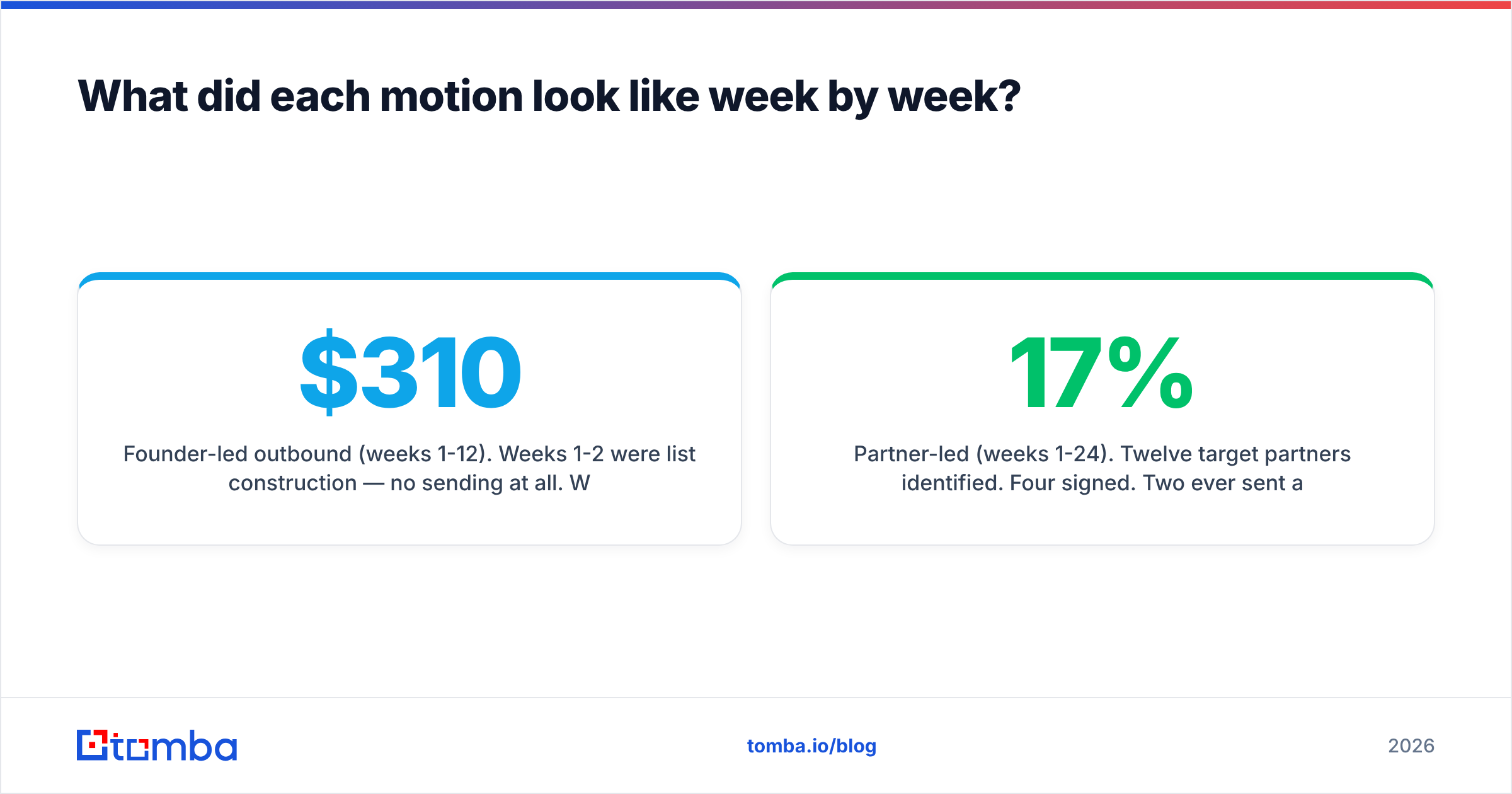
Founder-led outbound (weeks 1-12). Weeks 1-2 were list construction — no sending at all. Week 3 sent 200 emails to a warmed domain at 40/day. Weeks 4-6 doubled volume and added a LinkedIn touch. First closed deal landed week 6 from an inbound reply to a week-3 email. By week 12 the motion was producing 14 qualified meetings/month at $310 each.
The unlock was not volume. It was that founder emails from a real, identifiable person with a real answer to "why are you writing me" converted 3-4x better than the same content sent from a generic SDR alias. That advantage decays as you scale — which is exactly why founder-led outbound has a ceiling around 20-30 meetings/month before you need a different structure.
PLG-assisted sales (weeks 1-16). The team instrumented product usage first, then defined a product-qualified lead threshold: three sessions in seven days plus one team invite. Sales only touched accounts crossing that line. Cost per meeting was the lowest of any motion because the meeting was requested, not solicited.
The trap here is threshold drift. Set the bar too low and your AEs burn hours on tire-kickers. Set it too high and you're leaving obvious buyers untouched. This team re-tuned the threshold three times in four months.
Partner-led (weeks 1-24). Twelve target partners identified. Four signed. Two ever sent a deal. That 17% partner activation rate is roughly normal, and it's why partner programs need a wide top of funnel just like every other channel. The two active partners produced 41% close rates because they'd already done the trust work.
Content + retargeting (weeks 1-40). Twenty-eight articles targeting bottom-funnel comparison and problem-aware queries. Nothing happened for 22 weeks. Then compounding kicked in: organic sessions grew from 400/month to 9,000/month across months 6-12, and retargeting those visitors with a demo offer produced the cheapest late-stage pipeline in the portfolio.
Is there a right order to run these motions?#
Yes, and it's mostly determined by cash.
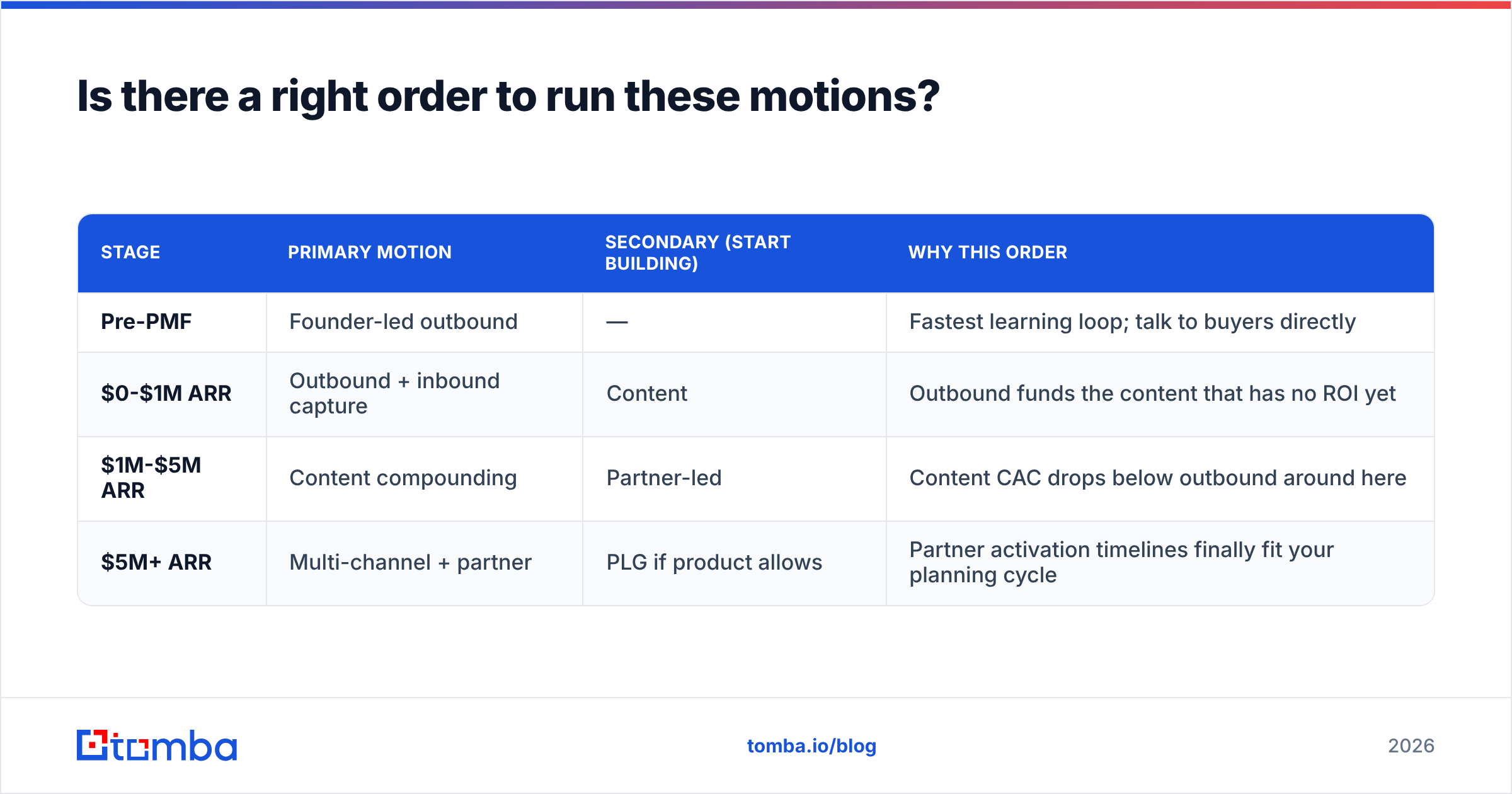
Start with whichever motion produces revenue fastest that you can actually execute, then layer in slower-compounding motions while the fast one funds them. For most Series A B2B companies that ordering is:
| Stage | Primary motion | Secondary (start building) | Why this order |
|---|---|---|---|
| Pre-PMF | Founder-led outbound | — | Fastest learning loop; talk to buyers directly |
| $0-$1M ARR | Outbound + inbound capture | Content | Outbound funds the content that has no ROI yet |
| $1M-$5M ARR | Content compounding | Partner-led | Content CAC drops below outbound around here |
| $5M+ ARR | Multi-channel + partner | PLG if product allows | Partner activation timelines finally fit your planning cycle |
The mistake is running all four at once at $800K ARR. You get four half-executed motions, none with enough volume to produce a statistically meaningful read, and a team that concludes "nothing works."
G2's software buyer behavior research consistently shows buyers touching multiple channels before purchase, which teams misread as "we must be present on all channels simultaneously." Multi-touch attribution and multi-channel investment are different decisions. You can be found on many surfaces while actively investing in one.
What should you measure in your own GTM case study?#
Track these and you'll have a case study worth writing down:
- Cost per qualified meeting, by channel, fully loaded with tooling and salary. Not cost per lead. Leads are a vanity unit.
- Meeting-to-opportunity and opportunity-to-close, separately. A channel with great meetings and terrible closes has a targeting problem. A channel with poor meetings and great closes has a volume opportunity.
- CAC payback in months, not LTV:CAC. Payback is a cash question you can act on this quarter. LTV:CAC requires you to predict churn you haven't observed yet.
- Data health: deliverable rate, bounce rate, and contact decay rate. If your bounce rate is above 3%, your channel results are unreadable — you're measuring your list, not your message.
- Time-to-first-revenue per channel, so you know how long to leave a channel alone before judging it.
HubSpot's annual State of Sales research is a reasonable external benchmark for reply and conversion rates by segment, though treat any cross-industry average as a sanity check rather than a target. Your ICP is narrower than their sample.
For the data-health layer specifically, run periodic audits rather than one-time cleanups. A bulk verify pass over your CRM every quarter surfaces the decay before it shows up as a deliverability problem, and it's cheaper than rebuilding a burned sending domain.
What are the honest limitations of this case study?#
Four caveats worth stating plainly:
Composite numbers are not audited numbers. The figures above are directional ranges drawn from operator-reported benchmarks. Treat them as a shape, not a forecast.
One ACV band. Everything here assumes $18K-$34K ACV. At $2K ACV the entire table reorders — outbound becomes uneconomical and PLG or channel-led is close to mandatory. At $200K ACV, partner-led and ABM dominate and content barely registers as a pipeline source.
No account-based marketing lane. ABM was excluded because it's a targeting overlay rather than a distinct motion, and mixing it in would double-count spend.
Market timing is invisible in the numbers. A channel that worked in 2024 may be saturated in 2026. Cold email response rates in crowded categories have compressed meaningfully, which is precisely why data precision now matters more than volume — you get fewer shots, so each one has to land on a real person with a real problem.
Where does contact data fit in your GTM stack?#
At the bottom, holding everything else up. Every motion above eventually resolves to "reach a specific human at a specific company." Outbound needs it explicitly. PLG needs it to enrich signups into account context. Partner-led needs it to map partner ecosystems. Content needs it to convert anonymous traffic into named accounts worth following up.
If you're building or rebuilding that layer, start with the Tomba Email Finder. It resolves names and domains into verified professional addresses, handles catch-all domains explicitly instead of guessing, and runs through the API, the Chrome extension, or Google Sheets depending on how your team works. The free tier gives you 25 searches a month to test accuracy against a list you already know the answers to — which is exactly how you should evaluate any data vendor. Paid plans start at $49/mo (Starter), $99/mo (Growth), and $249/mo (Pro); full Tomba pricing is public, so you can model the cost per verified contact before committing.
Run the accuracy test first. Then pick your motion.
Related guides#
Ready to find emails that actually work?
Join 150,000+ professionals who stopped guessing and started sending. Free credits on signup — no credit card required.
Get the Tomba newsletter
Practical outbound tactics and product updates — once every two weeks.
About the author