Go To Market Channels: How to Pick the Right Mix in 2026
Most GTM teams pick channels by vibes and then blame the copy. Here is a concrete framework for choosing outbound, inbound, partner, PLG, and marketplace channels based on ACV, sales cycle, and CAC payback.
TL;DR
- A go to market channel is the route you use to reach a buyer — outbound, inbound, product-led, partner, marketplace, community, or events. It is not the same thing as a tactic ("cold email") or a tool.
- Channel fit is mostly decided by two numbers: your average contract value (ACV) and your sales cycle length. Under ~$2K ACV, human-led outbound rarely pays back. Over ~$50K, PLG alone almost never closes.
- Most teams fail by running five channels at 20% effort each. Two channels run properly beat five run badly, every time.
- Every channel except pure PLG depends on contact data quality. A 30% bounce rate does not mean your channel is wrong — it means your list is.
- Budget 90 days minimum before judging any channel, and measure CAC payback, not lead volume.
What are go to market channels, exactly?#
A go to market channel is the path a prospect travels from "never heard of you" to "in a buying conversation." Think of it like distribution for a physical product: the same bottle of hot sauce can reach a customer through a supermarket shelf, a direct-to-consumer website, an Amazon listing, or a restaurant supplier. Same product, four completely different cost structures, margins, and speed.
Software works the same way. The product doesn't change. What changes is who does the work of finding the buyer, how much that costs you per closed deal, and how long it takes.
The confusion in most GTM planning meetings comes from mixing three different layers:
- Channel — the structural route to market. Outbound, inbound, PLG, partner/reseller, marketplace, community, events.
- Motion — how the sale gets closed inside that channel. Self-serve, low-touch (SDR → AE), high-touch enterprise, land-and-expand.
- Tactic — the specific execution. Cold email sequence, SEO cluster, LinkedIn ads, conference booth, integration listing.
Cold email is a tactic inside the outbound channel. Content marketing is a tactic inside inbound. When someone says "outbound is dead," they usually mean "our cold email tactic stopped working," which is a very different and much more fixable problem.
Which go to market channels actually exist in B2B?#
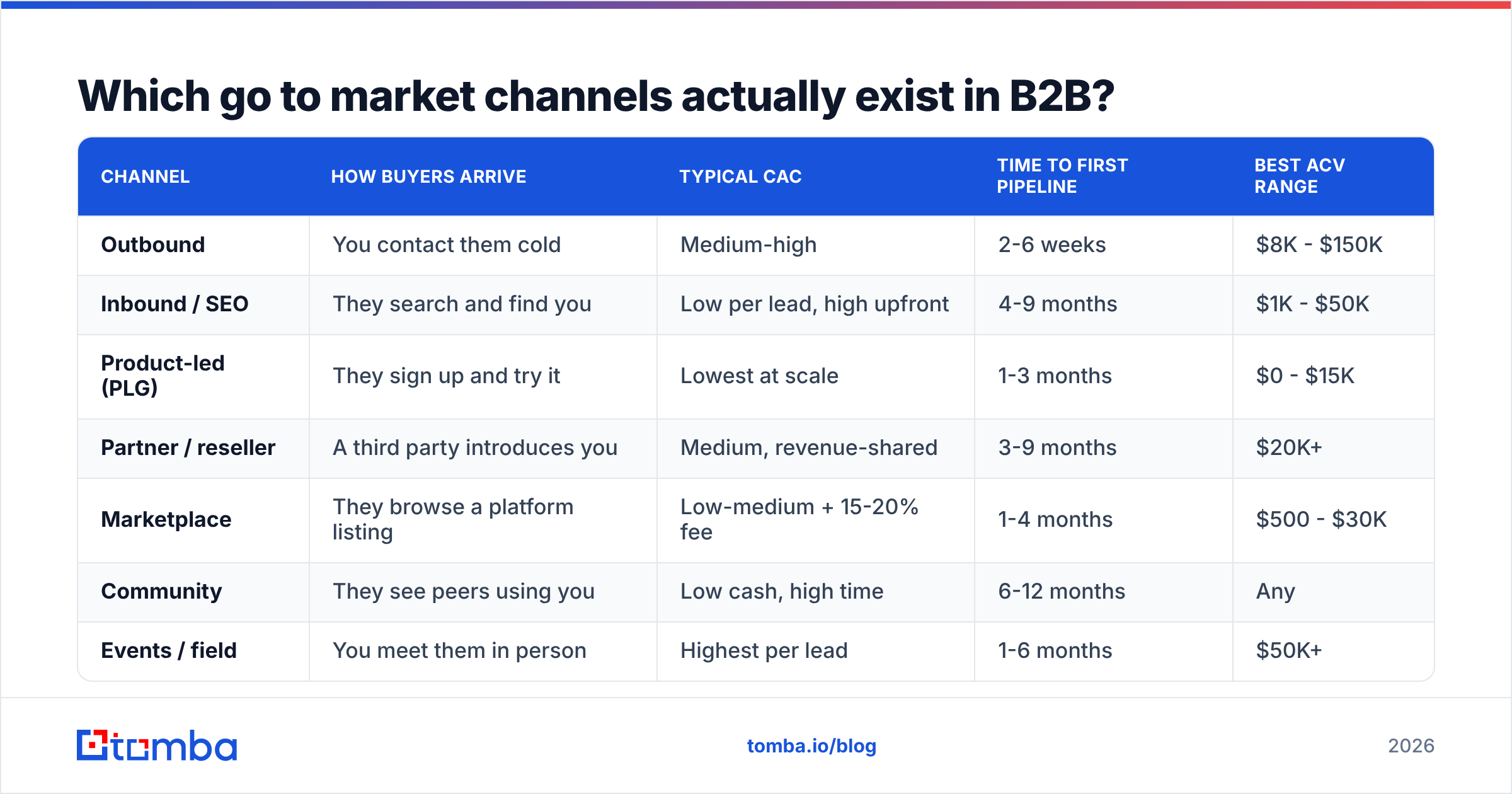
There are seven that matter. Everything else is a variation.
| Channel | How buyers arrive | Typical CAC | Time to first pipeline | Best ACV range |
|---|---|---|---|---|
| Outbound | You contact them cold | Medium-high | 2-6 weeks | $8K - $150K |
| Inbound / SEO | They search and find you | Low per lead, high upfront | 4-9 months | $1K - $50K |
| Product-led (PLG) | They sign up and try it | Lowest at scale | 1-3 months | $0 - $15K |
| Partner / reseller | A third party introduces you | Medium, revenue-shared | 3-9 months | $20K+ |
| Marketplace | They browse a platform listing | Low-medium + 15-20% fee | 1-4 months | $500 - $30K |
| Community | They see peers using you | Low cash, high time | 6-12 months | Any |
| Events / field | You meet them in person | Highest per lead | 1-6 months | $50K+ |
Two things jump out of that table. First, the channels with the lowest CAC (inbound, community) have the longest time to first pipeline. You are trading cash for patience. Second, outbound is the only channel that lets you pick exactly who you talk to — which is why it survives every "outbound is dead" cycle.

How do you choose between go to market channels?#
Run your business through these five filters in order. Stop at the first one that disqualifies a channel.
- ACV floor. A fully loaded SDR costs roughly $90K-$130K/year in the US and books maybe 15-20 qualified meetings a month at a good clip. If your ACV is $1,200, the math never closes. Push that segment to PLG or self-serve.
- Buyer discoverability. Can you build a list of the exact companies and roles you want? If your ICP is "VP of Engineering at 200-1000 employee fintechs in the EU," outbound works because that set is enumerable. If it's "anyone who occasionally needs a contract reviewed," it isn't — go inbound.
- Search demand. Pull the actual monthly volume for your category terms. If nobody searches for the problem you solve, SEO is a category-creation project, not a lead source, and it will take 18 months.
- Time-to-value in the product. PLG requires a user to feel something work within one session, alone, without a call. If your product needs data migration, an admin, or an integration to demo anything, PLG is off the table for now.
- Existing distribution nearby. Does someone already sell to your exact buyer without competing with you? That's a partner channel, and it's the most underused route in B2B — Forrester has consistently put partner-influenced revenue at roughly half of B2B revenue in large orgs.
Most companies discover after this exercise that they qualify for two channels, not five. That's the correct answer. Run those two properly.
Is outbound still a viable go to market channel in 2026?#
Yes — but the version that works looks nothing like the 2019 version.
What broke: volume. Google and Yahoo's 2024 bulk-sender requirements, followed by Microsoft's 2025 tightening for Outlook.com, made spam-rate thresholds enforceable rather than advisory. Sending 5,000 barely-personalized emails a day from a fleet of throwaway domains now gets you filtered within weeks. The Google bulk sender guidelines are worth reading directly rather than through a vendor's summary — the 0.3% spam complaint ceiling is the number that ends most spray campaigns.
What still works: precision. A 300-contact list where every contact is genuinely in-market, correctly titled, and verifiably reachable outperforms a 10,000-contact blast on every metric that matters — reply rate, meeting rate, and domain health.
That shift changes what you spend money on. The budget moves from sending volume to list quality:
- Verified contact data. Every invalid address is a direct hit to your sender reputation, not just a wasted send. Run lists through an email verifier before the first send, not after the bounces roll in.
- Trigger-based targeting. New funding, a relevant new hire, a tech-stack change, a job posting that implies the pain. Timing beats persona.
- Multi-threading. One contact per account is fragile. Three to five contacts across the buying committee is the current baseline for anything above $25K ACV.
- Channel stacking. Email plus LinkedIn outreach plus a phone touch against the same account, sequenced across two weeks.
The teams complaining that outbound is dead are almost always still measuring emails sent. The teams doing well are measuring accounts correctly identified.
What does each channel cost to run?#
Here is a realistic side-by-side for a Series A B2B SaaS company with a $20K ACV, priced in annual fully-loaded cost.
| Line item | Outbound | Inbound / SEO | Product-led | Partner |
|---|---|---|---|---|
| Headcount needed | 1 SDR + 1 AE | 1 content lead + freelancers | 1 growth eng + designer | 1 partner manager |
| Annual people cost | $180K - $240K | $110K - $160K | $200K - $260K | $130K - $180K |
| Tooling / data | $6K - $25K | $5K - $15K | $10K - $30K | $3K - $10K |
| Media / paid spend | $0 | $0 - $60K | $20K - $80K | $0 (rev-share instead) |
| Revenue share | None | None | None | 15% - 30% of ACV |
| Months to first closed deal | 2 - 4 | 6 - 12 | 3 - 5 | 5 - 10 |
| Predictability once running | High | Medium | High | Low |
| Scales by | Adding reps | Compounding content | Traffic + activation | Adding partners |
The uncomfortable line is "revenue share." Partner channels look cheap on headcount and then quietly take 20% of every deal forever. That's often still worth it — a partner-sourced deal typically closes faster and churns less — but model it as margin, not as free pipeline.
The other trap is inbound's "$0 media spend" line. It's true and it's misleading. Inbound's real cost is 6-12 months of a fully paid team producing revenue you cannot yet see. If you have less than 12 months of runway, inbound is not a channel, it's a bet.
How many go to market channels should you run at once?#
Two. Maybe three once you're past $5M ARR.
The failure pattern is predictable and it looks like this: the board asks about growth, so the team launches outbound and starts a blog and applies to three marketplaces and hires a partner manager, all in one quarter. Six months later every channel has a half-built system, none has enough data to evaluate, and the team concludes that "nothing works."
Channels compound internally and interfere externally. Outbound gets better as your list-building, messaging, and response rate benchmarking improve — but only if someone owns it full-time for two quarters. Split that person across four channels and none of them ever reaches the threshold where the compounding starts.
A sane sequence for most B2B companies:
- Months 0-9: One primary channel matched to your ACV. Get to repeatable — same message, same list criteria, predictable meeting count.
- Months 9-18: Add one supporting channel that feeds the primary. Inbound feeding outbound retargeting, or PLG feeding sales-assist.
- Months 18+: Add partner or marketplace, which both require a working product and reference customers to be credible.
How do you measure whether a go to market channel is working?#
Stop measuring lead volume. Measure these four, per channel, cohorted by month:
- CAC payback period. Fully loaded channel cost divided by (new ARR × gross margin), expressed in months. Under 12 months is healthy for SMB, under 18 for mid-market, under 24 for enterprise. This is the single number that decides whether to double down.
- Pipeline-to-close conversion. Outbound pipeline typically converts at a lower rate than inbound pipeline, because you picked them, not the other way round. If your outbound opportunities close at 8% and inbound at 25%, that's normal — price it in rather than panicking.
- Time from first touch to closed-won. Partner and event deals often look expensive until you notice they close in half the time.
- Net revenue retention by channel source. The most overlooked metric. A channel that brings in cheap logos that churn at 40% annually is a cost center wearing a growth costume.
Run these inside your CRM with a mandatory source field on every opportunity. If channel attribution is optional in your CRM, you do not have channel data — you have opinions.
One practical warning on attribution: don't build a six-touch fractional attribution model at Series A. Use first-touch for demand-gen decisions and self-reported source ("How did you hear about us?") on the demo form. Self-reported attribution is unfashionable and it is consistently more accurate than tracking pixels for B2B, where buyers research across devices, in Slack groups, and in podcasts nobody tags.
Which channels pair well together?#
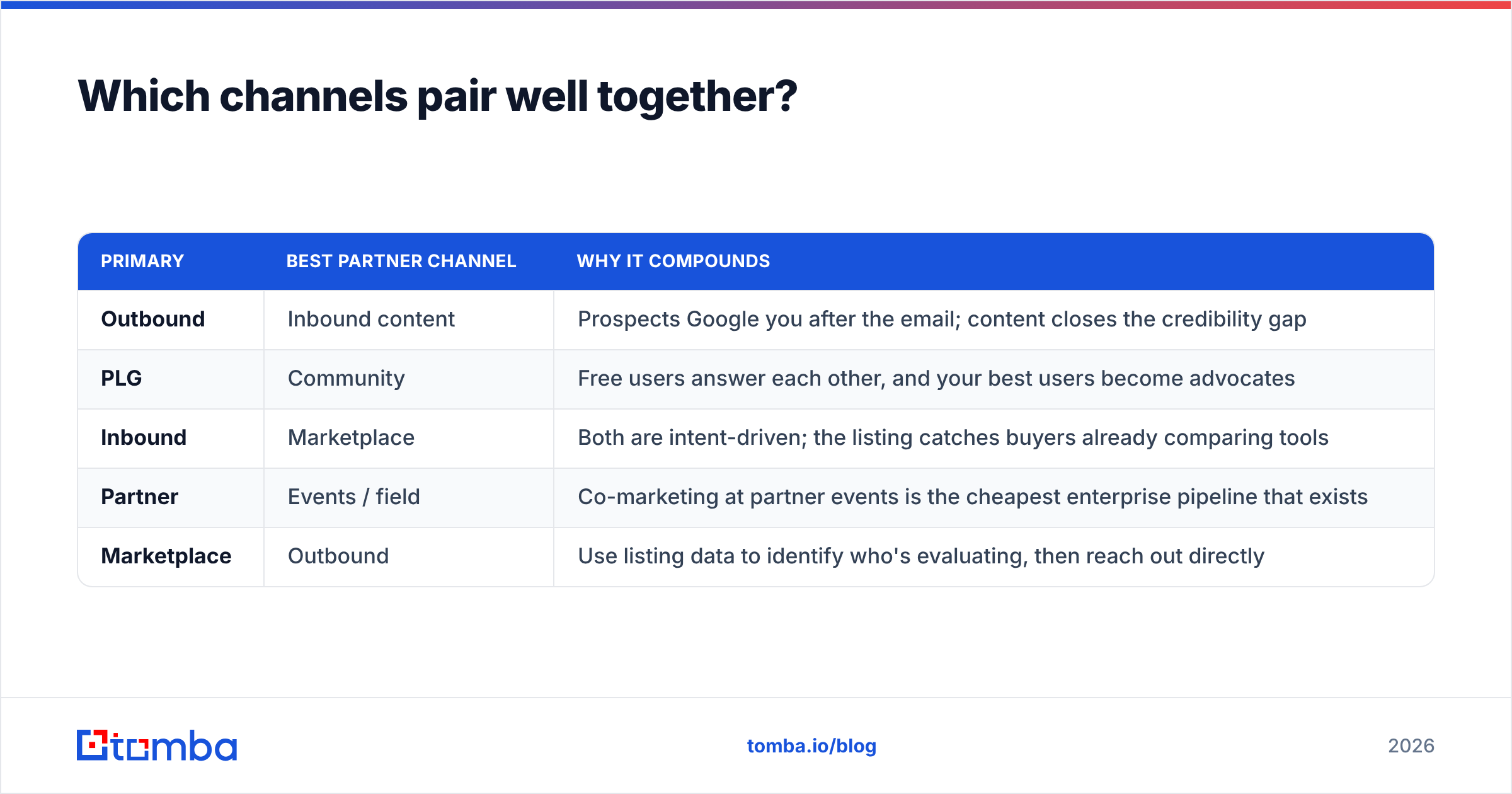
Channels aren't independent. Some combinations create leverage; others create a mess.
| Primary | Best partner channel | Why it compounds |
|---|---|---|
| Outbound | Inbound content | Prospects Google you after the email; content closes the credibility gap |
| PLG | Community | Free users answer each other, and your best users become advocates |
| Inbound | Marketplace | Both are intent-driven; the listing catches buyers already comparing tools |
| Partner | Events / field | Co-marketing at partner events is the cheapest enterprise pipeline that exists |
| Marketplace | Outbound | Use listing data to identify who's evaluating, then reach out directly |
The pairing that consistently disappoints is outbound plus paid ads at an early stage. Both are cash-hungry, both require constant creative iteration, and neither compounds. You end up with two expensive channels competing for the same budget and the same attention.
Where does contact data fit into all this?#
It sits underneath every channel except pure self-serve PLG.
Outbound obviously needs it. But so does partner co-selling (you need the right contacts at the partner's accounts), so does account-based inbound (you need to know who to retarget), and so does marketplace follow-up (a listing view is useless without a contact to reach). Data quality is not an outbound-only concern; it's the floor the whole GTM plan stands on.
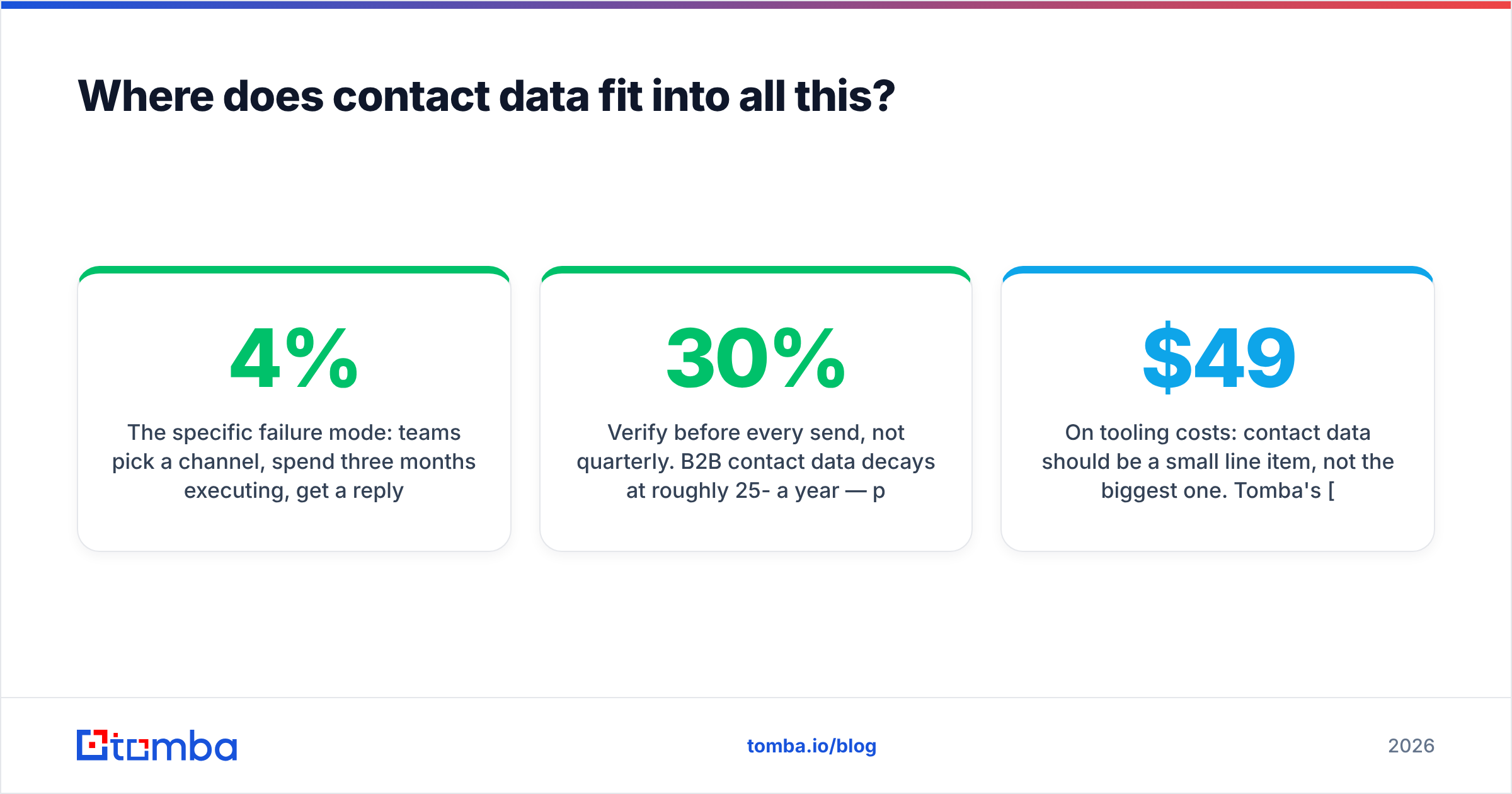
The specific failure mode: teams pick a channel, spend three months executing, get a 4% reply rate, and conclude the channel is broken. Then someone runs the list through verification and finds 22% invalid addresses, 15% wrong-title contacts, and 8% who left the company. The channel was fine. The inputs weren't.
Practical ways to keep the data layer honest:
- Verify before every send, not quarterly. B2B contact data decays at roughly 25-30% a year — people change jobs constantly. A list built in January is measurably worse by June.
- Build lists by company first, contacts second. Use domain search to map who actually works at a target account, then pick the right two or three people, rather than buying a pre-built list and hoping.
- Handle catch-all domains explicitly. A large share of enterprise domains accept everything, which makes standard verification useless. A dedicated catch-all verifier is the difference between "unknown" and "safe to send."
- Enrich for routing, not just contacting. Company size, tech stack, and funding stage decide which channel and which message an account should get. Data enrichment is what turns a flat list into a segmented plan.
- Automate it into the workflow. If verification is a manual step someone has to remember, it will be skipped under quota pressure. Push it into the pipeline via the Tomba API or your CRM sync so it happens by default.
On tooling costs: contact data should be a small line item, not the biggest one. Tomba's pricing starts free at 25 searches a month, with Starter at $49/mo, Growth at $99/mo, and Pro at $249/mo — which is the right order of magnitude relative to a $180K outbound team. Peers like BookYourData take a pay-as-you-go approach to prebuilt lists, which suits teams that want a one-time list rather than an ongoing search workflow. Both approaches are legitimate; pick based on whether your list-building is continuous or episodic.
If you want an outside read on any vendor before committing, G2's sales intelligence category is a reasonable starting point for filtering by company size and use case.
What's the fastest way to test a new channel?#
Give it a 90-day, single-owner, single-hypothesis pilot.
- Days 1-15: Build the input. For outbound, that's a 300-account list with verified contacts and a documented ICP definition. For inbound, a keyword cluster with real search volume. For partner, five signed intro agreements.
- Days 16-60: Execute at consistent volume. No mid-flight strategy changes. Change copy, not the hypothesis.
- Days 61-90: Measure meetings booked, opportunities created, and cost per opportunity. Compare against your existing channel's numbers at the same maturity, not at its current maturity.
- Day 90 decision: Double the investment, kill it, or run one more cycle with a specific fix. "Let it keep running quietly" is not an option — that's how you end up with five half-channels.
Write the success threshold down before you start. A channel evaluated against a number you invented after seeing the results is a channel you will never kill.
Getting the data layer right first#
Whichever channels you land on, the accounts and people you target determine more of the outcome than the channel label does. A precise 300-account list run through one channel beats a vague 5,000-account list run through four.
That's the job Tomba's Email Finder is built for: turning a target account list into verified, reachable contacts with the right titles, so your outbound, partner co-sell, and ABM efforts all draw from the same clean source. Start on the free tier at 25 searches a month, prove the list quality against your own ICP, and scale up only when the channel earns it.
Related guides#
Ready to find emails that actually work?
Join 150,000+ professionals who stopped guessing and started sending. Free credits on signup — no credit card required.
Get the Tomba newsletter
Practical outbound tactics and product updates — once every two weeks.
About the author