Go-To-Market Enablement in 2026: A Practical Operator's Guide
Most GTM enablement programs fail because they teach decks instead of fixing data, routing, and reps' first 30 seconds. Here's the operator's blueprint that actually moves win rates.
TL;DR
- Go to market enablement is the operating system that connects strategy, data, content, and rep behavior — not a content library with a training calendar bolted on.
- The single biggest failure mode is enabling reps on messaging while feeding them broken contact data. Bad emails kill more pipeline than bad talk tracks.
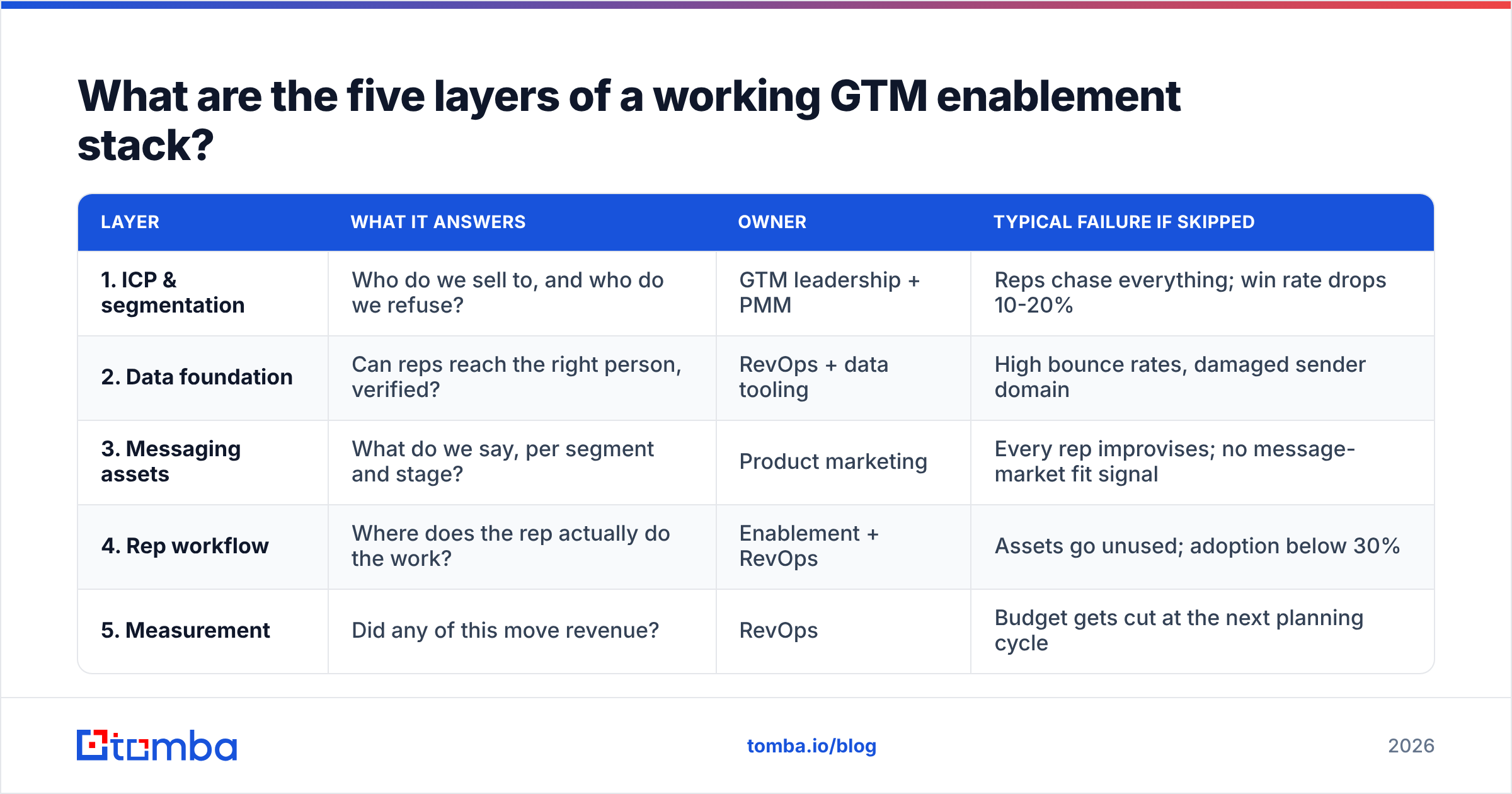
- A working program has five layers: ICP definition, data foundation, messaging assets, rep workflow, and measurement. Skip a layer and the rest degrades within a quarter.
- Measure enablement on pipeline-per-rep, ramp time, and win rate — not course completions or asset downloads.
- Start with the data layer. It is the cheapest fix and the one with the fastest measurable return.
Enablement gets budget when revenue misses. Then someone builds a Notion wiki, records fourteen videos, and buys a platform with a "content engagement score." Two quarters later, win rate hasn't moved and the wiki has 40 orphaned pages.
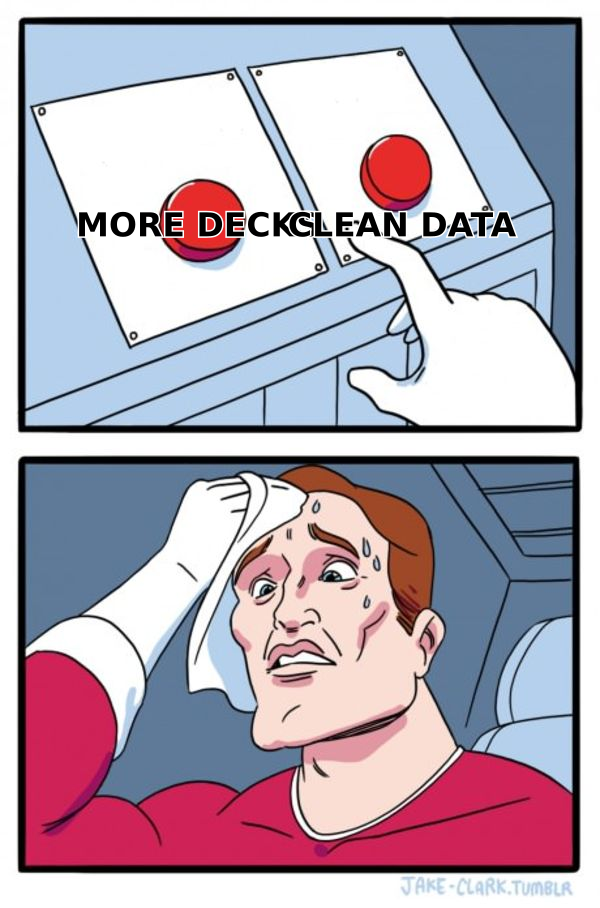
The problem is not effort. It is sequencing. Go to market enablement only compounds when the layers underneath it are solid — and the layer everyone skips is the boring one: whether your reps are emailing real people at real addresses with real context.
What is go to market enablement?#
Go to market enablement is the set of systems, data, content, and coaching that makes every customer-facing rep able to execute your GTM strategy consistently. Think of it like a restaurant kitchen. Strategy is the menu. Enablement is the mise en place — ingredients prepped, stations stocked, recipes standardized — so any cook on shift produces the same dish. Without it, every rep improvises, and quality depends entirely on who's working that night.
It differs from adjacent functions in scope:
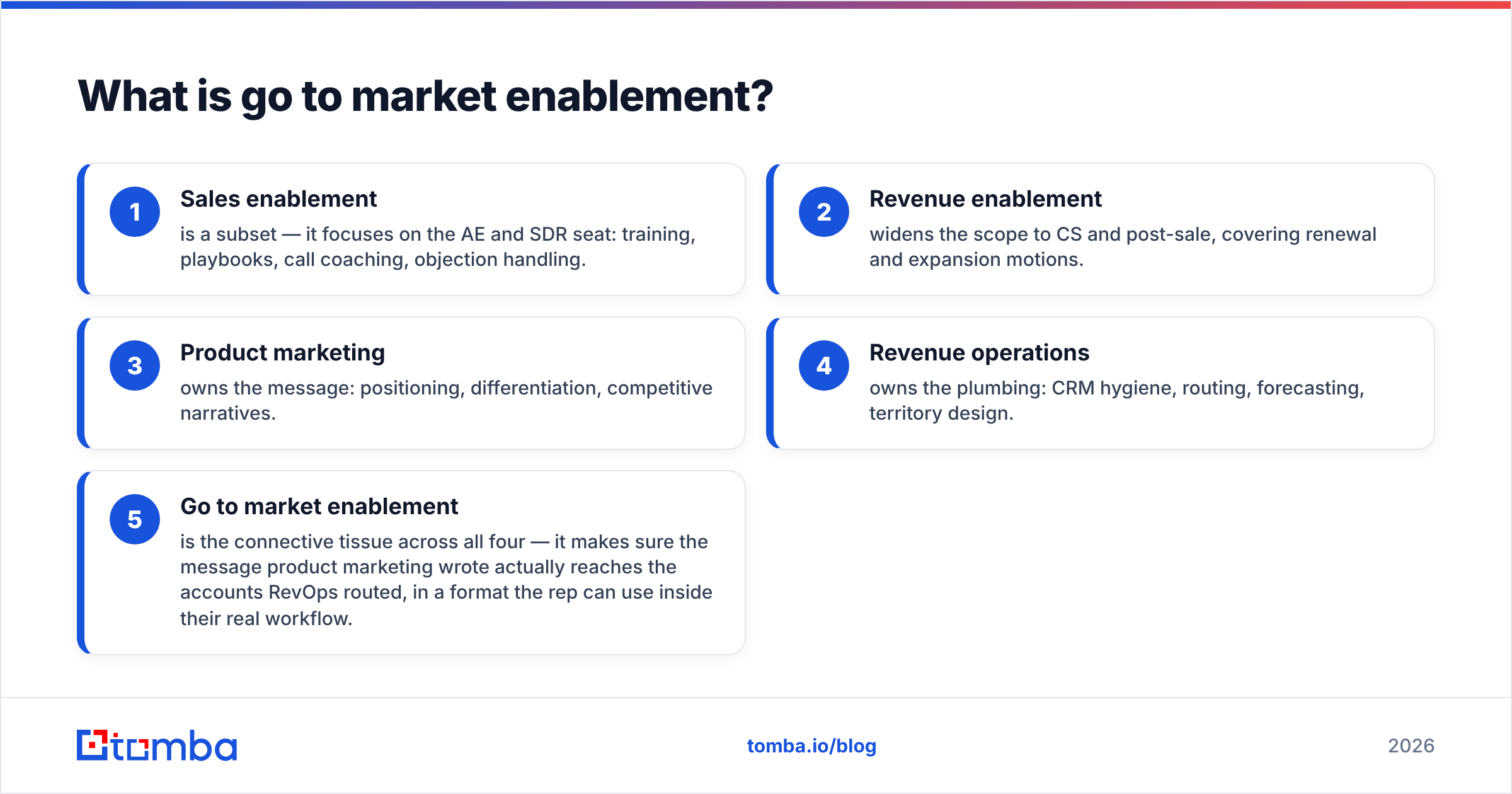
- Sales enablement is a subset — it focuses on the AE and SDR seat: training, playbooks, call coaching, objection handling.
- Revenue enablement widens the scope to CS and post-sale, covering renewal and expansion motions.
- Product marketing owns the message: positioning, differentiation, competitive narratives.
- Revenue operations owns the plumbing: CRM hygiene, routing, forecasting, territory design.
- Go to market enablement is the connective tissue across all four — it makes sure the message product marketing wrote actually reaches the accounts RevOps routed, in a format the rep can use inside their real workflow.
That last distinction matters. Most enablement teams produce artifacts. GTM enablement produces behavior change at the moment of execution.
Why do most GTM enablement programs fail?#
They optimize for the wrong bottleneck. Here is the honest failure taxonomy from teams that have run this badly:
Failure 1: Content without context. You build a 30-slide competitive battlecard. The rep is on a call in 90 seconds and needs one line. Nobody reads 30 slides mid-call. The asset exists; the behavior doesn't change.
Failure 2: Enabling on a broken foundation. You train reps on a beautiful three-touch sequence. Then 35% of the emails bounce because the list came from a scraped export nobody verified. The rep concludes "outbound doesn't work." It does — the email verification step was never in the workflow.
Failure 3: Measuring consumption, not outcomes. Course completion rate is a vanity metric. Gartner's research on sales enablement consistently points to the same gap: organizations track enablement activity far more reliably than they track its effect on deal progression. If your dashboard shows "82% of reps completed the module" and nothing about ramp time or stage conversion, you're measuring the wrong thing.
Failure 4: One-size-fits-all ramping. A rep selling into 500-person manufacturers needs a different first 30 days than one selling into 40-person agencies. Generic onboarding produces generic ramp times.
Failure 5: No feedback loop from the field. Product marketing ships a message. Nobody checks whether it survives contact with prospects. Six months later, reps are all using their own improvised version and nobody knows which one works.
What are the five layers of a working GTM enablement stack?#
Build them in this order. Each one makes the next cheaper.
| Layer | What it answers | Owner | Typical failure if skipped |
|---|---|---|---|
| 1. ICP & segmentation | Who do we sell to, and who do we refuse? | GTM leadership + PMM | Reps chase everything; win rate drops 10-20% |
| 2. Data foundation | Can reps reach the right person, verified? | RevOps + data tooling | High bounce rates, damaged sender domain |
| 3. Messaging assets | What do we say, per segment and stage? | Product marketing | Every rep improvises; no message-market fit signal |
| 4. Rep workflow | Where does the rep actually do the work? | Enablement + RevOps | Assets go unused; adoption below 30% |
| 5. Measurement | Did any of this move revenue? | RevOps | Budget gets cut at the next planning cycle |
Notice that layers 1, 2, and 5 are RevOps-adjacent. That is deliberate. Enablement without operations is a training department.
Layer 1: ICP and segmentation#
Write down who you don't sell to. Most ICP documents list only the positive criteria, which means reps read them as permission to pursue anything vaguely adjacent. A usable ICP has three columns: fits, disqualifies, and the observable signal that tells you which. "Uses Salesforce" is observable. "Is innovation-minded" is not.
Layer 2: The data foundation#
This is where programs quietly die. Your enablement content can be excellent and your reps well-trained, but if the contact data is stale, every downstream metric degrades.
Three checks belong in the workflow, not in a quarterly cleanup project:
- Find the right contact. Title-based domain search beats guessing at a generic info@ address. Reaching the actual decision maker changes reply rate more than any subject line rewrite.
- Verify before send. Anything above roughly 3% bounce rate starts damaging your sender reputation, and once that slips, even your good sends land in spam.
- Enrich for relevance. Company size, tech stack, and funding stage turn a generic template into a specific one. Contact enrichment is what makes personalization scale past 20 emails a day.
Layer 3: Messaging assets that reps actually use#
Assets should follow a strict format constraint: if it can't be consumed in under 60 seconds during live work, it needs a 60-second version. Every battlecard gets a one-line "if they say X, say Y." Every case study gets a two-sentence verbal version.
Layer 4: Rep workflow#
The best enablement asset is the one that appears where the rep already is. That means CRM-embedded, browser-extension-embedded, or sequence-embedded — not filed in a shared drive. Teams that push enablement into the CRM see materially higher adoption than teams that maintain a separate portal, for the obvious reason that nobody opens a second tab under quota pressure.
Layer 5: Measurement#
Four metrics, reviewed monthly:
- Ramp time to first closed deal — the cleanest single signal of onboarding quality.
- Pipeline generated per rep per quarter — normalizes across headcount changes.
- Stage-to-stage conversion — tells you where the message breaks, not just that it does.
- Win rate by segment — the only number that proves ICP discipline is working.
How do GTM enablement tool categories compare?#
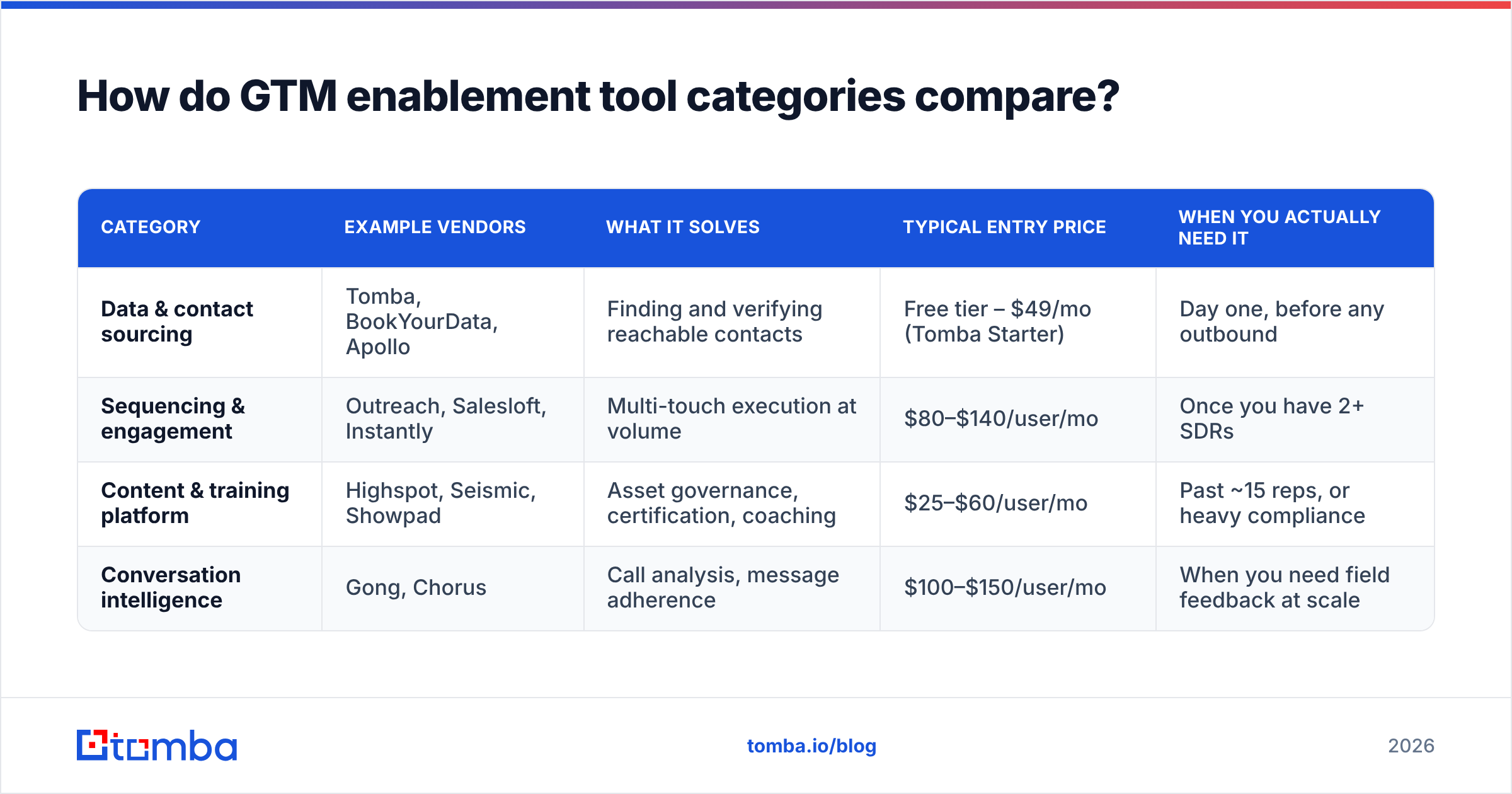
Nobody buys one tool for all of this. The stack splits into four categories with different jobs, and the mistake is buying a category-3 platform to solve a category-2 problem.
| Category | Example vendors | What it solves | Typical entry price | When you actually need it |
|---|---|---|---|---|
| Data & contact sourcing | Tomba, BookYourData, Apollo | Finding and verifying reachable contacts | Free tier – $49/mo (Tomba Starter) | Day one, before any outbound |
| Sequencing & engagement | Outreach, Salesloft, Instantly | Multi-touch execution at volume | $80–$140/user/mo | Once you have 2+ SDRs |
| Content & training platform | Highspot, Seismic, Showpad | Asset governance, certification, coaching | $25–$60/user/mo | Past ~15 reps, or heavy compliance |
| Conversation intelligence | Gong, Chorus | Call analysis, message adherence | $100–$150/user/mo | When you need field feedback at scale |
A 10-rep team does not need all four. It needs category 1 properly, category 2 lightly, and a disciplined human running the rest. Buying Highspot for eight reps is how enablement budgets get frozen.
On pricing specifically: data tooling is the cheapest layer and the one with the fastest payback, because it multiplies the value of everything above it. Tomba pricing starts at a free tier with 25 searches per month, then $49/mo for Starter, $99/mo for Growth, and $249/mo for Pro — meaningfully below the per-seat enablement platforms, and it's the layer you can't skip. BookYourData takes a different approach with prepaid, pay-as-you-go credit packs, which suits teams that buy lists in bursts rather than searching continuously; both models work, they just fit different buying rhythms.

What does a 90-day GTM enablement rollout look like?#
Compressed, sequenced, and deliberately unglamorous.
Days 1–30: Diagnose and fix the foundation. Audit your CRM for contact completeness and bounce history. Run a sample of 500 records through verification and measure the true invalid rate — most teams are shocked. Rewrite the ICP with a disqualification column. Interview your top three and bottom three reps separately; the delta between them is your real enablement curriculum.
Days 31–60: Build the minimum asset set. Not a library. Six assets: one-page ICP, a discovery question bank, three objection one-liners, a competitive one-pager per top-two competitor, a two-sentence case study per segment, and a sequence template with verified-data steps built into the process. Ship these into the CRM, not a wiki.
Days 61–90: Instrument and iterate. Turn on stage-to-stage conversion reporting. Sit on ten calls. Compare what reps actually say to what you wrote. Rewrite the assets that lost the argument in live conversations. Publish the first monthly enablement scorecard with the four metrics above.
Then repeat. Enablement is a maintenance function disguised as a project function — HubSpot's research on sales enablement and G2's enablement category data both reflect the same pattern: teams that treat it as continuous outperform teams that treat it as an annual initiative.
How do you enable reps on outbound specifically?#
Outbound is where enablement quality is most visible, because the feedback loop is days rather than quarters.
- Enable on research, not just writing. A rep who can find the right VP of Ops in 90 seconds outperforms one with better copy and worse targeting. Tooling that lives in the browser — a Chrome extension that surfaces contacts on a company page — removes the friction that makes reps default to generic inboxes.
- Bake verification into the sequence step, not a cleanup task. Make "verify before enroll" a mandatory field, not a best practice. Best practices get skipped at month-end.
- Give reps a bulk path and a single path. Prospecting an account list of 300 needs bulk email finder workflows. Prospecting one strategic account needs a single lookup. Reps use whichever is available; give them both.
- Set a bounce ceiling and enforce it. Under 3%. Publish it. Make it a rep-level metric. It changes behavior faster than any training session, because it makes data quality personally visible.
- Coach on the first 30 seconds. Most outbound coaching over-indexes on the whole email. The opening line and the subject carry the outcome. Everything after paragraph one only matters if paragraph one earned it.
What should you measure in the first two quarters?#
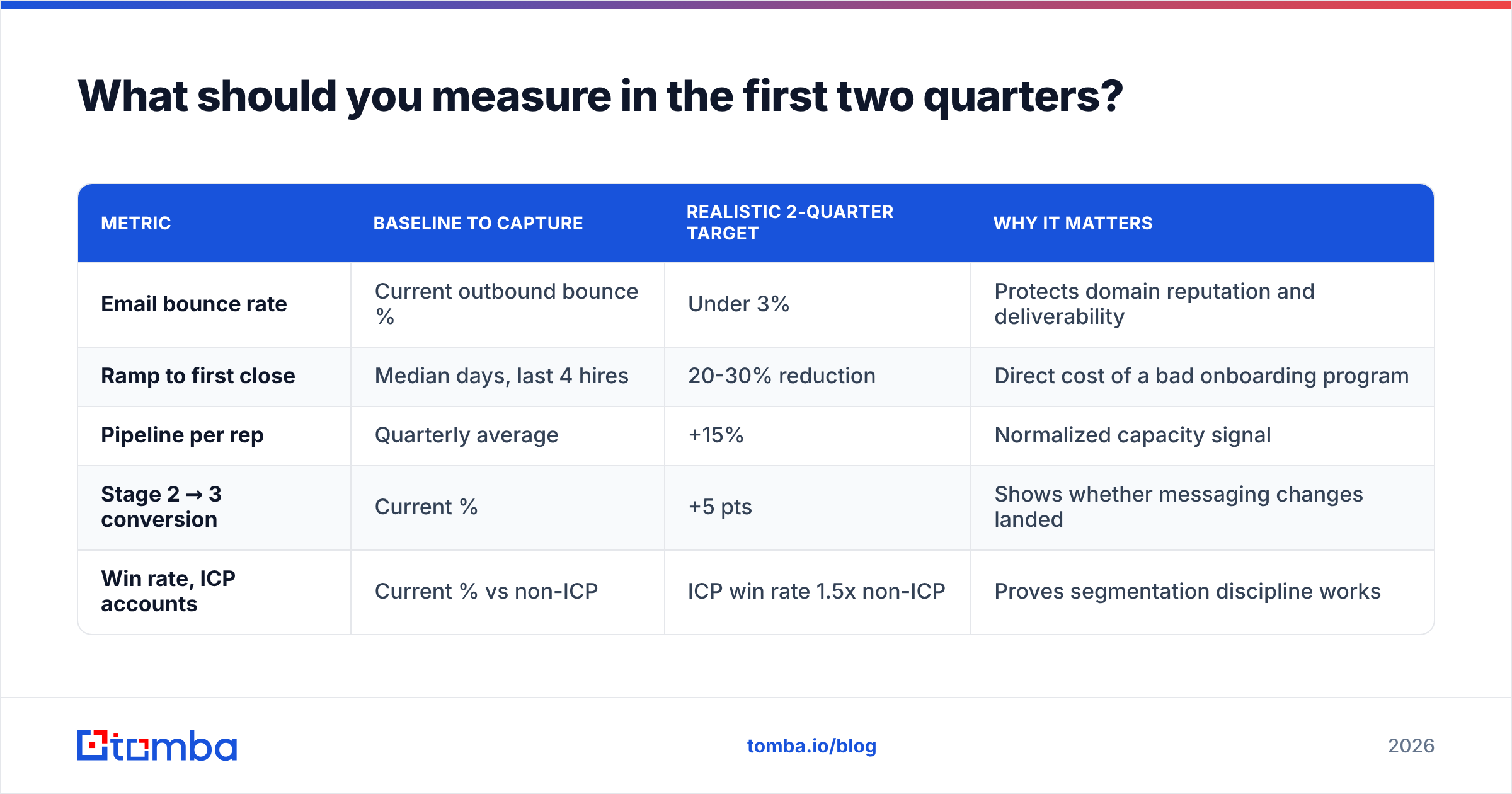
Set the baseline before you change anything — otherwise you'll have no way to attribute improvement.
| Metric | Baseline to capture | Realistic 2-quarter target | Why it matters |
|---|---|---|---|
| Email bounce rate | Current outbound bounce % | Under 3% | Protects domain reputation and deliverability |
| Ramp to first close | Median days, last 4 hires | 20-30% reduction | Direct cost of a bad onboarding program |
| Pipeline per rep | Quarterly average | +15% | Normalized capacity signal |
| Stage 2 → 3 conversion | Current % | +5 pts | Shows whether messaging changes landed |
| Win rate, ICP accounts | Current % vs non-ICP | ICP win rate 1.5x non-ICP | Proves segmentation discipline works |
If ICP-fit accounts don't close at a materially higher rate than non-ICP accounts, your ICP is wrong. That is the single most useful diagnostic in the table, and almost nobody runs it.
What's the honest verdict on GTM enablement in 2026?#
Enablement is not a content problem, a training problem, or a platform problem. It's a sequencing problem. Teams that fix data, then message, then workflow, then measurement — in that order — see compounding returns. Teams that start with a platform purchase see a Notion wiki with 40 orphaned pages.
The cheapest, highest-leverage place to start is the layer nobody wants to own: making sure the person your rep is emailing is real, reachable, and the right person. Everything upstream of that is theory.
If your reps are working lists they don't trust, start there. Tomba's Email Finder finds verified professional email addresses by domain, name, or company, with a free tier at 25 searches a month to benchmark your current list quality before you commit to anything. Run 500 of your existing CRM records through it, compare the invalid rate to what you assumed, and you'll have your enablement roadmap's first quarter written for you.
Related guides#
Ready to find emails that actually work?
Join 150,000+ professionals who stopped guessing and started sending. Free credits on signup — no credit card required.
Get the Tomba newsletter
Practical outbound tactics and product updates — once every two weeks.
About the author