Go To Market Example: 5 Real GTM Plans Broken Down
Five real go-to-market plans — PLG, sales-led, ABM, community-led, and partner-led — broken down by ICP, channel, budget, and the metrics each one actually moves.
TL;DR
- A go-to-market plan is four decisions written down: who you sell to, what you promise them, how they find you, and how you get paid. Everything else is execution detail.
- The five motions that cover almost every B2B launch: product-led (PLG), sales-led, account-based (ABM), community-led, and partner-led. Most companies run two, badly, instead of one, well.
- Budget follows motion. A PLG launch spends 70% on product and activation; an ABM launch spends 60% on data, research, and human outreach.
- The single most common failure isn't channel choice — it's an ICP defined so broadly that no message lands and no list can be built.
- Every motion below includes a worked example with real numbers you can copy into a spreadsheet today.
What is a go-to-market plan, actually?#
A go-to-market plan is the operating manual for turning a product into revenue. Think of it like a flight plan: the destination (revenue target) is obvious, but the plan is the specific route, fuel load, and checkpoints that get you there without improvising at 30,000 feet.
Most GTM documents fail because they're written as manifestos instead of instructions. A useful plan answers five questions in a form someone can act on Monday morning:
- Who exactly — Not "mid-market SaaS." Something like "Series A–B SaaS companies, 50–200 employees, US/UK, with an existing outbound SDR team of 2+."
- What changes for them — The specific before/after state. "Reps waste 6 hours a week on manual list building" → "lists build themselves overnight."
- How they discover you — The one channel you'll be genuinely good at first. Not five channels you'll be mediocre at.
- What the buying process looks like — Self-serve card entry, a 14-day pilot, or a six-person committee and a security review.
- What proves it's working — A leading metric you can read weekly, not just ARR at quarter-end.
If you can't fill those five in under a page, you don't have a GTM plan — you have a wish. Gartner's research on B2B buying consistently finds that buyers spend only about 17% of their journey with any supplier's sales reps, which is why the discovery and proof questions matter as much as the sales questions.
What are the five go-to-market motions?#
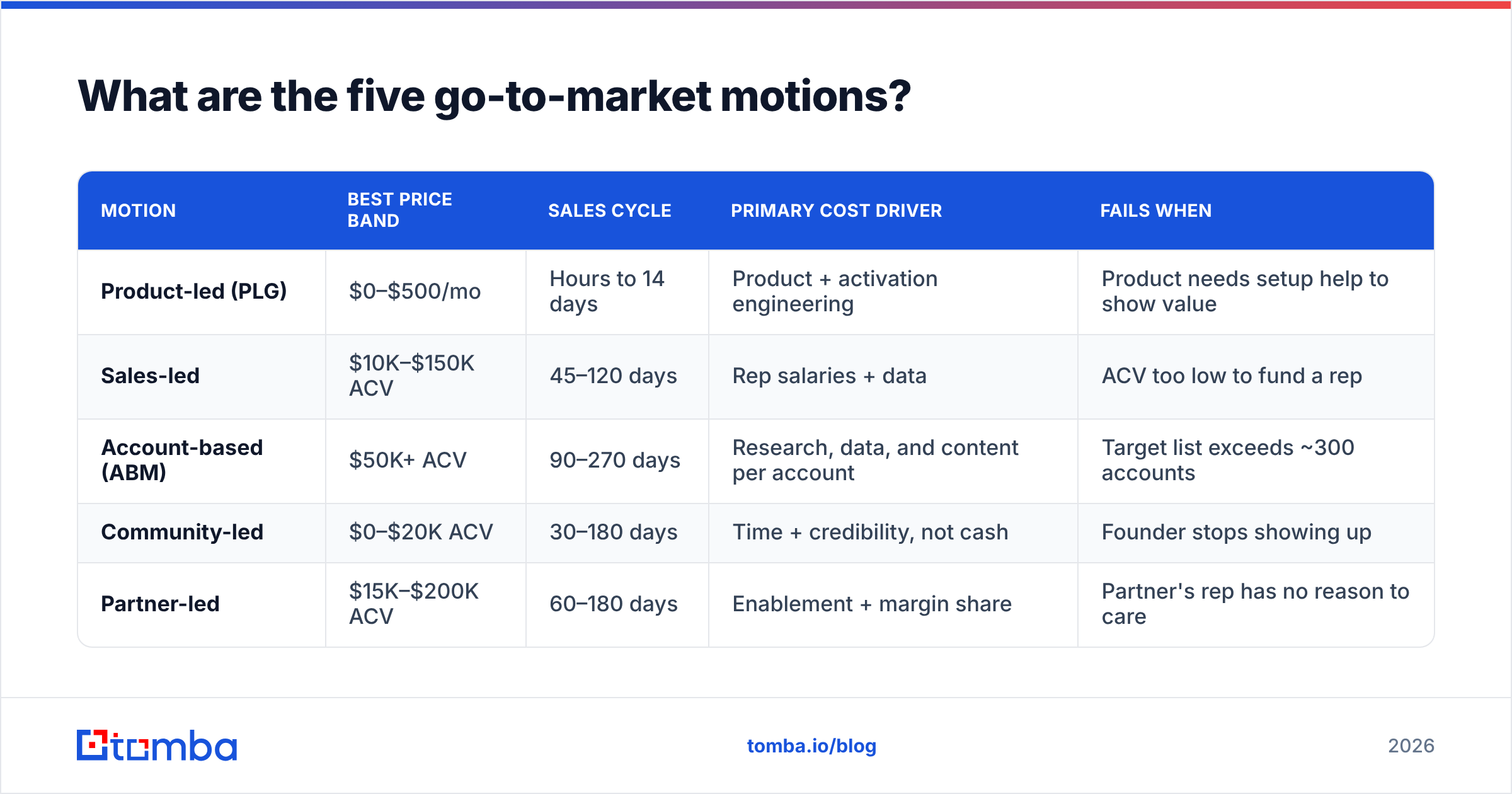
Here's the comparison that most GTM decks skip. Each motion has a natural buyer, a natural price band, and a natural failure mode — pick the one that matches your product's reality, not your ambition.
| Motion | Best price band | Sales cycle | Primary cost driver | Fails when |
|---|---|---|---|---|
| Product-led (PLG) | $0–$500/mo | Hours to 14 days | Product + activation engineering | Product needs setup help to show value |
| Sales-led | $10K–$150K ACV | 45–120 days | Rep salaries + data | ACV too low to fund a rep |
| Account-based (ABM) | $50K+ ACV | 90–270 days | Research, data, and content per account | Target list exceeds ~300 accounts |
| Community-led | $0–$20K ACV | 30–180 days | Time + credibility, not cash | Founder stops showing up |
| Partner-led | $15K–$200K ACV | 60–180 days | Enablement + margin share | Partner's rep has no reason to care |
Two rules that hold across all five. First, the motion has to be affordable at your average contract value: a fully loaded AE costs roughly $150K–$250K a year, so a $4K ACV product cannot carry a sales-led motion no matter how good the reps are. Second, whichever motion you choose, the data layer underneath it is the same — you need accurate contact records, and bad data breaks every motion equally.
Wait — that image needs its real form:
What does a product-led go to market example look like?#
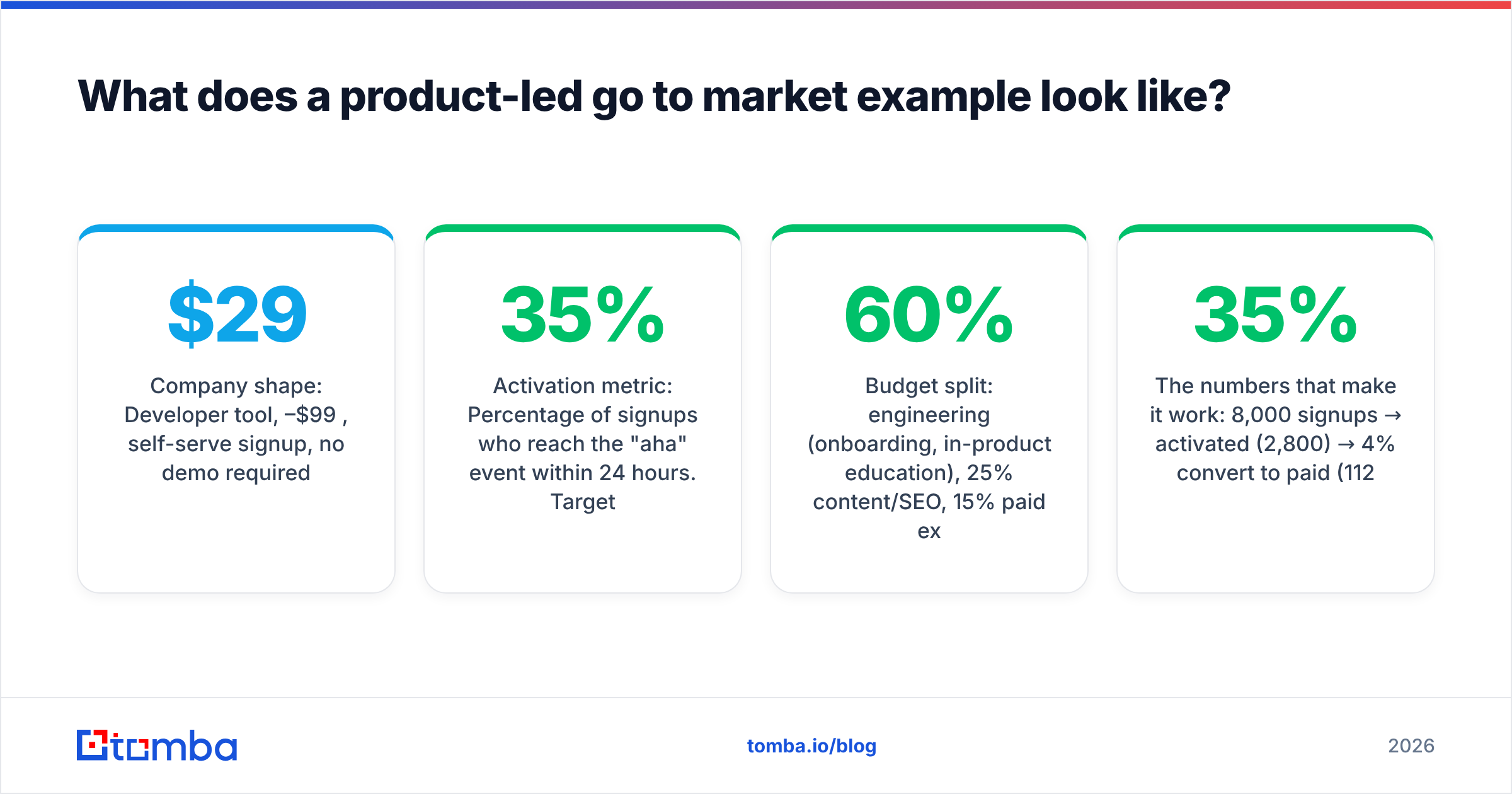
Company shape: Developer tool, $29–$99/mo, self-serve signup, no demo required.
The classic PLG example is a workflow tool that launches with a free tier capped by usage rather than features. The full plan:
- ICP: Individual engineers at companies of 20–500, discovered through search and peer recommendation.
- Wedge: One job done dramatically better — a task that takes 40 minutes manually finishes in 90 seconds.
- Acquisition: SEO on 60–80 long-tail "how do I X" queries, plus integration marketplace listings (Zapier, Slack, GitHub).
- Activation metric: Percentage of signups who reach the "aha" event within 24 hours. Target: 35%+.
- Monetization trigger: Usage cap, not a time-based trial. Users who hit the cap have already proven value.
- Budget split: 60% engineering (onboarding, in-product education), 25% content/SEO, 15% paid experiments.
The numbers that make it work: 8,000 signups/month → 35% activated (2,800) → 4% convert to paid (112 new customers) → at $49 average that's $5,488 new MRR/month, compounding. The whole model dies if activation drops below ~20%, so PLG teams obsess over the first session, not the funnel top.
Where PLG teams still need outbound: even self-serve companies run a "product-qualified lead" motion. When an account hits 5+ seats on the free tier, someone reaches out to the VP. That requires knowing who the VP is and having a working address — which is where a domain search fits into an otherwise fully automated motion.
What does a sales-led go to market example look like?#
Company shape: Compliance platform, $28K average ACV, 90-day cycle, buyer is a Head of Risk.
- ICP: Financial services and healthcare firms, 200–2,000 employees, US-based, that have had a SOC 2 or HIPAA audit in the last 18 months.
- List size: ~4,200 accounts. Roughly 3 contacts each = 12,600 target contacts.
- Team: 2 SDRs, 2 AEs, 1 solutions engineer shared.
- Channels: 60% outbound email + phone, 25% inbound from content, 15% events.
- Cadence: 9 touches over 21 days — 4 emails, 3 calls, 2 LinkedIn.
- Targets: 1.8% meeting rate on outbound → 227 meetings/year → 22% close → 50 deals → $1.4M new ARR.
That 1.8% meeting rate is the whole business, and it's mostly a data problem. If 25% of your addresses bounce or land in spam, the domain reputation damage drags the other 75% down with it. Sales-led teams that hit their number verify before they send, run email verification on every list, and keep bounce rates under 2%.
The phone half matters more than most teams admit. Direct dials convert meetings at several times the rate of switchboard numbers, so a phone finder step in list-building is worth the extra enrichment cost when ACV is above $20K.
What does an ABM go to market example look like?#
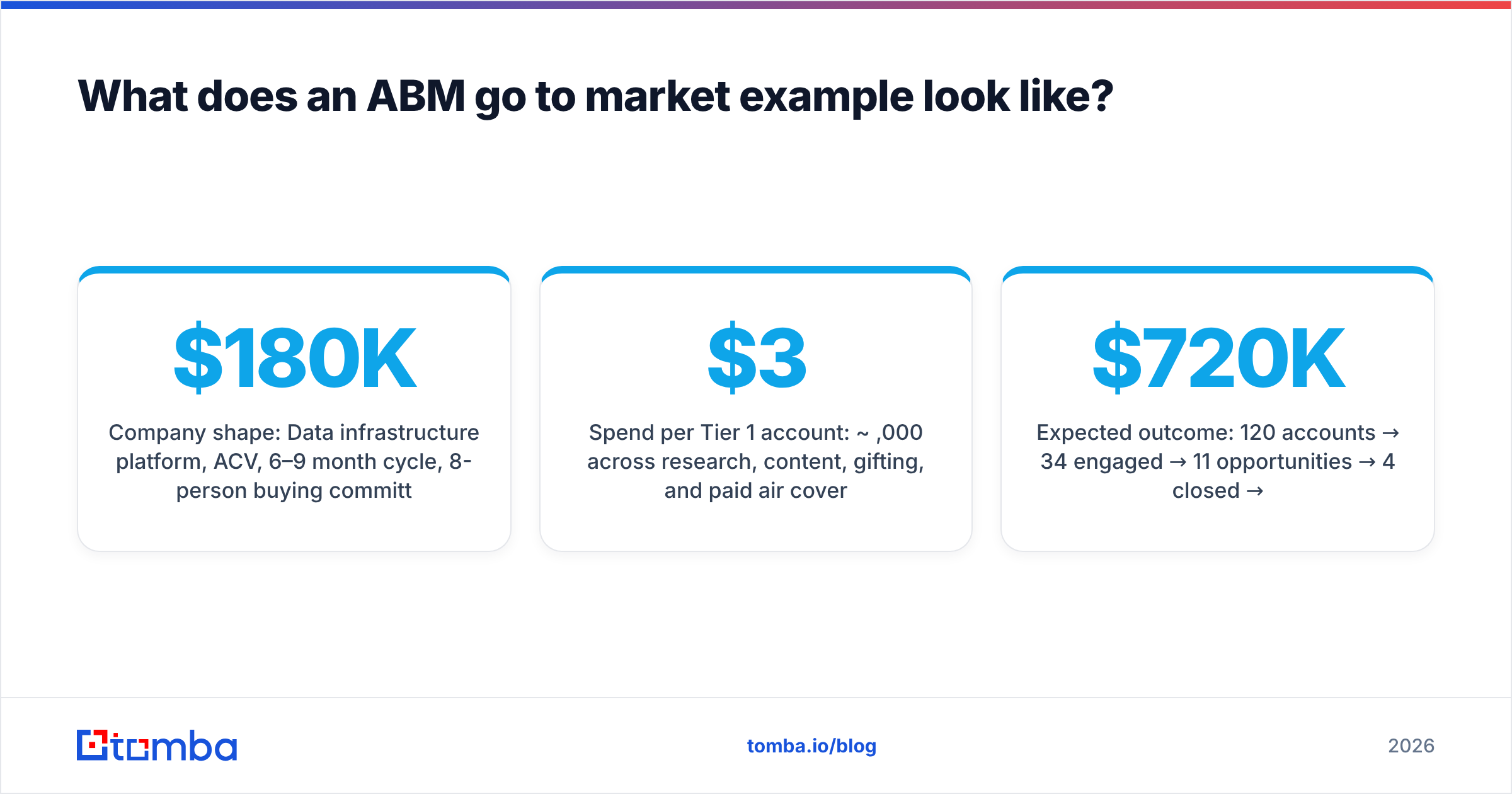
Company shape: Data infrastructure platform, $180K ACV, 6–9 month cycle, 8-person buying committee.
ABM is not outbound with better copy. It's a different economic model: you spend 10–50x more per account on a list that's 10–50x smaller.
- Target list: 120 accounts, chosen by a scoring model (tech stack signal, headcount growth, funding stage, existing vendor contract renewal date).
- Tiering: Tier 1 = 20 accounts get custom research and a bespoke landing page. Tier 2 = 40 get industry-personalized sequences. Tier 3 = 60 get segment-level campaigns.
- Contacts mapped per account: 6–9 across economic buyer, champion, technical evaluator, and blocker.
- Spend per Tier 1 account: ~$3,000 across research, content, gifting, and paid air cover.
- Metric that matters: Account engagement score — number of distinct contacts in an account showing intent in a 30-day window. Not MQLs.
- Expected outcome: 120 accounts → 34 engaged → 11 opportunities → 4 closed → $720K.
The operational bottleneck is always the same: mapping 6–9 real humans per account with current titles and reachable contact details. Doing that manually takes an SDR 20–30 minutes per account. Doing it with bulk lead generation tooling takes minutes for the whole list, and the saved hours go into the research that actually differentiates ABM.
Forrester's B2B research has argued for years that buying groups, not individual leads, are the correct unit of measurement — and if that's your unit of measurement, your data has to be complete at the account level, not the person level.
How do you choose between them?#
Run your product through this filter in order. Stop at the first "no."
- Can a user get value in one session, alone, without a human? If yes, PLG is available to you. If no, skip it — PLG on a product that requires implementation just produces churned free users.
- Is your ACV above roughly $12K? If yes, sales-led is fundable. Below that, a rep costs more than they can produce.
- Is your total addressable market under ~500 named accounts? If yes, ABM is the efficient choice — you can afford to know every account personally.
- Do you have a founder or team with existing standing in a real community? If yes, community-led is the cheapest acquisition you'll ever get. If no, don't fake it; audiences detect it instantly.
- Does someone else already sell to your exact buyer at the exact moment they'd need you? If yes, partner-led compounds faster than anything else.
Most companies answer yes to two or three. Pick one for the next four quarters and treat the others as experiments with capped budgets, not as parallel strategies.

What does the GTM budget actually look like?#
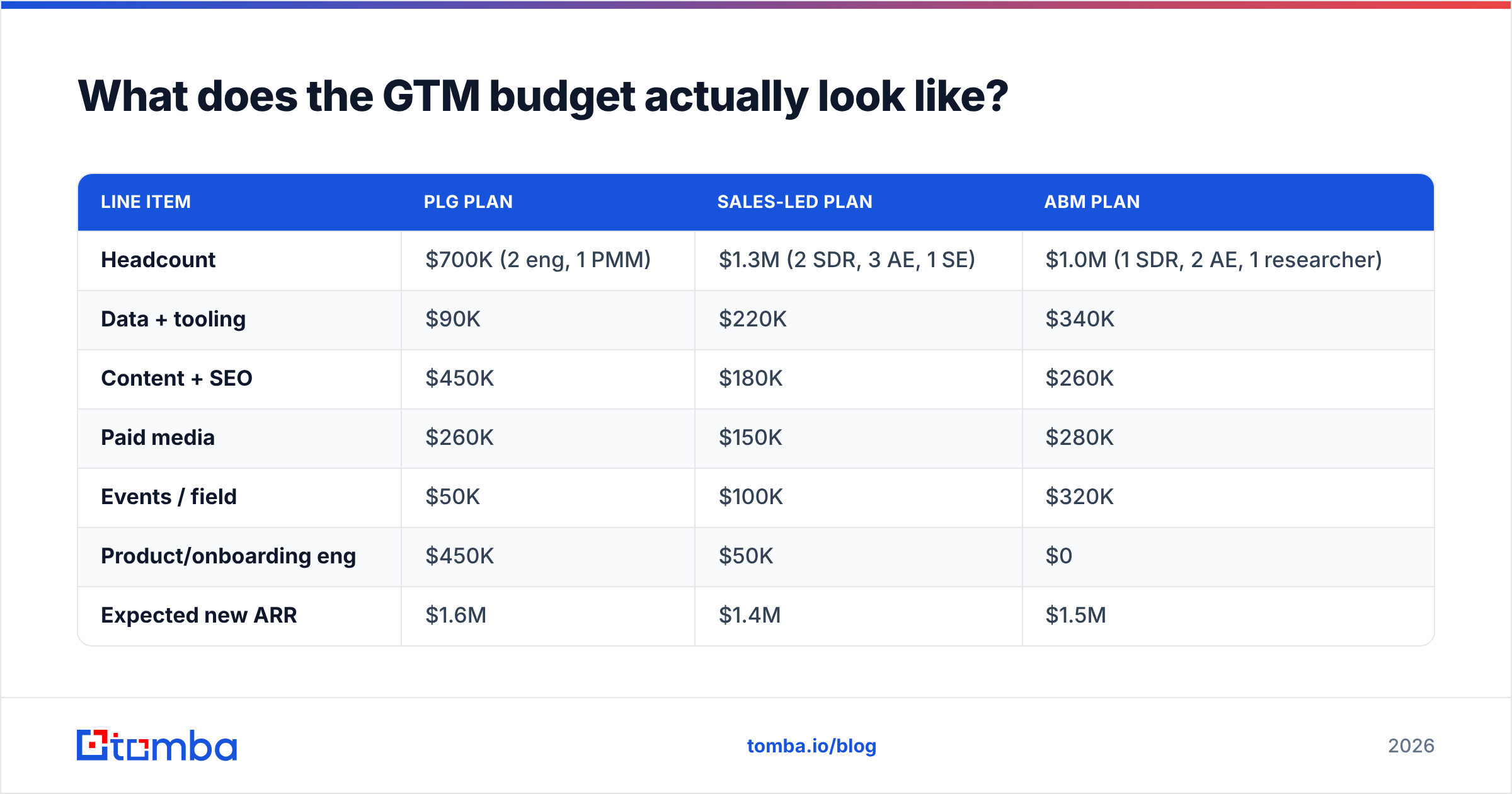
Here's a side-by-side for a $2M annual GTM budget deployed three different ways. The point isn't the exact percentages — it's that the same money produces radically different org charts.
| Line item | PLG plan | Sales-led plan | ABM plan |
|---|---|---|---|
| Headcount | $700K (2 eng, 1 PMM) | $1.3M (2 SDR, 3 AE, 1 SE) | $1.0M (1 SDR, 2 AE, 1 researcher) |
| Data + tooling | $90K | $220K | $340K |
| Content + SEO | $450K | $180K | $260K |
| Paid media | $260K | $150K | $280K |
| Events / field | $50K | $100K | $320K |
| Product/onboarding eng | $450K | $50K | $0 |
| Expected new ARR | $1.6M | $1.4M | $1.5M |
The ABM column spends nearly 4x the PLG column on data and tooling, and that ratio is not a rounding error — it's the motion. When your entire year depends on 120 accounts, a wrong contact record is expensive in a way it simply isn't when 8,000 people sign up on their own.
For teams building the data layer themselves, cost per verified contact is the number to track. Tomba pricing starts free at 25 searches a month, with Starter at $49/mo, Growth at $99/mo, and Pro at $249/mo — useful for benchmarking whether your enrichment spend is proportionate to your motion. Compare that against your rep's fully loaded hourly cost: if an SDR earning $70K spends six hours a week on manual list building, that's roughly $10K a year of salary spent on something tooling does in minutes.
What are the most common GTM mistakes?#
Defining the ICP by firmographics only. "500–2,000 employees, SaaS, US" is a filter, not an ICP. Add a trigger — recent funding, a job posting for the role your product replaces, a competitor's contract renewal window — and your list drops by 80% while your reply rate triples.
Launching all five motions at once. Running PLG, outbound, ABM, community, and partners simultaneously with a 6-person team means five things all get 20% of the attention required to work. Sequence them.
Measuring lagging indicators only. Pipeline and ARR tell you what happened last quarter. Activation rate, response rate, meetings-per-SDR-week, and account engagement tell you what's happening now.
Treating deliverability as an email problem instead of a GTM problem. A domain that gets flagged takes 4–8 weeks to recover, and during that window your entire outbound motion produces zero. Verify lists, warm domains, and cap daily volume per mailbox.
Building the plan without checking the data can be built. The plan that requires "every VP of Engineering at every Series B company in DACH" is only executable if that list exists and is reachable. Validate list-buildability before you commit headcount to it.
Skipping the loss review. Read G2's category data or your own closed-lost notes and you'll find the same three objections repeating. Those three objections are your next quarter's messaging.
How do you turn this into a plan this week?#
A working first draft takes about four hours, not four weeks:
- Hour one — write the one-page ICP with a trigger, not just firmographics. Name 10 companies that fit perfectly and 10 that almost fit but don't; the difference between the lists is your real criteria.
- Hour two — pick one motion using the five-question filter above. Write down what you're explicitly not doing this quarter.
- Hour three — build the list and check it's real. Pull the target accounts, map the roles you need at each, and enrich contacts. If your motion is outbound, verify before anything sends.
- Hour four — set the weekly leading metric and the review cadence. One number, reviewed every Monday, that tells you whether the motion is working before the quarter ends.
Then run it for a full quarter without changing motions. GTM plans fail more often from mid-quarter pivots than from bad initial choices.
Getting the data layer right#
Every plan above assumes one thing: that when you decide to reach a specific person at a specific company, you can. That assumption is where most GTM plans quietly break — the strategy is fine, the list is stale, and the motion never gets a fair test.
If your next quarter's plan depends on reaching named accounts, start by making sure the contacts exist and resolve. The Tomba Email Finder finds professional addresses by domain, name, or company, so you can build the target list your GTM plan assumes — and verify it before a single send. Start on the free tier, run your first 25 target accounts through it, and see whether your plan is executable before you staff it.
Related guides#
Ready to find emails that actually work?
Join 150,000+ professionals who stopped guessing and started sending. Free credits on signup — no credit card required.
Get the Tomba newsletter
Practical outbound tactics and product updates — once every two weeks.
About the author