Go To Market Fit: The 2026 Framework for GTM Teams
Product-market fit tells you people want it. Go to market fit tells you whether you can repeatedly reach, convince, and close them at a price that pays. Here's how to measure it.

TL;DR
- Product-market fit proves people want the product. Go to market fit proves you can find, reach, and close those people repeatedly at a cost that leaves margin. They are different problems and they fail for different reasons.
- The four components of GTM fit: a defined segment, a channel that reaches it economically, a motion that matches deal size, and a message that lands in that channel.
- The clearest quantitative signal is a CAC payback under 12 months holding steady while spend doubles. If payback degrades as you scale, you have channel fit, not go to market fit.
- Most "we have PMF but can't grow" companies actually have a segment definition problem — they are averaging three different buyers into one ICP and getting a message that lands for none of them.
- GTM fit is not permanent. Channels saturate, buyers change, competitors copy. Re-measure quarterly.
What is go to market fit?#
Go to market fit is the point where your channel, segment, motion, and message reinforce each other well enough that acquiring a customer costs meaningfully less than that customer is worth — and stays that way as you spend more.
Here's the everyday version. Product-market fit is discovering that people love your restaurant's food. Go to market fit is discovering that the restaurant sits on a street where those people actually walk, that your sign is readable from across the road, and that you can seat them fast enough to make rent. Great food on a dead street is a real business failure mode, and it has nothing to do with the food.
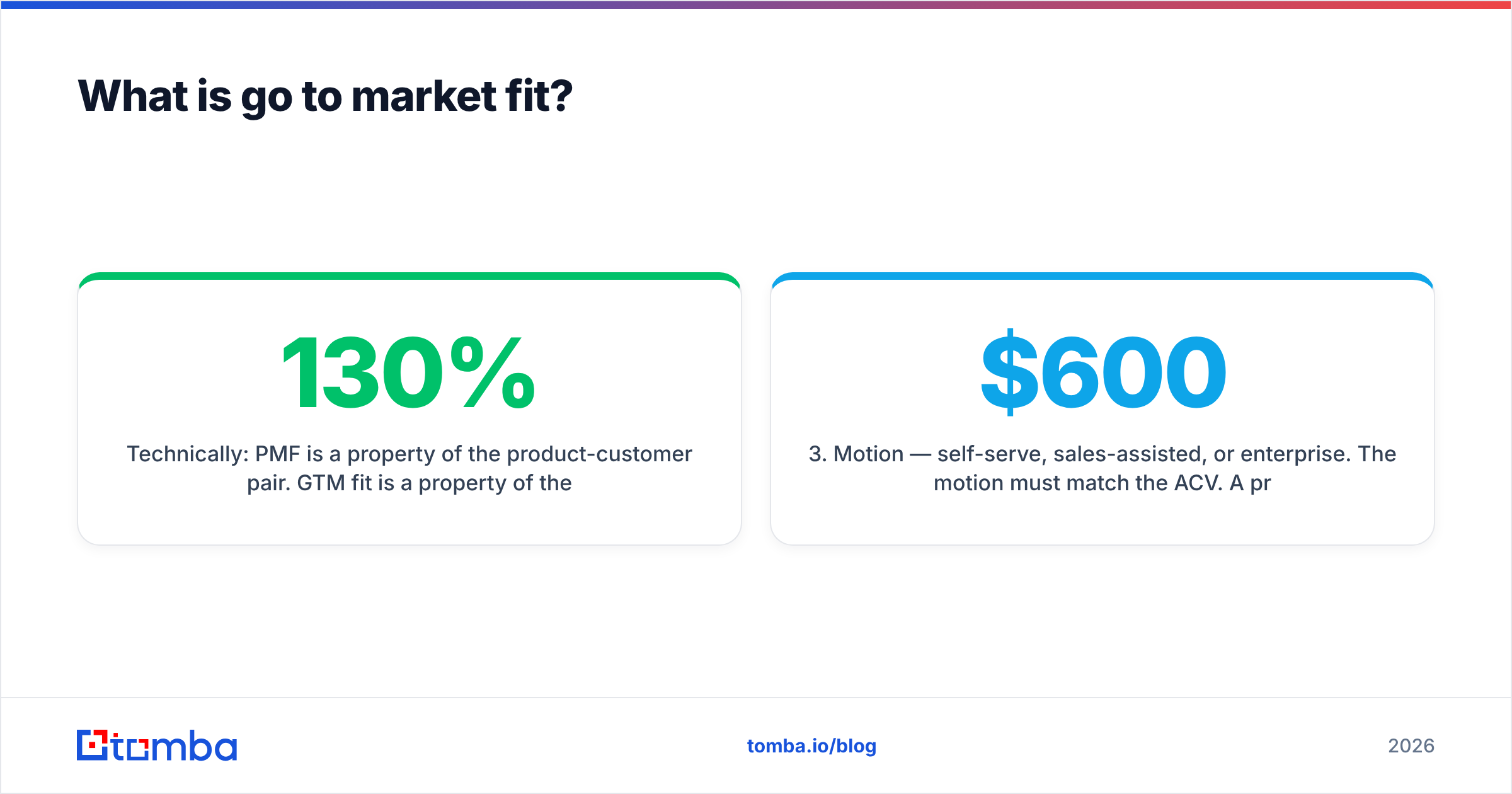
Technically: PMF is a property of the product-customer pair. GTM fit is a property of the system that connects them — the acquisition channel, the sales motion, the pricing, and the positioning working as one unit. You can have world-class PMF and zero GTM fit. Plenty of companies with rabid users and 130% net revenue retention burn out because every new customer costs $40,000 to acquire and generates $18,000 a year.
The four load-bearing components:
- Segment — a group narrow enough that one message works for all of them, and large enough to build a company on. Most GTM failures are actually segment failures in disguise.
- Channel — a repeatable way to reach that segment where the cost per qualified conversation is stable or falling. Outbound, paid, content, partnerships, PLG, community.
- Motion — self-serve, sales-assisted, or enterprise. The motion must match the ACV. A $600/year product cannot support a five-call sales cycle.
- Message — the specific words that make the segment stop scrolling. Message fit is channel-specific: what works in a LinkedIn DM dies in a Google ad.
Break any one and the whole thing stalls, which is why teams misdiagnose so often. A rising CAC feels like a channel problem when it's usually a segment problem upstream.

How is go to market fit different from product-market fit?#
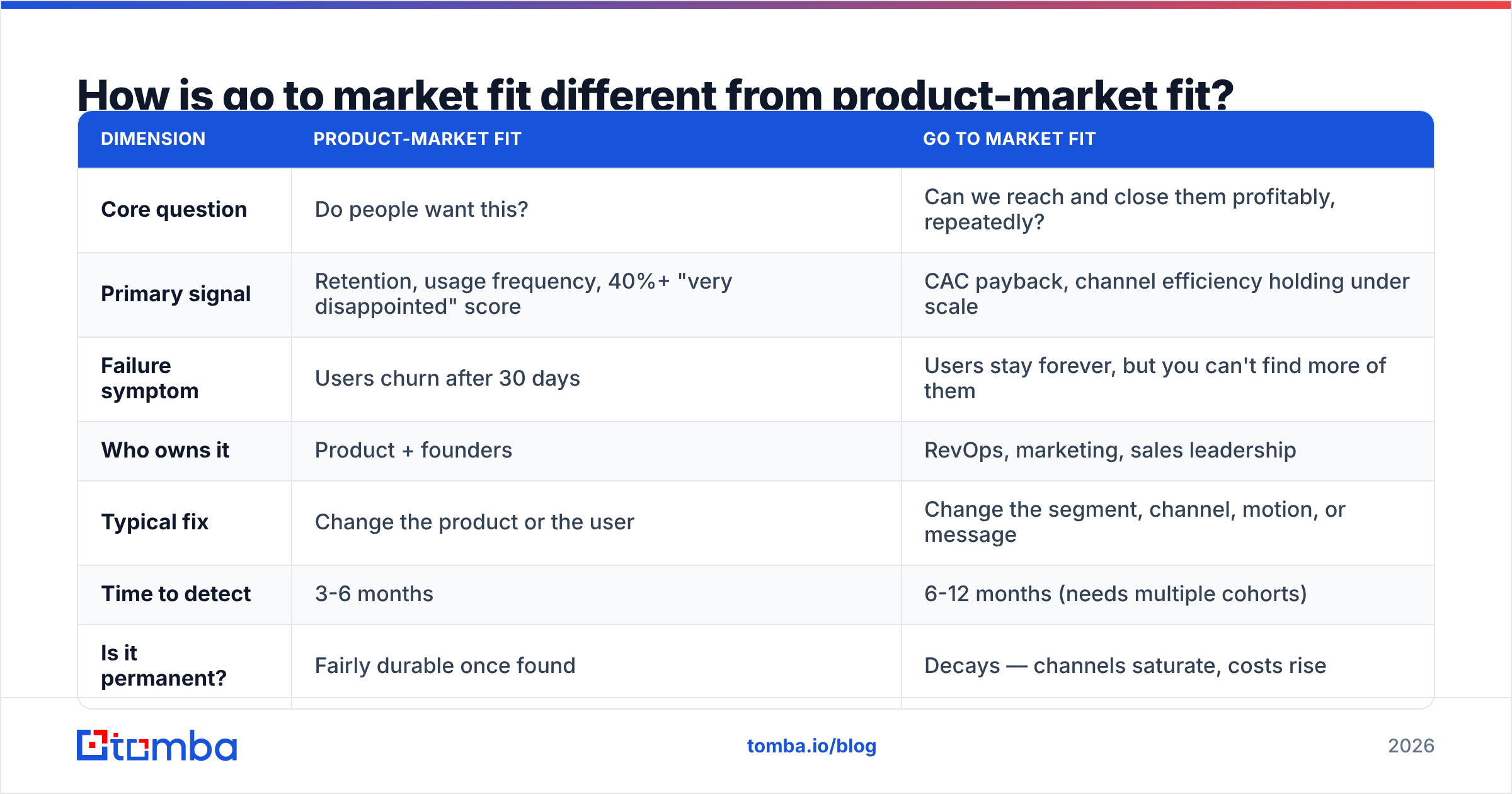
They fail at different points in the funnel, so they need different fixes.
| Dimension | Product-market fit | Go to market fit |
|---|---|---|
| Core question | Do people want this? | Can we reach and close them profitably, repeatedly? |
| Primary signal | Retention, usage frequency, 40%+ "very disappointed" score | CAC payback, channel efficiency holding under scale |
| Failure symptom | Users churn after 30 days | Users stay forever, but you can't find more of them |
| Who owns it | Product + founders | RevOps, marketing, sales leadership |
| Typical fix | Change the product or the user | Change the segment, channel, motion, or message |
| Time to detect | 3-6 months | 6-12 months (needs multiple cohorts) |
| Is it permanent? | Fairly durable once found | Decays — channels saturate, costs rise |
The dangerous pattern is inverted fit: strong GTM, weak PMF. A great outbound team with a compelling deck can sell a mediocre product to plenty of first-time buyers. The pipeline looks healthy for three quarters, then churn eats the base and net revenue goes flat while gross bookings still climb. If your logo churn is above 25% annually while new bookings grow, you have a GTM machine outrunning the product.
The reverse — strong PMF, weak GTM — is quieter and more common. Users love you, NPS is 60, and growth is 4% month over month powered entirely by word of mouth. Nobody sounds an alarm because no metric looks bad. It just never compounds.
What are the signals that you have go to market fit?#
Five signals. You want at least four of them true simultaneously, measured over two or more quarters.
1. CAC payback stays under 12 months as spend doubles. This is the single hardest test. Any channel is efficient at $5,000/month. GTM fit means efficiency survives $50,000/month. Track payback by cohort, not blended — blended payback hides a dying channel behind a healthy one.
2. Win rates are consistent across reps. If your top rep closes at 34% and the median closes at 11%, you don't have a repeatable motion — you have one talented person. Real GTM fit means a new rep hits quota within two ramp cycles because the system does the heavy lifting.
3. Sales cycle length is predictable within a tight band. Deals in a fitted segment close in a narrow window: 21-35 days, or 60-90 days, but not 14-180. Wild variance means you're selling to several different buyers and calling them one segment.
4. Inbound starts to mirror your outbound targeting. When the companies filling out your demo form look like the companies you've been deliberately targeting, your message has escaped the channel and is doing free work in the market.
5. Reps don't have to invent the pitch. Ask three reps to describe why a customer buys. If you get three different answers, message fit isn't there.
Signals two, three, and five are qualitative and cheap to check this afternoon. Do those first before you commission a dashboard.
How do you measure go to market fit numerically?#
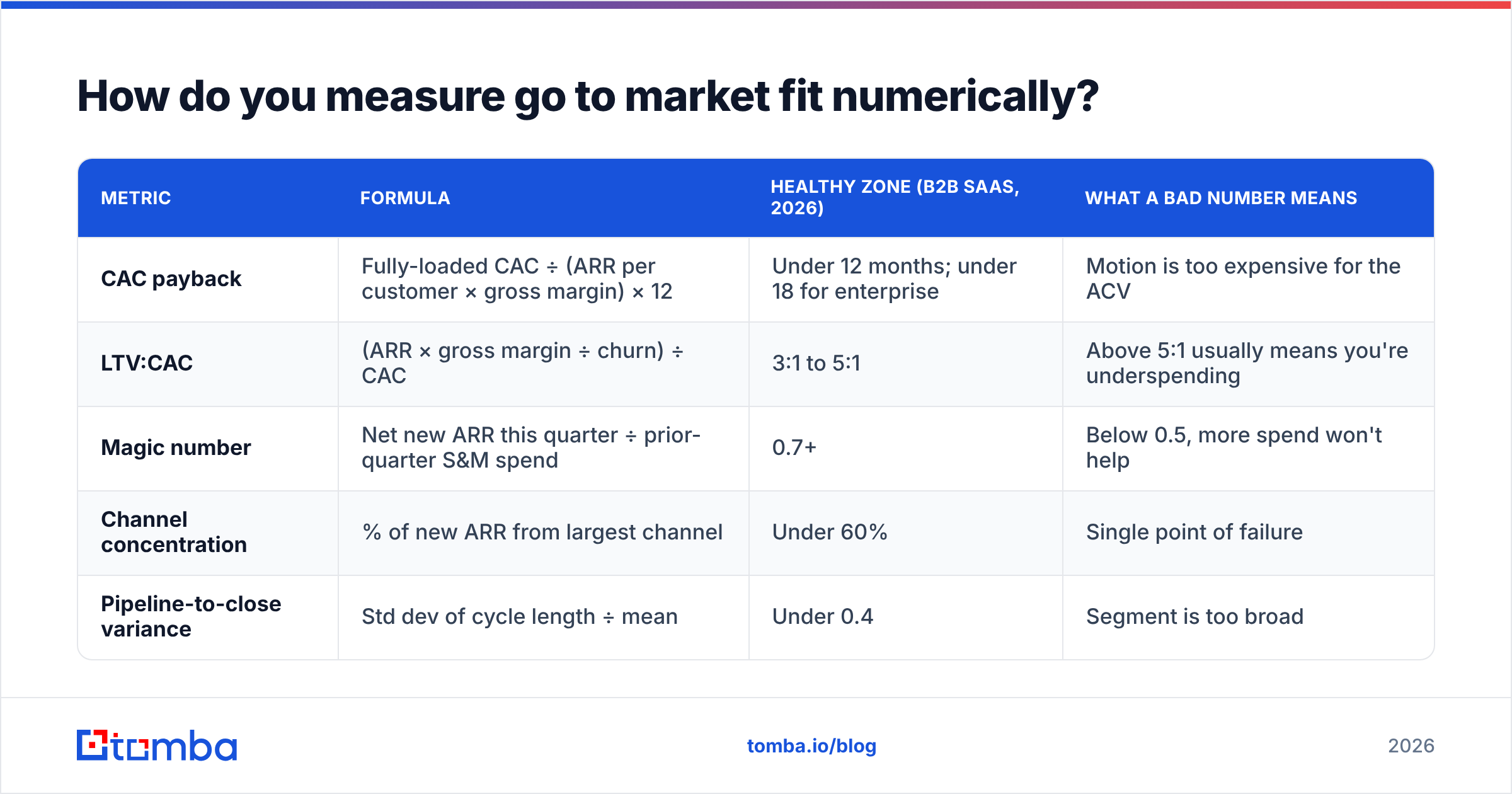
Four ratios do most of the work. None is meaningful alone.
| Metric | Formula | Healthy zone (B2B SaaS, 2026) | What a bad number means |
|---|---|---|---|
| CAC payback | Fully-loaded CAC ÷ (ARR per customer × gross margin) × 12 | Under 12 months; under 18 for enterprise | Motion is too expensive for the ACV |
| LTV:CAC | (ARR × gross margin ÷ churn) ÷ CAC | 3:1 to 5:1 | Above 5:1 usually means you're underspending |
| Magic number | Net new ARR this quarter ÷ prior-quarter S&M spend | 0.7+ | Below 0.5, more spend won't help |
| Channel concentration | % of new ARR from largest channel | Under 60% | Single point of failure |
| Pipeline-to-close variance | Std dev of cycle length ÷ mean | Under 0.4 | Segment is too broad |
A note on LTV:CAC that most articles skip: a ratio above 5:1 is not a trophy. It usually means there is profitable demand you're leaving on the table because you're too cautious with spend. The right response to 8:1 is to spend more until it falls toward 4:1, not to celebrate.
For a deeper grounding on how these fold into overall GTM planning, Gartner's B2B buying research is worth reading — it documents how buying groups have grown to 6-10 stakeholders, which is the structural reason cycle-length variance has widened across the whole category.
Why do most companies fail at go to market fit?#
Four recurring causes, in rough order of frequency.
Segment averaging. You sell to marketing agencies, in-house marketing teams, and freelance consultants, and you call them all "marketers." Each has a different budget, a different trigger, and a different word for the problem. Your message is the average of three messages, which lands for none of them. The fix is uncomfortable: pick one, and accept that you're deliberately writing copy that repels the other two for two quarters.
Motion-ACV mismatch. A $4,000 ACV product with an SDR-to-AE-to-solutions-engineer motion loses money on every deal. Rough rule: under $5K ACV needs self-serve or a single-call close; $5K-$25K supports one AE and a short cycle; above $25K justifies a full outbound team.
Channel borrowing. A competitor raised a round and went hard on paid search, so you do too — without checking whether their ACV is 4x yours. Channels are not transferable across economics.
Data decay masquerading as channel failure. This is the one RevOps teams catch last. Your outbound reply rate drops from 4.1% to 1.8% over six months and you conclude the channel is saturated. Actually, ~25-30% of B2B contact data goes stale annually as people change jobs, and your list is two years old. You're not saturating a channel; you're emailing people who left. Before declaring a channel dead, re-verify the list with an email verifier and re-run the same sequence against clean data. If reply rate recovers, the channel was fine.

How do you build go to market fit step by step?#
A practical 90-day sequence. It assumes PMF is already established — if retention is bad, stop and fix that first.
- Week 1-2 — Interrogate your closed-won list. Export every deal that closed in the last 12 months. Tag by company size, industry, trigger event, and cycle length. Look for the cluster with the shortest cycle and the highest retention. That cluster, not your aspirational ICP, is your real segment.
- Week 3-4 — Rewrite the segment definition to be uncomfortably narrow. "Series A-B B2B SaaS companies, 20-80 employees, with at least two SDRs, in the US" beats "growing tech companies." Narrow enough that you could build the target list by hand.
- Week 5-6 — Build the actual list. This is where GTM fit becomes an execution problem. Use domain search to pull contacts at every company matching the definition, then verify before a single send. A 500-company list you can name beats a 50,000-row purchase.
- Week 7-9 — Run one channel, one message, one motion. Resist testing four channels at once; you won't have the volume to read any of them. Pick the channel where your segment already congregates and run 300+ touches minimum before judging.
- Week 10-12 — Read cohort economics, not aggregate. Compute CAC payback for this cohort in isolation. Compare against the blended number. If the narrow cohort's payback is materially better, you've found the wedge — scale it before adding a second channel.
- Quarter 2 — Add exactly one variable. A second channel, or a second segment, never both. GTM fit is destroyed by simultaneous changes because you lose attribution.
The discipline that matters most is step 6. Teams that find a working motion immediately dilute it by adding three experiments, and six weeks later nobody can say what's working.
What role does data quality play in go to market fit?#
Larger than most GTM plans assume, because contact data sits underneath every other variable.
Think of it like a delivery business. You can have the right product, the right price, and the right van — if the addresses are wrong, none of it matters, and every downstream metric looks like a different problem. A stale list inflates CAC (you pay for sends that never land), corrupts channel testing (a good message reads as a bad message), and slowly wrecks sender reputation, which then makes the next clean list underperform too.
Concrete hygiene standard before you use any list to evaluate a channel:
- Bounce rate under 2%. Above that, your test results are measuring deliverability, not message fit.
- Verified within 90 days. Job-change rates in B2B roughly cluster at 25-30% annually, so a one-year-old list is a quarter fiction.
- Catch-all domains flagged separately. Catch-all servers accept everything, which means "valid" tells you nothing. Segment them out or run them through a catch-all verifier rather than letting them pollute your bounce math.
- Role accounts stripped. info@, sales@, support@ inflate list size and depress reply rate.
- One source of truth. If sales, marketing, and RevOps each maintain a list, your channel comparisons are comparing data quality, not channels.
HubSpot's research on database decay puts the annual degradation figure in the same 22-30% range that most vendors report independently, which is a reasonable planning assumption.
Which tools support each part of the GTM fit stack?#
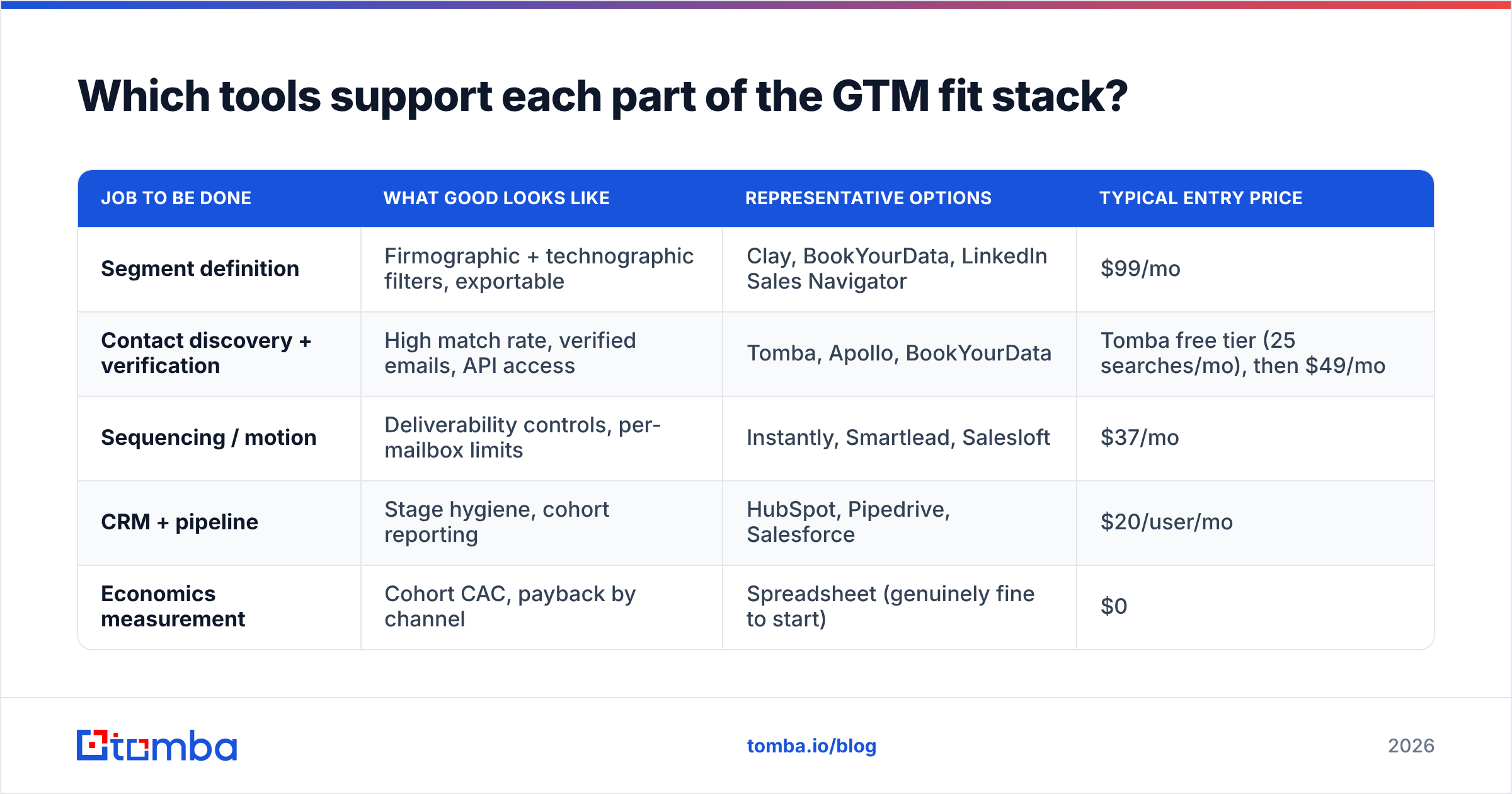
You need coverage across four jobs: define the segment, find the contacts, run the motion, and measure the economics. Nobody does all four well, and pretending otherwise is how teams end up paying enterprise prices for a data tool they use as a CRM.
| Job to be done | What good looks like | Representative options | Typical entry price |
|---|---|---|---|
| Segment definition | Firmographic + technographic filters, exportable | Clay, BookYourData, LinkedIn Sales Navigator | $99/mo |
| Contact discovery + verification | High match rate, verified emails, API access | Tomba, Apollo, BookYourData | Tomba free tier (25 searches/mo), then $49/mo |
| Sequencing / motion | Deliverability controls, per-mailbox limits | Instantly, Smartlead, Salesloft | $37/mo |
| CRM + pipeline | Stage hygiene, cohort reporting | HubSpot, Pipedrive, Salesforce | $20/user/mo |
| Economics measurement | Cohort CAC, payback by channel | Spreadsheet (genuinely fine to start) | $0 |
Two honest notes. First, the "economics measurement" row is a spreadsheet for most companies until roughly $5M ARR — buying an attribution platform before you have channel volume is buying precision you can't use. Second, BookYourData and Tomba solve overlapping problems from different angles: BookYourData is strong when you want a pre-built, pay-as-you-go list for a defined segment, while Tomba is stronger when you already know the companies and need verified contacts at those specific domains via search or API. Plenty of teams run both.
On pricing generally, Tomba pricing starts free at 25 searches/month, then $49/mo Starter, $99/mo Growth, and $249/mo Pro — which matters for GTM fit testing specifically, because the early phase is about running many small, cheap segment experiments rather than committing to one large annual data contract before you know which segment works.
How do you know when go to market fit has decayed?#
GTM fit is a lease, not a purchase. Four decay signals to watch quarterly:
- Payback creeping up while volume is flat. Not a scale cost — that's channel saturation or data decay.
- Cycle-length variance widening. Usually means you've drifted upmarket or downmarket without deciding to.
- Reply or conversion rates falling in a channel competitors just entered. Attention is finite; if four competitors started cold-emailing your segment this quarter, your 4% reply rate is now shared.
- Your best rep's win rate converging down toward the median. Counterintuitive but real: when the top performer stops outperforming, the market usually changed, not the rep.
The response to decay is the same 90-day loop, restarted at step one. Re-interrogate closed-won, because the winning cluster has probably moved.
Getting the data layer right first#
Every GTM fit experiment you run is only as trustworthy as the list you run it against. A great message to stale contacts reads identically to a bad message to good contacts — same bounce rate, same silence, same conclusion that "the channel doesn't work."
Start by fixing that variable so the rest of your tests mean something. The Tomba Email Finder lets you build verified contact lists for a narrowly-defined segment by domain, name, or company — with a free tier at 25 searches/month to validate a segment hypothesis before spending anything, and $49/mo Starter when you're ready to run the volume. Define the segment, verify the list, then judge the channel. In that order.
Related guides#
Ready to find emails that actually work?
Join 150,000+ professionals who stopped guessing and started sending. Free credits on signup — no credit card required.
Get the Tomba newsletter
Practical outbound tactics and product updates — once every two weeks.
About the author