Go-To-Market Framework McKinsey Uses: A 2026 Playbook
The go-to-market framework McKinsey teams run gets quoted constantly and applied badly. Here is what it actually contains, how it compares to Bain and BCG, and how to run it without a seven-figure retainer.
The go-to-market framework McKinsey uses gets quoted in board decks far more often than it gets read. Here is what it actually contains, where it holds up, and how to run a stripped-down version in 30 days.
TL;DR
- The go-to-market framework McKinsey teams run is not one document. It is a family of published models: growth micro-battles, the Growth Triple Play, and commercial excellence diagnostics.
- They all order the work the same way — market → segment → value proposition → channel → coverage model → enablement → metrics.
- The real value is sequencing. You do not pick a channel until you have sized the segment and priced the value.
- It breaks under roughly $50M ARR. It assumes an analyst bench, clean CRM data, and a change budget most teams lack.
- Bain and BCG cover similar ground with a different emphasis. The table below shows where each one wins.
- You can run a 30-day version yourself. The hard part is not strategy talent. It is contact data.
What is the go-to-market framework McKinsey uses?#
Start with the honest answer. McKinsey does not publish one canonical GTM framework the way HubSpot publishes the flywheel. What exists is a steady method. You can see it across their growth and marketing practice writing, in client decks that surface at conferences, and in alumni who carry the structure into operating jobs.
The skeleton has seven stages. The first four decide where you play.
- Market definition and sizing — Size the whole market, then cut it into what you can serve and what you can win. Show the math. McKinsey builds this bottom-up, from account counts times realistic contract values. Not top-down from an analyst report.
- Segmentation and prioritization — Score each segment twice. How good is it (size, growth, willingness to pay)? Can you win it (product fit, existing logos, competition)? The output is a familiar two-by-two. The discipline is that losing segments get zero budget, not a smaller one.
- Value proposition per segment — Each priority segment gets its own claim, proof, and pricing logic. One message for every segment counts as a failure.
- Channel and route-to-market design — Direct sales, inside sales, partner, product-led, or marketplace. Pick against segment economics. As a rule of thumb, cost-to-serve should sit under 25% of segment lifetime value.
The last three stages decide how you run it.
- Coverage model and capacity planning — How many reps, what territories, what quota, what ramp. In-house teams skip this stage. Consultants bill for it.
- Enablement and operating cadence — Playbooks, training, and the weekly rhythm that keeps the plan alive after kickoff.
- Metrics and micro-battles — A short list of leading indicators. Then funded 90-day sprints against one blocker each, instead of one giant transformation.
That last item is the most portable idea here. You skip the two-year transformation. Instead you run a 90-day, cross-functional push at one bottleneck — say, win rate in mid-market financial services — with a named owner and a target.

Why is this framework cited so often?#
Three reasons, and only two of them are good.
The good ones: it is sequenced and it is counted. Most internal GTM plans start at stage four. Someone wants to hire SDRs or launch a partner program, then works backward to a justification. This ordering forces you to prove a segment is worth entering first. And every stage produces a number you can be wrong about in public.
The weak reason is the brand. "This is what McKinsey uses" ends internal arguments. That is why the phrase shows up in decks written by people who never read the research. If you are here to win an argument rather than make a decision, any coherent model you actually follow will serve you better.
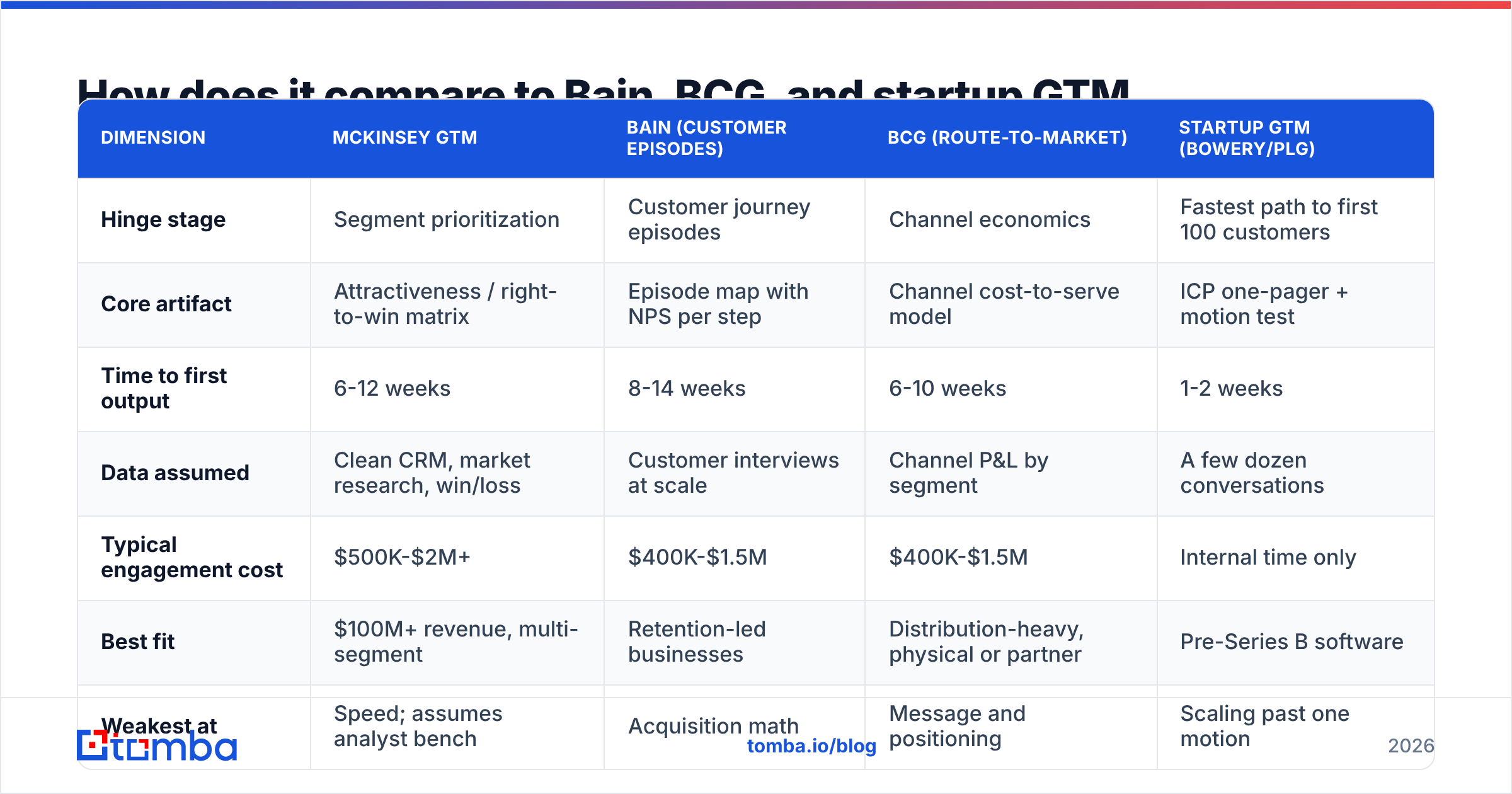
How does it compare to Bain, BCG, and startup GTM models?#
Consulting frameworks differ less than their marketing suggests. What matters is which stage they treat as the hinge, and what they assume about your data.
| Dimension | McKinsey GTM | Bain (Customer Episodes) | BCG (Route-to-Market) | Startup GTM (Bowery/PLG) |
|---|---|---|---|---|
| Hinge stage | Segment prioritization | Customer journey episodes | Channel economics | Fastest path to first 100 customers |
| Core artifact | Attractiveness / right-to-win matrix | Episode map with NPS per step | Channel cost-to-serve model | ICP one-pager + motion test |
| Time to first output | 6-12 weeks | 8-14 weeks | 6-10 weeks | 1-2 weeks |
| Data assumed | Clean CRM, market research, win/loss | Customer interviews at scale | Channel P&L by segment | A few dozen conversations |
| Typical engagement cost | $500K-$2M+ | $400K-$1.5M | $400K-$1.5M | Internal time only |
| Best fit | $100M+ revenue, multi-segment | Retention-led businesses | Distribution-heavy, physical or partner | Pre-Series B software |
| Weakest at | Speed; assumes analyst bench | Acquisition math | Message and positioning | Scaling past one motion |
| Reusable free artifact | Micro-battle sprint format | Episode NPS survey | Cost-to-serve template | ICP scoring sheet |
The practical read: under $50M ARR, take McKinsey's sequencing and Bain's customer interviews. Skip the coverage-model math from both firms until you have enough reps for territory design to matter. If you sell through distributors or resellers, BCG's route-to-market work is the better literature.
What does each stage need from you?#
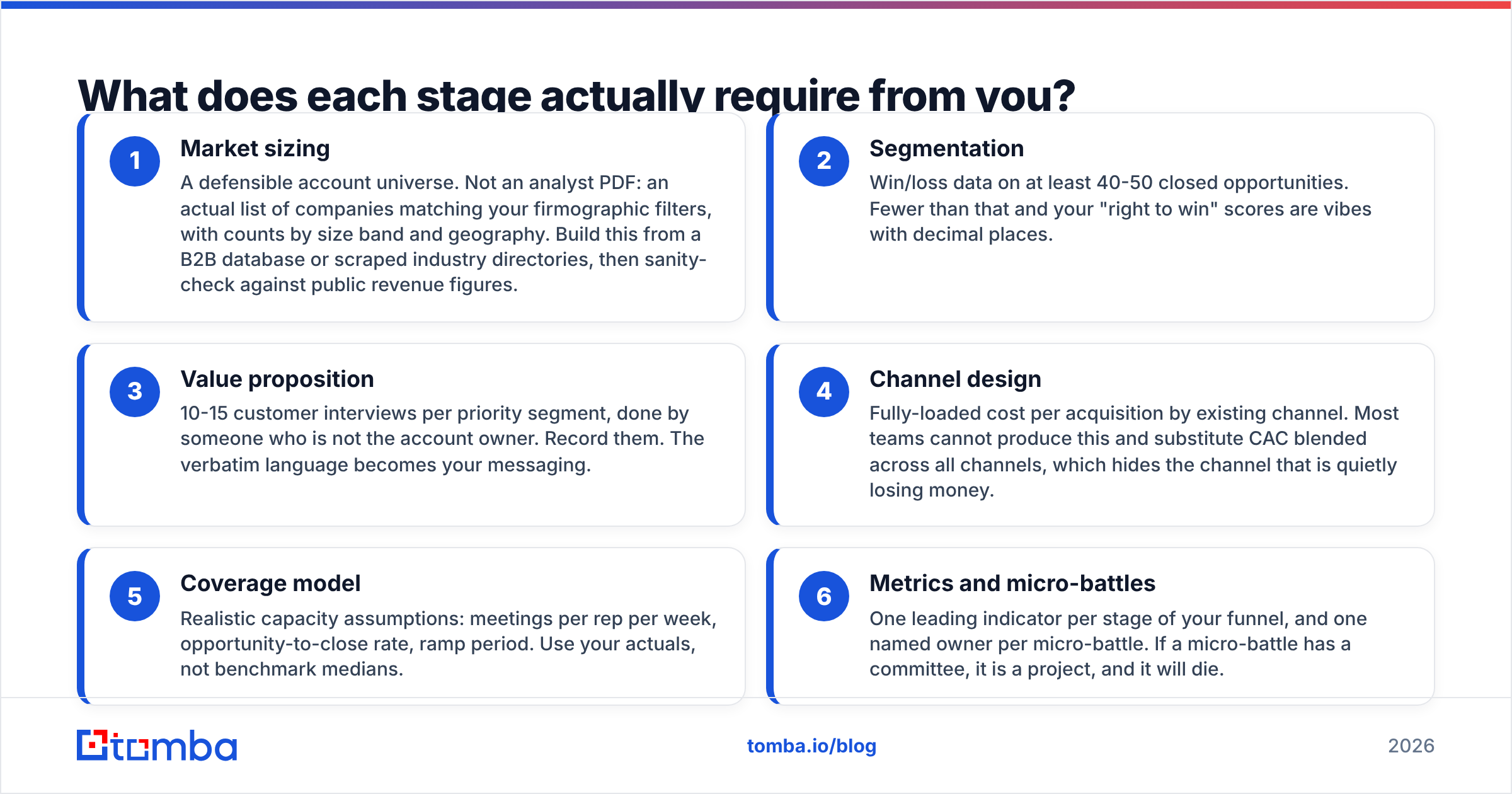
Here is the input list, stripped of consulting vocabulary. It decides whether you can run this in-house. The first three inputs are about evidence.
- Market sizing — A defensible account universe. Not an analyst PDF. An actual list of companies matching your filters, counted by size band and geography. Build it from a B2B database or industry directories, then check it against public revenue figures.
- Segmentation — Win/loss data on at least 40 to 50 closed deals. With fewer, your right-to-win scores are vibes with decimal places.
- Value proposition — Ten to 15 customer interviews per priority segment, run by someone who does not own the account. Record them. Their words become your messaging.
The last three are about money and capacity.
- Channel design — Fully loaded cost per acquisition, by channel. Most teams cannot produce this. They substitute blended CAC, which hides the channel that is quietly losing money.
- Coverage model — Honest capacity numbers: meetings per rep per week, close rate, ramp period. Use your actuals, not benchmark medians.
- Metrics and micro-battles — One leading indicator per funnel stage, and one named owner per micro-battle. If a micro-battle has a committee, it is a project, and it will die.
Stage one is where most self-run attempts collapse. The reason is mundane. You cannot test a segment without contact data for the accounts in it. Building that list, then finding the right people inside it, is a data problem rather than a strategy problem. A domain search across a few hundred target accounts answers it in an afternoon. You learn which titles exist, how deep the org chart runs, and whether your assumed buying committee is even there.
Is the go-to-market framework McKinsey sells worth paying for?#
It depends on which stages you cannot do yourself.
Pay for it when you have several business units with clashing GTM motions, a coverage model nobody has touched in five years, or a board that will only accept a third-party mandate for a painful reorg. Territory and quota redesign across hundreds of reps is hard, political work. Outside authority helps.
Do not pay for it when you have one product, one main motion, and under 50 people in revenue roles. At that size you can produce the same outputs in a month with a spreadsheet and honest customer calls. Gartner and Forrester publish enough of the method in subscription research to get you most of the way.
The awkward middle case is the $50-150M company. It has outgrown founder-led GTM but cannot absorb a seven-figure engagement. The usual answer is to hire an ex-consultant into a GTM strategy or revenue operations role. You get the fluency for good, instead of renting it for 12 weeks.
How do you run a 30-day version in-house?#
This compressed sequence keeps the useful parts and drops the ones that need an analyst bench.
Week 1 — Build the account universe. Set your filters and produce the actual list. Aim for 300 to 1,000 accounts. Sort them by size band and sub-industry. Do not jump to messaging. The list is the evidence base for everything after it.
Week 2 — Score and cut. Use two axes. Attractiveness is deal size times win rate times growth. Right-to-win is existing logos, product fit, and competition. Plot every segment. Cut the bottom half to zero budget. Write the cut down so someone can hold you to it in Q3.
Week 3 — Interview and reposition. Run ten to 15 conversations across your top two segments. Ask what they were doing the week before they bought. Ask what nearly stopped them. Ask what they told their boss to get approval. Then rewrite the value proposition in their words.
Week 4 — Test reachability and pick one micro-battle. Pull contacts for 100 accounts in your top segment and run a small, honest outreach test. You are measuring whether the segment can be reached, and whether the new message earns replies. You are not booking a quarter of pipeline. Then name one micro-battle, one owner, and one number for the next 90 days.
Week 4 has a hard dependency. Your results mean nothing if half the addresses bounce. A 12% bounce rate wastes sends and damages sender reputation. Reply rates drop on the accounts that were reachable. You then conclude the segment is dead when it was your data that died. Run every list through an email verifier first. Treat anything above 3% bounce as a data problem, not a strategic finding.
What do teams get wrong when they copy it?#
Treating segmentation as labeling. Renaming your customer list into four segments is not segmentation. Segmentation means some segments get nothing.
Skipping the cost-to-serve math. Channel choice without fully loaded cost is preference dressed as strategy. Partner channels look cheap until you count enablement, margin share, and deal-registration overhead.
Running micro-battles as committees. The whole value is one accountable owner with real authority for 90 days. Add a steering committee and you have rebuilt the program the format was meant to replace.
Building on stale data. The outputs are only as good as the data feeding them. Contact data decays at roughly 25% to 30% a year as people change roles. A segment map built on a two-year-old CRM export describes a market that no longer exists. Refresh the records with data enrichment before you score anything.
Deferring the reachability test. Teams spend eight weeks on analysis, then find the priority segment's decision makers are unreachable. Test reachability in week one, cheaply, before the strategy hardens.
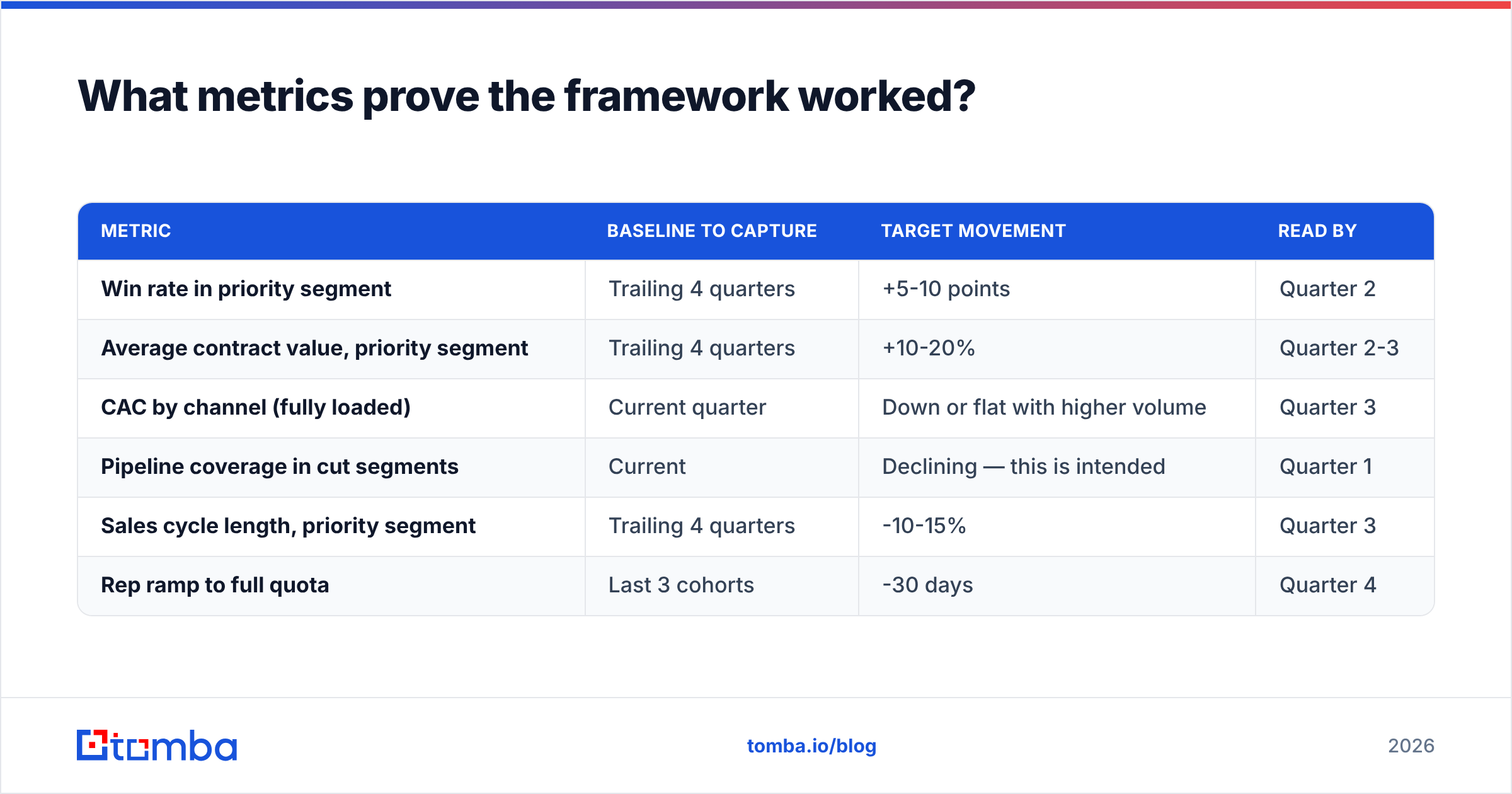
What metrics prove the framework worked?#
Set these before you start, not after.
| Metric | Baseline to capture | Target movement | Read by |
|---|---|---|---|
| Win rate in priority segment | Trailing 4 quarters | +5-10 points | Quarter 2 |
| Average contract value, priority segment | Trailing 4 quarters | +10-20% | Quarter 2-3 |
| CAC by channel (fully loaded) | Current quarter | Down or flat with higher volume | Quarter 3 |
| Pipeline coverage in cut segments | Current | Declining — this is intended | Quarter 1 |
| Sales cycle length, priority segment | Trailing 4 quarters | -10-15% | Quarter 3 |
| Rep ramp to full quota | Last 3 cohorts | -30 days | Quarter 4 |
Note the fourth row. Falling pipeline in cut segments is a success signal. It is also the one that causes the most internal panic. If nobody complains, the segmentation was never real.
Frequently asked questions#
Is there an official McKinsey GTM framework document? There is no single public one. The closest public artifacts are their micro-battles writing and commercial excellence diagnostics. Anything sold as "the official McKinsey GTM template" is someone's reconstruction.
How long does a full engagement take? Usually 12 to 20 weeks for diagnosis and design. Add 6 to 12 months of implementation support. The 30-day version above covers diagnosis and design at lower resolution.
Can this work for product-led companies? Partly. Stages one through three transfer cleanly. Stages five and six assume human coverage and need rework for self-serve. There, the questions are about activation surfaces and expansion triggers rather than territories.
What is the highest-leverage stage? Segmentation, and the cutting in particular. Every later stage gets better once the segment set is genuinely narrow.
Where to start this week#
The go-to-market framework McKinsey uses is sound, and its sequencing is the real value. Most of it runs without a consulting invoice. But every stage after the first depends on one question. Can you build a list of the accounts and people in your priority segment?
That is where in-house GTM plans stall. Not on strategy. On data. Use the Tomba Email Finder to build and check the account universe for your top segment before you commit a quarter's budget. The free tier covers 25 searches a month, enough to sanity-check a hypothesis. Paid plans start at $49/mo with bulk search and verification included. See Tomba pricing for the tier that fits your list size.
Run week one properly and the other three get much easier.
Related guides#
Ready to find emails that actually work?
Join 150,000+ professionals who stopped guessing and started sending. Free credits on signup — no credit card required.
Get the Tomba newsletter
Practical outbound tactics and product updates — once every two weeks.
About the author