Go-To-Market (GTM) Strategy: A Practical 2026 Playbook
Most GTM plans die on contact with a bad list and a vague ICP. Here is the framework that actually survives launch: motion selection, data layer, 90-day sequencing, and the metrics that tell you to double down or kill it.
TL;DR
- A go to market GTM strategy is a decision about four things: who you sell to, what motion you use, which channel carries the message, and what data feeds it. Everything else is execution detail.
- Most GTM plans fail at the data layer, not the messaging layer. A brilliant positioning doc pointed at a stale, unverified list produces zero pipeline.
- Pick one primary motion (product-led, sales-led, partner-led, or community-led) based on ACV and buying-committee size. Running three at once with one team is how teams burn a quarter.
- A functional GTM stack for a sub-20-person team runs roughly $400–$900/month in 2026 — data, sequencing, CRM, and deliverability included.
- Judge the strategy at 90 days on leading indicators (reply rate, meeting-to-opportunity, sales-cycle length), not on closed revenue, which arrives too late to steer.
What is a go-to-market (GTM) strategy?#
A go-to-market strategy is the plan for how a specific product reaches a specific buyer and converts them into revenue at a repeatable cost. That's it. It's not a brand deck, and it's not a marketing plan — a GTM strategy spans product, pricing, channel, sales motion, and post-sale expansion as one system.
Think of it like planning a delivery route rather than designing the truck. Product teams obsess over the truck. GTM asks: which streets, which houses, what time of day, who signs for the package, and how much fuel per stop. A great truck on the wrong route still delivers nothing.
The distinction matters because GTM has an owner problem. Marketing owns awareness, sales owns conversion, product owns activation, and finance owns unit economics — which means nobody owns the seam between them. That seam is where revenue operations lives, and it's why RevOps has become the de facto home for GTM strategy in most B2B companies.
A complete GTM strategy answers five questions in order:
- Who is the buyer? Not the industry — the person. Title, team size, tooling, trigger event, and the internal problem they get promoted for solving.
- What is the wedge? The single narrow use case where you're clearly better, not the full platform pitch.
- What motion delivers it? Self-serve signup, outbound sequence, partner referral, or community pull.
- What data feeds the motion? Contact records, firmographics, intent signals, and how you keep them from rotting.
- What proves it works? Two or three leading indicators reviewed weekly, with a pre-agreed kill threshold.
If you can't answer all five in a paragraph each, you don't have a strategy — you have a launch date.
Why do most GTM strategies fail before launch?#
They fail because the plan assumes data that doesn't exist yet.
Here's the pattern. A team spends six weeks on positioning, messaging, and a beautiful sequence in Outreach or Instantly. Then someone exports 4,000 "matching" contacts from a general-purpose database, half the emails bounce, the domain reputation tanks in week two, and the entire motion is judged a failure. The messaging was never tested. The channel was never tested. Only the list was tested, and it lost.
Gartner's sales research has repeatedly flagged data quality as a top constraint on B2B revenue teams, and every practitioner survey since says the same thing in different words: reps don't trust the CRM. When reps don't trust the data, they build private spreadsheets, and the moment that happens your GTM strategy is no longer measurable.
The second common failure is motion sprawl. A seed-stage team decides to run outbound and product-led and a partner program simultaneously because a board member mentioned all three. Each motion needs different content, different data, and a different comp plan. Three half-built motions produce less pipeline than one finished one.
The third failure is measuring too late. If your sales cycle is 60 days and you review GTM performance quarterly on closed-won revenue, you get roughly one usable signal per quarter — far too slow to correct course.
Which GTM motion fits your product?#
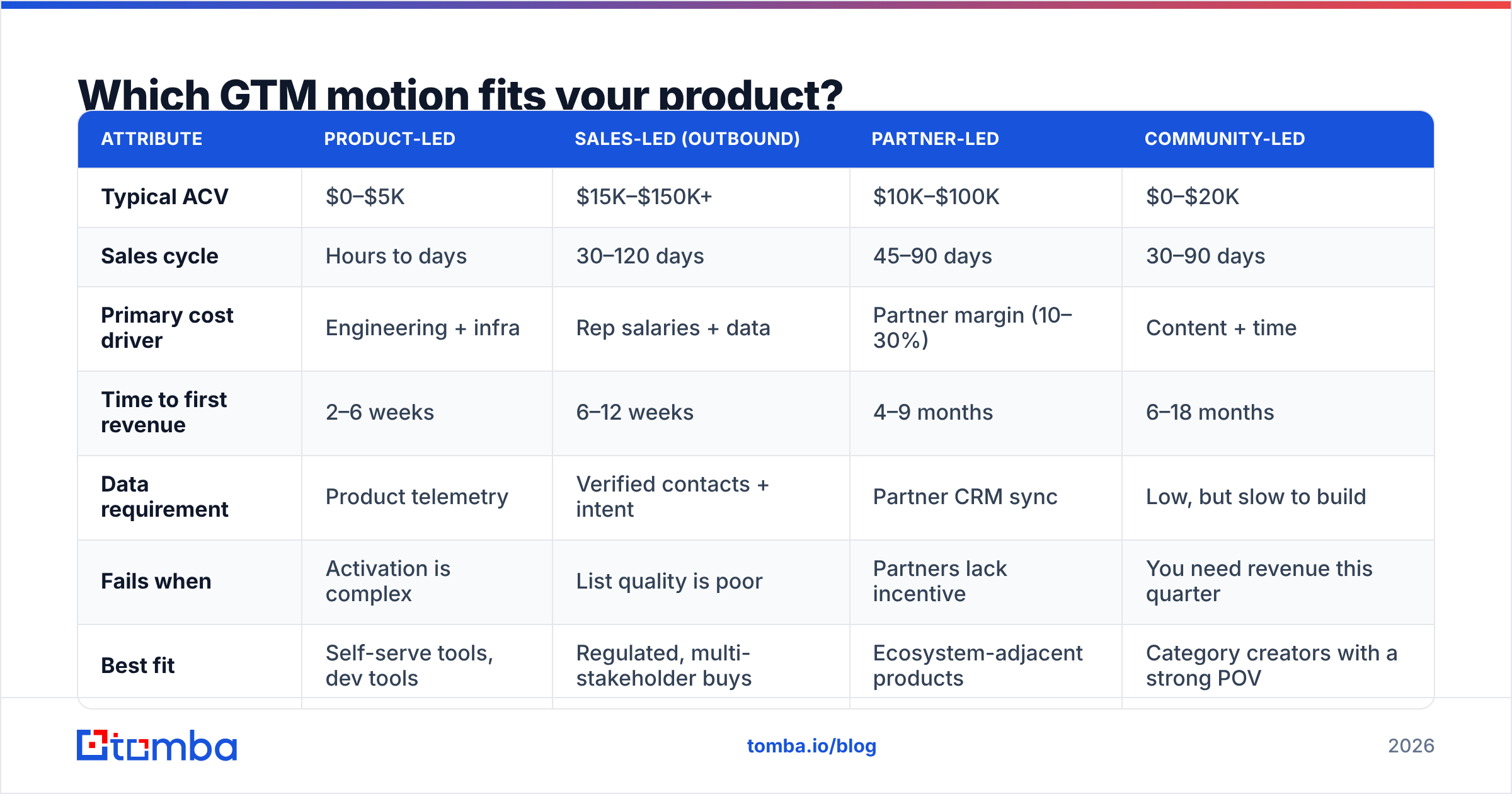
Match the motion to average contract value and buying-committee size. Those two variables predict more than industry or company stage.
| Attribute | Product-led | Sales-led (outbound) | Partner-led | Community-led |
|---|---|---|---|---|
| Typical ACV | $0–$5K | $15K–$150K+ | $10K–$100K | $0–$20K |
| Sales cycle | Hours to days | 30–120 days | 45–90 days | 30–90 days |
| Primary cost driver | Engineering + infra | Rep salaries + data | Partner margin (10–30%) | Content + time |
| Time to first revenue | 2–6 weeks | 6–12 weeks | 4–9 months | 6–18 months |
| Data requirement | Product telemetry | Verified contacts + intent | Partner CRM sync | Low, but slow to build |
| Fails when | Activation is complex | List quality is poor | Partners lack incentive | You need revenue this quarter |
| Best fit | Self-serve tools, dev tools | Regulated, multi-stakeholder buys | Ecosystem-adjacent products | Category creators with a strong POV |
Two practical rules follow from this table.
If your ACV is under about $5,000 and a single person can adopt the tool without IT approval, outbound rarely pays for itself — the cost to acquire a meeting exceeds the contract. Go product-led and spend the budget on activation.
If your buying committee has four or more people and procurement is involved, product-led alone will stall at the security review. You need a sales-led motion with outbound to open doors, even if a free tier exists as an entry point.
Hybrid motions are real, but they're a sequencing decision, not a simultaneous one. Add the second motion once the first one has a documented, repeatable playbook that a new hire can run in week two.
How do you build the ICP and target list that GTM actually runs on?#
Start narrow enough that the list is uncomfortable. A good starting ICP for a first outbound motion is 200–500 accounts, not 5,000.
Build it in four passes:
- Firmographic filter. Industry, headcount band, geography, funding stage. This gets you an account list, not a contact list. Keep it tight — you can widen later, but you can't un-burn a domain.
- Technographic or trigger filter. What tool are they already running that implies the problem? What event (new hire in a key role, funding round, product launch, migration) suggests the problem is urgent right now? Trigger-based lists routinely outperform static lists by a wide margin because timing does most of the persuasion.
- Contact resolution. Find the actual humans. This is where an email finder or domain search does the work — you supply a company domain and a role, and you get named contacts with verified addresses instead of a generic info@ inbox.
- Verification and enrichment. Verify before you send, then enrich with the fields your sequence personalizes on. Contact enrichment that fills in title, seniority, location, and social profiles is what turns a flat list into a segmentable one.
A few operating standards worth holding to:
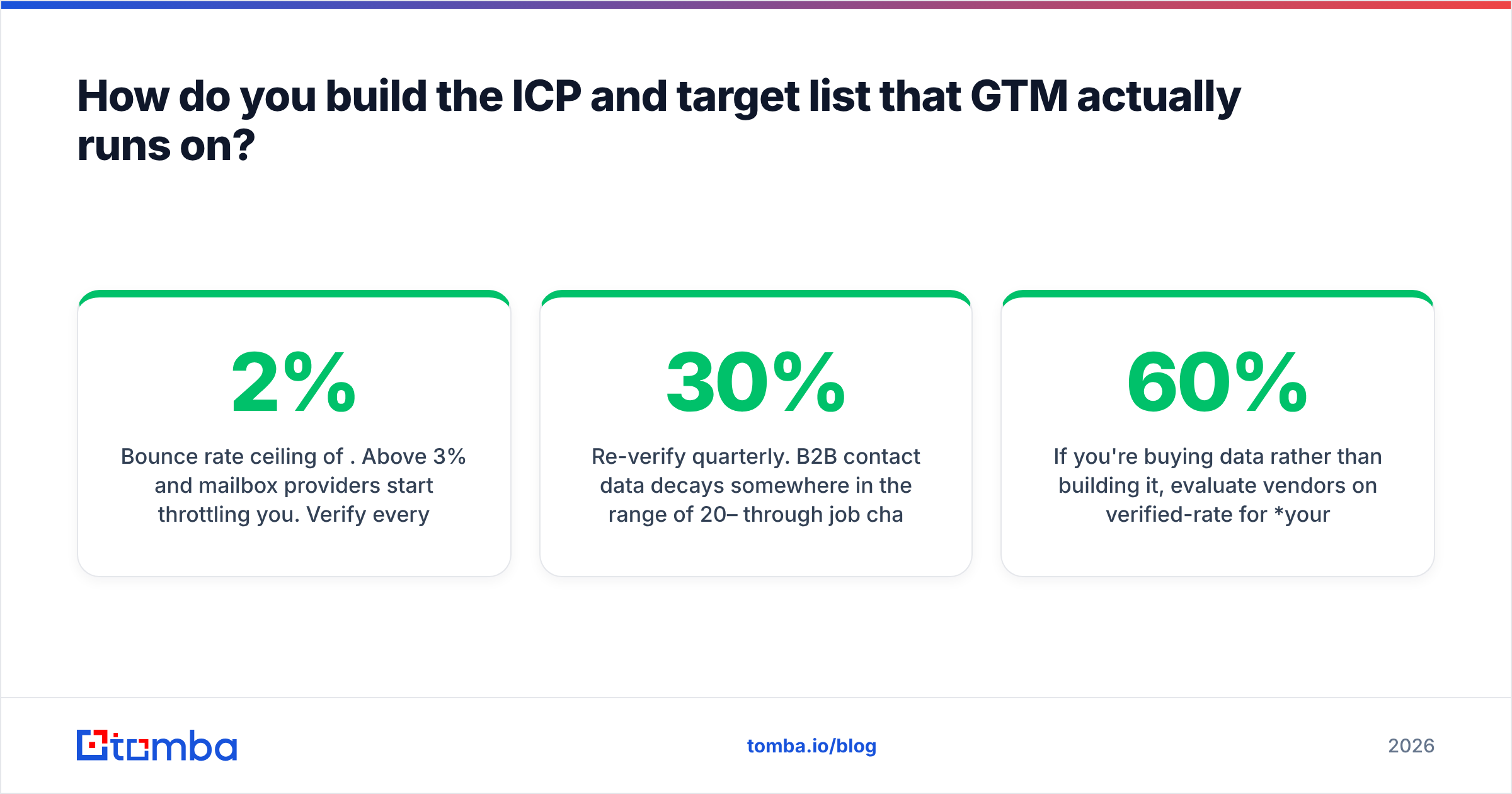
- Bounce rate ceiling of 2%. Above 3% and mailbox providers start throttling you. Verify every address before it enters a sequence, no exceptions for "we got this list from a good source."
- Catch-all domains need separate handling. A large share of enterprise domains accept everything at the SMTP layer, so a standard verifier returns "unknown." Route those through a catch-all verifier rather than either blindly sending or blindly discarding them — discarding catch-alls can silently remove a third of your enterprise TAM.
- Re-verify quarterly. B2B contact data decays somewhere in the range of 20–30% per year through job changes alone. A list built in January is materially wrong by July.
- Cap sends per mailbox. Roughly 30–50 cold sends per mailbox per day on a warmed domain. Scale by adding mailboxes and domains, not by increasing volume per inbox.
If you're buying data rather than building it, evaluate vendors on verified-rate for your segment, not on total database size. A provider with 50 million records and 60% accuracy in your niche is worse than one with 5 million at 95%. Verified-list vendors like BookYourData and API-first providers like Tomba solve different halves of this problem — one hands you a pre-built segment, the other lets you resolve contacts programmatically as your ICP shifts. Teams with a stable ICP often use both.
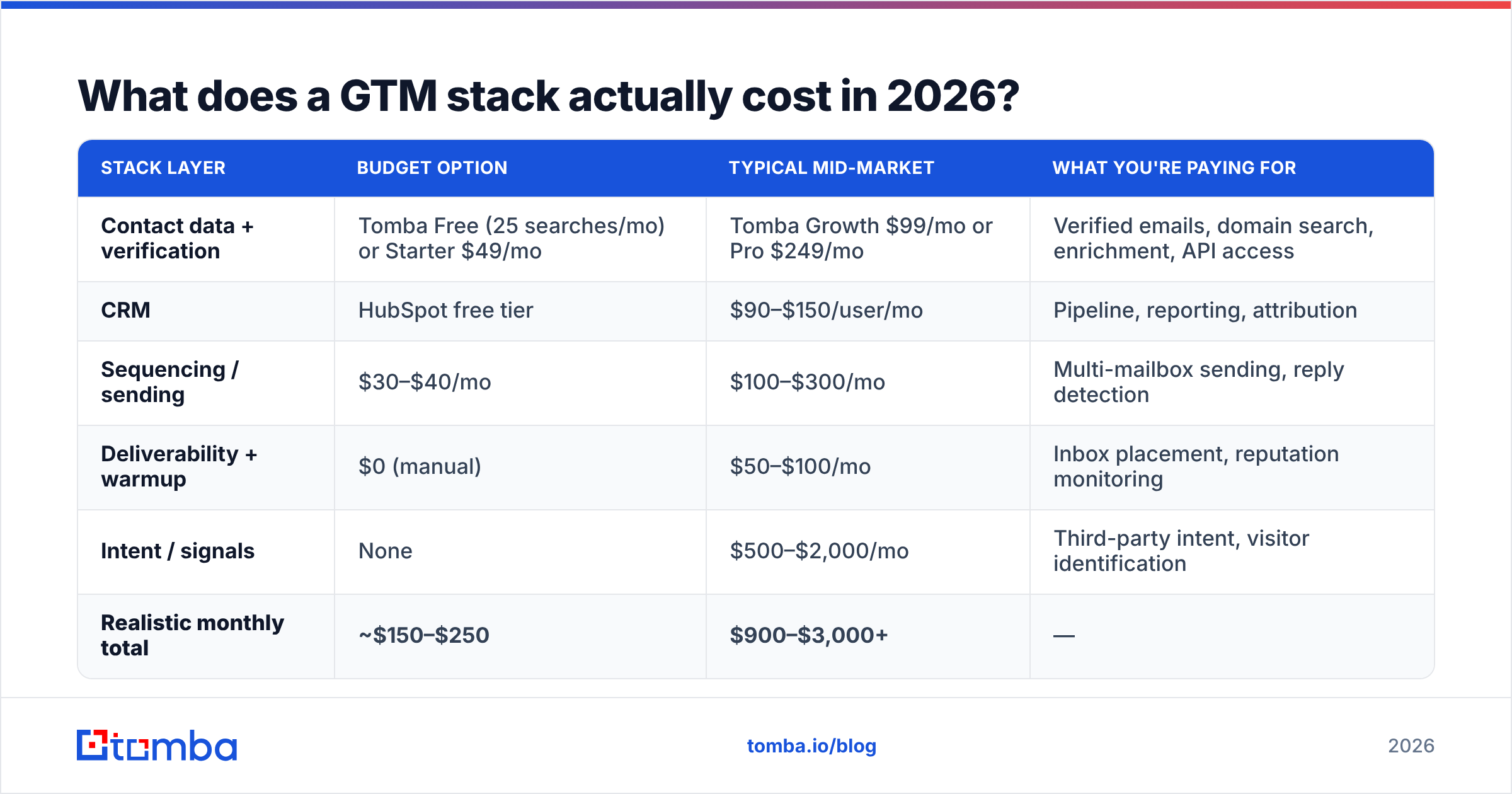
What does a GTM stack actually cost in 2026?#
Budget realistically. Under-funding the data layer to afford a fancier sequencer is the most common allocation mistake in early GTM.
| Stack layer | Budget option | Typical mid-market | What you're paying for |
|---|---|---|---|
| Contact data + verification | Tomba Free (25 searches/mo) or Starter $49/mo | Tomba Growth $99/mo or Pro $249/mo | Verified emails, domain search, enrichment, API access |
| CRM | HubSpot free tier | $90–$150/user/mo | Pipeline, reporting, attribution |
| Sequencing / sending | $30–$40/mo | $100–$300/mo | Multi-mailbox sending, reply detection |
| Deliverability + warmup | $0 (manual) | $50–$100/mo | Inbox placement, reputation monitoring |
| Intent / signals | None | $500–$2,000/mo | Third-party intent, visitor identification |
| Realistic monthly total | ~$150–$250 | $900–$3,000+ | — |
For a team under 20 people, the sub-$500 configuration is genuinely sufficient. See Tomba pricing for where the data layer lands; the free tier is enough to validate an ICP hypothesis before you commit budget to a full motion.
Two spending principles worth internalizing. First, spend on data before you spend on intent — intent signals pointed at unverifiable contacts are decorative. Second, treat deliverability tooling as insurance, not overhead. A burned sending domain costs weeks of recovery time, which is far more expensive than the monitoring subscription.
How do you sequence a 90-day GTM launch?#
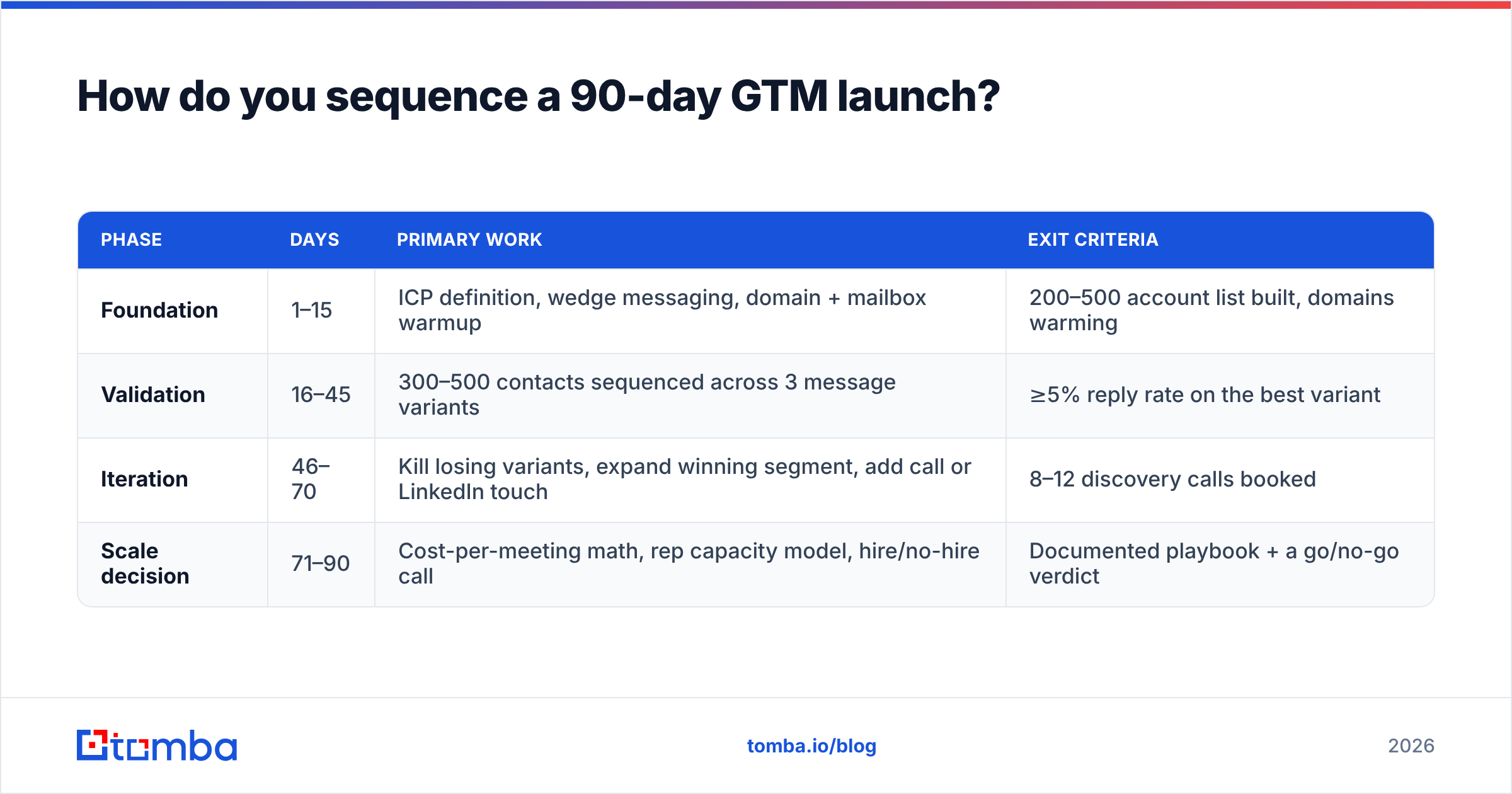
Phase the work so each stage produces a decision, not just activity.
| Phase | Days | Primary work | Exit criteria |
|---|---|---|---|
| Foundation | 1–15 | ICP definition, wedge messaging, domain + mailbox warmup | 200–500 account list built, domains warming |
| Validation | 16–45 | 300–500 contacts sequenced across 3 message variants | ≥5% reply rate on the best variant |
| Iteration | 46–70 | Kill losing variants, expand winning segment, add call or LinkedIn touch | 8–12 discovery calls booked |
| Scale decision | 71–90 | Cost-per-meeting math, rep capacity model, hire/no-hire call | Documented playbook + a go/no-go verdict |
The exit criteria are the point. Every phase should end with a number that either authorizes the next phase or stops the motion. Teams that skip exit criteria run the same failing sequence for eight months because nobody defined what failure looks like.
During the validation phase, resist the urge to test everything. Hold the list constant and test the message, or hold the message constant and test the segment — never both in the same window. Two simultaneous variables produce results you can't attribute.
What metrics prove the GTM strategy is working?#
Track leading indicators weekly and lagging indicators monthly. The full list, in the order they fire:
- Deliverability rate (target: >97%). If this drops, nothing downstream is measurable. Check it before you interpret any other number.
- Reply rate (target: 5–10% for a tight ICP). The single best early read on message-market fit. Under 2% usually means the list is wrong, not the copy. Compare against benchmark response rate ranges for your segment.
- Positive reply rate (target: 30–40% of replies). Separates "you got attention" from "you got interest."
- Meeting-to-opportunity rate (target: >50%). Below this, you're booking the wrong people — a targeting problem disguised as a sales-skill problem.
- Sales-cycle length trend. A shortening cycle means the wedge is landing. A lengthening one means you're selling to people who need internal consensus you haven't armed them for.
- CAC payback (target: under 12 months for SMB, under 18 for enterprise). The lagging metric that decides whether the motion survives contact with the budget.
Resources like HubSpot's blog and peer-review data on G2 publish updated benchmark ranges each year; treat them as sanity checks rather than targets, since segment variance is enormous. Gartner's sales research is useful on buying-committee dynamics if you're selling into enterprise.
What are the most common GTM mistakes to avoid?#
Positioning against a category instead of a competitor. Buyers don't compare you to an abstraction. They compare you to the specific tool on the invoice. Name it.
Launching before warmup finishes. Two weeks of domain warmup feels like dead time. Skipping it costs a month of throttled sending and forces a domain migration.
Treating the ICP as permanent. Your first ICP is a hypothesis. Review the closed-won list every quarter and rewrite the ICP to match who actually bought, not who you hoped would.
Hiring reps before the playbook exists. A rep hired into an unproven motion spends six months inventing one, badly. Prove the motion with founders or a single senior AE first.
Buying scraped lists to save time. A cheap list looks like a shortcut and behaves like a liability — bounces, spam traps, and a burned domain. If you need volume, use bulk email finder workflows against a defined account list so every record is resolved and verified rather than harvested.
Reporting activity instead of outcomes. "1,200 emails sent" is not a GTM metric. "18 opportunities at $340 cost-per-opportunity" is.
Where should you start this week?#
Pick one motion, define 200 accounts, and resolve real contacts for them. That's the entire first sprint. The positioning doc can wait — it improves faster when it's tested against replies than when it's workshopped in a room.
For the data layer underneath all of it, Tomba Email Finder is a straightforward place to start: search by domain, name, or company, verify before you send, and pull the whole thing through the API when your list-building becomes a recurring job rather than a one-off. The free tier covers 25 searches a month, which is enough to validate an ICP hypothesis end to end before any budget conversation. Get the list right first, and every other part of the go-to-market strategy gets easier to judge.
Related guides#
Ready to find emails that actually work?
Join 150,000+ professionals who stopped guessing and started sending. Free credits on signup — no credit card required.
Get the Tomba newsletter
Practical outbound tactics and product updates — once every two weeks.
About the author