Go To Market Launch: The 2026 Playbook That Actually Works
Most launches fail on distribution, not product. Here is the 90-day go to market launch framework — motion selection, ICP list build, channel budget math, and the scoreboard that tells you to double down or kill it.

TL;DR
- A go to market launch is a distribution plan, not a launch-day event. The product ships once; the motion has to keep working on day 90.
- Pick one primary motion (product-led, sales-led, community-led, or partner-led) and one supporting motion. Teams that run four at once starve all four.
- Your addressable list is the real constraint. A 400-account list you can actually reach beats a 40,000-row export with a 22% bounce rate.
- Budget the launch in three buckets — build (30%), distribute (50%), measure (20%). Most teams invert this and wonder why nobody showed up.
- Judge the launch on qualified conversations in the first 30 days, not signups, impressions, or Product Hunt rank.
What is a go to market launch, exactly?#
A go to market launch is the coordinated plan for how a specific product reaches a specific buyer, at a specific price, through a specific channel — and the operating cadence that keeps that plan running after launch week.
Think of it like opening a restaurant. The menu is your product. But the launch is the location you picked, the hours you keep, the people who walk past at 7pm, and whether the person who walked in last Tuesday comes back. Nobody opens a restaurant, posts one sign, and calls it a strategy. Yet that is how most B2B software gets launched: a landing page, a LinkedIn post, a Product Hunt submission, and silence by week three.
The distinction that matters is scope. A product launch is an announcement. A go to market launch covers five decisions that have to agree with each other:
- Who — the ICP, narrowed to accounts you can name, not a segment you can describe.
- What problem — the specific, expensive, currently-unsolved pain your product removes.
- How they find you — the channel where that buyer already spends attention.
- What it costs — pricing and packaging that match the buyer's budget authority.
- Who closes it — self-serve, an SDR, a partner, or a founder on a Zoom call.
If any one of those five is undefined, the launch will underperform regardless of product quality. That is not a motivational statement — it is a structural one. A great product routed to the wrong buyer through the wrong channel produces the same revenue as a mediocre one.

Which go-to-market motion should you pick?#
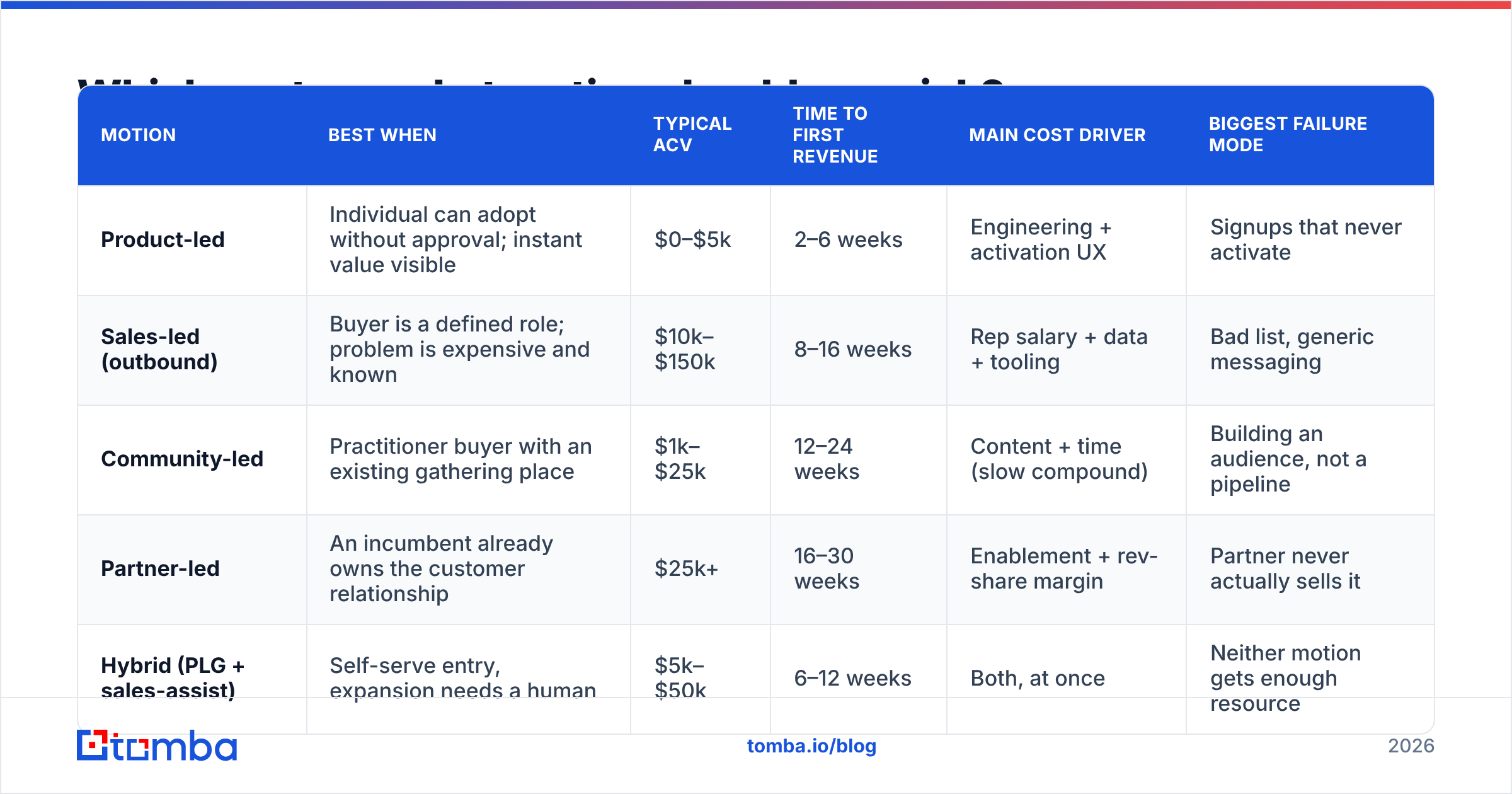
Pick the motion your buyer's behavior already supports, not the one you find most impressive. Here is the practical comparison:
| Motion | Best when | Typical ACV | Time to first revenue | Main cost driver | Biggest failure mode |
|---|---|---|---|---|---|
| Product-led | Individual can adopt without approval; instant value visible | $0–$5k | 2–6 weeks | Engineering + activation UX | Signups that never activate |
| Sales-led (outbound) | Buyer is a defined role; problem is expensive and known | $10k–$150k | 8–16 weeks | Rep salary + data + tooling | Bad list, generic messaging |
| Community-led | Practitioner buyer with an existing gathering place | $1k–$25k | 12–24 weeks | Content + time (slow compound) | Building an audience, not a pipeline |
| Partner-led | An incumbent already owns the customer relationship | $25k+ | 16–30 weeks | Enablement + rev-share margin | Partner never actually sells it |
| Hybrid (PLG + sales-assist) | Self-serve entry, expansion needs a human | $5k–$50k | 6–12 weeks | Both, at once | Neither motion gets enough resource |
The single most common 2026 mistake is running a product-led motion for a product that requires a security review, a procurement cycle, and an admin to install it. If your buyer cannot swipe a card and be useful in ten minutes, PLG is a lead-gen tactic, not a motion.
Gartner's research on B2B buying has consistently found that buyers spend a small minority of the buying cycle with any vendor's sales rep — most of the journey is independent research across sources you do not control. That has a direct launch implication: your launch has to place useful material where the buyer already looks, not just where you can post it.
The four launch tiers — right-size the effort#
Not every release deserves the full machine. Sort each launch into a tier before you spend a dollar:
- Tier 1 — Company-defining. New category, new ICP, or new pricing model. Full launch: analyst briefings, paid budget, sales enablement, dedicated landing page, 90-day operating cadence.
- Tier 2 — New product line. Existing ICP, new revenue stream. Sales-enabled launch with an outbound campaign against your installed base and lookalikes.
- Tier 3 — Major feature. Changes the buying decision for a known objection. Email to existing users, changelog, one comparison asset, a CS talk track.
- Tier 4 — Incremental. Changelog entry and release note. Nothing more. Discipline here is what funds Tier 1 properly.
- Tier 0 — Repositioning. No new code at all. Same product, new problem framing, new ICP. Often the highest-ROI "launch" a struggling company can run.
- Tier X — Kill. Sunset communication is a launch too. Plan the migration path and the messaging with the same rigor, or you generate churn plus a public complaint thread.
How do you build the launch list before launch day?#
Build the list four weeks before launch, not the morning of. This is where most go to market launch plans quietly break: the strategy deck is beautiful, and then someone exports 30,000 rows from a database and 6,000 of them bounce.
Work in this order:
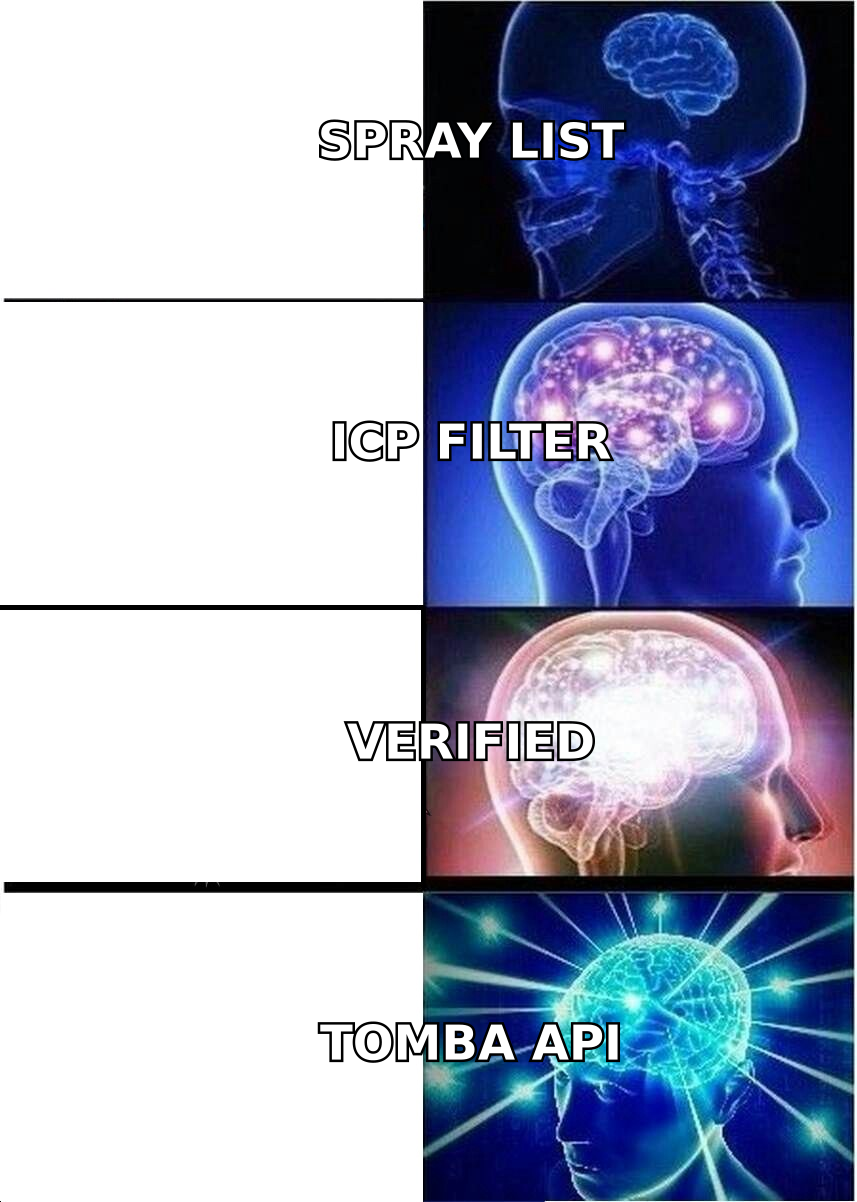
Step 1 — Define the account list, not the contact list. Start with 200–500 named accounts that match firmographic and technographic filters you can defend: company size band, funding stage, tech stack signal, hiring signal, geography. If you cannot articulate why an account is on the list in one sentence, take it off.
Step 2 — Map roles, not names. For each account, define the champion role, the economic buyer role, and the blocker role. Enterprise deals die on blockers you never contacted.
Step 3 — Find and verify contact data. This is the step people underinvest in. A launch campaign to unverified data damages your sending domain right when you need it most. Use a domain search to pull the contacts for each target account, then run every address through an email verifier before a single send. Catch-all domains need their own handling — treat them as a separate risk bucket rather than mixing them into your main sequence.
Step 4 — Enrich for personalization inputs. You need one true, specific fact per account to write a first line that isn't filler. Job posting, recent funding, a product they shipped, a stack change. Contact enrichment at list-build time is far cheaper than a rep manually researching 400 accounts at three minutes each.
Step 5 — Segment into three tiers. Tier A (50 accounts, fully personalized, multi-channel), Tier B (150 accounts, semi-personalized sequences), Tier C (the rest, automated). Spend your human hours where the deal size justifies them.
Step 6 — Warm the sending infrastructure. If your launch requires cold email volume, your domains need four to six weeks of ramp. SPF, DKIM, and DMARC configured, a separate sending domain from your primary, and a volume curve that does not spike on launch day. Skipping this converts a good launch into a deliverability incident.
What does a realistic 90-day launch timeline look like?#
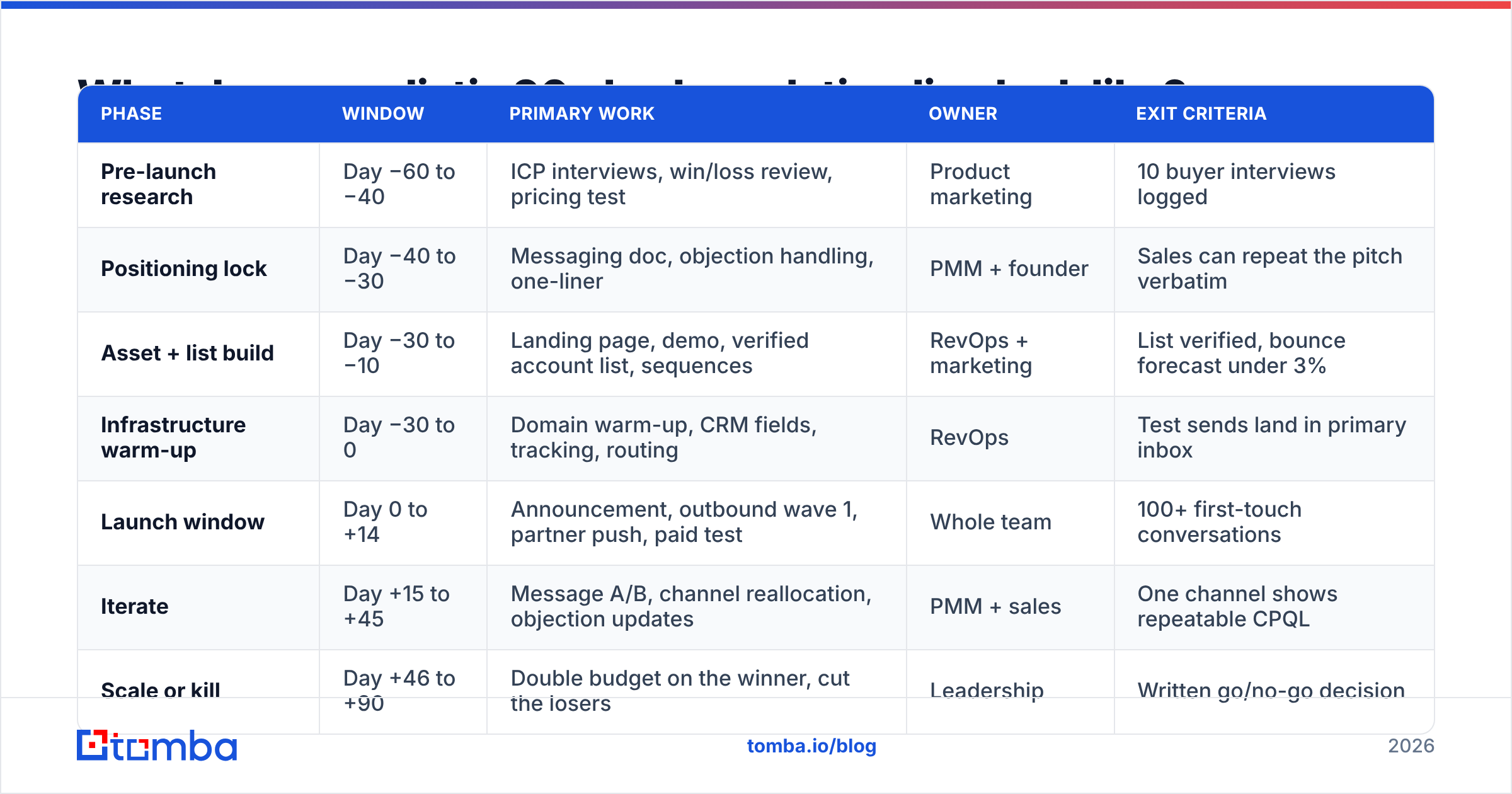
| Phase | Window | Primary work | Owner | Exit criteria |
|---|---|---|---|---|
| Pre-launch research | Day −60 to −40 | ICP interviews, win/loss review, pricing test | Product marketing | 10 buyer interviews logged |
| Positioning lock | Day −40 to −30 | Messaging doc, objection handling, one-liner | PMM + founder | Sales can repeat the pitch verbatim |
| Asset + list build | Day −30 to −10 | Landing page, demo, verified account list, sequences | RevOps + marketing | List verified, bounce forecast under 3% |
| Infrastructure warm-up | Day −30 to 0 | Domain warm-up, CRM fields, tracking, routing | RevOps | Test sends land in primary inbox |
| Launch window | Day 0 to +14 | Announcement, outbound wave 1, partner push, paid test | Whole team | 100+ first-touch conversations |
| Iterate | Day +15 to +45 | Message A/B, channel reallocation, objection updates | PMM + sales | One channel shows repeatable CPQL |
| Scale or kill | Day +46 to +90 | Double budget on the winner, cut the losers | Leadership | Written go/no-go decision |
Two notes on this table. First, more than half the calendar sits before launch day — that ratio is the whole point. Second, the "scale or kill" gate is a written decision with a date on it. Launches rarely fail loudly; they fail by being quietly kept alive at 20% effort for nine months.
How should you split the launch budget?#
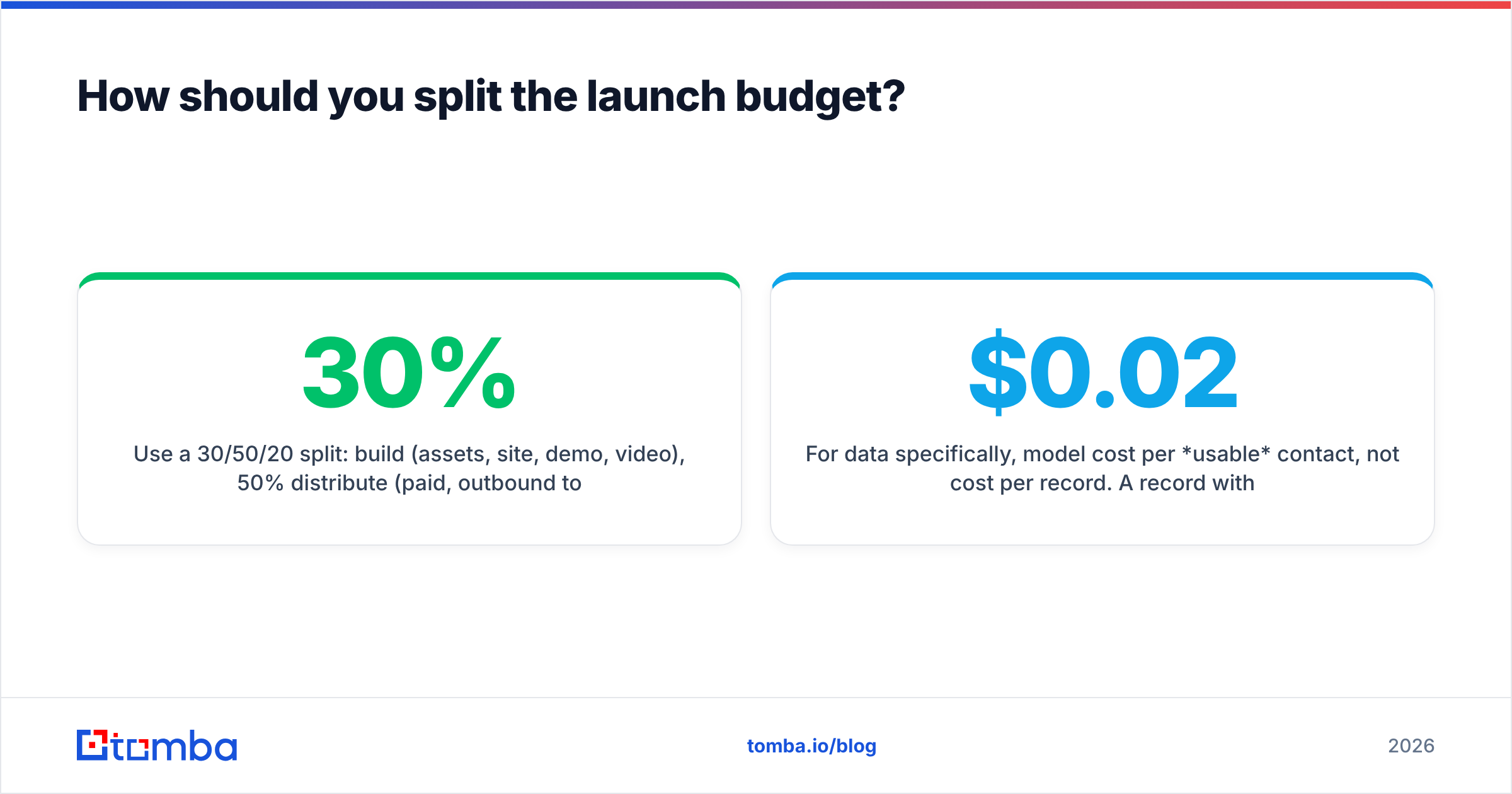
Use a 30/50/20 split: 30% build (assets, site, demo, video), 50% distribute (paid, outbound tooling and data, events, partner incentives, content promotion), 20% measure (attribution, CRM work, research, analysis time).
Most teams run something closer to 70/25/5 — they overspend on a beautiful launch page and underspend on getting anyone to see it. A useful gut check: if you spent more on the launch video than on reaching your target accounts, your budget is inverted.
For data specifically, model cost per usable contact, not cost per record. A $0.02 record with a 25% bounce rate and no verified role costs more in reputation damage and rep time than a $0.10 verified record. Compare providers on match rate against your ICP, not on their marketing claims — vendors like BookYourData, and providers reviewed on G2's lead intelligence category, differ enormously by geography and segment. Run a 100-row bake-off before you commit budget.
Which metrics tell you the launch is working?#
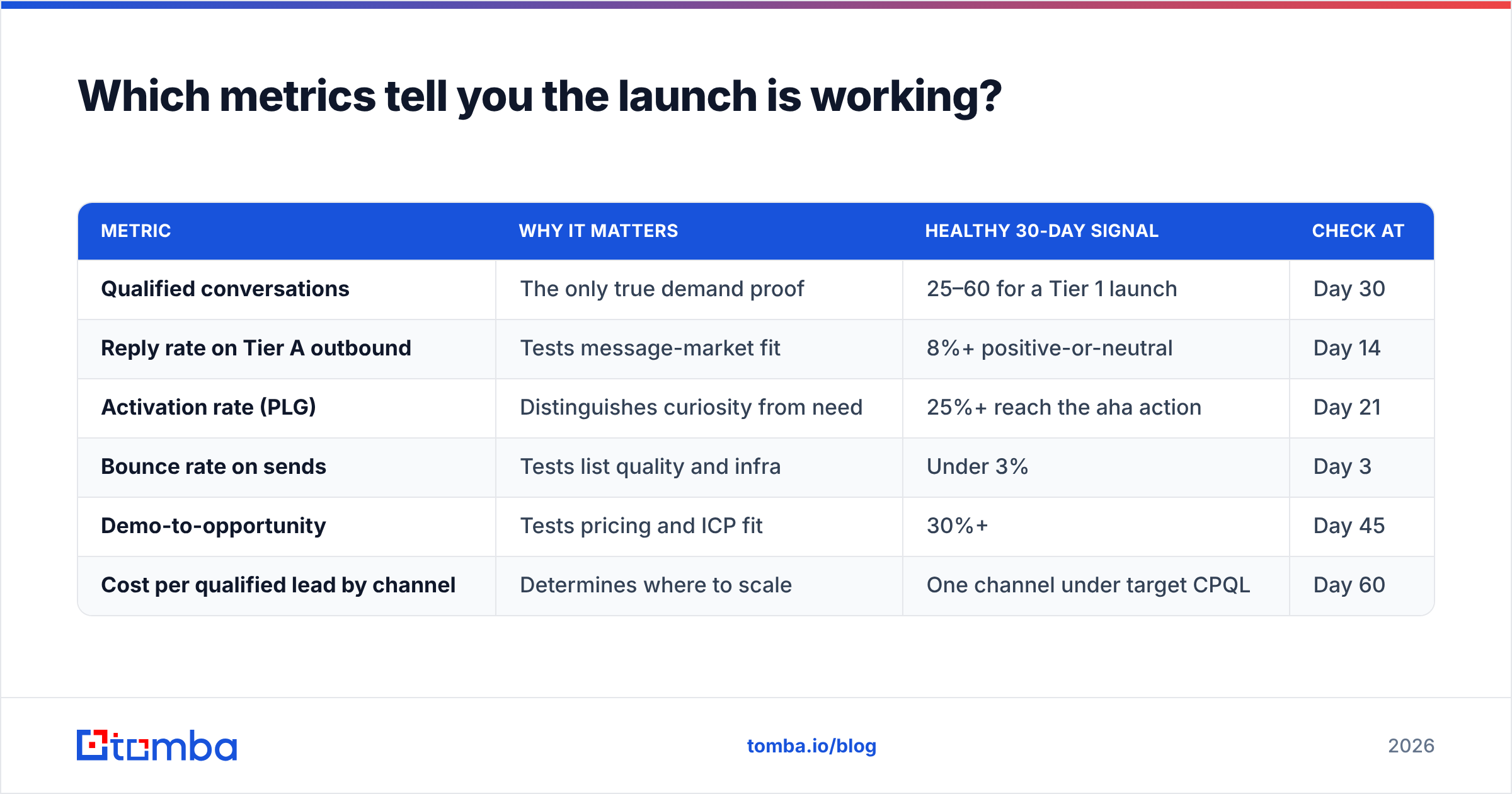
Ignore vanity signals for the first 30 days. Impressions, upvotes, and signup counts move independently of revenue, especially at launch when curiosity traffic inflates everything.
| Metric | Why it matters | Healthy 30-day signal | Check at |
|---|---|---|---|
| Qualified conversations | The only true demand proof | 25–60 for a Tier 1 launch | Day 30 |
| Reply rate on Tier A outbound | Tests message-market fit | 8%+ positive-or-neutral | Day 14 |
| Activation rate (PLG) | Distinguishes curiosity from need | 25%+ reach the aha action | Day 21 |
| Bounce rate on sends | Tests list quality and infra | Under 3% | Day 3 |
| Demo-to-opportunity | Tests pricing and ICP fit | 30%+ | Day 45 |
| Cost per qualified lead by channel | Determines where to scale | One channel under target CPQL | Day 60 |
The diagnostic pattern is what makes this useful. High reply rate but low demo-to-opportunity means your message attracts the wrong buyer. Good activation but no revenue means your pricing sits above the value the buyer perceives. High bounce rate means the list build failed, and every downstream number is unreliable — fix that before drawing any other conclusion.
HubSpot's sales and marketing research is a reasonable public benchmark set, but treat all external benchmarks as directional. Your own week-two numbers are more informative than someone else's median.
Where do most launches actually go wrong?#
Four failure modes account for the majority:
Positioning drift. The deck says one thing, the website says another, and the rep says a third. Test it: ask three people to write the one-liner from memory. If you get three different answers, the launch has no message.
Distribution as an afterthought. The team spends 10 weeks building and 3 days planning reach. The fix is calendar-enforced — start list build at day −30, not day −3.
No kill criteria. Without a written go/no-go date, launches consume budget indefinitely at low intensity. Write the criteria before launch, when you are still objective.
Data decay. B2B contact data degrades meaningfully every year through job changes alone. A list built six months ago and never re-verified is not the list you think it is. Re-verify before every major wave, and treat verification as a recurring cost line, not a one-time purchase. This is also where revenue operations earns its keep — someone must own list hygiene as a standing process.
What should you do in the first week after launch?#
Run a daily 15-minute standup with one question: what did we learn about the buyer yesterday? Log every objection verbatim. Objections collected in launch week become your best messaging asset for the following quarter — they are free, honest, and specific in a way that no survey will be.
Then reallocate fast. If one channel is producing conversations at half the cost of the others by day 14, move budget on day 15. Launch budgets should be treated as a portfolio you rebalance weekly, not a plan you execute for 90 days.
Get your launch list right before day zero#
Everything above depends on one input: a contact list you can actually reach. The most common launch autopsy finding is not weak positioning — it is a campaign that never landed in enough of the right inboxes to prove or disprove the positioning at all.
Start your list build four weeks out. Use the Tomba Email Finder to pull verified professional addresses for your named target accounts, verify every one before the first send, and enrich the list with the personalization inputs your reps need. The free tier covers 25 searches per month so you can pressure-test match rate on your own ICP before spending anything; paid plans start at $49/mo, and the Tomba pricing page shows where volume tiers land as your launch scales. Build the list first — then launch.
Related guides#
Ready to find emails that actually work?
Join 150,000+ professionals who stopped guessing and started sending. Free credits on signup — no credit card required.
Get the Tomba newsletter
Practical outbound tactics and product updates — once every two weeks.
About the author