Go To Market Marketing Strategy: A 2026 Playbook That Works
Most GTM plans die in the slide deck. This is the 2026 playbook for building a go to market marketing strategy that survives contact with real buyers, real data, and a real pipeline target.
TL;DR
- A go to market marketing strategy is the operating plan that connects one segment, one message, and one motion to a revenue number — not a deck of personas nobody opens again.
- The four decisions that matter: who you sell to (ICP), what you say (positioning), how you reach them (motion + channels), and how you know it worked (leading metrics).
- Product-led, sales-led, and channel-led motions have very different cost structures. Picking the wrong one burns 6–12 months of budget before anyone notices.
- Contact data quality is the silent killer. A brilliant message sent to a 42%-valid list looks identical to a bad message in your dashboard.
- Budget rule of thumb for early-stage B2B: 60% into the one channel that's already working, 30% into the next-best bet, 10% into genuine experiments.
What is a go to market marketing strategy?#
A go to market marketing strategy is the documented plan for how you turn a specific product into revenue from a specific set of buyers, within a specific time window. It answers four questions in order, and each answer constrains the next:
- Who — the segment, the account profile, the buying committee, the trigger event that makes them shop.
- What — the positioning and the proof. Why this, why now, why not the incumbent or the status quo.
- How — the motion (self-serve, sales-assisted, enterprise, partner) and the channel mix that feeds it.
- How you'll know — the leading indicators you'll watch weekly, not the lagging revenue number you'll see in six months.
The distinction people get wrong: a marketing strategy is ongoing brand and demand work across your whole business. A go-to-market strategy is scoped to one product-and-segment pair, with a start date and a review date. You can have five GTM strategies running at once — one per segment — under a single marketing strategy.
If your GTM doc doesn't name a segment you would refuse to sell to, it isn't a strategy. It's a wish list.
Why do most GTM plans fail before the first campaign?#
Three failure patterns show up over and over, and none of them are about creative quality.
Failure 1: The ICP is a demographic, not a behavior. "Series B SaaS companies, 50–200 employees, North America" describes 40,000 companies and predicts nothing. A usable ICP adds a trigger: they just hired a first RevOps lead, they posted three SDR roles this quarter, they migrated off a legacy tool. Triggers turn a list into a queue.
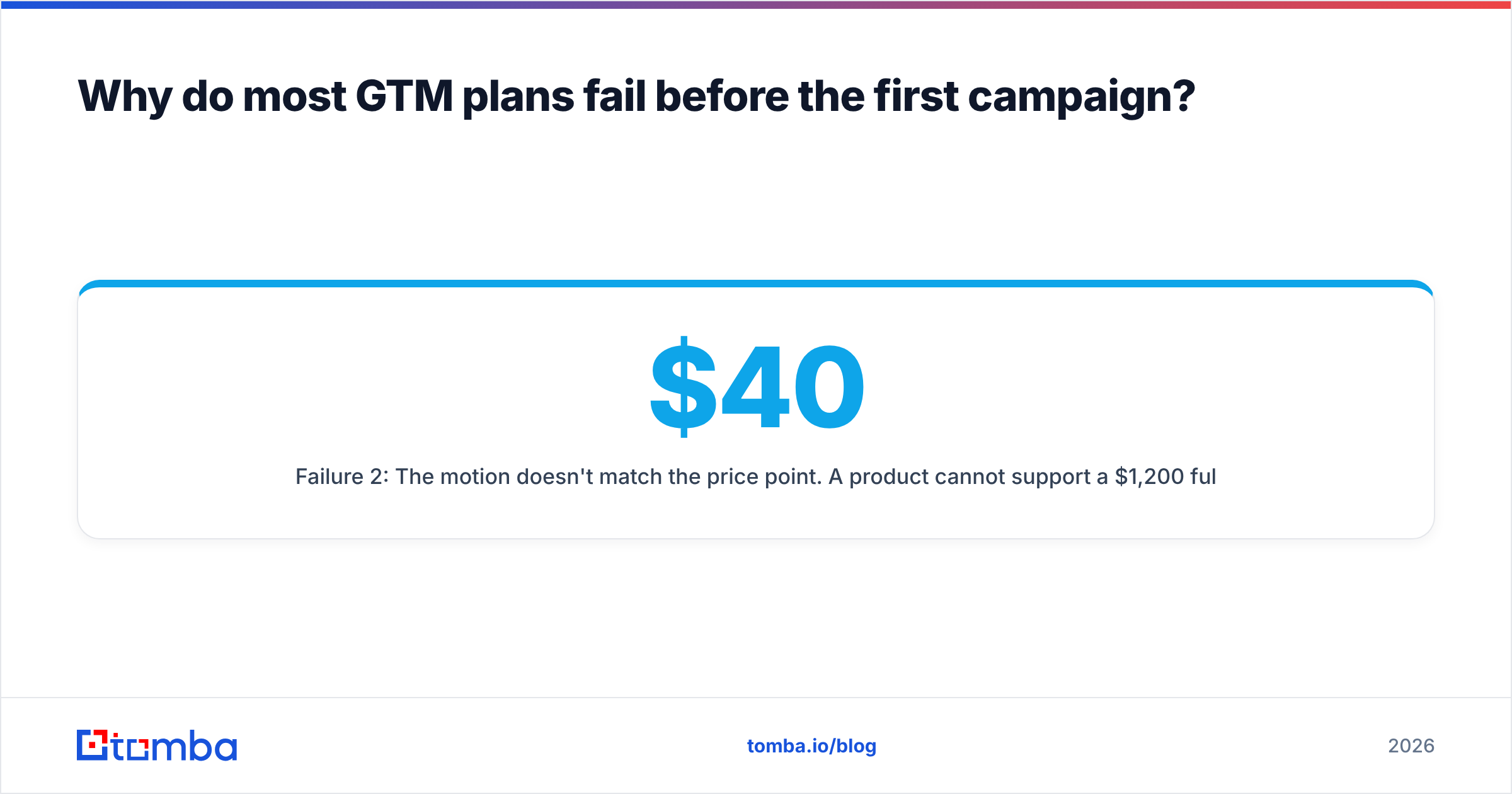
Failure 2: The motion doesn't match the price point. A $40/month product cannot support a $1,200 fully-loaded cost of an outbound-sourced meeting. A $90k ACV product will not close itself through a free trial and a nurture sequence. Match ACV to motion first, then pick channels.
Failure 3: Nobody owns the handoff. Marketing books the meeting, sales calls it unqualified, marketing says sales didn't work it. This is a revenue operations problem, not a personality problem — you need one shared definition of a qualified opportunity, written down, with an SLA on response time.
Forrester's research on B2B buying groups consistently finds that purchase decisions involve multiple stakeholders across a long, non-linear journey — which means a GTM plan that targets a single "persona" is under-specifying the problem by design. You're not marketing to a job title. You're arming an internal champion with material they can forward.
How do you choose the right GTM motion?#
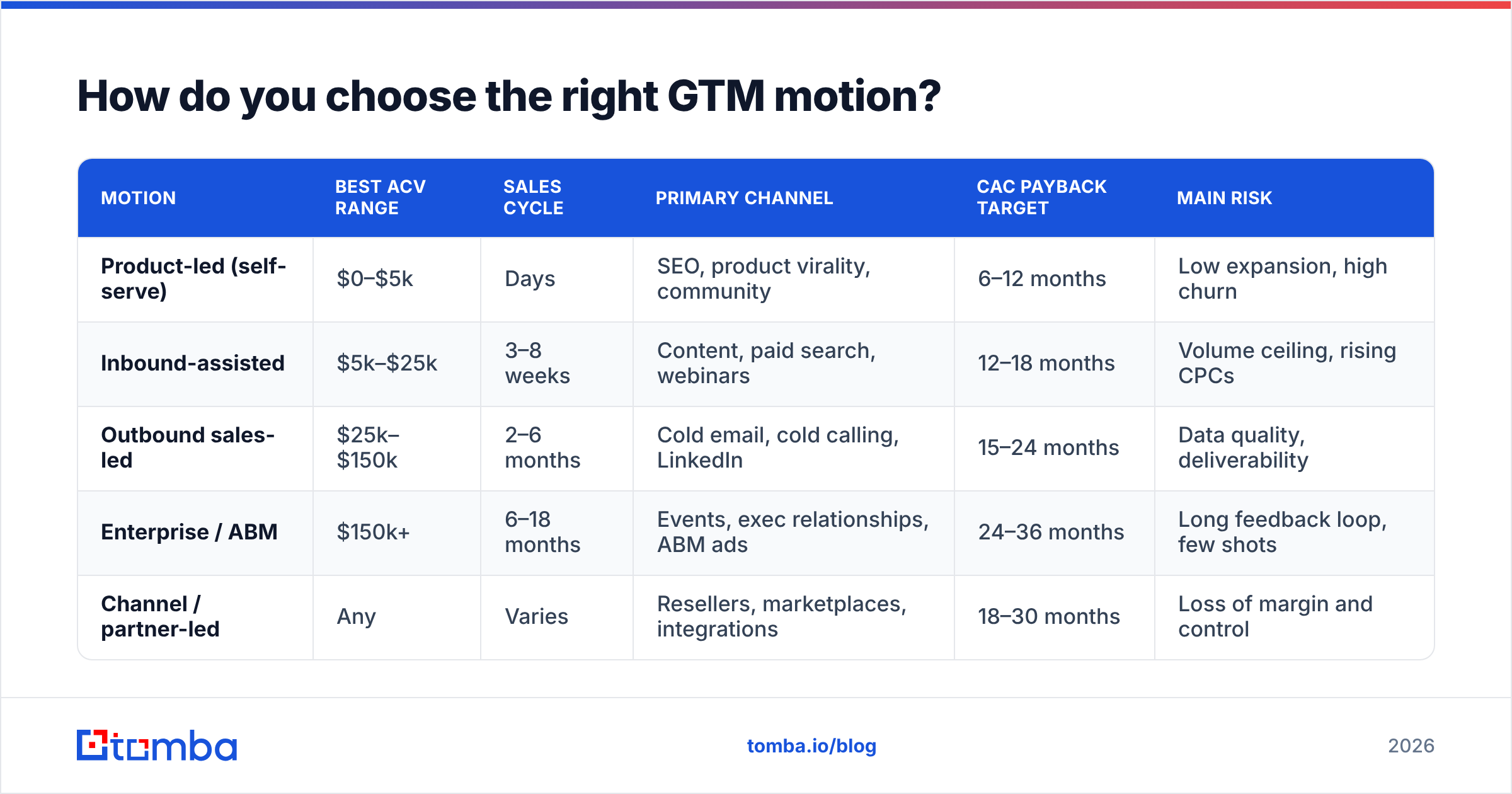
Start from ACV and sales cycle length. Everything else follows.
| Motion | Best ACV range | Sales cycle | Primary channel | CAC payback target | Main risk |
|---|---|---|---|---|---|
| Product-led (self-serve) | $0–$5k | Days | SEO, product virality, community | 6–12 months | Low expansion, high churn |
| Inbound-assisted | $5k–$25k | 3–8 weeks | Content, paid search, webinars | 12–18 months | Volume ceiling, rising CPCs |
| Outbound sales-led | $25k–$150k | 2–6 months | Cold email, cold calling, LinkedIn | 15–24 months | Data quality, deliverability |
| Enterprise / ABM | $150k+ | 6–18 months | Events, exec relationships, ABM ads | 24–36 months | Long feedback loop, few shots |
| Channel / partner-led | Any | Varies | Resellers, marketplaces, integrations | 18–30 months | Loss of margin and control |
Most companies run two motions, not one. A common working pair in 2026: product-led acquisition at the bottom to generate usage signal, plus outbound targeting the accounts whose usage crosses a threshold. That combination is cheap at the top and precise at the bottom.
The mistake is running four motions at 25% effort each. You get four sets of infrastructure costs and zero channels with enough data to optimize.
What does a GTM strategy actually contain?#
Here's the minimum viable document. If you can't fill in all six, you're not ready to spend budget.
- Segment definition with exclusions — who you target, and explicitly who you don't. Include firmographic filters, tech-stack signals, and at least one behavioral trigger.
- Positioning statement and three proof points — one sentence on the alternative you're replacing, plus evidence a skeptic would accept (numbers, named customers, a benchmark).
- Motion and channel allocation — which motion, which two or three channels, and the percentage of budget and headcount going to each.
- Message-to-channel map — the same positioning, translated per channel. What works in a 90-word cold email is not what works in a 12-minute webinar.
- Data and tooling plan — where contact data comes from, how it's verified, how it flows into the CRM, who owns hygiene.
- Metric tree with weekly leading indicators — reply rate, meeting-set rate, opportunity conversion, and pipeline coverage, each with a target and an owner.
That last one deserves emphasis. Revenue is a lagging indicator that tells you what your GTM was doing 90 days ago. Reply rate tells you what it's doing this week.
Which channels should you fund in 2026?#
Channel economics have shifted meaningfully in the last two years. Paid search costs in most B2B software categories have risen faster than conversion rates. LinkedIn ads remain excellent for targeting and expensive for volume. Organic search is being reshaped by AI answer engines that summarize rather than click through.
What's held up:
- Outbound email to a well-defined, well-verified list. Not spray-and-pray — 200 highly researched sends beat 5,000 generic ones on every metric that matters, including domain health.
- Cold calling for high-ACV segments. It stopped being fashionable, which is precisely why connect rates recovered for teams that kept doing it well.
- Founder-led content and social selling. Distribution attached to a human face still outperforms brand accounts by a wide margin.
- Integration and marketplace listings. If your buyer already lives inside HubSpot or Salesforce, being in the integrations directory is a durable acquisition channel with no CPC.
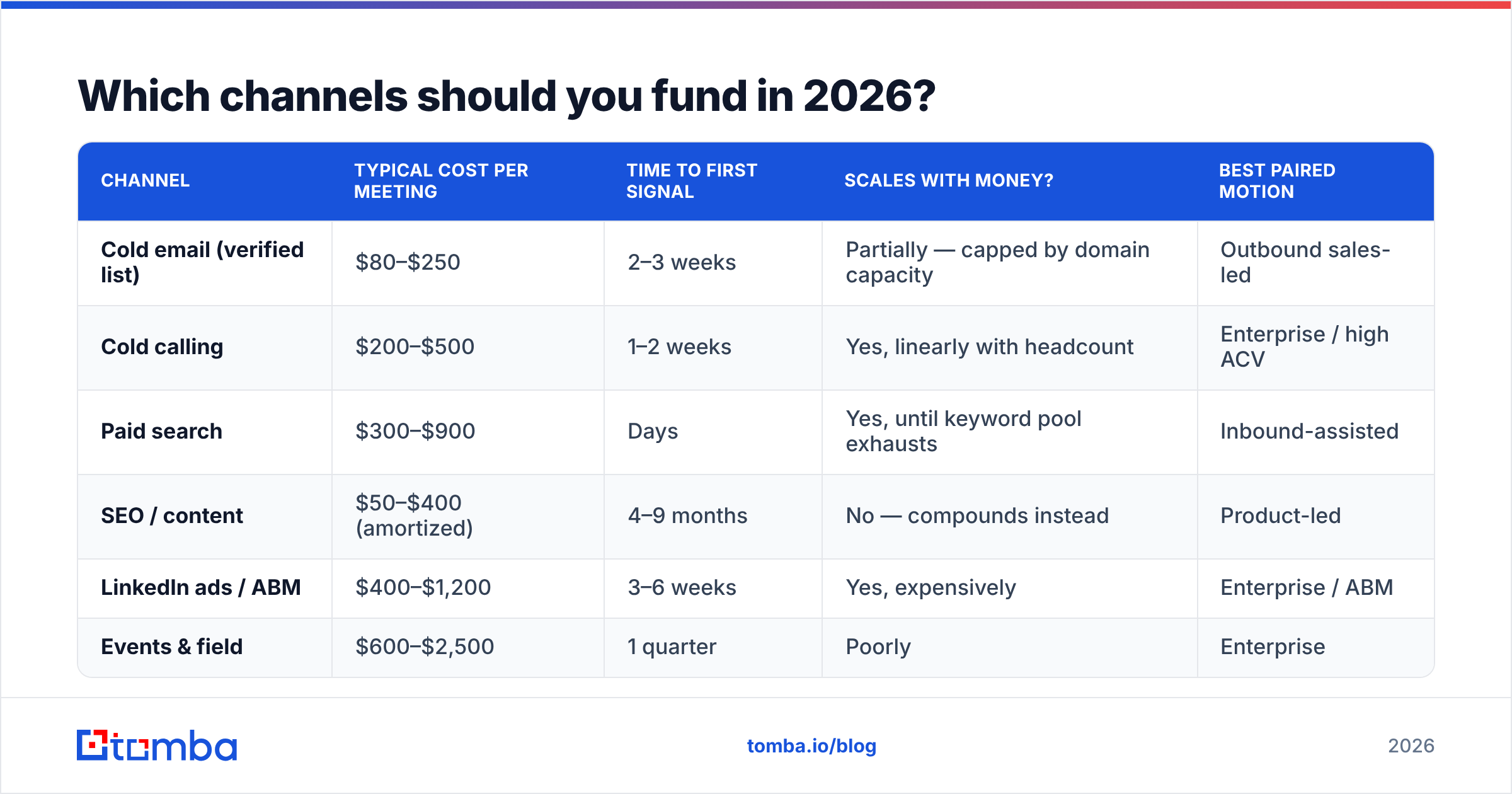
The channel comparison below is about where the money goes, not where the excitement is.
| Channel | Typical cost per meeting | Time to first signal | Scales with money? | Best paired motion |
|---|---|---|---|---|
| Cold email (verified list) | $80–$250 | 2–3 weeks | Partially — capped by domain capacity | Outbound sales-led |
| Cold calling | $200–$500 | 1–2 weeks | Yes, linearly with headcount | Enterprise / high ACV |
| Paid search | $300–$900 | Days | Yes, until keyword pool exhausts | Inbound-assisted |
| SEO / content | $50–$400 (amortized) | 4–9 months | No — compounds instead | Product-led |
| LinkedIn ads / ABM | $400–$1,200 | 3–6 weeks | Yes, expensively | Enterprise / ABM |
| Events & field | $600–$2,500 | 1 quarter | Poorly | Enterprise |
Read this table as a starting hypothesis for your own model, not as gospel — cost per meeting varies enormously by category and by how tight your targeting is. The point is the shape: fast-signal channels are expensive per unit, slow-signal channels compound.
How does contact data quality change GTM outcomes?#
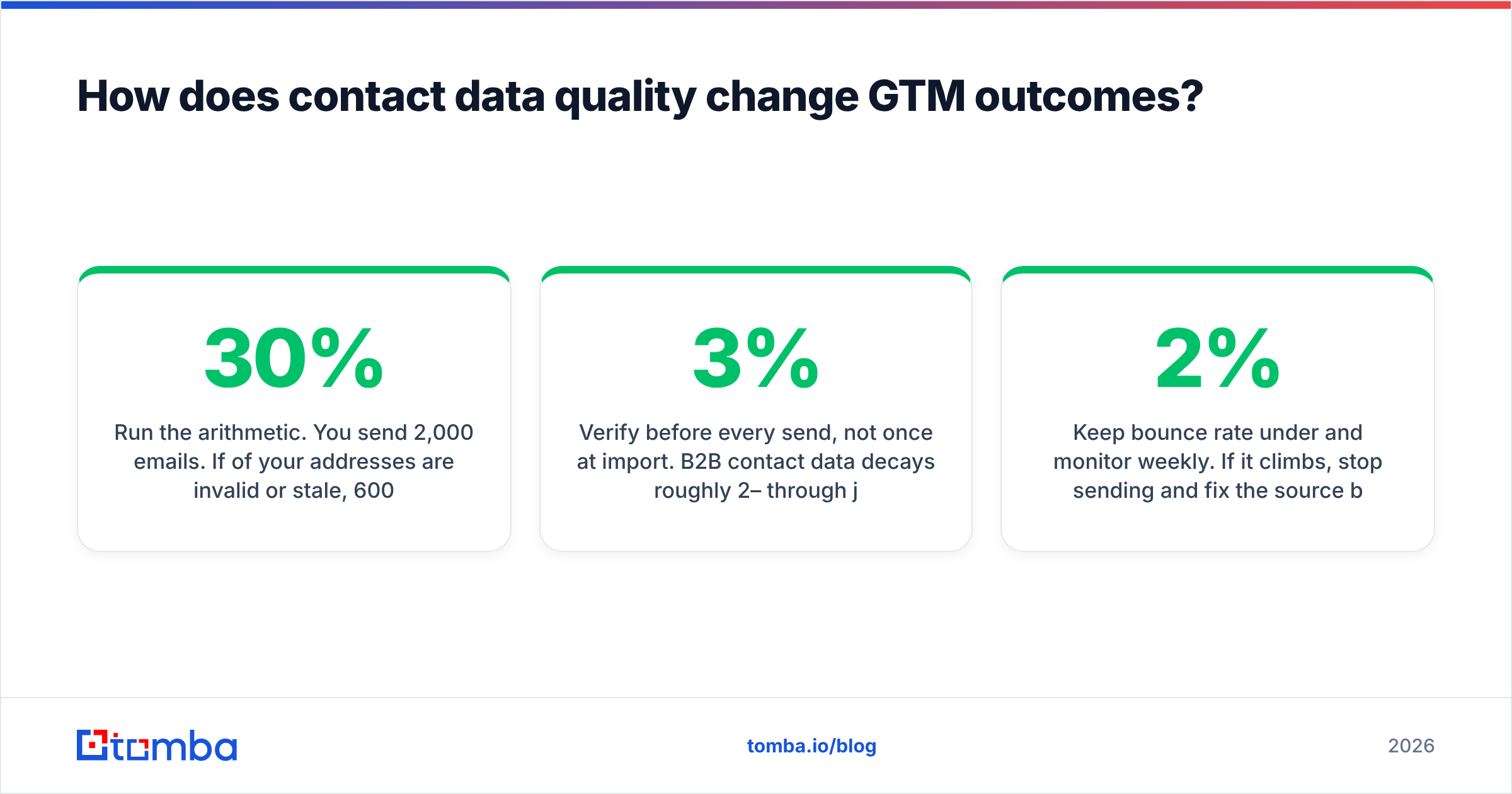
More than any other single input in an outbound motion, and it's routinely under-managed.
Run the arithmetic. You send 2,000 emails. If 30% of your addresses are invalid or stale, 600 of those bounce or land nowhere. Your bounce rate blows past the threshold that mailbox providers tolerate, your sender reputation drops, and the 1,400 valid addresses start landing in spam. You didn't run a campaign with a 4% reply rate — you ran a campaign that damaged your ability to run the next one.
Practical guardrails:
- Verify before every send, not once at import. B2B contact data decays roughly 2–3% per month through job changes alone. A list verified in January is meaningfully worse by April.
- Treat catch-all domains as their own bucket. They aren't automatically bad, but they need a catch-all verifier and a separate send policy rather than being mixed into your main list.
- Enrich for routing, not for vanity. Firmographic fields you'll actually use in segmentation are worth paying for. Fields nobody filters on are storage costs.
- Keep bounce rate under 2% and monitor weekly. If it climbs, stop sending and fix the source before you touch the copy.
An email verifier run as a pre-send gate is one of the highest-ROI process changes available to an outbound team, because it protects the asset — domain reputation — that every future campaign depends on.
How do you sequence a GTM launch over 90 days?#
Compress the learning loop. The goal of the first quarter is not revenue — it's finding out which of your assumptions were wrong, cheaply.
Days 1–30: Narrow and instrument. Pick one segment. Build a target list of 300–500 accounts with real triggers, not a 20,000-row export. Verify every contact. Set up tracking so you can attribute a meeting back to a channel and a message variant. Write three message angles, not one.
Days 31–60: Run and read. Send at low volume across all three angles. Book calls. Sit in on every single one — the transcript of a discovery call is more useful than a dashboard at this stage. Kill the two weakest angles by day 45.
Days 61–90: Concentrate. Take the winning angle and the winning channel, and put 60% of remaining budget behind them. Expand the list using the pattern that actually converted, not the pattern you designed in month one. Document the ICP refinement — it will be noticeably different from where you started.
Two things break this plan most often: launching before the data layer is ready (so you can't distinguish a message problem from a list problem), and changing the message every week (so no variant accumulates enough sends to be readable).
Which metrics tell you the GTM is working?#
Build a metric tree with three layers, and review the top layer weekly.
Leading (weekly): deliverability rate, reply rate, positive reply rate, meetings set, connect rate on calls. These move within days and tell you whether targeting and message are landing.
Mid-funnel (monthly): meeting-to-opportunity conversion, average deal size by segment, sales cycle length, pipeline coverage ratio against next quarter's target. These tell you whether the meetings are the right meetings.
Lagging (quarterly): CAC by channel, CAC payback period, win rate by segment, net revenue retention. These tell you whether the whole motion is economically viable.
The diagnostic pattern to memorize: high reply rate plus low meeting-to-opportunity conversion means your message is attracting the wrong people. Low reply rate plus high conversion on the few that reply means your targeting is right and your copy or deliverability is broken. Those two problems have completely different fixes, and teams that only watch revenue can't tell them apart.
For benchmarks against your peers, G2's category reports and vendor-published data are directionally useful — but your own historical baseline is the only comparison that's genuinely apples-to-apples.
What tooling stack does a GTM motion actually need?#
Less than vendors would like you to believe. Four categories cover the essentials:
- A source of accurate contact data — email addresses, phone numbers, and enough firmographic detail to segment. This is the foundation; everything downstream inherits its error rate.
- A verification layer — pre-send validation and catch-all handling, run as a gate rather than a cleanup job.
- A sending and sequencing tool — with per-mailbox volume controls and reply detection.
- A CRM as the single source of truth — with an agreed, documented definition of every stage. HubSpot's own guidance on pipeline stage definitions is a reasonable starting template if you don't have one.
Everything else — intent data, conversation intelligence, ABM ad platforms — is a genuine multiplier once the first four are solid, and an expensive distraction before that. Buy in that order.
For the data layer specifically, evaluate on three axes: coverage in your target geography and company-size band, verified accuracy rate (ask for the methodology, not just the headline number), and how the pricing scales as your list grows. Tools like BookYourData and Tomba take different approaches here — prebuilt list purchase versus on-demand lookup and verification — and the right choice depends on whether your ICP is stable enough to buy a static list or moves fast enough to need live enrichment. Check Tomba pricing against your monthly contact volume before committing to an annual plan anywhere; per-credit costs vary widely at different tiers.
Build the data layer first#
A go to market marketing strategy is only as good as the list it runs against. You can rewrite copy in an afternoon. You cannot un-burn a domain that spent three months bouncing into Gmail's spam filter.
Start by making the contact layer boring and reliable: build your target account list, then use the Tomba Email Finder to get verified, current addresses for the buying committee at each one — with bulk email finder for the list-level work and domain search when you need every relevant contact at a single account. The free tier covers 25 searches a month if you want to test accuracy against contacts you already know are valid, and Starter runs $49/mo when you're ready to run a real campaign. Get the input right, and the rest of the GTM plan finally has something honest to measure.
Related guides#
Ready to find emails that actually work?
Join 150,000+ professionals who stopped guessing and started sending. Free credits on signup — no credit card required.
Get the Tomba newsletter
Practical outbound tactics and product updates — once every two weeks.
About the author