Go To Market Meaning: What GTM Actually Means in B2B
GTM is one of the most overused terms in B2B — and one of the least understood. Here is what go to market actually means, how it differs from marketing strategy, and the five components every working GTM motion needs.
TL;DR
- Go to market (GTM) means the full plan for how a company sells a specific product to a specific buyer — pricing, packaging, channel, sales motion, and messaging together. It is not a synonym for "marketing."
- A GTM strategy answers five questions: who buys, what they buy, why they switch, how they buy, and who touches the deal at each stage.
- The biggest failure mode in 2026 is not bad copy — it is a vague ICP feeding a well-built outbound machine with the wrong contacts.
- Product-led, sales-led, and partner-led are motions, not strategies. Most B2B companies run two at once.
- GTM only works when contact data is accurate. A 12% bounce rate kills a campaign faster than weak positioning does.
What Is the Go To Market Meaning in Plain English?#
Go to market means the specific plan a company uses to put a product in front of the people who will pay for it, and to convert them. Think of it like opening a restaurant. The food is your product. Go to market is everything else: who you're feeding (office workers or families), what you charge, whether you do delivery or dine-in only, how people hear about you, and who greets them at the door.
Marketing is one line item in that plan. So is sales. So is pricing. GTM is the container.
The formal version: a go-to-market strategy is an operating plan that defines your target market, value proposition, pricing model, distribution channels, and sales process for a given product or product line. It has a scope (one product, one segment, one region) and a time horizon (usually a quarter to a year).
That scope point matters. Companies don't have one GTM strategy. They have one per meaningful product-segment pair. Your self-serve plan sold to solo founders in the US and your enterprise tier sold to European banks are two different go-to-market motions that happen to share a logo.
How Is GTM Different From a Marketing Strategy?#
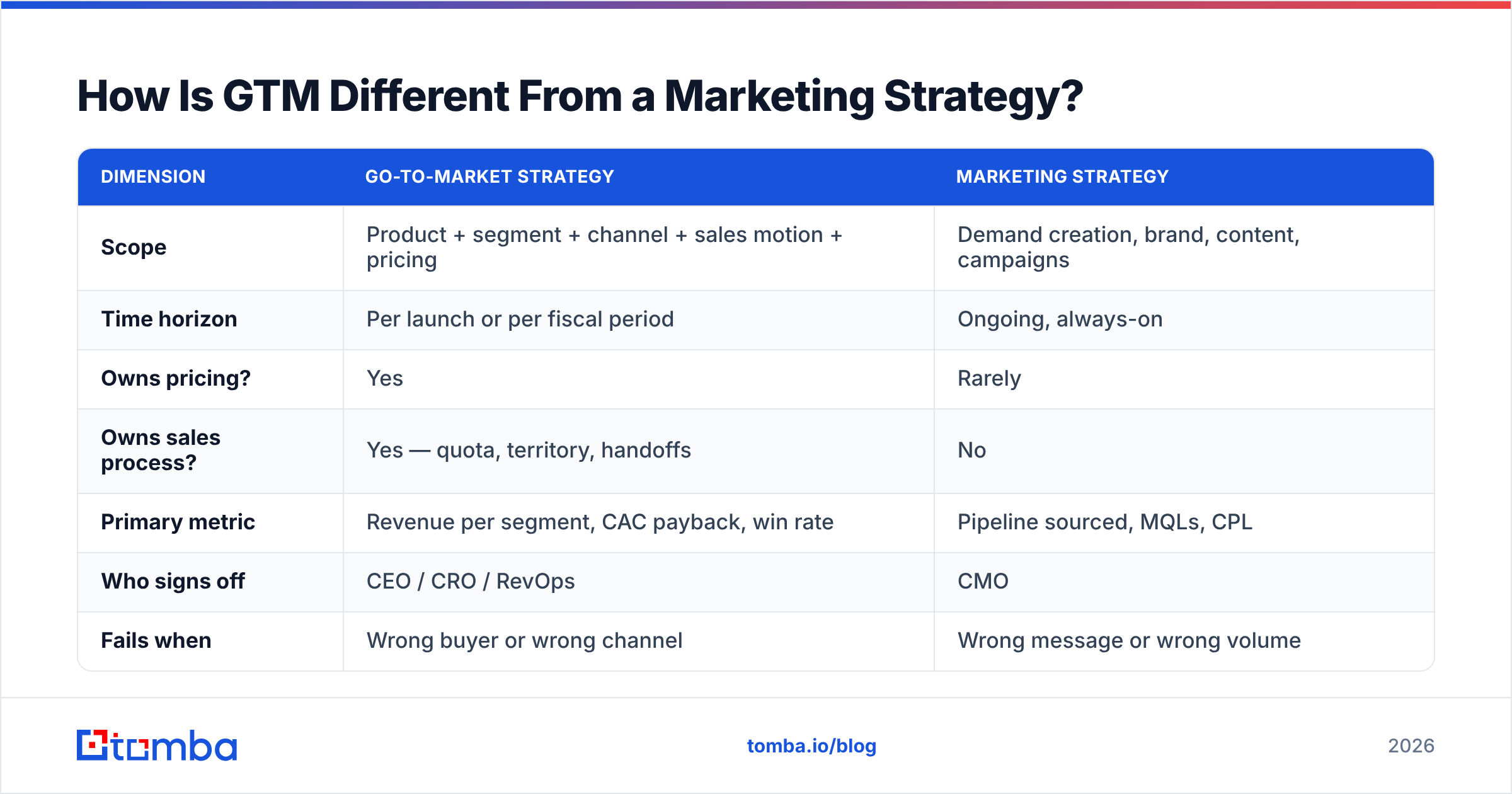
The two get used interchangeably in job titles and board decks, which is why the go to market meaning gets fuzzy. Here is the actual split:
| Dimension | Go-to-Market Strategy | Marketing Strategy |
|---|---|---|
| Scope | Product + segment + channel + sales motion + pricing | Demand creation, brand, content, campaigns |
| Time horizon | Per launch or per fiscal period | Ongoing, always-on |
| Owns pricing? | Yes | Rarely |
| Owns sales process? | Yes — quota, territory, handoffs | No |
| Primary metric | Revenue per segment, CAC payback, win rate | Pipeline sourced, MQLs, CPL |
| Who signs off | CEO / CRO / RevOps | CMO |
| Fails when | Wrong buyer or wrong channel | Wrong message or wrong volume |
A marketing strategy can be excellent while the GTM is broken. If you're generating 400 leads a month for a product priced at $12,000/year with a self-serve checkout and no sales team, marketing is doing its job and the go-to-market design is the thing failing.
The reverse also happens. Solid GTM design — right buyer, right price, right channel — with a weak message just underperforms. It doesn't collapse.
What Are the Five Components of a Go-To-Market Strategy?#
Every functional GTM plan answers these five in writing. If any one is a guess, the whole thing is a guess.
- Target market and ICP. Not "B2B SaaS companies." Something like: Series A–B vertical SaaS companies, 50–200 employees, US and UK, with an existing RevOps hire and HubSpot in the stack. Narrow enough that you can build a list from it.
- Value proposition and positioning. What you replace, what you're compared against, and the one measurable outcome you own. Positioning is a choice about competitive frame, not a tagline.
- Pricing and packaging. Tiers, seat vs. usage vs. flat, free tier or trial, annual discount, and what triggers an upgrade. Pricing is a GTM decision, not a finance decision.
- Distribution channels. Direct outbound, inbound content, marketplaces, resellers, partner co-sell, or product-led signup. Most teams pick one primary and one secondary, and neglect the rest deliberately.
- Sales motion and handoffs. Who prospects, who demos, who closes, who onboards. Define the trigger for each handoff — a scored marketing qualified lead, a booked meeting, a signed order form.
Write those five on one page. If two people on your team write meaningfully different versions of that page, you don't have a GTM strategy — you have a set of overlapping habits.
What Are the Main GTM Motions and When Does Each Work?#
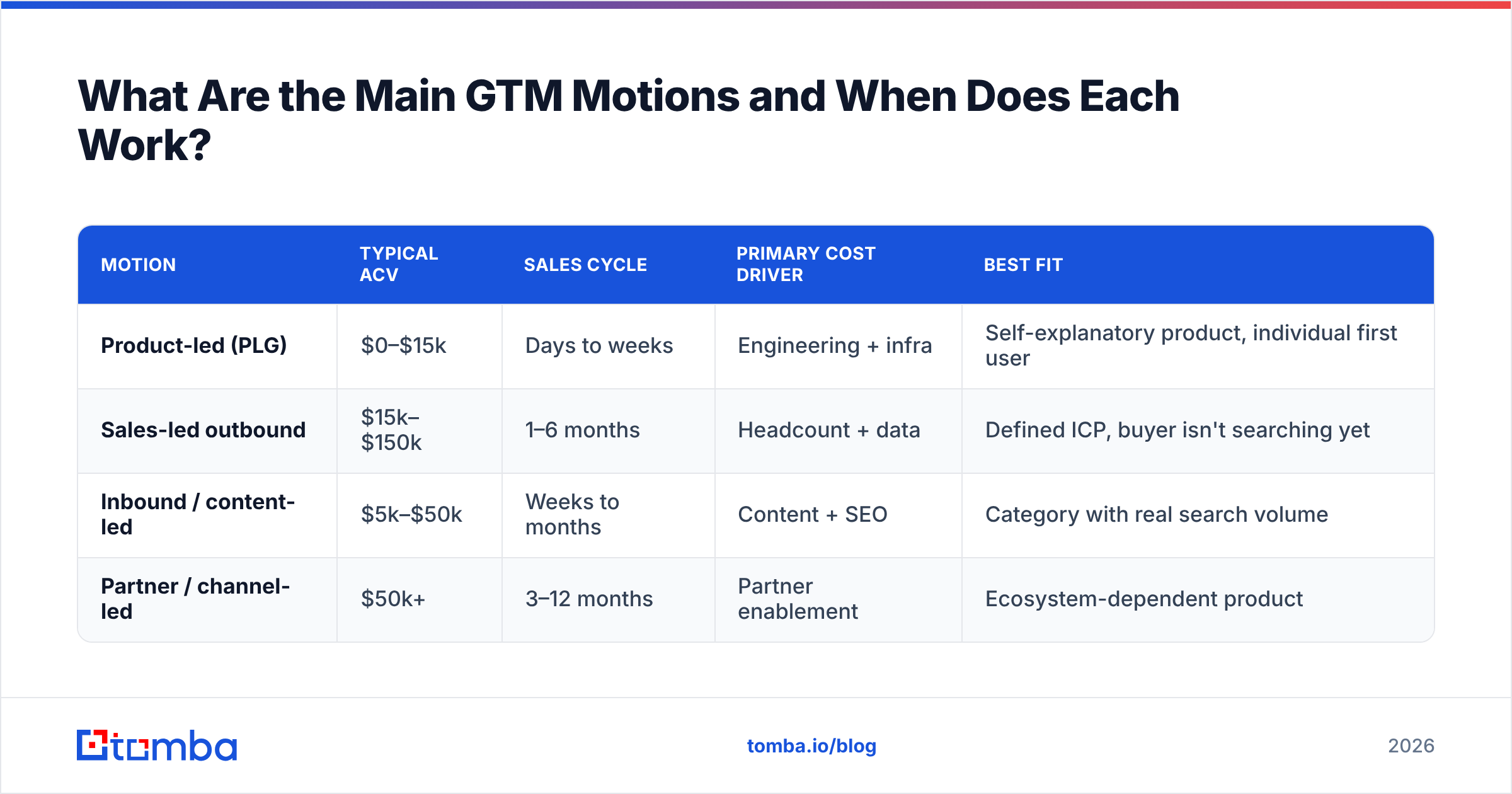
A motion is how revenue gets created. The strategy chooses the motion; the motion isn't the strategy. Four dominate B2B in 2026:
| Motion | Typical ACV | Sales cycle | Primary cost driver | Best fit |
|---|---|---|---|---|
| Product-led (PLG) | $0–$15k | Days to weeks | Engineering + infra | Self-explanatory product, individual first user |
| Sales-led outbound | $15k–$150k | 1–6 months | Headcount + data | Defined ICP, buyer isn't searching yet |
| Inbound / content-led | $5k–$50k | Weeks to months | Content + SEO | Category with real search volume |
| Partner / channel-led | $50k+ | 3–12 months | Partner enablement | Ecosystem-dependent product |
Most companies past $5M ARR run two. A classic pair: PLG captures individual users on a free tier, then sales-led outbound targets the accounts where 5+ free users already exist. That second half only works if you can resolve a free signup's work email to a company, and then find the budget holder above them — which is a data problem before it's a sales problem.
According to G2's category data, sales intelligence and contact-data tooling is now one of the fastest-growing categories in the sales stack, which reflects exactly this: outbound motions have gotten harder, and teams are compensating with better targeting rather than more volume.
Why Do Most Go-To-Market Plans Fail?#
They fail in a predictable order. Ranked by how often I see it kill a quarter:
1. The ICP is a paragraph, not a filter. "Mid-market companies that care about efficiency" cannot be turned into a list. An ICP is only real if you can express it as search criteria: industry code, headcount band, geography, tech stack, funding stage, hiring signals. If your GTM doc's ICP can't be pasted into a database query, rewrite it.
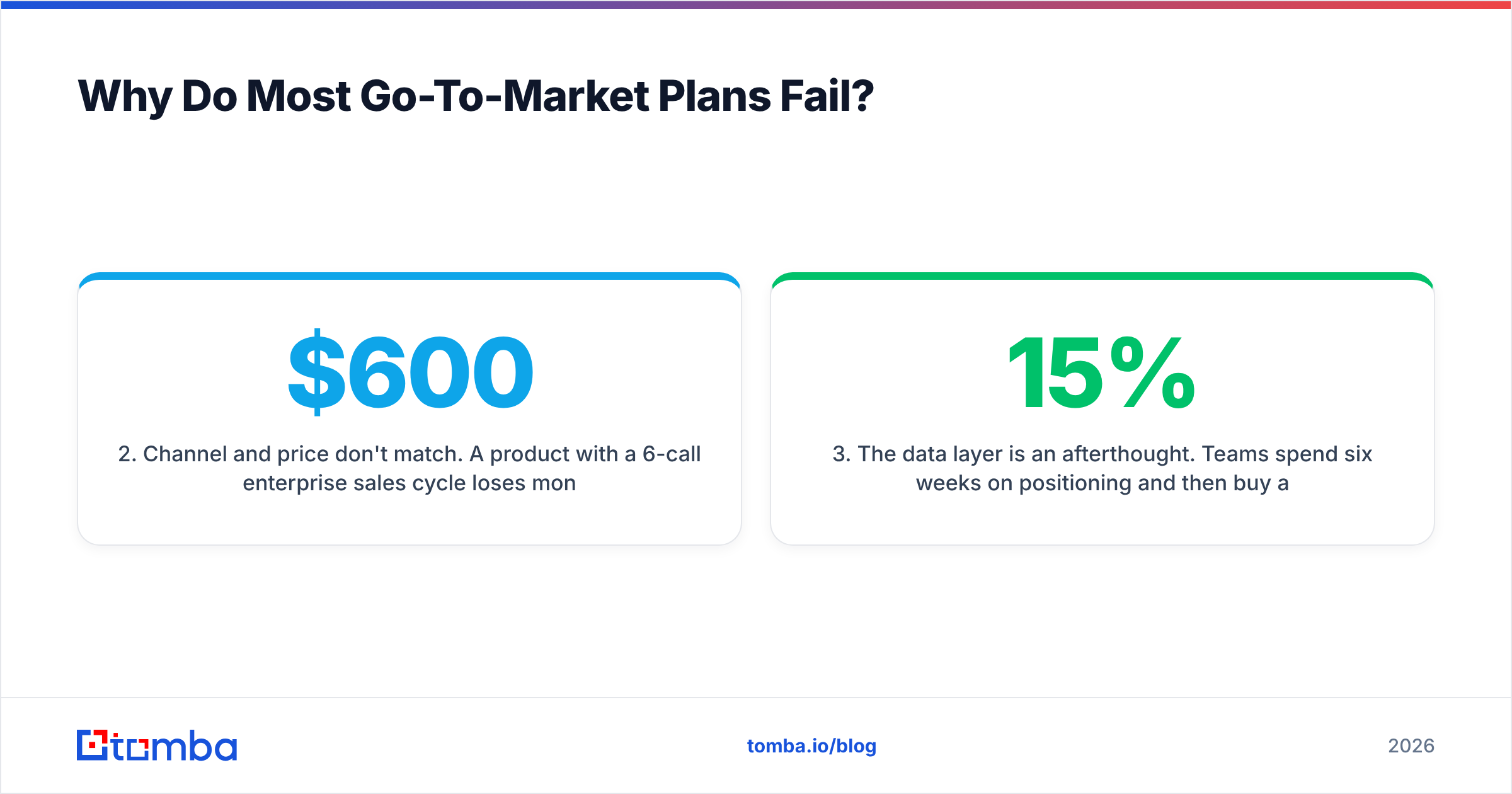
2. Channel and price don't match. A $600/year product with a 6-call enterprise sales cycle loses money on every deal. A $90k product with a self-serve checkout and no human contact never closes. Gartner's B2B buying research has consistently found buyers spend a minority of the cycle with any vendor's sales rep — so the channel has to fit how that buyer actually researches, not how you'd prefer to sell.
3. The data layer is an afterthought. Teams spend six weeks on positioning and then buy a list. Bounce rates hit 15%, the sending domain gets throttled, and the conclusion is "outbound doesn't work for us." It wasn't outbound. It was the list.
4. No one owns the handoff. Marketing declares a lead qualified, sales says it isn't, and nobody has written down the criteria. This is what revenue operations exists to fix, and it's the single cheapest fix on this list.
5. Success metrics are activity, not outcome. Emails sent, calls made, and content published are inputs. If your GTM review reads like a activity report, you'll optimize the wrong loop for two quarters.
How Does Data Quality Change the GTM Meaning in Practice?#
Here's the part most GTM guides skip. Every component above — ICP, channel, motion, handoff — resolves into a list of humans with contact details. That list is the physical form of your strategy. If it's wrong, nothing upstream matters.
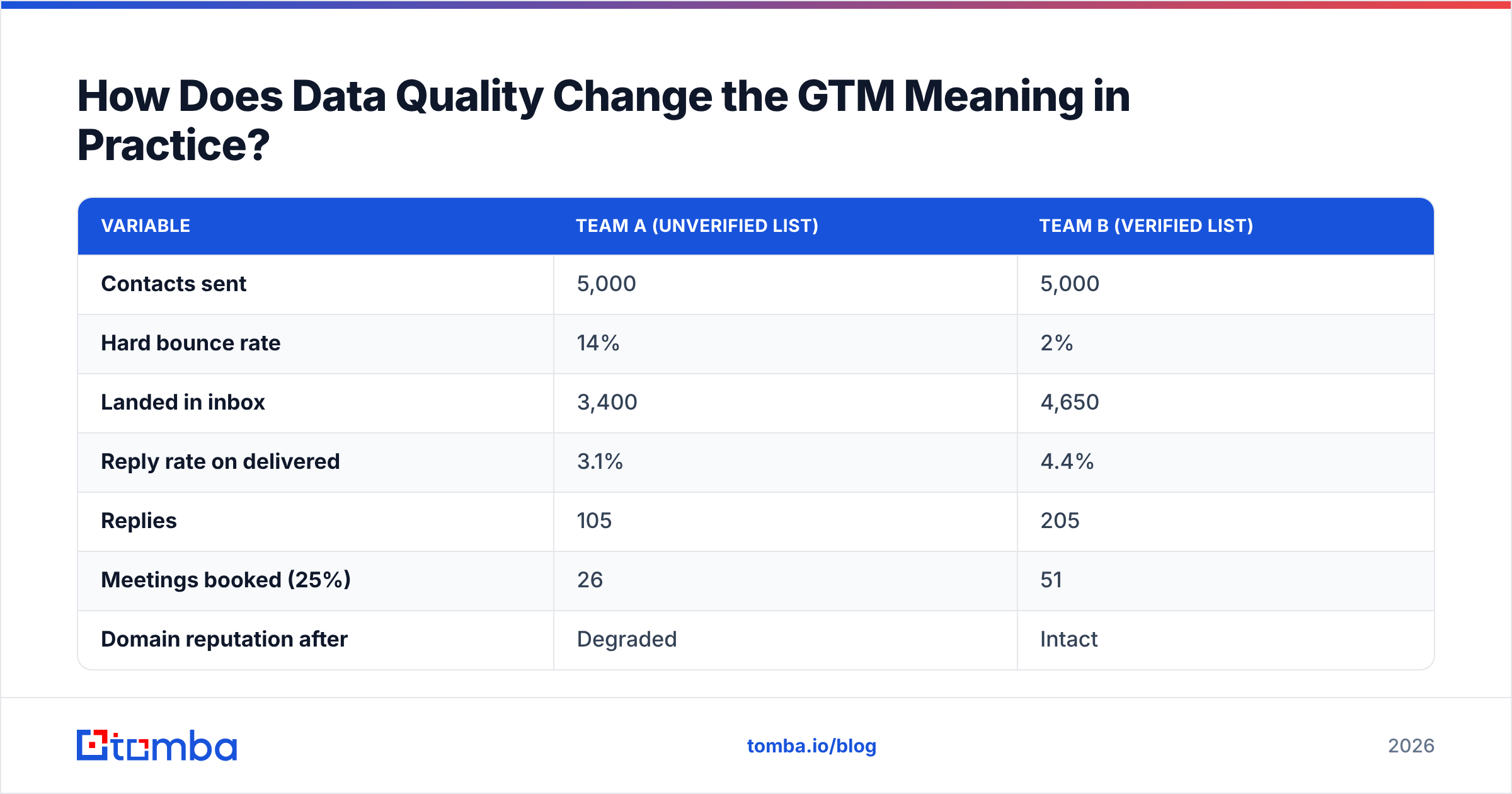
Concrete arithmetic. Two teams run the same 5,000-contact campaign with identical copy and identical ICP definition:
| Variable | Team A (unverified list) | Team B (verified list) |
|---|---|---|
| Contacts sent | 5,000 | 5,000 |
| Hard bounce rate | 14% | 2% |
| Landed in inbox | 3,400 | 4,650 |
| Reply rate on delivered | 3.1% | 4.4% |
| Replies | 105 | 205 |
| Meetings booked (25%) | 26 | 51 |
| Domain reputation after | Degraded | Intact |
Team B nearly doubles output with the same strategy document. The reply-rate lift isn't magic — it's that a clean list correlates with correctly identified people, and a healthy sender reputation means more of what you send is actually seen.
This is why the data step belongs inside the GTM plan, not in a procurement ticket after it. When you write your channel section, name the source of truth for contacts. A domain search pass to map the account's org structure, an email verifier run before every send, and a documented refresh cadence — quarterly at minimum, since B2B contact data decays roughly 2–3% per month as people change jobs.

How Do You Build a Go-To-Market Plan in 30 Days?#
A workable sequence. Compress or extend, but keep the order — each step feeds the next.
Week 1 — Evidence. Interview 8–12 customers who bought in the last two quarters. Ask what they were doing before, what triggered the search, who else was in the room, and what almost stopped the deal. This produces your ICP and your positioning frame. Don't skip to writing.
Week 2 — Definition. Write the one-pager: ICP filters, value prop, pricing tiers, primary and secondary channel, sales motion with named handoff triggers. Circulate for disagreement, not approval. Disagreement is the useful signal.
Week 3 — List and infrastructure. Turn the ICP filters into an actual account list. Enrich it — decision-maker names, verified work emails, phone numbers where the motion needs them. Set up sending domains, warm them, configure SPF records and DMARC. Build the CRM fields you'll need to measure by segment later, because retrofitting them is miserable.
Week 4 — Small live test. Run 200–400 contacts through the full motion. You are not testing for revenue at this volume. You're testing whether the ICP filters produce people who recognize the problem, and whether your handoff triggers survive contact with a real deal.
Then review against outcome metrics — reply rate by segment, meeting-to-opportunity rate, win rate — and scale only the segments that cleared. Most teams find one of three ICP sub-segments carries the whole result. Cutting the other two is the highest-leverage decision in the first quarter.
What Should You Measure to Know If Your GTM Is Working?#
Pick a small set and hold them across quarters. The list below is ordered by how early it tells you something:
- Reply rate by ICP sub-segment — earliest signal that targeting is right or wrong. Available in week 2 of execution.
- Meeting-to-opportunity conversion — tells you if the people replying are actually buyers, or just polite.
- Win rate by segment and by channel — the number that decides where next quarter's budget goes.
- CAC payback period — the honest test of whether the pricing-to-channel match works. Under 12 months for SMB, under 18 for mid-market, as a rough bar.
- Net revenue retention — validates that you sold to the right ICP in the first place. Low NRR in a segment usually means a GTM targeting error, not a product error.
Vanity metrics to keep out of the GTM review: emails sent, LinkedIn connections, content pieces published, MQL count without a downstream conversion attached.
Is GTM Different for AI-Era B2B Products in 2026?#
Somewhat, in three specific ways — the fundamentals are unchanged.
First, buying committees got larger and more technical. Security and data-governance reviewers now appear in mid-market deals that used to close with one champion. Your GTM plan needs contacts in those functions mapped before the deal stalls, not after.
Second, outbound volume stopped working as a lever. Inbox providers filter aggressively, and buyers pattern-match generated copy instantly. The teams winning outbound in 2026 send fewer, better-targeted emails to verified contacts, with research that's genuinely specific. Volume strategies are actively negative now — they burn domains.
Third, evaluation cycles compressed for self-serve products and lengthened for anything touching production data. That splits your GTM: the same company may need a PLG motion for the workflow tool and a full enterprise motion for the platform tier.
None of this changes the go to market meaning. It changes which motions are efficient. The five components still have to be answered in writing, and the list still has to be clean.
Where Should You Start?#
Start with the one-pager and the customer interviews. Positioning without evidence is guessing, and every downstream cost — headcount, ad spend, tooling — compounds on top of a wrong ICP.
Once the ICP is written as filters rather than adjectives, the execution layer is a solved problem. Use Tomba Email Finder to turn your target account list into verified decision-maker contacts by domain, name, or company — the step where most go-to-market plans quietly break. The free tier covers 25 searches a month if you want to test the accuracy on accounts you already know; paid plans start at $49/mo on Starter, $99/mo on Growth, with full Tomba pricing and API access for teams wiring it into their CRM. Build the list your strategy actually described, then go execute it.
Related guides#
Ready to find emails that actually work?
Join 150,000+ professionals who stopped guessing and started sending. Free credits on signup — no credit card required.
Get the Tomba newsletter
Practical outbound tactics and product updates — once every two weeks.
About the author