Go-To-Market Model: How to Pick the Right One in 2026
Most GTM failures are model failures, not execution failures. Here's how sales-led, product-led, and hybrid go-to-market models actually differ — and how to pick using CAC, ACV, and deal cycle math.
TL;DR
- A go to market model is the repeatable system that connects a segment, a motion, a channel, and a pricing structure — not a launch plan or a marketing campaign.
- Three primary models dominate B2B: sales-led, product-led, and channel/partner-led. Most companies past $5M ARR run a hybrid of two.
- The deciding variable is almost always annual contract value (ACV). Under ~$5K ACV, human-touch sales math breaks. Over ~$25K ACV, self-serve alone stalls.
- Your model determines your data requirements. Sales-led motions live or die on contact accuracy; product-led motions live or die on activation instrumentation.
- Switching models is expensive. Running a second model in parallel is usually smarter than replacing the first.
What Is a Go To Market Model?#
A go to market model is the operating system your revenue org runs on. It answers four questions in a way that is repeatable across hundreds of deals: who you sell to, how the buying decision gets made, which channel carries the message, and what pricing structure captures the value.
Think of it like choosing between a restaurant, a food truck, and a grocery aisle. All three sell food. But the kitchen layout, staffing, rent, margin per unit, and customer expectations are completely different systems. You cannot run a Michelin kitchen out of a truck window, and you cannot serve 400 covers a night from a grocery shelf. Picking wrong is not a tactics problem — it is a structural mismatch that no amount of hustle repairs.
The confusion in most companies comes from mixing three layers:
- Go-to-market strategy — the positioning bet. Who you win against, and why.
- Go-to-market model — the structural system. Motion, channel, pricing, org shape.
- Go-to-market plan — the 90-day execution calendar. Campaigns, quotas, launch dates.
Teams argue about plans when the model is broken. That is why "we need better sequences" is the most expensive sentence in B2B — it treats a structural mismatch as a copywriting problem.

What Are the Main Go To Market Models?#
There are three primary models plus two common hybrids. Each has a distinct cost structure and a distinct failure mode.
1. Sales-led (SLG). Humans drive the deal from first touch to signature. AEs, SDRs, demos, security reviews, procurement. Works when the buyer needs to be educated, the contract is large enough to fund headcount, and the purchase requires multi-stakeholder consensus. Failure mode: CAC balloons when reps chase deals too small to pay for the rep.
2. Product-led (PLG). The product itself does the selling — free tier, free trial, or freemium, with expansion happening inside the app. Works when time-to-value is measured in minutes, the individual user can adopt without permission, and the product is self-explanatory. Failure mode: a giant free base that never converts, because nothing forces the upgrade decision.
3. Channel/partner-led. Resellers, agencies, MSPs, or marketplaces carry the motion. Works when partners already own the customer relationship and your product plugs into their delivery. Failure mode: you lose the customer relationship and the margin at the same time.
4. Community-led (hybrid). A variant of PLG where a public community, open-source project, or content ecosystem creates demand ahead of the product. Slow to build, extremely durable once it exists.
5. Product-led sales (PLS). The dominant 2026 hybrid. Self-serve acquisition creates usage signals; a sales team works only the accounts showing buying intent. This is what most successful SaaS companies converge on between $10M and $50M ARR.
Which Go To Market Model Fits Your ACV?#
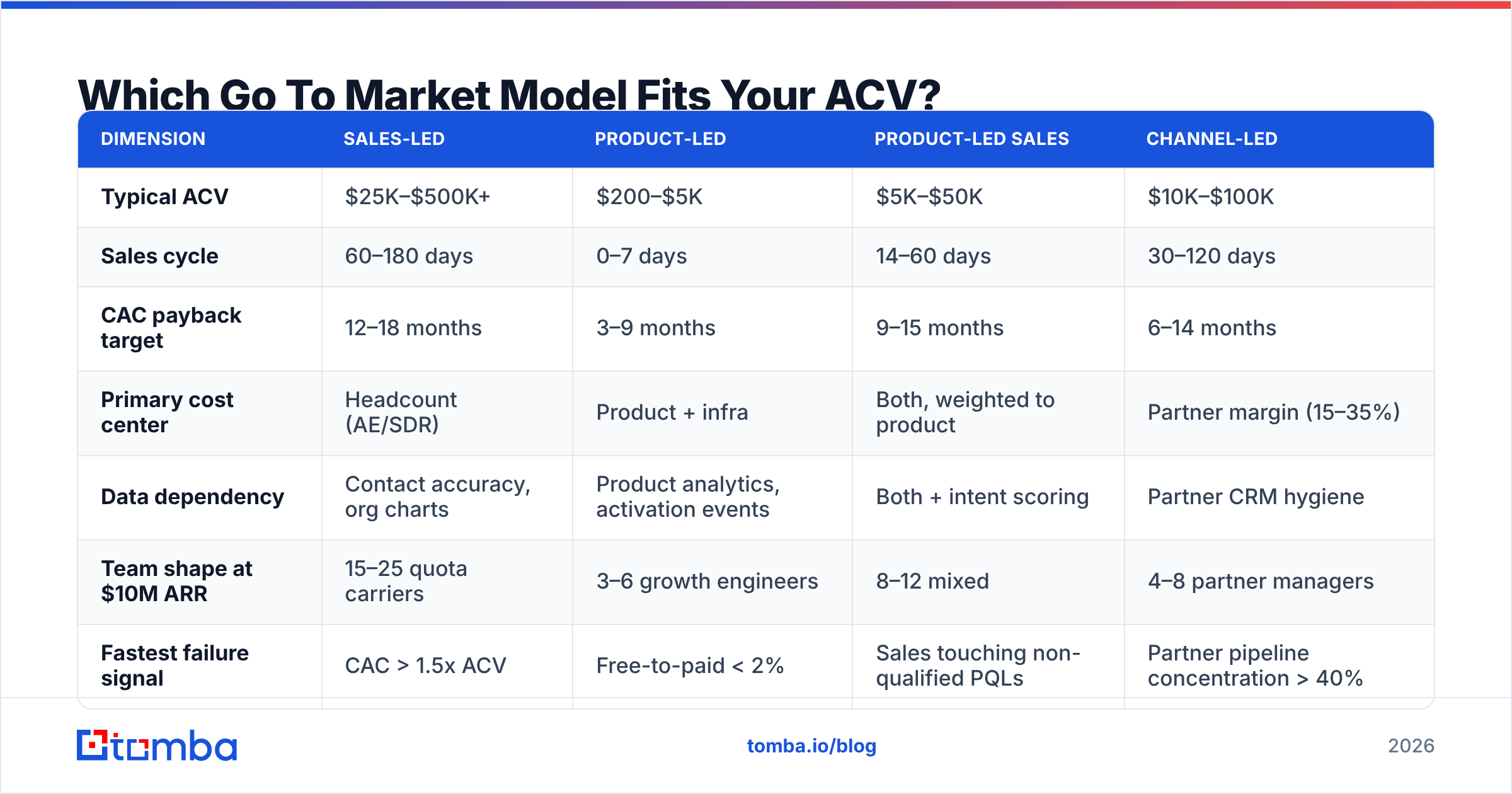
This is the table that settles most internal debates. Run your own numbers against it before you argue about org charts.
| Dimension | Sales-Led | Product-Led | Product-Led Sales | Channel-Led |
|---|---|---|---|---|
| Typical ACV | $25K–$500K+ | $200–$5K | $5K–$50K | $10K–$100K |
| Sales cycle | 60–180 days | 0–7 days | 14–60 days | 30–120 days |
| CAC payback target | 12–18 months | 3–9 months | 9–15 months | 6–14 months |
| Primary cost center | Headcount (AE/SDR) | Product + infra | Both, weighted to product | Partner margin (15–35%) |
| Data dependency | Contact accuracy, org charts | Product analytics, activation events | Both + intent scoring | Partner CRM hygiene |
| Team shape at $10M ARR | 15–25 quota carriers | 3–6 growth engineers | 8–12 mixed | 4–8 partner managers |
| Fastest failure signal | CAC > 1.5x ACV | Free-to-paid < 2% | Sales touching non-qualified PQLs | Partner pipeline concentration > 40% |
| Gross margin impact | Neutral | High (low touch) | High | Reduced by partner cut |
The pattern is consistent across public SaaS reporting and benchmark studies published by firms like Gartner and Forrester: sales headcount only pays for itself when the deal is large enough to absorb fully loaded rep cost, which in most US/EU markets sits somewhere between $150K and $250K per AE per year. If your ACV is $4,000, one rep needs to close roughly 50 deals annually just to break even on salary — before quota, before ramp, before churn.
How Do You Actually Choose a Go To Market Model?#
Run these five checks in order. Stop at the first one that gives you a clear answer.
- The ACV test. Divide fully loaded rep cost by your target ACV. If the result is more than ~20 deals per rep per year and your cycle is longer than 45 days, sales-led math will not close. Look at PLG or PLS.
- The permission test. Can a single user adopt your product without asking anyone — no security review, no SSO requirement, no budget approval? If yes, PLG is available to you. If no, you are structurally sales-led regardless of price point.
- The time-to-value test. Measure the minutes between signup and the first moment a user gets something they'd miss. Under 10 minutes, self-serve works. Over an hour, you need a human to bridge the gap.
- The buying committee test. Count the stakeholders who must say yes. One or two, self-serve is viable. Five or more, you need enterprise sales choreography — champion building, business cases, procurement navigation.
- The distribution test. Does someone else already own daily access to your buyer, and does your product make their offering better? If yes, channel-led can outrun both alternatives on speed to first $1M.
Most teams get stuck between checks 2 and 4, because the honest answer is "both." That is not indecision — that is the signal that you should be running a hybrid.
Is Product-Led Growth Replacing Sales-Led Models?#
No, and the framing is wrong. PLG replaced lead generation, not selling.
What changed between 2018 and 2026 is where qualification happens. In the old model, an SDR qualified a prospect through conversation. In the current model, the product qualifies them through behavior — seats invited, API calls made, workspace limits hit. The sales conversation still happens; it just starts later, with far more information, and closes faster.
The data that matters here is different too. A sales-led org needs verified contact data and accurate org mapping. A product-led org needs event instrumentation and a working product-qualified-lead (PQL) definition. A PLS org needs both, plus a routing layer that decides which signals earn a human.
That last piece is where most PLS implementations break. Teams define a PQL as "used the product," which floods AEs with tire-kickers, or they define it so narrowly that reps get four leads a month and go back to cold outbound anyway. A workable PQL combines a usage threshold, a firmographic filter, and a recency window — for example: 3+ seats active in the last 14 days at a company with 50+ employees.
Enriching those accounts is where the model becomes operational. Once a PQL fires, you need the rest of the buying committee — not just the one person who signed up. That means contact enrichment against the account domain and domain search to surface the VP or director who actually controls budget.
What Does Each Model Require From Your Data Stack?#
Your go to market model dictates your data spend more than any other decision. Here is what each one actually consumes.
Sales-led data requirements:
- Verified contact data — bounce rates above 5% will hurt sender reputation and cap outbound volume within weeks.
- Org charts and reporting lines — enterprise deals need champion + economic buyer + technical evaluator identified separately.
- Direct dials — email-only enterprise outbound underperforms multichannel by a wide margin in most published benchmark sets.
- Account-level intent — hiring signals, tech-stack changes, funding events that justify a timely first touch.
Product-led data requirements:
- Event instrumentation — activation, aha-moment, and limit-hit events tracked per workspace, not just per user.
- Reverse identity resolution — turning a free signup email into a company profile so you can score the account.
- Self-serve funnel analytics — where signups stall between signup and first value.
- Expansion signals — seat growth, usage ceiling proximity, admin invites.
Hybrid (PLS) requirements: everything above, plus a routing rules engine and a shared definition of "qualified" that both product and sales teams agreed to in writing.
For sales-led and hybrid motions, list hygiene is the unglamorous constraint that decides everything downstream. Running your prospect list through an email verifier before a campaign is the difference between a deliverable domain and a burned one — and once your domain reputation drops, no model works. Vendors in the B2B data space have converged on similar quality claims, so verify against your own sample before committing budget; comparison sites like G2 are useful for narrowing the list but not for validating accuracy on your specific ICP.
How Do You Transition Between Go To Market Models?#
You don't switch. You layer.
Ripping out a working sales-led motion to "go PLG" is how companies lose two quarters of revenue and half their AE team. The safer pattern is to run the new model as a parallel track with its own owner, its own budget, and its own success metric, until it proves unit economics on real customers.
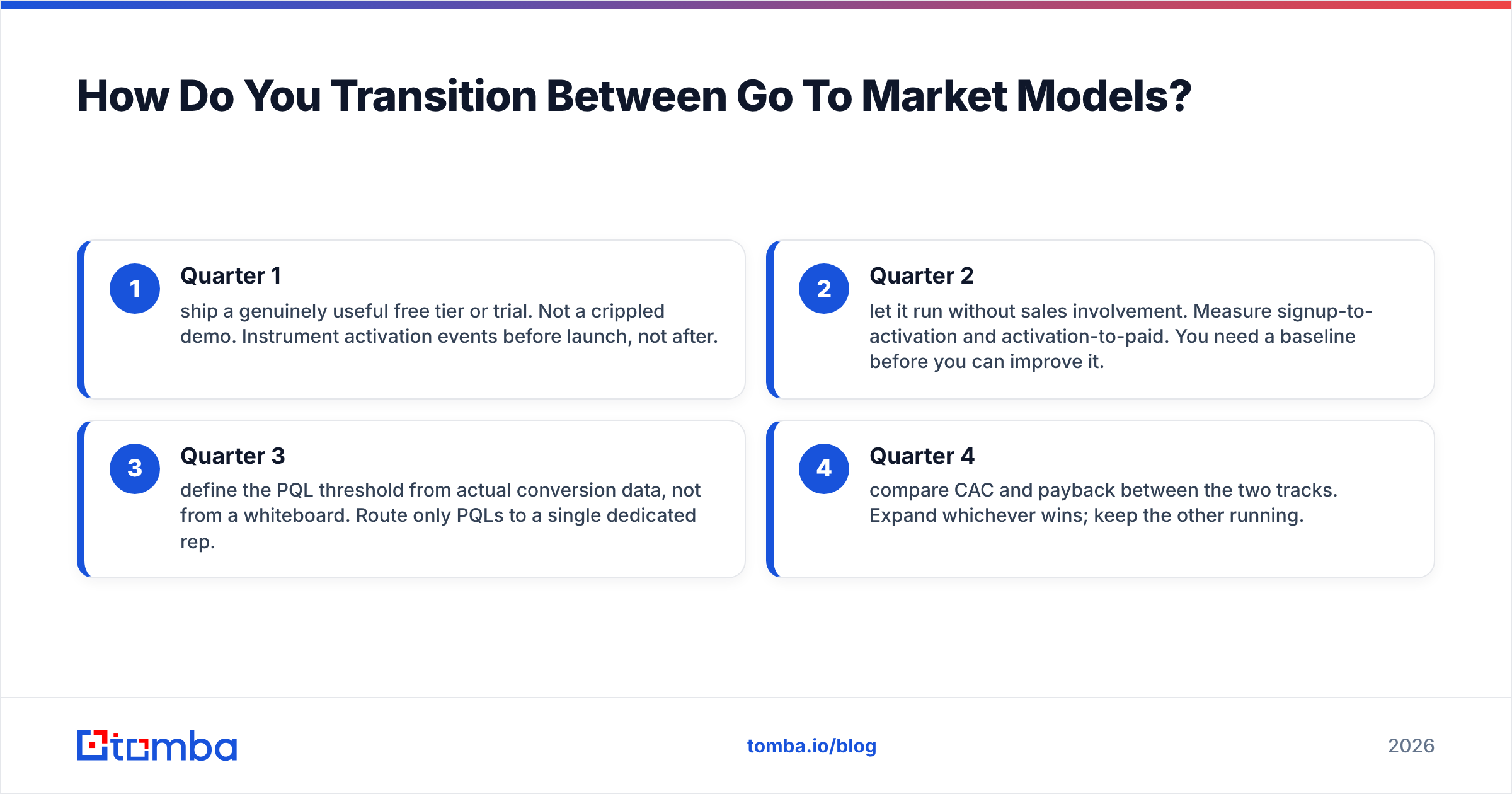
A workable sequence for adding PLG on top of sales-led:
- Quarter 1 — ship a genuinely useful free tier or trial. Not a crippled demo. Instrument activation events before launch, not after.
- Quarter 2 — let it run without sales involvement. Measure signup-to-activation and activation-to-paid. You need a baseline before you can improve it.
- Quarter 3 — define the PQL threshold from actual conversion data, not from a whiteboard. Route only PQLs to a single dedicated rep.
- Quarter 4 — compare CAC and payback between the two tracks. Expand whichever wins; keep the other running.
For the reverse direction — adding sales to a PLG base — the trap is hiring enterprise AEs before you have enterprise product capability. SSO, audit logs, role-based permissions, and a security questionnaire response library need to exist before a rep can close a $50K deal. Hiring the rep first just creates an expensive person with nothing to sell.
Both transitions depend on knowing who is actually inside your accounts. If your free tier is full of @gmail.com signups, a reverse email lookup step in your enrichment pipeline is what turns anonymous signups into scoreable accounts.
What Metrics Prove Your Model Is Working?#
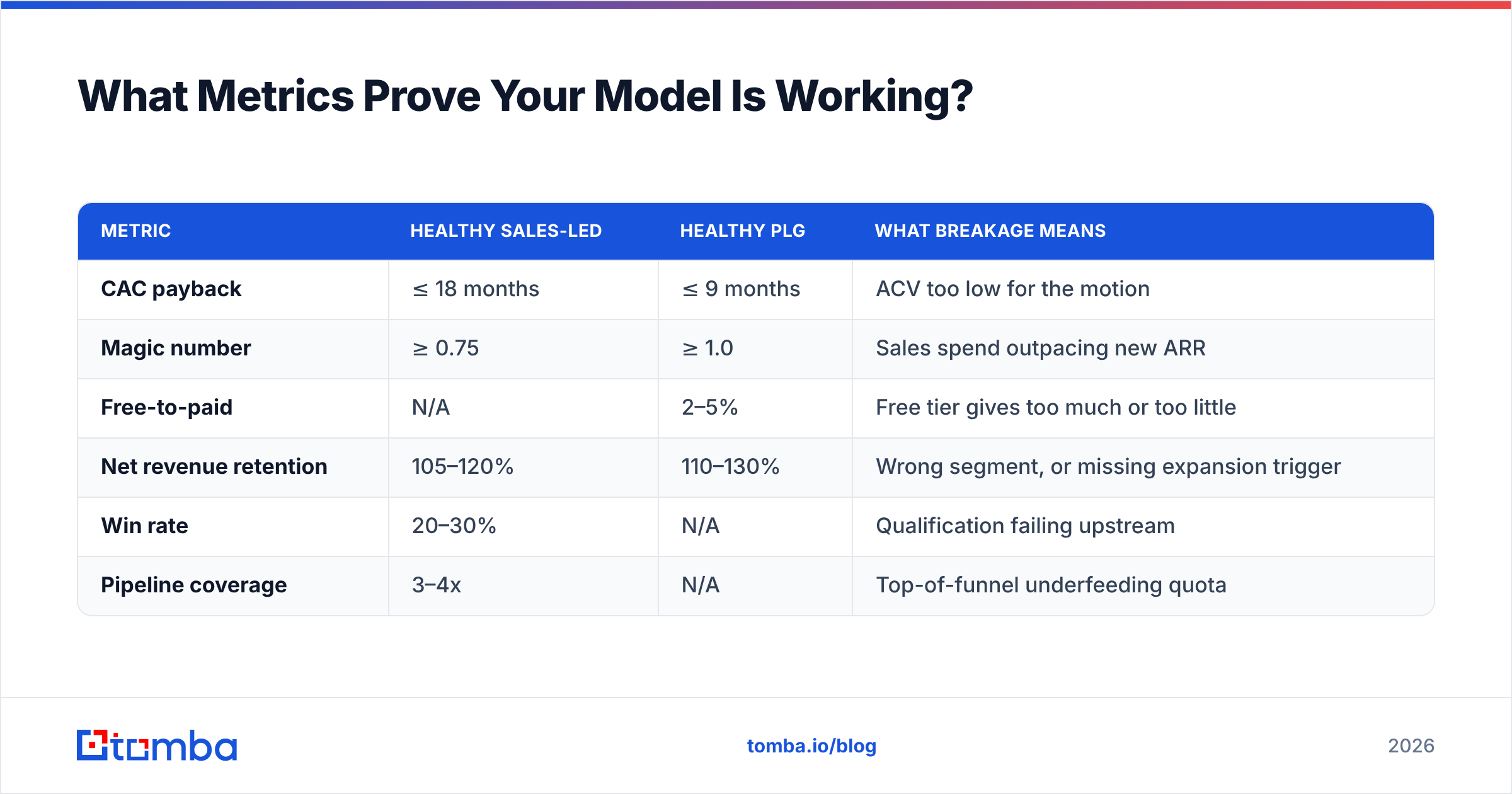
Track these four ratios by model. If they drift outside range for two consecutive quarters, the model is mismatched — not the team.
| Metric | Healthy Sales-Led | Healthy PLG | What Breakage Means |
|---|---|---|---|
| CAC payback | ≤ 18 months | ≤ 9 months | ACV too low for the motion |
| Magic number | ≥ 0.75 | ≥ 1.0 | Sales spend outpacing new ARR |
| Free-to-paid | N/A | 2–5% | Free tier gives too much or too little |
| Net revenue retention | 105–120% | 110–130% | Wrong segment, or missing expansion trigger |
| Win rate | 20–30% | N/A | Qualification failing upstream |
| Pipeline coverage | 3–4x | N/A | Top-of-funnel underfeeding quota |
Two notes on reading these. First, blended numbers hide everything — always segment by motion before you draw conclusions, or a healthy PLG track will mask a bleeding enterprise track. Second, magic number and CAC payback move in opposite directions during a model transition, which is normal for roughly two quarters and alarming after three.
Which Model Should Most B2B Companies Start With?#
Start with the model your first ten customers actually bought through, then formalize it.
Founders routinely design a model in a deck before they have evidence. The faster path: sell the first ten deals manually — founder-led, unscalable, whatever it takes — and then look at what repeated. If eight of ten came through a warm intro plus a demo, you are sales-led. If eight of ten signed up and paid without talking to you, you are product-led. If they came through an agency that resold you, you are channel-led and should double down there.
Only after that pattern is visible does tooling matter. And when it does, the sequence is boring but effective: define the ICP tightly, build a clean contact list, verify it, then run a small, specific outbound test before scaling anything. Peers in the data space — including BookYourData, a solid choice for pre-built B2B lists — solve the sourcing half well; the part teams underinvest in is the verification and enrichment layer that keeps those lists usable past week two.
Ready to Operationalize Your Go To Market Model?#
Whichever model you land on, sales-led and product-led-sales motions both bottleneck on the same thing: knowing exactly who to contact inside a target account, with an address that actually delivers.
The Tomba Email Finder handles that layer. Search by domain, name, or company to surface verified professional addresses, with confidence scoring so you know what you're sending to before you send it. The free tier gives you 25 searches per month to test against your own ICP; paid plans start at $49/mo (Starter), with Growth at $99/mo and Pro at $249/mo — see full Tomba pricing for volumes and API access. If your motion is programmatic, the Tomba API drops the same lookups directly into your enrichment pipeline or PQL routing logic.
Pick the model your math supports. Then feed it data that holds up.
Related guides#
Ready to find emails that actually work?
Join 150,000+ professionals who stopped guessing and started sending. Free credits on signup — no credit card required.
Get the Tomba newsletter
Practical outbound tactics and product updates — once every two weeks.
About the author