Go To Market Model Examples: 7 GTM Motions That Work in 2026
Seven go-to-market model examples broken down by ACV, CAC payback, headcount, and the exact failure mode of each — plus a decision framework for picking one.
TL;DR
- A go-to-market model is the repeatable path a company uses to turn a target segment into revenue: who you sell to, how they discover you, who closes, and what it costs.
- Seven models cover almost every B2B company in 2026: product-led, sales-led outbound, inbound/content-led, channel/partner-led, community-led, ecosystem/marketplace-led, and hybrid PLG-plus-sales.
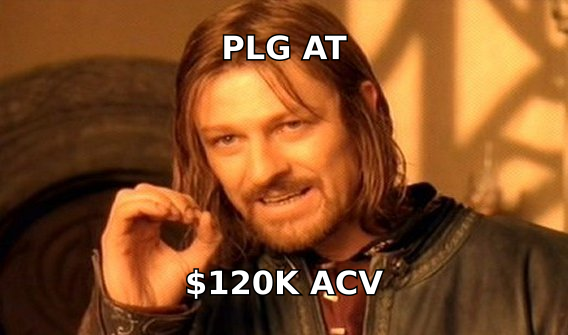
- Average contract value (ACV) is the single best predictor of which model fits. Under $2K ACV, human selling rarely pays back. Above $50K, self-serve rarely closes.
- Every model except pure PLG breaks without a contact data layer — accurate emails, verified phones, and firmographic enrichment feeding the CRM.
- Most failures are not model choice failures. They are mismatch failures: running sales-led economics on a self-serve price point, or expecting PLG to close a security-reviewed six-figure deal.
What Is a Go-To-Market Model?#
A go-to-market model is your company's answer to one question: what is the cheapest repeatable path between a stranger and a signed contract?
Think of it like a restaurant format. A food truck, a fast-casual chain, and a tasting-menu restaurant all sell food. But they differ in ticket size, staffing, real estate, and how a customer finds them. You do not staff a food truck with a sommelier, and you do not run a tasting menu off a walk-up window. The format has to match the price point. GTM models work the same way.
Every model, regardless of label, is built from the same five components:
- Segment definition — the firmographic and technographic box you draw around "who we sell to." Company size, industry, tech stack, geography, trigger event.
- Demand source — where qualified attention originates. Product signup, outbound sequence, organic search, a partner's customer base, or a community.
- Qualification logic — the rules that separate a browser from a buyer. Product usage thresholds, MQL scoring, BANT-style discovery, or partner referral vetting.
- Closing motion — self-serve checkout, inside sales, field sales, or partner-closed. This is where the bulk of your cost sits.
- Expansion mechanism — seat growth, usage growth, cross-sell, or renewal-plus-upsell. In 2026, net revenue retention carries more weight in board decks than new logo count.
Change any one of those five and you have effectively changed models. That is why "we do PLG and outbound" is not a contradiction — it is a hybrid, and it needs to be resourced as two separate systems that share a database.
What Are the Main Go-To-Market Model Examples?#
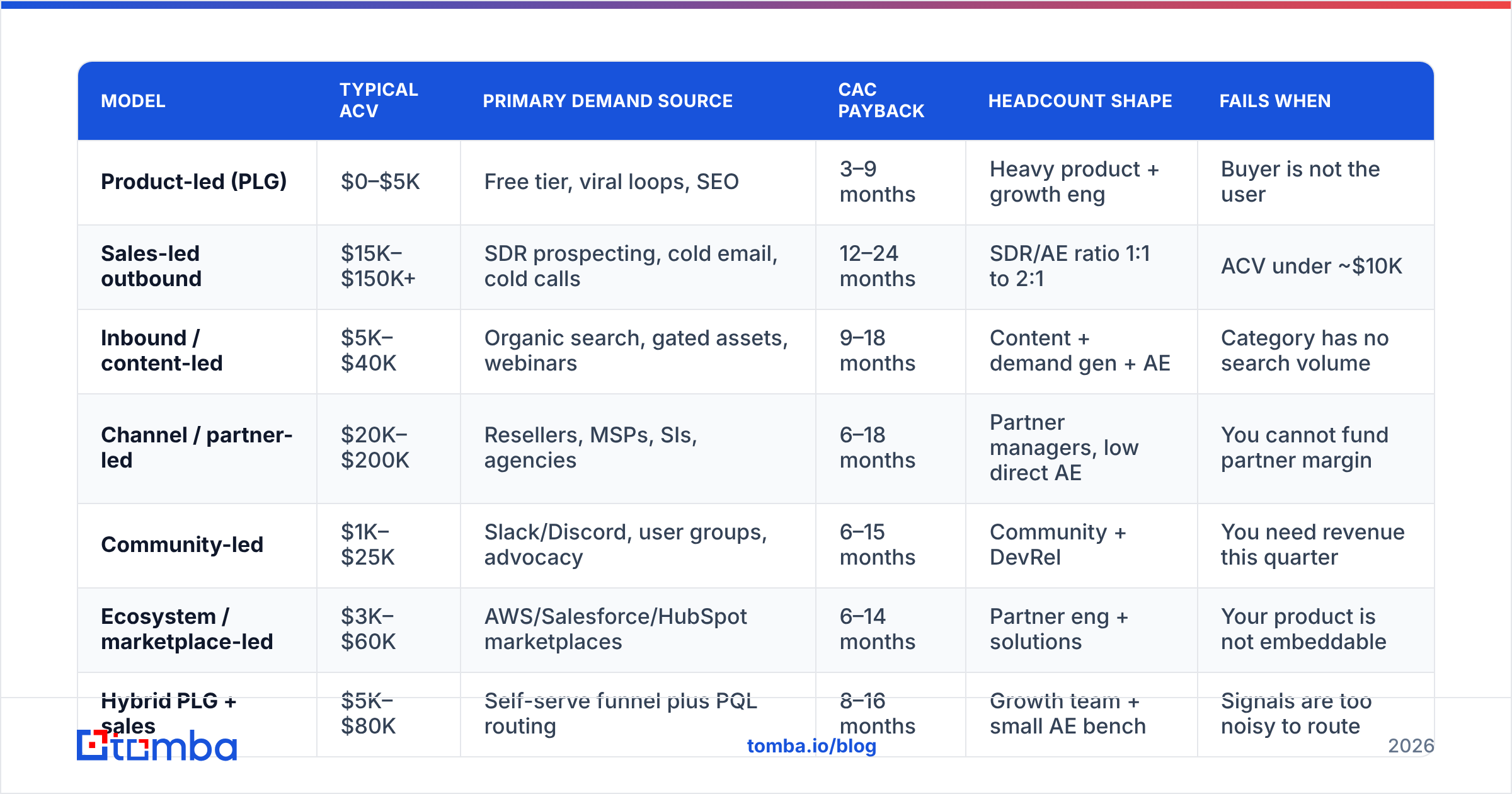
Here are the seven models with the economics that actually determine fit. The ACV bands are directional ranges observed across B2B SaaS, not laws of physics, but they are close enough to use as a first filter.
| Model | Typical ACV | Primary demand source | CAC payback | Headcount shape | Fails when |
|---|---|---|---|---|---|
| Product-led (PLG) | $0–$5K | Free tier, viral loops, SEO | 3–9 months | Heavy product + growth eng | Buyer is not the user |
| Sales-led outbound | $15K–$150K+ | SDR prospecting, cold email, cold calls | 12–24 months | SDR/AE ratio 1:1 to 2:1 | ACV under ~$10K |
| Inbound / content-led | $5K–$40K | Organic search, gated assets, webinars | 9–18 months | Content + demand gen + AE | Category has no search volume |
| Channel / partner-led | $20K–$200K | Resellers, MSPs, SIs, agencies | 6–18 months | Partner managers, low direct AE | You cannot fund partner margin |
| Community-led | $1K–$25K | Slack/Discord, user groups, advocacy | 6–15 months | Community + DevRel | You need revenue this quarter |
| Ecosystem / marketplace-led | $3K–$60K | AWS/Salesforce/HubSpot marketplaces | 6–14 months | Partner eng + solutions | Your product is not embeddable |
| Hybrid PLG + sales | $5K–$80K | Self-serve funnel plus PQL routing | 8–16 months | Growth team + small AE bench | Signals are too noisy to route |
The table hides one thing worth stating plainly: models are not equally reversible. You can bolt outbound onto a product-led company in a quarter. Rebuilding a sales-led company into a self-serve one takes two years and usually a repricing.
How Does Product-Led Growth Actually Work in Practice?#
PLG means the product does the qualifying. A user signs up without talking to anyone, hits value inside a session, and either converts on a card or generates enough usage to trigger a sales conversation.
Real examples of the mechanic, not the marketing version:
- Figma — collaboration is the acquisition channel. Inviting a teammate to view a file is both the product's core action and its distribution loop.
- Slack — a workspace becomes stickier with each added member, and pricing scales with the same variable.
- Calendly — every meeting link sent is an impression on a prospect who is, by definition, someone who books meetings.
The pattern behind all three: the act of using the product exposes it to the next buyer. If your product does not have that property, you are not doing PLG, you are doing self-serve checkout, which is a pricing decision rather than a growth model.
PLG's honest weakness is the buyer-user gap. In security software, compliance tooling, and most data infrastructure, the person who feels the pain has no signing authority. A free trial in those categories produces a champion, not a purchase order — which is exactly the point where hybrid models start to make sense.
When Is Sales-Led Outbound the Right Model?#
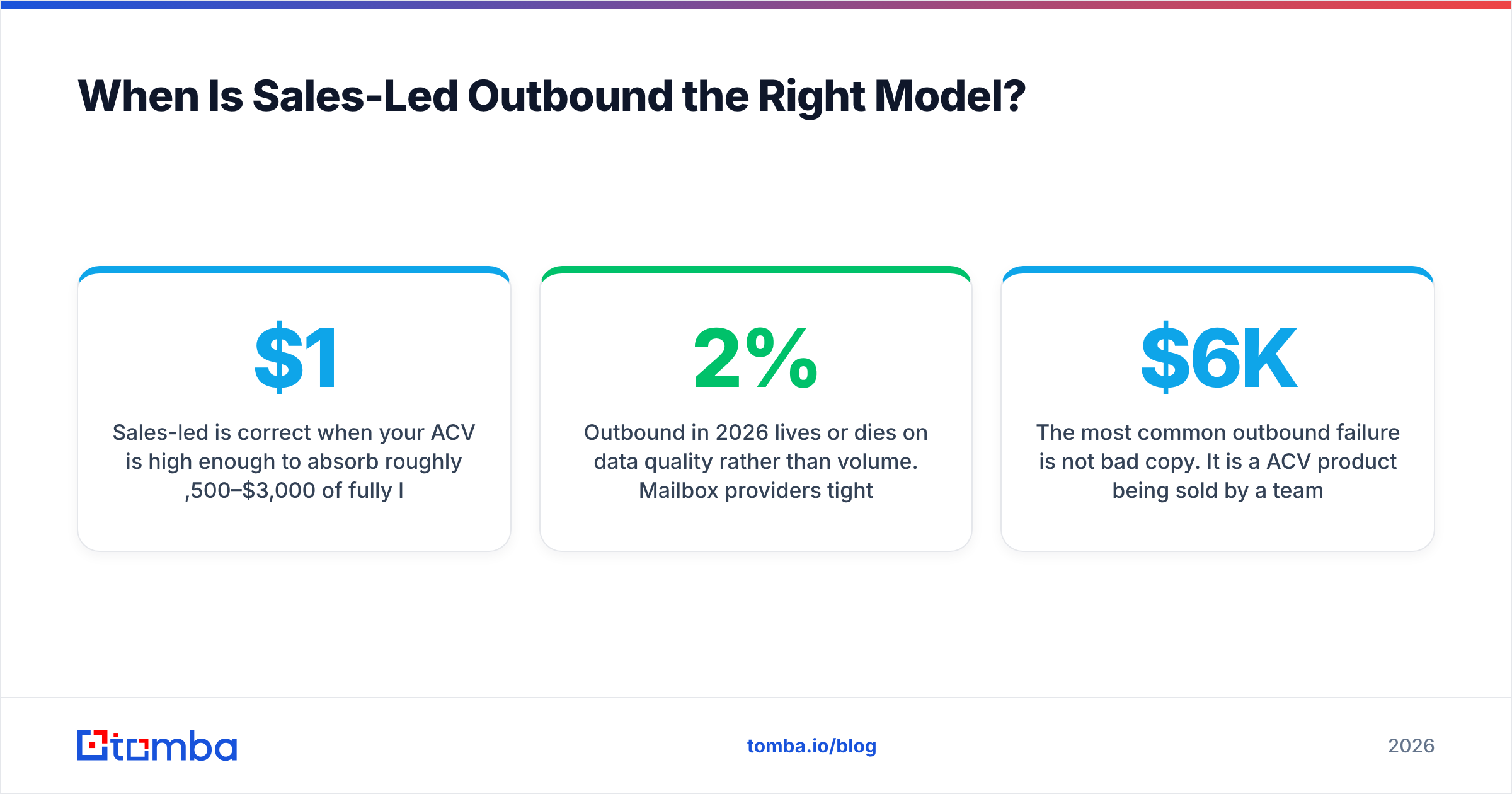
Sales-led is correct when your ACV is high enough to absorb roughly $1,500–$3,000 of fully loaded cost per closed deal in prospecting labor alone, and when your buyer will not find you on their own because they are not searching for your category.
The classic shape: an SDR team builds targeted lists, runs multi-channel sequences across email and phone, books meetings, and hands qualified opportunities to AEs who run a 30–90 day cycle. Gartner's sales research has documented for years that B2B buying groups now average six to ten stakeholders, which is why outbound is best understood as an account motion, not a contact motion.
Outbound in 2026 lives or dies on data quality rather than volume. Mailbox providers tightened bulk sender rules across 2024–2025, and the tolerance for bounce rates above 2% is effectively zero. That makes two upstream steps non-negotiable:
- Find the right contact, not any contact. Use a domain search to map the org chart at a target account before writing a single line of copy, so your sequence reaches the economic buyer and the champion rather than a generic info@ inbox.
- Verify before send. Running the list through an email verifier protects sender reputation, which is the asset that actually compounds in outbound.
The most common outbound failure is not bad copy. It is a $6K ACV product being sold by a team whose cost structure needs $30K deals.
Is Inbound and Content-Led Still Viable in 2026?#
Yes, but the shape changed. AI-generated answers absorb a meaningful share of informational queries, which flattens traffic on "what is X" content while leaving comparison, pricing, and integration queries relatively intact. Those bottom-funnel pages convert at multiples of top-funnel traffic anyway.
Practical implication: an inbound model built on volume alone is fragile. An inbound model built on the twenty queries your buyer types when they have already decided to buy something is still one of the cheapest CAC structures available. Vendors like HubSpot built entire companies on this and have spent the last few years shifting the mix toward product-led acquisition — a useful signal about where content-led alone tops out.
Inbound also pairs unusually well with enrichment. A visitor who downloads a comparison guide gives you a domain; data enrichment turns that domain into headcount, tech stack, and funding stage so routing rules can decide between a nurture sequence and a same-day AE call.
What Do Channel, Community, and Ecosystem Models Look Like?#
These three get bundled together because they share one trait: someone else owns the relationship, and you rent it.
Channel/partner-led. Resellers, managed service providers, and systems integrators sell your product into accounts you would never reach. You trade 15–35% margin for access and credibility. It works when your product needs implementation labor you do not want to hire. It fails when your gross margin cannot fund partner economics, or when partners have no reason to prioritize you over the other eleven vendors in their catalog.
Community-led. A group of practitioners becomes the top of your funnel. Developer tools do this best because the audience already congregates. The honest tradeoff is timeline: communities take 12–24 months to produce measurable pipeline, so they function as a compounding asset rather than a quarterly lever.
Ecosystem/marketplace-led. You list inside a platform your customers already pay for — Salesforce AppExchange, the HubSpot marketplace, AWS Marketplace. AWS Marketplace deals in particular can draw down committed cloud spend, which removes budget friction entirely. This model requires real engineering investment in the integration surface, and your ceiling is capped by the platform's own growth.
What Does a Hybrid PLG-Plus-Sales Model Look Like?#
Hybrid is where most successful B2B companies land by Series B, and it is the model with the highest operational overhead.
The mechanic is product-qualified lead (PQL) routing. Self-serve signups flow in freely. A scoring layer watches for signals — seat count crossing a threshold, an API key generated, three users from the same domain, a pricing page visit from an enterprise IP — and promotes a subset to a human. Everyone else stays in automated nurture.
Two failure modes to plan around:
- Signal noise. If your PQL definition promotes 40% of signups, you have not built routing, you have built an expensive lead list. Tighten until the AE-accepted rate exceeds 60%.
- Compensation conflict. When an AE can be paid on an account that would have self-converted anyway, you are buying revenue you already had. Cap or exclude self-serve-eligible accounts from quota credit.
Hybrid also needs the strongest data layer of any model, because a domain arriving from a self-serve signup carries almost no context. Enrichment has to fill in company size, industry, and the other decision-makers at that account before routing logic can do anything useful. This is the point where teams stop scraping manually and move to an email finder API that resolves contacts inside the signup workflow itself.
How Do You Choose Between These Go-To-Market Models?#
Run these five checks in order. The first one that returns a hard answer usually decides it.
- What is your ACV? Under $2K, human selling does not pay back and you need self-serve. Over $50K, self-serve does not close and you need people. Between those, you have a real choice.
- Who feels the pain versus who signs? If they are the same person, PLG is on the table. If they are three levels apart, you need a sales motion regardless of price.
- Does your buyer search for your category? If monthly search volume for your problem is negligible, inbound cannot be your primary source. Outbound or partners will be.
- Does using the product expose it to others? If yes, you have a viral loop worth engineering around. If no, do not model PLG assumptions into your plan.
- How long is your runway? Community and ecosystem motions pay off in year two. Outbound pays off in quarter two at a higher cost. Match the model to the cash you have, not the model you admire.
Peer review helps here. Category pages on G2 show which competitors are winning self-serve versus enterprise deals, and the pricing pages of five direct competitors will tell you more about viable models in your category than any framework will.
What Data Layer Does Every GTM Model Need?#
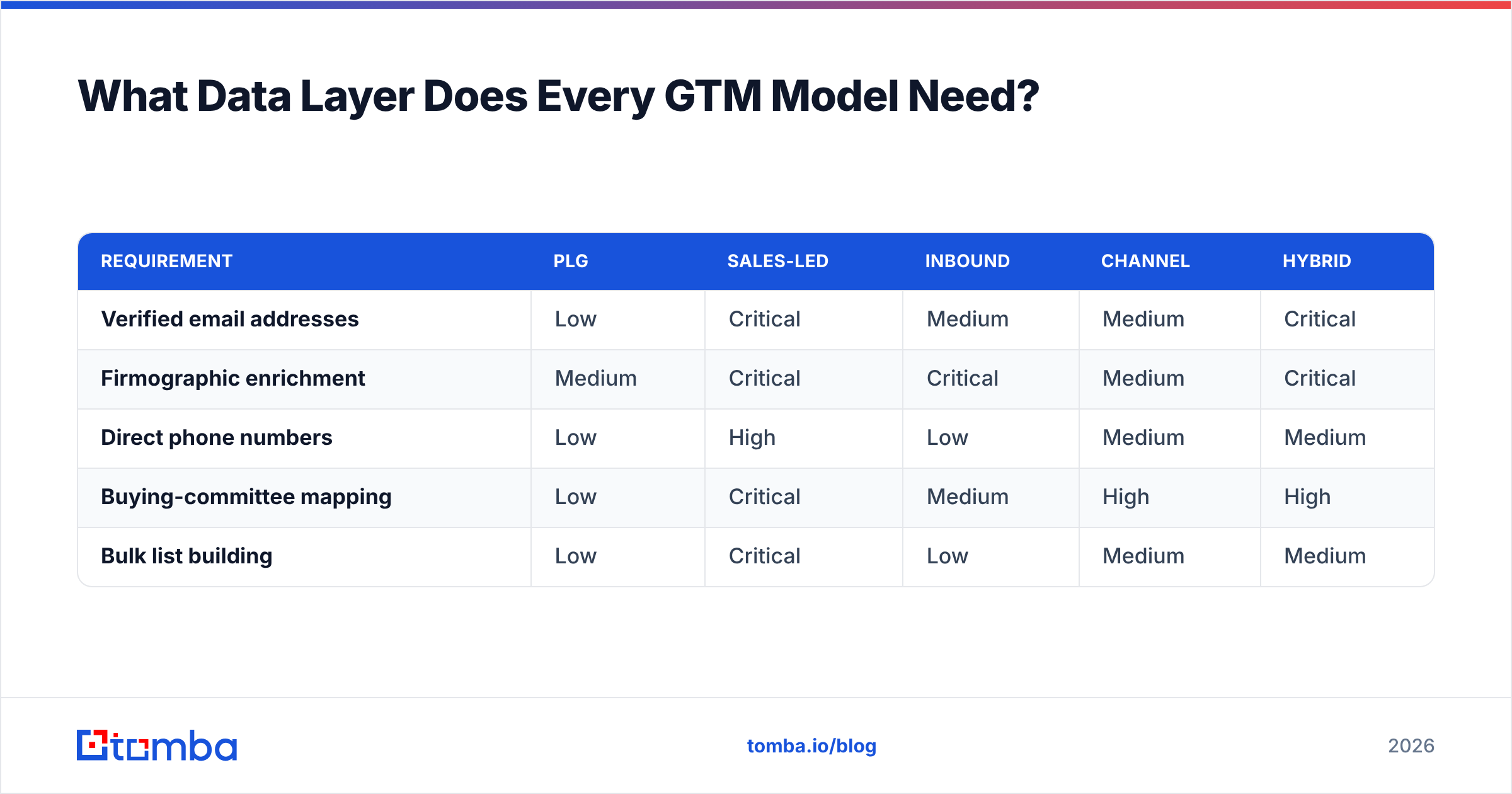
Strip away the labels and every model except pure viral PLG depends on the same three primitives: knowing which accounts to target, knowing who inside them to contact, and knowing the contact details are real.
| Requirement | PLG | Sales-led | Inbound | Channel | Hybrid |
|---|---|---|---|---|---|
| Verified email addresses | Low | Critical | Medium | Medium | Critical |
| Firmographic enrichment | Medium | Critical | Critical | Medium | Critical |
| Direct phone numbers | Low | High | Low | Medium | Medium |
| Buying-committee mapping | Low | Critical | Medium | High | High |
| Bulk list building | Low | Critical | Low | Medium | Medium |
Providers differ in how they solve this. Some, like BookYourData, lead with a large pre-built contact database you buy by the record — a good fit when you want volume in one purchase. Others resolve contacts on demand against live sources. Tomba sits in the second camp, with pattern detection and SMTP-level verification behind the email finder, plus a bulk email finder when a campaign needs thousands of rows at once. Which one is right depends on whether your motion is campaign-shaped or workflow-shaped. Teams running both usually keep one of each.
The signal to watch is bounce rate. Above 3%, your model choice stops mattering because your messages are not being delivered. Below 1%, you can attribute results to the motion rather than the plumbing.
Which Model Should You Start With?#
If you are pre-product-market fit, start with founder-led outbound regardless of your eventual model. It is the only motion that produces conversations fast enough to correct your positioning, and it costs nothing but time. Layer the durable model on top once you can predict which accounts say yes.
If you already have a working motion, the highest-leverage move is usually not adding a new model. It is fixing the data underneath the one you have — deduplicating the CRM, verifying the list, and enriching accounts so routing rules fire on facts instead of guesses.
Whichever go-to-market model you land on, the contact layer is the part you cannot skip. Start with the Tomba Email Finder: 25 free searches per month to test accuracy against your own target accounts, then $49/mo on Starter, $99/mo on Growth, and $249/mo on Pro as volume grows. Run fifty of your actual target companies through it, check the bounce rate, and let the data decide whether your model is ready to scale.
Related guides#
Ready to find emails that actually work?
Join 150,000+ professionals who stopped guessing and started sending. Free credits on signup — no credit card required.
Get the Tomba newsletter
Practical outbound tactics and product updates — once every two weeks.
About the author