Go To Market Objectives: How to Set GTM Goals That Work
Most GTM plans fail because the objectives were vague from day one. Here's how to write go to market objectives with real numbers, owners, and kill criteria — plus a framework you can copy this quarter.

TL;DR
- A go to market objective is not "grow revenue." It's a measurable outcome with a number, a deadline, an owner, and a kill criterion.
- Most GTM plans die because they set activity targets (emails sent, demos booked) instead of outcome targets (pipeline created, payback period, win rate by segment).
- Use a three-layer structure: one North Star objective → 3-5 supporting objectives → leading indicators per channel. Anything beyond that is noise.
- Your objectives are only as good as your data. If contact accuracy is 60%, a "500 SQLs" target is fiction — you're funding bounce rates.
- Set review cadence before launch: weekly on leading indicators, monthly on lagging, quarterly on the objective itself.
What are go to market objectives?#
Go to market objectives are the specific, measurable outcomes a company commits to when launching a product, entering a segment, or expanding into a new geography. They define what "success" means before the first dollar of budget is spent.
Think of it like a flight plan. "Fly west" is a direction. "Land at SFO at 14:20 with 40 minutes of reserve fuel" is an objective — it tells you when you're off course, and it tells you when to divert. Most GTM plans are written as directions.
The technical definition: a GTM objective binds four things together.
- A target metric — pipeline created, net-new ARR, logo count, activation rate, payback period. One number, not a dashboard.
- A quantified threshold — $2.4M in qualified pipeline, not "significant pipeline."
- A time boundary — by end of Q2 2026, measured on the last business day.
- A single accountable owner — a named person, not "marketing and sales."
- A kill criterion — the condition under which you stop, pivot, or reallocate budget. Almost nobody writes this down, and it's the one that saves the most money.
- A data dependency — what inputs (list size, accuracy rate, ad inventory) the objective assumes are available.
If any of the six is missing, you have an aspiration. Gartner's research on go-to-market strategy consistently finds that misalignment between commercial teams — not bad tactics — is the top cause of launch underperformance. Misalignment is usually just two teams working from two different definitions of the same objective.
Why do most go to market objectives fail?#
They fail for four reasons, and all four are visible before launch.
They measure activity instead of outcomes. "Send 10,000 cold emails in Q1" is an input, and it can be hit perfectly while producing zero revenue. Outcome objectives force honesty. Input objectives let a team look busy while the business stalls.
They're set at the wrong altitude. A single company-wide objective ("$5M new ARR") gives no team a decision rule. Fifteen objectives give every team an excuse. Three to five supporting objectives under one North Star is the range where people can actually prioritize.
They assume data that doesn't exist. This is the quiet killer. A team commits to 400 SQLs from outbound, then discovers their contact list is 45% stale — wrong titles, departed employees, catch-all domains that swallow every send. The objective was never achievable at the accuracy level the data supported. Running your list through an email verifier before the plan is signed off changes the math on what's realistic.
They have no kill criterion. Budget keeps flowing into a dead channel for two more quarters because nobody defined "dead" in advance. Write it before launch: "If CAC payback on paid social exceeds 18 months by week 8, we reallocate to partner-led."
What does a good GTM objective framework look like?#
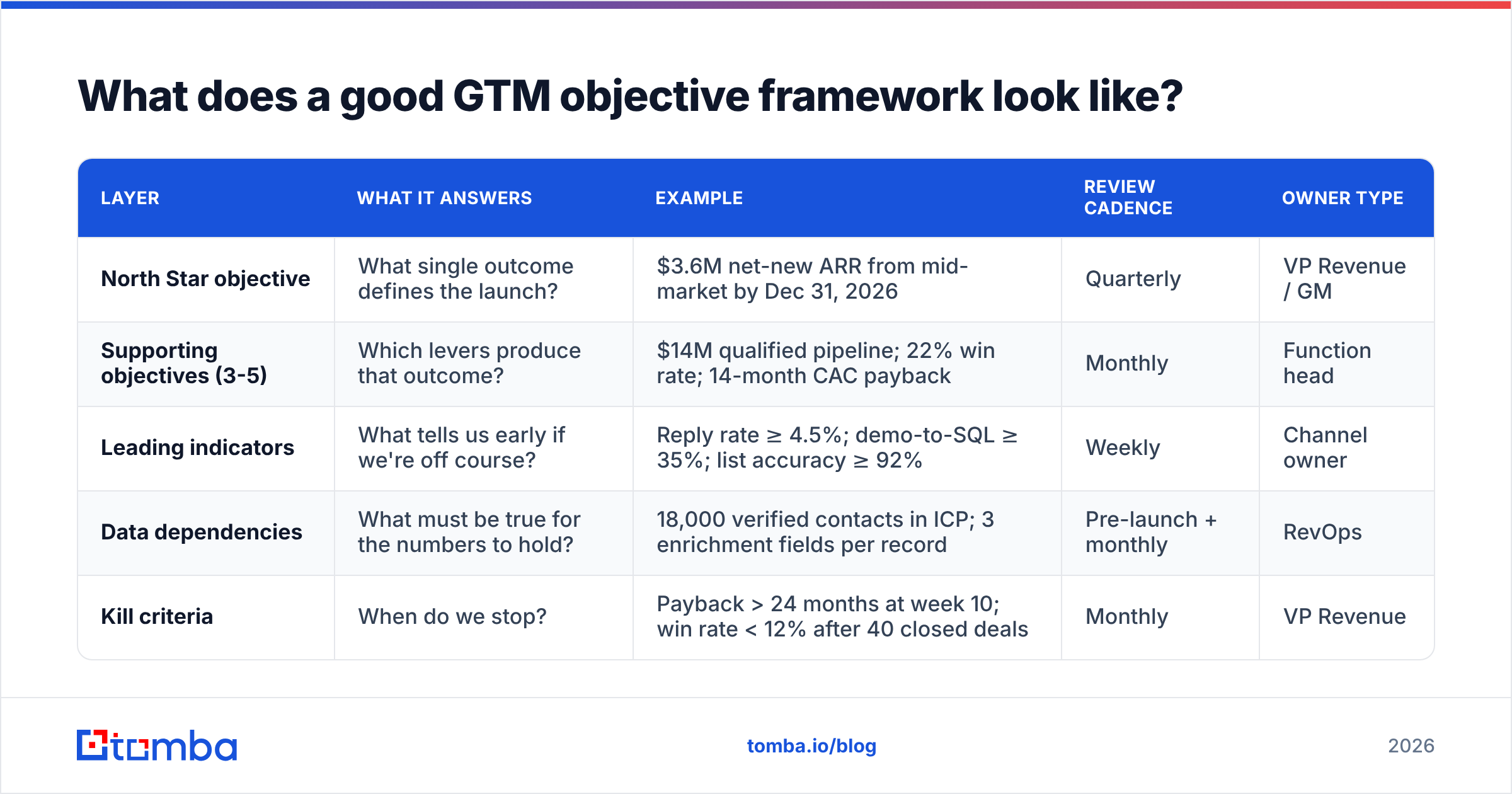
Here's the three-layer structure that survives contact with a real quarter.
| Layer | What it answers | Example | Review cadence | Owner type |
|---|---|---|---|---|
| North Star objective | What single outcome defines the launch? | $3.6M net-new ARR from mid-market by Dec 31, 2026 | Quarterly | VP Revenue / GM |
| Supporting objectives (3-5) | Which levers produce that outcome? | $14M qualified pipeline; 22% win rate; 14-month CAC payback | Monthly | Function head |
| Leading indicators | What tells us early if we're off course? | Reply rate ≥ 4.5%; demo-to-SQL ≥ 35%; list accuracy ≥ 92% | Weekly | Channel owner |
| Data dependencies | What must be true for the numbers to hold? | 18,000 verified contacts in ICP; 3 enrichment fields per record | Pre-launch + monthly | RevOps |
| Kill criteria | When do we stop? | Payback > 24 months at week 10; win rate < 12% after 40 closed deals | Monthly | VP Revenue |
The discipline is in the third and fourth rows. Leading indicators are the only layer you can act on inside a quarter — lagging metrics tell you what already happened. And data dependencies are what turn an objective from a wish into a plan, because they force someone to check whether the raw material exists.
How do you turn a GTM objective into numbers?#
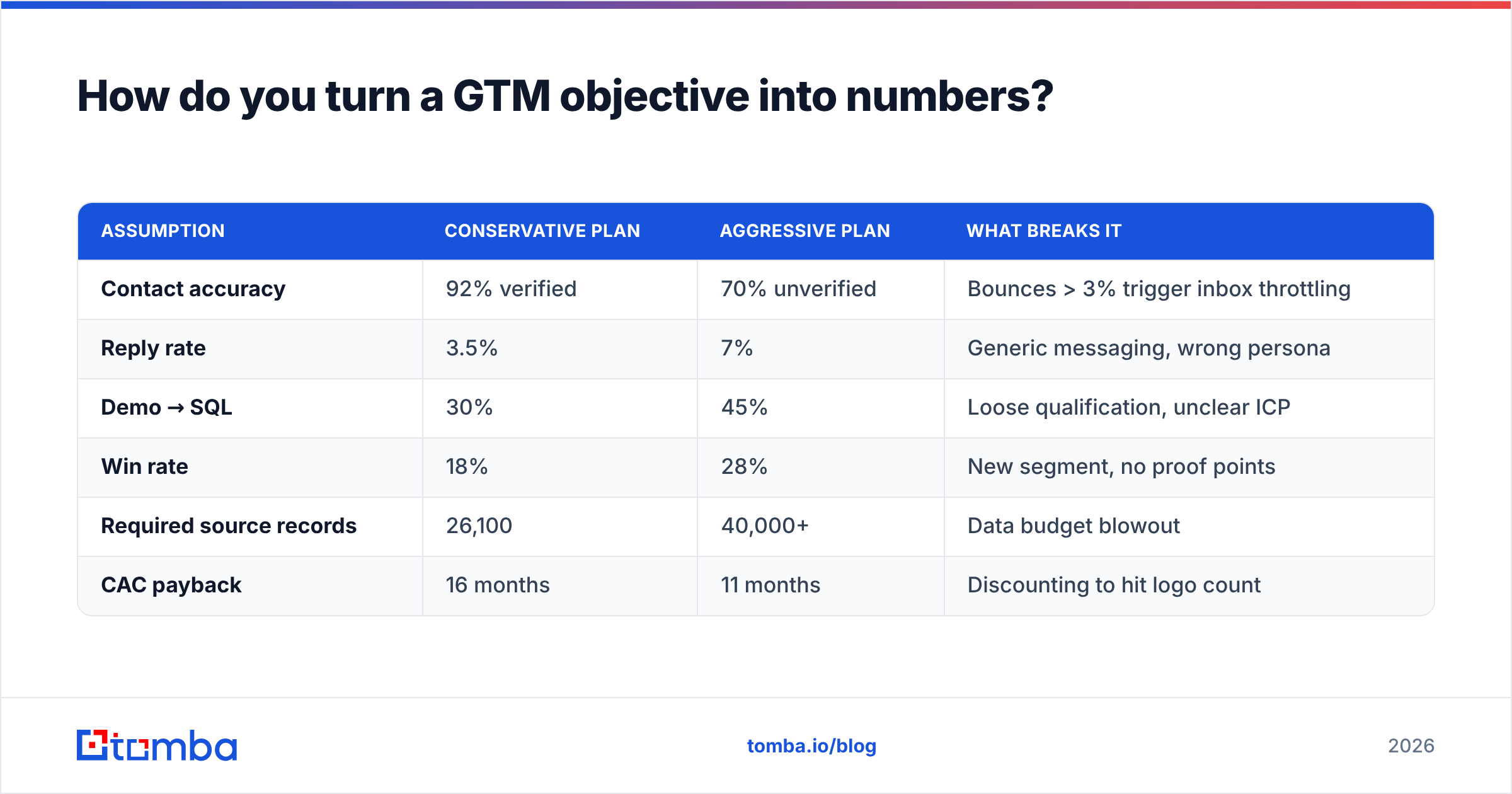
Work backwards from revenue, and be brutal about conversion assumptions.
Start with the target: $3.6M net-new ARR. Average contract value is $24K, so you need 150 new customers. At a 22% win rate, that's 682 qualified opportunities. If 35% of demos become qualified opportunities, you need 1,949 demos. At an 8% demo-booking rate from qualified conversations, you need roughly 24,000 meaningful touches.
Now the part most plans skip: how many contacts do you need to source to generate 24,000 meaningful touches? If your data is 92% deliverable, you need about 26,100 records. If it's 60% deliverable — which is common for scraped or aging lists — you need 40,000, and a third of your sends are landing in bounce territory, dragging your sender reputation down with them.
That single accuracy variable moves your required list size by 50% and your deliverability risk by a lot more. It belongs in the objective, not in a footnote.
| Assumption | Conservative plan | Aggressive plan | What breaks it |
|---|---|---|---|
| Contact accuracy | 92% verified | 70% unverified | Bounces > 3% trigger inbox throttling |
| Reply rate | 3.5% | 7% | Generic messaging, wrong persona |
| Demo → SQL | 30% | 45% | Loose qualification, unclear ICP |
| Win rate | 18% | 28% | New segment, no proof points |
| Required source records | 26,100 | 40,000+ | Data budget blowout |
| CAC payback | 16 months | 11 months | Discounting to hit logo count |
Build the conservative column first. If the plan only works in the aggressive column, it isn't a plan.
Which metrics belong in your GTM objectives?#
Not all metrics deserve objective status. Use this filter: can a team change it inside one quarter, and does it move revenue? If no to either, it's a report, not an objective.
- Qualified pipeline created — the single best mid-funnel objective. It's early enough to influence and close enough to revenue to matter.
- CAC payback period — better than raw CAC because it accounts for pricing and gross margin. Under 18 months is healthy for most B2B SaaS; under 12 is strong.
- Win rate by segment — aggregate win rate hides everything. Split by segment, and you'll usually find one segment carrying the average while another burns rep time.
- Time to first value — for product-led motions, this predicts retention better than signup volume.
- Pipeline coverage ratio — target 3-4x of quota. Below 3x, the quarter is already lost and nobody has said it out loud yet.
- Data freshness rate — the percentage of your CRM contacts verified in the last 90 days. Boring, unglamorous, and it silently caps every other number on this list.

That last one deserves a paragraph. HubSpot's research on CRM data decay puts B2B contact data decay at roughly 22-30% per year — people change jobs, companies rebrand, domains migrate. If you set a 2026 objective against a contact database last cleaned in 2024, roughly a quarter of your addressable list doesn't exist anymore. Continuous data enrichment isn't a nice-to-have in that context; it's the difference between your model and reality.
How do go to market objectives differ by motion?#
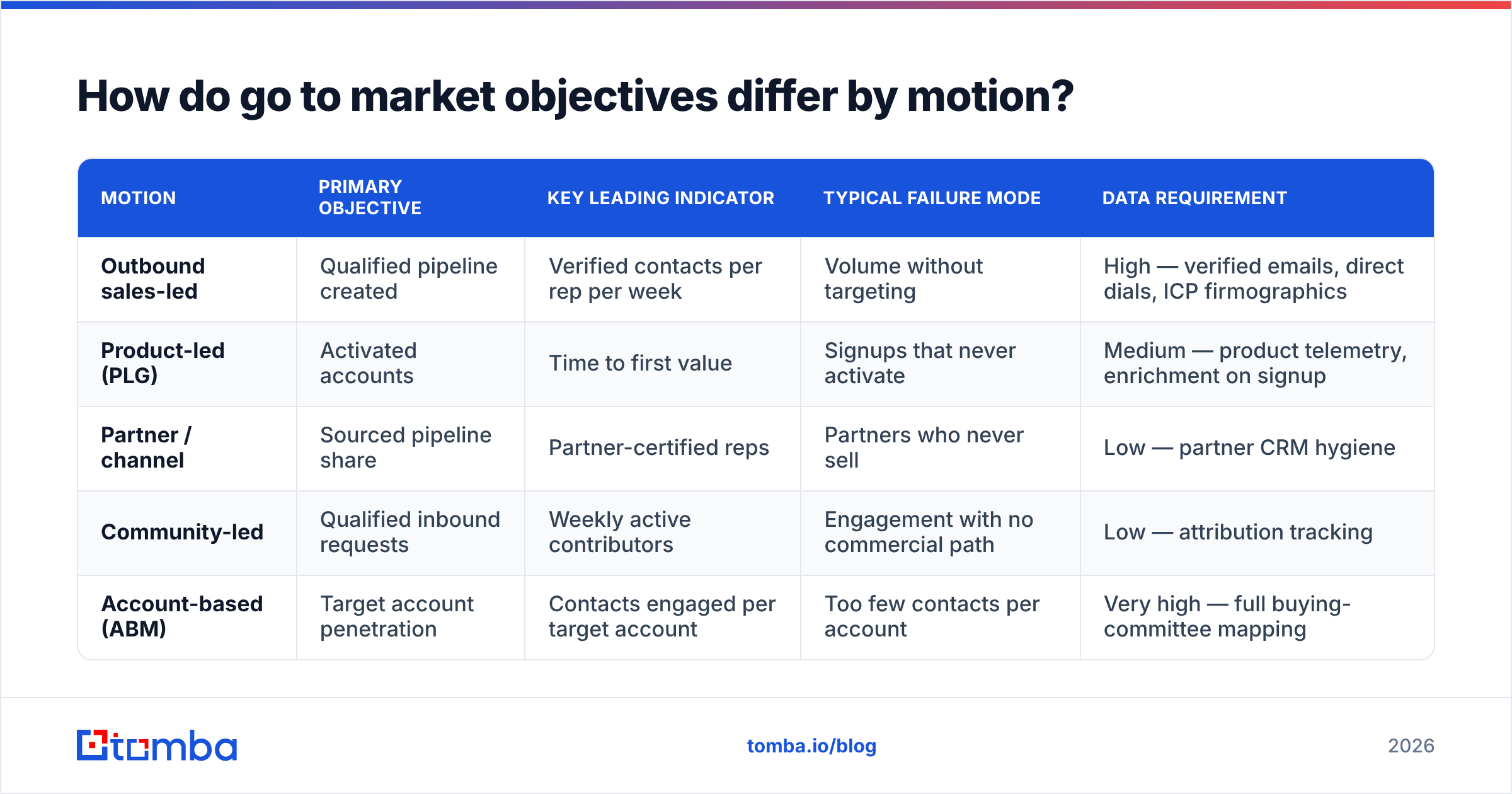
The framework holds, but the leading indicators change completely depending on how you sell.
| Motion | Primary objective | Key leading indicator | Typical failure mode | Data requirement |
|---|---|---|---|---|
| Outbound sales-led | Qualified pipeline created | Verified contacts per rep per week | Volume without targeting | High — verified emails, direct dials, ICP firmographics |
| Product-led (PLG) | Activated accounts | Time to first value | Signups that never activate | Medium — product telemetry, enrichment on signup |
| Partner / channel | Sourced pipeline share | Partner-certified reps | Partners who never sell | Low — partner CRM hygiene |
| Community-led | Qualified inbound requests | Weekly active contributors | Engagement with no commercial path | Low — attribution tracking |
| Account-based (ABM) | Target account penetration | Contacts engaged per target account | Too few contacts per account | Very high — full buying-committee mapping |
ABM is the most data-hungry of the five. The whole motion depends on reaching six to ten people inside one account, which means you need the full org chart, not just one VP. A domain search across a target account gives you the coverage picture in one pass instead of hunting contacts one at a time — and coverage is exactly what your objective is measuring.
How often should you review GTM objectives?#
Three cadences, three different questions.
Weekly — leading indicators only. Reply rates, meeting counts, activation, list health. The question is "are our inputs on track?" Nobody should be debating strategy in this meeting. Fifteen minutes, one dashboard, exceptions only.
Monthly — supporting objectives. Pipeline created, conversion between stages, payback trending. The question is "are our assumptions holding?" This is where you catch a broken conversion rate before it eats the quarter, and where kill criteria get checked against reality.
Quarterly — the North Star objective. The question is "is this the right objective at all?" Markets move, competitors launch, a segment that looked wide open closes. Changing the objective quarterly is fine; changing it weekly means you never had one.
One rule that saves teams from themselves: never change an objective and its measurement in the same meeting. If you lower the target, keep the metric. If you change the metric, keep the target. Otherwise you lose the ability to compare quarters, and every historical trend becomes uninterpretable.
What tools support GTM objective execution?#
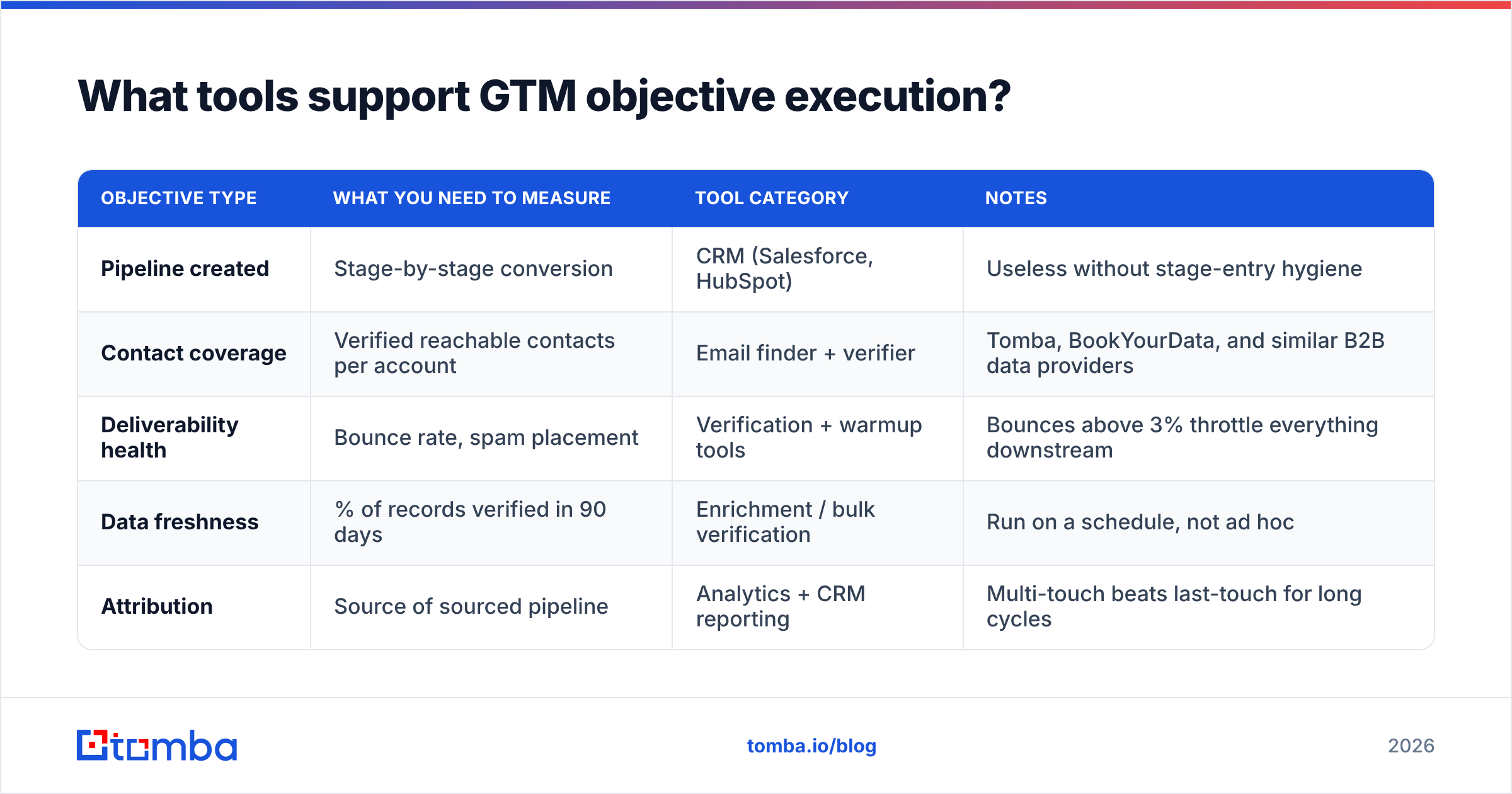
Your objectives create data requirements, and the tooling stack should map to them directly rather than to vendor categories.
| Objective type | What you need to measure | Tool category | Notes |
|---|---|---|---|
| Pipeline created | Stage-by-stage conversion | CRM (Salesforce, HubSpot) | Useless without stage-entry hygiene |
| Contact coverage | Verified reachable contacts per account | Email finder + verifier | Tomba, BookYourData, and similar B2B data providers |
| Deliverability health | Bounce rate, spam placement | Verification + warmup tools | Bounces above 3% throttle everything downstream |
| Data freshness | % of records verified in 90 days | Enrichment / bulk verification | Run on a schedule, not ad hoc |
| Attribution | Source of sourced pipeline | Analytics + CRM reporting | Multi-touch beats last-touch for long cycles |
For the contact-coverage row specifically, the two things that matter are accuracy and cost per usable record — not headline database size. A provider claiming 500 million records is irrelevant if only 40% of your ICP slice is deliverable. Tomba pricing starts with a free tier at 25 searches per month, then $49/mo for Starter, $99/mo for Growth, and $249/mo for Pro, which makes it straightforward to model cost per verified contact against the list size your objective actually requires. BookYourData takes a pay-as-you-go approach that suits one-off campaign lists rather than continuous enrichment — worth comparing if your GTM motion is burst-based rather than always-on.
Whichever you pick, put the cost per verified contact into your objective math. It's a line item, and it scales linearly with your pipeline target.
What does a finished GTM objective look like?#
Here's the full shape, using a mid-market expansion as the example.
North Star: Generate $3.6M net-new ARR from US mid-market (200-1,000 employees) by December 31, 2026. Owner: VP Revenue.
Supporting objectives:
- Pipeline: $14.4M qualified pipeline created (4x coverage). Owner: Demand Gen Lead. Monthly.
- Efficiency: CAC payback ≤ 16 months blended. Owner: RevOps. Monthly.
- Conversion: Win rate ≥ 22% on mid-market opportunities. Owner: Sales Director. Monthly.
- Coverage: 4+ verified contacts in each of 1,200 target accounts. Owner: RevOps. Monthly.
Leading indicators (weekly): outbound reply rate ≥ 4%, demo-to-SQL ≥ 32%, list bounce rate ≤ 2%, contact verification rate ≥ 92%.
Kill criteria: If pipeline coverage is below 2.5x at end of Q2, reallocate 40% of paid budget to partner-led. If mid-market win rate is below 14% after 40 closed opportunities, pause segment expansion and re-run ICP analysis.
Data dependencies: 1,200 target accounts mapped with buying committee; minimum 4,800 verified contacts sourced and re-verified quarterly; enrichment fields (title, seniority, tech stack) present on ≥ 85% of records.
Notice how much of it is unglamorous. That's the point. A GTM objective that reads like a marketing headline won't survive week six. One that reads like an engineering spec will.
Where should you start?#
Start with the data dependency row, because it's the one you can validate today and it constrains everything above it. Pull a sample of 500 contacts from your target segment, verify them, and measure your real accuracy rate. If it's 92%, your model holds. If it's 61%, every downstream number in your plan needs to be rebuilt before you commit to it in a board deck.
That single check — done in an afternoon — prevents the most expensive failure mode in GTM planning: committing to a pipeline number your list can't physically produce.
The Tomba Email Finder is built for exactly this step. Search by domain, name, or company to build verified contact lists for your target accounts, check coverage across the full buying committee before you commit to a number, and re-verify on a schedule so your data-freshness indicator stays green all quarter. Start on the free tier with 25 searches to sanity-check your accuracy assumption, then scale into Starter at $49/mo once you know what your objective actually requires.
Set the objective. Verify the data behind it. Then run the quarter.
Related guides#
Ready to find emails that actually work?
Join 150,000+ professionals who stopped guessing and started sending. Free credits on signup — no credit card required.
Get the Tomba newsletter
Practical outbound tactics and product updates — once every two weeks.
About the author