Go To Market Plan Sample: A Full 2026 Template You Can Copy
A complete go-to-market plan sample built around a real B2B SaaS launch, including the ICP table, motion choice, channel budget, forecast math, and the 90-day sequence most templates leave out.

TL;DR
- A go-to-market plan is nine sections: market, ICP, positioning, pricing, motion, channels, budget, forecast, and a 90-day sequence. Anything longer is a deck, not a plan.
- The sample below is filled in for a fictional $99/mo mid-market SaaS so you can see real numbers instead of empty prompts.
- Your motion choice (PLG, sales-led, hybrid) determines the rest of the plan. Pick it in section 5, not at the end.
- Most GTM plans fail on data quality, not strategy. A perfect ICP is worthless if 30% of your contact list bounces.
- Budget rule of thumb: hold CAC payback under 12 months on the primary motion, and cut any channel that misses it twice in a row.
What Is a Go-To-Market Plan, and What Goes In One?#
A go-to-market plan is the document that says who you are selling to, why they buy, how you reach them, what it costs, and what you expect back. That is it. It is not a brand deck, not a product roadmap, and not a 40-slide board narrative.
The useful mental model: a GTM plan is a flight plan, not a travel brochure. A brochure describes the destination. A flight plan lists the route, the fuel load, the checkpoints, and what happens if you miss one. If your document does not include numbers you can be wrong about, it is a brochure.
Gartner's sales research has consistently found that most B2B buying groups now involve six to ten stakeholders, which is why the ICP section below covers buying committees, not just job titles. And the general definition of go to market is broad enough to be useless on its own, which is exactly why teams need a filled-in sample rather than a definition.
Here is the structure this go to market plan sample follows:
- Market and problem — the size of the pain, who has it, and what they do today instead of buying you.
- ICP and segments — firmographics, technographics, trigger events, and the buying committee. One table, not three paragraphs.
- Positioning and messaging — the one-sentence claim, the three proof points, and the competitor you displace.
- Pricing and packaging — tiers, the land price, the expansion path, and the discount floor.
- GTM motion — product-led, sales-led, or hybrid, and the headcount each implies.
- Channels and budget — where the pipeline actually comes from, with a dollar figure per channel.
- Forecast — leads, conversion, ACV, CAC payback, and the sanity check on all four.
- 90-day launch sequence — week-by-week, with owners.
- Kill criteria — what result makes you stop a channel, a segment, or the whole motion.
What Does the Filled-In Go To Market Plan Sample Look Like?#
The example company: Flowdesk, a workflow automation tool for mid-market operations teams. Seat-based, $99/mo starter, self-serve signup available, average deal $14k ARR when sales-assisted.
Section 1 — Market and problem. Mid-market ops teams (200-2,000 employees) run approvals across email and spreadsheets. The status quo competitor is not another vendor, it is a Google Sheet plus a Slack channel. Estimated serviceable market in North America and EMEA: 46,000 companies.
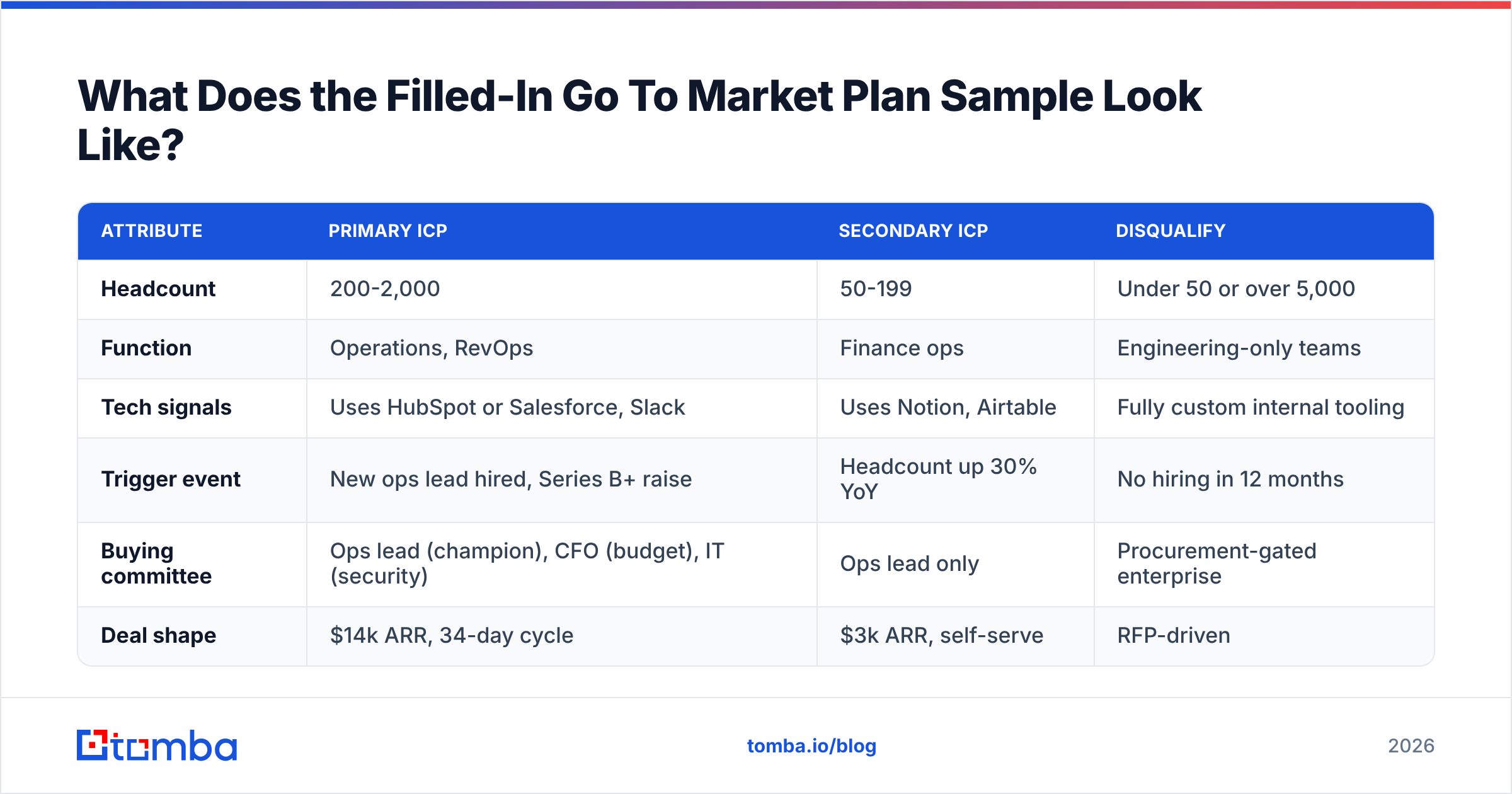
Section 2 — ICP and segments.
| Attribute | Primary ICP | Secondary ICP | Disqualify |
|---|---|---|---|
| Headcount | 200-2,000 | 50-199 | Under 50 or over 5,000 |
| Function | Operations, RevOps | Finance ops | Engineering-only teams |
| Tech signals | Uses HubSpot or Salesforce, Slack | Uses Notion, Airtable | Fully custom internal tooling |
| Trigger event | New ops lead hired, Series B+ raise | Headcount up 30% YoY | No hiring in 12 months |
| Buying committee | Ops lead (champion), CFO (budget), IT (security) | Ops lead only | Procurement-gated enterprise |
| Deal shape | $14k ARR, 34-day cycle | $3k ARR, self-serve | RFP-driven |
Section 3 — Positioning. "Flowdesk replaces the spreadsheet-plus-Slack approval process with an audit-ready workflow your CFO will actually sign off on." Three proof points: setup in one afternoon, SOC 2 report available, native two-way sync with your CRM. Primary displacement target: manual process. Secondary: a legacy BPM suite nobody enjoys.
Section 4 — Pricing. Starter $99/mo (up to 10 seats), Team $399/mo, Business $1,200/mo, Enterprise custom. Land on Team, expand to Business by adding departments. Discount floor: 15% for annual prepay, 25% absolute maximum with VP approval. No unlimited-seat deals in year one.
Which GTM Motion Should You Pick?#
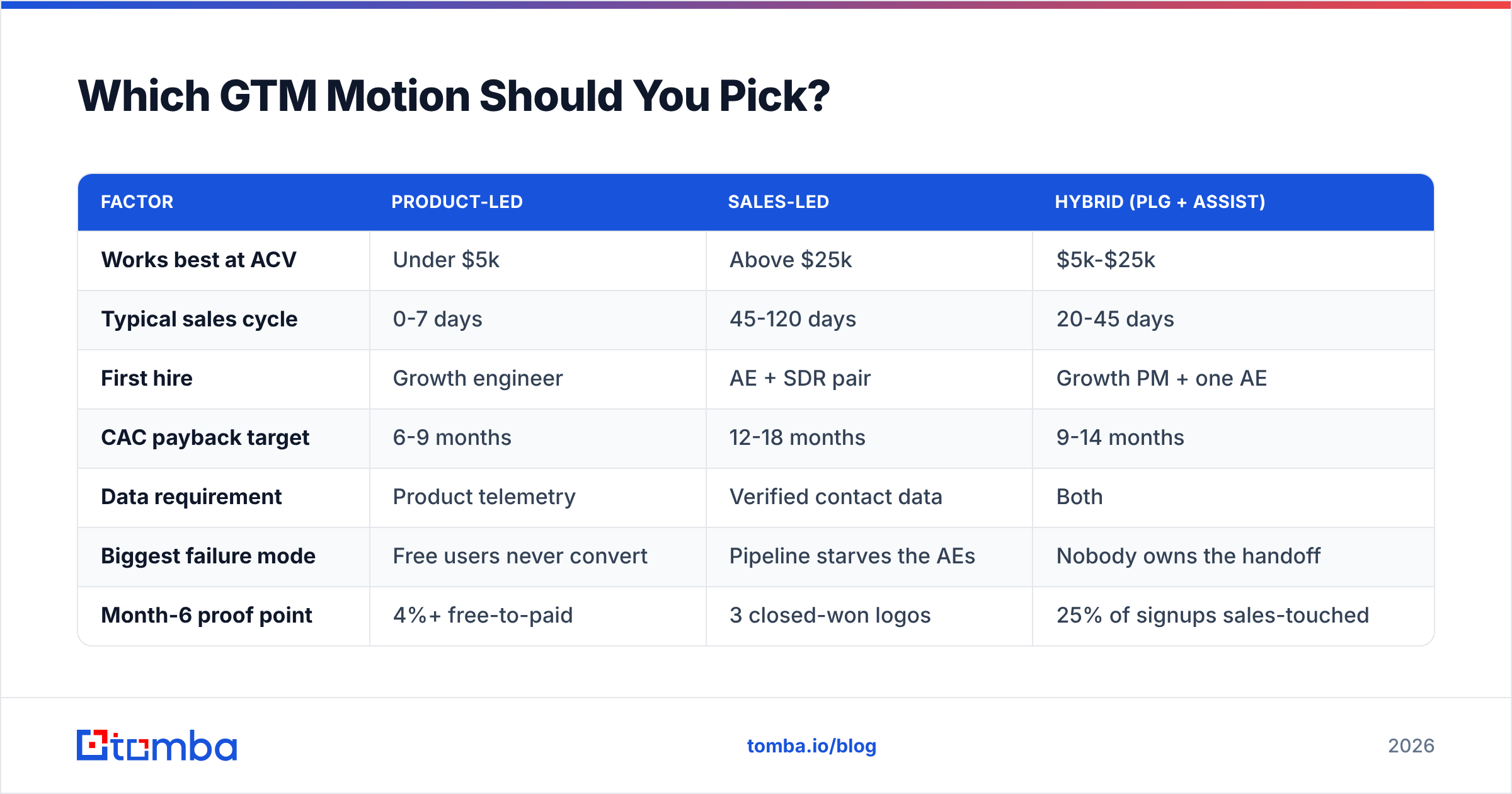
This is the decision that cascades into everything else. Choose it before you write the budget, because each motion buys completely different things.
| Factor | Product-led | Sales-led | Hybrid (PLG + assist) |
|---|---|---|---|
| Works best at ACV | Under $5k | Above $25k | $5k-$25k |
| Typical sales cycle | 0-7 days | 45-120 days | 20-45 days |
| First hire | Growth engineer | AE + SDR pair | Growth PM + one AE |
| CAC payback target | 6-9 months | 12-18 months | 9-14 months |
| Data requirement | Product telemetry | Verified contact data | Both |
| Biggest failure mode | Free users never convert | Pipeline starves the AEs | Nobody owns the handoff |
| Month-6 proof point | 4%+ free-to-paid | 3 closed-won logos | 25% of signups sales-touched |
Flowdesk sits at $14k ACV, so the plan picks hybrid: self-serve signup stays open, but any signup matching the primary ICP gets routed to an AE within one business day. That single routing rule is the whole motion. Write it down explicitly, because "hybrid" without a routing rule means two teams fighting over the same account.
One honest caveat: hybrid is the hardest motion to staff. If you have fewer than four people on GTM, pick one lane and run it properly. Splitting a three-person team across two motions produces two mediocre motions.
How Do You Build the Channel Plan and Budget?#
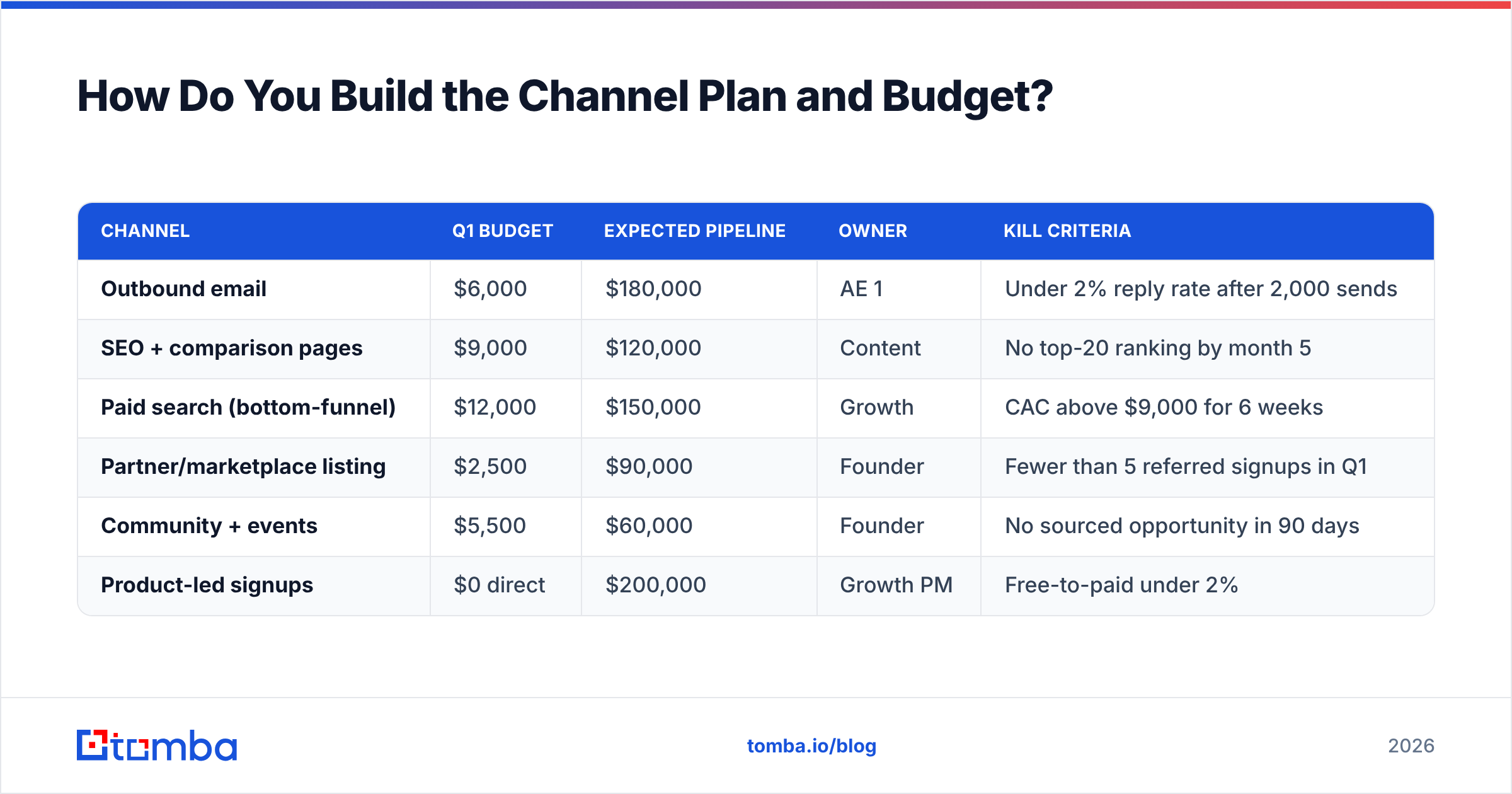
Channels get a dollar figure, an owner, and an expected pipeline number. A channel without a number attached is a hobby.
| Channel | Q1 budget | Expected pipeline | Owner | Kill criteria |
|---|---|---|---|---|
| Outbound email | $6,000 | $180,000 | AE 1 | Under 2% reply rate after 2,000 sends |
| SEO + comparison pages | $9,000 | $120,000 | Content | No top-20 ranking by month 5 |
| Paid search (bottom-funnel) | $12,000 | $150,000 | Growth | CAC above $9,000 for 6 weeks |
| Partner/marketplace listing | $2,500 | $90,000 | Founder | Fewer than 5 referred signups in Q1 |
| Community + events | $5,500 | $60,000 | Founder | No sourced opportunity in 90 days |
| Product-led signups | $0 direct | $200,000 | Growth PM | Free-to-paid under 2% |
Two things matter more than the exact allocation. First, every channel has a kill criterion written before launch, when you are still capable of being objective about it. Second, the outbound line item is the cheapest to start and the fastest to destroy your domain if you run it on bad data.
That is where most GTM plans quietly break. You can nail the ICP table and still send 2,000 emails into a list where a third of the addresses are stale, role-based, or catch-all guesses. Bounce rate climbs, sender reputation tanks, and by week three even your good addresses land in spam. Build the contact list from a source that gives you a confidence score, then run a verification pass before the first send. A bulk email finder plus an email verifier step is a fifteen-minute addition to the workflow that protects the entire outbound channel.
What Numbers Belong in the GTM Forecast?#
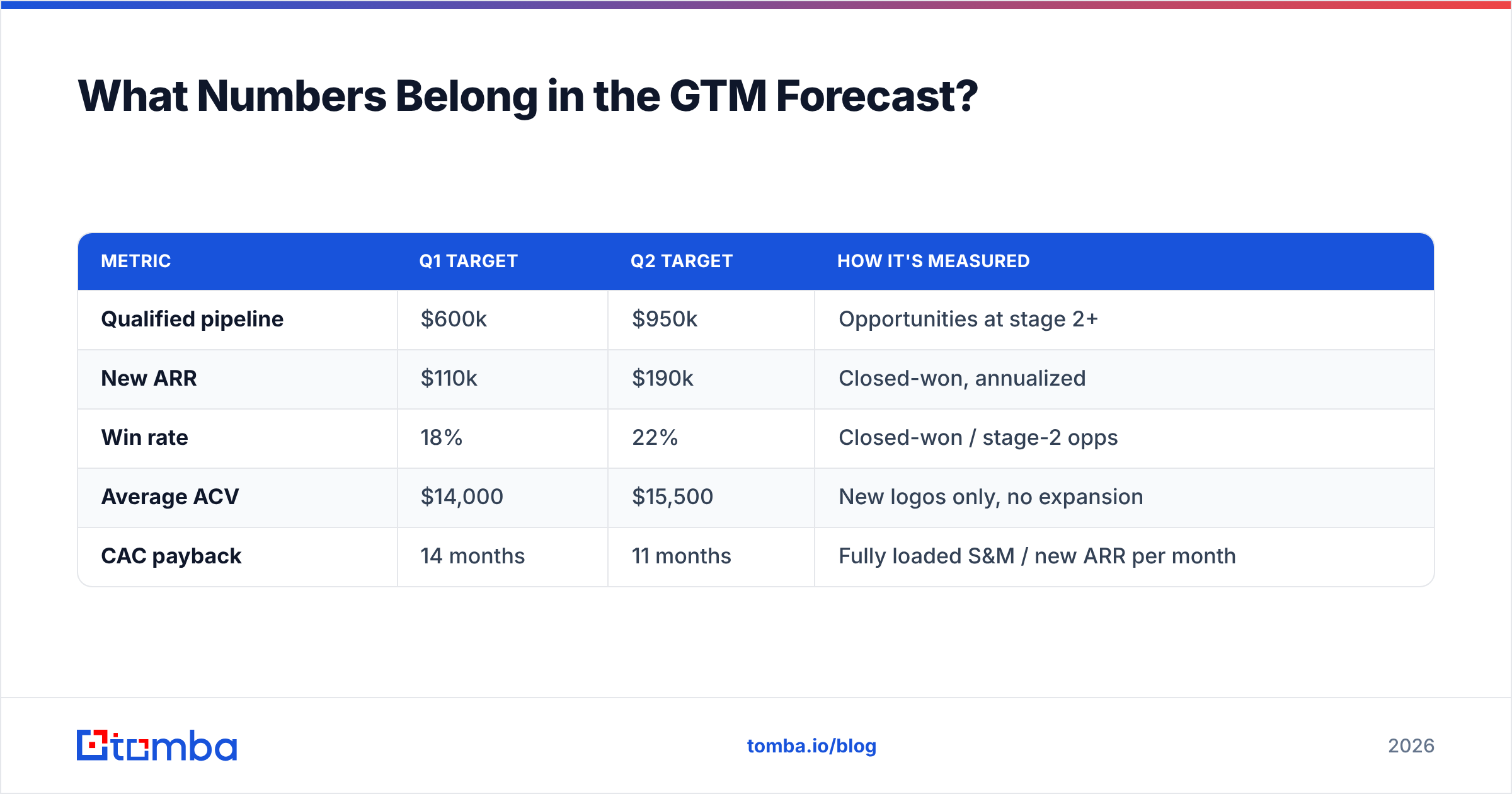
Five, and they have to reconcile with each other. If your forecast has twenty rows, nobody will notice when one of them is fantasy.
| Metric | Q1 target | Q2 target | How it's measured |
|---|---|---|---|
| Qualified pipeline | $600k | $950k | Opportunities at stage 2+ |
| New ARR | $110k | $190k | Closed-won, annualized |
| Win rate | 18% | 22% | Closed-won / stage-2 opps |
| Average ACV | $14,000 | $15,500 | New logos only, no expansion |
| CAC payback | 14 months | 11 months | Fully loaded S&M / new ARR per month |
The sanity check: multiply pipeline by win rate and confirm it lands near your ARR target. $600k × 18% = $108k, which reconciles with the $110k goal. If the two numbers are 3x apart, the plan is wrong somewhere and you now know where to look. This is the single most valuable ten seconds in the whole document.
Also fix your definitions before the quarter starts. What counts as a marketing qualified lead at your company should be one sentence in the plan, agreed by marketing and sales. Teams that skip this spend the whole quarter arguing about attribution instead of selling. The HubSpot and G2 libraries both publish benchmark data you can use to sanity-check whether your assumed conversion rates are inside the normal range for your category.
How Do You Turn the Plan Into a 90-Day Launch Sequence?#
The sequence is where plans usually collapse into good intentions. Assign weeks and owners.
Weeks 1-2 — Foundations. Finalize ICP table. Build the target account list (300 accounts for Flowdesk). Set up domain authentication, warm the sending mailboxes, publish the pricing page.
Weeks 3-4 — Data and messaging. Enrich the account list with contacts for the three committee roles. Verify every address. Write three outbound sequences, one per persona. Ship the two highest-intent comparison pages.
Weeks 5-8 — First contact. Launch outbound at 40 emails/day/mailbox, not 400. Turn on bottom-funnel paid search. Route matching self-serve signups to the AE. Review reply rates weekly, not daily.
Weeks 9-12 — Read the signal. Apply kill criteria honestly. Double the budget on whatever channel produced a real opportunity. Rewrite the sequences that got replies but no meetings. Report against the five forecast numbers, not against activity.
By day 90 you want three things: at least one closed-won logo in the primary ICP, one channel with a proven cost per opportunity, and a written list of what you were wrong about. The third is worth the most.
Which Tools Do You Actually Need to Execute It?#
Less than the average stack diagram suggests. Four categories cover the whole plan.
| Category | Purpose in the plan | What to look for | Rough monthly cost |
|---|---|---|---|
| CRM | Pipeline, forecast, stage definitions | Native reporting on win rate | $0-$150/user |
| Contact data + verification | Fuels sections 2, 6, 7 | Confidence scores, catch-all handling, API access | $49-$249 |
| Sending / sequencing | Executes the outbound channel | Per-mailbox throttling, warmup | $30-$100/mailbox |
| Analytics | Proves the kill criteria | Channel-level cost per opportunity | $0-$200 |
On the data line, the credible options include Tomba, Apollo, and BookYourData, which each solve a slightly different problem. Apollo bundles data with sequencing, BookYourData is strong when you want a purchased, pre-built list with a bounce guarantee, and Tomba is the pick when you want accuracy-first lookups and an API you can wire into your own workflow. Tomba pricing starts with a free tier at 25 searches/month, then $49/mo Starter, $99/mo Growth, and $249/mo Pro, so a seed-stage GTM plan can budget the data line at under $100.
What Are the Most Common GTM Plan Mistakes?#
- Writing the ICP as adjectives. "Fast-growing, innovative mid-market companies" is not filterable. Headcount ranges, tech signals, and trigger events are.
- Forecasting from ARR backwards without checking pipeline. If the math does not reconcile, the plan is a wish.
- No kill criteria. Without them, every channel survives forever because someone is emotionally invested.
- Treating data quality as an ops detail. Bad contact data breaks outbound, poisons your CRM reporting, and makes your win-rate denominator meaningless.
- Planning for a motion you cannot staff. Enterprise sales-led with no AE is not a motion, it is a founder doing demos at midnight.
- One plan for all segments. Primary and secondary ICPs need different messaging, different channels, and often different price points.
How Often Should You Rewrite the Plan?#
Quarterly, and it should get shorter each time. The first version is long because you are guessing. By quarter three you should be able to state the motion, the two channels that work, and the five numbers on a single page. If your plan is growing, you are adding hypotheses faster than you are resolving them.
Keep a changelog at the bottom of the document: what you believed, what happened, what you changed. That log is the most valuable GTM asset your company will own in year two, more valuable than the plan itself, because it is the only record of which assumptions actually held.
Start With the List, Not the Deck#
A go-to-market plan only becomes real at the moment you have named accounts, named people, and reachable addresses. Everything before that is a hypothesis about a market. Everything after it is a testable pipeline.
Build the contact layer first. Use Tomba Email Finder to turn your 300 target accounts into verified, committee-level contacts, run them through verification before the first send, and let the outbound channel in section 6 start producing data on day 30 instead of day 90. The free tier is enough to validate whether your ICP table survives contact with the market, which is the only test that matters.
Related guides#
Ready to find emails that actually work?
Join 150,000+ professionals who stopped guessing and started sending. Free credits on signup — no credit card required.
Get the Tomba newsletter
Practical outbound tactics and product updates — once every two weeks.
About the author