Go-To-Market Playbook: How to Build One That Actually Works
Most GTM playbooks are 40-slide decks nobody opens. Here is the seven-section structure that survives contact with a real quarter, plus the data layer that makes it executable.
TL;DR
- A go to market playbook is an operating document, not a strategy deck. If a new rep cannot run their first week from it, it is not a playbook.
- Seven sections cover almost every case: ICP, segmentation, motion, messaging, channel plan, data layer, and the metric tree.
- The section teams skip most often is the data layer, which is why the other six degrade within a quarter.
- Motion choice (product-led, sales-led, or hybrid) should follow deal size and time-to-value, not what your competitors post on LinkedIn.
- Version it quarterly. A playbook that has not changed in a year is a fossil, not a system.
What is a go-to-market playbook?#
A go-to-market playbook is the written, versioned set of decisions that tells your revenue team who to sell to, what to say, through which channel, and how success gets measured. Think of it as the recipe card in a professional kitchen: the chef already knows how to cook, but the card makes sure the dish is identical whether it leaves the pass at noon or at midnight.
The distinction that matters most is playbook versus strategy. Strategy is the argument for why a market is worth entering. The playbook is the set of repeatable instructions that follow from that argument. Strategy lives in a board deck. The playbook lives where the work happens: your CRM, your sequencer, your onboarding docs.
Here is what separates the two in practice:
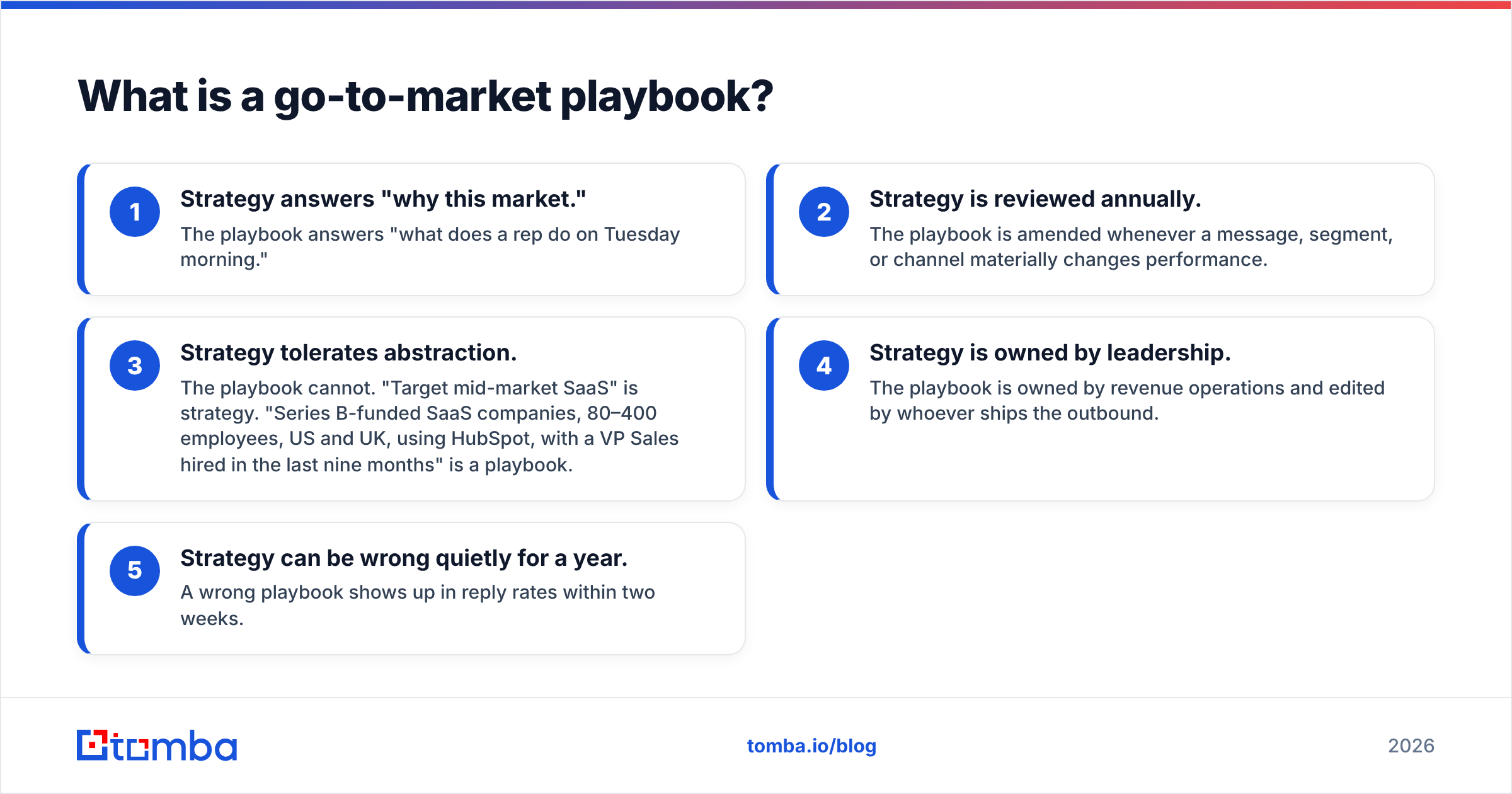
- Strategy answers "why this market." The playbook answers "what does a rep do on Tuesday morning."
- Strategy is reviewed annually. The playbook is amended whenever a message, segment, or channel materially changes performance.
- Strategy tolerates abstraction. The playbook cannot. "Target mid-market SaaS" is strategy. "Series B-funded SaaS companies, 80–400 employees, US and UK, using HubSpot, with a VP Sales hired in the last nine months" is a playbook.
- Strategy is owned by leadership. The playbook is owned by revenue operations and edited by whoever ships the outbound.
- Strategy can be wrong quietly for a year. A wrong playbook shows up in reply rates within two weeks.
That last point is the real value. A good playbook is falsifiable. It makes claims specific enough that the market can tell you they are wrong, quickly and cheaply.
What goes inside a go-to-market playbook?#
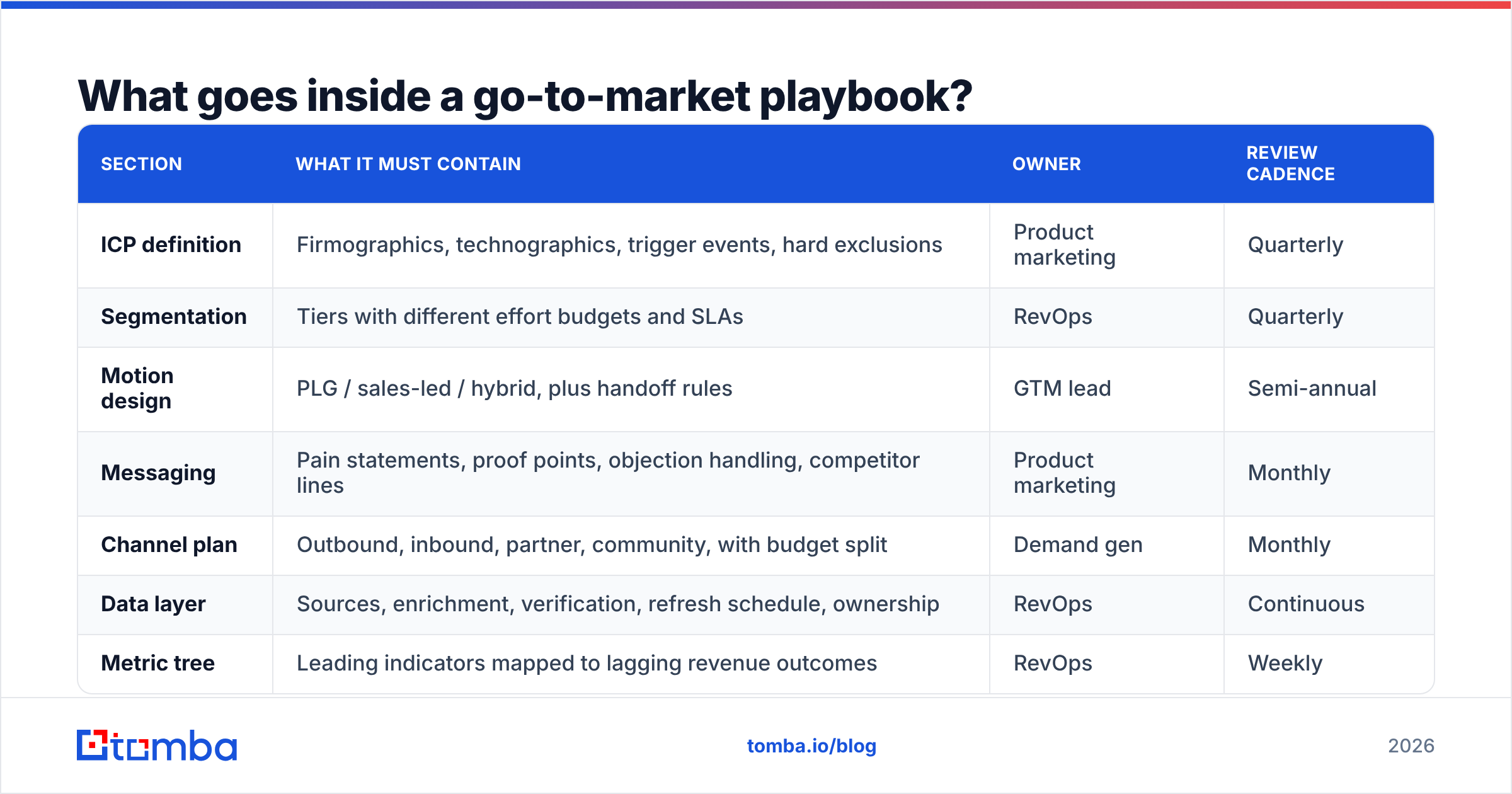
Seven sections. Any fewer and something gets improvised; any more and nobody reads it. Each section should have a named owner and a review cadence, otherwise it rots.
| Section | What it must contain | Owner | Review cadence |
|---|---|---|---|
| ICP definition | Firmographics, technographics, trigger events, hard exclusions | Product marketing | Quarterly |
| Segmentation | Tiers with different effort budgets and SLAs | RevOps | Quarterly |
| Motion design | PLG / sales-led / hybrid, plus handoff rules | GTM lead | Semi-annual |
| Messaging | Pain statements, proof points, objection handling, competitor lines | Product marketing | Monthly |
| Channel plan | Outbound, inbound, partner, community, with budget split | Demand gen | Monthly |
| Data layer | Sources, enrichment, verification, refresh schedule, ownership | RevOps | Continuous |
| Metric tree | Leading indicators mapped to lagging revenue outcomes | RevOps | Weekly |
The pattern to notice: three of the seven sections are owned by operations, not marketing. Playbooks that live entirely inside a marketing function tend to produce beautiful positioning that nobody can act on because the contact data underneath it is six months stale.
How do you define an ICP that actually filters?#
An ideal customer profile is only useful if it excludes things. If your ICP does not disqualify at least 80% of the addressable universe, it is a description, not a filter.
Build it from closed-won evidence rather than aspiration. Pull your last 40 closed-won deals and your last 40 closed-lost, then look for attributes that separate them. Not attributes that describe the winners, attributes that separate. Every B2B company has customers with websites; that tells you nothing.
The four layers worth encoding:
- Firmographic: employee count, revenue band, geography, funding stage, industry. Use ranges, not single values.
- Technographic: what they already run. A company on a competing tool is a different conversation from a company running spreadsheets.
- Trigger: a recent event that creates urgency. New executive hire, funding round, office expansion, compliance deadline, a job posting for the role your product replaces.
- Exclusion: the anti-ICP. Company sizes you cannot support, industries with procurement cycles longer than your runway, regions you cannot invoice.
Gartner's research on B2B buying has consistently found that buying groups now involve six to ten stakeholders, each arriving with independently gathered information. That changes the ICP job: you are not profiling a company, you are profiling a buying committee. Your playbook needs a named persona set per account tier, with a distinct message for the economic buyer, the champion, and the blocker.
Write the ICP as a query you could actually run. If you cannot express it as filters against a B2B database, it is too vague to operationalise.
Which motion should you pick: PLG, sales-led, or hybrid?#
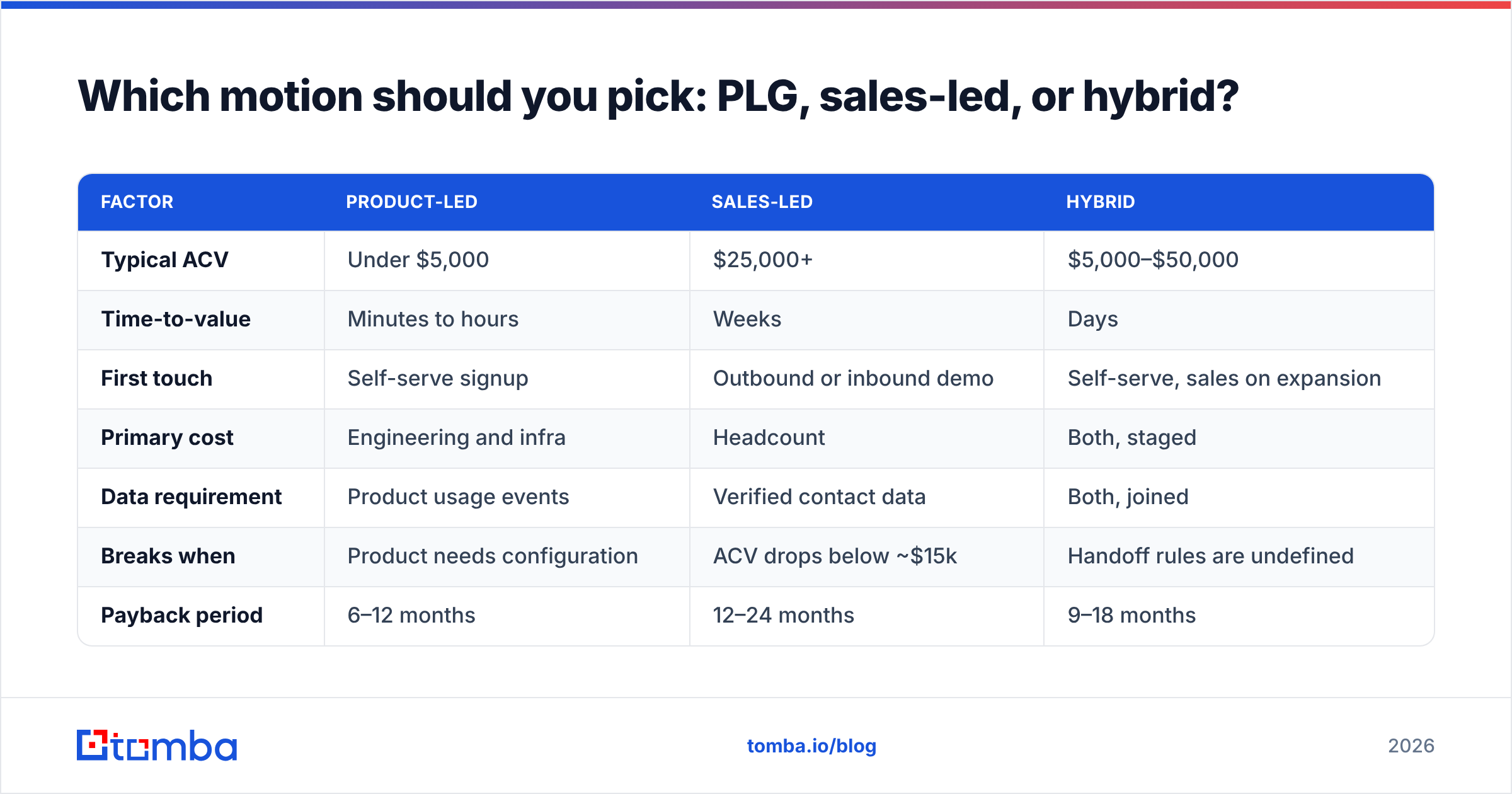
The motion determines your cost structure for the next two years, so it deserves more scrutiny than it usually gets. The honest decision inputs are deal size, time-to-value, and how much of the product a user can experience alone.
| Factor | Product-led | Sales-led | Hybrid |
|---|---|---|---|
| Typical ACV | Under $5,000 | $25,000+ | $5,000–$50,000 |
| Time-to-value | Minutes to hours | Weeks | Days |
| First touch | Self-serve signup | Outbound or inbound demo | Self-serve, sales on expansion |
| Primary cost | Engineering and infra | Headcount | Both, staged |
| Data requirement | Product usage events | Verified contact data | Both, joined |
| Breaks when | Product needs configuration | ACV drops below ~$15k | Handoff rules are undefined |
| Payback period | 6–12 months | 12–24 months | 9–18 months |
Hybrid is the default answer for most B2B software in 2026, and it is also the one that fails most often, because hybrid means you now need explicit handoff rules. Which product signal promotes a self-serve account to sales-assisted? Who owns the account during the transition? What happens if a rep touches an account below the threshold?
Write those rules down. Ambiguous handoffs are where hybrid motions quietly become sales-led motions with extra infrastructure cost.
What does the data layer look like?#
This is the section that gets one line in most playbooks and deserves a full page. Your ICP, segmentation, and channel plan all resolve to the same question at execution time: do you have accurate, verified contact records for the accounts you just defined?
A working data layer specifies four things:
- Sources. Where records originate: your CRM, enrichment providers, scraped intent signals, event lists, inbound forms. Each source gets a trust score.
- Enrichment rules. What gets appended, in what priority order, and what happens on conflict. If your CRM says "Director" and your enrichment provider says "VP," which wins?
- Verification. Every email address gets checked before it enters a sequence. This is non-negotiable in 2026, because mailbox providers now enforce complaint-rate thresholds that a 12% bounce list will breach within a week.
- Refresh schedule. B2B contact data decays somewhere around 25–30% per year, and faster in high-churn functions like sales and marketing. Decide whether records are re-verified quarterly or on-use, and log the decision.
The practical build is simpler than it sounds. Define the account list from your ICP filters, run domain search to map the org chart at each target, resolve individual contacts with an email finder, then push everything through an email verifier before it reaches your sequencer. Catch-all domains get flagged rather than blindly mailed. That is four steps, and it is the difference between a playbook that runs and one that generates a deliverability incident in week three.
One rule worth writing in bold in your own document: no unverified record enters an outbound sequence. It sounds obvious. Audit your current sequences and see how often it holds.
How do you turn the playbook into sequences and calls?#
Messaging in a playbook should be modular, not scripted. Scripts break the moment a prospect says something unexpected. Modules survive.
Build a message library with four component types:
- Pain statements — one sentence, in the buyer's vocabulary, per persona. Three to five per persona maximum.
- Proof points — a customer outcome with a number and a named segment. "Cut research time 60% for a 40-person agency" beats "improves efficiency."
- Objection responses — the seven objections you hear most, with a response and an escalation path.
- Competitive frames — what you say when a named competitor comes up, written in a way you would be comfortable having forwarded to that competitor.
Reps then assemble sequences from modules rather than reciting a wall of text. This also makes testing tractable: you are testing modules, not entire emails, so you learn faster from less volume.
HubSpot's sales research has documented for years that personalisation at the account level outperforms volume, and the arithmetic still holds. A hundred well-researched sends beat a thousand generic ones on both reply rate and domain health.
What metrics prove the playbook is working?#
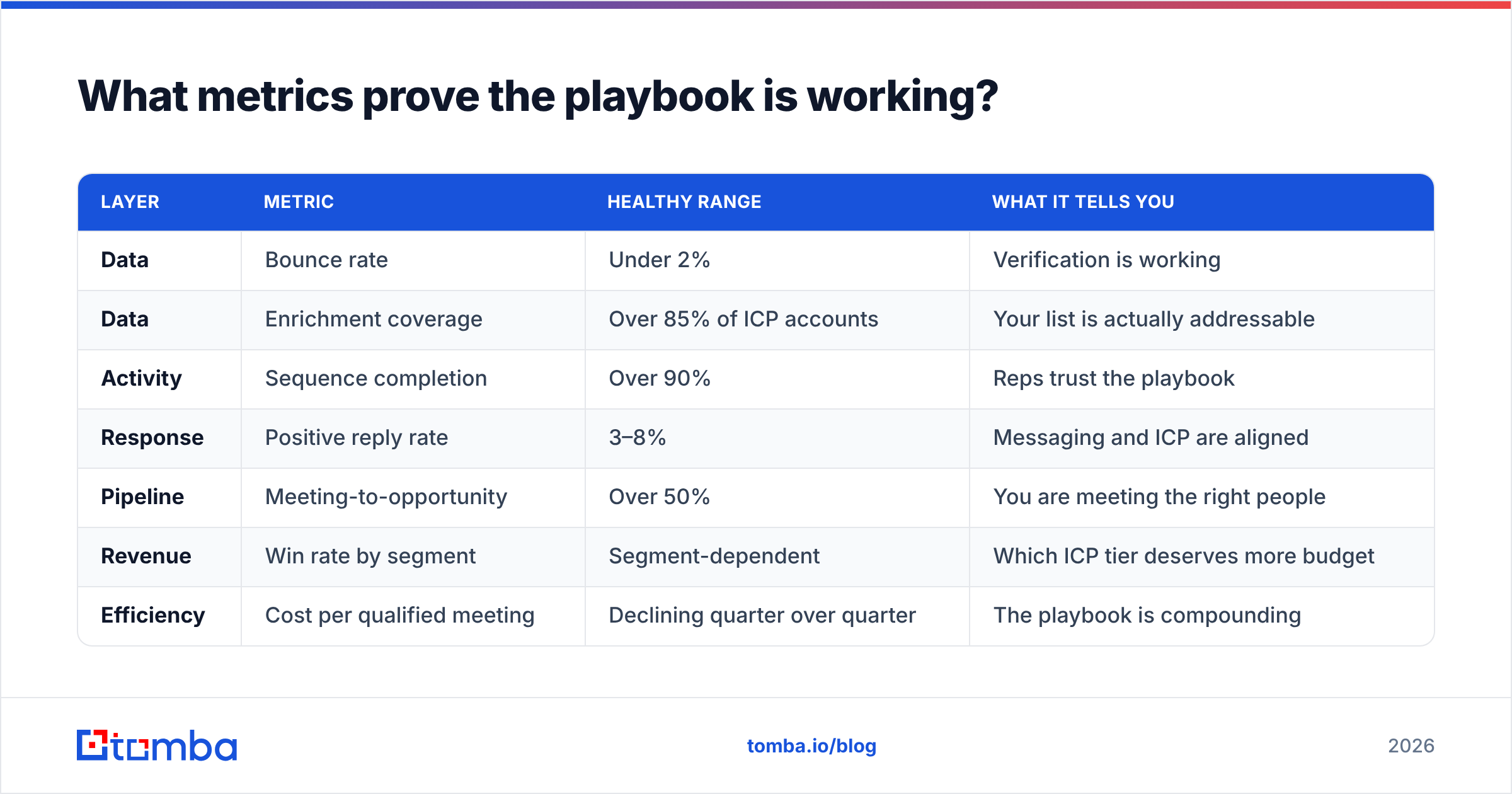
A metric tree connects things you can influence this week to outcomes you will see next quarter. Without it, teams optimise the loudest number rather than the causal one.
| Layer | Metric | Healthy range | What it tells you |
|---|---|---|---|
| Data | Bounce rate | Under 2% | Verification is working |
| Data | Enrichment coverage | Over 85% of ICP accounts | Your list is actually addressable |
| Activity | Sequence completion | Over 90% | Reps trust the playbook |
| Response | Positive reply rate | 3–8% | Messaging and ICP are aligned |
| Pipeline | Meeting-to-opportunity | Over 50% | You are meeting the right people |
| Revenue | Win rate by segment | Segment-dependent | Which ICP tier deserves more budget |
| Efficiency | Cost per qualified meeting | Declining quarter over quarter | The playbook is compounding |
Read the tree top-down when something breaks. A falling win rate is rarely a closing problem. Nine times out of ten it traces back to the top two rows: you targeted accounts that were never going to buy, or you reached people who were never going to sign. Peer review sites like G2's category grids are useful here for sanity-checking which segments genuinely evaluate your category versus which ones you assumed did.
What are the most common go-to-market playbook mistakes?#
- Writing it as a deck. Decks get presented once and archived. Put the playbook in a living document with version history and a changelog.
- No named owners. A section without an owner is a section that will be six months out of date the next time someone opens it.
- Confusing TAM with ICP. Total addressable market is a fundraising number. Your ICP should be an order of magnitude smaller and far more specific.
- Skipping the anti-ICP. Teams that never define who they will not sell to end up with a support burden that quietly destroys gross margin.
- Treating data as a procurement decision. Contact data is infrastructure, not a one-time purchase. Budget for continuous verification and contact enrichment, not an annual list buy.
- Never killing anything. Every quarterly review should remove at least one channel, segment, or message. Playbooks that only grow become unusable.
- Measuring activity instead of progression. Emails sent is not a metric. Meetings that become opportunities is.
How often should you update it?#
Quarterly for structure, continuously for content. Messaging modules and channel budgets should change monthly based on what the metric tree shows. ICP and motion should only change quarterly, because changing them faster means you never gather enough signal to know whether the previous version worked.
Keep a changelog at the top of the document with date, section, what changed, and why. Six months from now, when someone asks why you dropped a segment, the answer should take ten seconds to find rather than a Slack archaeology expedition.
Where to start#
Pick the section you are weakest on and fix that one first. For most teams reading this, it is the data layer, because it is the only section whose failure mode is invisible until deliverability collapses.
Start by building one verified account list against your tightest ICP definition. Use Tomba's Email Finder to resolve contacts across your target accounts, verify before you send, and see whether your reply rate moves before you scale volume. The free tier gives you 25 searches a month to test the workflow, and paid plans start at $49/mo if it works. Full Tomba pricing is public, so you can model the data line of your playbook before you commit to it.
Related guides#
Ready to find emails that actually work?
Join 150,000+ professionals who stopped guessing and started sending. Free credits on signup — no credit card required.
Get the Tomba newsletter
Practical outbound tactics and product updates — once every two weeks.
About the author