Go To Market Pricing Strategy: How to Price a B2B Product in 2026
Most B2B teams pick a number, then spend three years defending it. Here's how to build a go to market pricing strategy around value metrics, packaging, and real willingness-to-pay evidence.
TL;DR
- A go to market pricing strategy is not a number — it's the link between your value metric, your packaging, your discount policy, and the sales motion that sells it.
- Cost-plus and "look at three competitors and subtract 10%" are the two most expensive shortcuts in B2B. Both leave money on the table and both are hard to unwind later.
- Pick your value metric first (seats, credits, contacts, revenue processed). Everything else — tiers, add-ons, overage, annual discount — is downstream of that one choice.
- Price changes are experiments, not announcements. Test on new logos, grandfather existing accounts, and measure net revenue retention, not just win rate.
- Your pricing model is only as good as the data behind it. If your ICP definition is guesswork, your willingness-to-pay research is guesswork too.
What is a go to market pricing strategy?#
A go to market pricing strategy is the set of decisions that determine what you charge, who you charge, how the charge scales, and how your sellers are allowed to move that number in a deal.
Think of it like a restaurant menu. The dish prices matter, but the menu design matters more: what's a starter versus a main, what's included with the entrée, what's an upsell, and whether the server can comp dessert. Two restaurants with identical food costs can have wildly different margins based purely on menu architecture. B2B software works the same way.
A complete strategy has five components:
- Value metric — the unit you charge for. Seats, API calls, contacts enriched, GB stored, revenue processed. This is the single highest-leverage decision you make.
- Packaging — how features bundle into tiers, and which capability forces the upgrade from tier two to tier three.
- Price points — the actual numbers, including annual versus monthly and the size of the annual commitment discount.
- Discount policy — floors, approval thresholds, and what a rep can concede without asking (multi-year terms, extra seats, onboarding credits).
- Motion fit — whether the pricing supports self-serve checkout, product-led sales, or a 90-day enterprise cycle with procurement and security review.
Get the value metric wrong and no amount of tier tinkering fixes it. Get it right and pricing compounds: customers who grow, grow your revenue automatically.
Why do most B2B pricing strategies fail?#
Because they're set once, by a founder, in a spreadsheet, at 11pm before a board meeting — and then never revisited.
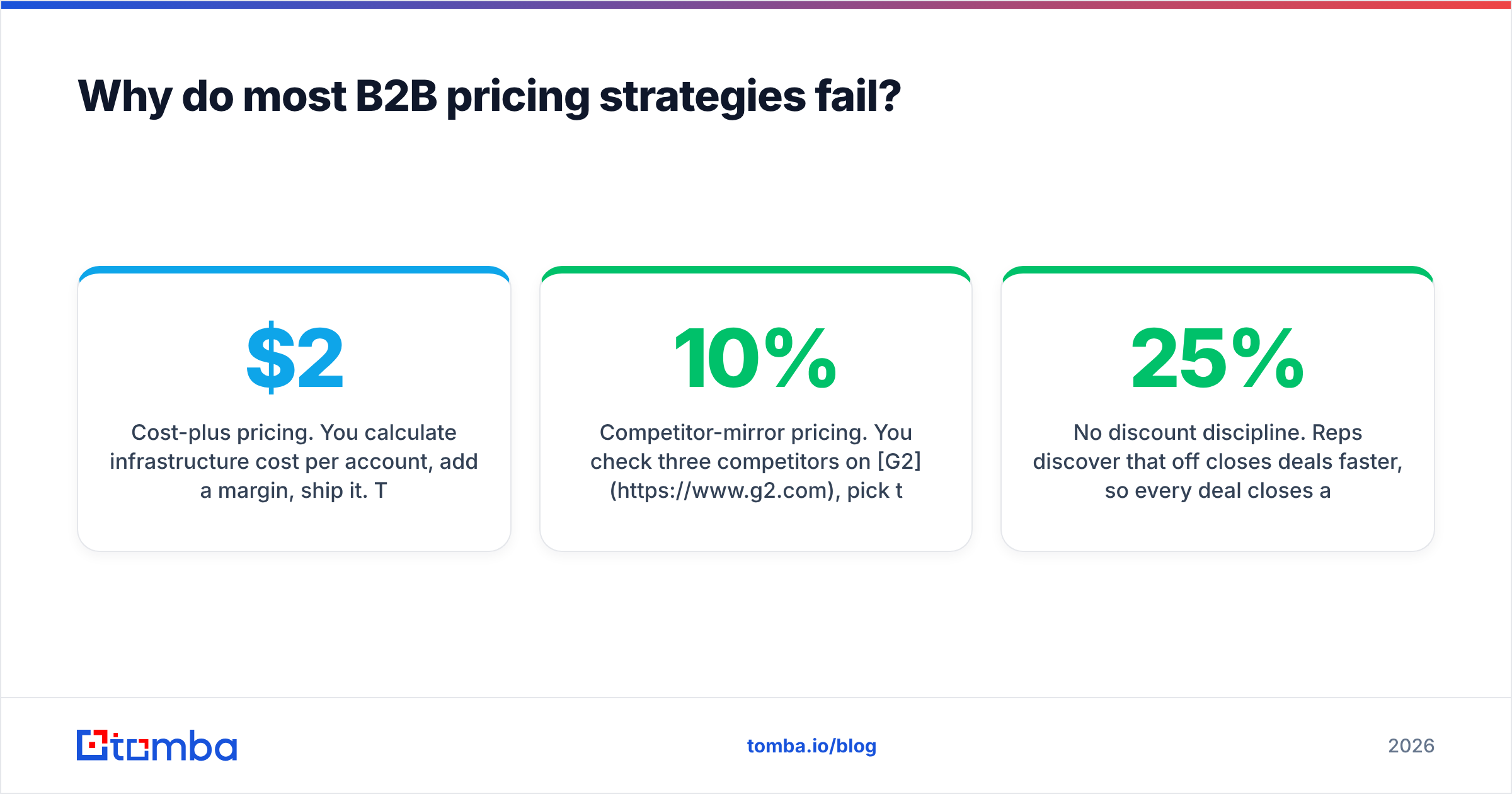
Four failure patterns show up repeatedly:
Cost-plus pricing. You calculate infrastructure cost per account, add a margin, ship it. This ignores the only number that matters: what the buyer would pay. Software cost of goods is nearly irrelevant to perceived value. A tool that saves an SDR team 15 hours a week is worth the same whether it costs you $2 or $20 a month to run.
Competitor-mirror pricing. You check three competitors on G2, pick the middle, subtract 10%. You've now inherited someone else's assumptions about their cost structure, their ICP, and their funding stage. Worse, you've signalled you're a cheaper substitute rather than a different product.
Seat-based pricing on a non-seat product. If your product's value scales with data volume or automation runs, but you charge per seat, customers will share logins. You've created an incentive to under-adopt your own product.
No discount discipline. Reps discover that 25% off closes deals faster, so every deal closes at 25% off. Your list price becomes fiction, your forecasting breaks, and renewals anchor to the discounted number forever.
Gartner's research on B2B buying consistently finds that buyers spend the majority of their purchase cycle doing independent research rather than talking to sellers — which means your published pricing page is doing sales work whether you want it to or not. If your pricing page hides everything behind "contact sales," you've removed yourself from the shortlist for every buyer who won't take a call.
Which pricing model fits your go-to-market motion?#
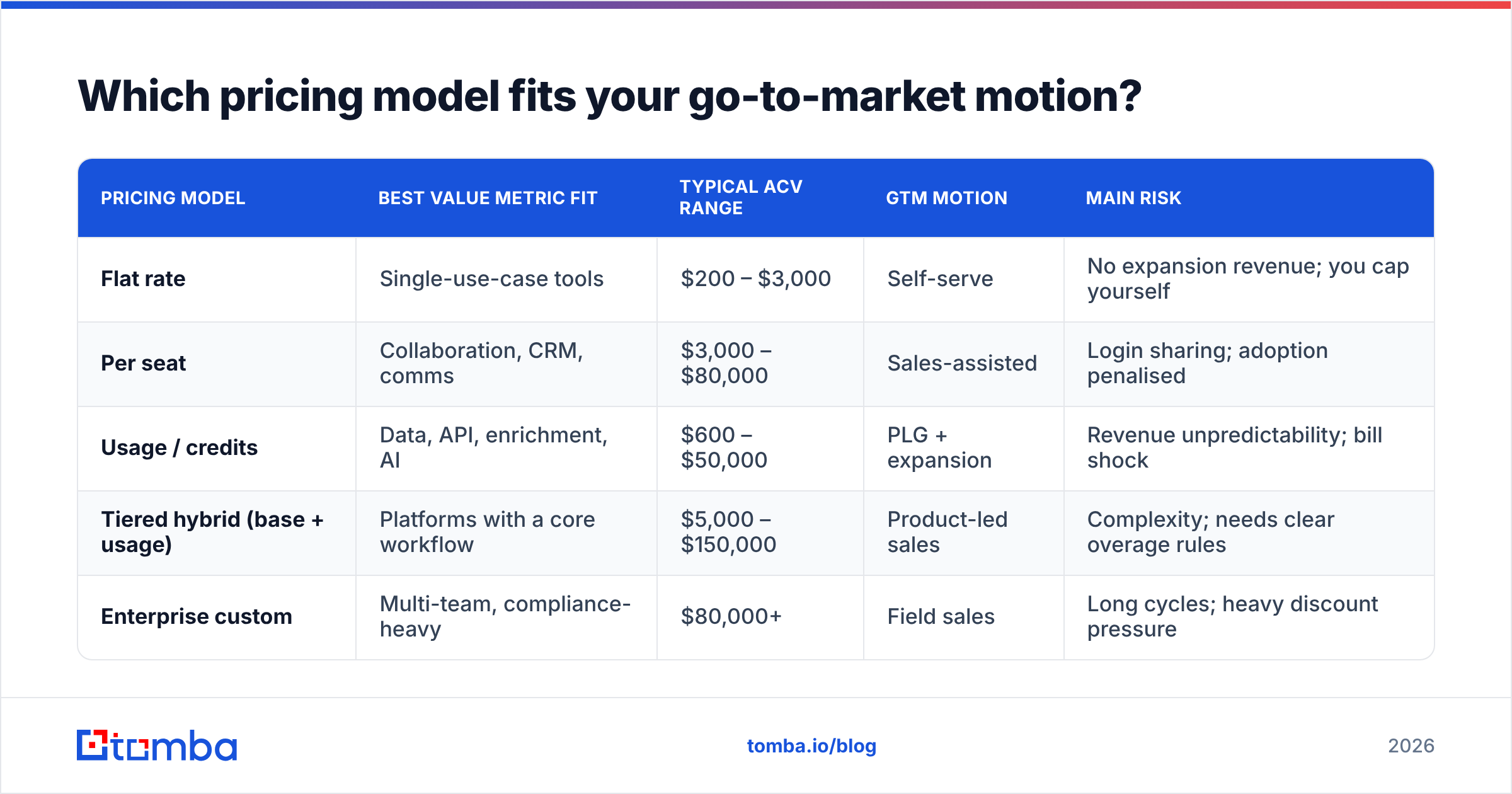
There is no universally correct model. There's a correct model for your value metric, your ACV, and your sales capacity. Here's how the five common models compare.
| Pricing model | Best value metric fit | Typical ACV range | GTM motion | Main risk |
|---|---|---|---|---|
| Flat rate | Single-use-case tools | $200 – $3,000 | Self-serve | No expansion revenue; you cap yourself |
| Per seat | Collaboration, CRM, comms | $3,000 – $80,000 | Sales-assisted | Login sharing; adoption penalised |
| Usage / credits | Data, API, enrichment, AI | $600 – $50,000 | PLG + expansion | Revenue unpredictability; bill shock |
| Tiered hybrid (base + usage) | Platforms with a core workflow | $5,000 – $150,000 | Product-led sales | Complexity; needs clear overage rules |
| Enterprise custom | Multi-team, compliance-heavy | $80,000+ | Field sales | Long cycles; heavy discount pressure |
Most successful B2B tools in 2026 land on the hybrid: a flat platform fee for access plus a metered component that grows with usage. It gives you a predictable floor and an uncapped ceiling.
Look at how this plays out in practice with a data tool. Tomba's own structure is a clean example of a credit-based hybrid: a free tier at 25 searches per month, Starter at $49/mo, Growth at $99/mo, Pro at $249/mo, and custom Enterprise pricing. The credit is the value metric — it maps directly to the outcome the buyer wants (a verified contact), so a customer who doubles their prospecting volume doubles their spend without a renegotiation.
Contrast that with a seat-based data tool. A five-person SDR team pays the same whether they run 500 lookups or 50,000. The vendor either overcharges the light user or undercharges the heavy one. There's no version of that where both parties feel fairly treated.
How do you find your actual willingness to pay?#
Stop guessing and start asking — but ask correctly. Direct questions ("what would you pay?") return useless answers. Structured pricing research returns usable ones.
Run this sequence:
- Segment before you survey. Split your customer base by the value metric, not by company size. A 40-person agency running 20,000 lookups a month is a different segment than a 400-person enterprise running 2,000.
- Run Van Westendorp on each segment. Four questions: at what price is this too expensive, too cheap, getting expensive, a bargain? The intersections give you an acceptable range per segment, not a single number. Van Westendorp's Price Sensitivity Meter has been the standard for decades because it works with sample sizes as small as 40 per segment.
- Test feature-tier attachment with MaxDiff. Ask which capabilities buyers would sacrifice first. The features nobody will give up belong in your base tier; the ones with polarised responses are your upgrade triggers.
- Validate against churn and expansion data. If accounts consistently churn within 60 days of hitting an overage charge, your overage rate is punitive, not profitable.
- Check win/loss notes for price objections that are actually value objections. "Too expensive" usually means "I don't see the ROI." Those need better packaging, not a lower price.
- Re-run annually. Willingness to pay moves with the market. A 2024 study is a historical document by 2026.
A word of caution on step one: your segmentation is only as accurate as your contact and firmographic data. If half your CRM records have stale job titles and missing company sizes, your "enterprise segment" survey is contaminated with mid-market responses. Clean data enrichment before pricing research is not a nice-to-have — it's the input that determines whether the output means anything.
Is value-based pricing better than competitor-based pricing?#
Yes, in almost every case — but only if you can actually quantify the value.
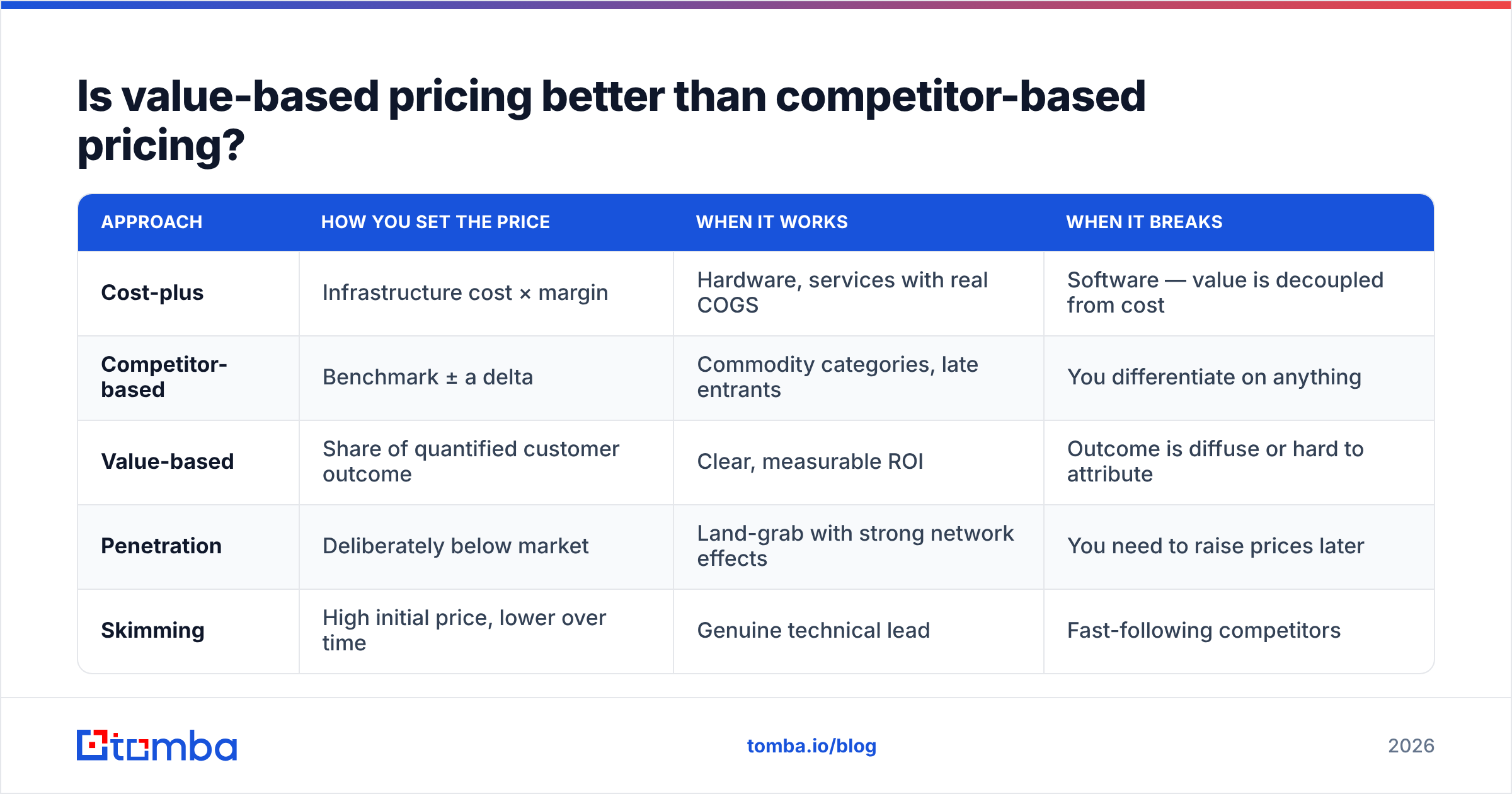
Value-based pricing means you price against the economic outcome the customer gets, not against a competitor's list price. If your tool replaces a $65,000/year researcher role, $12,000/year is a bargain regardless of what a competitor charges. The mechanics:
| Approach | How you set the price | When it works | When it breaks |
|---|---|---|---|
| Cost-plus | Infrastructure cost × margin | Hardware, services with real COGS | Software — value is decoupled from cost |
| Competitor-based | Benchmark ± a delta | Commodity categories, late entrants | You differentiate on anything |
| Value-based | Share of quantified customer outcome | Clear, measurable ROI | Outcome is diffuse or hard to attribute |
| Penetration | Deliberately below market | Land-grab with strong network effects | You need to raise prices later |
| Skimming | High initial price, lower over time | Genuine technical lead | Fast-following competitors |
Value-based pricing has a hard prerequisite: you need a defensible ROI story with numbers your buyer recognises. "Save time" is not a number. "Cut cost-per-verified-contact from $1.40 to $0.19" is.
HubSpot's own pricing model is a public case study in this. They price by marketing contacts — a metric that scales with the customer's own growth — and gate advanced automation behind tiers rather than charging for it a la carte. The customer's success is mechanically tied to their bill going up, which is the definition of good value-metric design.
How should you handle discounting and price increases?#
Discounting is where good pricing strategies die quietly.
Set three rules and enforce them:
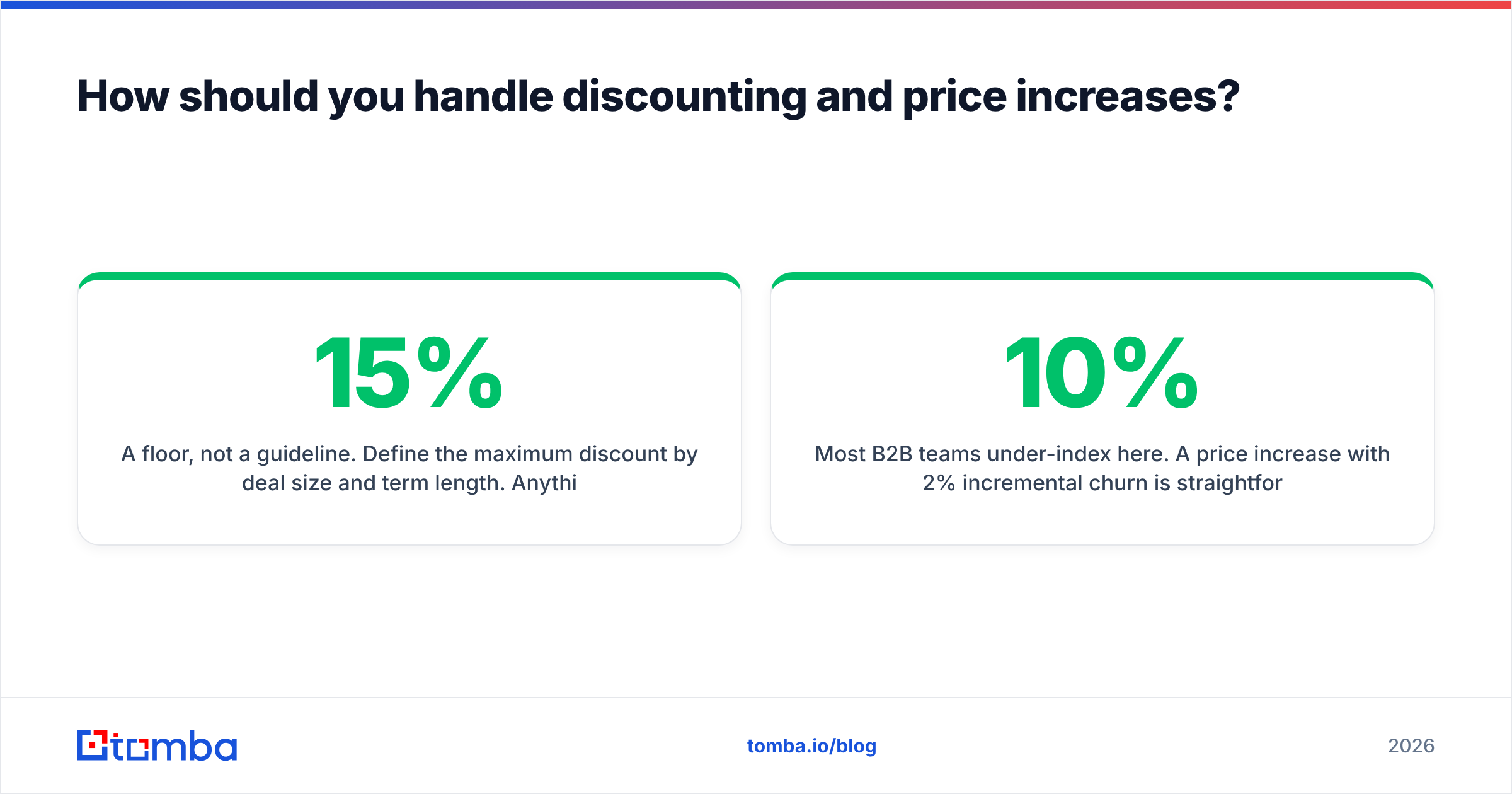
- A floor, not a guideline. Define the maximum discount by deal size and term length. Anything past it goes to a VP. If exceptions run above 15% of closed deals, your list price is wrong — fix the price rather than the approvals.
- Trade, never give. Every discount buys something: annual prepay, a multi-year term, a case study, a reference call, a broader seat commitment. A discount with nothing in return trains the buyer to push harder at renewal.
- Never discount the value metric. Discount the platform fee if you must, but keep the per-unit price intact. Otherwise your expansion revenue is permanently impaired.

For increases, the safe sequence is: raise prices on new logos first, watch win rate for one full quarter, then move existing customers at renewal with 90 days' notice and a clear "what's new since you signed" summary. Grandfather your earliest customers for longer than feels necessary — they're your reference base, and the goodwill costs less than the churn.
Most B2B teams under-index here. A 10% price increase with 2% incremental churn is straightforwardly accretive, yet the fear of that 2% keeps prices frozen for years while costs rise.
What metrics prove your pricing strategy is working?#
Win rate alone is a trap — you can hit 90% by pricing too low. Track these together:
- Net revenue retention (NRR). The single best signal that your value metric is right. Above 110% means customers grow into higher spend without a renegotiation. Below 100% means your pricing punishes success or your product doesn't expand.
- Average discount depth and frequency. Rising discount depth with flat win rate means your list price has drifted above market perception.
- Tier mix. If 85% of customers sit on your entry tier, your upgrade trigger isn't compelling. If 85% sit on your top tier, you're underpriced at the ceiling.
- Time to first expansion. In usage-based models, the median days from signup to first overage or upgrade tells you whether the entry allowance is calibrated.
- Price-related loss reasons in win/loss. Segment them: "no budget" (wrong ICP), "cheaper alternative" (positioning problem), "couldn't justify ROI" (packaging problem). Three different fixes.
Feed these into your revenue operations reporting cadence rather than reviewing them once a year. Pricing is an operating system, not a project.
How does data quality change your pricing decisions?#
Pricing research runs on segmentation, and segmentation runs on contact data. This is the unglamorous dependency nobody puts in the pricing deck.
Three concrete places it bites:
Segment sizing. You can't decide whether to build an enterprise tier without knowing how many accounts in your addressable market actually have 500+ employees and the relevant job function. That requires firmographic accuracy, not a scraped list.
Survey routing. Willingness-to-pay surveys need to reach the economic buyer, not whoever answered your last newsletter. Reaching a VP of Sales rather than an SDR changes the answers by an order of magnitude — you need a reliable way to find email addresses for a defined title set at a defined account list.
Expansion forecasting. If your usage-based model assumes accounts grow, you need to know which accounts are hiring, funding, or expanding. Stale enrichment data means you forecast expansion revenue from companies that shrank two quarters ago.
Teams that treat data as a pricing input — rather than as a marketing list problem — consistently produce sharper segment definitions and defend their price points better in deals.
Where should you start this quarter?#
Do not redesign everything at once. Sequence it:
- Week 1–2: Audit your current discount data. Pull every closed-won deal from the last four quarters and chart discount depth against deal size. You'll find your real price in about an hour.
- Week 3–4: Define or confirm your value metric. Ask whether a customer who gets twice the value pays roughly twice as much. If not, the metric is wrong.
- Week 5–8: Run segmented willingness-to-pay research on 40+ respondents per segment. Clean the contact list first.
- Week 9–12: Ship a new price list for new logos only. Hold existing customers. Measure win rate, deal velocity, and tier mix for a full quarter before touching the base.
That's one quarter to a defensible go to market pricing strategy — versus the alternative, which is another year of defending a number someone picked at 11pm.
Build the segment data your pricing research depends on. Accurate willingness-to-pay work starts with reaching the right economic buyers at the right accounts. Tomba's Email Finder locates verified professional email addresses by domain, name, or company — so your pricing survey lands in the inbox of the VP who signs the contract, not the intern who forwards it. Start on the free tier with 25 searches a month, or scale to Starter at $49/mo when your research list grows.
Related guides#
Ready to find emails that actually work?
Join 150,000+ professionals who stopped guessing and started sending. Free credits on signup — no credit card required.
Get the Tomba newsletter
Practical outbound tactics and product updates — once every two weeks.
About the author