The Go To Market Process: A 7-Stage Playbook for 2026
Most GTM plans die between the strategy deck and the first outbound email. Here is the 7-stage go to market process that actually survives contact with a real pipeline, with the data, owners, and metrics for each stage.
TL;DR
- A go to market process is the repeatable sequence that turns a product decision into booked revenue: ICP definition, positioning, channel selection, data and list build, outbound and demand motion, measurement, and iteration.
- Most GTM plans fail at stage four — the data layer. A perfect ICP is worthless if you cannot produce a clean, reachable list of the people who match it.
- Product-led, sales-led, and partner-led motions are not competing religions. They are three cost structures you pick between based on ACV and buying-committee size.
- Every stage needs one named owner and one number. GTM plans with shared ownership across five departments stall in about 90 days.
- Budget roughly 20-30% of your GTM tooling spend on contact data and verification. It is the cheapest fix for a broken funnel.
What is a go to market process?#
A go to market process is the documented, repeatable sequence a company follows to take an offer to a defined audience through defined channels, with defined success metrics. It is not a launch. A launch is one event inside the process.
The everyday analogy: a launch is opening night. The go to market process is the whole production — casting, rehearsal, ticketing, the venue deal, and the review cycle after the first week of shows. Companies that only plan opening night get one good night and then silence.
Technically, the process spans seven stages that run in sequence the first time and then in a loop:
- Segment and ICP definition — who exactly buys, and who exactly does not.
- Positioning and messaging — the claim you make, and the alternative you displace.
- Motion and channel selection — sales-led, product-led, partner-led, or a hybrid.
- Data and list construction — the actual named accounts and reachable contacts.
- Execution — outbound, demand gen, product onboarding, or partner enablement.
- Measurement — conversion rates per stage, not vanity totals.
- Iteration — what you kill, keep, and double down on each quarter.
Skipping stage 4 is the single most common failure. Teams write beautiful ICP documents and then hand the SDR team a scraped list with 40% bounce rates.
Why do most go to market plans fail?#
They fail for boring, structural reasons — not strategic ones.
Failure 1: The ICP is a demographic, not a behavior. "Mid-market SaaS companies, 50-500 employees, North America" is a filter, not an ICP. A real ICP includes a trigger ("just hired a first RevOps lead"), a pain ("their CRM data hygiene broke after a merger"), and a budget owner.
Failure 2: No single owner. When marketing owns positioning, sales owns the motion, and RevOps owns measurement, nobody owns the process. Gartner's research on buying groups has consistently shown that B2B purchases now involve six to ten stakeholders — mirroring that complexity internally with a six-person GTM committee is how quarters get lost.
Failure 3: The data layer is an afterthought. Teams budget $3,000/month for a sequencer and $0 for verified contact data. The sequencer then burns domain reputation on invalid addresses.
Failure 4: Measurement starts at "meetings booked." If you only measure the bottom, you cannot tell whether the problem is list quality, subject lines, or the offer itself.
Failure 5: No kill criteria. A channel with no pre-agreed threshold for shutting it down runs forever on hope.
What are the three go to market motions, and which fits you?#
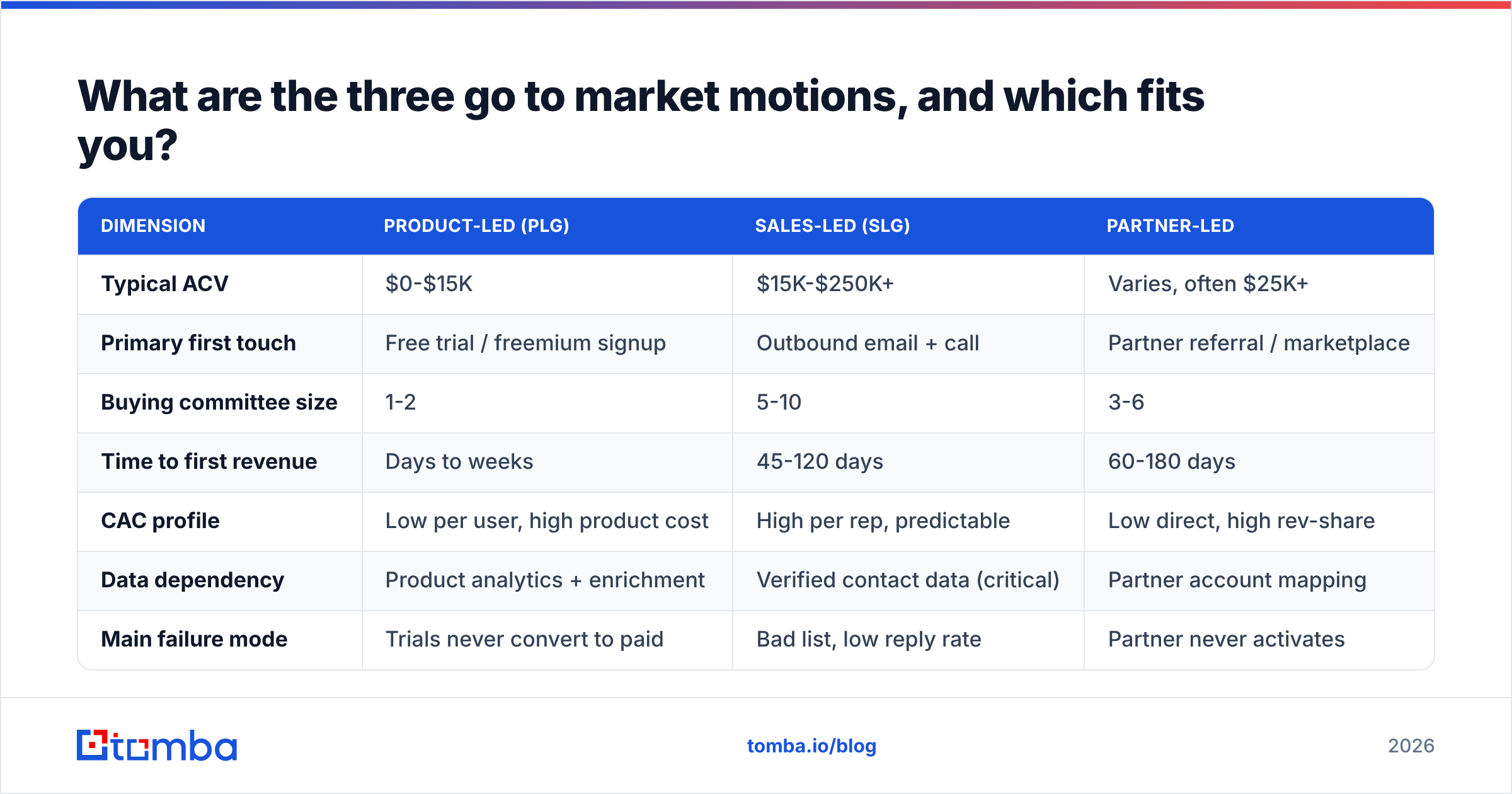
Pick based on average contract value and how many people must say yes. Not on what worked at the last company you read about.
| Dimension | Product-Led (PLG) | Sales-Led (SLG) | Partner-Led |
|---|---|---|---|
| Typical ACV | $0-$15K | $15K-$250K+ | Varies, often $25K+ |
| Primary first touch | Free trial / freemium signup | Outbound email + call | Partner referral / marketplace |
| Buying committee size | 1-2 | 5-10 | 3-6 |
| Time to first revenue | Days to weeks | 45-120 days | 60-180 days |
| CAC profile | Low per user, high product cost | High per rep, predictable | Low direct, high rev-share |
| Data dependency | Product analytics + enrichment | Verified contact data (critical) | Partner account mapping |
| Main failure mode | Trials never convert to paid | Bad list, low reply rate | Partner never activates |
| Best for | Self-serve tools, dev tools | Complex, multi-stakeholder | Ecosystem-heavy categories |
Most companies over $20K ACV end up hybrid: PLG for top-of-funnel signal, sales-led for expansion. That hybrid only works if your enrichment layer can tell you which free signup belongs to a 4,000-person enterprise.
How do you build the ICP and account list?#
This is stage 1 and stage 4 fused, and it is where the go to market process becomes concrete.
Step 1 — Mine your existing wins. Pull your last 30 closed-won deals. Tag firmographics (industry, size, geo), technographics (what they already run), and the trigger event that started the deal. Patterns of three or more repeats are real; single instances are noise.
Step 2 — Write exclusion criteria. List who you will not sell to. Companies under 20 employees. Anyone on a legacy on-prem stack. Regions you cannot support. This shortens every downstream list.
Step 3 — Build the account universe. Source named accounts from a B2B database, your CRM, partner lists, and event attendee data. Target 300-1,000 accounts for a first motion — not 50,000.
Step 4 — Map the buying committee. For each account, identify the economic buyer, the champion, and the blocker. Three roles, minimum.
Step 5 — Find and verify contacts. Use domain search to pull every published address pattern at a target company, then run every address through an email verifier before it touches a sequencer. Catch-all domains need their own handling — a standard verifier returns "unknown," which is not the same as "invalid."
Step 6 — Enrich for personalization inputs. Job change dates, funding events, tech stack. Without these, your personalization collapses into "I loved your website."
The output of stage 4 is not a spreadsheet. It is a validated, deduplicated list where you can state the bounce-rate expectation before you send.

Which data tools support the go to market process?#
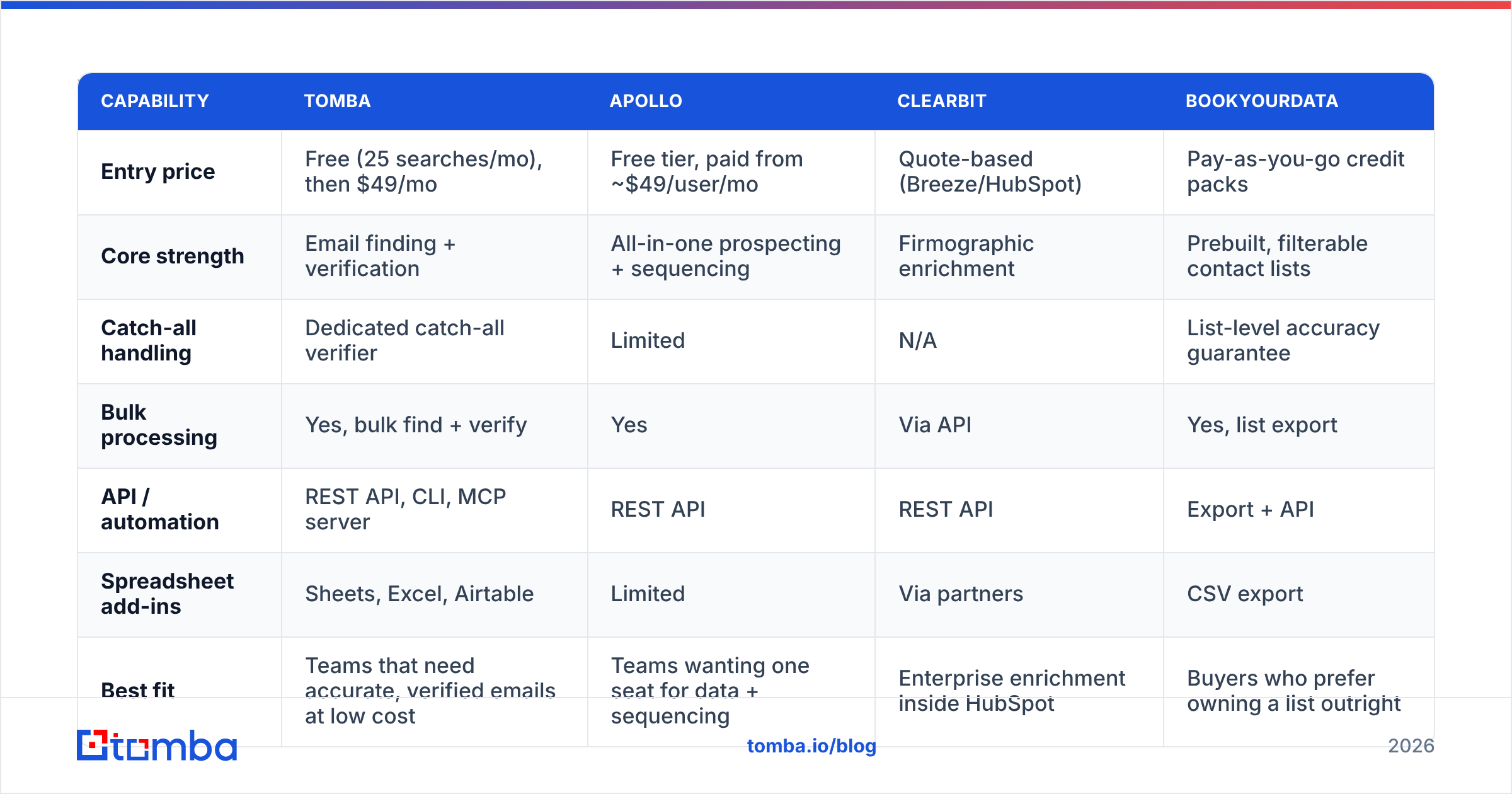
The data layer splits into three jobs: finding contacts, verifying them, and enriching them. Some vendors do one well; some cover all three at different quality levels.

| Capability | Tomba | Apollo | Clearbit | BookYourData |
|---|---|---|---|---|
| Entry price | Free (25 searches/mo), then $49/mo | Free tier, paid from ~$49/user/mo | Quote-based (Breeze/HubSpot) | Pay-as-you-go credit packs |
| Core strength | Email finding + verification | All-in-one prospecting + sequencing | Firmographic enrichment | Prebuilt, filterable contact lists |
| Catch-all handling | Dedicated catch-all verifier | Limited | N/A | List-level accuracy guarantee |
| Bulk processing | Yes, bulk find + verify | Yes | Via API | Yes, list export |
| API / automation | REST API, CLI, MCP server | REST API | REST API | Export + API |
| Spreadsheet add-ins | Sheets, Excel, Airtable | Limited | Via partners | CSV export |
| Best fit | Teams that need accurate, verified emails at low cost | Teams wanting one seat for data + sequencing | Enterprise enrichment inside HubSpot | Buyers who prefer owning a list outright |
Two honest notes. First, all-in-one platforms trade depth for breadth — Apollo's sequencer is convenient, but teams frequently pair it with a dedicated verifier because deliverability depends on address quality, not sequencing features. Second, BookYourData's prepaid list model is genuinely different: if your GTM motion is a one-time campaign into a fixed segment rather than continuous prospecting, buying a guaranteed list outright can be cheaper than a subscription. Match the pricing model to the motion.
For teams running continuous prospecting, per-search pricing wins. Review current Tomba pricing against your monthly contact volume before committing to any annual plan — the math flips around 5,000 lookups/month.
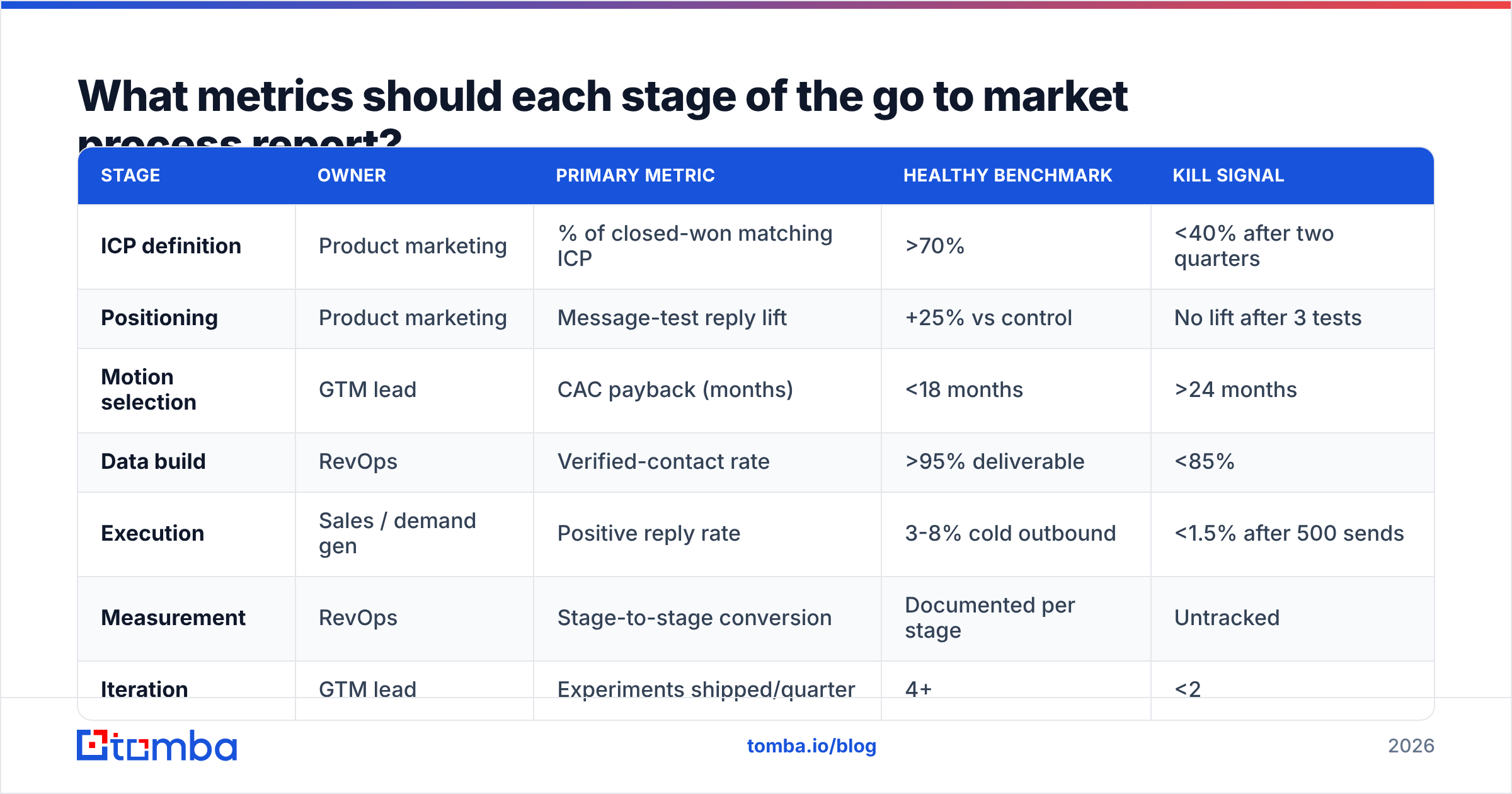
What metrics should each stage of the go to market process report?#
One metric per stage. Not a dashboard of forty.
| Stage | Owner | Primary metric | Healthy benchmark | Kill signal |
|---|---|---|---|---|
| ICP definition | Product marketing | % of closed-won matching ICP | >70% | <40% after two quarters |
| Positioning | Product marketing | Message-test reply lift | +25% vs control | No lift after 3 tests |
| Motion selection | GTM lead | CAC payback (months) | <18 months | >24 months |
| Data build | RevOps | Verified-contact rate | >95% deliverable | <85% |
| Execution | Sales / demand gen | Positive reply rate | 3-8% cold outbound | <1.5% after 500 sends |
| Measurement | RevOps | Stage-to-stage conversion | Documented per stage | Untracked |
| Iteration | GTM lead | Experiments shipped/quarter | 4+ | <2 |
The verified-contact rate deserves emphasis. If it drops below 85%, nothing downstream is diagnosable — a low reply rate could be your copy, your targeting, or the fact that a fifth of your sends never arrived. Fix data quality first, then read every other number.
How do you sequence the first 90 days?#
Days 1-15: Define and exclude. Run the closed-won analysis. Write the ICP document with explicit exclusion criteria. Get one named owner per stage on paper. Do not build any list yet.
Days 16-30: Position and test cheaply. Write three positioning variants. Test them in low-cost channels — LinkedIn posts, a small paid test, or 50 manual emails. You are looking for relative signal, not statistical significance.
Days 31-50: Build the data layer. Construct the account universe, map committees, find and verify contacts. This is where a bulk email finder earns its keep — manual lookup at 500+ accounts is a two-week time sink. Deduplicate. Verify. Then hand off.
Days 51-75: Execute the first motion. Run one channel properly rather than four badly. For outbound, that means a warmed domain, verified list, and a three-to-five touch sequence. Track reply rate daily, not weekly.
Days 76-90: Measure and cut. Compare actuals against the benchmark table above. Kill anything below its threshold. Document what you learned about the ICP — the first 90 days almost always narrow it.
The mistake here is running all seven stages simultaneously because the board wants pipeline in Q1. Parallel execution without a data layer produces activity metrics and no revenue.
How does GTM differ for a new product versus a new market?#
Different starting points change which stages carry risk.
New product, existing market. Your ICP and channels are known. Risk sits in positioning — you must explain why this product beats the alternative your existing buyers already run. Reuse your account list; rewrite your messaging.
Existing product, new market. Positioning mostly holds. Risk sits in data and channels. Email patterns differ by region, local compliance rules bite (GDPR consent requirements in the EU, for example), and the channels that work in North America often underperform in DACH or Japan. Rebuild stage 4 from scratch.
New product, new market. Everything is risk. Halve your target list size and double your test count. Treat the first two quarters as research spend, not revenue expectation.
Existing product, existing market, new segment. The most common real scenario. Usually this means moving upmarket. The failure mode: keeping SMB messaging and SMB list-building while selling to enterprise committees. Enterprise requires mapping five-plus stakeholders per account, which means your contact enrichment depth matters far more than raw list volume.
What does a healthy go to market process look like after year one?#
It looks boring, which is the point.
- The ICP document has been revised at least twice and has grown shorter each time.
- At least one channel has been killed with documented reasoning.
- Verified-contact rate is a tracked number that someone gets asked about.
- Positioning has one primary claim that sales, marketing, and the website all state identically.
- There is a quarterly review where the seven stages get scored, and someone is allowed to say a stage is failing.
- New rep ramp time is measurable because the process is written down.
Companies that reach this state are the ones review sites like G2 show retaining customers well beyond the first renewal — repeatability compounds, and the compounding starts at the data layer.
Where should you start?#
Start at stage 4, even though it is stage 4. Pull your last 30 wins, write down what they had in common, and then go build a verified list of 300 accounts that match. You will learn more about your ICP from the act of building the list than from another quarter of strategy meetings.
If your current list has a bounce rate you cannot state from memory, that is your first problem. Run your existing prospect file through the Tomba Email Finder to fill missing contacts and confirm the ones you have — the free tier covers 25 searches to test on a sample before you commit to Starter at $49/mo. Clean data is not a nice-to-have inside a go to market process. It is the stage everything else depends on.
Related guides#
Ready to find emails that actually work?
Join 150,000+ professionals who stopped guessing and started sending. Free credits on signup — no credit card required.
Get the Tomba newsletter
Practical outbound tactics and product updates — once every two weeks.
About the author