Go To Market Roles in 2026: Who Does What on a GTM Team
A field guide to the go to market roles that actually move revenue in 2026 — what each seat owns, what it costs, and which ones you can skip until you hit $3M ARR.

TL;DR
- A go-to-market team is five functions, not five job titles: demand, pipeline creation, closing, expansion, and the ops layer that keeps all four honest.
- The hiring order that survives contact with reality: founder-led sales → first AE → RevOps (even part-time) → SDR → marketing → CS. Most teams invert this and burn a year.
- Fully loaded US costs in 2026 run roughly $95K–$130K for an SDR, $180K–$260K OTE for an enterprise AE, and $150K–$200K for a RevOps lead.
- The GTM engineer is the one genuinely new seat of the last two years — a technical operator who builds automated prospecting systems instead of managing people.
- Every role above depends on contact data quality. Bad data doesn't slow a GTM team down proportionally; it compounds, because each downstream seat inherits the errors.
What are go to market roles, exactly?#
Go to market roles are the specific seats a company staffs to take a product from "built" to "bought at scale." They're distinct from product roles (what gets made) and general operations (how the company runs). Every GTM role answers one of five questions:
- Who should know about us? — demand generation, product marketing, content, brand
- Who's ready to talk? — SDRs, BDRs, GTM engineers, inbound qualification
- Who signs? — account executives, sales engineers, deal desk
- Who stays and grows? — customer success, account management, renewals
- Is any of this actually working? — revenue operations, sales enablement, analytics
That's the entire map. Job titles multiply endlessly — "Growth Marketing Manager, Lifecycle," "Enterprise Account Director, Strategic" — but every one of them collapses into one of those five buckets. When you're deciding what to hire next, ask which of the five questions your company currently answers worst. Hire that.
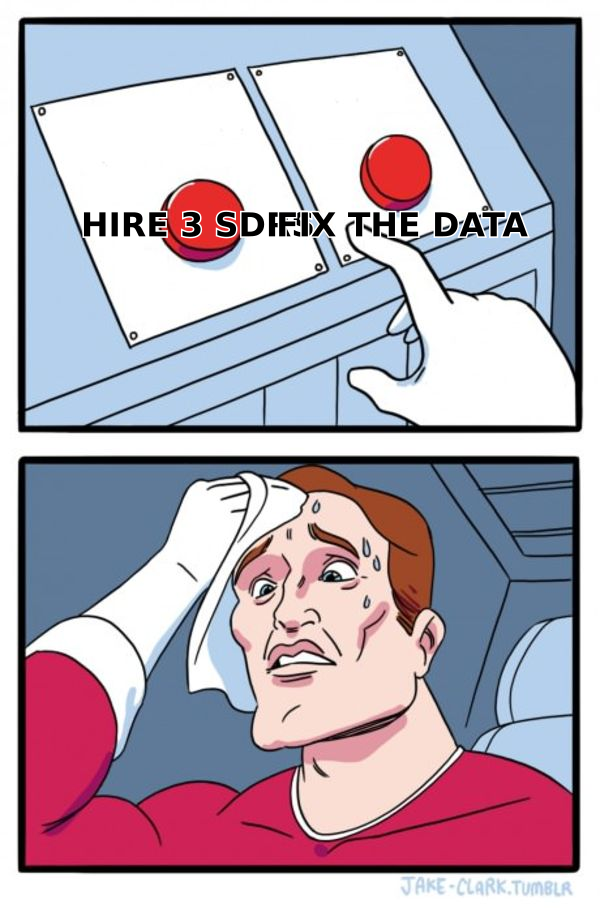
The mistake almost every seed-stage team makes: hiring for bucket 2 (SDRs) when bucket 5 (RevOps) is the actual bottleneck. You add three reps to a system with 34% bounce rates and no lead routing, and you've just tripled the volume of a broken process.
Sorry — that image reference is wrong. Here is the correct one:

What does each go to market role actually own?#
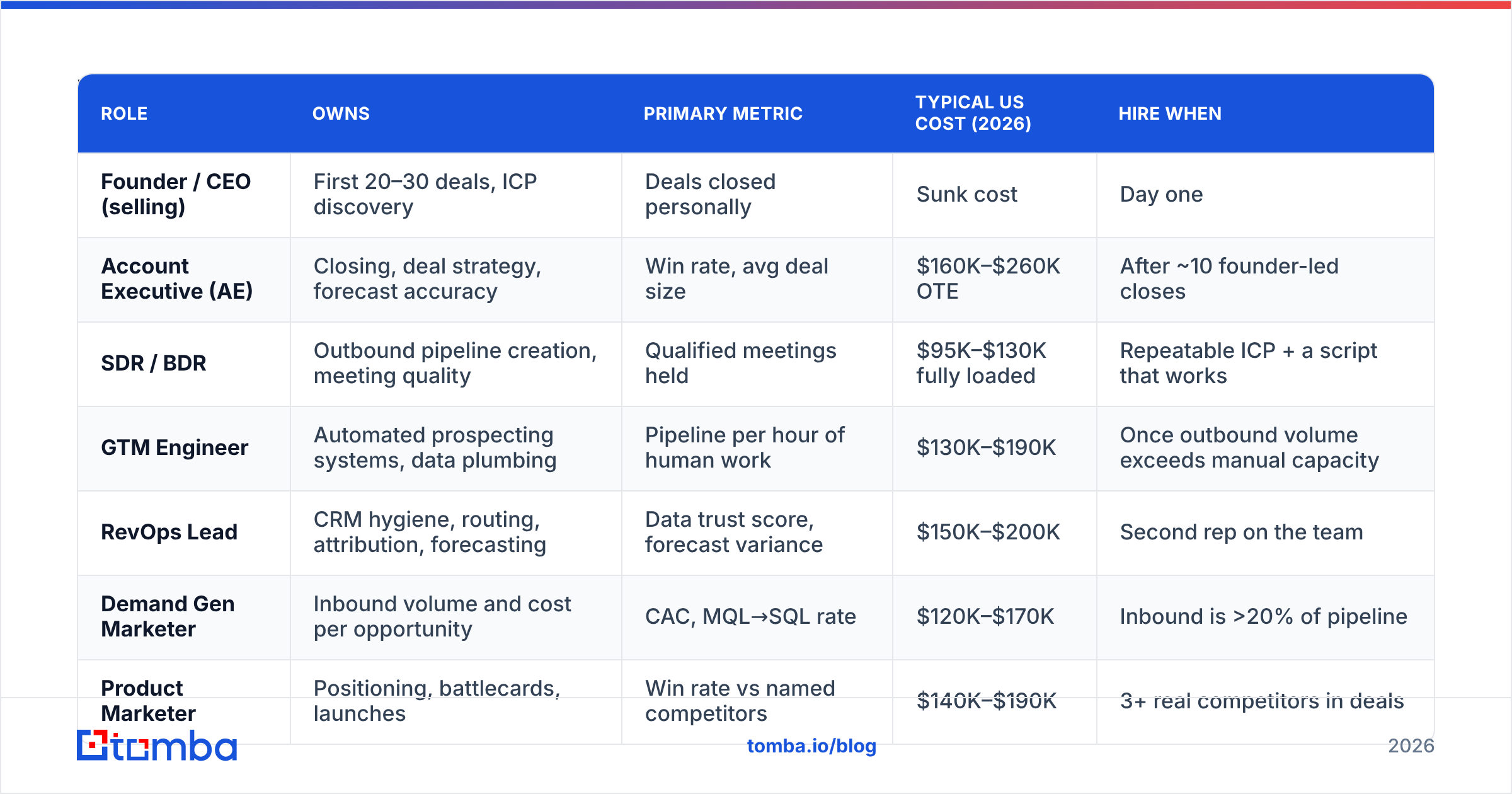
Titles lie. Ownership doesn't. Here's what each seat is genuinely accountable for, and the metric that tells you whether it's working.
| Role | Owns | Primary metric | Typical US cost (2026) | Hire when |
|---|---|---|---|---|
| Founder / CEO (selling) | First 20–30 deals, ICP discovery | Deals closed personally | Sunk cost | Day one |
| Account Executive (AE) | Closing, deal strategy, forecast accuracy | Win rate, avg deal size | $160K–$260K OTE | After ~10 founder-led closes |
| SDR / BDR | Outbound pipeline creation, meeting quality | Qualified meetings held | $95K–$130K fully loaded | Repeatable ICP + a script that works |
| GTM Engineer | Automated prospecting systems, data plumbing | Pipeline per hour of human work | $130K–$190K | Once outbound volume exceeds manual capacity |
| RevOps Lead | CRM hygiene, routing, attribution, forecasting | Data trust score, forecast variance | $150K–$200K | Second rep on the team |
| Demand Gen Marketer | Inbound volume and cost per opportunity | CAC, MQL→SQL rate | $120K–$170K | Inbound is >20% of pipeline |
| Product Marketer | Positioning, battlecards, launches | Win rate vs named competitors | $140K–$190K | 3+ real competitors in deals |
| Sales Engineer / SC | Technical validation, POCs, security review | POC→close rate | $150K–$210K OTE | Deals stall on technical objections |
| Customer Success Manager | Adoption, renewal, health scoring | Net revenue retention | $95K–$150K | 20+ paying accounts |
| Account Manager | Expansion, upsell, cross-sell | Expansion ARR | $130K–$200K OTE | NRR matters more than new logos |
Two notes on that table. First, the cost ranges are fully loaded US figures — base plus variable plus roughly 25% for benefits, tooling, and payroll tax. European and LATAM equivalents typically run 35–55% lower. Second, "hire when" is deliberately conditional. Nobody should hire an SDR because a blog post said Series A companies have SDRs.
Which go to market roles do you actually need first?#
Conclusion first: for a team under $1M ARR, you need exactly two GTM seats — a closer and someone who owns the data. Everything else is premature.
Here's the sequence that holds up across most B2B software companies:
- Founder-led sales (0 → ~$500K ARR). Non-negotiable. The founder learns the objection patterns, the real ICP, and which words make prospects lean in. Delegating this early is the single most expensive mistake in early GTM.
- First AE (~$500K → $1.5M). Hire a closer who has sold at your deal size, not one who sold six-figure enterprise contracts if your ACV is $8K. Deal-size mismatch is why most first AE hires fail inside nine months.
- RevOps, even fractional (~$1M). The moment two people touch the same pipeline, you need someone owning CRM hygiene, routing rules, and a single source of truth for pipeline. A part-time contractor at 10 hours/week beats a full-time hire you can't afford.
- SDR or GTM engineer (~$1.5M). Only after the AE proves the motion converts. If your outbound is list-driven and repeatable, a GTM engineer building automated sourcing often out-produces two SDRs.
- Demand gen marketer (~$2M). When you have enough conversion data to know what a qualified inbound lead actually looks like.
- Customer success (~$2–3M, or earlier if churn bites). Usually triggered by the first painful renewal, which is one renewal too late.
The most common inversion: hiring marketing and SDRs simultaneously at $800K ARR because the board deck says "build the funnel." You end up with three people generating volume nobody can close, measured by a CRM nobody trusts.
What is a GTM engineer and why did the role appear?#
The GTM engineer is the one legitimately new seat of the last three years, and it exists because prospecting became a systems problem rather than a headcount problem.
A traditional SDR sends 60 manually researched emails a day. A GTM engineer builds a pipeline that identifies 2,000 companies matching a trigger — hiring signal, tech-stack change, funding event — enriches them, finds contacts, verifies deliverability, and routes the qualified subset into a sequence. The human work moves from execution to system design.
What the role actually requires:
- API fluency, not full-stack engineering. They chain together an email finder API, a CRM, an enrichment provider, and a sequencer. Python or n8n/Make, not React.
- Data modeling instincts. Knowing that a company record and a contact record need different refresh cadences is more valuable than clever prompt engineering.
- Deliverability literacy. A system that sends 5,000 emails against unverified data doesn't scale — it burns domains. Understanding sender reputation is core to the job, not a nice-to-have.
- Comfort being measured on pipeline. The good ones report to sales, not engineering, and carry a number.
The economics are what drive adoption. One GTM engineer at $160K who builds systems producing 40 qualified meetings a month replaces roughly three SDRs at $110K each. That's not a universal law — complex enterprise sales still needs human researchers — but for mid-market SaaS with a definable ICP, the math is hard to argue with.
[Screenshot placeholder: n8n workflow canvas showing a trigger-based enrichment pipeline — company signal → enrichment → email finder → verification → CRM routing]
How do go to market roles differ by company stage?#
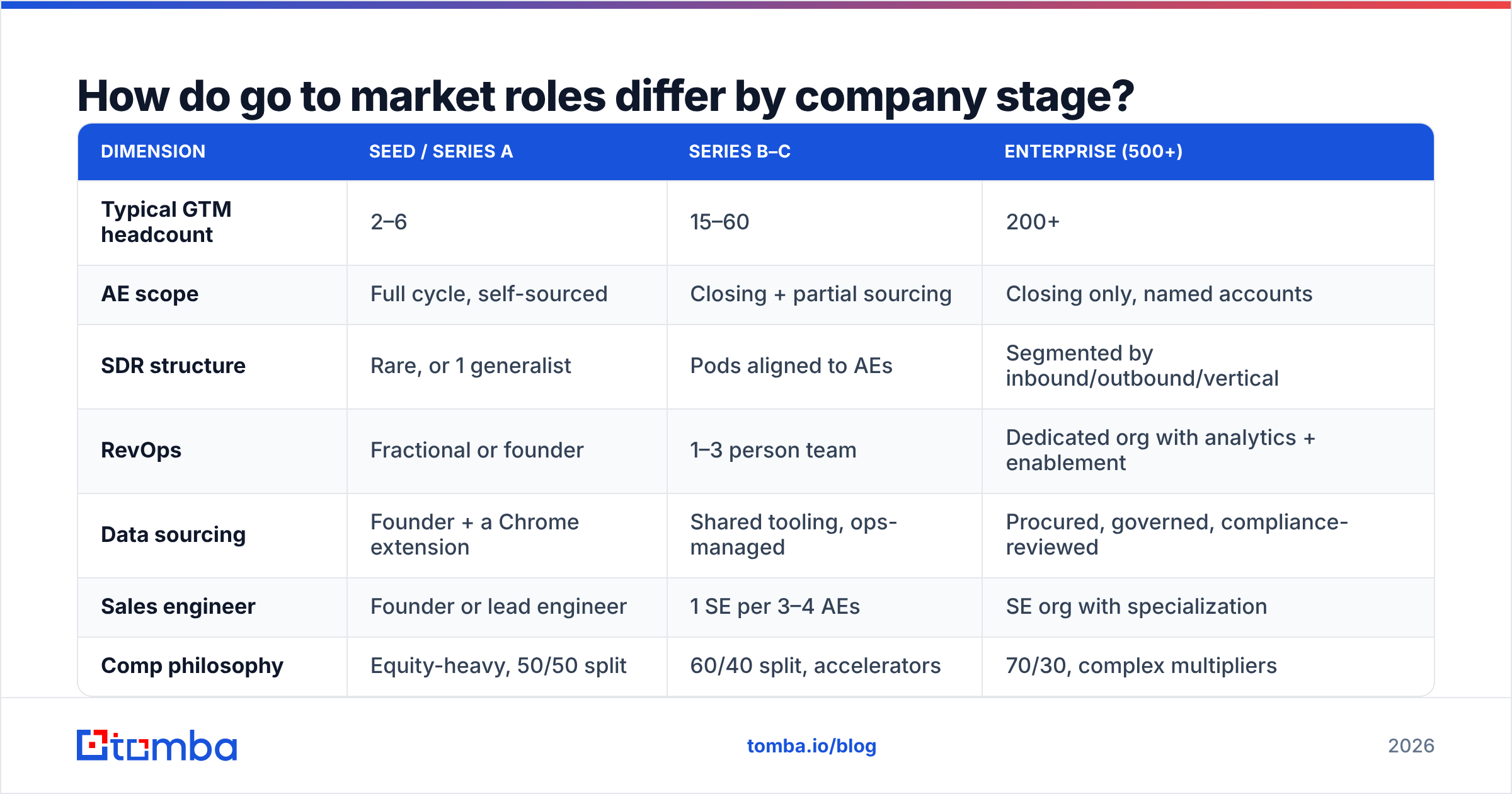
The same title means genuinely different jobs at different scales. An AE at a 12-person startup does their own prospecting, demos, security questionnaires, and onboarding. An AE at a 900-person company does discovery and negotiation, and hands everything else to a specialist.
| Dimension | Seed / Series A | Series B–C | Enterprise (500+) |
|---|---|---|---|
| Typical GTM headcount | 2–6 | 15–60 | 200+ |
| AE scope | Full cycle, self-sourced | Closing + partial sourcing | Closing only, named accounts |
| SDR structure | Rare, or 1 generalist | Pods aligned to AEs | Segmented by inbound/outbound/vertical |
| RevOps | Fractional or founder | 1–3 person team | Dedicated org with analytics + enablement |
| Data sourcing | Founder + a Chrome extension | Shared tooling, ops-managed | Procured, governed, compliance-reviewed |
| Sales engineer | Founder or lead engineer | 1 SE per 3–4 AEs | SE org with specialization |
| Comp philosophy | Equity-heavy, 50/50 split | 60/40 split, accelerators | 70/30, complex multipliers |
The practical takeaway: when you hire, hire for the stage you're in, not the one on your roadmap. A VP Sales from a 400-person company will ask where the enablement team is, and the answer will be "you are it." That mismatch kills more executive hires than skill gaps do.
What does the ops layer actually do?#
RevOps is the least glamorous and most leveraged seat on this list. Their job is to make sure the numbers on the board slide correspond to something real.
Concretely, a RevOps lead owns:
- Lead routing and territory rules — so two reps don't call the same account and no lead sits unclaimed for nine days.
- CRM data hygiene — deduplication, field standardization, and enforcing that "Closed Won" means the same thing to everyone. Data enrichment is usually their responsibility, not the reps'.
- Forecasting and pipeline inspection — building the model that says whether you'll hit the quarter, and being the person willing to say no.
- Tech stack ownership — every tool that touches revenue, plus the budget for it, plus killing the four tools nobody logs into.
- Attribution — an imperfect but necessary answer to which channels produce revenue.
Gartner's research on revenue operations has consistently found that companies with a dedicated RevOps function see meaningfully higher predictability in forecasting than those where ops responsibilities are split across sales and marketing — the effect comes less from any single process than from having one owner of definitional truth. If you want a deeper read on how the function is scoped in practice, HubSpot's RevOps documentation is a reasonable, vendor-neutral-enough starting point, and G2's RevOps software category is useful for seeing which tools cluster around the role.
What's the biggest failure mode across all GTM roles?#
Bad contact data, and it's not close.
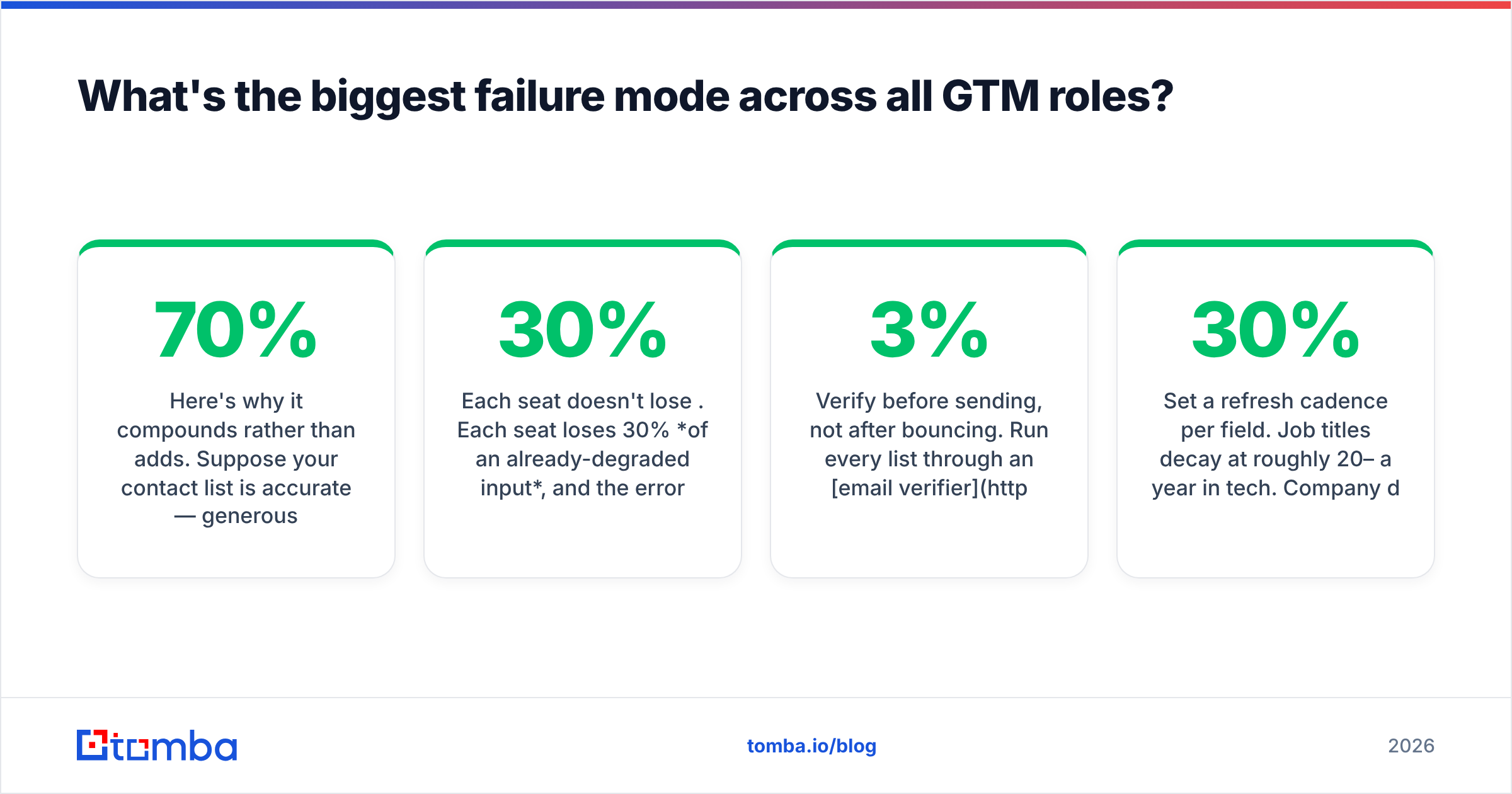
Here's why it compounds rather than adds. Suppose your contact list is 70% accurate — generous for a scraped or aging list. The SDR wastes 30% of their sending volume and damages domain reputation with bounces. The AE inherits meetings booked with people who don't have budget authority, because the title field was stale. RevOps builds a forecast on pipeline that includes accounts that were never real. Marketing computes CAC against a denominator that includes garbage leads and concludes the wrong channel is working.
Each seat doesn't lose 30%. Each seat loses 30% of an already-degraded input, and the errors are correlated — the same bad records poison every downstream decision. That's how a team of six with mediocre data underperforms a team of three with clean data.
The fix is unglamorous and mostly procedural:
- Verify before sending, not after bouncing. Run every list through an email verifier before it enters a sequence. Bounce rates above 3% put your domain at risk with major inbox providers.
- Set a refresh cadence per field. Job titles decay at roughly 20–30% a year in tech. Company data decays slower. Treat them differently.
- Handle catch-all domains explicitly. A large share of B2B domains accept all mail, which means standard verification returns "unknown." A dedicated catch-all verifier is the difference between guessing and knowing on those records.
- Make one person accountable. If data quality is everyone's job, it's nobody's. It belongs to RevOps or the GTM engineer.
- Instrument the decay. Track bounce rate by list source monthly. The source that degrades fastest is the one to replace.
How should you structure comp across GTM roles?#
Short answer: variable pay should scale with how directly the role controls the outcome it's measured on.
- AEs: 50/50 or 60/40 base-to-variable. They control the close. Accelerators above 100% of quota are standard and worth paying.
- SDRs: 70/30 or 80/20. They control activity and meeting quality, not revenue. Paying them on closed revenue creates gaming and resentment when an AE fumbles a good meeting.
- GTM engineers: 80/20 or salary plus bonus. Systems take a quarter to show results; monthly variable pay is a poor fit.
- RevOps: mostly salary, company-performance bonus. You do not want your forecasting function financially incentivized to inflate the forecast.
- CSMs: 85/15, tied to net revenue retention. Renewal-only comp encourages defensive behavior; expansion components encourage growth.
One structural warning: do not pay marketing on MQLs. You will get MQLs. You will not get revenue. Tie demand gen variable pay to qualified opportunities or pipeline created, both of which require sales to agree on the definition — which is itself a healthy forcing function.
What tools does each GTM role need?#
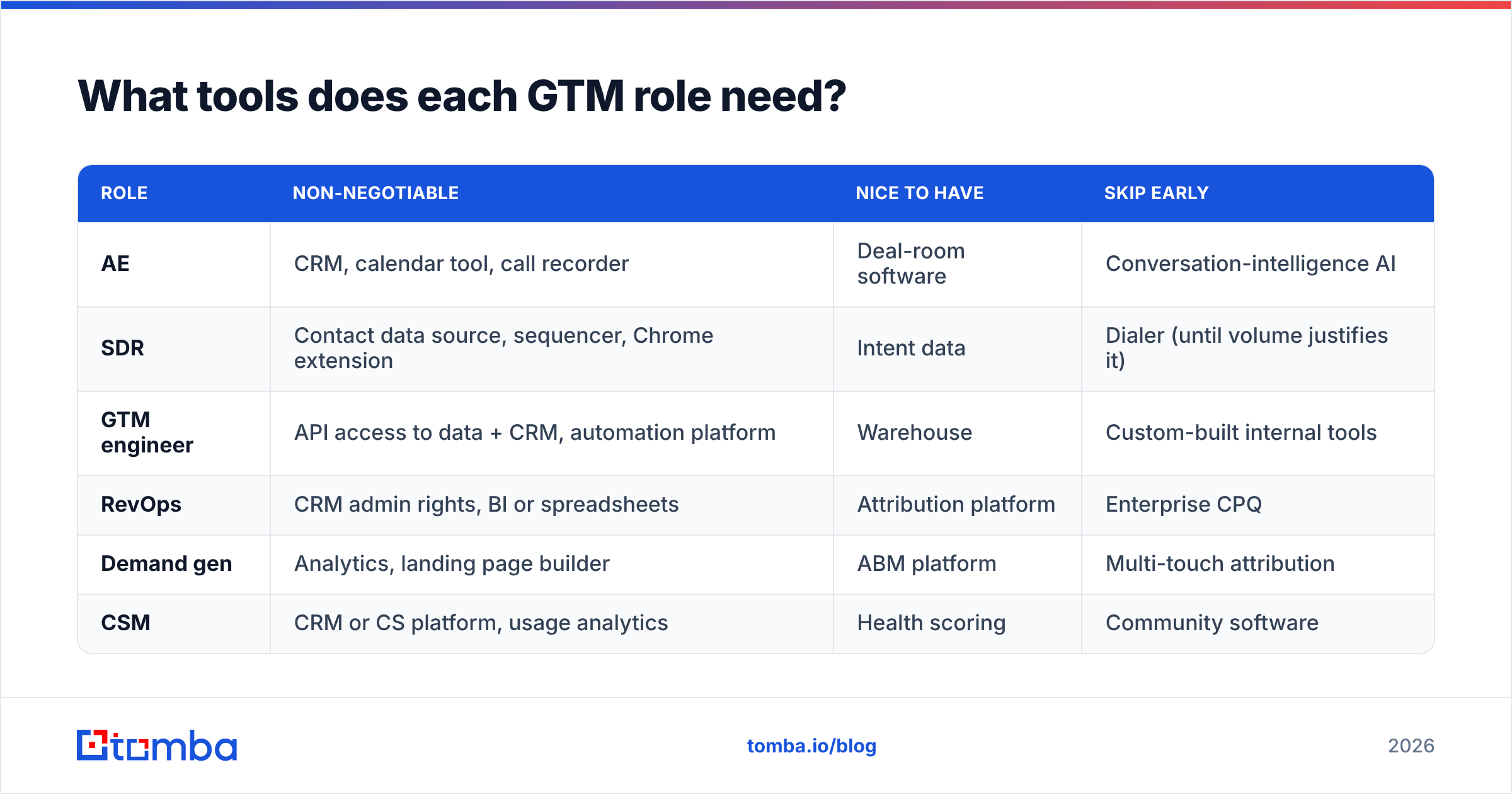
Keep it minimal. Every tool you add is a data-sync problem someone eventually has to own.
| Role | Non-negotiable | Nice to have | Skip early |
|---|---|---|---|
| AE | CRM, calendar tool, call recorder | Deal-room software | Conversation-intelligence AI |
| SDR | Contact data source, sequencer, Chrome extension | Intent data | Dialer (until volume justifies it) |
| GTM engineer | API access to data + CRM, automation platform | Warehouse | Custom-built internal tools |
| RevOps | CRM admin rights, BI or spreadsheets | Attribution platform | Enterprise CPQ |
| Demand gen | Analytics, landing page builder | ABM platform | Multi-touch attribution |
| CSM | CRM or CS platform, usage analytics | Health scoring | Community software |
The pattern: everyone needs the CRM and a reliable contact-data source. Almost nobody at an early stage needs the category-leading enterprise tool. Buy the cheap version, outgrow it visibly, then upgrade.
Where should you start?#
Pick the weakest of the five questions at the top of this post and staff it. If you don't know which is weakest, it's almost always question five — nobody can tell you what's working, so every hiring decision after that is a guess.
Then fix the data before you add headcount. A GTM team is a machine that converts contact records into revenue, and no amount of talent compensates for feeding it broken inputs. Start by making sure the names, emails, and companies your reps work from are real.
That's where Tomba's Email Finder fits. It finds verified professional emails by domain, name, or company, so your SDRs aren't sending into the void and your RevOps lead isn't forecasting on ghosts. The free tier gives you 25 searches a month to test accuracy against a list you already know the answer to — which is exactly how you should evaluate any data vendor. Paid plans start at $49/mo, and you can see full Tomba pricing before committing. Verify the data first, then hire against it.
Related guides#
Ready to find emails that actually work?
Join 150,000+ professionals who stopped guessing and started sending. Free credits on signup — no credit card required.
Get the Tomba newsletter
Practical outbound tactics and product updates — once every two weeks.
About the author