Go To Market Sales Strategy: The 2026 Operator's Playbook
Most GTM plans fail at the sales layer, not the strategy deck. Here's how to build a go to market sales strategy with real segments, motions, and data that closes.
TL;DR
- A go to market sales strategy is not a positioning deck. It's four decisions: who you sell to, which motion reaches them, what it costs to acquire them, and which data feeds the whole thing.
- Pick one primary motion per segment. Teams that run sales-led, product-led, and partner-led simultaneously at under $10M ARR usually execute all three badly.
- Your CAC payback target sets your motion. Under 12 months supports an inside sales team; over 24 months means you need self-serve or channel.
- The data layer is the silent killer. A 30% bounce rate on your prospect list doesn't cost you 30% of pipeline — it costs your sending domain, which costs you everything.
- Build a 90-day validation loop before you hire. One rep, 200 verified contacts, measured reply rate. Then scale what worked.
What is a go to market sales strategy?#
A go to market sales strategy is the operational plan that connects your product to a specific buyer through a specific, repeatable revenue motion. Marketing GTM answers "how do people hear about us." Sales GTM answers "how does a qualified conversation become a signed contract, at what cost, and how many times per quarter can we do it."
The distinction matters because most GTM documents stop at positioning. They define the ICP in two adjectives ("mid-market SaaS"), name three personas, and hand the rest to a VP of Sales who discovers in month four that the ICP is 40,000 companies wide and nobody built a list.
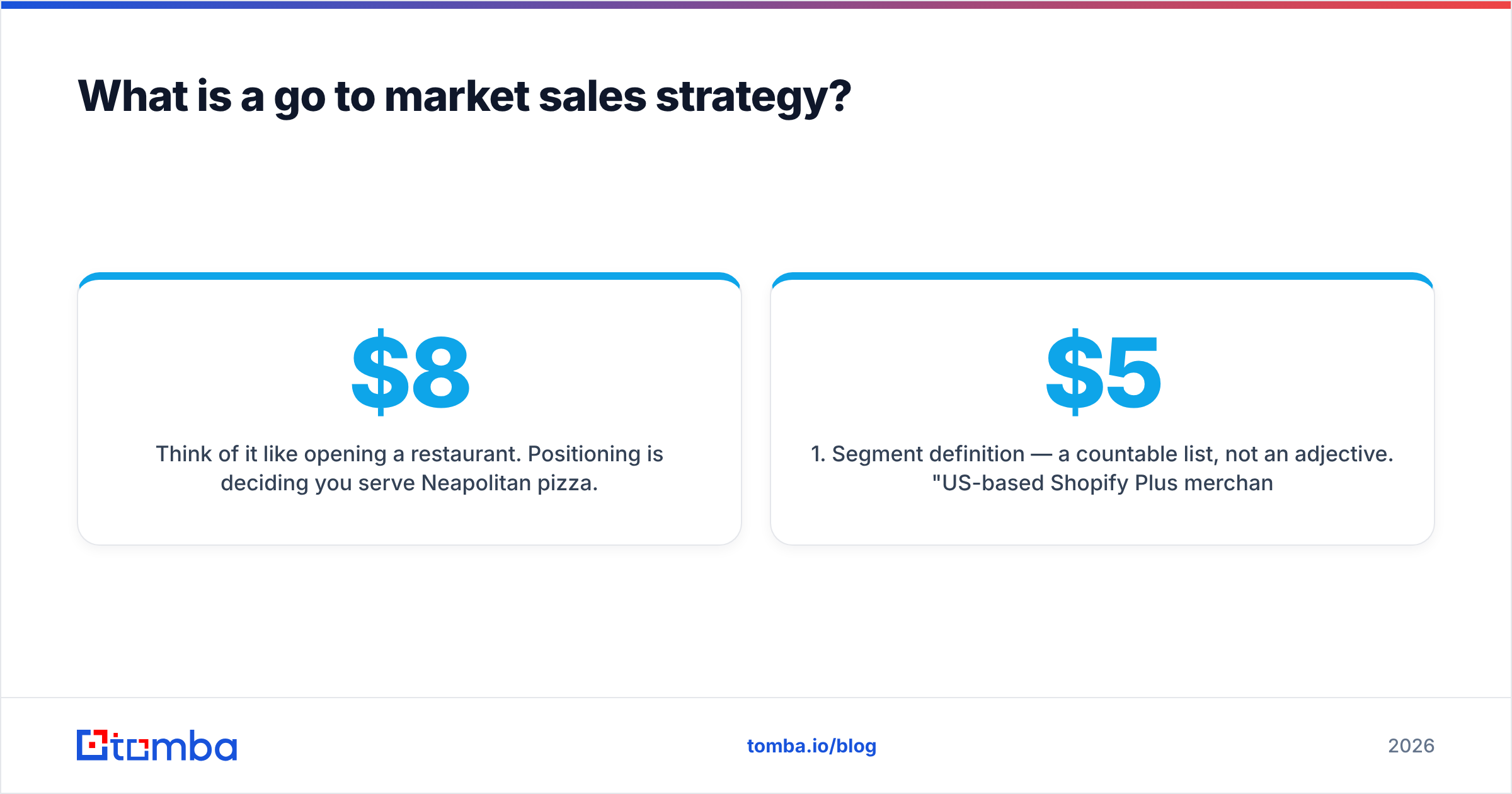
Think of it like opening a restaurant. Positioning is deciding you serve Neapolitan pizza. GTM sales strategy is deciding you serve it at lunch to office workers within a six-block radius, that you'll reach them through a delivery app rather than walk-ins, that each customer costs $8 to acquire and spends $22, and that you need a supplier who can deliver 400 dough balls by 9am every day. The second document is the one that determines whether you're open in two years.
A complete go to market sales strategy has five components:
- Segment definition — a countable list, not an adjective. "US-based Shopify Plus merchants doing $5-50M GMV with an in-house marketing team" is 2,800 companies you can name. "E-commerce brands" is not a segment.
- Motion selection — sales-led, product-led, partner-led, or community-led. One primary per segment, with a clearly subordinate secondary.
- Unit economics — CAC, CAC payback period, ACV, and sales cycle length. These four numbers determine which motion you can actually afford.
- Coverage model — how many accounts per rep, how many touches per account, across which channels, at what cadence.
- Data infrastructure — the contact records, enrichment, and verification that make the coverage model executable rather than aspirational.
Most teams write components 1 and 2, gesture at 3, and skip 4 and 5 entirely. Then they wonder why the strategy "didn't work."
Which GTM motion should you choose?#
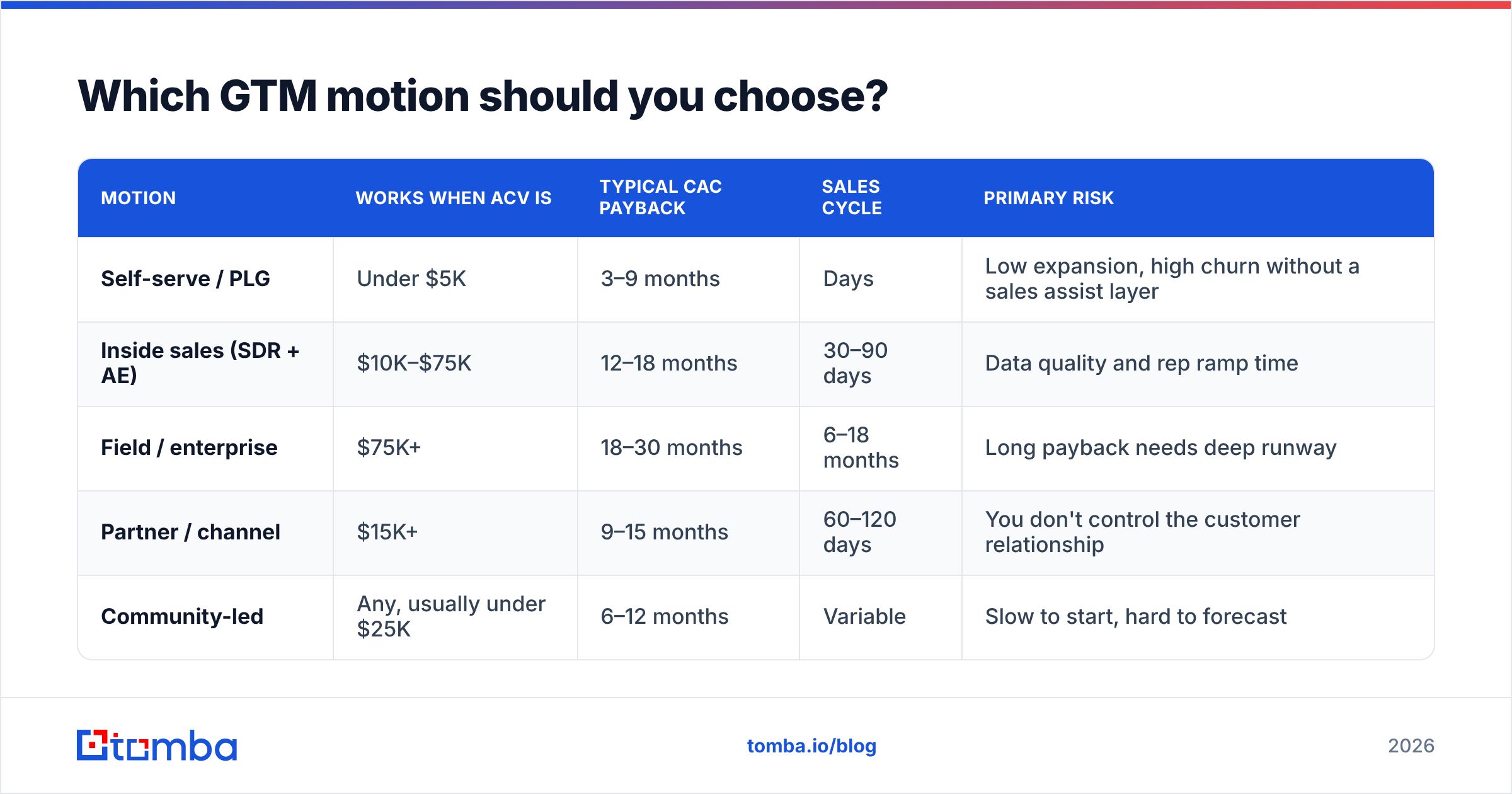
Choose based on ACV and buyer behavior, not on what worked at your last company. The motion has to be affordable at your contract size — that's a math constraint, not a preference.
| Motion | Works when ACV is | Typical CAC payback | Sales cycle | Primary risk |
|---|---|---|---|---|
| Self-serve / PLG | Under $5K | 3–9 months | Days | Low expansion, high churn without a sales assist layer |
| Inside sales (SDR + AE) | $10K–$75K | 12–18 months | 30–90 days | Data quality and rep ramp time |
| Field / enterprise | $75K+ | 18–30 months | 6–18 months | Long payback needs deep runway |
| Partner / channel | $15K+ | 9–15 months | 60–120 days | You don't control the customer relationship |
| Community-led | Any, usually under $25K | 6–12 months | Variable | Slow to start, hard to forecast |
The failure pattern is running an inside sales motion on a $3K ACV product. A fully loaded SDR plus AE costs roughly $18–22K per month in the US. At $3K ACV and a 20% close rate on qualified meetings, you need something like 40 qualified conversations a month just to break even before payback. That's not a strategy problem, it's an arithmetic problem.
The inverse fails too. Enterprise buyers with $200K budgets don't self-serve, and a PLG funnel aimed at them produces a lot of free-tier signups from junior analysts who have no purchasing authority. Gartner's B2B buying research consistently finds enterprise deals involve six to ten decision-makers — that's a buying committee, and committees don't convert on a credit card form.
How do you validate a motion before scaling it?#
Run a 90-day test with a deliberately small footprint:
- Days 1–15: Build a list of exactly 200 accounts inside your defined segment. Not 2,000. Two hundred, hand-checked.
- Days 16–30: Enrich and verify. Find the actual decision-maker, get a validated email, confirm the company still matches your criteria. Expect to lose 15–25% of the list here — that's the process working.
- Days 31–75: One rep, one sequence, full coverage. Measure reply rate, meeting rate, and meeting-to-opportunity rate separately. Aggregate "conversion" hides where the funnel actually breaks.
- Days 76–90: Read the numbers. Under a 4% reply rate on a well-verified list means your message or segment is wrong. Over 8% with meetings converting means you have something worth hiring against.
The reason this loop works is that it separates three failure modes that otherwise look identical from the dashboard: bad data, bad targeting, and bad messaging. If your emails bounce, it's data. If they deliver and get ignored, it's targeting or messaging. If they get replies but no meetings, it's your offer.
Why does the data layer decide whether your GTM works?#
Because every motion above the self-serve tier depends on reaching a named human, and reaching a named human depends on having a correct email address for them. This is the least glamorous part of a go to market sales strategy and the part that most reliably kills it.
Here's the compounding problem. B2B contact data decays at roughly 25–30% per year — people change jobs, companies rebrand, domains migrate. A list you bought in January is materially wrong by October. When you send to that decayed list, three things happen at once:
- Hard bounces spike. Mailbox providers read bounce rate as a spam signal. Above 2%, your sender reputation starts degrading. Above 5%, you're in real trouble.
- Spam traps get hit. Abandoned addresses get recycled as traps. One hit from a pristine trap can blacklist your domain outright.
- Your good emails stop landing. This is the part teams miss. Poor email deliverability doesn't just hurt the bad addresses — it moves your entire outbound program to the spam folder, including the 70% of contacts who were valid.
So a "30% bad data" problem isn't a 30% performance hit. It's a cliff. Your reply rate goes from 6% to 0.8% and the dashboard tells you the messaging is broken when the messaging was fine.

The fix is procedural, not heroic. Verify before every send, not once at list-build time. Re-verify anything older than 90 days. Route catch-all domains to a separate, lower-volume sequence rather than blasting them with the main list — a catch-all verifier tells you which of those addresses actually resolve. And segment your sending so that a bad batch can't take down your primary domain.
What does the data stack actually cost?#
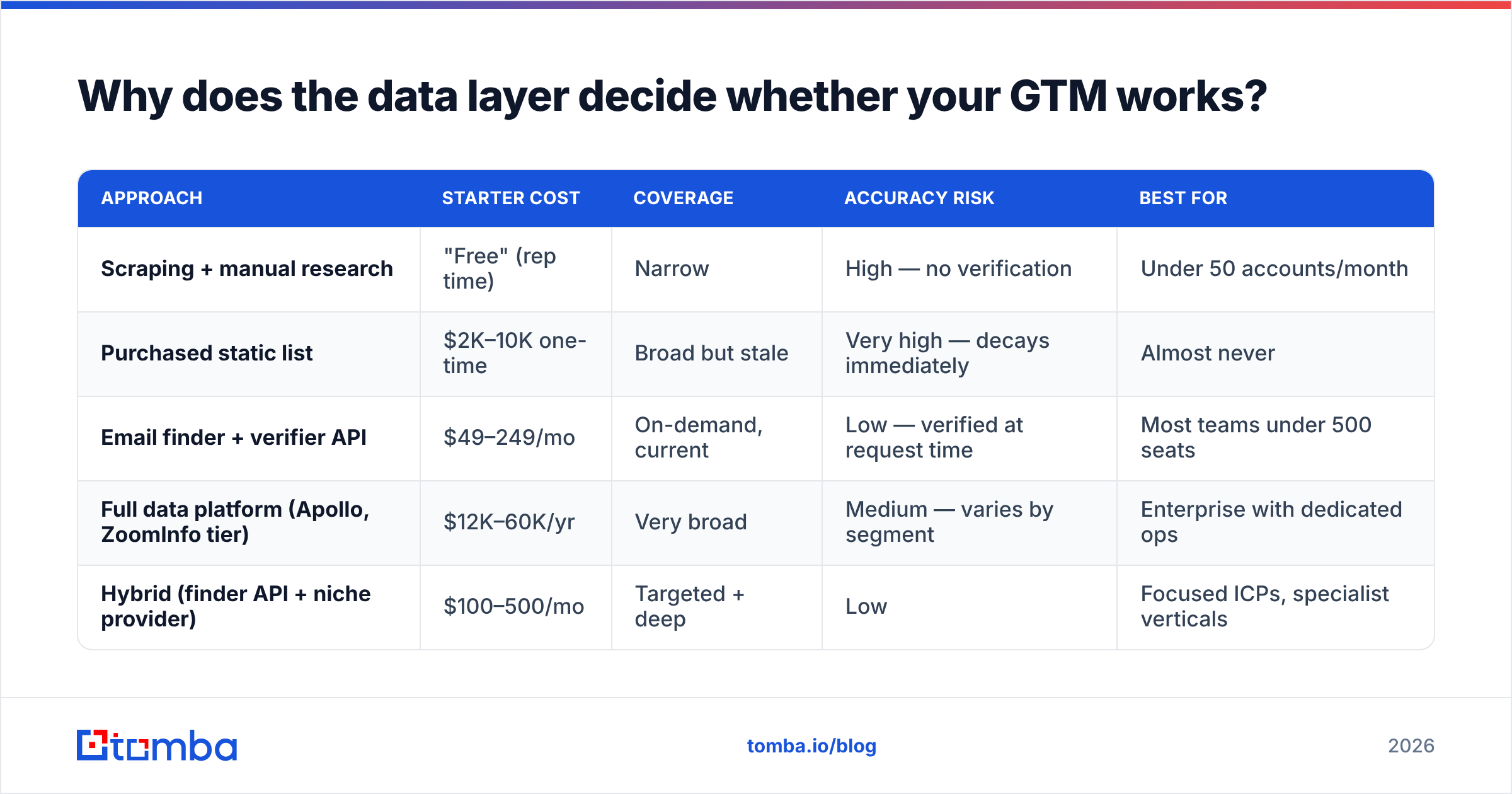
Build-vs-buy on GTM data is where budgets get lit on fire. The honest comparison:
| Approach | Starter cost | Coverage | Accuracy risk | Best for |
|---|---|---|---|---|
| Scraping + manual research | "Free" (rep time) | Narrow | High — no verification | Under 50 accounts/month |
| Purchased static list | $2K–10K one-time | Broad but stale | Very high — decays immediately | Almost never |
| Email finder + verifier API | $49–249/mo | On-demand, current | Low — verified at request time | Most teams under 500 seats |
| Full data platform (Apollo, ZoomInfo tier) | $12K–60K/yr | Very broad | Medium — varies by segment | Enterprise with dedicated ops |
| Hybrid (finder API + niche provider) | $100–500/mo | Targeted + deep | Low | Focused ICPs, specialist verticals |
The "free" option is the most expensive one. A rep spending 12 hours a week manually researching contacts at a $90K fully loaded cost is burning roughly $27K a year on data entry — and producing unverified addresses anyway.
Where a specialist provider earns its keep: if your ICP is a specific vertical with unusual firmographics, a niche database like BookYourData can deliver depth in that segment that broad platforms miss, and it's worth pricing against a general provider rather than assuming the bigger vendor wins.
For most teams, the practical setup is an on-demand email finder that resolves contacts at the moment you need them, wired into your CRM so records enrich automatically. Tomba's Tomba pricing starts with a free tier at 25 searches/month, Starter at $49/mo, Growth at $99/mo, and Pro at $249/mo — which puts a verified-data workflow inside the budget of a two-person GTM team, not just a funded ops department.
How do you build the coverage model?#
Coverage is the arithmetic that turns your segment into a weekly rep activity plan. Skip it and your team defaults to whatever's easiest — which is usually re-touching the same 40 warm accounts.
Work backwards from the revenue target:
- Start with the number. $2M new ARR next year at $25K ACV = 80 closed deals.
- Apply close rate. At 22% opportunity-to-close, that's 364 opportunities.
- Apply meeting-to-opp rate. At 45%, that's 809 first meetings.
- Apply reply-to-meeting rate. At 35%, that's 2,311 positive replies needed.
- Apply reply rate. At 6% on verified data, that's roughly 38,500 outbound contacts touched — across all channels, all year.
Now check whether your segment is even big enough. If your defined ICP is 2,800 companies with an average of 2.5 relevant contacts each, that's 7,000 people. To hit 38,500 touches you'd need roughly 5.5 touches per person per year, which is reasonable. If your ICP is 400 companies, the math doesn't close and you need to either expand the segment, raise ACV, or change the motion.
This is also where the data layer becomes concrete rather than abstract. Building a list of 7,000 verified contacts across 2,800 companies is a domain search job, not a manual one. Run the domains, pull the patterns, verify the results, load the CRM.
Three coverage rules that hold across most B2B teams:
- Multi-threading beats single-threading. Touch two to three contacts per account, not one. Forrester's B2B research has documented buying-group expansion for years — a single champion is a single point of failure.
- Channel mix beats channel volume. Email plus LinkedIn plus phone outperforms triple the email volume, and it protects your domain.
- Cadence density matters more than duration. Eight touches over three weeks beats eight touches over twelve weeks. Buyer memory is short.
How do you know if the strategy is working?#
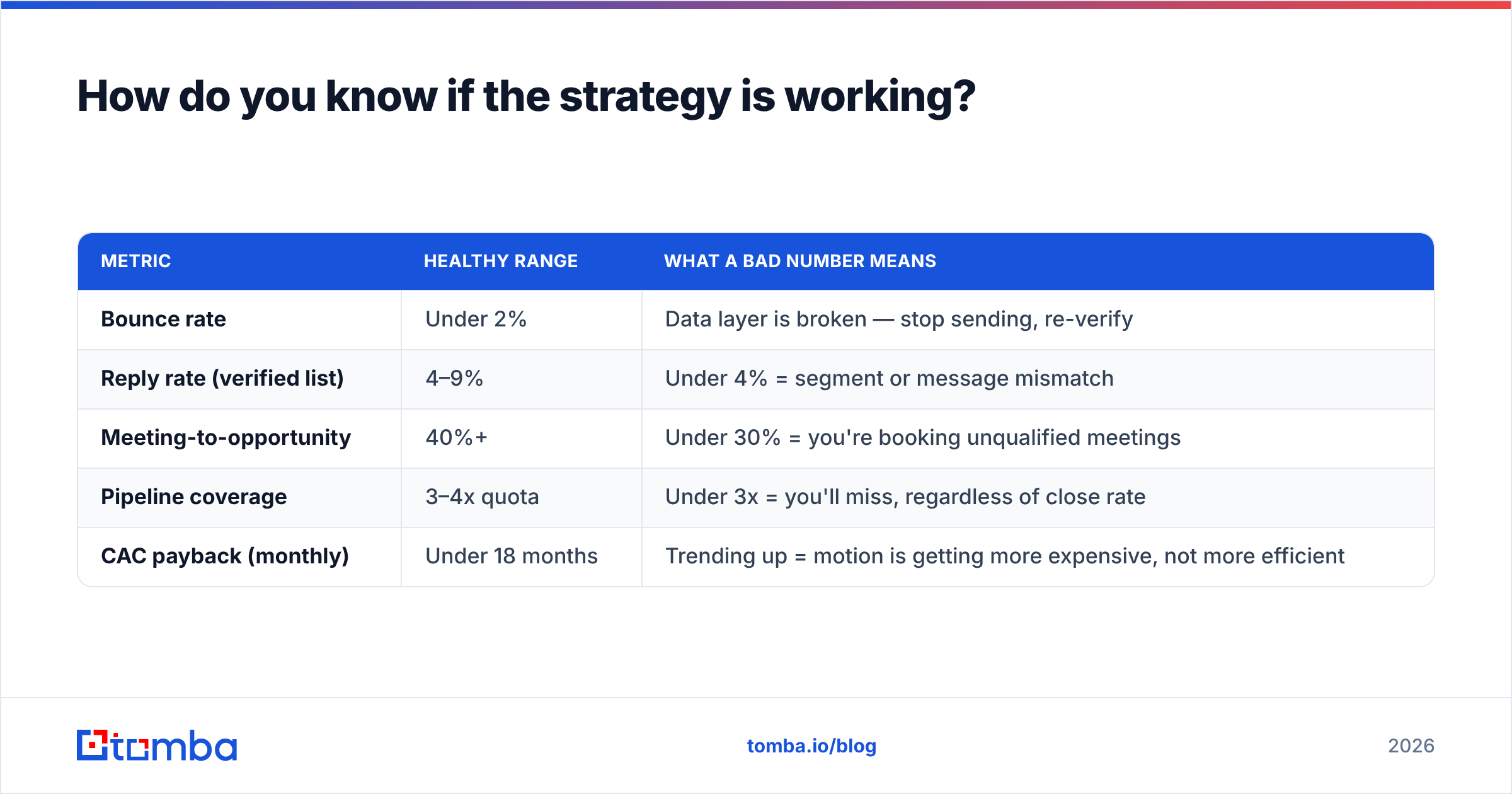
Track four leading indicators weekly and one lagging indicator monthly. More than that and nobody reads the dashboard.
| Metric | Healthy range | What a bad number means |
|---|---|---|
| Bounce rate | Under 2% | Data layer is broken — stop sending, re-verify |
| Reply rate (verified list) | 4–9% | Under 4% = segment or message mismatch |
| Meeting-to-opportunity | 40%+ | Under 30% = you're booking unqualified meetings |
| Pipeline coverage | 3–4x quota | Under 3x = you'll miss, regardless of close rate |
| CAC payback (monthly) | Under 18 months | Trending up = motion is getting more expensive, not more efficient |
The trap is optimizing the metric closest to the rep. Teams push activity volume because it's controllable, and activity volume is the metric most weakly correlated with revenue. If your reply rate is 2%, sending twice as many emails gets you a 2% reply rate on a damaged domain.
Check the sequence instead: is the data clean, is the segment right, is the message specific, is the offer worth a meeting. In that order. Each one is upstream of the next, and fixing a downstream problem while an upstream one is live wastes the quarter.
What should you do in your first 30 days?#
If you're building or rebuilding a go to market sales strategy right now:
- Count your segment. Not describe it — count it. If you can't produce a number, you don't have a segment yet.
- Run the coverage math. Revenue target → deals → opportunities → meetings → replies → touches. See if the segment supports the number.
- Audit your existing list. Run your current CRM contacts through verification. The bounce rate you find will tell you how much of your last quarter's underperformance was data.
- Pick one motion. Write down the second motion you're explicitly not running this year. Naming what you're not doing is most of the discipline.
- Ship the 90-day validation loop before you hire the team.
None of this requires a new CRM, a consultant, or a rebrand. It requires a countable segment, honest unit economics, and a contact list you can trust.
Start with the list. If you're spending rep hours on manual contact research or sending to addresses you haven't verified this quarter, that's the cheapest fix on the board. Tomba's Email Finder resolves verified professional emails by domain, name, or company — free tier at 25 searches/month to test the workflow on your first 200 accounts, and $49/mo Starter when the loop proves out. Get the data layer right, and the rest of the go to market sales strategy is just arithmetic you can actually execute.
Related guides#
Ready to find emails that actually work?
Join 150,000+ professionals who stopped guessing and started sending. Free credits on signup — no credit card required.
Get the Tomba newsletter
Practical outbound tactics and product updates — once every two weeks.
About the author