Go To Market Strategist: Role, Skills, and Salary in 2026
A go to market strategist decides which segments you attack, what you say, and which channel carries it. Here is what the role actually owns, how it differs from product marketing, and the stack it runs on.
TL;DR
- A go to market strategist owns the decision layer above execution: which segment you attack, what promise you make, which channel carries it, and what proof says it worked.
- The role is not product marketing, not demand gen, and not RevOps — but it borrows the sharp edges of all three and sits closest to RevOps in reporting lines.
- Median US compensation in 2026 runs roughly $135K–$185K base for senior individual contributors, with director-level GTM strategy roles clearing $200K+ base in enterprise SaaS.
- The job is measurable. Segment win rate, pipeline-per-segment, CAC payback by motion, and time-to-first-revenue on a new launch are the four numbers that survive a board review.
- Everything downstream breaks if the contact data is wrong. Strategy without a clean, verified list is a slide deck.
What is a go to market strategist?#
A go to market strategist decides how a company turns a product into revenue — which buyers, which message, which motion, in which order.
Think of a restaurant opening. The chef builds the menu (product). The servers take orders (sales). The go to market strategist is the person who decided the place should be a 40-seat neighborhood bistro serving dinner only, priced at $38 a plate, marketed to people within a 15-minute walk — instead of a 200-seat lunch cafeteria downtown. Every downstream execution decision inherits that call.
Technically, the strategist owns a set of interlocking choices:
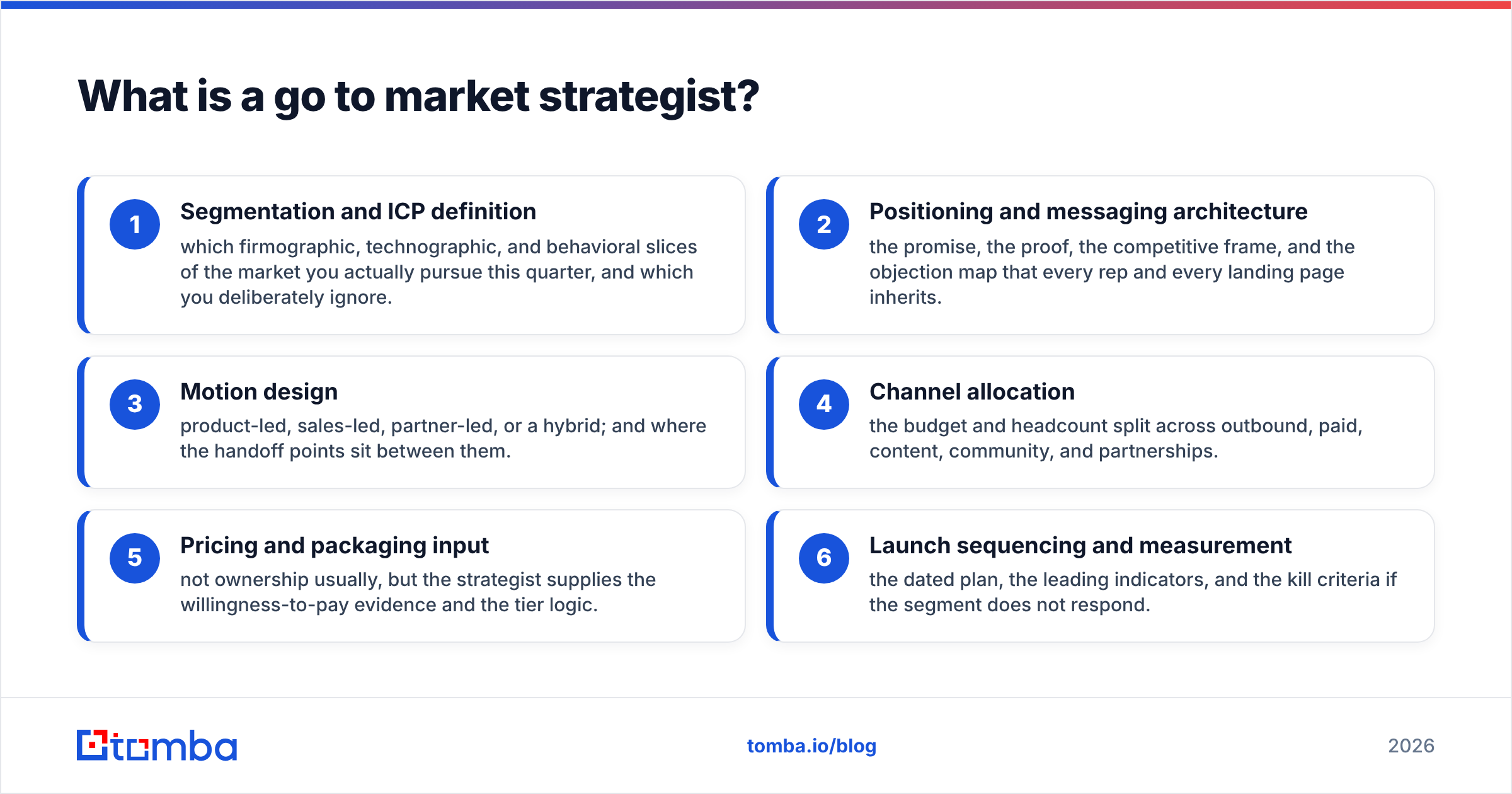
- Segmentation and ICP definition — which firmographic, technographic, and behavioral slices of the market you actually pursue this quarter, and which you deliberately ignore.
- Positioning and messaging architecture — the promise, the proof, the competitive frame, and the objection map that every rep and every landing page inherits.
- Motion design — product-led, sales-led, partner-led, or a hybrid; and where the handoff points sit between them.
- Channel allocation — the budget and headcount split across outbound, paid, content, community, and partnerships.
- Pricing and packaging input — not ownership usually, but the strategist supplies the willingness-to-pay evidence and the tier logic.
- Launch sequencing and measurement — the dated plan, the leading indicators, and the kill criteria if the segment does not respond.
The distinguishing trait is that a strategist writes things down that constrain other people's work. If your recommendations do not change anyone's calendar next Monday, you are doing market research, not go-to-market strategy.
How is a go to market strategist different from product marketing or RevOps?#
They overlap heavily, and in companies under 100 people they are often the same human. At scale they separate cleanly.
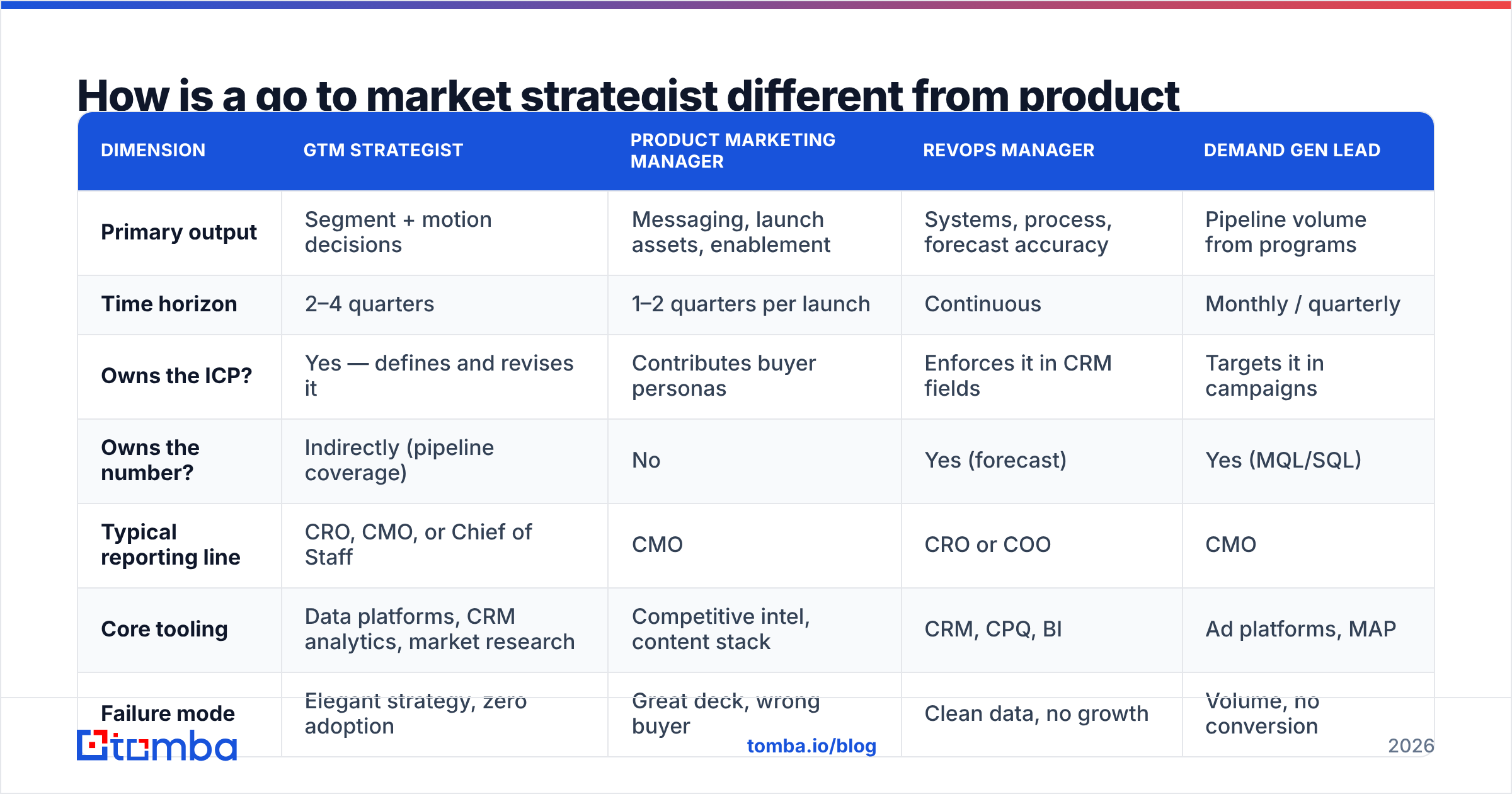
| Dimension | GTM Strategist | Product Marketing Manager | RevOps Manager | Demand Gen Lead |
|---|---|---|---|---|
| Primary output | Segment + motion decisions | Messaging, launch assets, enablement | Systems, process, forecast accuracy | Pipeline volume from programs |
| Time horizon | 2–4 quarters | 1–2 quarters per launch | Continuous | Monthly / quarterly |
| Owns the ICP? | Yes — defines and revises it | Contributes buyer personas | Enforces it in CRM fields | Targets it in campaigns |
| Owns the number? | Indirectly (pipeline coverage) | No | Yes (forecast) | Yes (MQL/SQL) |
| Typical reporting line | CRO, CMO, or Chief of Staff | CMO | CRO or COO | CMO |
| Core tooling | Data platforms, CRM analytics, market research | Competitive intel, content stack | CRM, CPQ, BI | Ad platforms, MAP |
| Failure mode | Elegant strategy, zero adoption | Great deck, wrong buyer | Clean data, no growth | Volume, no conversion |
The cleanest mental separation: revenue operations makes the machine run reliably; the go to market strategist decides what the machine should be pointed at. Product marketing translates the strategist's decision into language a buyer understands.
In practice, strong strategists come from three feeder paths — management consulting (structure, market sizing), product marketing (buyer empathy, message testing), and sales leadership (deal reality, objection depth). The consultants tend to overbuild frameworks. The sales leads tend to underweight the market data. The product marketers land in the middle most often, which is why the role increasingly reports into the CMO office at Series B and beyond.
What does a go to market strategist actually do week to week?#
Strip the title away and the work looks like this:
Weeks 1–2 of a cycle: evidence gathering. Win/loss interviews, CRM cohort pulls, pricing objection tallies, competitive teardowns. You are looking for the gap between what you assumed about the buyer and what the closed-won data says. A strategist who has not personally listened to ten sales calls this quarter is guessing.
Week 3: segment scoring. You build or refresh a scored account universe. This is where the job becomes unglamorous — you need firmographics, tech stack signals, headcount growth, funding events, and a reachable contact for each account. Most strategy work stalls here, because the account list exists in a spreadsheet and the contacts do not.
Week 4: the recommendation. One page. Segment, why now, the message, the motion, the budget, and the kill criteria. If it takes twelve slides, the thinking is not finished.
Ongoing: instrumentation. Every recommendation ships with the two or three metrics that will prove or kill it inside 90 days. Nobody trusts a GTM strategy that cannot be falsified.
The uncomfortable truth is that step 3 consumes 50–60% of the calendar in most organizations. Building a scored, contactable account universe is a data problem wearing a strategy costume. Teams that solve it with tooling — a B2B database for the account layer, a bulk email finder for the contact layer — buy back weeks of strategist time per quarter.
What skills and background does the role require?#
Rank these by how often they show up in real job requirements:
- Quantitative market sizing. TAM/SAM/SOM that survives a CFO's questions. Bottom-up beats top-down every time — count accounts, multiply by realistic ACV, discount by reachable coverage.
- Segmentation modeling. Cluster accounts by behavior and value, not just by employee count. The best segments are defined by a shared trigger, not a shared size band.
- Message testing discipline. Run the positioning against real buyers before it hits the website. Landing page splits, cold email subject variants, and sales call A/Bs are all valid instruments.
- Financial literacy. CAC payback, LTV:CAC by segment, gross margin by motion, and the sensitivity of each to pricing changes. You will be challenged on these in every planning cycle.
- Data operations fluency. You do not need to write production SQL, but you need to pull cohorts, join sources, and know when a data set is too dirty to trust.
- Narrative construction. The strategy only exists if other people can repeat it back accurately. Write for a rep on their fourth call of the day, not for the board.
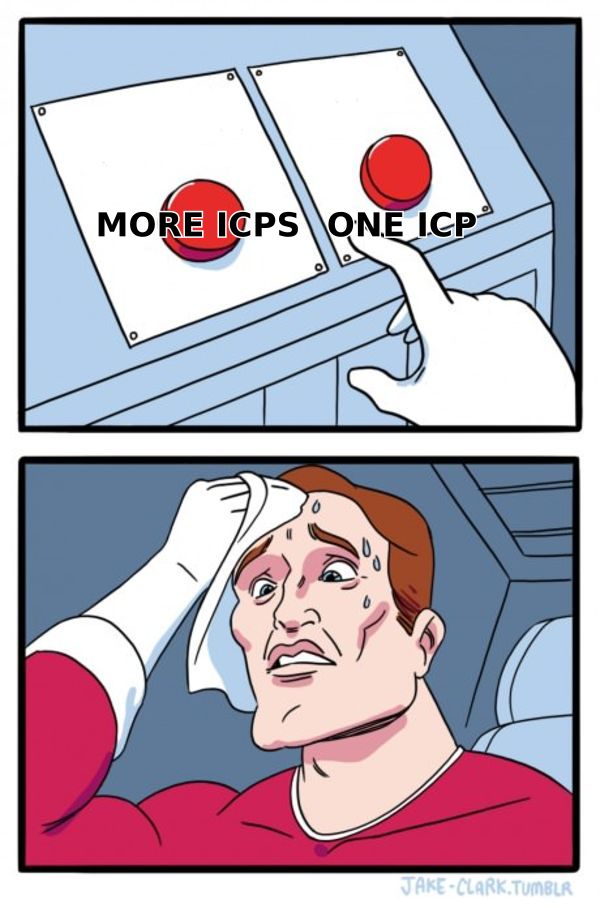
Missing from most job descriptions but decisive in practice: the willingness to say no to a segment publicly. Strategy is subtraction. A strategist who expands the ICP every quarter to avoid conflict is not doing the job.
What does the go to market strategist tech stack look like in 2026?#
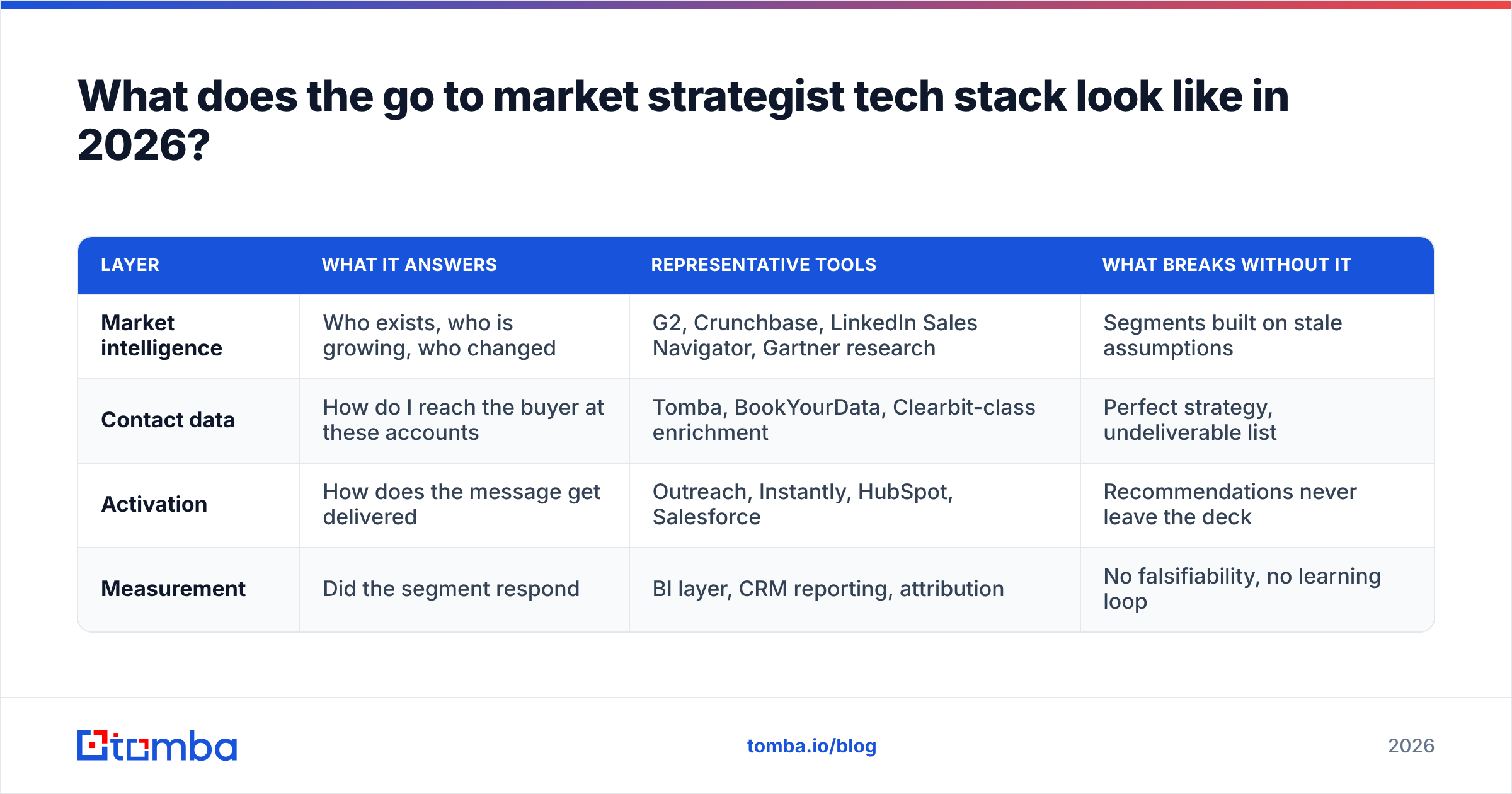
The stack has consolidated. Four layers, and you need coverage in each:
| Layer | What it answers | Representative tools | What breaks without it |
|---|---|---|---|
| Market intelligence | Who exists, who is growing, who changed | G2, Crunchbase, LinkedIn Sales Navigator, Gartner research | Segments built on stale assumptions |
| Contact data | How do I reach the buyer at these accounts | Tomba, BookYourData, Clearbit-class enrichment | Perfect strategy, undeliverable list |
| Activation | How does the message get delivered | Outreach, Instantly, HubSpot, Salesforce | Recommendations never leave the deck |
| Measurement | Did the segment respond | BI layer, CRM reporting, attribution | No falsifiability, no learning loop |
The contact-data layer is where GTM strategies quietly die. You can define a beautiful segment of 2,400 mid-market logistics companies running a specific WMS, and then discover that 40% of your contact records bounce. Bounce rates above 3% start damaging sender reputation, which means your next three campaigns underperform regardless of how good the positioning is.
That is why serious strategists treat verification as a strategy dependency, not an ops chore. Running your target list through an email verifier before launch is a five-minute step that protects the entire quarter's test. If your segment is defined by company rather than by individual, domain search gets you the full contact map at each target account, which is usually what a segment test actually needs.
On budget: a two-person GTM strategy function typically runs $400–$900/month in data tooling. Tomba pricing sits at $49/mo for Starter, $99/mo Growth, and $249/mo Pro, with a free tier of 25 searches for pressure-testing a hypothesis before committing budget. BookYourData takes a different approach — prepaid list credits with a per-record model — which suits teams doing one large annual list build rather than continuous weekly enrichment. Both are legitimate; the choice depends on whether your GTM cadence is bursty or continuous.
How much does a go to market strategist earn in 2026?#
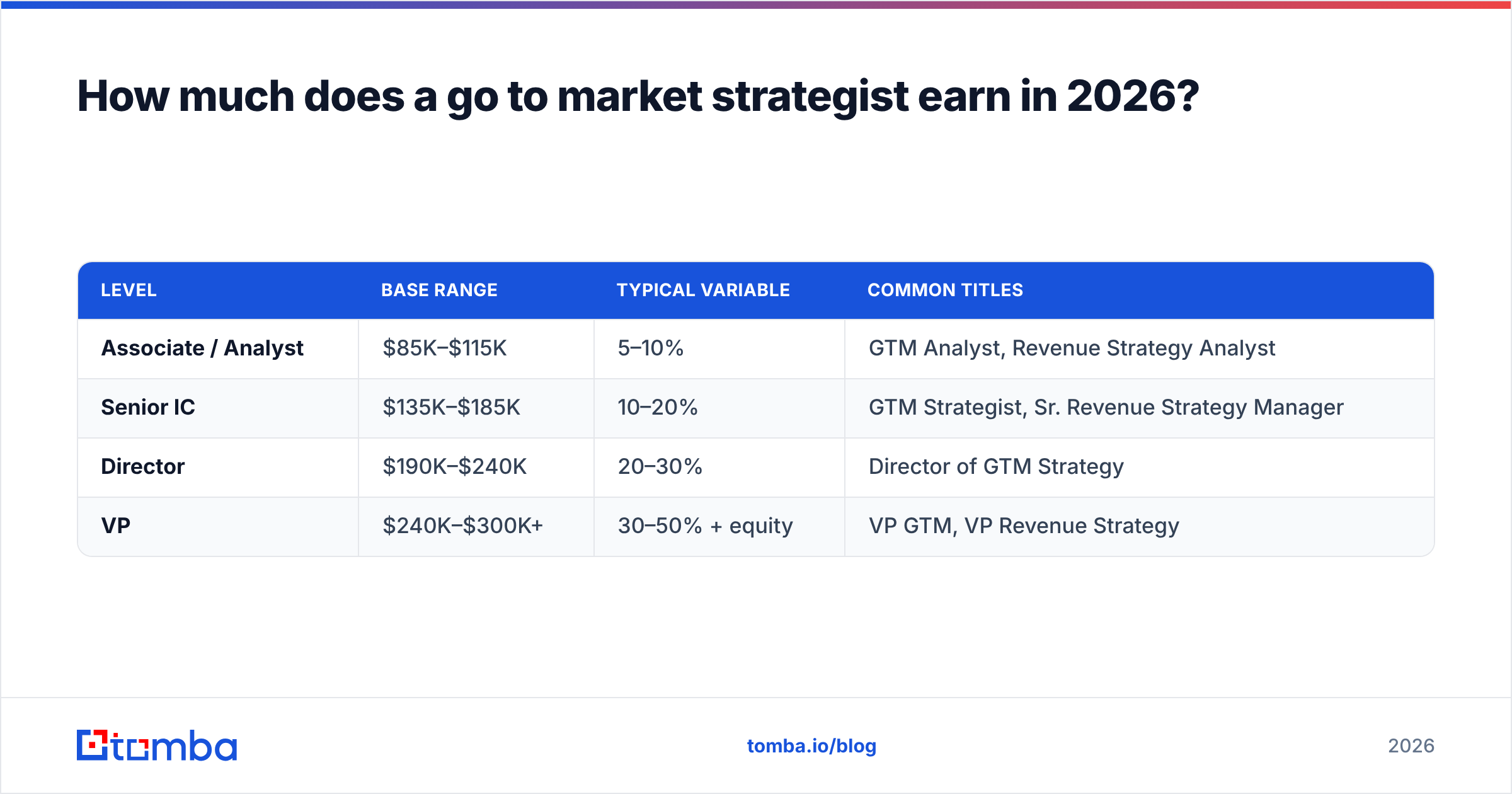
Compensation varies more by company stage than by title, which makes posted salary bands misleading. Broad US ranges:
| Level | Base range | Typical variable | Common titles |
|---|---|---|---|
| Associate / Analyst | $85K–$115K | 5–10% | GTM Analyst, Revenue Strategy Analyst |
| Senior IC | $135K–$185K | 10–20% | GTM Strategist, Sr. Revenue Strategy Manager |
| Director | $190K–$240K | 20–30% | Director of GTM Strategy |
| VP | $240K–$300K+ | 30–50% + equity | VP GTM, VP Revenue Strategy |
Three modifiers move these numbers materially. Enterprise SaaS pays 15–25% above PLG-heavy companies for the same title, because the segmentation work carries more revenue per decision. Post-Series-C companies pay more base and less equity than seed-stage ones. And strategists with direct forecast accountability — where the number lands on their scorecard, not just their influence — command roughly a 20% premium over pure-advisory roles.
If you are hiring, the signal to test in an interview is not framework knowledge. Ask the candidate to describe a segment they killed and what evidence killed it. Candidates who have only ever expanded scope have not been forced to make the hard half of the decision.
How do you measure whether the go to market strategy is working?#
Four metrics, checked quarterly, that hold up under scrutiny:
- Win rate by segment, not blended. A blended win rate hides everything. If Segment A closes at 28% and Segment B at 6%, the strategy question answers itself.
- CAC payback by motion. Outbound, inbound, and partner motions have wildly different payback curves. Averaging them produces a number that describes no actual motion you run.
- Time to first revenue on a new segment. From launch date to first closed-won. If it exceeds two sales cycles, the segment probably was not real.
- Pipeline coverage in the target segment specifically. Total coverage can look healthy while your priority segment starves — which means reps are quietly reverting to the old ICP.
Add one leading indicator: reply rate in the target segment versus your baseline. A strategist can read the market's verdict on new positioning within three weeks of outbound, long before any deal closes. If the response rate in the new segment is at or below your baseline in a comparable segment, the message is not landing and you should revise before spending another cycle.
A word on attribution: do not let it become the argument. GTM strategy decisions are made at the segment level, and segment-level revenue is directionally measurable without solving multi-touch attribution. Teams that wait for perfect attribution before making a segment call ship nothing. Both Forrester and Gartner have published extensively on the diminishing returns of attribution precision in complex B2B buying groups — the buying committee has grown, and single-thread attribution models cannot track it.
What are the most common go-to-market strategy mistakes?#
- Segmenting by company size alone. Headcount is a proxy, not a driver. The best segments share a trigger event — a funding round, a compliance deadline, a new hire in a specific role.
- Testing message and channel simultaneously. If a campaign fails, you cannot tell which variable killed it. Fix the channel, test the message, then vary the channel.
- Ignoring reachability in segment selection. A segment you cannot contact economically is not a segment. Check contact coverage before you commit budget — a quick pass on a sample of 200 target accounts tells you whether the whole list is viable.
- No kill criteria. Every segment test needs a written condition under which you stop. Without it, sunk cost decides for you.
- Confusing enablement with strategy. Shipping a battlecard is not a go-to-market decision. It is the artifact of one.
- Skipping list hygiene. A 12% bounce rate on a launch campaign does not just waste sends; it degrades your domain for the campaigns that follow. Verify first, then launch. Catch-all domains in particular need a dedicated catch-all verifier pass, since standard SMTP checks return an ambiguous result on them.
Independent review data from G2 consistently shows that teams rating their GTM alignment highly also rate their data quality highly — the two travel together, and the causality runs mostly from data to alignment. Clean, shared account definitions are what make cross-functional agreement possible in the first place.
Should you hire a go to market strategist or build the function?#
Hire when three conditions hold: you have more than one viable segment, more than one motion, and a leadership team that disagrees about which to prioritize. Below that threshold, the CEO or CRO can hold the strategy in their head and a dedicated hire adds coordination cost without adding clarity.
Build the function internally when your existing product marketing or RevOps lead already makes segment calls informally. Formalizing an existing decision-maker beats importing an outsider who needs six months of context. Give them the mandate, the data budget, and one non-negotiable: the segment recommendation ships as one page with kill criteria attached.
Either way, the constraint is rarely analytical talent. It is contact data. A strategist with a brilliant segment thesis and no way to reach the buyers in it will spend their first two quarters building lists instead of testing hypotheses.
That is the gap Tomba Email Finder is built to close. Define your segment, pull verified professional emails across every target account by domain or by name, and get your positioning in front of real buyers in days rather than weeks. Start on the free tier with 25 searches to validate a single segment hypothesis — if the reply rate confirms your thesis, scale the list from there. Strategy is only as good as the list it lands on.
Related guides#
Ready to find emails that actually work?
Join 150,000+ professionals who stopped guessing and started sending. Free credits on signup — no credit card required.
Get the Tomba newsletter
Practical outbound tactics and product updates — once every two weeks.
About the author