Go To Market Strategy: The 2026 Playbook for B2B Teams
Most GTM plans fail because they skip the boring parts: a defined ICP, a channel that fits the buyer, and data clean enough to execute on. Here is the 2026 framework, with a model comparison and real numbers.
TL;DR
- A go to market strategy is not a launch plan. It is a decision about which buyer you serve, which motion reaches them profitably, and what proof convinces them — written down before you spend money.
- Four motions dominate B2B in 2026: product-led, sales-led, channel/partner-led, and community-led. Most companies run a hybrid, and most pick the wrong primary.
- Your ACV determines your motion. Under ~$5K ACV, a human-touch sales motion usually loses money. Above ~$25K ACV, self-serve alone rarely closes.
- The single most common failure is not positioning — it is execution data. A perfect ICP with a 40% bounce rate on your contact list produces zero pipeline.
- Build the GTM in five layers: ICP → positioning → motion → channel mix → measurement. Skip a layer and the ones above it collapse.
What is a go to market strategy?#
A go to market strategy is the written plan for how a specific product reaches a specific buyer at a profit. That is the whole definition. Everything else — the personas, the messaging houses, the launch calendars — is downstream detail.
Think of it like opening a restaurant. The menu is your product. The go to market strategy is deciding whether you are a lunch spot near an office park, a delivery-only kitchen, or a destination restaurant people book three weeks out. Same food, three completely different businesses. Pick the wrong one and the food quality never gets a chance to matter.
A complete GTM strategy answers five questions in order:
- Who exactly buys this? Not "mid-market SaaS" — a firmographic and behavioral definition tight enough that you could build a list from it today.
- Why do they switch? The specific pain, the trigger event, and the status quo you are displacing.
- How do they find out? The motion and the channels, ranked by cost per qualified opportunity.
- What does the sale look like? Cycle length, number of stakeholders, procurement friction, expected close rate.
- How do you know it is working? Leading indicators you can read in 30 days, not lagging revenue you read in nine months.
Most GTM documents answer question one vaguely and question five never. That is why they end up as slideware.
Wait — corrected placement below.
What are the four go to market motions, and which fits you?#
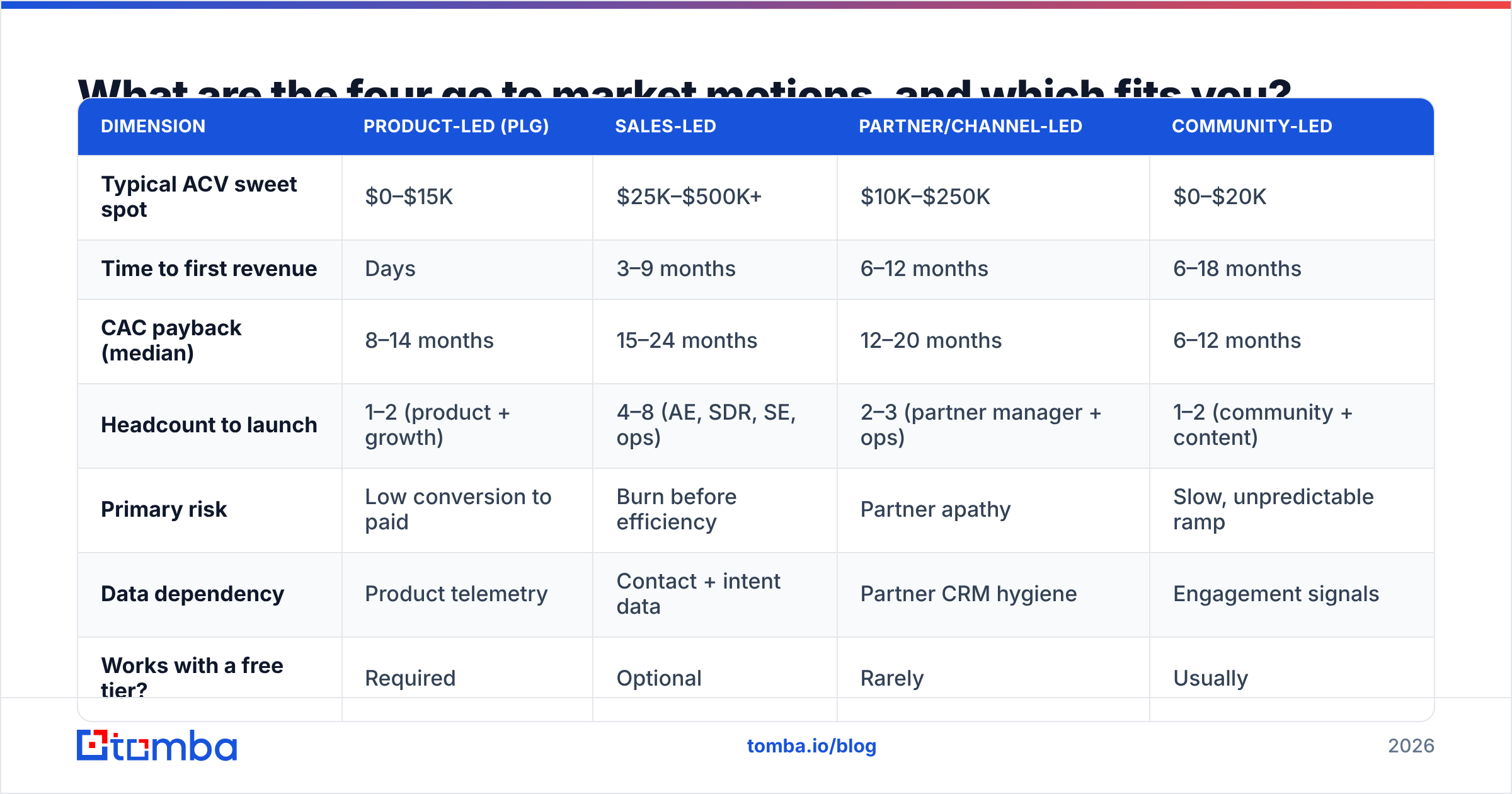
The motion is the engine. Everything else bolts onto it. Here is how the four primary motions compare on the dimensions that actually determine fit.
| Dimension | Product-Led (PLG) | Sales-Led | Partner/Channel-Led | Community-Led |
|---|---|---|---|---|
| Typical ACV sweet spot | $0–$15K | $25K–$500K+ | $10K–$250K | $0–$20K |
| Time to first revenue | Days | 3–9 months | 6–12 months | 6–18 months |
| CAC payback (median) | 8–14 months | 15–24 months | 12–20 months | 6–12 months |
| Headcount to launch | 1–2 (product + growth) | 4–8 (AE, SDR, SE, ops) | 2–3 (partner manager + ops) | 1–2 (community + content) |
| Primary risk | Low conversion to paid | Burn before efficiency | Partner apathy | Slow, unpredictable ramp |
| Data dependency | Product telemetry | Contact + intent data | Partner CRM hygiene | Engagement signals |
| Works with a free tier? | Required | Optional | Rarely | Usually |
The rule of thumb that survives contact with reality: your average contract value picks your motion, not your preference. A $3,000 ACV product cannot support a $180,000 fully loaded AE unless that AE closes 90+ deals a year, which almost nobody does. A $120,000 ACV product cannot close itself through a credit-card checkout because five people have to sign off and one of them is in security review.
Hybrid is normal now. The common 2026 shape is PLG for acquisition and a sales-assist layer that triggers on usage thresholds — the account hits 15 seats or 10,000 API calls, and a human reaches out. That works because the sales conversation starts with evidence instead of a cold pitch.
How do you define an ICP that a team can actually execute against?#
An ideal customer profile is only useful if someone can turn it into a list. "Fast-growing B2B companies that value data quality" is not an ICP. It is a mood.
A usable ICP has four executable layers:
- Firmographic filters — industry codes, employee count band, revenue band, geography, funding stage. These must map to fields in a real database. If you cannot filter on it, it is not a criterion.
- Technographic signals — what they already run. If your product replaces or plugs into a known tool, the presence of that tool is your highest-signal filter.
- Trigger events — a new VP of Sales, a Series B, a hiring spike in a specific function, a compliance deadline. Triggers explain why now, which is what turns a fit account into an active opportunity.
- Buying-committee map — the economic buyer, the champion, the blocker, and the end user, with the actual job titles each holds at this company size. A 200-person company has a different committee than a 5,000-person one.
- Disqualifiers — the accounts that look like fit but churn. Write these down. They are more valuable than the inclusion criteria because nobody ever documents them.
Once those five layers exist, the ICP becomes a query. You run that query against a B2B database, you get a target account list, and you move on to contacts. That handoff — from ICP definition to a real list of named humans with reachable addresses — is where most go to market strategy work quietly dies.
Why does GTM execution fail even when the strategy is right?#
Because the data layer is treated as an afterthought. You can nail the ICP, the positioning, and the motion, then hand your SDR team a list where a third of the emails bounce and the titles are two years stale. Every downstream metric — reply rate, meeting rate, pipeline coverage — reads as a strategy failure when it is actually a data failure.
Three failure patterns show up repeatedly:
Pattern 1: The list nobody validated. A scraped or purchased list goes straight into a sequence. Bounces spike above 5%, mailbox providers throttle the domain, and the sending reputation takes weeks to recover. The fix is boring and non-negotiable: run every address through an email verifier before it enters a sequence, and re-verify anything older than 90 days. B2B contact data decays at roughly 25–30% per year — people change jobs, companies get acquired, domains consolidate.
Pattern 2: The catch-all black hole. Large enterprises frequently run catch-all domains that accept every address at the SMTP layer, so standard verification returns "unknown." Teams either dump all of them (losing real enterprise contacts) or send to all of them (poisoning their sender reputation). A dedicated catch-all verifier resolves the middle ground so you can keep the accounts worth keeping.
Pattern 3: Enrichment without a schema. Data gets appended from four vendors into overlapping CRM fields with no ownership rules. Six months later nobody trusts the account tier field, and territory planning becomes a negotiation instead of a calculation. Decide field ownership before you enrich, not after.
The pattern underneath all three: GTM strategy documents allocate budget to headcount and ad spend, and treat contact data as a line item someone in ops will sort out. It is not a line item. It is the fuel line.
How do you pick the right channel mix?#
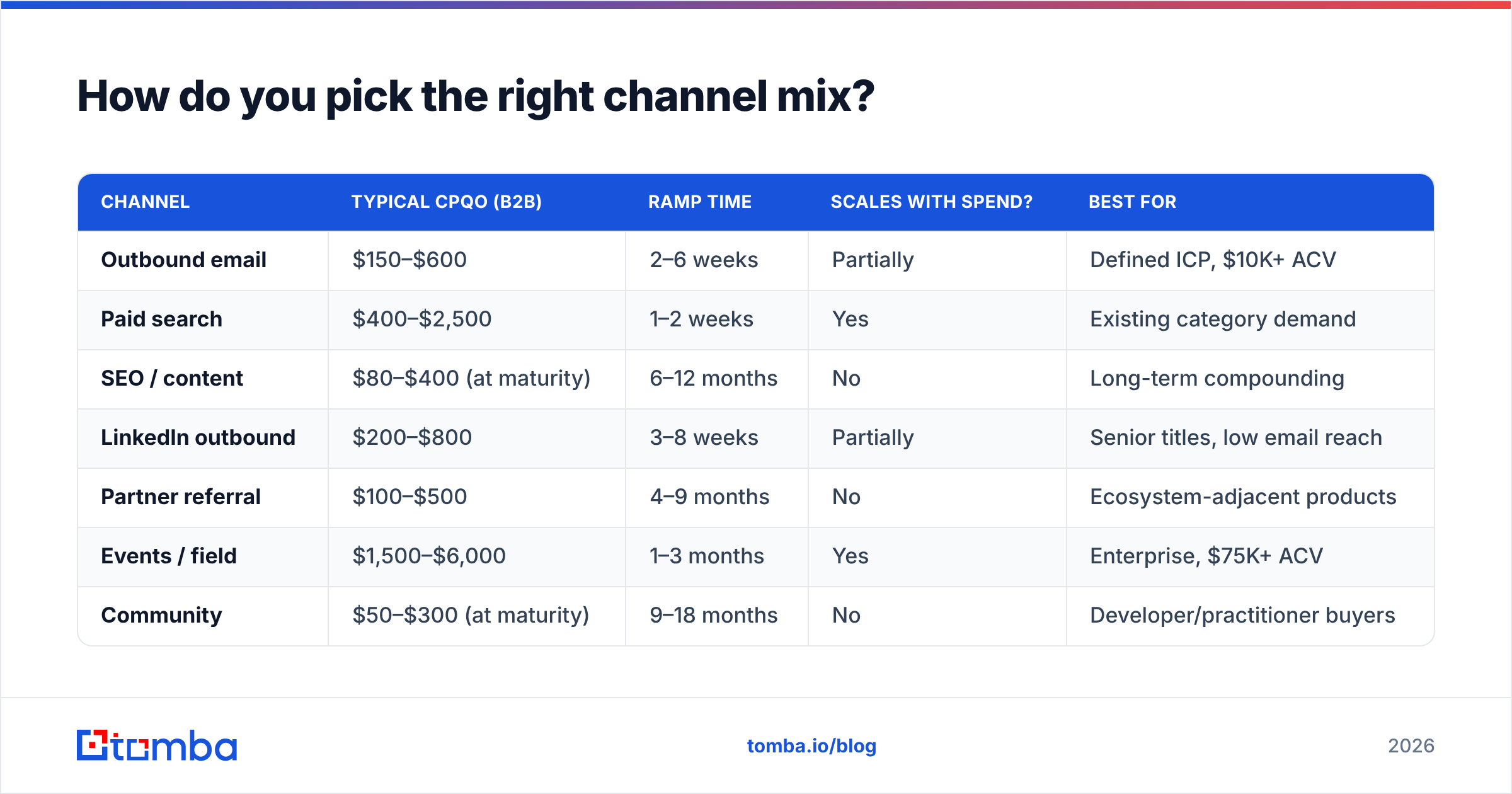
Rank channels by cost per qualified opportunity, not cost per lead. A $4 lead that never takes a meeting is more expensive than a $400 lead that does.
| Channel | Typical CPQO (B2B) | Ramp time | Scales with spend? | Best for |
|---|---|---|---|---|
| Outbound email | $150–$600 | 2–6 weeks | Partially | Defined ICP, $10K+ ACV |
| Paid search | $400–$2,500 | 1–2 weeks | Yes | Existing category demand |
| SEO / content | $80–$400 (at maturity) | 6–12 months | No | Long-term compounding |
| LinkedIn outbound | $200–$800 | 3–8 weeks | Partially | Senior titles, low email reach |
| Partner referral | $100–$500 | 4–9 months | No | Ecosystem-adjacent products |
| Events / field | $1,500–$6,000 | 1–3 months | Yes | Enterprise, $75K+ ACV |
| Community | $50–$300 (at maturity) | 9–18 months | No | Developer/practitioner buyers |
Two things this table hides that you should internalize. First, ramp time is the real constraint on early-stage GTM — if you have nine months of runway, SEO is not a strategy, it is a hope. Second, only paid channels scale linearly with money. Everything else scales with time or headcount, which means your channel mix should include at least one fast channel to fund the slow ones.
For most B2B teams under $50M ARR, the practical answer is outbound plus one demand-capture channel, with content compounding in the background. Outbound works when the ICP is genuinely narrow — you are not sending 50,000 emails, you are sending 800 well-researched ones to accounts that match a trigger. That requires finding the right person at the right company, which is a domain search problem before it is a copywriting problem.
Research from HubSpot's annual sales reports and buyer-behavior work published by Gartner consistently show B2B buyers completing the majority of their evaluation before contacting a vendor. That does not make outbound obsolete — it changes what outbound is for. Your first touch is not a pitch. It is an attempt to get into the consideration set before the buyer builds their shortlist without you.

What does a 90-day go to market rollout look like?#
Strategy that cannot be sequenced is not strategy. Here is a defensible 90-day shape for a new motion or a new segment.
Days 1–30 — Define and instrument. Write the ICP with all five layers. Build the target account list — 200 to 500 accounts, not 5,000. Set up tracking so you can attribute a meeting back to a source. Draft positioning against the actual status quo (which is usually "spreadsheet" or "do nothing," not a named competitor). Verify your contact data before anyone sends anything.
Days 31–60 — Run the first real test. Send to a controlled slice, 150 to 250 accounts. Hold the variables still: one ICP segment, one message thesis, one channel. Measure reply rate and meeting rate, not open rate — open tracking has been unreliable since privacy protections became the default in major mail clients. Talk to every prospect who replies negatively; the "no" reasons are your positioning research.
Days 61–90 — Decide, then scale or kill. You need one of three verdicts: the segment converts and you scale spend, the message is wrong but the segment is right so you iterate copy, or the segment is wrong and you move on. The failure mode here is the fourth option teams invent — "let's give it another quarter" — which burns two more months to learn what you already knew.
Set thresholds before you start. Something like: 4%+ positive reply rate to continue, under 1.5% to kill, in between to iterate. Numbers written in advance beat judgment written after, because after you have already spent the money you will find reasons to justify it.
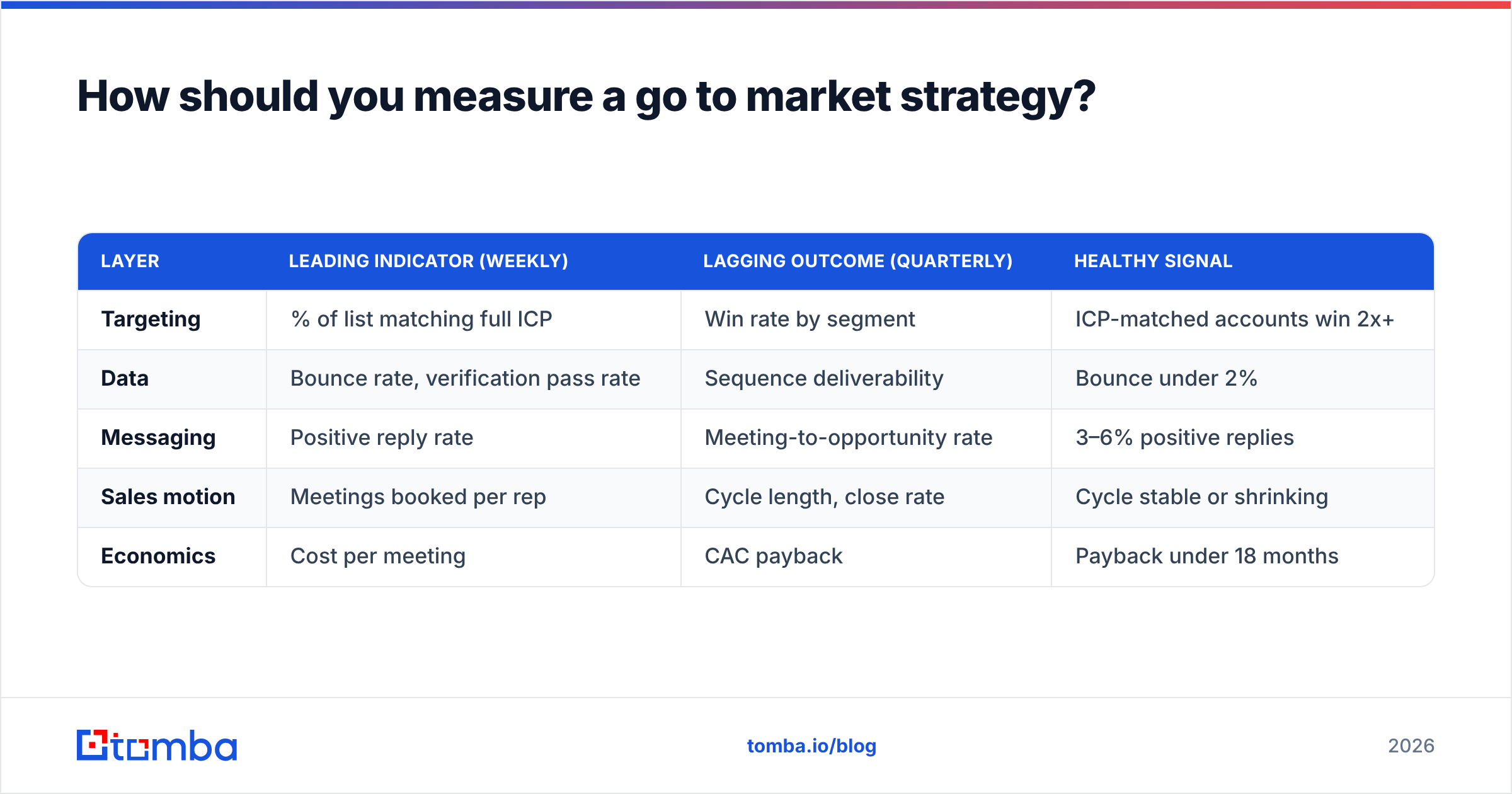
How should you measure a go to market strategy?#
Measure leading indicators weekly and lagging outcomes quarterly. The most common measurement mistake is judging a GTM motion on revenue in month two, when revenue in month two is a function of what you did last quarter.
| Layer | Leading indicator (weekly) | Lagging outcome (quarterly) | Healthy signal |
|---|---|---|---|
| Targeting | % of list matching full ICP | Win rate by segment | ICP-matched accounts win 2x+ |
| Data | Bounce rate, verification pass rate | Sequence deliverability | Bounce under 2% |
| Messaging | Positive reply rate | Meeting-to-opportunity rate | 3–6% positive replies |
| Sales motion | Meetings booked per rep | Cycle length, close rate | Cycle stable or shrinking |
| Economics | Cost per meeting | CAC payback | Payback under 18 months |
The row that people skip is the data row, and it is the one with the fastest feedback loop. You know your bounce rate in 24 hours. You know your win rate in six months. Fix the thing you can see this week.
Also track response rate by segment rather than in aggregate. An aggregate 2% reply rate can hide a 7% segment and a 0.4% segment, and the whole point of the exercise is finding the 7%.
How does contact data quality change your GTM economics?#
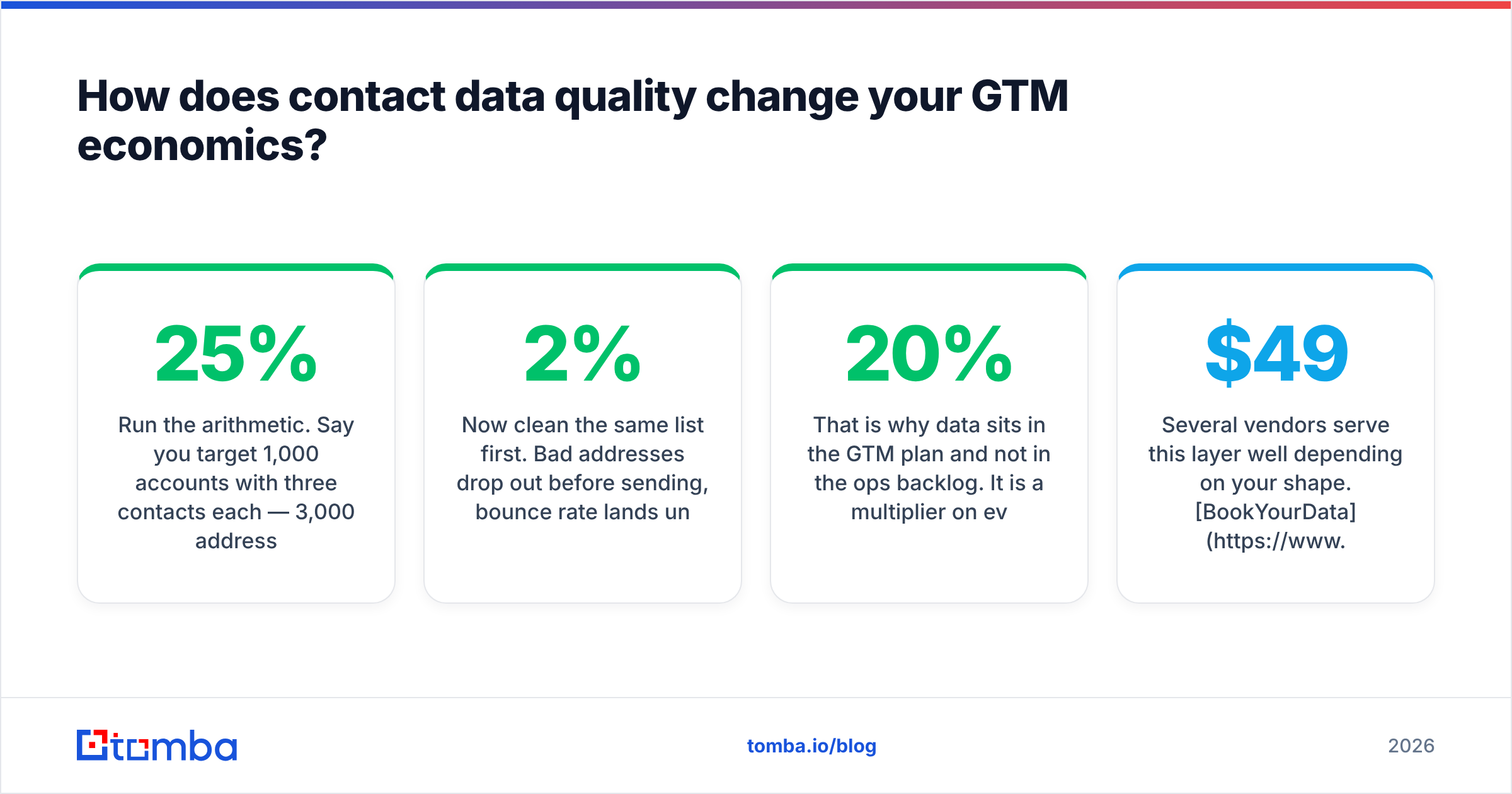
Run the arithmetic. Say you target 1,000 accounts with three contacts each — 3,000 addresses. At a 25% bad-data rate, 750 sends are wasted, your bounce rate lands near 12%, and mailbox providers start filtering the domain. Deliverability drops for the 2,250 good addresses too, so effective reach might be 1,600. You paid for 3,000 and reached roughly half.
Now clean the same list first. Bad addresses drop out before sending, bounce rate lands under 2%, email deliverability holds, and effective reach is 2,200 of 2,250. Same budget, 37% more conversations, and your sending domain survives to run next quarter's campaign.
That is why data sits in the GTM plan and not in the ops backlog. It is a multiplier on every other line item. You can improve your copy by 20% with hard work; you can improve your reach by 40% by not sending to dead addresses.
Several vendors serve this layer well depending on your shape. BookYourData is a solid choice when you want a pre-built, pay-as-you-go list with strong coverage and no subscription commitment — useful for one-off campaigns or when you are testing a new segment before committing budget. Tools like Tomba fit better when you need continuous, API-driven discovery and verification wired into a repeatable motion, with Tomba pricing starting free at 25 searches per month and moving to $49/mo (Starter), $99/mo (Growth), and $249/mo (Pro) as volume grows. Peer reviews on G2 are the fastest way to sanity-check any of them against your own use case before you buy.
What separates a 2026 GTM plan from a 2020 one?#
Three things changed materially.
Buyers filter harder. Inbox protections, spam filtering, and simple fatigue mean generic volume outbound converts far worse than it did five years ago. The winning teams send less and research more.
AI collapsed the cost of personalization but not the cost of relevance. Everyone can generate a personalized first line now, which means personalized first lines no longer signal effort. What still signals effort is knowing something true about the account's situation — which comes from trigger data, not from a language model paraphrasing a LinkedIn bio.
Efficiency replaced growth-at-all-costs as the default board expectation. CAC payback and net revenue retention now gate hiring in a way they did not in 2020. That pushes GTM design toward motions with shorter payback: product-led acquisition, expansion revenue, and tightly-targeted outbound over broad-spray demand gen.
The practical consequence: narrow beats broad on every axis. A tighter ICP, a smaller list, better data, and fewer channels executed properly will outperform a wide plan run at half quality. Most teams already know this. Fewer act on it, because narrowing feels like giving up potential revenue — right up until you count how much of the wide plan's spend produced nothing.
Getting the data layer right#
Your go to market strategy is only as good as the list it runs on. Before your next campaign, take the ICP you just defined and turn it into real, reachable contacts — the Tomba Email Finder resolves professional email addresses by domain, name, or company, with verification built in so bad addresses never reach your sequence. Start on the free tier at 25 searches a month, confirm the data holds up against your own known accounts, and scale to a paid plan only once the segment proves out. That is the same discipline you should apply to every other line in the plan.
Related guides#
Ready to find emails that actually work?
Join 150,000+ professionals who stopped guessing and started sending. Free credits on signup — no credit card required.
Get the Tomba newsletter
Practical outbound tactics and product updates — once every two weeks.
About the author