Go To Market Strategy Best Practices: A 2026 Playbook
Most GTM plans fail on execution, not ideas. Here are the go to market strategy best practices that actually move pipeline in 2026 — with a motion-by-motion comparison and the data layer that holds it all together.
TL;DR
- A go-to-market strategy is not a launch plan. It is a repeatable system that connects one ICP, one motion, one message, and one data layer — and most teams break at the data layer.
- Pick a single primary motion (PLG, sales-led, partner-led, or community-led) for the first four quarters. Hybrid motions work, but only after one motion is already producing predictable pipeline.
- Segment before you spend. Teams that define ICP by observable firmographic and technographic signals — not by gut feel — consistently cut cost per opportunity.
- Your CRM decays roughly 25–30% per year. A GTM plan without a contact hygiene loop is a plan with a built-in expiry date.
- Measure the four numbers that matter: pipeline coverage, win rate by segment, CAC payback, and net revenue retention. Everything else is a vanity slide.
What is a go-to-market strategy, really?#
A go-to-market strategy is the operating agreement between product, marketing, sales, and success about who you sell to, how you reach them, what you say, and how you know it worked.
Think of it like a restaurant opening. The menu is your product. The GTM strategy is everything else: which neighborhood you open in, whether you do delivery or dine-in, what the sign says, how you staff the kitchen for Friday night, and which number on the P&L tells you it's working. Great food in the wrong neighborhood with no sign still closes in eight months.
Most published "go to market strategy best practices" stop at the menu. This guide covers the neighborhood.
The four pillars that every workable GTM plan contains:
- Ideal customer profile (ICP) — a written definition using observable attributes: employee count, revenue band, tech stack, funding stage, geography, and a trigger event. If a rep can't check it in 30 seconds, it isn't an ICP.
- Primary motion — the dominant path a customer takes from first touch to closed-won. Self-serve, sales-assisted, enterprise, partner, or community. One primary. Others are secondary.
- Message and offer — the specific pain you name, the alternative you displace, and the pricing structure that makes switching easy.
- Data and measurement layer — the contact data, the account records, the attribution model, and the four metrics you'll review weekly.
Skip any one and the other three underperform. Skip the fourth and you won't know why.
Which go-to-market motion should you pick in 2026?#
Pick the motion your buyer already prefers, not the one your board deck admires.
Product-led growth got romanticized between 2020 and 2023, then a lot of teams discovered that a free tier without a sales layer caps out around $15M ARR in most B2B categories. Sales-led motions got written off as expensive, then teams rediscovered that a $60k ACV product does not sell itself through a signup form.
Here is the honest comparison:
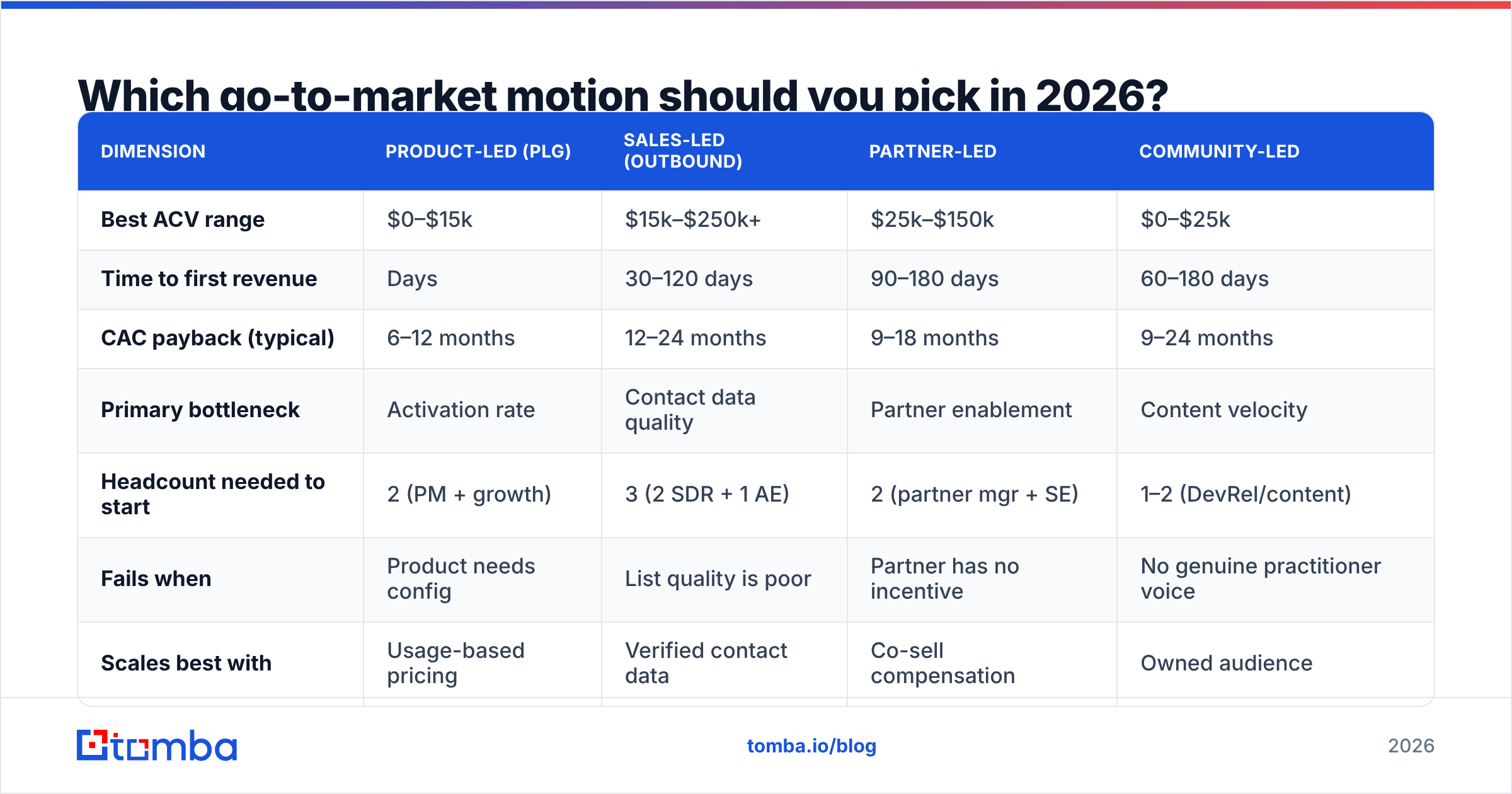
| Dimension | Product-led (PLG) | Sales-led (outbound) | Partner-led | Community-led |
|---|---|---|---|---|
| Best ACV range | $0–$15k | $15k–$250k+ | $25k–$150k | $0–$25k |
| Time to first revenue | Days | 30–120 days | 90–180 days | 60–180 days |
| CAC payback (typical) | 6–12 months | 12–24 months | 9–18 months | 9–24 months |
| Primary bottleneck | Activation rate | Contact data quality | Partner enablement | Content velocity |
| Headcount needed to start | 2 (PM + growth) | 3 (2 SDR + 1 AE) | 2 (partner mgr + SE) | 1–2 (DevRel/content) |
| Fails when | Product needs config | List quality is poor | Partner has no incentive | No genuine practitioner voice |
| Scales best with | Usage-based pricing | Verified contact data | Co-sell compensation | Owned audience |
The pattern across all four columns: the motion determines your bottleneck, and the bottleneck determines your budget. If you choose outbound, your budget problem is contact data and deliverability, not headcount. If you choose PLG, your problem is activation, not traffic.
A practical sequencing rule that has held up across most B2B categories: run one motion until it produces two consecutive quarters of forecastable pipeline, then layer the second. Teams that launch PLG and outbound simultaneously in month one usually produce two mediocre motions instead of one good one.
How do you define an ICP that sales will actually use?#
Define it in filters, not adjectives.
"Mid-market SaaS companies that value data quality" is not an ICP. It's a mood. Here's the format that survives contact with a rep:
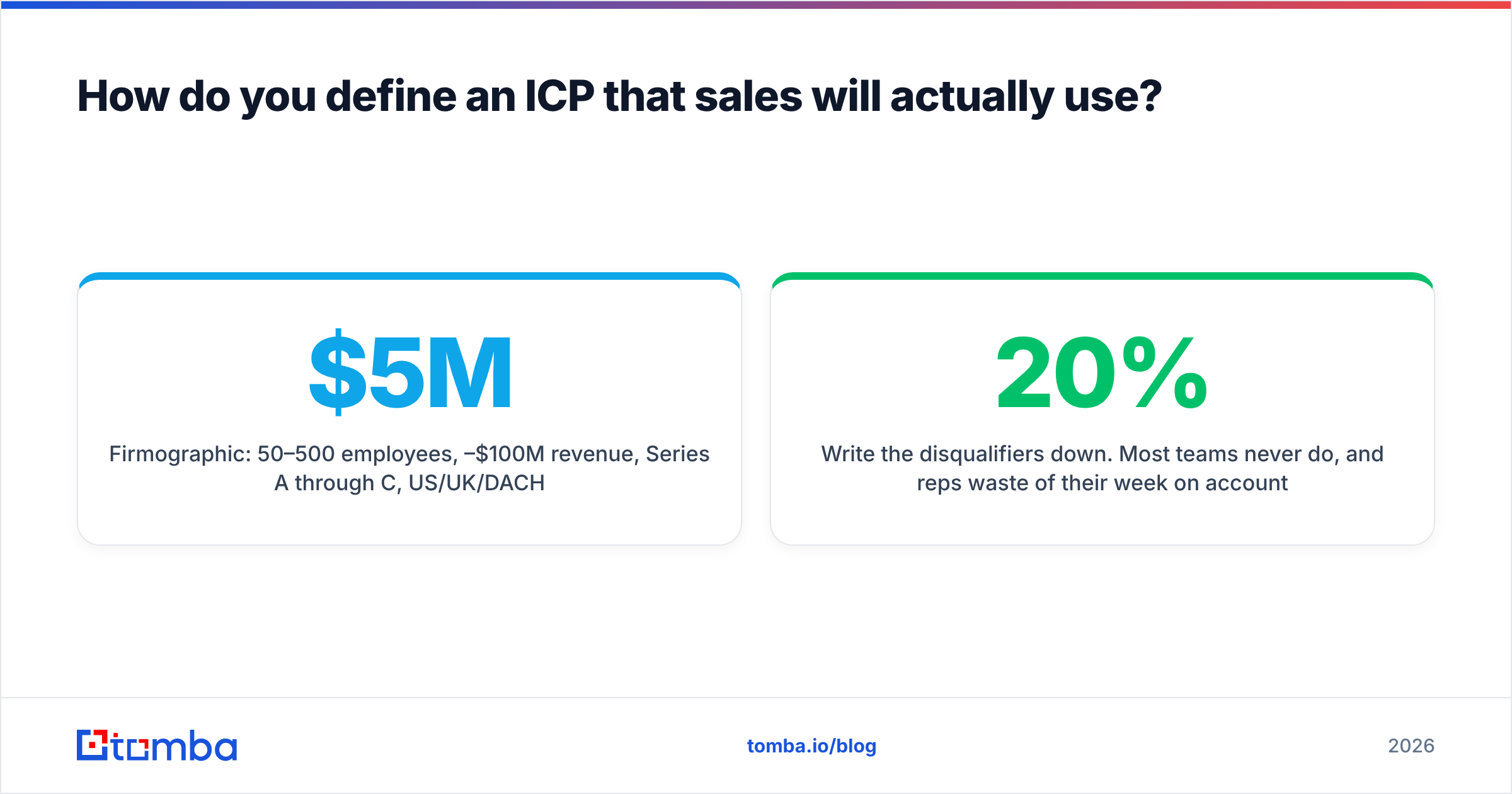
- Firmographic: 50–500 employees, $5M–$100M revenue, Series A through C, US/UK/DACH.
- Technographic: Running HubSpot or Salesforce, plus at least one sales engagement tool (Outreach, Salesloft, Instantly, Apollo).
- Structural: Has a named RevOps or Sales Ops person on LinkedIn. This single filter is one of the strongest qualifiers in B2B software — it proves budget authority exists.
- Trigger: Hired 2+ SDRs in the last 90 days, announced funding in the last 6 months, or posted a job for "demand generation."
- Disqualifiers: Agencies reselling your category, companies under 20 employees, anyone in a region you can't support.
Write the disqualifiers down. Most teams never do, and reps waste 20% of their week on accounts that were never going to close.
Once the filters exist, they become a query. You can run technographic checks with a website tech stack lookup, pull the contact layer for matching domains through domain search, and enrich the resulting accounts so scoring has something to score. The ICP stops being a slide and becomes a list you can refresh monthly.
For a shared vocabulary across the team, the B2B glossary is a reasonable place to align on what "MQL," "win rate," and "revenue operations" actually mean inside your company — definitional drift between marketing and sales is a silent GTM killer.
Why does GTM execution break at the data layer?#
Because contact data decays faster than anyone plans for, and the failure is invisible until the numbers are already bad.
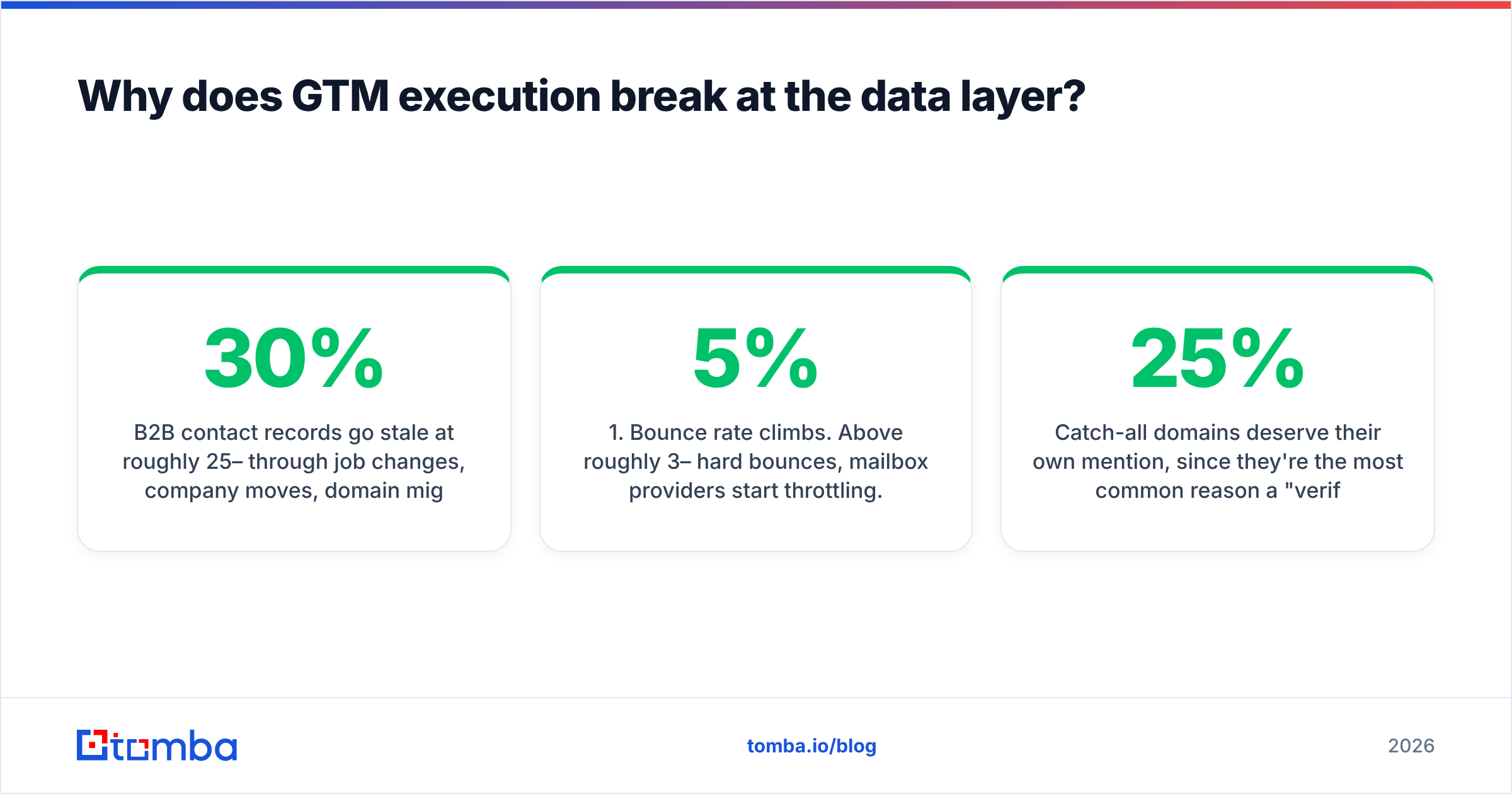
B2B contact records go stale at roughly 25–30% per year through job changes, company moves, domain migrations, and role shifts. In a 12-month GTM plan built on a 10,000-contact list, you're planning around 2,500–3,000 records that will be wrong before the plan ends. Nobody puts that line item in the board deck.
The compounding damage looks like this:
- Bounce rate climbs. Above roughly 3–5% hard bounces, mailbox providers start throttling. Google's own Postmaster Tools guidance and its bulk sender requirements make this explicit.
- Sender reputation drops. Once the domain is flagged, even your good emails land in spam — including emails to accounts already in your pipeline.
- Forecast accuracy collapses. Reps log activity against contacts who left the company. The pipeline looks healthy and converts at half the expected rate.
- Attribution becomes fiction. You can't tell whether the message failed or the address did.
The fix is boring and it works: a hygiene loop that runs on a schedule, not on a crisis. Verify before every send, re-verify quarterly, and re-enrich accounts when a trigger fires. Running a list through an email verifier before a campaign costs a fraction of what one throttled domain costs in recovered deliverability time.

Catch-all domains deserve their own mention, since they're the most common reason a "verified" list still bounces. Roughly 20–25% of B2B domains accept all mail at the SMTP layer and silently discard it later. Standard verification returns "accepted" and you find out three weeks later. A dedicated catch-all verifier pass is the difference between a list that's clean on paper and one that's clean in the inbox.
What does the GTM tech stack actually need?#
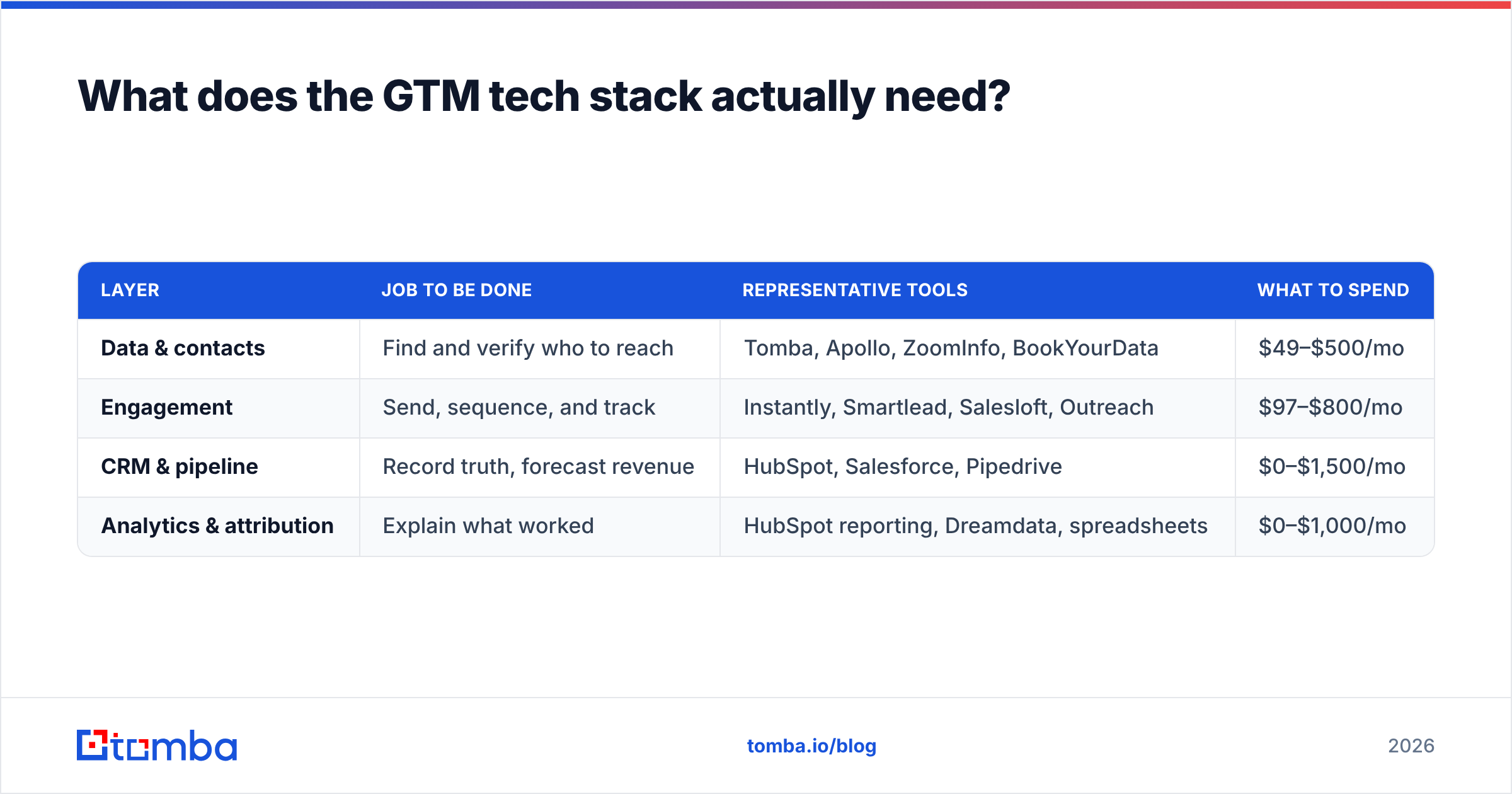
Fewer tools than most stacks contain, arranged in four layers.
| Layer | Job to be done | Representative tools | What to spend |
|---|---|---|---|
| Data & contacts | Find and verify who to reach | Tomba, Apollo, ZoomInfo, BookYourData | $49–$500/mo |
| Engagement | Send, sequence, and track | Instantly, Smartlead, Salesloft, Outreach | $97–$800/mo |
| CRM & pipeline | Record truth, forecast revenue | HubSpot, Salesforce, Pipedrive | $0–$1,500/mo |
| Analytics & attribution | Explain what worked | HubSpot reporting, Dreamdata, spreadsheets | $0–$1,000/mo |
Notes on the layers, in order of how often teams get them wrong:
- Data layer first. Every other layer inherits its quality. Buying a $800/mo engagement platform to send to an unverified list is paying for faster failure. Tomba pricing starts free at 25 searches/mo, with Starter at $49/mo and Growth at $99/mo — cheap enough that there's no honest excuse for skipping verification. Peers like BookYourData take a different route, selling pre-built verified lists by segment, which suits teams that want a ready-made database rather than a search-and-verify workflow. Both approaches are legitimate; pick based on whether your ICP is broad and static or narrow and signal-driven.
- Engagement layer second. Buy sequencing, not "AI personalization" you won't audit. Machine-written first lines that get facts wrong cost more reputation than they save time.
- CRM third, and keep it dumb. A CRM with 60 custom fields nobody fills in is worse than one with 12 that everyone does. Push enriched data in automatically through the HubSpot integration or Salesforce integration rather than asking reps to type it.
- Analytics last. Do not buy attribution software before you have 100 closed-won deals. Below that volume, a spreadsheet and honest conversations beat any model.
For teams with engineering resources, wiring the data layer directly via the Tomba API into a nightly enrichment job removes the manual step entirely — the list refreshes itself and reps never touch a CSV.

Which GTM metrics should you review weekly?#
Four. Reviewing forty means reviewing none.
- Pipeline coverage — open pipeline divided by the quota for the period. Below 3x, you have a top-of-funnel problem, not a closing problem. Above 6x, your qualification is too loose.
- Win rate by segment — not blended. Blended win rate hides that you close 34% in your core segment and 6% in the segment your CEO likes. Cut the second one. Win rate per segment is the single fastest way to find where GTM focus is leaking.
- CAC payback in months — fully loaded sales and marketing cost divided by new gross profit per month. Under 12 months means you can raise spend. Over 24 means the motion is wrong, not underfunded.
- Net revenue retention — the metric that decides whether GTM compounds or treadmills. Under 100% means you're refilling a leaking bucket and every new dollar of acquisition spend is partially wasted.
Two supporting metrics worth tracking monthly rather than weekly: response rate by segment (which tells you whether the message or the list is at fault) and speed-to-lead in minutes (which is usually the cheapest conversion improvement available — inbound leads contacted in under five minutes convert dramatically better than those contacted the next day).
What to stop reporting: email opens (unreliable since Apple Mail Privacy Protection), raw MQL count without conversion rate attached, and "activities logged." Activity metrics measure compliance with a process, not progress toward revenue.
How do you build a 90-day GTM launch plan?#
Compress the planning, extend the measurement.
Days 1–30 — define and instrument. Write the ICP with disqualifiers. Pick one motion. Build the target account list — 300 accounts is plenty to start, not 30,000. Verify every contact before the first send. Set up the four metrics in a dashboard even if the numbers are zero. Agree on the definition of a qualified opportunity in writing, signed by both marketing and sales.
Days 31–60 — run and instrument harder. Ship the first campaigns. Keep messaging variants to three, not fifteen — you need enough volume per variant to learn something. Record every objection verbatim in a shared doc; that doc becomes your positioning update in month four. Watch bounce rate daily for the first two weeks; if it exceeds 3%, stop and re-verify before you damage the domain.
Days 61–90 — cut and double down. Kill the worst-performing segment. Kill the worst-performing channel. Take the budget from both and put it into whichever combination produced the lowest cost per qualified opportunity. Resist the instinct to "give it another quarter" on something with zero signal — 90 days at reasonable volume is enough to distinguish noise from a dead end.
The mistake to avoid across all three phases: changing the ICP, the message, and the channel in the same week. When three variables move at once, you learn nothing. Change one per cycle.
Independent validation helps here. Buyer reviews on G2 and category research from firms like Gartner are useful for pressure-testing whether your positioning matches how buyers actually describe the problem — they rarely use your internal category name.
What are the most common GTM mistakes?#
Ranked by how much revenue they quietly cost:
- Launching before the ICP is written. Produces broad, cheap-feeling activity and expensive, unqualified pipeline.
- Treating data as a one-time purchase. A list bought in January is materially wrong by September. Build the refresh loop into the plan and the budget.
- Copying a competitor's motion. Their motion fits their ACV, their sales cycle, and their funding position. Yours are different.
- Over-hiring before product-market fit in a segment. Five AEs on an unproven motion produce five sets of anecdotes, not a repeatable playbook. Prove it with two.
- Confusing volume with reach. Sending 10,000 emails to a 60%-accurate list reaches fewer real humans than 2,000 to a verified one — and damages the domain you'll need next quarter.
- No single owner. When GTM is "everyone's job," nobody arbitrates the tradeoff between marketing's lead volume goal and sales' quality complaint. Name one owner with budget authority.
Ready to fix the layer everything else depends on?#
Every go-to-market strategy best practice in this guide sits on top of one assumption: that when a rep hits send, a real person receives it. That assumption is wrong more often than most teams measure.
Start with the Tomba Email Finder. Search by domain, name, or company, get verified professional addresses with confidence scores, and push them straight into your CRM or sequencer. The free tier gives you 25 searches a month to test accuracy against your own known-good contacts before you commit — Starter is $49/mo and Growth is $99/mo when you're ready to scale the list behind your motion.
Fix the data layer first. The rest of the strategy finally gets a fair test.
Related guides#
Ready to find emails that actually work?
Join 150,000+ professionals who stopped guessing and started sending. Free credits on signup — no credit card required.
Get the Tomba newsletter
Practical outbound tactics and product updates — once every two weeks.
About the author