Go To Market Strategy Components: The 7 That Actually Matter
Most GTM plans fail on execution, not strategy. Here are the seven go to market strategy components that decide whether your launch finds revenue or stalls at slide 14.
TL;DR
- A go-to-market strategy has seven components: ICP, value proposition, segmentation and TAM, channel mix, pricing and packaging, sales motion, and measurement. Skip one and the others compensate badly.
- The two components most teams under-build are ICP precision and the data layer that makes ICP operational. A perfect ICP you can't turn into a contact list is a slide, not a strategy.
- Build order matters: ICP → value prop → segmentation → motion → channel → pricing → measurement. Most teams start at channel and reverse-engineer the rest.
- Product-led, sales-led, and hybrid motions each demand a different component weighting. Copying a PLG playbook into a $60k ACV enterprise deal is the most common failure mode.
- Your measurement layer should be defined before launch, not after the first bad quarter. Pick 4-6 leading indicators, not 20 dashboards.
What is a go-to-market strategy, and what are its components?#
A go-to-market strategy is the specific plan for how a company takes an offer to a defined set of buyers, through defined channels, at a defined price, with a defined sales motion — and how it knows whether that is working.
That definition is deliberately mechanical. GTM gets mystified in board decks, but it decomposes into seven parts that each produce a concrete artifact. If a component doesn't produce an artifact somebody can act on Monday morning, it isn't done.
Here are the seven go to market strategy components and what each one must output:
- Ideal customer profile (ICP) — outputs a firmographic and behavioral filter specific enough to build a target account list from. "Mid-market SaaS" is not an ICP. "B2B SaaS, 50–300 employees, Series A/B, using HubSpot, hiring SDRs in the last 90 days" is.
- Value proposition and positioning — outputs the sentence a buyer repeats to their boss. It names the alternative you displace, the specific pain, and the measurable outcome.
- Market segmentation and sizing — outputs a tiered account universe (Tier 1 / 2 / 3) with a real count, not a $40B TAM number from a Gartner press release.
- Channel strategy — outputs the ranked list of routes to the buyer, with expected cost per opportunity for each.
- Pricing and packaging — outputs the price card, the packaging logic, and the discounting guardrails.
- Sales motion and process — outputs the stage definitions, exit criteria, and who does what at each stage.
- Measurement and feedback loop — outputs the leading indicators and the review cadence that adjusts the other six.
The order is not decorative. Each component consumes the output of the one before it. Channel decisions made before ICP decisions are guesses dressed as strategy.

Which go-to-market component do teams get wrong most often?#
ICP — and specifically, the gap between a described ICP and an addressable one.
Most companies can describe their best customers. Far fewer can produce a list of 3,000 companies matching that description with named contacts and verified email addresses attached. That gap is where GTM strategies die. The strategy document says "target VP Marketing at 100–500 person e-commerce brands." The SDR team opens a browser and starts guessing.
An operational ICP has three layers:
- Firmographic filter — industry, headcount, revenue band, geography, funding stage. This is the cheap layer; almost any B2B database covers it.
- Technographic and behavioral signals — what they run, what they just changed, who they just hired. This is what separates a warm account from a cold one.
- Contactability — for each account, the named decision maker, their role, and a deliverable email or phone number. Without this layer, the first two are academic.
The contactability layer is where the strategy becomes executable. If your ICP describes 4,000 accounts and you can only reach decision makers at 600 of them, your real TAM for this quarter is 600. Plan against that number, not the aspirational one.
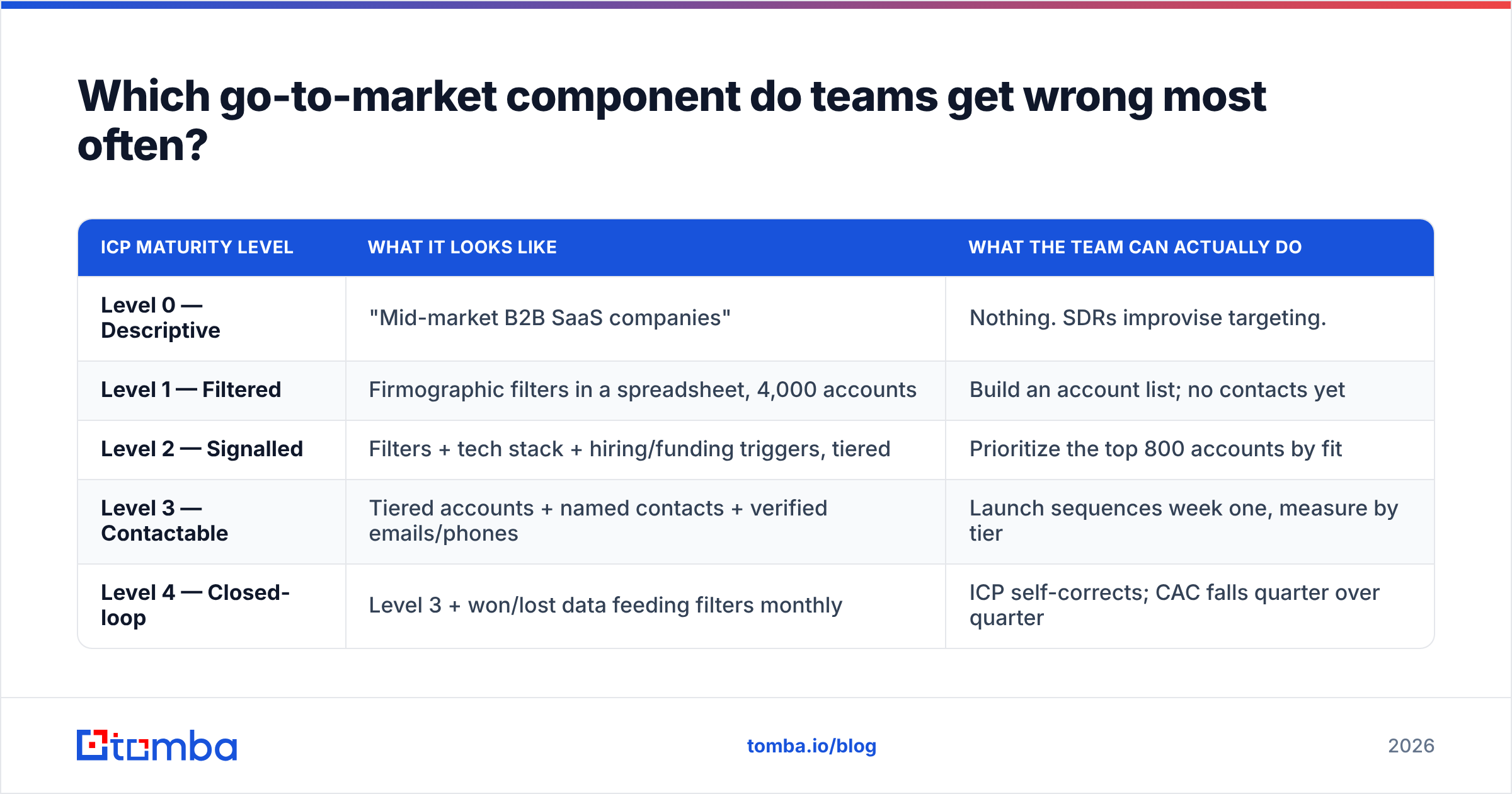
| ICP maturity level | What it looks like | What the team can actually do |
|---|---|---|
| Level 0 — Descriptive | "Mid-market B2B SaaS companies" | Nothing. SDRs improvise targeting. |
| Level 1 — Filtered | Firmographic filters in a spreadsheet, 4,000 accounts | Build an account list; no contacts yet |
| Level 2 — Signalled | Filters + tech stack + hiring/funding triggers, tiered | Prioritize the top 800 accounts by fit |
| Level 3 — Contactable | Tiered accounts + named contacts + verified emails/phones | Launch sequences week one, measure by tier |
| Level 4 — Closed-loop | Level 3 + won/lost data feeding filters monthly | ICP self-corrects; CAC falls quarter over quarter |
Most teams claim Level 3 and operate at Level 1. Audit yours honestly: pick ten accounts from your target list at random and see how long it takes to get a verified decision-maker email for each. If it takes more than two minutes per account, your ICP isn't operational yet.
How do the components change by sales motion?#
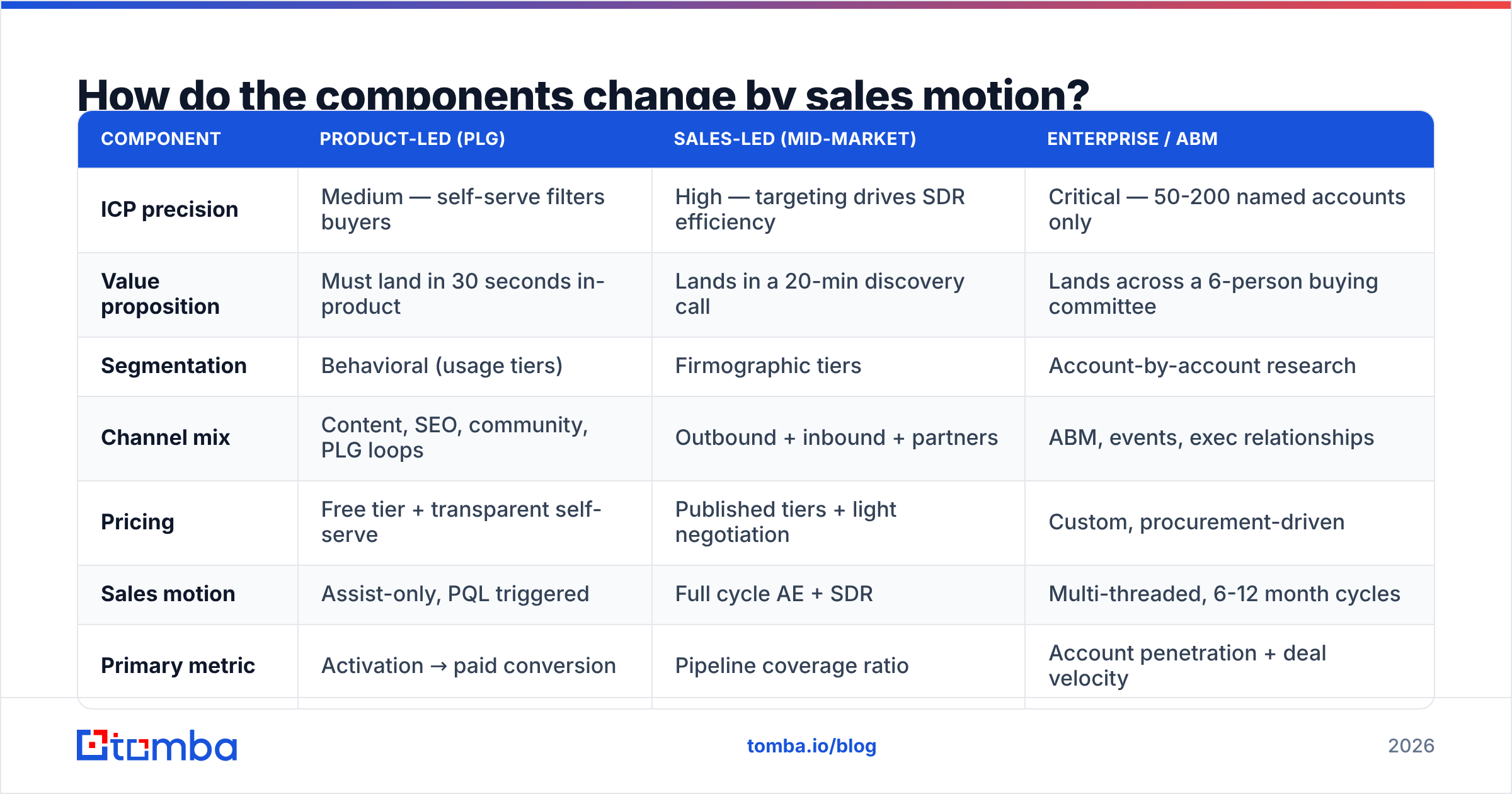
Weighting shifts dramatically. The same seven components exist in every GTM plan, but a product-led company invests 60% of its effort in three of them and a field-sales company invests it in a different three.
| Component | Product-led (PLG) | Sales-led (mid-market) | Enterprise / ABM |
|---|---|---|---|
| ICP precision | Medium — self-serve filters buyers | High — targeting drives SDR efficiency | Critical — 50-200 named accounts only |
| Value proposition | Must land in 30 seconds in-product | Lands in a 20-min discovery call | Lands across a 6-person buying committee |
| Segmentation | Behavioral (usage tiers) | Firmographic tiers | Account-by-account research |
| Channel mix | Content, SEO, community, PLG loops | Outbound + inbound + partners | ABM, events, exec relationships |
| Pricing | Free tier + transparent self-serve | Published tiers + light negotiation | Custom, procurement-driven |
| Sales motion | Assist-only, PQL triggered | Full cycle AE + SDR | Multi-threaded, 6-12 month cycles |
| Primary metric | Activation → paid conversion | Pipeline coverage ratio | Account penetration + deal velocity |
| Typical CAC payback | 6-12 months | 12-18 months | 18-30 months |
The failure pattern is importing a weighting from a company that looks like you but sells differently. A $99/month tool with a free tier and a $60k enterprise contract can serve the same industry and need almost opposite GTM builds. If your ACV is above roughly $15k, PLG content advice will mislead you on channel and pricing regardless of how well-written it is.
How do you build the value proposition component?#
Write the sentence the buyer says internally when they justify the purchase. Then work backwards.
Weak value props describe the product. Strong ones name three things: the alternative being displaced, the specific cost of the status quo, and the measurable delta. "We help sales teams find emails" describes a category. "Cut your SDR's list-building time from six hours a week to twenty minutes, at a third of what you pay ZoomInfo" is a value prop — it names the displaced alternative, the quantified pain, and the delta.
Test it with four questions:
- Does it name an alternative? If a buyer can't tell what they'd stop doing, there's no reason to change.
- Is the pain quantified in the buyer's units? Hours, dollars, headcount, days-to-close — not "efficiency."
- Would a competitor's marketing team be uncomfortable saying it? If any vendor in your category could put it on their homepage, it's a category claim, not positioning.
- Does the champion repeat it accurately? Ask three recent buyers to describe what you do. If you get three different answers, positioning is the broken component, not lead gen.
April Dunford's work on positioning is the most useful reference here, and HubSpot's positioning frameworks cover the mechanics well for teams building this from scratch.
What does the channel component actually require?#
A ranked list with a cost-per-opportunity estimate for each route — not a list of everything you could do.
Most channel sections list eight channels and staff two of them. That's a wish list. The channel component is finished when each route has an owner, a budget, an expected volume, and a kill criterion.
- Outbound email — highest control, lowest cost per contact, entirely dependent on data quality and email deliverability. Bad data doesn't just lower reply rates; it burns sending domains through bounces.
- Inbound / SEO — compounding, slow, expensive to start. Right for PLG and horizontal products; usually too slow to be a launch channel.
- Paid — fast signal, expensive at high ACV, useful mainly for testing messaging before committing to it.
- Partnerships and channel sales — long ramp, high leverage, only viable once your value prop is stable enough for someone else to sell.
- Events and community — expensive per touch, unmatched for enterprise where the buying committee is the bottleneck.
- Website visitor identification — turns existing traffic into named accounts. Underused because most teams never connect anonymous traffic to their outbound list. Website visitor reveal closes that gap.
For most B2B companies under $10M ARR, outbound plus one compounding channel is the correct answer. The constraint on outbound is almost never creativity — it's data. Sequences fail on bad addresses long before they fail on bad copy. Running your list through an email verifier before launch protects both your reply rate and your sender reputation.
How do you set up the measurement component before launch?#
Pick four to six leading indicators, define them precisely, and set the review cadence before the first campaign goes out. Retrofitting metrics after a bad quarter guarantees you argue about definitions instead of causes.
Leading indicators for a new GTM motion, by phase:
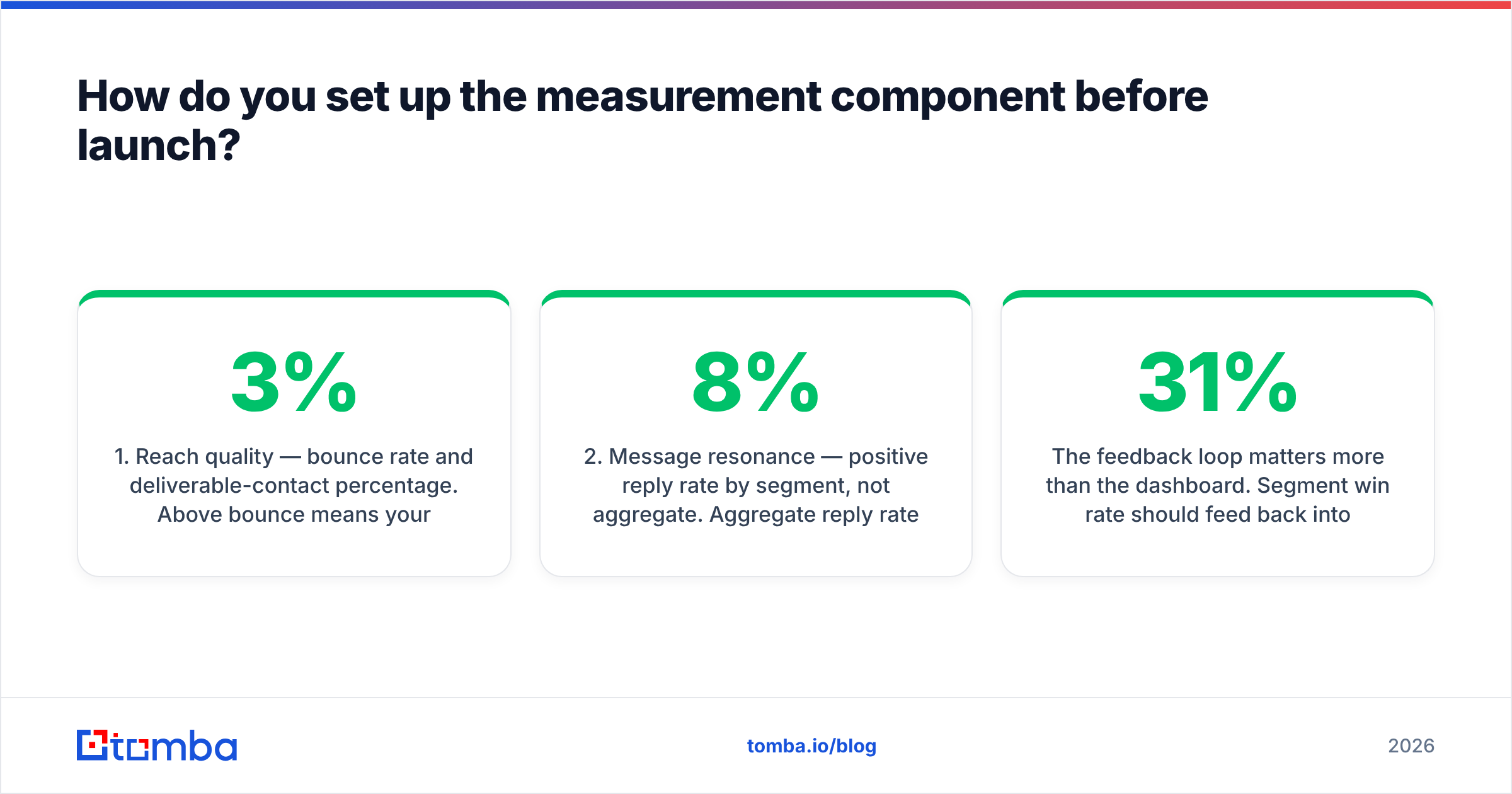
- Reach quality — bounce rate and deliverable-contact percentage. Above 3% bounce means your data layer is broken, and every downstream metric is noise.
- Message resonance — positive reply rate by segment, not aggregate. Aggregate reply rate hides the fact that one segment is at 8% and three are at 0.4%.
- Qualification efficiency — meetings booked per 100 deliverable contacts, split by tier.
- Pipeline coverage — open pipeline divided by quota for the period. Below 3x, the problem is top-of-funnel; above 5x with low win rates, the problem is qualification.
- Segment win rate — win rate sliced by ICP tier. This is the single most useful ICP-correction signal you have.
- CAC payback by channel — the number that eventually decides which channels survive.
Review cadence: reach and resonance weekly for the first eight weeks, qualification and coverage monthly, win rate and payback quarterly. G2's B2B SaaS benchmarks are a reasonable external sanity check when you need to know whether a number is bad or just unfamiliar.
The feedback loop matters more than the dashboard. Segment win rate should feed back into the ICP filter every quarter. If enterprise fintech converts at 31% and mid-market retail at 4%, that's not a coaching problem — it's your segmentation component telling you it was wrong.
How do the components fit together in practice?#
Sequence them. Here is a realistic 90-day build for a team launching a new motion or a new segment:
Days 1-15 — ICP and positioning. Interview ten won accounts and five lost ones. Extract the firmographic pattern and the language buyers actually use. Draft the ICP filter and the value prop sentence. Deliverable: a one-page ICP definition and a positioning statement.
Days 16-30 — Segmentation and list build. Turn the filter into an actual account list. Tier it. Attach named contacts. This is where the strategy becomes operational or stalls. A domain search across your Tier 1 accounts turns a list of company names into a list of people with roles and addresses in an afternoon rather than a fortnight.
Days 31-45 — Motion and channel setup. Define stages and exit criteria. Pick two channels. Set budgets and kill criteria. Warm sending domains if outbound is one of them.
Days 46-60 — Pricing and packaging validation. Test the price card against 15-20 real conversations. Watch for the tier nobody buys and the discount everybody asks for — both are packaging signals.
Days 61-90 — Launch and instrument. Run the motion. Track the six leading indicators weekly. Hold a formal review at day 90 that explicitly revisits the ICP filter with segment win-rate data.
The teams that execute this well aren't smarter about strategy. They're faster at the operational middle — turning a filter into a contactable list — because that step is where 80% of the elapsed time goes when it's done manually.
What's the fastest way to make your ICP contactable?#
You need three things at scale: company-level coverage, contact-level coverage inside those companies, and verification before send.
For company-level, most teams already have a source — LinkedIn Sales Navigator, a database subscription, or a scraped list. The gap is almost always the second and third steps. Building a target list of 1,200 accounts is a two-hour job. Finding a verified VP-level email at each of those 1,200 accounts, by hand, is roughly three weeks of SDR time you will never get back.
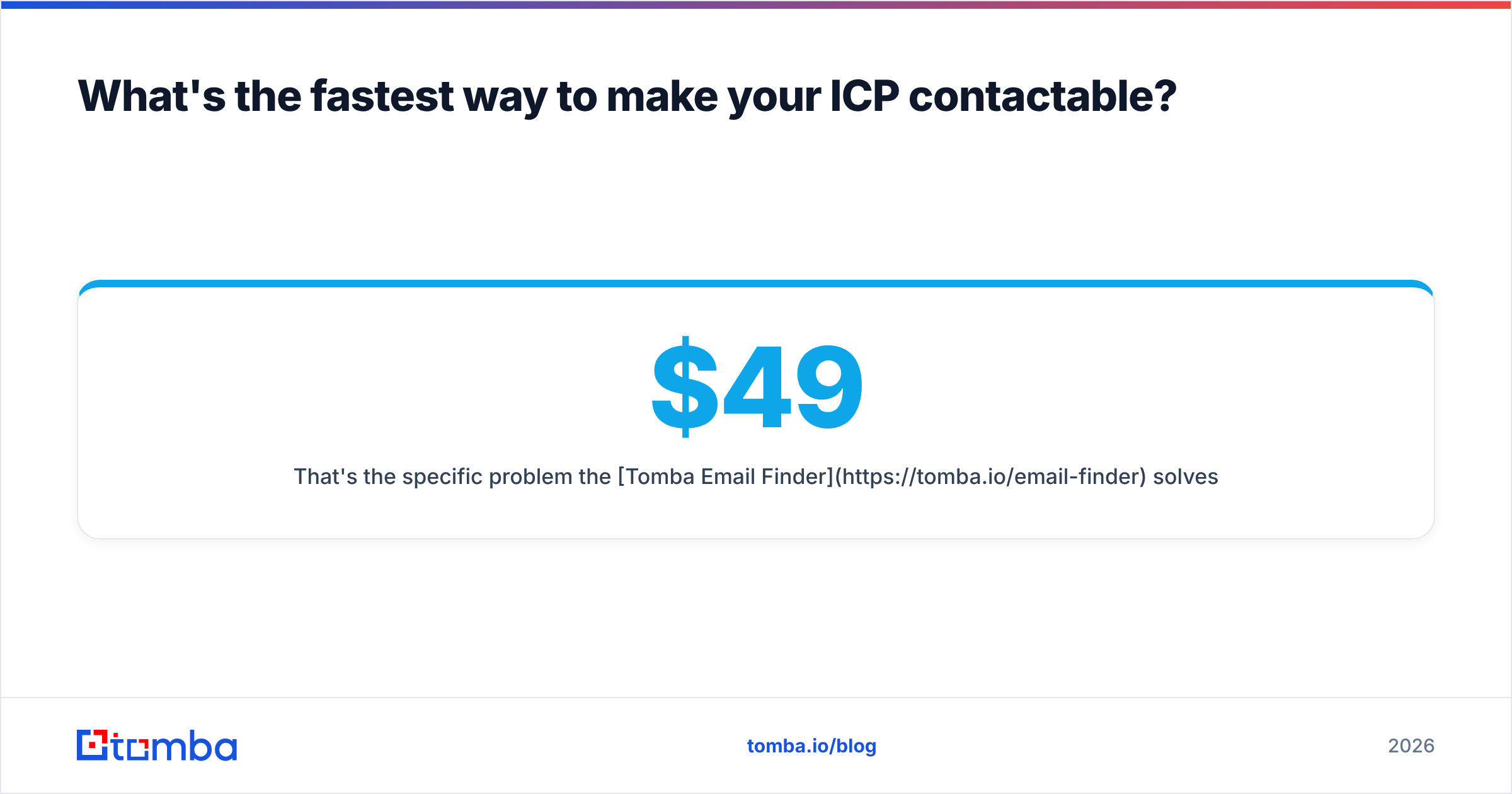
That's the specific problem the Tomba Email Finder solves: give it a domain and a name, or just a domain, and it returns the professional addresses that exist there, with a confidence score and verification attached. Free tier covers 25 searches a month if you want to test the accuracy on accounts where you already know the answer — the only honest way to evaluate any data vendor. Paid plans start at $49/month on Starter, $99/month on Growth, and $249/month on Pro; Tomba pricing has the credit breakdown per tier.
Run your Tier 1 list through it, verify before you send, and the reach-quality metric at the top of your measurement stack stops being the thing that breaks every campaign. Your go-to-market strategy components are only as strong as the layer that makes them addressable — start there, and the other six get easier.
Related guides#
Ready to find emails that actually work?
Join 150,000+ professionals who stopped guessing and started sending. Free credits on signup — no credit card required.
Get the Tomba newsletter
Practical outbound tactics and product updates — once every two weeks.
About the author