Go To Market Strategy Development: A 2026 Operator's Guide
Most GTM plans die because nobody owns the data layer. Here is the seven-stage build — ICP, segmentation, motion selection, channel math, and the metrics that tell you to double down or kill it.
TL;DR
- Go to market strategy development is a sequence, not a document: define the segment, pick the motion, price for that motion, build the channel math, then instrument it. Skip a stage and the later ones produce noise.
- The single biggest failure point in 2026 is not messaging — it's the contact data layer. A perfect ICP you cannot reach is a slide, not a strategy.
- Choose one primary motion (PLG, sales-led, partner-led, or community-led) for the first two quarters. Hybrid motions cost roughly double and rarely beat a well-run single motion below $5M ARR.
- Budget by CAC payback, not by channel enthusiasm. If a channel can't show payback under 18 months by month six, cut it.
- Your GTM plan needs a kill criterion written before launch. Most teams never define one, so failing motions run for years.
What is go to market strategy development, exactly?#
Go to market strategy development is the process of deciding who you sell to, how you reach them, what you charge, and how you'll know it's working — before you spend real money finding out.
Think of it like planning a delivery route before buying the truck. Plenty of companies buy the truck first: they hire three SDRs, license a sequencer, and only then ask which neighborhoods actually order. The route comes last, and the fuel bill comes due anyway.
A GTM strategy is distinct from three things people confuse it with:
- A marketing plan. Marketing is one channel inside GTM. A GTM strategy also governs pricing, packaging, sales structure, partner motion, and post-sale expansion.
- A product roadmap. The roadmap says what you build. GTM says who receives it and through what pipe.
- A launch checklist. A launch is an event. GTM is the operating system that survives the launch.
The output of a real GTM process is not a 40-slide deck. It's four artifacts: a written ICP with disqualifiers, a motion decision with a stated reason, a channel budget with CAC targets per channel, and a metrics dashboard someone owns by name.
Why do most GTM strategies fail before the first campaign?#
They fail on inputs, not execution. Three patterns account for most of it.
Pattern one: the ICP is a demographic, not a behavior. "Series B SaaS companies in North America with 50-200 employees" is a filter, not an ICP. It tells you nothing about what triggers a purchase. A behavioral ICP reads: "Series B SaaS companies that just hired a first RevOps lead and have two or more overlapping data tools in their stack." That version tells your SDR what to say.
Pattern two: nobody costed the data. Teams model pipeline from a TAM number, then discover their reachable list is a fraction of it. If your ICP has 12,000 companies and you can only source verified contacts for 4,000 of them, your model is off by 3x on day one. This is why the data layer belongs in strategy, not in ops.
Pattern three: no kill criterion. Channels get funded, underperform, and stay funded because unwinding a decision feels like admitting error. Write the kill line before launch: "If paid search CAC payback exceeds 20 months at month six, we stop."

How do you build the ICP and segmentation layer?#
Start narrow enough to feel uncomfortable. Segment expansion is cheap; segment retreat is expensive because you've already hired for the wrong profile.
Work through these six inputs in order:
- Closed-won analysis. Pull your last 30 wins. What do the top decile by ACV and retention share? If you have fewer than 30 wins, use win conversations — the deals that moved fast even if they didn't close.
- Trigger events. What observable change precedes a purchase? New funding, a leadership hire, a compliance deadline, a competitor's price increase, a hiring spike in a specific function.
- Disqualifiers. Write the anti-ICP explicitly. "Companies under 20 employees" or "anyone whose data lives in a single spreadsheet." Reps need permission to say no.
- Buying committee map. Name the economic buyer, the champion, the blocker, and the end user. Most B2B GTM plans list a title and stop — then die in procurement.
- Reachability audit. For a sample of 200 ICP accounts, how many can you actually contact? Run a domain search against each company domain and count verified addresses. If reachability is under 60%, your segment definition or your data source needs work before anything else proceeds.
- Willingness to pay. Interview 10 accounts in-segment. Ask what they currently spend to solve the problem badly. That number, not your cost structure, anchors pricing.
The reachability step is the one teams skip and the one that quietly caps growth. A list of 5,000 target accounts with 40% contactability behaves like a list of 2,000. Build the audit into the strategy phase so your pipeline model reflects reality.
Which go-to-market motion should you pick?#
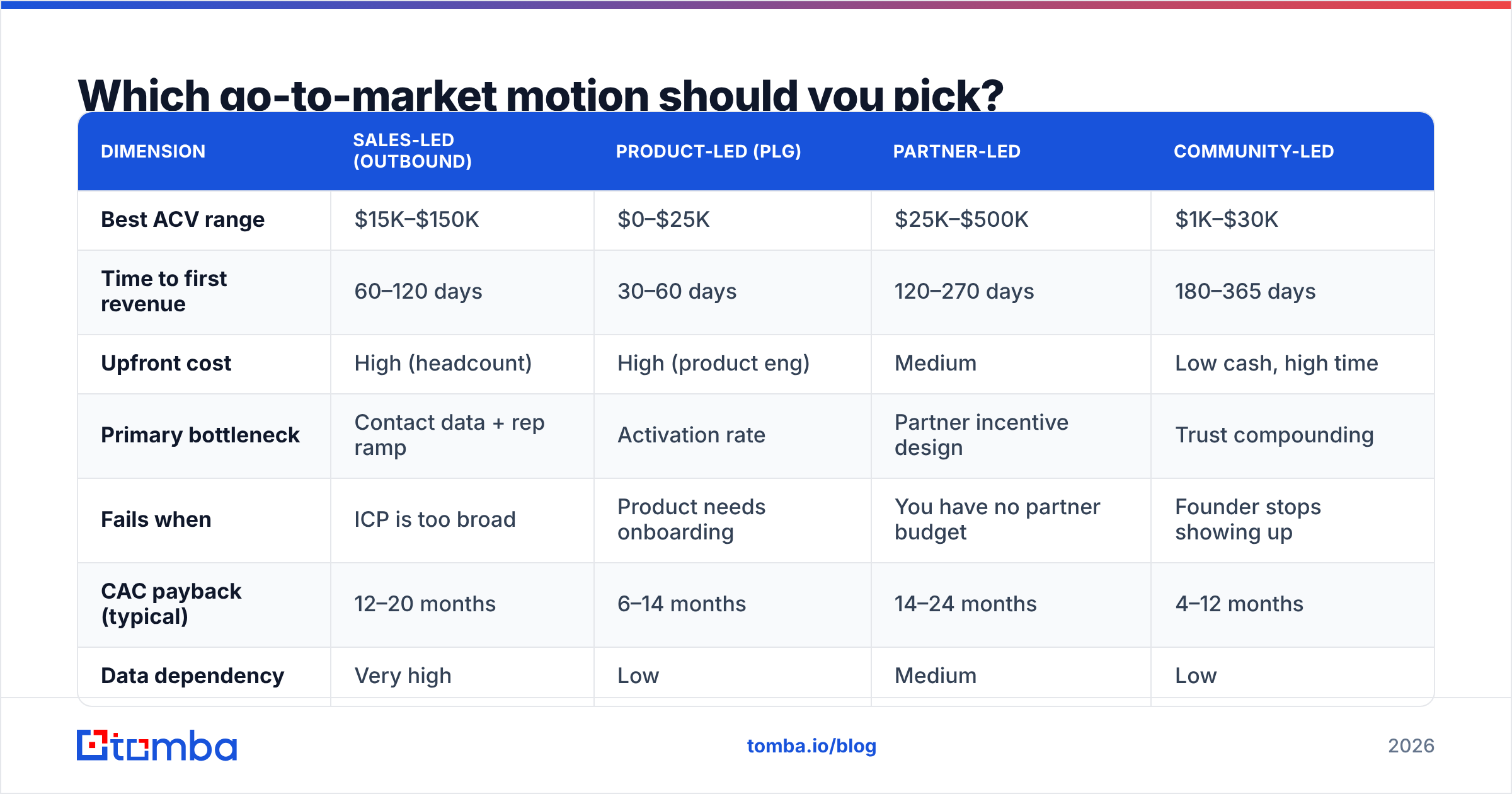
Pick one primary motion. The table below is the honest comparison — not the version where every motion sounds viable.
| Dimension | Sales-led (outbound) | Product-led (PLG) | Partner-led | Community-led |
|---|---|---|---|---|
| Best ACV range | $15K–$150K | $0–$25K | $25K–$500K | $1K–$30K |
| Time to first revenue | 60–120 days | 30–60 days | 120–270 days | 180–365 days |
| Upfront cost | High (headcount) | High (product eng) | Medium | Low cash, high time |
| Primary bottleneck | Contact data + rep ramp | Activation rate | Partner incentive design | Trust compounding |
| Fails when | ICP is too broad | Product needs onboarding | You have no partner budget | Founder stops showing up |
| CAC payback (typical) | 12–20 months | 6–14 months | 14–24 months | 4–12 months |
| Data dependency | Very high | Low | Medium | Low |
Three rules for reading this table:
- ACV decides more than preference. Below roughly $10K ACV, an outbound SDR team rarely pays back — the human cost per touch exceeds the deal value. Above $100K, PLG alone almost never closes; someone has to negotiate.
- Time-to-revenue matters more when runway is short. If you have under 12 months of cash, partner-led and community-led are strategically correct and financially fatal.
- Data dependency is a real line item. Sales-led motions consume verified contacts continuously. Budget for it like you budget for seats, because a rep without deliverable contacts is a rep at 30% capacity.
For a full breakdown of how these motions get operationalized, revenue operations is the function that owns the handoffs between them.
How do you price and package for the motion you chose?#
Pricing is downstream of motion, and packaging is downstream of pricing. Getting the order backward is why so many teams end up with a pricing page their sales team quietly ignores.
If you chose PLG: you need a free tier that delivers a real outcome, not a demo. The free tier's job is to prove value before a card is entered. Set the paywall at the point where the user's usage implies a budget — seats, volume, or integrations.
If you chose sales-led: publish list prices anyway. Buyers in 2026 research before they talk, and a hidden pricing page loses more deals than a high number does. Reserve discounting for multi-year and volume, not for closing pressure.
If you chose partner-led: margin structure is the product. A partner needs 20–30% to care and predictable deal registration to invest.
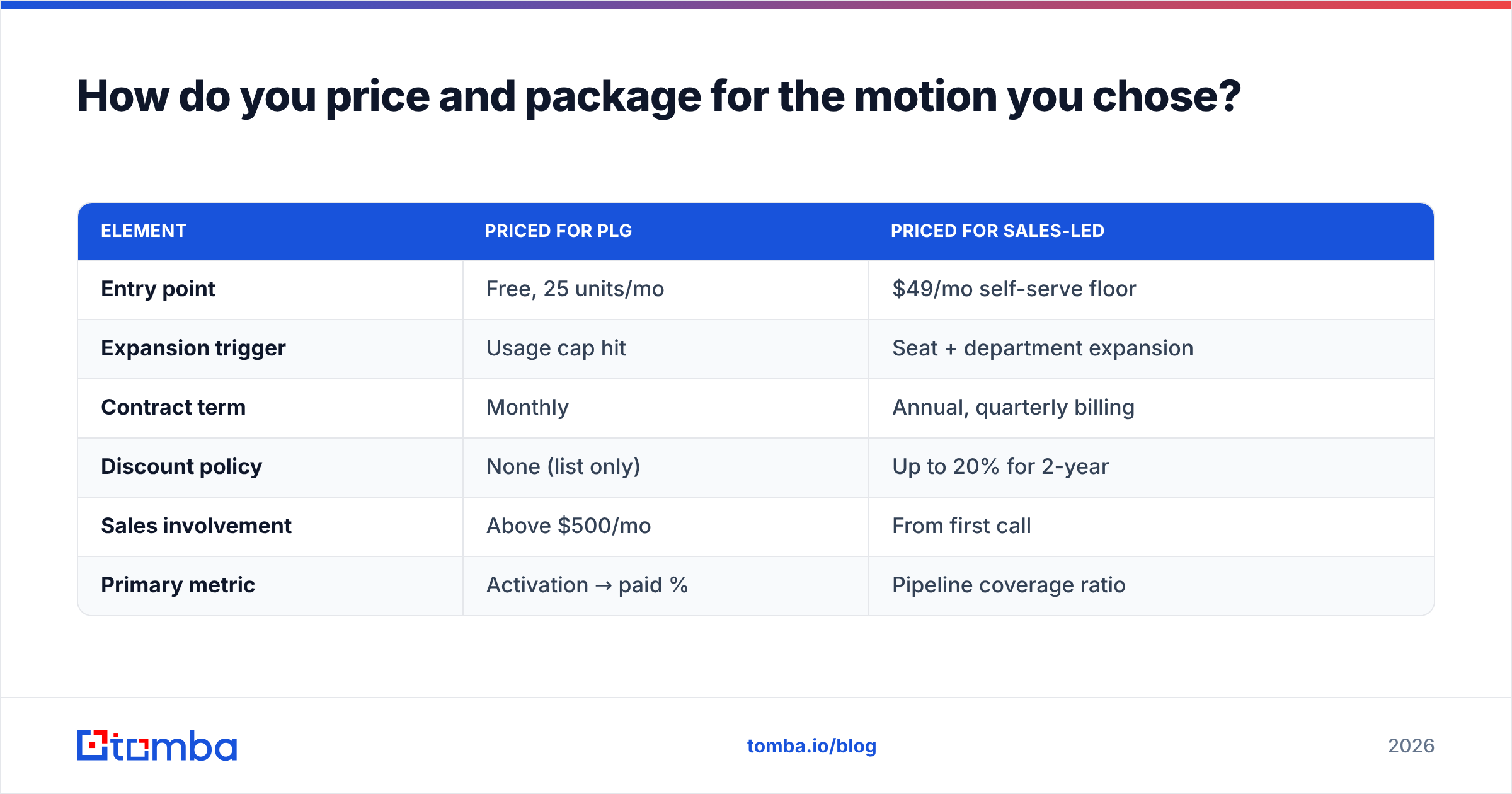
Here's a worked example of the same product priced for two different motions:
| Element | Priced for PLG | Priced for sales-led |
|---|---|---|
| Entry point | Free, 25 units/mo | $49/mo self-serve floor |
| Expansion trigger | Usage cap hit | Seat + department expansion |
| Contract term | Monthly | Annual, quarterly billing |
| Discount policy | None (list only) | Up to 20% for 2-year |
| Sales involvement | Above $500/mo | From first call |
| Primary metric | Activation → paid % | Pipeline coverage ratio |
Tomba's own structure is a useful reference point for a hybrid: a free tier at 25 searches per month, then Starter at $49/mo, Growth at $99/mo, Pro at $249/mo, and custom enterprise pricing. Self-serve carries the low end; sales carries anything with team-wide deployment. You can see the full breakdown on the Tomba pricing page.
What does the channel plan actually look like?#
A channel plan is a budget with a hypothesis attached to each line. Every channel gets: a target CAC, a payback ceiling, a review date, and a kill criterion.
Run this structure per channel:
- Outbound email. Cost = data + tooling + rep time. The variable that moves outcomes most is contact accuracy, not copy. A 25% bounce rate doesn't just waste sends — it damages sender reputation and suppresses the deliverability of the 75% that were fine. Verify before send, every time, with an email verifier.
- Paid search. Highest intent, highest cost, fastest signal. Good for validating messaging in week one even if you kill it in month three.
- Content and SEO. Slowest to compound, cheapest at steady state. Do not model revenue from it inside six months.
- Partnerships. Model it as a pipeline source with a 6-month lag, not as a revenue line.
- Events. Only defensible when your ACV exceeds roughly $40K or the event is your ICP's primary gathering.
The math that governs all of them:
CAC payback (months) = fully-loaded channel cost ÷ (new MRR from channel × gross margin)
Under 12 months is strong. 12–18 is acceptable for enterprise. Over 24 months means you're financing growth with equity, which is a decision to make deliberately rather than discover in a board meeting.
How do you instrument a GTM strategy so it self-corrects?#
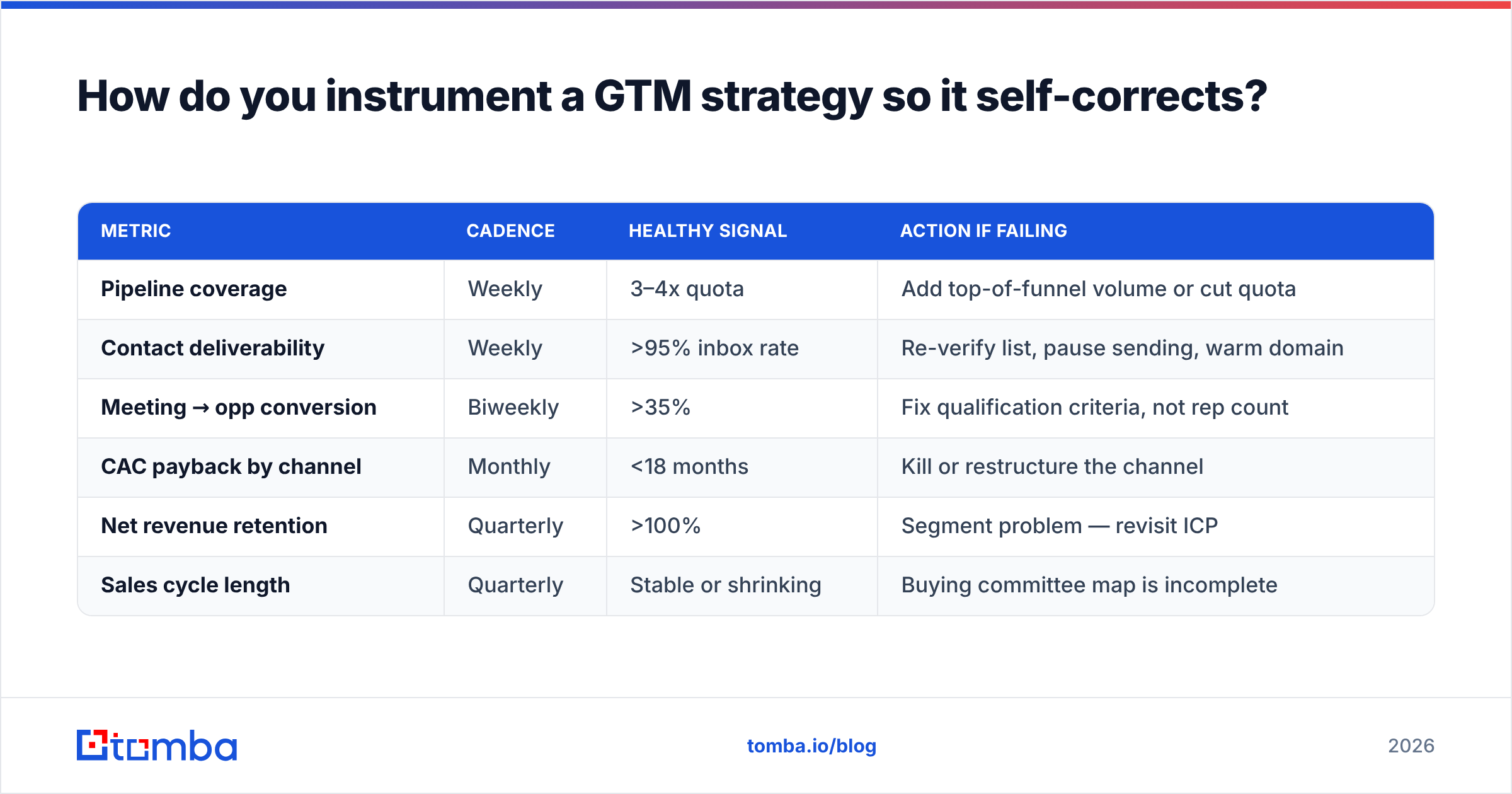
Instrumentation is the difference between a strategy and a guess with a budget. Six metrics, reviewed on a fixed cadence, with one named owner each:
| Metric | Cadence | Healthy signal | Action if failing |
|---|---|---|---|
| Pipeline coverage | Weekly | 3–4x quota | Add top-of-funnel volume or cut quota |
| Contact deliverability | Weekly | >95% inbox rate | Re-verify list, pause sending, warm domain |
| Meeting → opp conversion | Biweekly | >35% | Fix qualification criteria, not rep count |
| CAC payback by channel | Monthly | <18 months | Kill or restructure the channel |
| Net revenue retention | Quarterly | >100% | Segment problem — revisit ICP |
| Sales cycle length | Quarterly | Stable or shrinking | Buying committee map is incomplete |
Two of these deserve extra attention.
Contact deliverability is the leading indicator nobody watches until it breaks. By the time reply rates drop, domain reputation has already degraded and recovery takes weeks. Track it weekly at the list level and treat a bounce spike as a data-source problem, not a copy problem. Google and Yahoo's bulk sender requirements — documented by Google — put a hard 0.3% spam complaint ceiling on senders, and exceeding it affects everything you send afterward.
Net revenue retention is your ICP grading itself. If NRR sits below 100% while acquisition looks healthy, you're selling to the wrong segment efficiently. That's a strategy problem wearing a customer-success costume.
What tooling stack does GTM development require?#
Keep the stack small enough that one person can explain it end to end. Four layers, in dependency order:
- Data layer — company and contact sourcing, verification, enrichment. Everything downstream inherits this layer's error rate.
- Engagement layer — sequencer, dialer, LinkedIn tooling.
- System of record — CRM. One. Not two.
- Analytics layer — attribution and cohort reporting.
The mistake is buying layers 2–4 first because they demo well, then discovering layer 1 is 40% wrong. Contact data decays at roughly 25–30% per year as people change jobs, which means a list built in January is materially different by December. G2's category data shows how crowded the sourcing layer has become — the differentiator is verification depth, not database size.
Practical setup for a team building GTM from scratch:
- Source contacts by company domain, not by scraped lists. A bulk email finder run against your ICP account list gives you a reachability number you can actually plan against.
- Verify before every send. Not once at import — before every campaign, because the list decayed since import.
- Enrich for segmentation fields, not vanity fields. If a field won't change what you say or who you route to, don't pay for it.
- Pipe it into the CRM automatically. Manual CSV steps are where data quality dies. A HubSpot integration or equivalent removes the human error step.
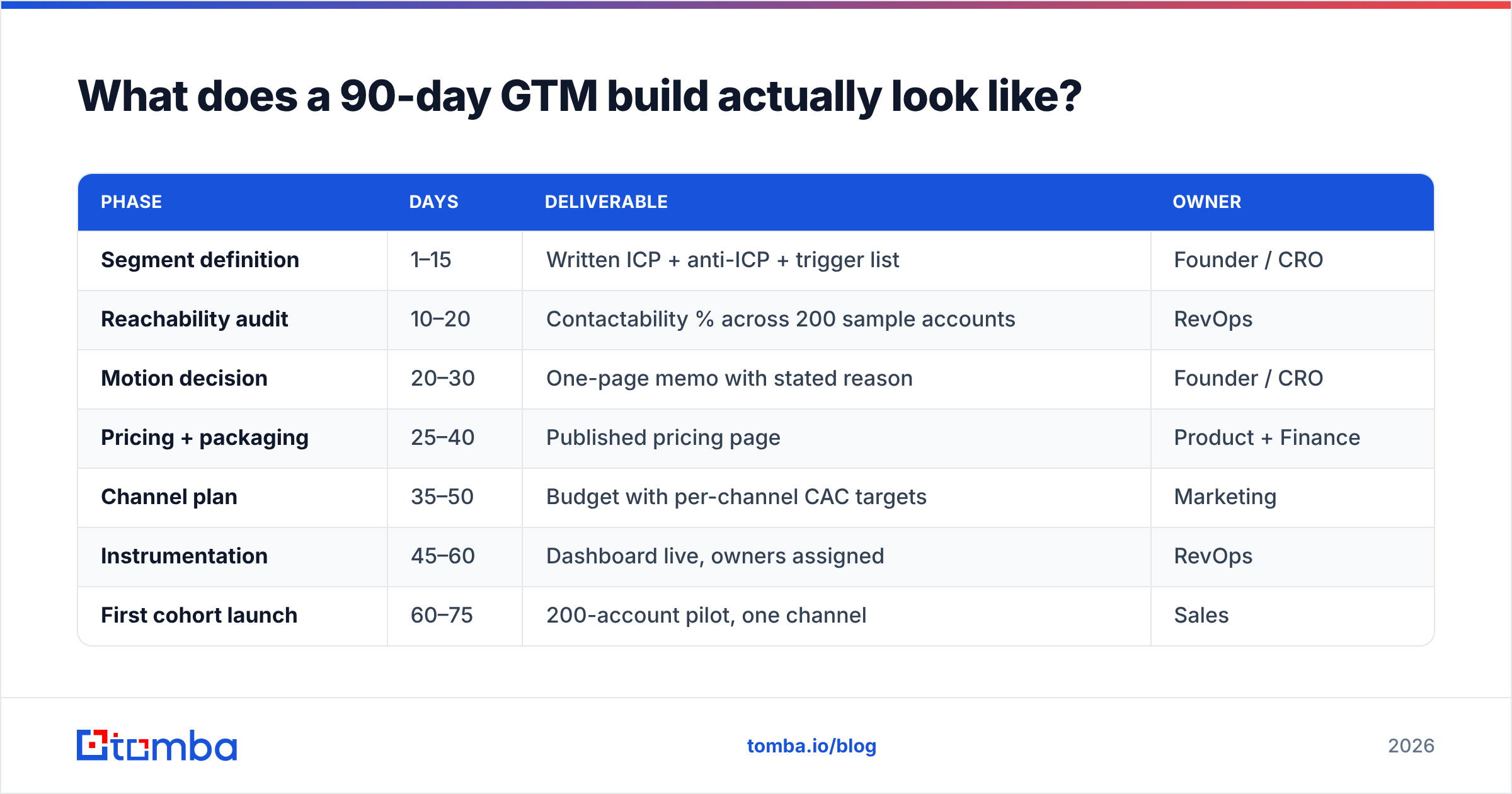
What does a 90-day GTM build actually look like?#
| Phase | Days | Deliverable | Owner |
|---|---|---|---|
| Segment definition | 1–15 | Written ICP + anti-ICP + trigger list | Founder / CRO |
| Reachability audit | 10–20 | Contactability % across 200 sample accounts | RevOps |
| Motion decision | 20–30 | One-page memo with stated reason | Founder / CRO |
| Pricing + packaging | 25–40 | Published pricing page | Product + Finance |
| Channel plan | 35–50 | Budget with per-channel CAC targets | Marketing |
| Instrumentation | 45–60 | Dashboard live, owners assigned | RevOps |
| First cohort launch | 60–75 | 200-account pilot, one channel | Sales |
| Review + kill decisions | 75–90 | Continue / restructure / kill per channel | Leadership |
Two notes on the sequence. The reachability audit runs before the motion decision, because discovering that only 45% of your ICP is contactable should change which motion you pick. And the first cohort is deliberately small — 200 accounts, one channel — because a pilot you can read beats a launch you can't.
Where does go-to-market strategy go wrong in year two?#
The year-two failure mode is different from year one. You've found a motion that works, so you scale it — and the unit economics quietly invert.
Three specific traps:
- Segment dilution. To hit a bigger number, reps go outside the ICP. Win rates drop, cycles lengthen, NRR falls. The fix is holding the ICP line and expanding the motion, not the segment.
- Data decay compounding. A database that was 92% accurate at build is 70% accurate two years later. Teams blame messaging fatigue. It's usually stale contacts. Re-verification on a rolling quarterly schedule is cheaper than the pipeline you lose.
- Motion sprawl. Adding a second motion before the first is at steady state splits attention and doubles ops overhead. Wait until the first motion is boring.
If you're evaluating whether your current stack supports the next stage, Gartner's research on B2B buying behavior is worth reading — buyers now spend the large majority of the journey without sales contact, which changes what "coverage" means.
Start with the layer everything else depends on#
Every stage above sits on top of one question: can you actually reach the companies you decided to sell to? Segment definition, motion choice, channel math, and pipeline modeling all inherit the accuracy of that answer.
Run the reachability audit first. Take 200 accounts from your draft ICP, find the verified decision-maker addresses, and calculate what percentage you can genuinely contact. If it's above 70%, your segment is workable. If it's below 50%, fix the data or fix the segment before you spend a dollar on channels.
Tomba Email Finder is built for exactly that step — find professional email addresses by domain, name, or company, with verification built in so your reachability number reflects deliverable contacts rather than guesses. The free tier covers 25 searches a month, which is enough to run a sample audit before you commit to anything. Start there, get a real number, and build the rest of your go-to-market strategy on top of it.
Related guides#
Ready to find emails that actually work?
Join 150,000+ professionals who stopped guessing and started sending. Free credits on signup — no credit card required.
Get the Tomba newsletter
Practical outbound tactics and product updates — once every two weeks.
About the author