Go-To-Market Strategy Example PDF: Templates That Work
Most GTM strategy PDFs are 40 slides of theory nobody uses. Here's what a real go-to-market strategy example PDF contains, which templates are worth downloading, and how to fill one in.
TL;DR
- A go-to-market strategy example PDF is only useful if it forces you to write down four numbers: ICP size, expected conversion rate, cost per opportunity, and payback period. Most free templates skip all four.
- The best templates are one to three pages. Forty-slide consultancy decks get downloaded, skimmed once, and never opened again.
- There are three GTM motions worth templating separately — sales-led, product-led, and community/partner-led — and a single generic PDF cannot serve all three.
- The section people fill in worst is "target account list." A strategy that says "mid-market SaaS companies in North America" is not a list; a strategy with 400 named accounts and verified contacts is.
- Below: a full section-by-section breakdown you can rebuild in Google Docs in 30 minutes, plus a comparison of the template sources actually worth your download.
What is a go-to-market strategy, in practical terms?#
A go-to-market strategy is the written answer to five questions: who you sell to, what problem you solve for them, how they find out about you, how money changes hands, and what has to be true for the numbers to work.
That's it. Everything else in a GTM document — positioning canvases, competitive matrices, messaging pillars — is supporting evidence for one of those five answers.
The reason people search for a go to market strategy example pdf is rarely because they don't understand the concept. It's because they need a structure to argue inside of. A template gives you an agenda for the meeting where marketing, sales, and product finally have to agree on who the customer is.
Think of it like a flight plan. The pilot doesn't need a document to know the plane flies. The document exists so that when the weather changes at 30,000 feet, everyone on the crew has the same reference for what "on course" means.
What should a go-to-market strategy example PDF actually contain?#
Here is the section list that survives contact with a real quarter. If a template you download is missing more than two of these, it's a marketing lead magnet, not a working document.
- Market definition and ICP — Not "SMBs." A firmographic definition with employee count, revenue band, tech stack signals, geography, and a named-account list you can actually load into a CRM.
- Problem statement and value hypothesis — The specific pain, stated in the buyer's words, plus the measurable outcome you claim to deliver. If you can't put a number on the outcome, your pricing will be guesswork.
- Positioning and differentiation — Which alternatives the buyer is comparing you against, including "do nothing" and "build it internally." Most GTM plans forget those two, and they win the majority of deals.
- Channel and motion selection — Outbound, inbound, product-led, partner, or events. Pick a primary and a secondary. Picking four means picking none.
- Pricing and packaging — Tiers, entry price, expansion mechanic, discount floor. The discount floor matters more than the list price.
- Sales process and required assets — Stage definitions, exit criteria per stage, and the collateral each stage needs.
- Metrics and targets — Pipeline coverage ratio, conversion rate per stage, CAC, payback period, and the leading indicator you'll watch weekly.
- 90-day execution plan — Owner, deadline, and success criterion per line. This is the only section your team will read twice.
Sections 1 and 7 are where most downloadable PDFs are thinnest, because those are the sections that require your data rather than the template author's framework.
Which go-to-market template sources are worth downloading?#
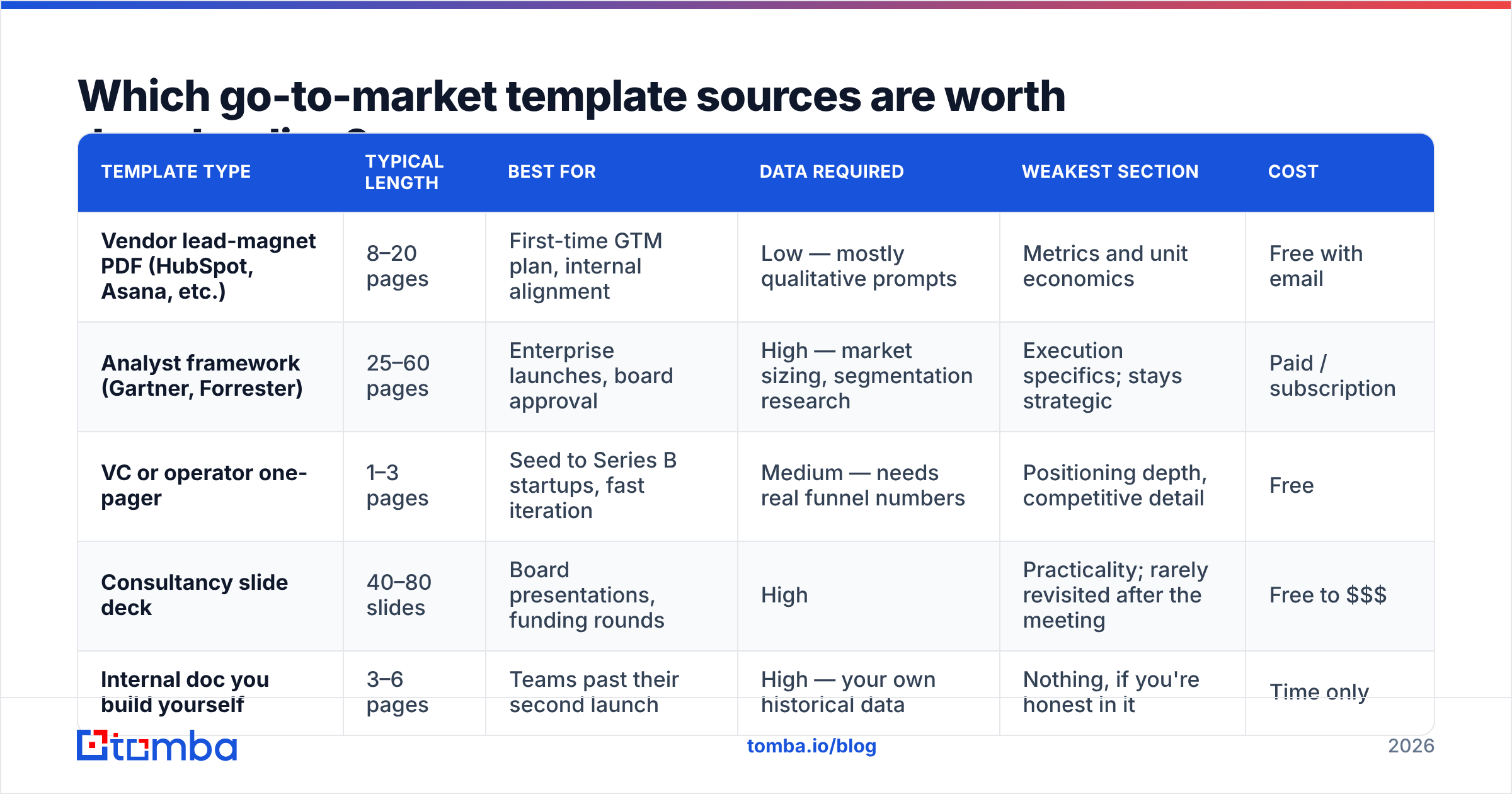
The template market splits into four types, and they serve genuinely different needs. Here's how they compare on the things that determine whether you'll finish filling one in.
| Template type | Typical length | Best for | Data required | Weakest section | Cost |
|---|---|---|---|---|---|
| Vendor lead-magnet PDF (HubSpot, Asana, etc.) | 8–20 pages | First-time GTM plan, internal alignment | Low — mostly qualitative prompts | Metrics and unit economics | Free with email |
| Analyst framework (Gartner, Forrester) | 25–60 pages | Enterprise launches, board approval | High — market sizing, segmentation research | Execution specifics; stays strategic | Paid / subscription |
| VC or operator one-pager | 1–3 pages | Seed to Series B startups, fast iteration | Medium — needs real funnel numbers | Positioning depth, competitive detail | Free |
| Consultancy slide deck | 40–80 slides | Board presentations, funding rounds | High | Practicality; rarely revisited after the meeting | Free to $$$ |
| Internal doc you build yourself | 3–6 pages | Teams past their second launch | High — your own historical data | Nothing, if you're honest in it | Time only |
The pattern: length and usefulness are inversely correlated past roughly six pages. HubSpot's GTM resources and similar vendor templates are a reasonable starting scaffold. Analyst material from Gartner is worth the cost only when you need external authority for a board conversation, not when you need to run next quarter.
Download two templates, not five. Merge the ICP section from the rigorous one into the execution plan from the short one, and you have something better than either.
How do you fill in the ICP section without guessing?#
This is the section that separates a strategy document from a wish list, and it's where the download-and-abandon cycle usually starts.
A usable ICP definition has three layers:
- Firmographic filters — headcount, revenue, industry, region, funding stage. These get you a universe.
- Behavioral or technographic signals — they use a specific tool, they posted a relevant job listing, they raised recently, their site loads a certain script. These narrow the universe to accounts with a live trigger.
- A named list with contacts — actual companies, actual people, actual verified email addresses. Without this layer, everything above is a description, not a target.
Most teams stop after layer one because layer three is tedious. That's the mistake. A GTM plan whose account list exists only as a filter description will produce a first quarter of "we're still building the list."
Build layer three the same week you write the strategy. Pull the company list from your firmographic filters, then run a domain search against each domain to pull the contacts who actually sit in the buying committee. Run the results through an email verifier before anything touches a sequence — a 12% bounce rate on your first campaign will damage sender reputation for months and make your channel test look like a positioning failure when it was a data failure.
If your ICP work happens on LinkedIn, a LinkedIn finder closes the gap between a profile you found and an address you can write to.
Write the count in the document. "Target list: 412 accounts, 1,180 verified contacts, refreshed monthly." That single line makes the rest of the plan auditable.
What metrics belong in the go-to-market plan?#
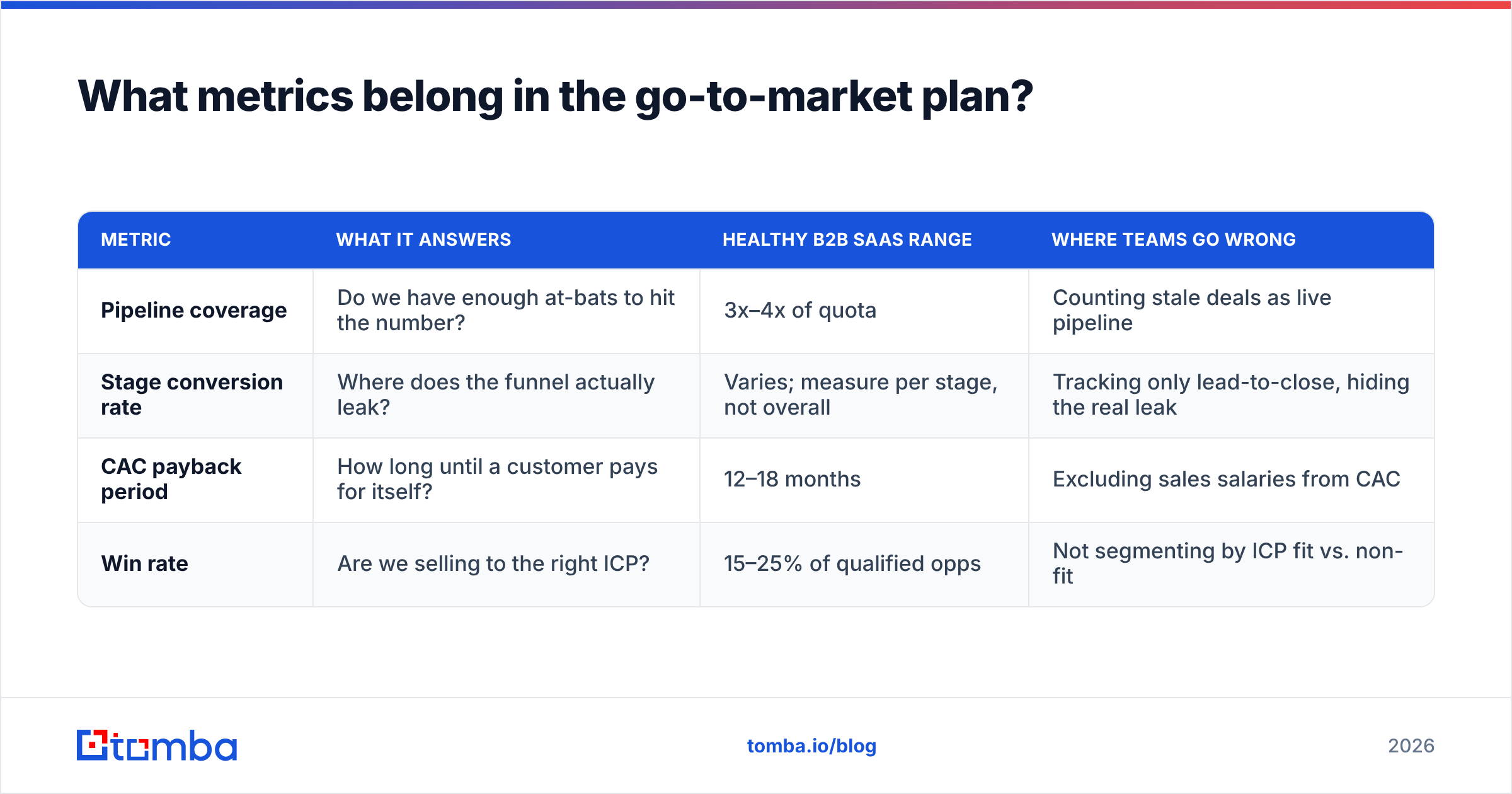
Four numbers, and every template that omits them is decoration.
| Metric | What it answers | Healthy B2B SaaS range | Where teams go wrong |
|---|---|---|---|
| Pipeline coverage | Do we have enough at-bats to hit the number? | 3x–4x of quota | Counting stale deals as live pipeline |
| Stage conversion rate | Where does the funnel actually leak? | Varies; measure per stage, not overall | Tracking only lead-to-close, hiding the real leak |
| CAC payback period | How long until a customer pays for itself? | 12–18 months | Excluding sales salaries from CAC |
| Win rate | Are we selling to the right ICP? | 15–25% of qualified opps | Not segmenting by ICP fit vs. non-fit |
Segment win rate by ICP fit and you'll usually find the answer to your entire GTM question in one chart. If ICP-fit deals close at 30% and off-ICP deals close at 6%, your strategy is not "improve the pitch" — it's "stop working off-ICP accounts." For definitions worth aligning your team on, Tomba's B2B glossary covers win rate and related terms.
Set a leading indicator too. Pipeline and revenue are lagging by 60–120 days. Meetings booked per week, or qualified accounts contacted per week, tells you Monday whether the plan is working.
How does the GTM motion change the template?#
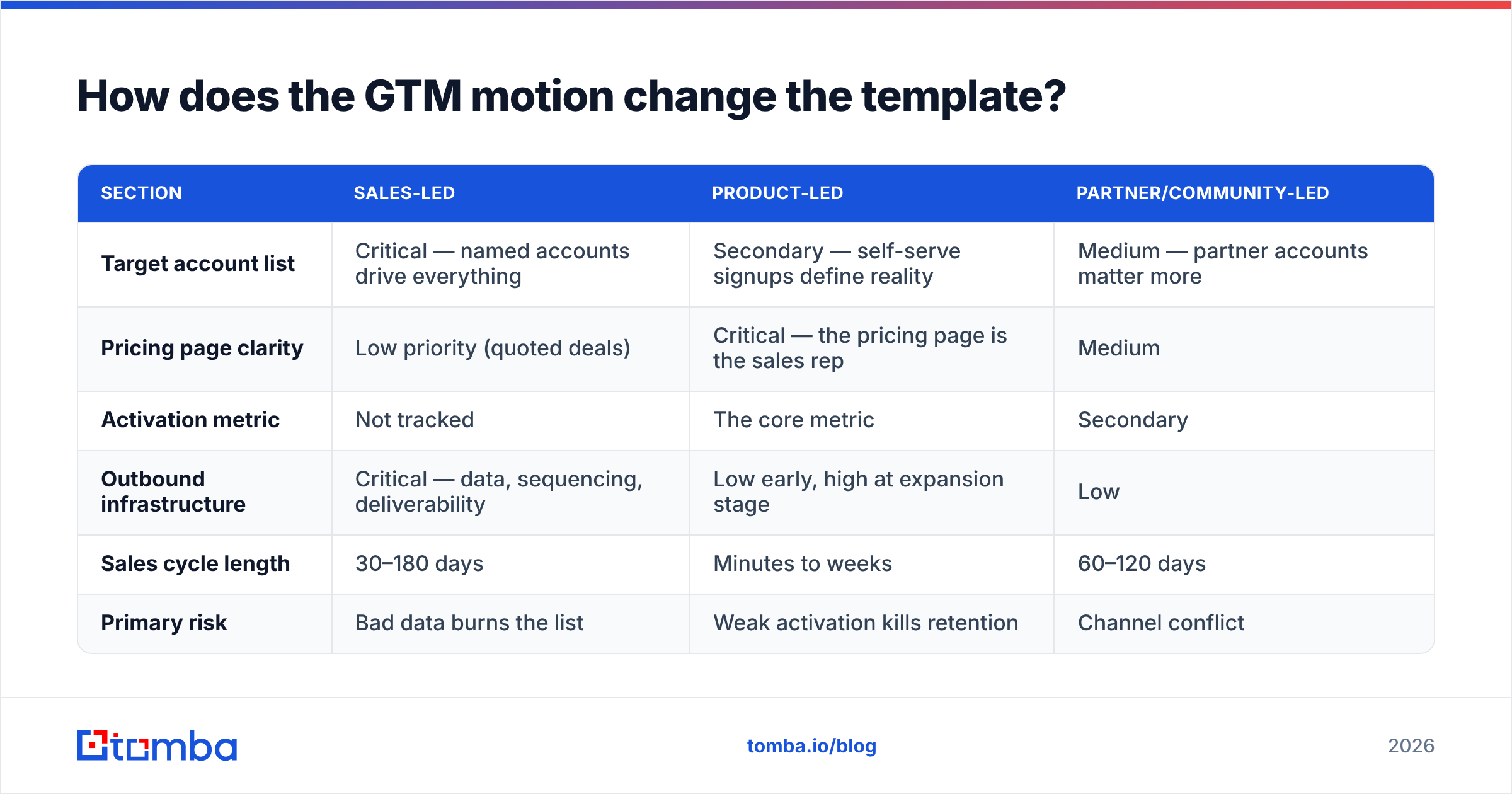
A go-to-market strategy example PDF built for a product-led company will actively mislead a sales-led one. The sections have different weights.
| Section | Sales-led | Product-led | Partner/community-led |
|---|---|---|---|
| Target account list | Critical — named accounts drive everything | Secondary — self-serve signups define reality | Medium — partner accounts matter more |
| Pricing page clarity | Low priority (quoted deals) | Critical — the pricing page is the sales rep | Medium |
| Activation metric | Not tracked | The core metric | Secondary |
| Outbound infrastructure | Critical — data, sequencing, deliverability | Low early, high at expansion stage | Low |
| Sales cycle length | 30–180 days | Minutes to weeks | 60–120 days |
| Primary risk | Bad data burns the list | Weak activation kills retention | Channel conflict |
If you're sales-led, roughly half your GTM planning effort should go into the data and deliverability layer — the list, the verification, the sending infrastructure. That's unglamorous and it's what determines whether the strategy has any chance.
What does the 90-day execution section look like?#
Strategy documents die in the gap between "we will focus on mid-market fintech" and "who is doing what by Friday."
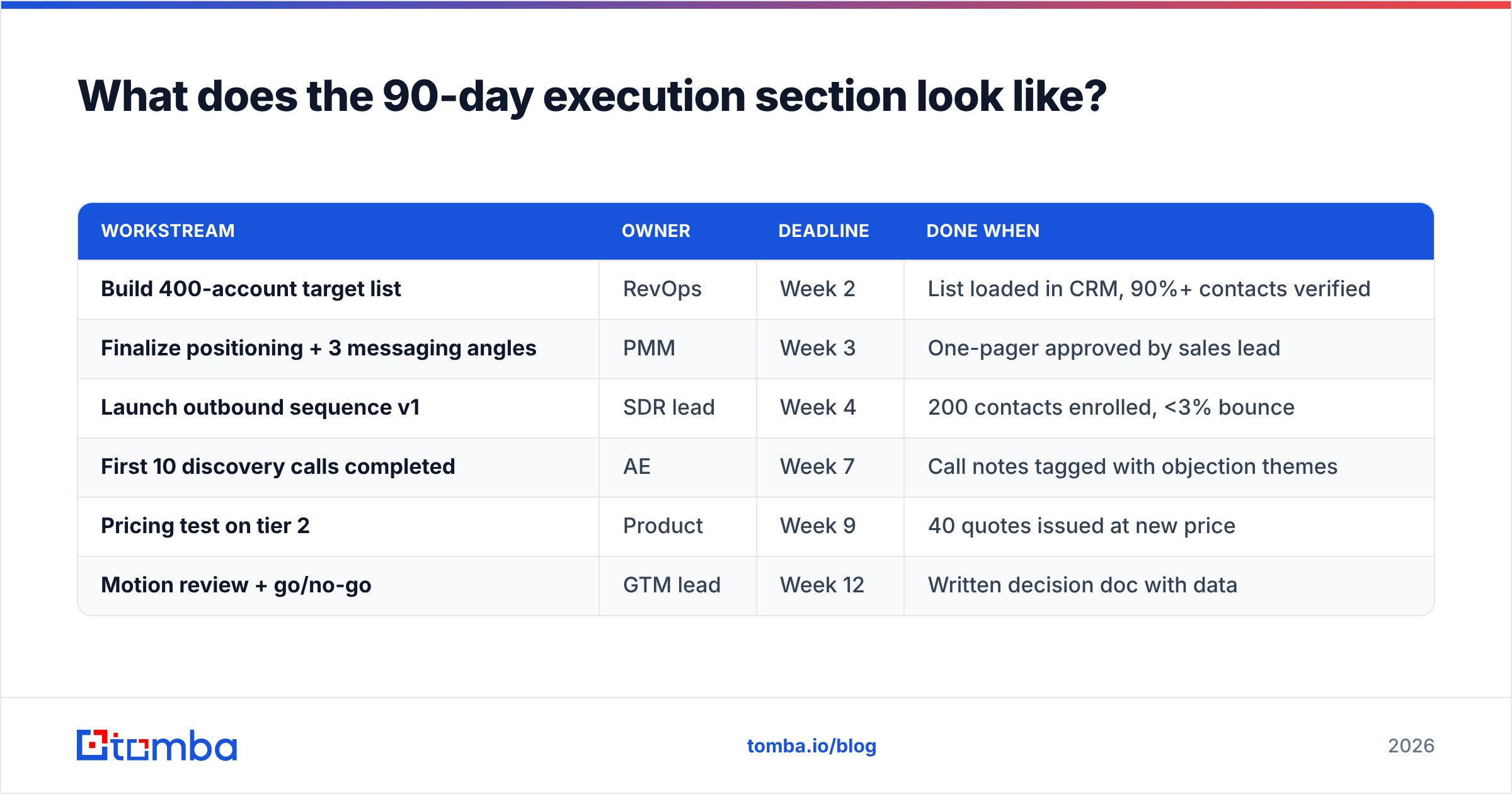
Structure the execution section as a table with four columns and nothing else: workstream, owner, deadline, done-when. The "done-when" column is what makes it real.
| Workstream | Owner | Deadline | Done when |
|---|---|---|---|
| Build 400-account target list | RevOps | Week 2 | List loaded in CRM, 90%+ contacts verified |
| Finalize positioning + 3 messaging angles | PMM | Week 3 | One-pager approved by sales lead |
| Launch outbound sequence v1 | SDR lead | Week 4 | 200 contacts enrolled, <3% bounce |
| First 10 discovery calls completed | AE | Week 7 | Call notes tagged with objection themes |
| Pricing test on tier 2 | Product | Week 9 | 40 quotes issued at new price |
| Motion review + go/no-go | GTM lead | Week 12 | Written decision doc with data |
Six to eight rows. If your execution table has 25 rows, you have a roadmap, not a plan, and nothing will get the attention it needs.
Note the bounce-rate criterion in week 4. Bake data-quality gates into the execution plan rather than treating them as an operational afterthought — that's the difference between a channel test that produces a signal and one that produces noise.
What are the most common mistakes in GTM strategy documents?#
Writing the market section for investors, not operators. TAM slides are for fundraising. Your GTM document needs the serviceable, reachable segment — the accounts you can actually contact this quarter.
Treating channels as additive. Teams list six channels and staff none of them properly. One channel, executed to the point of statistical significance, beats six half-tests every time.
Skipping the "why now" for the buyer. Your product being good is not a reason for a prospect to change vendors this quarter. Identify the trigger event — funding, a new hire in the buying role, a compliance deadline, a competitor's price increase — and build the account list around it.
No data refresh cadence. B2B contact data decays somewhere around 25–30% per year as people change jobs. A target list built in January is meaningfully wrong by July. Set a refresh cadence in the document and use data enrichment to keep records current rather than rebuilding from scratch each quarter.
Confusing the document with the work. The PDF is a coordination artifact. It exists to prevent the wrong argument from being re-litigated in every meeting. It does not itself generate pipeline.
Should you use a PDF at all?#
Probably not, past the first version.
PDFs are good for one thing: distributing a frozen snapshot to people outside your team — a board, an investor, a partner. For internal use, a PDF is the wrong format because a GTM strategy is a living argument that changes as data arrives.
Keep the working version in a doc or wiki where the metrics table updates monthly and the execution table gets checked weekly. Export to PDF when someone external needs a copy. Treat the exported file as a photograph, not the plan.
Sites like G2 are useful for the competitive-alternatives section — read what buyers say about the tools you're displacing, and use their language rather than your own positioning vocabulary. That research goes into the living doc, not the frozen PDF.
How do you pressure-test the strategy before committing budget?#
Run it against three questions before the quarter starts.
- If the top 20 accounts on our list all said yes, would we hit the number? If not, the list is too small or the ACV assumption is wrong. Fix that before anything else.
- What would have to be true for this to fail? Write three failure modes explicitly. Usually one of them is "the contact data was bad and we never reached the buying committee" — which is fixable in advance, not in retrospect.
- What's the cheapest test that would change our mind? Often it's 100 well-targeted, verified outbound contacts and two weeks. That's a fraction of the cost of a full quarter committed to the wrong segment.
The teams that get GTM right aren't the ones with the best-looking document. They're the ones who wrote down what they expected, measured what happened, and changed the document in month two.
Build the account list your GTM plan depends on#
Every section above eventually points back to the same bottleneck: a real list of real people at real companies, with addresses that work. You can write the positioning in an afternoon. Assembling 400 verified contacts across the buying committee is the part that takes real effort — and the part most strategy documents quietly assume is already done.
The Tomba Email Finder turns your ICP filter into a contactable list: search by domain or company, pull the roles that sit in your buying committee, and verify before you send. The free tier gives you 25 searches a month to test whether your segment is reachable at all; Tomba plans start at $49/mo for Starter when you're ready to build the full list, with Growth at $99/mo for teams running multiple segments at once.
Write the strategy this week. Build the list the same week. The document only earns its keep once someone is actually sending against it.
Related guides#
Ready to find emails that actually work?
Join 150,000+ professionals who stopped guessing and started sending. Free credits on signup — no credit card required.
Get the Tomba newsletter
Practical outbound tactics and product updates — once every two weeks.
About the author