Go To Market Strategy Examples: 7 Real GTM Playbooks (2026)
Seven real go-to-market strategy examples — PLG, outbound-led, ABM, channel, community, and hybrid — with the numbers, team shapes, and failure modes behind each one.
TL;DR
- A go-to-market strategy is not a launch plan. It is a repeatable answer to four questions: who buys, why now, how they find you, and who does the work.
- The seven examples below — PLG, sales-led outbound, ABM, channel/partner, community-led, marketplace-led, and hybrid — map cleanly to price point. Under $50/month, self-serve wins. Over $25K ACV, humans win.
- The single most common failure is copying a motion built for a different ACV. Slack's PLG playbook does not work on a $180K enterprise contract, and outbound SDR teams burn cash on a $29/month product.
- Every motion in this list depends on contact data quality. Outbound and ABM collapse without verified emails; PLG collapses without enrichment on signup.
- Pick one motion, run it for two quarters, and instrument it. Running three at once with a five-person team is how startups produce three mediocre channels instead of one good one.
What Is a Go-To-Market Strategy, Exactly?#
A go-to-market strategy is the specific mechanism by which a product reaches a buyer and converts revenue — repeatably, at a cost you can afford.
Think of it like choosing how to get a restaurant's food to customers. You can open a dining room (sales-led), run a takeaway counter (self-serve/PLG), deliver through Uber Eats (marketplace), franchise the recipe (channel), or cook at food festivals until people seek you out (community-led). The food is the same. The economics, staffing, and failure modes are completely different.
Most teams confuse GTM with a launch checklist — press release, landing page, Product Hunt post. That is a launch. A GTM strategy is the standing machine that keeps producing pipeline in month 14.
Four components define any GTM motion:
- ICP definition — the narrow set of companies and roles where your product wins. Not "SMBs in North America." Something like "Series A-B B2B SaaS with 15-60 employees running HubSpot and hiring their second AE."
- Value hypothesis and trigger — why this buyer acts now. A funding round, a competitor's price hike, a compliance deadline, a new hire in the buying role.
- Distribution channel — the path from stranger to first conversation. Cold email, self-serve signup, a partner's customer base, a marketplace listing, a Slack community.
- Revenue motion and team shape — who closes, at what cost, in how many touches. This determines whether you need an SDR team, a growth engineer, or a partner manager.
Miss any one and the machine stalls. Most stalls that get diagnosed as "our messaging is off" are actually ICP problems — you are messaging the right thing to the wrong list.
What Are the Main Go-To-Market Motions?#
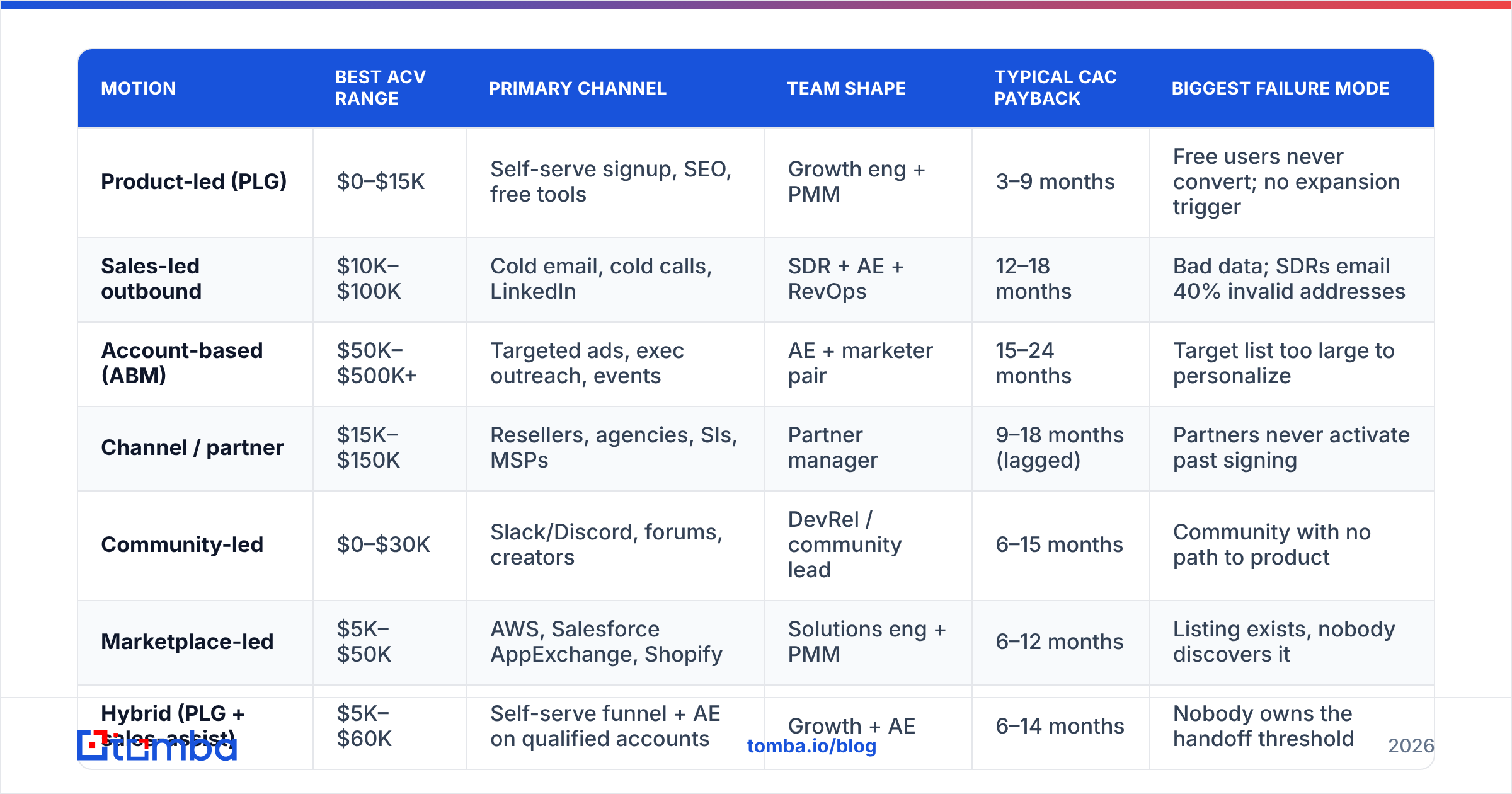
Here is the comparison that matters most, because it maps motion to price point. Ignore this mapping and you will burn a seed round proving something already known.
| Motion | Best ACV range | Primary channel | Team shape | Typical CAC payback | Biggest failure mode |
|---|---|---|---|---|---|
| Product-led (PLG) | $0–$15K | Self-serve signup, SEO, free tools | Growth eng + PMM | 3–9 months | Free users never convert; no expansion trigger |
| Sales-led outbound | $10K–$100K | Cold email, cold calls, LinkedIn | SDR + AE + RevOps | 12–18 months | Bad data; SDRs email 40% invalid addresses |
| Account-based (ABM) | $50K–$500K+ | Targeted ads, exec outreach, events | AE + marketer pair | 15–24 months | Target list too large to personalize |
| Channel / partner | $15K–$150K | Resellers, agencies, SIs, MSPs | Partner manager | 9–18 months (lagged) | Partners never activate past signing |
| Community-led | $0–$30K | Slack/Discord, forums, creators | DevRel / community lead | 6–15 months | Community with no path to product |
| Marketplace-led | $5K–$50K | AWS, Salesforce AppExchange, Shopify | Solutions eng + PMM | 6–12 months | Listing exists, nobody discovers it |
| Hybrid (PLG + sales-assist) | $5K–$60K | Self-serve funnel + AE on qualified accounts | Growth + AE | 6–14 months | Nobody owns the handoff threshold |
The pattern: as ACV rises, human involvement rises, cycles lengthen, and the cost of a bad contact list rises with them. An SDR working a $60K-ACV list who wastes 30% of sends on invalid addresses does not lose 30% of pipeline — they lose 30% of pipeline plus domain reputation, which compounds against every future send.
What Are 7 Real Go-To-Market Strategy Examples?#
These are drawn from publicly documented company behavior, not hypotheticals. Use them as structural templates rather than scripts to copy verbatim.
1. Slack — PLG with a viral team-invite loop#
Slack's motion was free workspace signup with no credit card, then an invite mechanic that made the product worse for a single user and better with each teammate added. The paid conversion trigger was message history hitting the free cap — a limit users felt only after the product was embedded in daily work.
What to steal: tie the paywall to a moment of accumulated value, not to a feature gate encountered on day one. What not to steal: the viral loop only works when the product is inherently multiplayer. A single-player analytics tool bolting on "invite your team" gets nothing.
2. Datadog — bottom-up PLG feeding a top-down enterprise team#
Engineers installed the agent themselves on a free trial. Once usage crossed a threshold, an enterprise AE appeared with a consolidated contract covering teams the original engineer had never met. Datadog effectively ran two motions on the same account, sequenced.
What to steal: use self-serve as the cheapest possible lead qualification, then let sales monetize the account, not the individual.
3. Gong — outbound-led with a category-creation content engine#
Gong ran aggressive outbound into revenue leaders while simultaneously publishing data-backed content ("we analyzed 100,000 sales calls"). The content gave SDRs a reason to reach out that was not a pitch. Note the dependency: this motion consumes an enormous volume of accurate contact records for VP Sales and CRO roles.
What to steal: give your outbound team a proprietary data asset to lead with. "I have a benchmark you don't" beats "do you have 15 minutes."
4. Snowflake — ABM into a named account list#
A tightly bounded list of large data-heavy enterprises, worked with paired AE-and-marketer teams, executive dinners, and a marketplace presence on cloud providers. Deal cycles ran quarters, not weeks. The list was small enough that every account got genuine research.
What to steal: if your ACV is above $100K, your target list should be small enough that one person can name every account from memory.
5. HubSpot — inbound content plus a partner/agency channel#
HubSpot built enormous organic traffic through free educational content and free tools, then layered an agency partner program where marketing agencies resold and implemented the platform. The partners handled onboarding, which is the expensive part of SMB software. Their own inbound methodology documentation is still the clearest public writeup of the motion.
What to steal: in SMB, the partner absorbs your service costs. In exchange, they get margin and a stickier client.
6. Figma — community-led with template distribution#
Shareable design files functioned as marketing assets. Every public community file was both a product demo and an SEO asset, and every share link brought a non-user into the product as a viewer. Viewers converted to editors when they needed to change something.
What to steal: make the artifact your users produce shareable to non-users, with a soft edge that converts viewers.
7. Twilio — developer-first, docs as the funnel#
The funnel was documentation and a free API key. No sales conversation until usage scaled. Sales entered on volume commitments, not on first purchase. Developer trust was the moat, and it was earned with reference-grade docs rather than marketing copy.
What to steal: if your buyer is technical, your docs are your landing page. Treat them with the same rigor.
Which Go-To-Market Example Fits Your Company?#
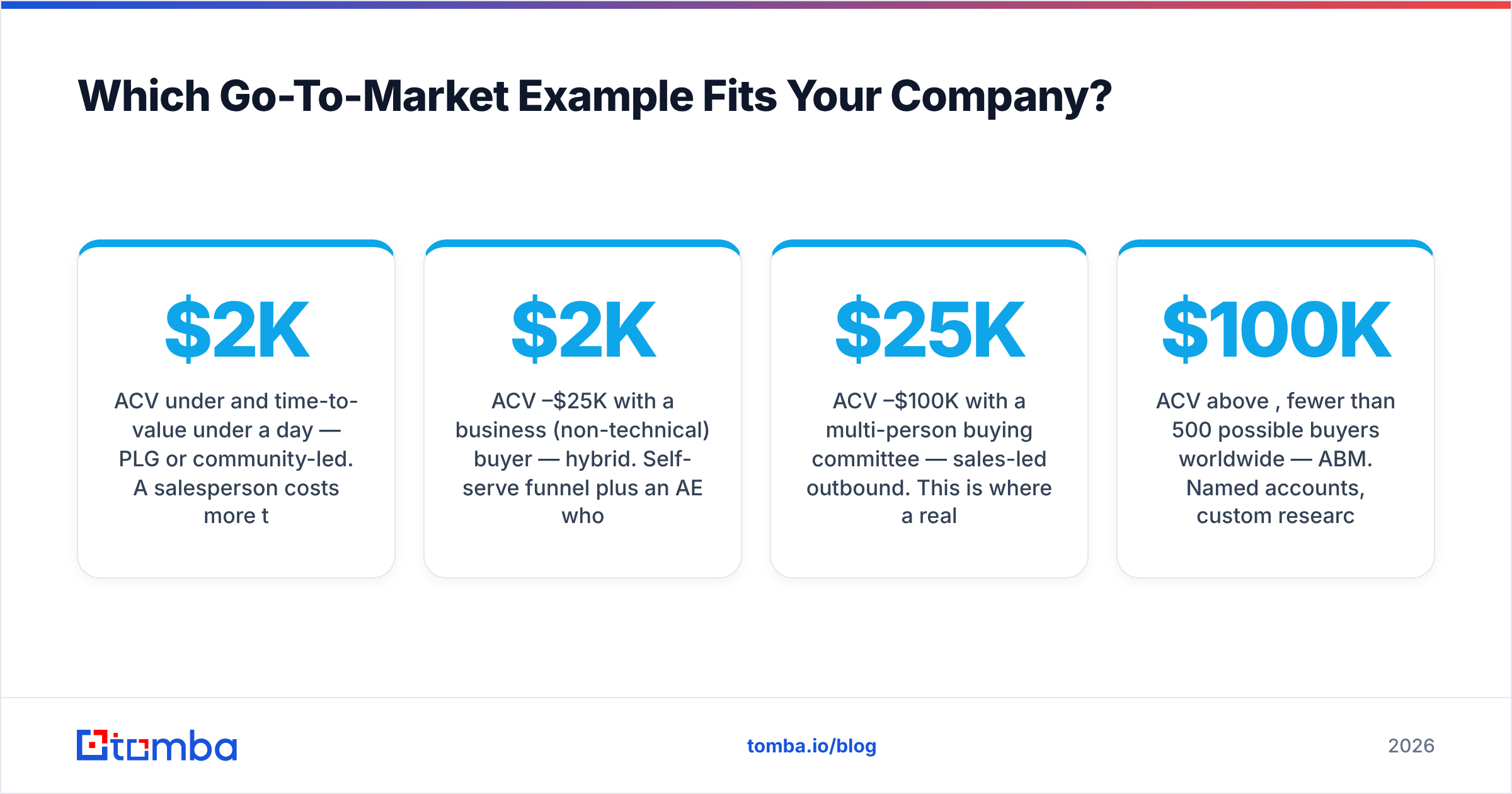
Work backwards from three inputs: ACV, buyer sophistication, and time-to-value.
- ACV under $2K and time-to-value under a day — PLG or community-led. A salesperson costs more than the deal. Invest in onboarding, free tools, and SEO.
- ACV $2K–$25K with a business (non-technical) buyer — hybrid. Self-serve funnel plus an AE who intervenes when an account hits a usage or firmographic threshold.
- ACV $25K–$100K with a multi-person buying committee — sales-led outbound. This is where a real B2B database and disciplined list-building start to determine the quarter.
- ACV above $100K, fewer than 500 possible buyers worldwide — ABM. Named accounts, custom research, executive relationships, long cycles.
- You sell into an ecosystem that already has a marketplace (Salesforce, Shopify, AWS) — marketplace-led, layered onto whichever of the above applies.
One caveat on the hybrid motion, because it is the one most teams get wrong: define the handoff threshold numerically before you launch it. "AE reaches out when the account looks good" is not a threshold. "AE reaches out when a signup has 3+ seats, 50+ employees, and 5 sessions in 14 days" is. Ambiguous thresholds produce AEs cherry-picking and growth teams complaining.
What Data Does Every GTM Motion Actually Require?#
Every motion above is a distribution hypothesis stacked on top of a data layer. When GTM plans fail in month three, the cause is usually the data layer, not the hypothesis.
Here is what each motion needs to function:
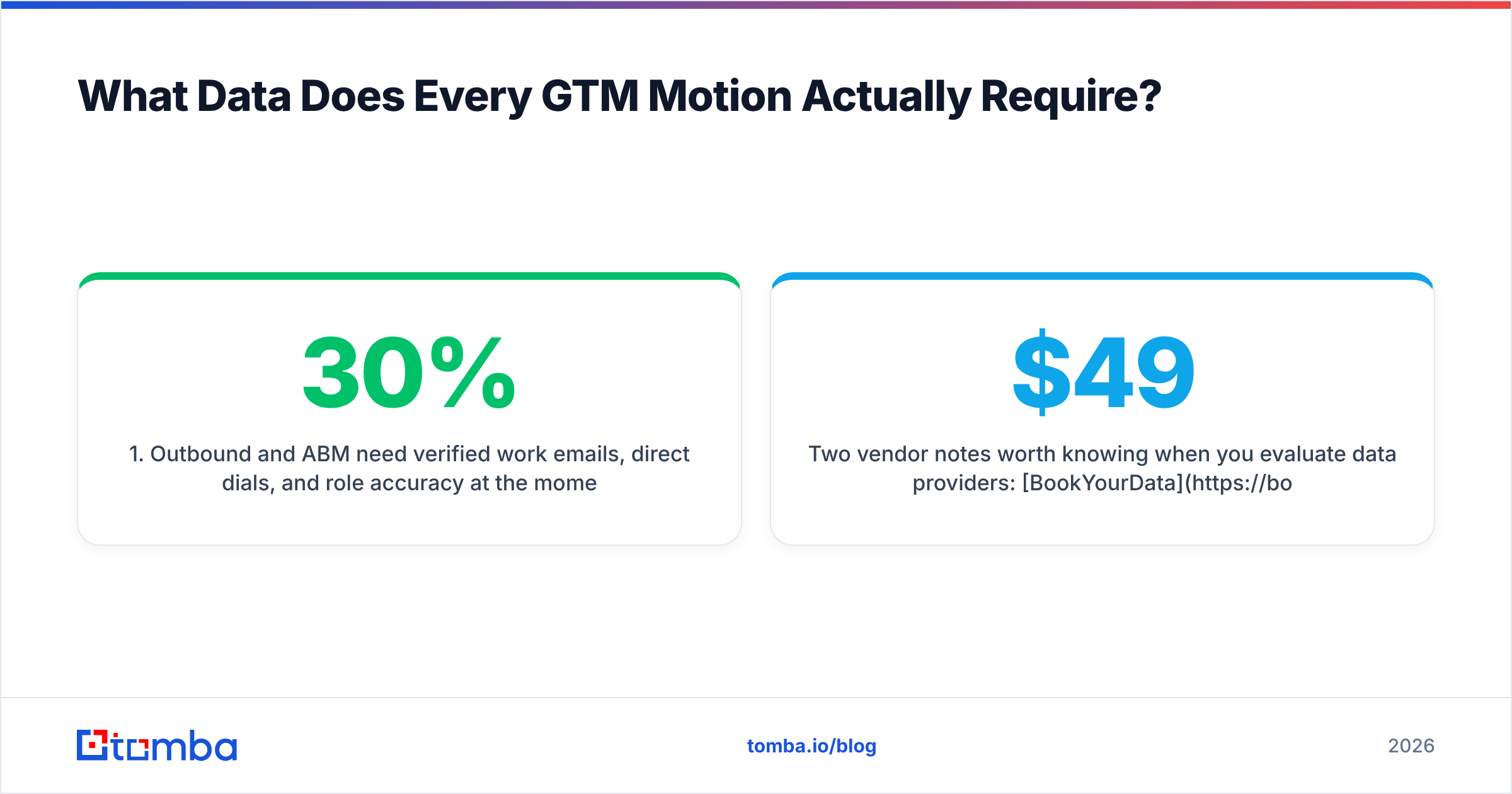
- Outbound and ABM need verified work emails, direct dials, and role accuracy at the moment of send. A list built six months ago has roughly 20–30% decay in B2B, driven by job changes. Run every list through an email verifier before it touches your sending domain — bounce rate is the fastest way to destroy email deliverability you spent a year building.
- PLG and hybrid need enrichment at signup. A free-email signup with no company context cannot be scored or routed. Enriching on signup turns
jenny@gmail.cominto "Head of Ops at a 120-person logistics company," which is the difference between a lead and a row. - Channel and partner need firmographic data on the partner's book of business, so you can tell which partners actually serve your ICP before you invest in enabling them.
- Community-led needs identity resolution — matching a Slack handle or GitHub username to a company, so community activity can be attributed to pipeline instead of vibes.
- Marketplace-led needs clean company records to reconcile marketplace billing entities against your CRM, which is otherwise a quarterly reconciliation nightmare.
For the outbound and ABM cases specifically, the mechanical starting point is finding contacts at target accounts. A domain search returns the email pattern and known contacts at a company, which is faster than guessing formats one at a time. For enrichment on signup, an API call at the point of registration is cheaper than any downstream sales cycle spent qualifying manually.
Two vendor notes worth knowing when you evaluate data providers: BookYourData is a solid option if you want prepaid, pay-as-you-go lists with no subscription commitment, and Tomba's Tomba pricing starts with a free tier at 25 searches/month, then Starter at $49/mo, Growth at $99/mo, and Pro at $249/mo. Different shapes for different buying preferences — credits versus subscription is mostly a procurement question, not a quality one. If you want third-party signal on either, G2's lead intelligence category has volume-weighted reviews.
How Do You Build Your Own GTM Plan in 30 Days?#
A workable sequence, assuming a team of three to eight people:
Week 1 — Narrow the ICP. Pull your last 20 closed-won deals and your last 20 closed-lost. Find the two or three attributes that separate them. Industry is usually a weak signal; team structure, tech stack, and a specific trigger event are usually strong ones. Write the ICP as a sentence a new hire could act on without asking questions.
Week 2 — Build a 200-account test list. Not 5,000. Two hundred, built by hand or by filtered search, where you can defend every inclusion. Find the contacts, verify them, and note the trigger for each account.
Week 3 — Run one motion only. Whichever the ACV mapping told you to run. If outbound: 200 accounts, three personas per account, four-touch sequence. If PLG: one onboarding change and one enrichment-based routing rule. Instrument everything — reply rate, meeting rate, and cost per meeting for outbound; activation rate and time-to-value for PLG.
Week 4 — Read the numbers honestly. Below 3% positive reply on a well-built outbound list means the offer or the ICP is wrong, not the copy. Below 15% activation on PLG means onboarding, not acquisition. Fix the upstream layer before scaling spend.
Then run the same motion for another two quarters before adding a second. GTM motions compound slowly and die fast when starved of attention. The teams that win are boring: one ICP, one motion, one channel, instrumented relentlessly, for long enough to see the compounding. Forrester's B2B research and Gartner's sales practice both publish buying-committee data worth reading before you finalize persona counts — most B2B deals now involve six to ten stakeholders, which should change how many contacts per account you target.
What Are the Most Common GTM Mistakes?#
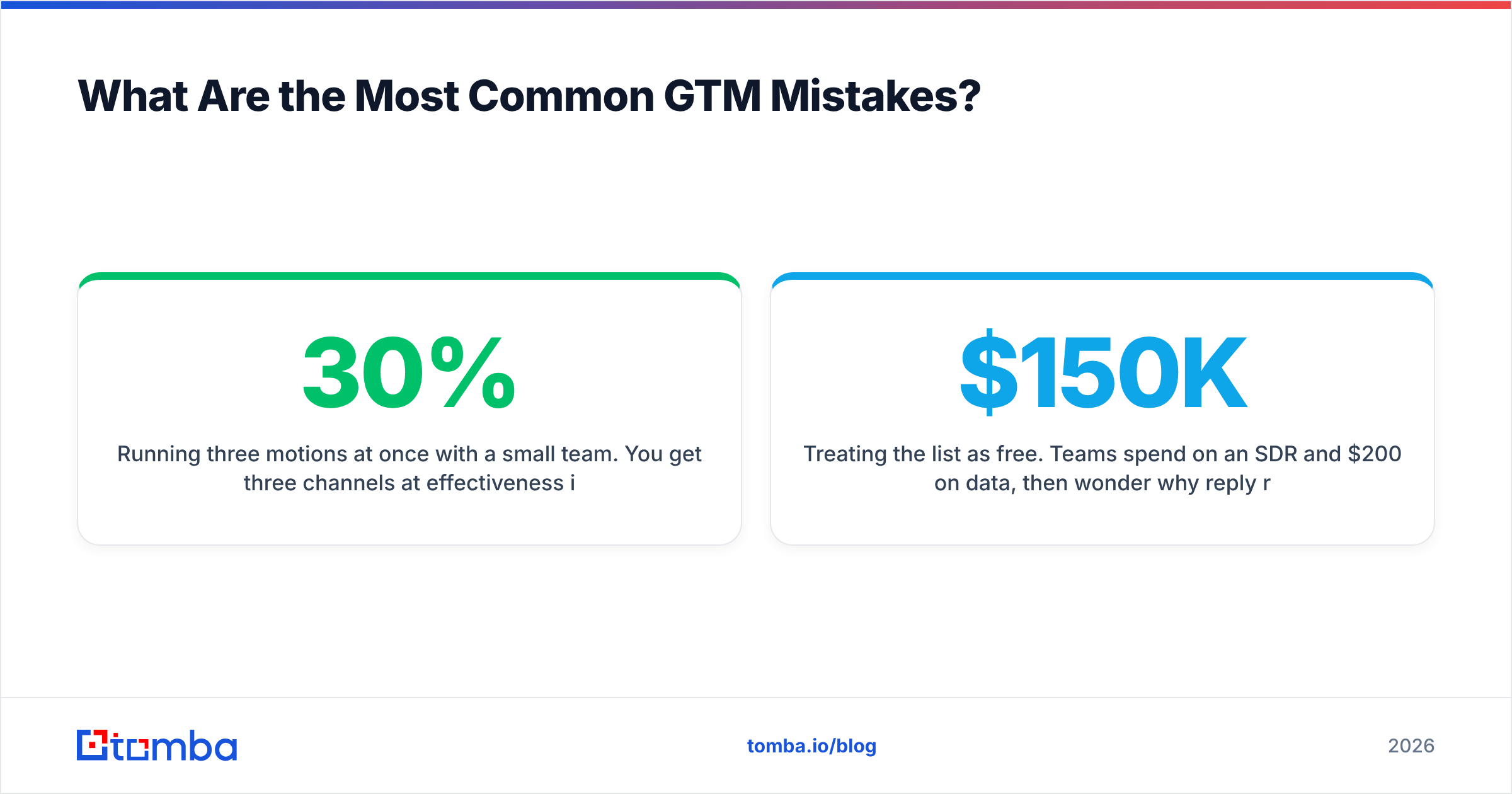
- Running three motions at once with a small team. You get three channels at 30% effectiveness instead of one at 90%.
- Copying a motion from a company with a different ACV. The most expensive mistake on this list.
- Treating the list as free. Teams spend $150K on an SDR and $200/month on data, then wonder why reply rates are bad.
- No trigger in the outreach. "I saw you're a marketing leader" is not a trigger. "I saw you posted three SDR roles last month" is.
- Scaling before the unit economics close. If CAC payback is 30 months at 20 accounts, it will not improve at 200.
- No named owner. A GTM strategy without a single accountable person becomes a deck that gets re-presented quarterly.
Where Should You Start?#
Start with the list, because every motion above degrades to noise without accurate contacts. Pick 200 accounts inside a narrow ICP, find the decision-makers, verify the addresses, and log the trigger for each one. That single artifact is what makes outbound, ABM, and hybrid motions measurable — and it takes an afternoon, not a quarter.
The Tomba Email Finder is built for exactly this step: give it a domain and a name, get a verified professional email back, with confidence scoring and source attribution so you know what you are sending to. The free tier covers 25 searches a month if you want to test the workflow on a sample of your list before committing; Starter is $49/mo when you are ready to build the full 200-account set. Build the list first, then pick your motion — the order matters more than most teams expect.
Related guides#
Ready to find emails that actually work?
Join 150,000+ professionals who stopped guessing and started sending. Free credits on signup — no credit card required.
Get the Tomba newsletter
Practical outbound tactics and product updates — once every two weeks.
About the author