Go To Market Strategy FMCG: The 2026 Operator's Guide
FMCG go-to-market lives or dies on distribution math, not brand decks. Here's how modern CPG teams pick channels, structure distributor deals, and build the buyer contact data that makes retail launches actually land.
Most go to market strategy FMCG advice stops at the brand deck. This guide starts where the money is: channel math, distributor terms, and the buyer contacts that get you onto a shelf.
TL;DR
- FMCG go-to-market is a distribution problem wearing a marketing costume. If you cannot answer "how does a case get from my pallet to a shelf, and who reorders it," the brand work is decoration.
- The three viable routes to market — direct-to-retail, distributor-led, and DTC/marketplace — have wildly different margin stacks. Model all three before you commit, because switching later costs you a year.
- Trade spend eats 15-25% of gross revenue in most categories. Budget it as a line item on day one, not as a surprise deduction in month nine.
- Category-manager and buyer relationships are still won by direct contact. The bottleneck is usually finding the right person's email, not the pitch.
- Velocity (units per store per week) is the only metric retailers care about. Design your entire GTM plan backwards from it.
Go to market strategy FMCG basics: why it is different#
A go to market strategy FMCG teams can run is the plan for moving a cheap, fast-selling product from your pallet to a shopper's cart at a profit. On paper it sounds like B2B SaaS GTM. The mechanics are not the same.
Think of software GTM as a direct flight: you sell, you provision, you keep the whole fare. FMCG GTM is a connecting flight with three airlines: a distributor, a retailer, and sometimes a broker. Each one takes a cut. Each one keeps its own schedule. None of them has to care whether your bag arrives.
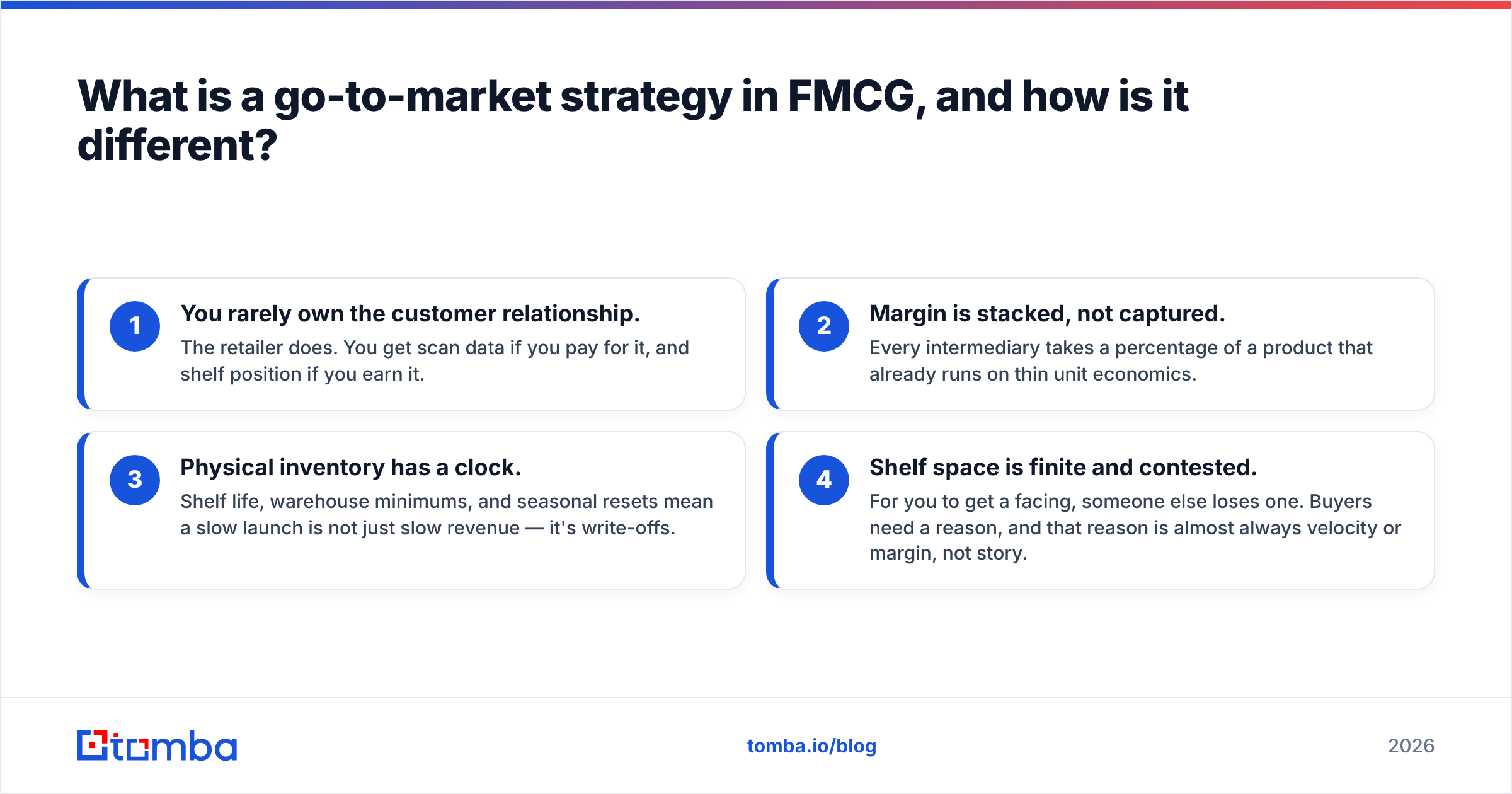
That difference creates four constraints that shape everything else:
- You rarely own the customer relationship. The retailer does. You get scan data if you pay for it, and shelf position if you earn it.
- Margin is stacked, not captured. Every middleman takes a percentage of a product that already runs on thin unit economics.
- Physical inventory has a clock. Shelf life, warehouse minimums, and seasonal resets mean a slow launch is not just slow revenue. It is write-offs.
- Shelf space is finite and contested. For you to get a facing, someone else loses one. Buyers need a reason, and that reason is almost always velocity or margin, not story.
Teams that get this right treat GTM as a supply chain problem with commercial terms attached. Teams that get it wrong build a beautiful brand identity, sign one distributor, and wonder why sell-through stalled at month four.
Which route to market should you choose?#
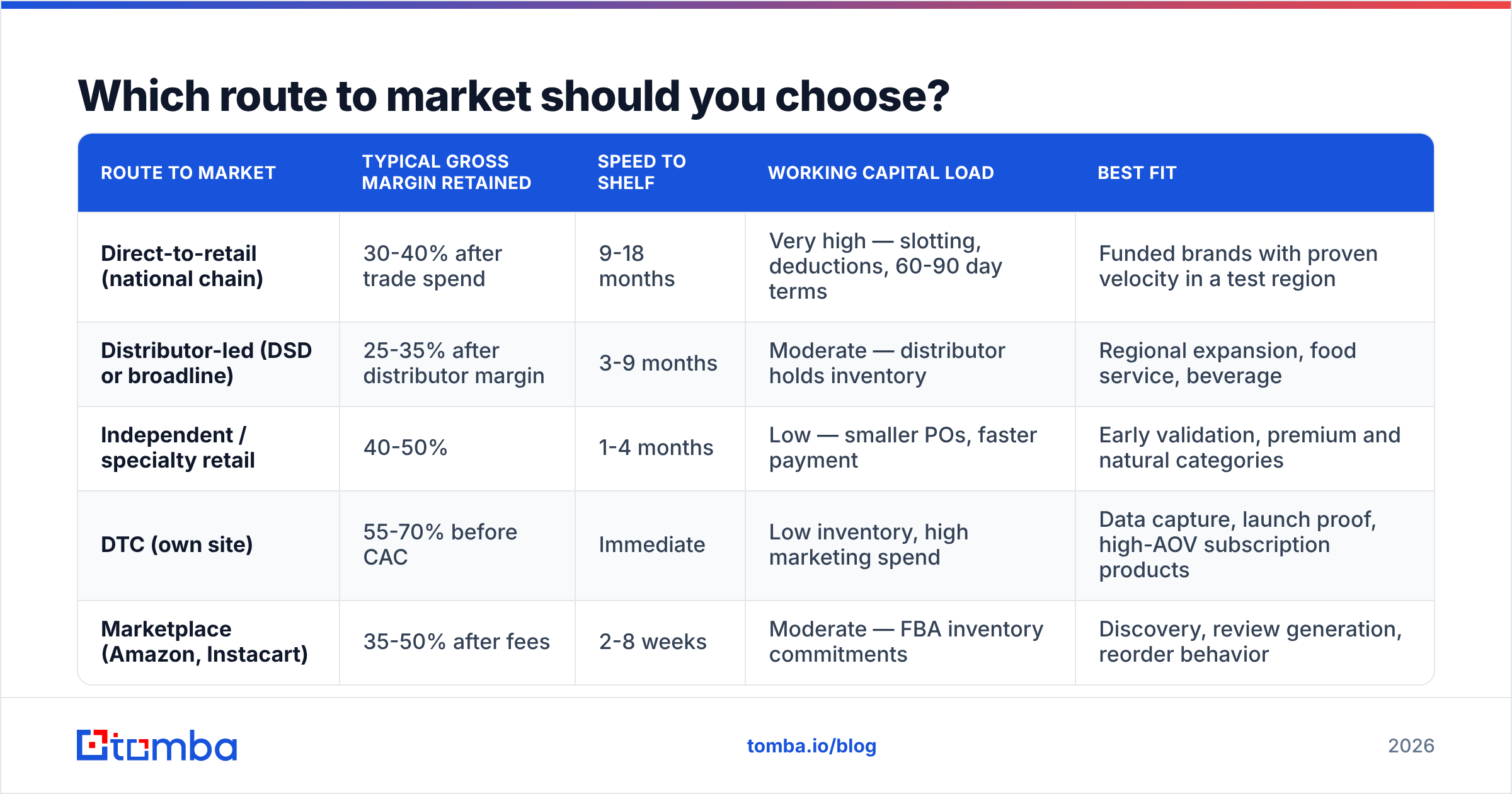
Start by modeling the margin stack. Every FMCG route to market has a predictable set of deductions. The best channel is the one where your unit economics survive at the volume you can realistically hit.
| Route to market | Typical gross margin retained | Speed to shelf | Working capital load | Best fit |
|---|---|---|---|---|
| Direct-to-retail (national chain) | 30-40% after trade spend | 9-18 months | Very high — slotting, deductions, 60-90 day terms | Funded brands with proven velocity in a test region |
| Distributor-led (DSD or broadline) | 25-35% after distributor margin | 3-9 months | Moderate — distributor holds inventory | Regional expansion, food service, beverage |
| Independent / specialty retail | 40-50% | 1-4 months | Low — smaller POs, faster payment | Early validation, premium and natural categories |
| DTC (own site) | 55-70% before CAC | Immediate | Low inventory, high marketing spend | Data capture, launch proof, high-AOV subscription products |
| Marketplace (Amazon, Instacart) | 35-50% after fees | 2-8 weeks | Moderate — FBA inventory commitments | Discovery, review generation, reorder behavior |
Read that table as a sequence, not a menu. Most successful CPG brands ran the same ladder over the last decade. DTC or specialty retail first, to prove the concept and gather velocity data. Then a regional distributor, to build density. Then a national chain conversation, backed by real numbers.
Skipping steps is where money burns. Walk into a national buyer meeting with no velocity history and you are asking for a bet the buyer has no reason to make. You pay for that bet in slotting fees, free fills, and promo commitments. Those costs can gut your margin for two years.
Four questions that pick the channel for you#
- What is your unit contribution at 30% off list? If it goes negative, retail is not viable yet. Fix your cost of goods before your GTM.
- How long is your shelf life? Under 90 days pushes you toward DSD (direct store delivery) or local. Over a year opens broadline distribution and marketplaces.
- Can you fund 90-day payment terms? Retail is a lending business dressed up as a sales channel. Distributors usually pay faster than chains.
- Does your product need explanation? Hard-to-explain products lose on a crowded shelf. They win on DTC and marketplace listings, where copy and reviews do the selling.
How do you build the FMCG channel plan itself?#
Once the route is chosen, the plan has five moving parts. Treat each as a deliverable with an owner and a date.
- Target account list with tiers. Not "grocery." Name the 40 chains and 200 independents that match your shopper. Tier them by fit, not by size. A tier-1 account is one where your product solves a gap the buyer already knows they have.
- Pricing architecture. Set your list price, wholesale price, distributor price, and promoted price at the same time. If you set list first and back into the rest, you end up with a promoted price that loses money. That is the most common FMCG pricing error.
- Trade spend budget. Slotting, free fill, off-invoice allowances, ad features, demos, and deductions. Model 15-25% of gross revenue depending on category, and put a hard cap per account.
The last two parts decide whether the first three ever reach a shelf.
- Field execution plan. Who checks the shelf? Who fixes out-of-stocks? A product that is authorized but not on shelf is a rounding error in your P&L and a failure in the buyer's report.
- Buyer contact strategy. Category managers move roles constantly. You need a repeatable way to find the current buyer for your category at each target account, plus the broker or distributor rep who covers it.
That last one is where most plans go vague. It is also the one you can solve with data work instead of luck.
How do you actually reach FMCG buyers and category managers?#
The pitch is not the hard part. Reaching the right human is.
Retail buying teams rotate category managers every 12-24 months. They use email formats you cannot guess, and they publish almost nothing about who owns what. Brokers guard their relationships, and generic info@ inboxes are graveyards. Here is the workflow that works in 2026.
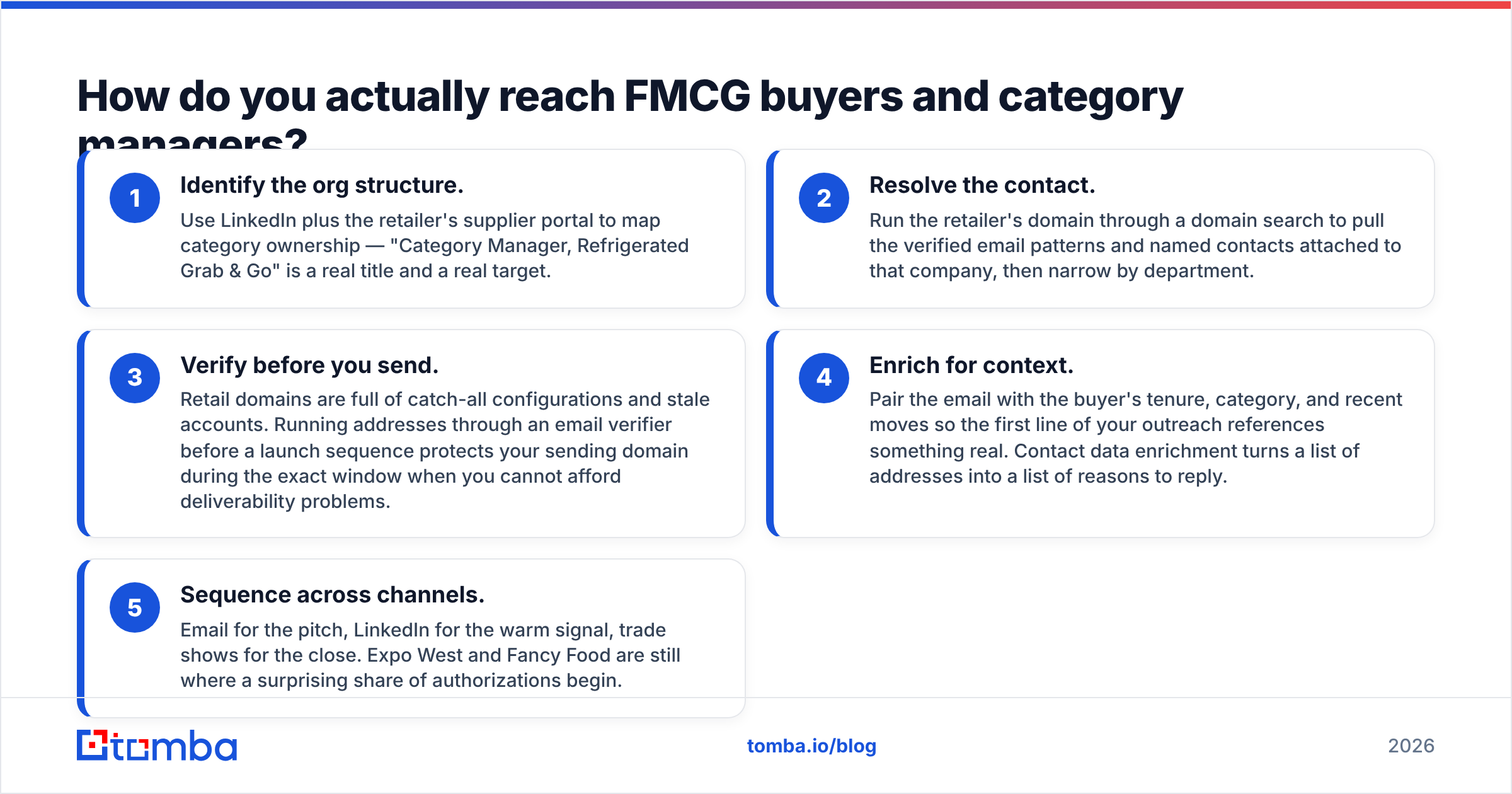
- Identify the org structure. Use LinkedIn plus the retailer's supplier portal to map category ownership. "Category Manager, Refrigerated Grab & Go" is a real title and a real target.
- Resolve the contact. Run the retailer's domain through a domain search to pull verified email patterns and named contacts at that company. Then narrow by department.
- Verify before you send. Retail domains are full of catch-all setups and stale accounts. Run addresses through an email verifier first. It protects your sending domain during the exact window when you cannot afford deliverability problems.
The last two steps turn a verified address into a reply.
- Enrich for context. Pair the email with the buyer's tenure, category, and recent moves. Then the first line of your outreach can reference something real. Contact data enrichment turns a list of addresses into a list of reasons to reply.
- Sequence across channels. Email for the pitch, LinkedIn for the warm signal, trade shows for the close. Expo West and Fancy Food still start a surprising share of authorizations.
One discipline separates brands that get meetings from brands that get ignored. Lead with velocity data and a category gap, never with founder story. A buyer's job is to grow dollars per linear foot. Your opening line should be a number.
What does the FMCG GTM tech stack look like in 2026?#
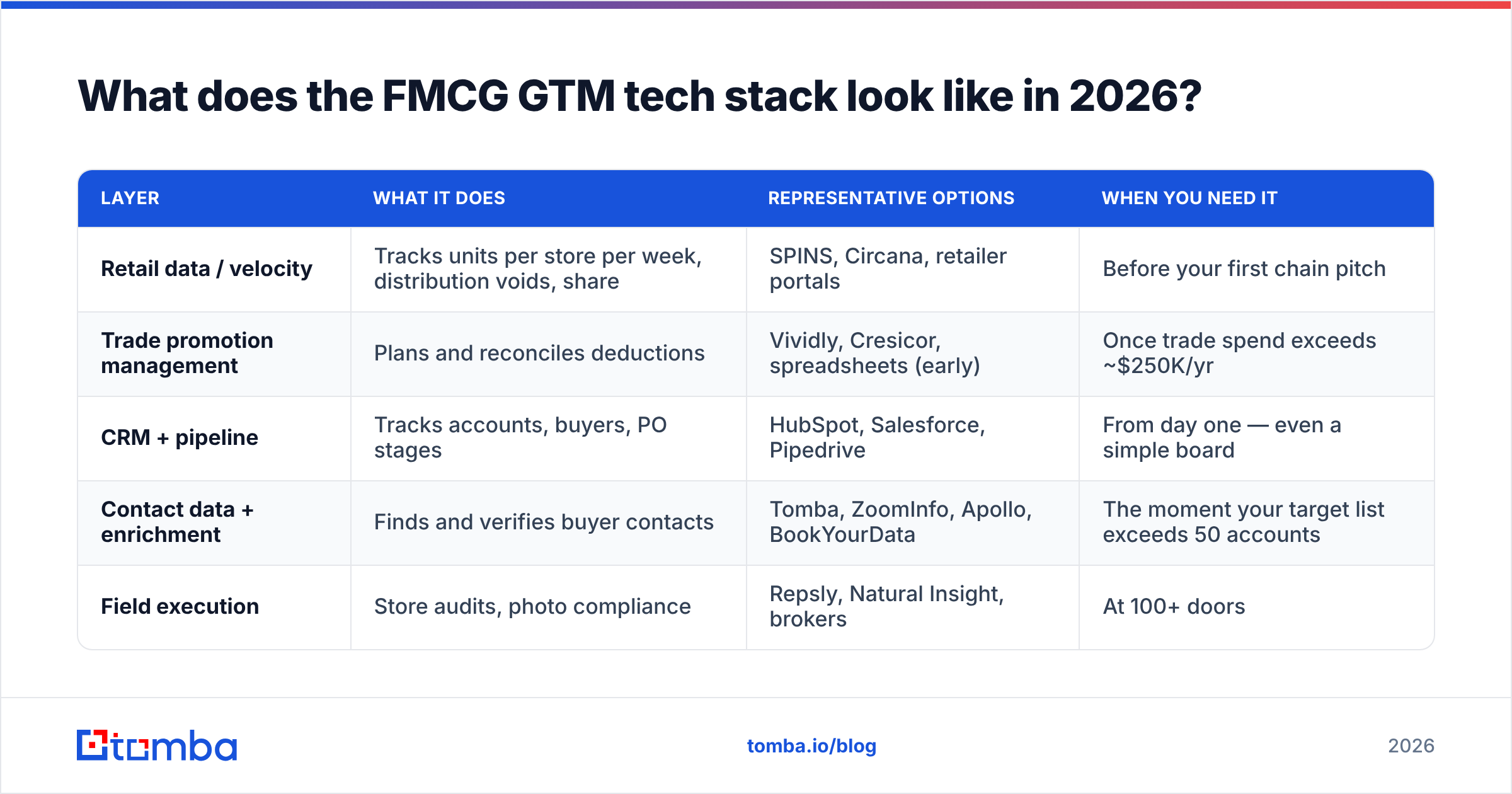
The category has settled into four layers. You do not need best-in-class in all of them at seed stage, but you need something in each.
| Layer | What it does | Representative options | When you need it |
|---|---|---|---|
| Retail data / velocity | Tracks units per store per week, distribution voids, share | SPINS, Circana, retailer portals | Before your first chain pitch |
| Trade promotion management | Plans and reconciles deductions | Vividly, Cresicor, spreadsheets (early) | Once trade spend exceeds ~$250K/yr |
| CRM + pipeline | Tracks accounts, buyers, PO stages | HubSpot, Salesforce, Pipedrive | From day one — even a simple board |
| Contact data + enrichment | Finds and verifies buyer contacts | Tomba, ZoomInfo, Apollo, BookYourData | The moment your target list exceeds 50 accounts |
| Field execution | Store audits, photo compliance | Repsly, Natural Insight, brokers | At 100+ doors |
The contact-data layer is the one teams underinvest in and then over-blame. If your list is 40% stale, your outreach metrics say the pitch failed. The truth is the email never landed. Verify first, then judge the message.
On pricing: contact-data tooling ranges widely. Enterprise sales-intelligence suites often start in the low five figures per year, with seat minimums. Lighter, credit-based tools sit far below that. Tomba's pricing runs a free tier at 25 searches per month, Starter at $49/mo, Growth at $99/mo, and Pro at $249/mo. API access is included for teams that want to enrich a target-account list in bulk rather than through a UI. For a CPG team building a 500-account retail list, the credit-based model usually costs less than one month of an enterprise seat.
What metrics prove your go to market strategy FMCG plan is working?#
Retailers evaluate you on a short list. Adopt their scoreboard as yours.
- Velocity (units/store/week). The number that decides whether you keep your facing. Benchmarks vary by category, but below roughly 1 unit per store per week in grocery, you are on the delist list.
- ACV distribution. The share of the market's total sales volume represented by stores that carry you. Growing ACV without growing velocity is how brands go broke expanding.
- Repeat rate. From panel data or your own DTC cohort. High trial with low repeat is a product problem no GTM plan can fix.
- Trade spend efficiency. Incremental units divided by promotional dollars. Most brands find that 30-40% of promo spend drives zero lift once they measure it.
Two more matter, and both are operational.
- Fill rate. Your ability to ship what was ordered. Chronic short-shipping ends relationships faster than weak velocity.
- Cash conversion cycle. Days from paying your co-packer to getting paid by your retailer. This number, not revenue, decides whether you survive growth.
Two of these deserve extra attention. Velocity is the leading indicator that predicts everything downstream. Cash conversion is the constraint that kills healthy brands during their best year. Retail growth eats cash before it produces it. Gartner's supply chain research flags working capital as the main failure mode when consumer brands scale, not demand.
What are the most common FMCG GTM mistakes?#
Launching nationally before proving regionally. A failed national launch is nearly unrecoverable. You have burned the buyer relationship, the slotting fee, and your inventory. A failed regional launch costs you a quarter and teaches you something.
Treating distributors as a sales team. A distributor is a logistics company that also takes orders. They will not create demand for you. Brands that hand over a region and disappear come back a year later to find their SKU sitting in a warehouse. You still need field work, demos, and retailer-level marketing.
Underpricing to win the first PO. Your first price becomes your ceiling. Buyers benchmark you against your own history. Taking a price increase in year two is far harder than starting 8% higher.
Ignoring the broker economics. Brokers take 3-5% of net sales and represent dozens of brands. If you are not in their top ten by commission, you are not in their conversations. Either earn priority or handle those accounts direct.
Building the list once. Buyer turnover is high enough that a target list built in January is wrong by June. Refresh contact data every quarter. A bulk email finder run against your account list takes an afternoon and saves a quarter of dead sequences.
Confusing awareness with distribution. You can be talked about everywhere and buyable nowhere. Paid social that sends shoppers to stores that do not carry you is a marketing expense with negative ROI. Match media spend to your real ACV footprint, market by market.
How should you sequence the first 12 months?#
Months 1-3: Prove and price. Lock your cost of goods, build the full pricing architecture across all channels, and launch DTC or 20-40 independent doors. Instrument everything. You are buying data, not revenue.
Months 4-6: Build the target list and the contact layer. Map 200-400 accounts, resolve buyer contacts, verify them, and start structured outreach. Attend one category trade show. Sign a regional distributor only if you have field capacity to support them.
Months 7-9: Density over reach. Push velocity in the doors you have. Demos, shelf resets, secondary placement. Assemble a velocity story with real numbers by account tier.
Months 10-12: Convert the story into chain conversations. With 6+ months of velocity data, you can walk into a regional chain and make a margin argument instead of a story argument. This is the meeting your whole first year was funding.
The pattern holds across categories because it follows the constraint. Retailers reward proof, and proof takes shelf time. Compressing the timeline means paying cash instead of showing evidence. That is exactly what a slotting fee is.
Where does contact data fit in all of this?#
It is the unglamorous layer that gates everything above it. You can have a category-defining product, a clean margin stack, and a perfect deck, and still stall. None of it counts if the pitch never reaches the person who owns the category.
Build the contact layer on purpose. Start from the retailer domain. Pull the verified email patterns. Filter to merchandising and category management. Verify deliverability, then enrich with role context before you write a line of outreach. Refresh it every quarter. A stale buyer list is expired inventory, and it deserves the same treatment.
If you are building or refreshing an FMCG target-account list right now, start with the Tomba Email Finder. Feed it a retailer or distributor domain and a buyer name, and get a verified address back before you spend a sequence on it. The free tier covers 25 searches a month, enough to test it against ten accounts you already know. The Tomba API handles bulk once your list outgrows manual work. Get the contact layer right, and the rest of your go to market strategy FMCG plan finally gets to run.
Related guides#
Ready to find emails that actually work?
Join 150,000+ professionals who stopped guessing and started sending. Free credits on signup — no credit card required.
Get the Tomba newsletter
Practical outbound tactics and product updates — once every two weeks.
About the author