Go To Market Strategy For An App: 2026 Playbook
Most app launches fail on distribution, not product. Here's a concrete go-to-market strategy for an app in 2026 — segmentation, motion choice, channel math, and the launch checklist that actually moves activations.
TL;DR
- A go-to-market strategy for an app is four decisions, not a document: who you sell to, which motion moves them, which channels reach them, and what "working" looks like numerically in 90 days.
- Pick one primary motion — product-led, sales-led, or community-led — before you pick channels. Teams that pick channels first burn budget on traffic that never activates.
- Consumer apps live or die on install-to-activation. B2B apps live or die on account coverage and reply rates, which means your contact data quality is a GTM input, not an ops detail.
- Budget by CAC payback, not by vibes: if payback exceeds 12 months on a $30/mo product, the motion is wrong, not the ad copy.
- Ship a launch with three waves — private beta, design-partner proof, public launch — instead of one big day that generates a spike and a flatline.
What Is a Go-To-Market Strategy for an App?#
A go-to-market strategy for an app is the specific plan for how a defined segment of users discovers, tries, adopts, and pays for your software. It's not a marketing plan and it's not a launch date. It's the sequencing that connects a target account list to a repeatable activation event.
Most founders confuse a GTM strategy with a launch checklist. The checklist matters, but it's downstream. The strategy answers harder questions: which 5,000 companies or 50,000 consumers are the wedge, what job the app does better than the incumbent, what triggers a switch, and which motion converts a trigger into a paying account at a cost you can sustain.
Here's the practical test. If someone asks "who is this for?" and your answer is a persona card with no company list, no subreddit, no ICP filter, and no contact set behind it, you don't have a GTM strategy yet. You have positioning. Positioning is necessary and insufficient.
The four load-bearing components:
- Segment definition — a filterable list, not an adjective. "Series A B2B SaaS companies in North America with 20-200 employees running HubSpot" is a segment. "Modern teams" is not.
- Motion selection — product-led, sales-led, community-led, or partner-led. One primary, at most one secondary in year one.
- Channel portfolio — three to five channels max, each with an owner, a budget, and a kill date if it misses target.
- Activation and revenue math — the CAC, payback period, and activation rate that make the motion viable.
Which Go-To-Market Motion Fits Your App?#
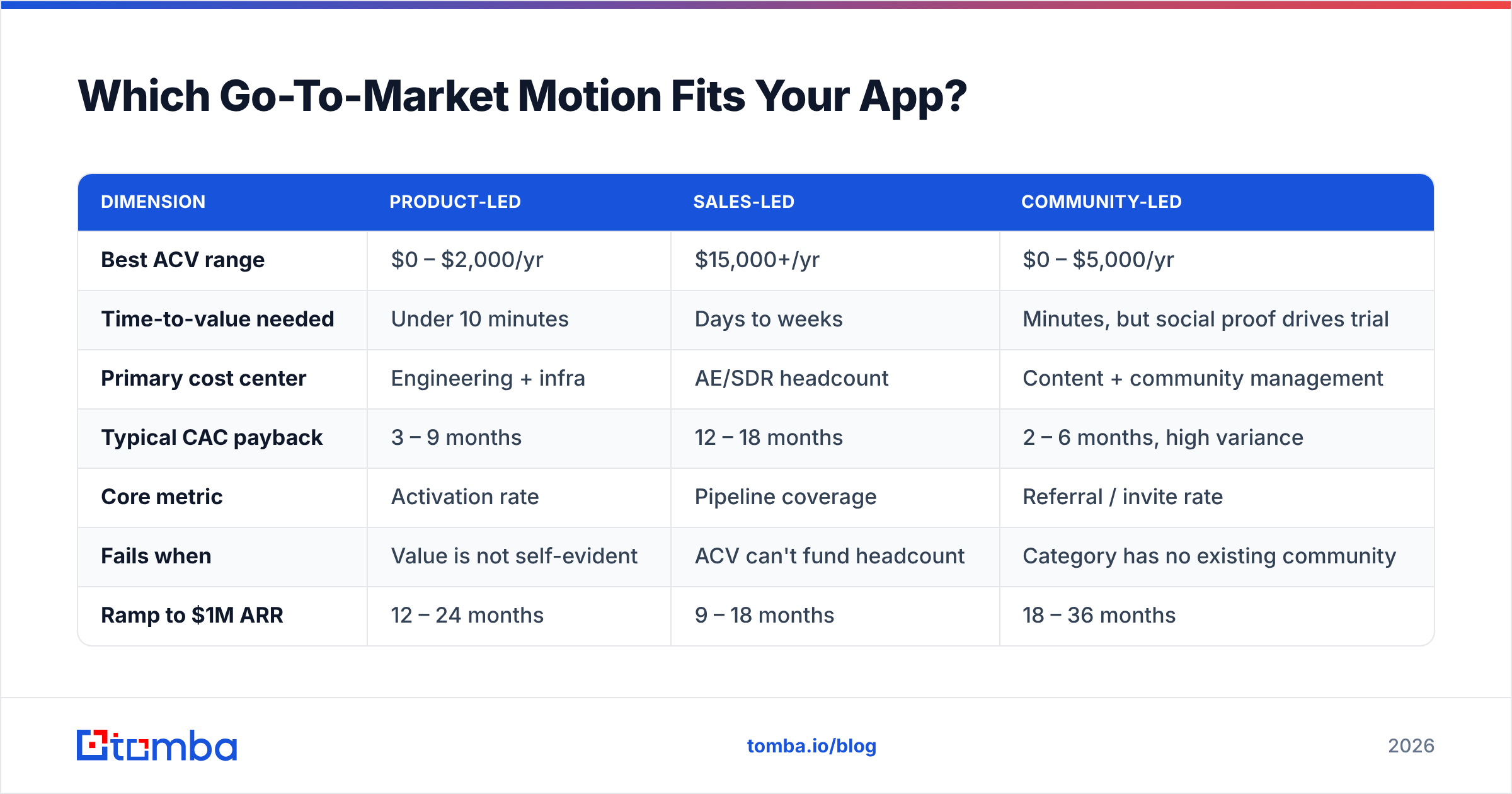
Motion selection is the highest-leverage decision in the whole plan, and it's mostly determined by two variables: annual contract value and time-to-value.
If your app delivers obvious value in under ten minutes and costs under $500/year, product-led is almost always correct — a human sales conversation costs more than the account is worth. If value requires configuration, data migration, or multi-stakeholder buy-in and the contract clears $15,000/year, sales-led is correct. The messy middle — $2,000 to $15,000 ACV — is where most B2B apps live, and that's where a hybrid works: self-serve entry, sales-assisted expansion.
| Dimension | Product-Led | Sales-Led | Community-Led |
|---|---|---|---|
| Best ACV range | $0 – $2,000/yr | $15,000+/yr | $0 – $5,000/yr |
| Time-to-value needed | Under 10 minutes | Days to weeks | Minutes, but social proof drives trial |
| Primary cost center | Engineering + infra | AE/SDR headcount | Content + community management |
| Typical CAC payback | 3 – 9 months | 12 – 18 months | 2 – 6 months, high variance |
| Core metric | Activation rate | Pipeline coverage | Referral / invite rate |
| Fails when | Value is not self-evident | ACV can't fund headcount | Category has no existing community |
| Ramp to $1M ARR | 12 – 24 months | 9 – 18 months | 18 – 36 months |
The failure mode to avoid: running a sales-led cost structure on product-led pricing. If you hire two SDRs and an AE to sell a $49/month app, you need roughly 200 net-new paying accounts per rep per year just to cover loaded cost — and that ignores churn. Do that arithmetic before you post the job.
Community-led deserves a caveat. It works spectacularly for developer tools and creator apps because those categories already have gathering places. If your buyer is a mid-market compliance manager, there is no thriving compliance-manager Discord waiting to adopt you. Don't force it.
How Do You Define the Segment You Actually Launch Into?#
Narrow beats broad, and the reason is mechanical, not philosophical. A narrow segment lets you write one message that lands, pick two channels instead of eight, and get enough at-bats in the same context to learn something within a quarter.
Build the segment in three layers:
- Firmographic filter. Industry, headcount, geography, funding stage, tech stack. This produces a finite list — ideally 1,000 to 10,000 accounts for B2B. If your list is 200,000 accounts, you haven't filtered; you've described a market.
- Trigger filter. What recent event makes this account more likely to buy right now? New funding round, a hiring spike for a relevant role, a competitor's price increase, a new compliance deadline, a tooling migration. Triggers roughly double reply rates versus untriggered outreach in most cold programs.
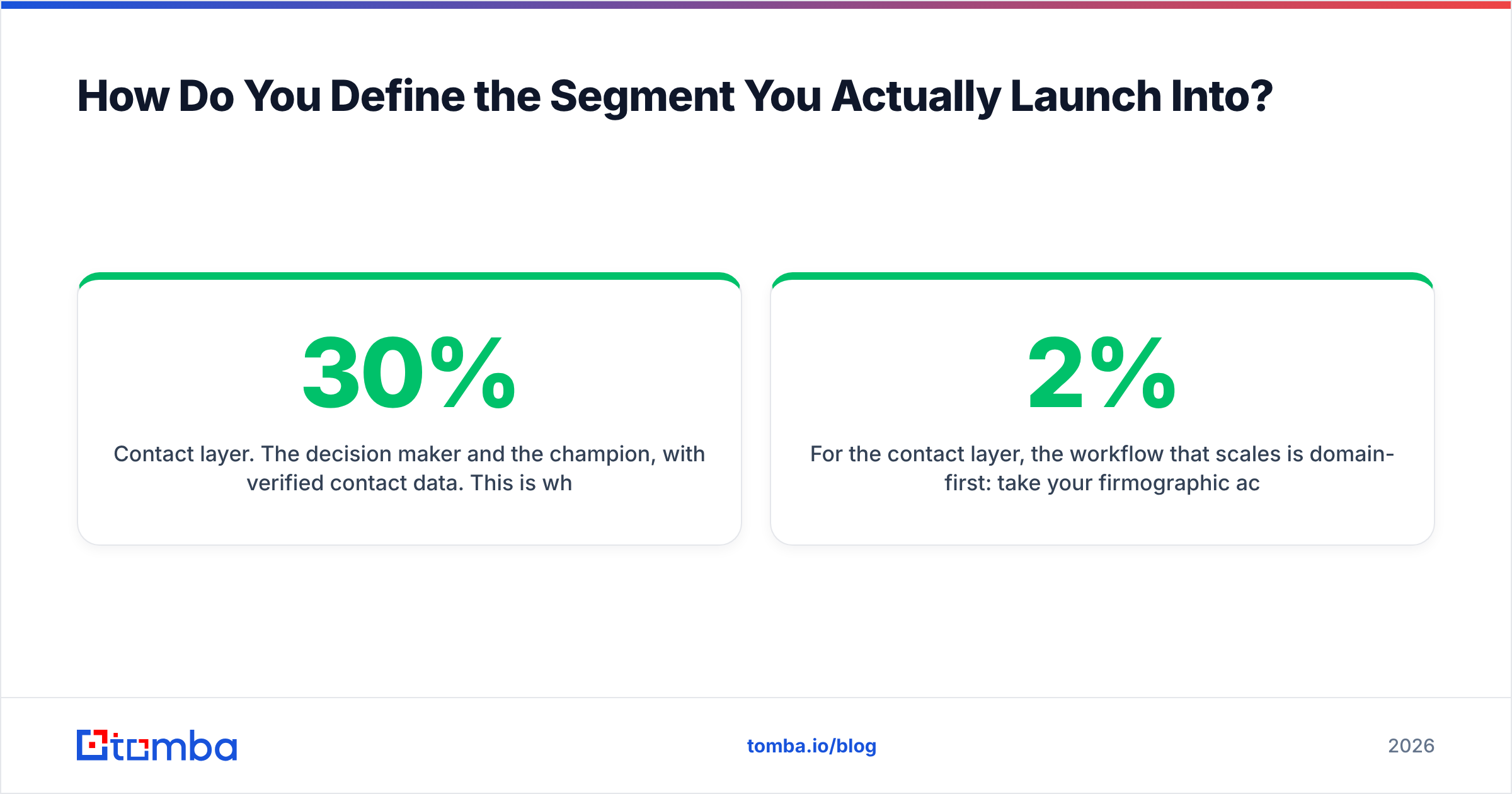
- Contact layer. The decision maker and the champion, with verified contact data. This is where a lot of otherwise-good GTM plans quietly break. You can nail segment and trigger and still fail if 30% of your emails bounce, because bounces damage your sender reputation and suppress the deliverability of the messages that would have landed.
For the contact layer, the workflow that scales is domain-first: take your firmographic account list, run domain search to pull the people in relevant roles, then verify before anything sends. Running a list through an email verifier is cheap insurance — a 2% bounce rate keeps mailbox providers calm; a 12% bounce rate gets your domain throttled and quietly ruins the launch quarter you spent six months planning.
For consumer apps, the equivalent layers are behavioral: platform (iOS vs Android), acquisition surface (App Store search vs paid social vs referral), and the specific job-to-be-done moment. A budgeting app targeting "people who want to save money" will lose to one targeting "people who just got their first paycheck after a job change."
What Channels Should an App Launch Actually Use?#
Pick three. Give each one a 90-day window, a budget, and a numeric bar. Kill the ones that miss.
The realistic channel set for most app launches in 2026:
- Founder-led outbound. Highest signal-to-noise for B2B in the first 100 customers. Nothing teaches you your own positioning faster than 300 personalized emails and the replies they generate. This is not scalable and it isn't supposed to be — it's a learning channel that happens to produce revenue.
- Content and SEO. Slow, compounding, and still the best CAC in software over a 24-month horizon. Target problem-aware queries, not brand queries. Twelve well-researched posts against real search demand beats sixty AI-spun ones — and Google's helpful-content systems now actively suppress the latter.
- Paid acquisition. Fast feedback on messaging, expensive as a permanent strategy. Use it to test hooks and to defend high-intent keywords, not to build a business. Watch payback weekly.
- App store optimization. Non-negotiable for mobile. Roughly two-thirds of app installs still originate from store search, so your title, subtitle, screenshots, and first three reviews are acquisition infrastructure, not design tasks.
- Partnerships and integrations. Listing in a marketplace your buyer already lives in — HubSpot's App Marketplace or the Salesforce AppExchange, for example — puts you in front of qualified users at near-zero CAC. Slow to build, durable once built.
- Community and social proof. Review sites like G2 matter more than founders expect at the evaluation stage, because buyers who are already convinced go there to be reassured. Ten honest reviews from real users outperform a hundred incentivized ones.
The mistake to avoid is running all six at 15% effort. Two channels at full effort will teach you more in a quarter than six at partial effort will teach you in a year.
How Do You Sequence the Launch?#
One big launch day is a bad structure. It concentrates all your learning into 24 hours, generates a traffic spike your onboarding isn't ready for, and leaves you with a flatline and no diagnosis.
Three waves works better:
Wave 1 — Private beta (weeks 1-6). Twenty to fifty hand-picked users from your segment. Goal is not revenue; it's finding the activation cliff. Instrument everything. You're looking for the step where 40% of users drop, because that step is your real GTM problem masquerading as a product problem.
Wave 2 — Design partners and proof (weeks 6-12). Five to ten accounts who agree to be referenced. Charge them — discounted, but charge them, because free users don't generate real objection data. Exit criteria: three case studies with a number in them, and a repeatable onboarding path that doesn't require a founder on a call.
Wave 3 — Public launch (week 12+). Now the spike has somewhere to land. Coordinate the store listing, the launch post, the outbound sequence, and the paid test in the same week so you can read the interaction effects.
Between waves, your outbound list needs maintenance. Contact data decays at roughly 25-30% per year as people change jobs, so a list you built in January is measurably worse by September. Re-verification before each wave is a ten-minute job that protects the whole program; running bulk verify across the segment before Wave 3 is standard practice, not paranoia.
What Metrics Tell You the GTM Strategy Is Working?#
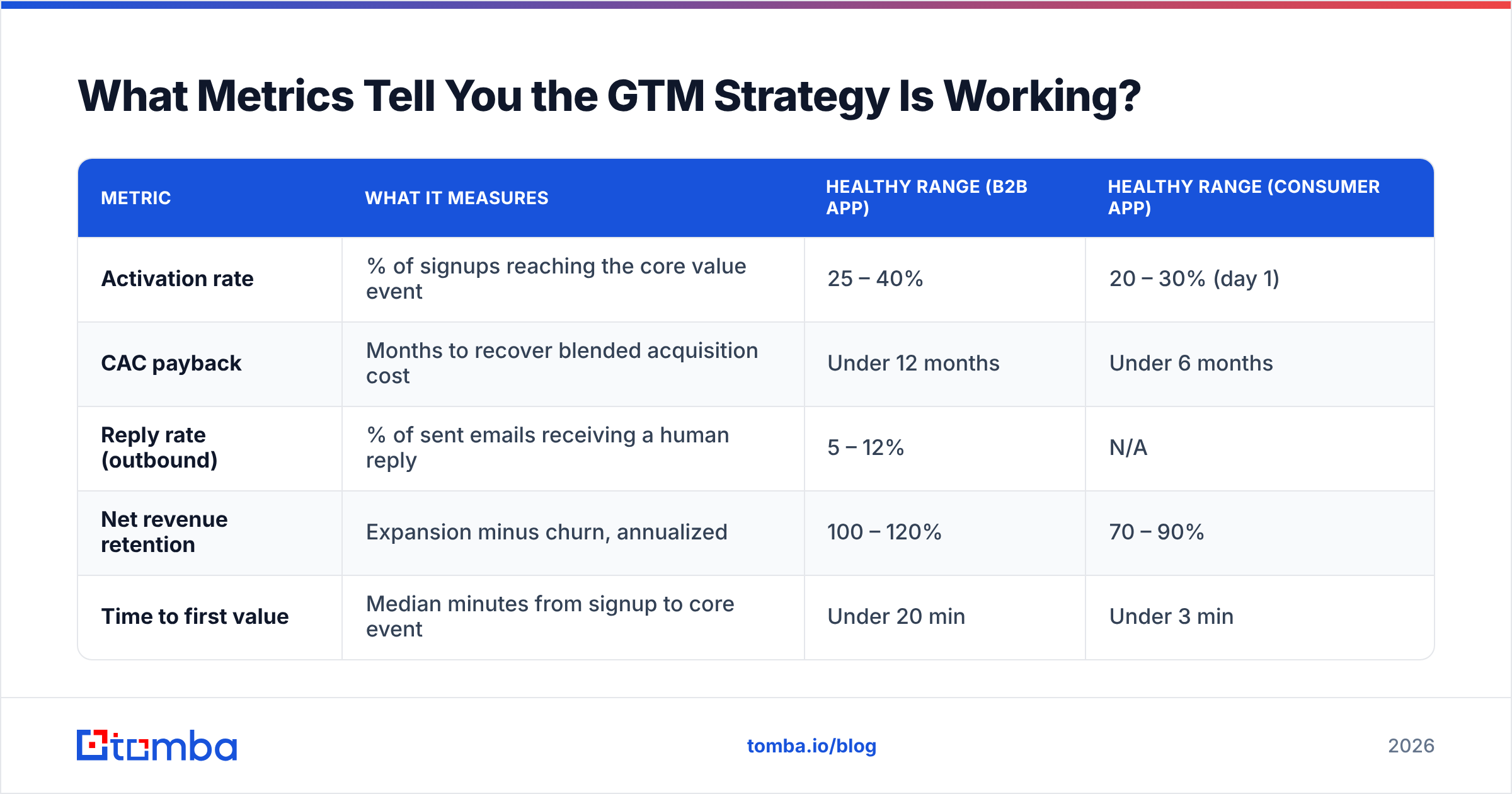
Track five numbers. More than that and nobody looks at any of them.
| Metric | What it measures | Healthy range (B2B app) | Healthy range (consumer app) |
|---|---|---|---|
| Activation rate | % of signups reaching the core value event | 25 – 40% | 20 – 30% (day 1) |
| CAC payback | Months to recover blended acquisition cost | Under 12 months | Under 6 months |
| Reply rate (outbound) | % of sent emails receiving a human reply | 5 – 12% | N/A |
| Net revenue retention | Expansion minus churn, annualized | 100 – 120% | 70 – 90% |
| Time to first value | Median minutes from signup to core event | Under 20 min | Under 3 min |
Activation is the one to obsess over first. Everything upstream — ads, content, outbound — multiplies against it. Doubling activation from 15% to 30% has the same revenue effect as doubling your entire acquisition budget, and it costs a fraction as much.
On CAC payback, the discipline is to compute it blended and by channel. Blended tells you whether the business works. By-channel tells you where to move money next month. If paid social shows a 22-month payback and content shows 5, the decision makes itself.
One caution on outbound reply rates: a high reply rate on a tiny, hyper-targeted list is not proof of a scalable channel. Founder-led outbound to 200 warm-adjacent contacts routinely hits 15%. The same sequence at 5,000 contacts will land near 4%. Model the scaled number, not the pilot number.
How Much Should You Budget, and Where?#
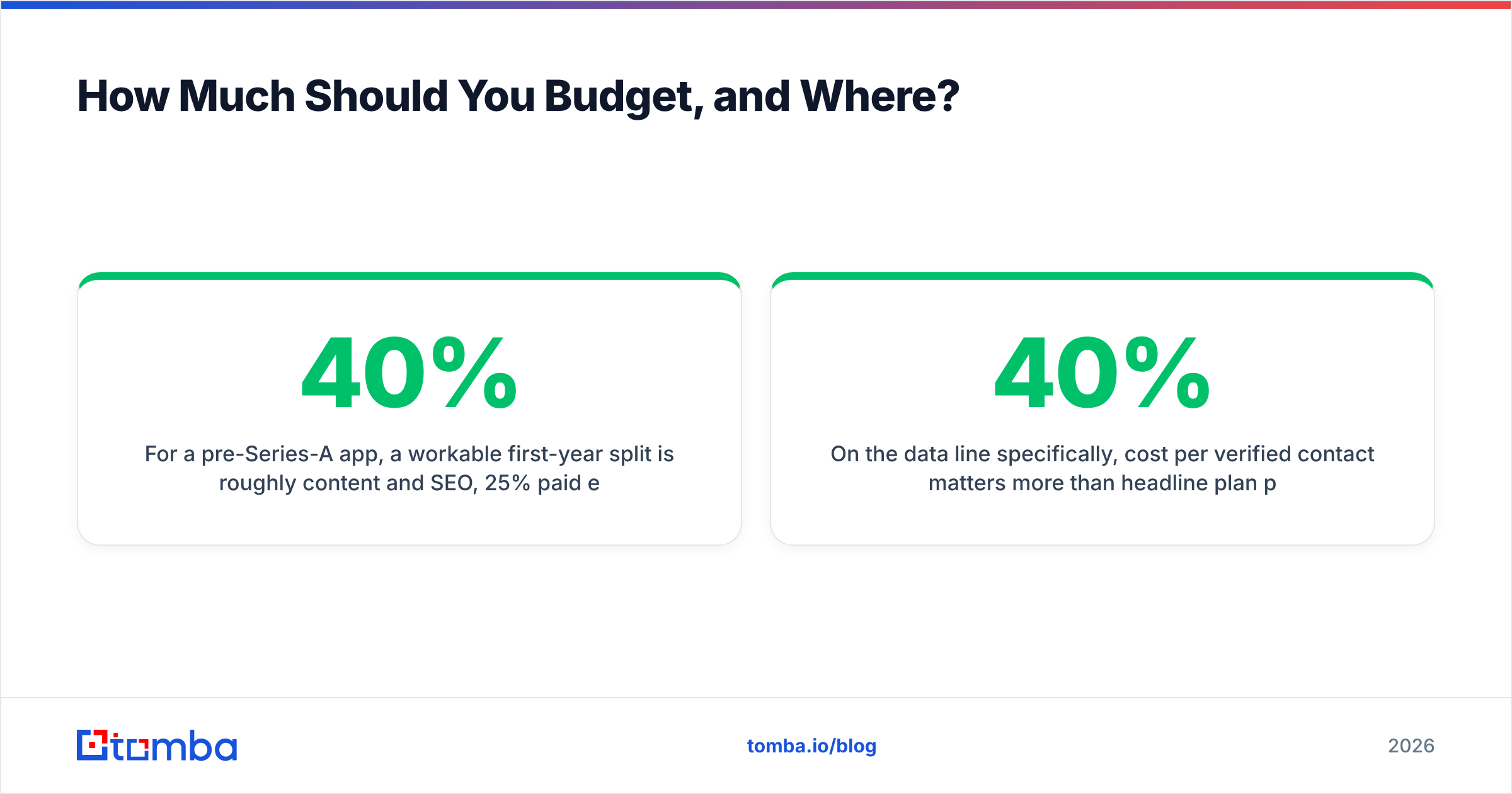
For a pre-Series-A app, a workable first-year split is roughly 40% content and SEO, 25% paid experimentation, 20% outbound tooling and headcount, 15% partnerships and events. Adjust hard toward outbound if your ACV is above $15,000 and hard toward content if you're sub-$1,000.
The tooling line is where teams overspend fastest. A functional B2B GTM stack in 2026 needs: a CRM, a sequencing tool, a data and contact source, an analytics layer, and nothing else until something breaks. Vendors will sell you intent data, conversation intelligence, and an AI SDR before you have product-market fit. Those are scaling tools for a motion that already works — buying them early just makes an unproven motion more expensive.
On the data line specifically, cost per verified contact matters more than headline plan price, since a cheap plan with 40% unusable records costs more per usable record than a pricier accurate one. Established options span the range: Tomba's plans start free at 25 searches/month and move to Starter at $49/mo, Growth at $99/mo, and Pro at $249/mo; BookYourData is a solid pay-as-you-go option if you want to buy a list outright rather than run searches; larger platforms bundle data with sequencing at a higher floor. Match the model to your motion — search-based works for targeted outbound, list purchase works for broad campaigns.
What Are the Most Common GTM Mistakes App Founders Make?#
- Launching to everyone. Broad targeting feels safe and produces uninterpretable data. You can't tell whether the message failed or the audience was wrong.
- Treating the launch as the strategy. Product Hunt day is a tactic. If your plan ends on launch day, you have no plan for weeks 2-52.
- Ignoring activation until acquisition works. Backwards. Fix the leak before you turn up the tap — otherwise you're paying for users your onboarding will lose.
- Hiring sales too early. Founders should close the first 20-30 customers personally. Handing an unproven pitch to a new AE guarantees you learn nothing and blame the wrong person.
- Skipping data hygiene. Bounced emails, wrong titles, and stale contacts silently cap every outbound number you report. It's the least glamorous fix with the highest floor-raising effect.
- Changing everything at once. New pricing, new positioning, new channel, same month. Now nothing is attributable. Change one variable per cycle.
Getting the Contact Layer Right#
Every GTM motion that involves reaching a human eventually bottoms out on the same question: do you have the right person's real contact details? Segmentation and messaging are worthless if the message doesn't arrive.
The Tomba Email Finder handles that layer — search by domain to map the people in relevant roles at your target accounts, verify before you send, and keep bounce rates low enough that your sender reputation survives the scale-up. The free tier covers 25 searches a month if you want to test the workflow against your own account list before committing, and Starter at $49/mo covers most founder-led outbound programs through the first hundred customers. Build the list, verify it, then spend your energy on the part that actually differentiates you: the message.
Related guides#
Ready to find emails that actually work?
Join 150,000+ professionals who stopped guessing and started sending. Free credits on signup — no credit card required.
Get the Tomba newsletter
Practical outbound tactics and product updates — once every two weeks.
About the author