Go To Market Strategy For B2B Products: 2026 Playbook
Most B2B GTM plans fail because they pick a motion before they know who buys. Here is the sequencing, the motion comparison table, and the numbers that decide it.
TL;DR
- A go to market strategy for B2B products is four decisions in order: who buys, what motion reaches them, what the pricing model implies about that motion, and what payback period you will tolerate. Skip the order and you rebuild everything in month nine.
- The motion is downstream of deal size. Under ~$5K ACV, self-serve or product-led is the only thing that pays back. Above ~$50K ACV, you need humans, and the CAC math tolerates them.
- Segment before you build a list. A tight ICP with 2,000 accounts beats a "TAM" of 400,000 companies you cannot name a single buyer inside.
- Your first 100 customers are a research project, not a revenue plan. Instrument them: source, cycle length, objections, expansion.
- Data quality gates everything downstream. A 65% valid contact list turns a working outbound motion into a broken one on paper.
What is a go to market strategy for B2B products?#
A go to market strategy for B2B products is the specific, testable set of choices about how a product reaches a buyer, converts them, and expands. It is not a positioning doc and not a launch plan — those are components. The strategy is the connective tissue: which segment, which motion, which price, which channel, and what the unit economics have to look like for the whole thing to survive.
The useful mental model: GTM is a supply chain, not a campaign. Raw material (a defined account list) goes in one end, passes through stages that each have yield rates, and finished revenue comes out the other. If the raw material is bad, every downstream stage inherits the defect. If one stage has a 3% yield when your model assumed 12%, the whole chain is uneconomic regardless of how good the last stage is.
Most GTM failures are diagnosed as "our messaging is off" when they are actually sequencing failures. A team picks a motion (usually outbound, because it feels controllable) before it has decided who it is selling to, then spends two quarters optimizing subject lines for the wrong audience.
The four decisions, in order#
- Segment. Which accounts, defined by attributes you can actually filter on — headcount band, tech stack, funding stage, regulatory exposure, department size. "Mid-market SaaS" is not a segment. "Series B–C SaaS companies, 50–300 employees, running HubSpot, with a named RevOps hire" is.
- Motion. Product-led, sales-led, marketing-led, partner-led, or community-led. Pick one primary and at most one supporting motion. Two primaries means neither gets enough reps to learn.
- Pricing model. Seat, usage, tier, or hybrid. Pricing decides whether the motion is affordable, and it constrains expansion. Seat-based pricing on a product used by two people per company caps your NRR before you write a line of onboarding copy.
- Economics. Target CAC payback, target NRR, and the gross margin that makes both survivable. Write these down before you spend, because they are the only thing that tells you whether a channel is working or just busy.
Which GTM motion fits your product?#
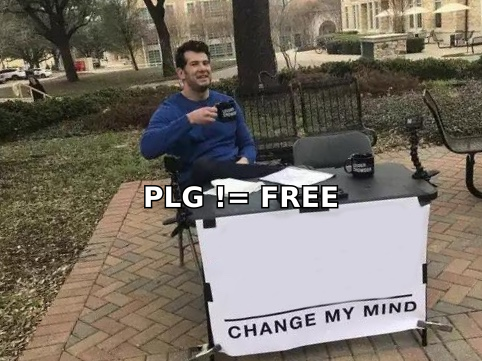
The honest answer is that ACV picks the motion, not preference. A human-touch sales cycle costs somewhere between $8,000 and $25,000 in fully-loaded rep time per closed deal in most B2B categories. If your ACV is $2,400, that arithmetic never works no matter how good the rep is.
Here is how the five common motions compare on the attributes that actually decide the choice:
| Attribute | Product-Led | Sales-Led (Inside) | Enterprise / Field | Partner-Led | Community-Led |
|---|---|---|---|---|---|
| Typical ACV range | $0–$10K | $10K–$60K | $60K+ | $15K–$100K | $0–$15K |
| Sales cycle | Hours to 14 days | 30–75 days | 90–270 days | 45–120 days | Highly variable |
| CAC payback target | Under 6 months | 12–18 months | 18–24 months | 9–15 months | Under 9 months |
| Primary cost center | Engineering + infra | SDR/AE salaries | AE + SE + travel | Rev share (15–30%) | Content + DevRel |
| Time to first signal | 2–6 weeks | 6–10 weeks | 2–3 quarters | 2–3 quarters | 3–4 quarters |
| Biggest failure mode | Free tier cannibalizes paid | List quality collapses pipeline | One champion leaves, deal dies | Partner never sells | Never converts to revenue |
| Data dependency | Low (users self-identify) | Very high | High (org mapping) | Medium | Low |
Read the "data dependency" row carefully, because it is the one most plans ignore. A sales-led motion is a bet that you can reliably identify and reach the right person at the right account. If your contact data is 65% accurate, your rep's 40 touches per day become 26 real touches, your reply rate looks half as good as it is, and you conclude the message is wrong when the list was wrong.
Choosing between product-led and sales-led#
Ask three questions:
- Can a single user get value without their organization changing? If yes, product-led is viable. If the product only works once IT, security, and two departments cooperate, self-serve will stall at signup.
- Is the time-to-value under 20 minutes? Self-serve funnels leak badly past that. Long TTV products need a human to carry the buyer across the gap.
- Is the buyer the user? When the economic buyer never touches the product, product-led generates usage but no purchase order. That is the most expensive version of "great engagement, no revenue."
Plenty of good companies run hybrid: free tier for discovery, sales-assist above a usage threshold. That is a legitimate structure — but only after the self-serve funnel proves it can produce qualified accounts on its own. Bolting sales onto a broken funnel just makes the broken funnel more expensive.
How do you define an ICP that actually converts?#
Narrow until it feels uncomfortable, then validate against closed-won data.
The practical test: can you produce a finite, named list of accounts that match your ICP? If you cannot enumerate them, you have described a market, not an ICP. Most successful early GTM motions run against 500–3,000 named accounts, not hundreds of thousands.
Build the ICP from three layers:
- Firmographic — headcount, revenue band, geography, industry code, funding stage. These are the filters you will actually use to build lists.
- Technographic — what they already run. If your product replaces or extends a specific tool, that tool's presence is the highest-signal filter available. A website tech stack check turns this into a repeatable step rather than guesswork.
- Behavioral / trigger — hiring for a role you serve, a funding round, a new compliance deadline, a leadership change, a competitor's price increase. Triggers are what turn a good account into a timely one.
Then reverse-test. Pull your last 30 closed-won deals and your last 30 closed-lost, and check which attributes actually separate them. Teams are consistently wrong about this — the attribute founders believe drives fit (industry, usually) is often less predictive than something mundane like "has a dedicated ops person." Gartner's B2B buying research is worth reading here: buying groups in complex B2B purchases now average six to ten stakeholders, which means your ICP needs to describe an account structure, not just a persona.
The account list is infrastructure, not a task#
Once the ICP is defined, the list becomes an operational asset you maintain, not a spreadsheet you buy once. That means:
- Enrich on entry. Every new account gets firmographic and contact data attached before it enters a sequence. Contact enrichment at the point of ingest is far cheaper than cleaning up a polluted CRM six months later.
- Verify before sending. Bounce rates above 3% start damaging domain reputation, and reputation damage is slow to repair. Run the list through an email verifier before it touches a sequence, not after.
- Re-verify quarterly. B2B contact data decays roughly 2–3% per month through job changes alone. A list that was clean in January is meaningfully stale by June.
- Track source-level yield. Which list source produced meetings, not just opens. This is the number that kills or funds a channel.
What does the GTM sequence look like in practice?#
Run it in phases, and refuse to advance until the prior phase produces a signal. The most common mistake is hiring reps in phase two, before there is anything for them to repeat.
Phase 1 — Founder-led validation (first 10–20 customers). Founders sell. No SDRs, no automation, no CRM hygiene rules. The output is not revenue; it is a written list of the five objections you hear every time, the two use cases that close fast, and the one that never does. Sell manually. Take notes obsessively.
Phase 2 — Repeatability test (customers 20–100). Now try to write down what the founder does and hand it to one other person. If that person cannot reproduce roughly half the founder's conversion rate within a quarter, the motion is not repeatable yet — the product or the segment is still doing too much of the work. Fix that before spending on headcount.
Phase 3 — Channel scaling. Only here do you add reps, ad budget, or partners. Scale the one channel with proven yield; do not add three at once. Concurrent channel experiments make attribution unreadable at low volume.
Phase 4 — Expansion engineering. Land-and-expand is not automatic. It requires a defined second use case, an in-product path to it, and a compensation structure that rewards it. NRR above 110% is engineered, not lucky.
Which metrics tell you the GTM is working?#
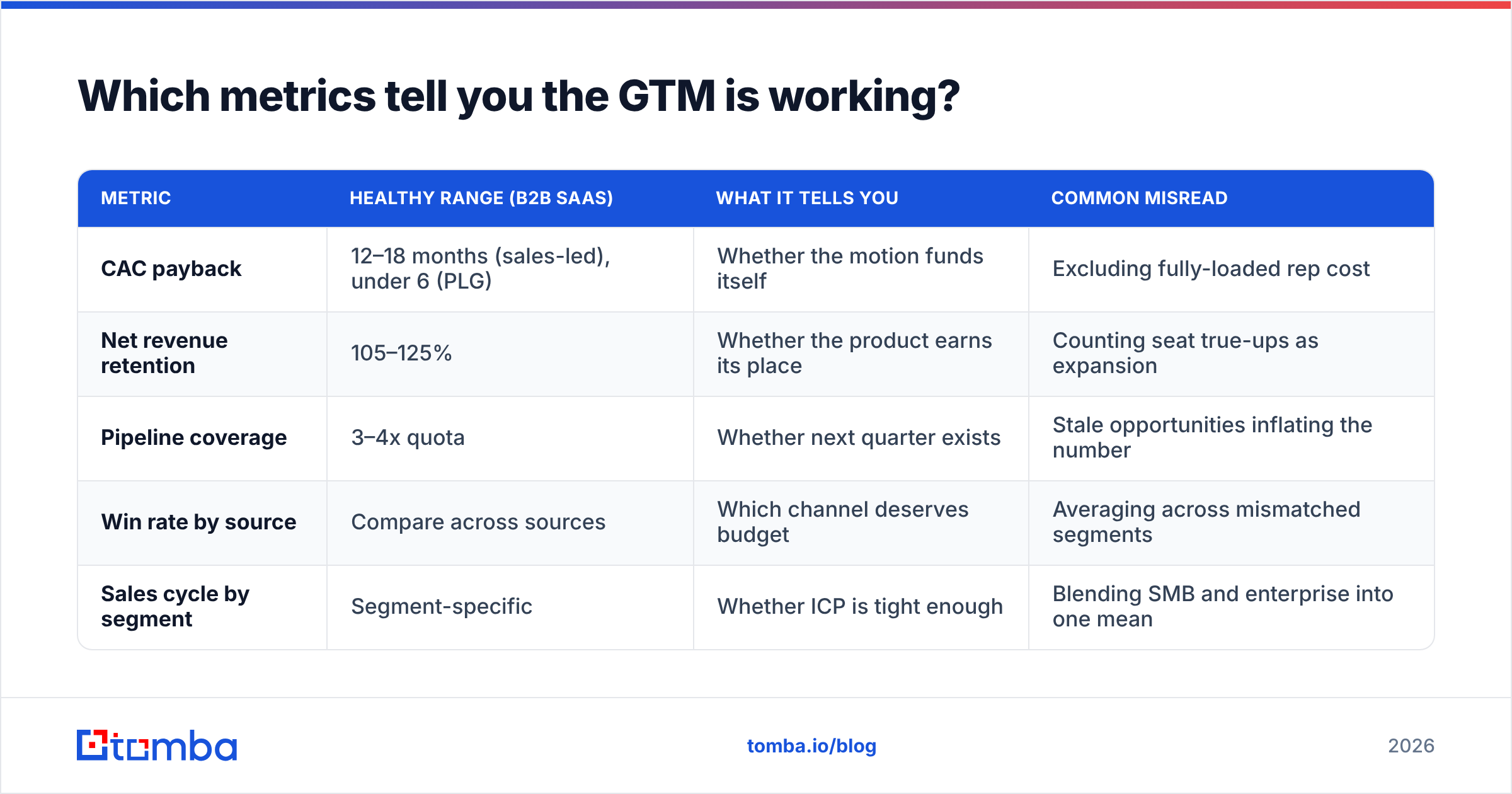
Four numbers, checked monthly, tell you almost everything:
| Metric | Healthy range (B2B SaaS) | What it tells you | Common misread |
|---|---|---|---|
| CAC payback | 12–18 months (sales-led), under 6 (PLG) | Whether the motion funds itself | Excluding fully-loaded rep cost |
| Net revenue retention | 105–125% | Whether the product earns its place | Counting seat true-ups as expansion |
| Pipeline coverage | 3–4x quota | Whether next quarter exists | Stale opportunities inflating the number |
| Win rate by source | Compare across sources | Which channel deserves budget | Averaging across mismatched segments |
| Sales cycle by segment | Segment-specific | Whether ICP is tight enough | Blending SMB and enterprise into one mean |
The discipline is in segmenting each of these. A blended 22% win rate is meaningless if it is 41% in your core segment and 7% everywhere else — the correct action there is to stop selling everywhere else, and a blended number hides that entirely.
One caution on pipeline coverage: it is the metric most easily gamed. Coverage built from opportunities that have not moved a stage in 45 days is not coverage. Add a staleness filter before you trust it.
How does contact data quality change the GTM math?#
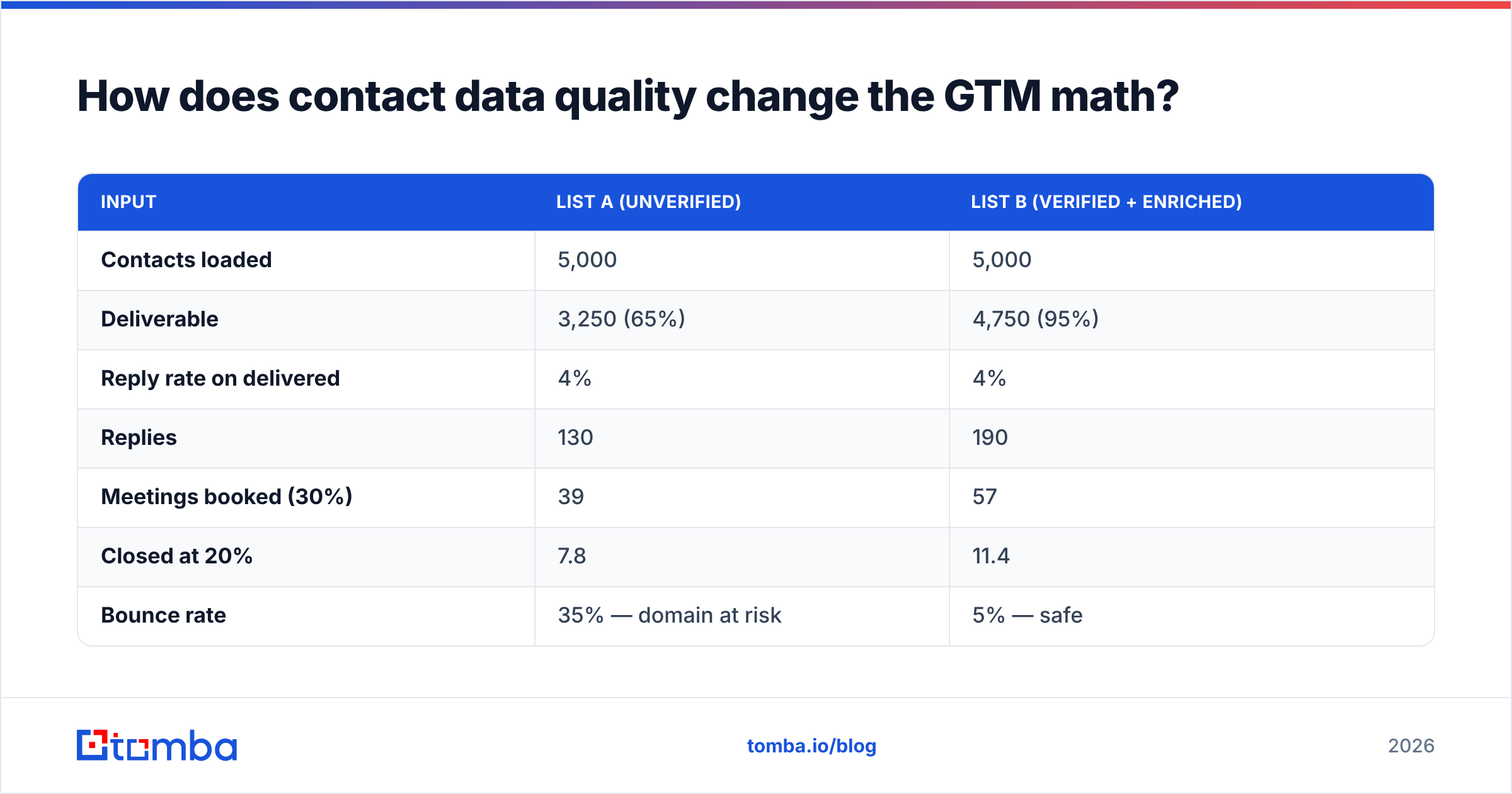
More than most teams model. Consider two identical outbound motions, differing only in list quality:
| Input | List A (unverified) | List B (verified + enriched) |
|---|---|---|
| Contacts loaded | 5,000 | 5,000 |
| Deliverable | 3,250 (65%) | 4,750 (95%) |
| Reply rate on delivered | 4% | 4% |
| Replies | 130 | 190 |
| Meetings booked (30%) | 39 | 57 |
| Closed at 20% | 7.8 | 11.4 |
| Bounce rate | 35% — domain at risk | 5% — safe |
Same copy, same reps, same offer — 46% more closed deals, plus the second list does not burn the sending domain. And that domain damage compounds: once sender reputation drops, even your good contacts stop seeing messages, so the next quarter's numbers fall for reasons that have nothing to do with the next quarter's work.
This is why data sits upstream of everything in a GTM plan rather than being a procurement line item. Practical setup for a sales-led motion:
- Define the account list from ICP filters — finite and named.
- Map the buying group per account. Six to ten stakeholders means you need more than one contact per account, and probably three: user, economic buyer, and blocker.
- Find and verify contacts at the account. A domain search returns the addresses on a company domain along with the pattern, which lets you predict formats for names you cannot find directly.
- Enrich with context — role, seniority, tenure. Tenure under 90 days is a strong trigger signal; new leaders buy.
- Re-verify on a schedule and route job-change alerts back into the pipeline as new opportunities at the contact's new company.
For a comparison of how the major B2B data vendors differ on coverage and price, G2's sales intelligence category is a reasonable neutral starting point — vendor-reported accuracy claims are close to worthless, but user-reported coverage complaints are informative. Among the broader providers, tools like BookYourData serve teams that want prepaid, downloadable list volume, while API-first tools fit teams enriching continuously inside a pipeline. Both are legitimate; the choice depends on whether your data need is a one-time list build or a continuous flow.
What are the most common B2B GTM mistakes?#
- Picking the motion before the segment. You end up optimizing tactics for an audience you have not defined. This is the single most expensive ordering error in GTM.
- Hiring reps to fix a product-market fit problem. Reps amplify a working motion. They do not create one. Adding five AEs to a motion that does not close will produce five times the burn and roughly the same revenue.
- Running four channels at 10% effort each. At low volume, none of them generates statistically readable data, so you learn nothing from any of them. Pick one, run it hard enough to get a clear answer, then add the next.
- Treating pricing as a launch-week decision. Pricing structure determines whether expansion is possible at all. Changing it later is a migration project affecting every existing customer.
- Measuring activity instead of yield. Emails sent, calls made, and demos booked are inputs. Only closed-won by source and segment tells you where to put the next dollar.
- Assuming the buying group is one person. Complex B2B purchases involve multiple stakeholders with veto power. A GTM plan that reaches one of them is a plan with a low ceiling.
How do you pressure-test the plan before spending?#
Write the model backwards from the revenue target and check whether each required rate is one you have actually observed.
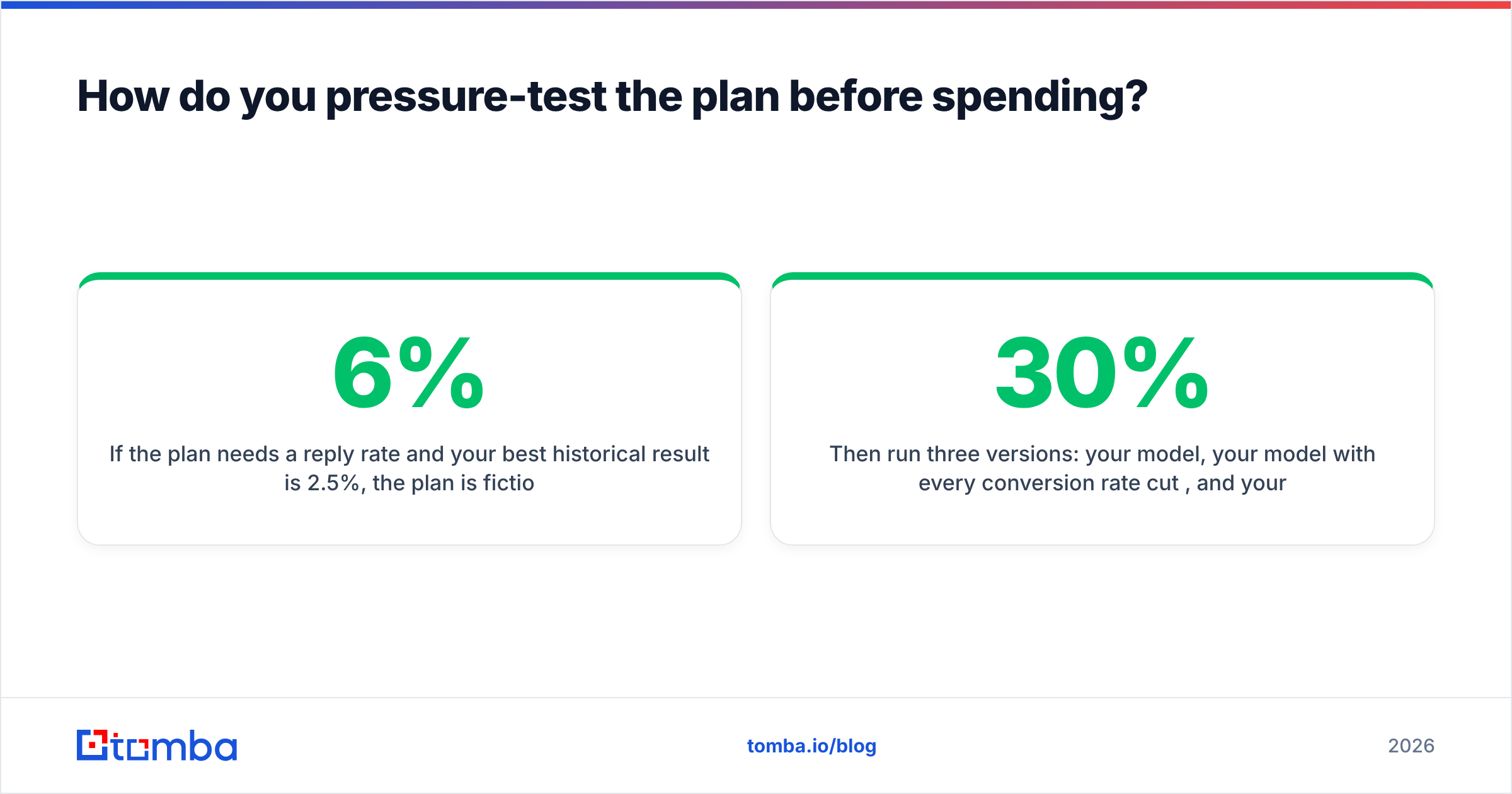
If the plan needs a 6% reply rate and your best historical result is 2.5%, the plan is fiction. Same for a 25% win rate when you have run 18%, or a 60-day cycle when yours has been 95. Assumptions that exceed your observed performance need either evidence or a smaller number.
Then run three versions: your model, your model with every conversion rate cut 30%, and your model with cycle length extended 40%. If the downside case is survivable, the plan is fundable. If only the base case works, you do not have a strategy — you have a hope with a spreadsheet attached.
Finally, define kill criteria upfront. "If this channel has not produced X qualified meetings at Y cost by month four, we stop." Written before you start, this is discipline. Written after, it is rationalization.
Where should you start this quarter?#
Do the sequencing work first, and make the account list real before anything else. Define your ICP in filterable terms, enumerate the accounts that match, map the buying group inside them, and verify the contact data before a single sequence goes out. Everything downstream — copy, cadence, comp plan — is cheap to change. A GTM motion built on a list you cannot trust is expensive to change, because you will spend two quarters misdiagnosing the failure.
If your motion depends on reaching named people at named accounts, start where the leverage is: build the list correctly. Tomba Email Finder finds verified professional addresses by domain, name, or company, with verification built into the same workflow so your list is clean before it enters a sequence. The free tier covers 25 searches a month if you want to test coverage against your own ICP first; paid plans start at $49/mo, with full Tomba pricing if you need bulk volume or API access to enrich accounts continuously as they enter your pipeline.
Related guides#
Ready to find emails that actually work?
Join 150,000+ professionals who stopped guessing and started sending. Free credits on signup — no credit card required.
Get the Tomba newsletter
Practical outbound tactics and product updates — once every two weeks.
About the author