Go To Market Strategy For B2B SaaS: 2026 Playbook
Most B2B SaaS GTM plans fail on execution, not strategy. Here's the motion-by-motion playbook — PLG vs sales-led vs hybrid, CAC math, ICP scoring, and the data layer that makes any of it work.
TL;DR
- A go to market strategy for B2B SaaS is three decisions, not a deck: who you sell to (ICP), how they buy (motion), and what it costs you to reach them (CAC payback).
- Product-led works when time-to-value is under 10 minutes and ACV is under roughly $15k. Sales-led earns its cost above ~$25k ACV. Most companies land in a hybrid and pretend they didn't.
- The 2026 shift: buying committees grew, self-serve trials stopped converting on autopilot, and outbound only works when contact data is verified before send.
- Budget by motion, not by channel. A $99/mo tooling stack that produces 400 verified contacts beats a $3k/mo intent platform you never action.
- The single highest-leverage fix for most teams is not a new channel — it's cleaning the contact layer feeding the channels you already run.
What is a go to market strategy for B2B SaaS?#
A go to market strategy is the plan that connects a product to the specific people who will pay for it, through a repeatable path. That's it. Everything else — positioning docs, channel matrices, persona cards — is supporting material.
Think of it like opening a restaurant. The food is your product. GTM is deciding whether you're a takeout window, a 40-seat bistro, or a catering company. Same kitchen, three completely different cost structures, staffing plans, and locations. Founders who skip this decision end up running a bistro with takeout margins.
For B2B SaaS specifically, a complete GTM strategy answers five questions:
- Who exactly buys this? Not "mid-market companies" — firmographic and technographic criteria you could hand to an analyst and get a list back.
- What motion reaches them? Self-serve, inside sales, field sales, partner-led, or community-led.
- What does one customer cost to acquire? Fully loaded: salaries, tooling, ads, content, the SDR who touched them nine times.
- How fast does that cost come back? CAC payback in months is the number your board actually watches.
- What has to be true for this to scale 5x? Usually a data constraint, a hiring constraint, or a pricing constraint.
If you can't answer all five in writing, you have a marketing plan, not a GTM strategy.
Which GTM motion should you pick in 2026?#
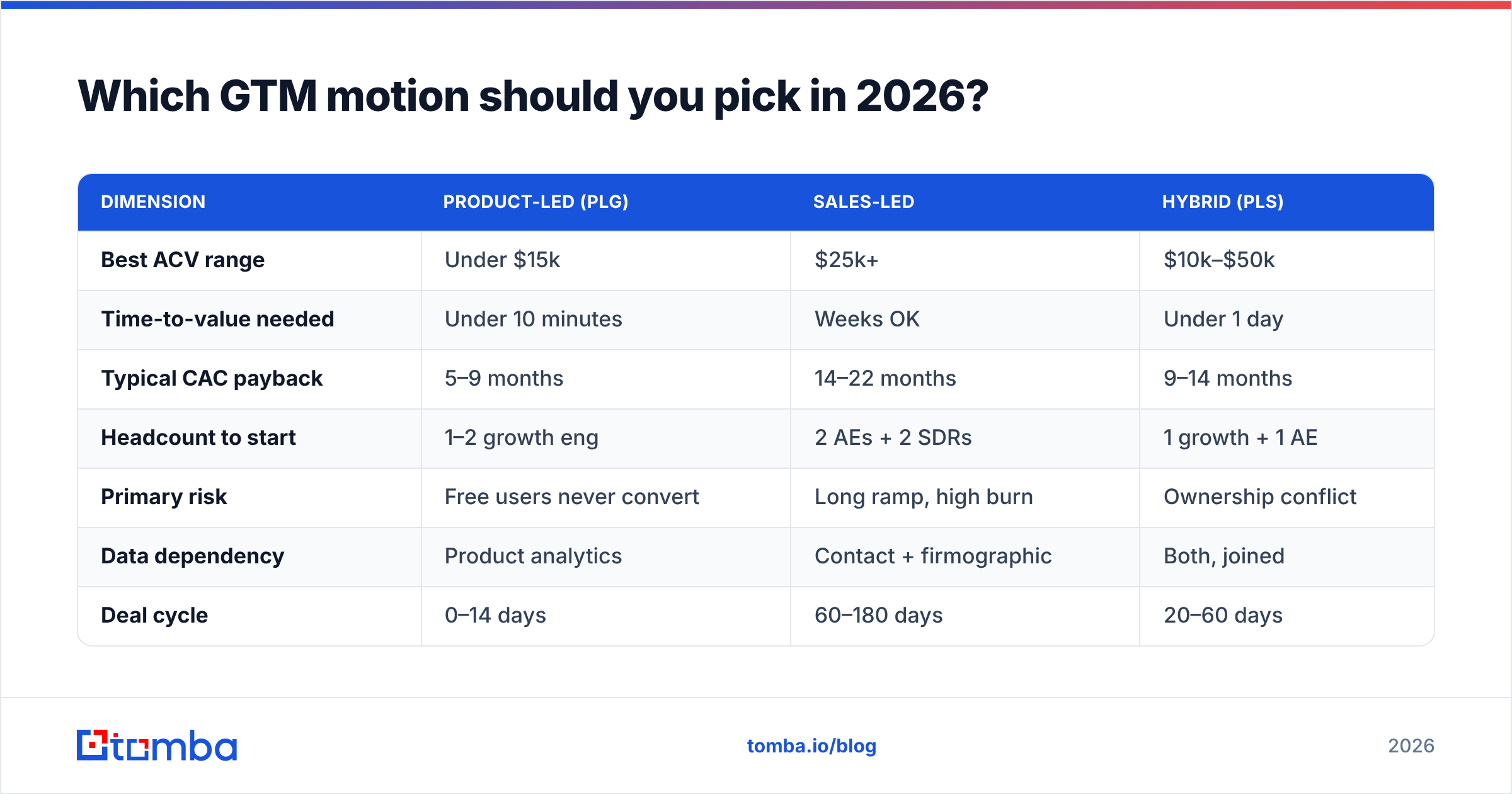
Pick by average contract value and time-to-value. Those two variables predict motion fit better than any other framework.
| Dimension | Product-Led (PLG) | Sales-Led | Hybrid (PLS) |
|---|---|---|---|
| Best ACV range | Under $15k | $25k+ | $10k–$50k |
| Time-to-value needed | Under 10 minutes | Weeks OK | Under 1 day |
| Typical CAC payback | 5–9 months | 14–22 months | 9–14 months |
| Headcount to start | 1–2 growth eng | 2 AEs + 2 SDRs | 1 growth + 1 AE |
| Primary risk | Free users never convert | Long ramp, high burn | Ownership conflict |
| Data dependency | Product analytics | Contact + firmographic | Both, joined |
| Deal cycle | 0–14 days | 60–180 days | 20–60 days |
The uncomfortable truth from the last two years: pure PLG got harder. Free-trial-to-paid conversion at the median B2B SaaS company slid as buyers consolidated tools and procurement re-entered deals under $20k. Self-serve signups still arrive — they just stall in a committee you can't see from a product analytics dashboard.
That's why product-led sales became the default in 2026. You keep the self-serve funnel, then layer human outreach on accounts showing multi-seat activity. It requires knowing who else works at that domain, which is a data problem before it's a sales problem.

When sales-led is still correct#
Don't let PLG evangelism talk you out of a sales motion when:
- Your buyer is a role that doesn't self-serve software (CFO, general counsel, plant manager).
- Implementation requires integration work or data migration.
- Security review is mandatory — meaning a human answers a 200-line questionnaire.
- Your ACV clears $25k, where a $180k fully loaded AE closing 12 deals a year pencils out.
How do you define an ICP that sales can actually use?#
An ideal customer profile is only useful if it produces a list. If your ICP document can't be turned into a filterable query, it's positioning prose.
Build it in four layers:
- Firmographic — employee count band, revenue band, geography, industry codes. Keep bands tight. "50–500 employees" is three different buying processes.
- Technographic — what's already in their stack. If you integrate with HubSpot, companies running HubSpot convert at multiples of those who don't. A website tech stack check turns this into a filter instead of a guess.
- Trigger events — new funding, a relevant executive hire, a job posting for the role your product supports, a pricing page change at a competitor.
- Contact-level — the specific titles in the buying committee, and whether you can reach each of them.
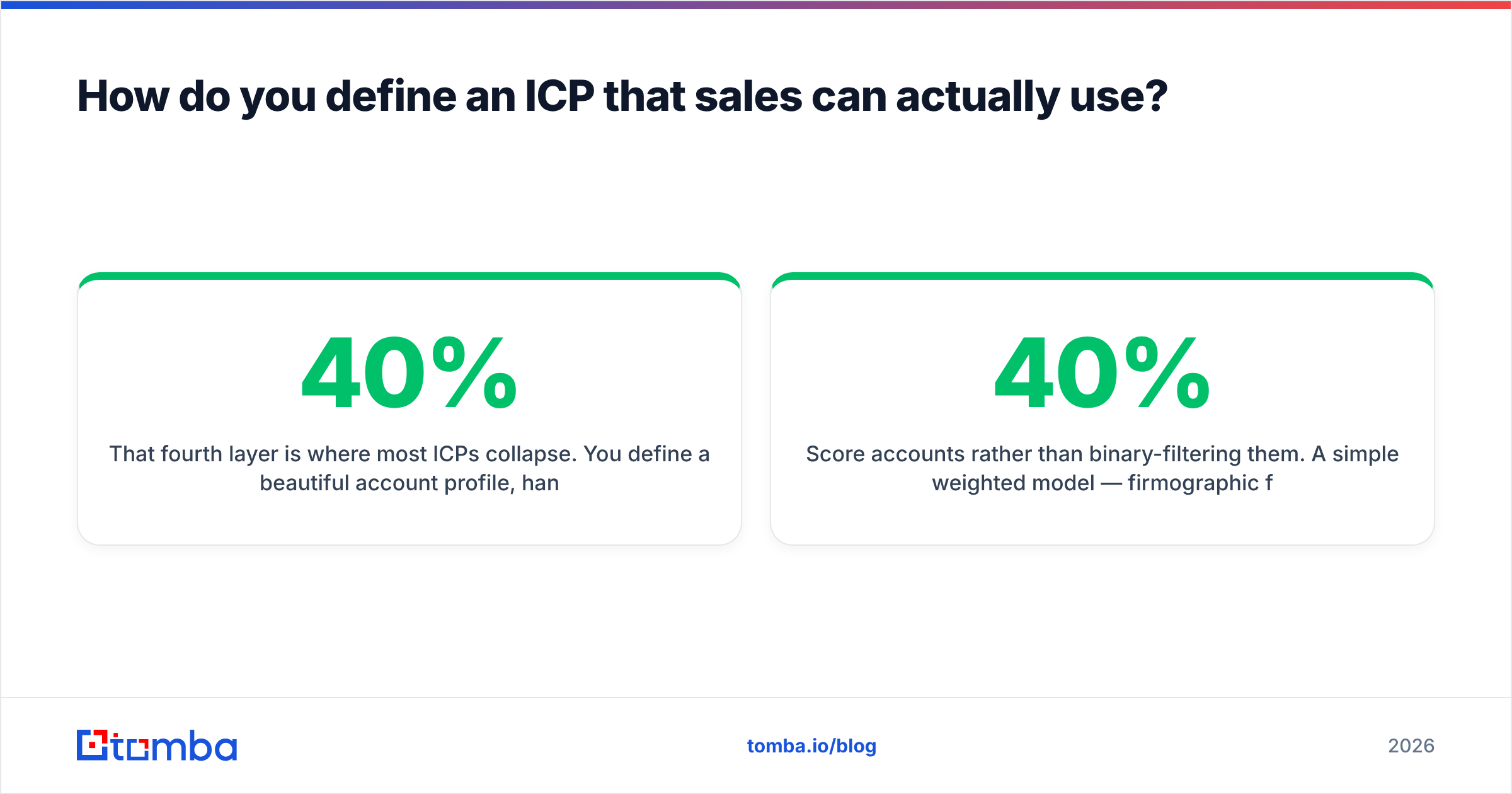
That fourth layer is where most ICPs collapse. You define a beautiful account profile, hand it to an SDR, and they spend 40% of their week hunting for the actual humans. Gartner's buying-group research has consistently put the average B2B buying committee somewhere between six and ten people; assume you need to reach at least three of them for any deal above $20k.
Score accounts rather than binary-filtering them. A simple weighted model — 40% firmographic fit, 30% technographic, 20% trigger recency, 10% engagement — beats a yes/no list because it tells reps where to start, not just who's eligible. If you're formalizing this, our note on lead scoring and MQL definitions is a reasonable starting frame.
What does a realistic GTM budget look like?#
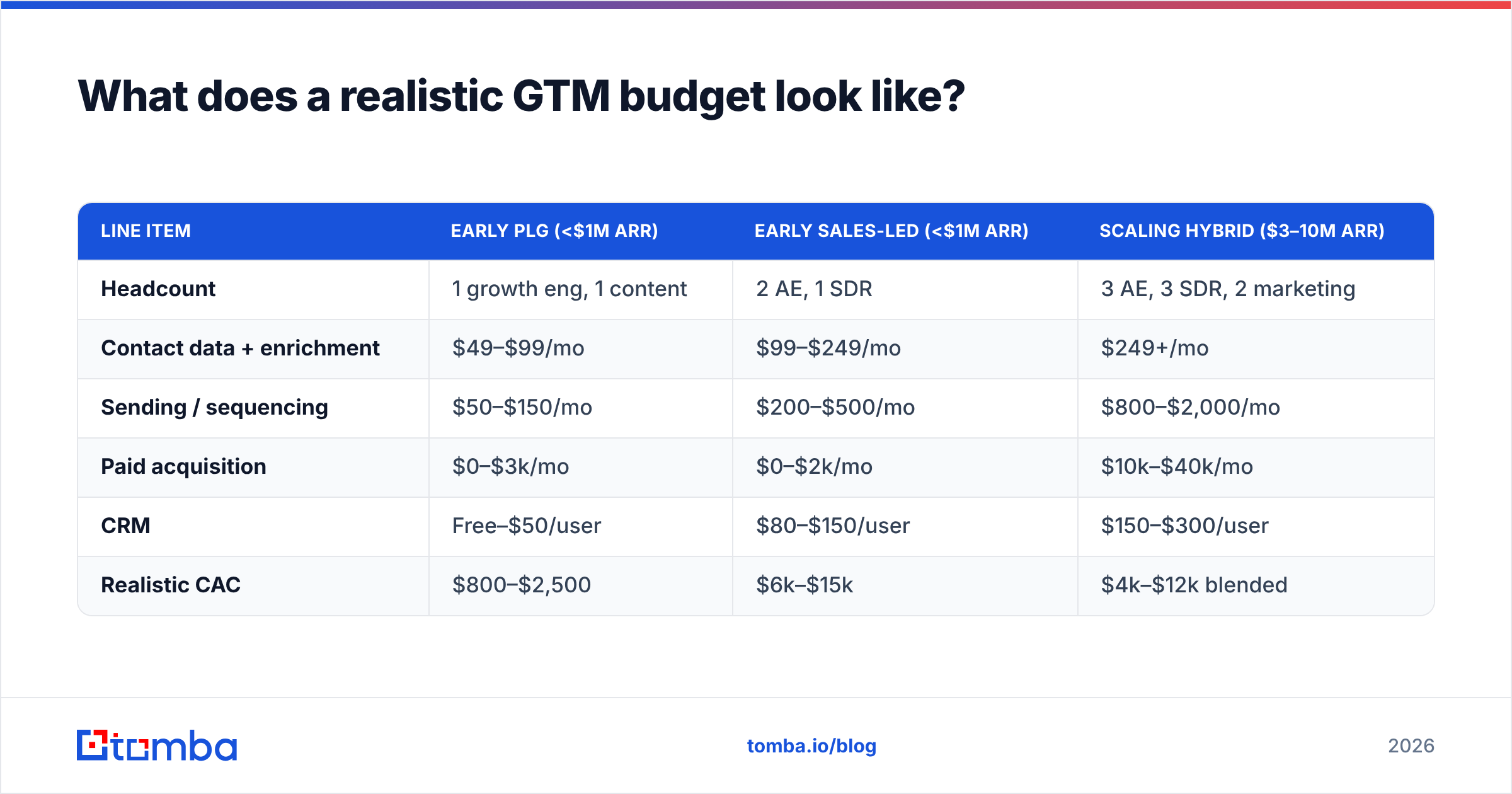
Budget by motion. A PLG company that hires four AEs before proving self-serve conversion burns 18 months. A sales-led company that spends $200k on content before hiring an AE burns the same.
| Line item | Early PLG (<$1M ARR) | Early sales-led (<$1M ARR) | Scaling hybrid ($3–10M ARR) |
|---|---|---|---|
| Headcount | 1 growth eng, 1 content | 2 AE, 1 SDR | 3 AE, 3 SDR, 2 marketing |
| Contact data + enrichment | $49–$99/mo | $99–$249/mo | $249+/mo |
| Sending / sequencing | $50–$150/mo | $200–$500/mo | $800–$2,000/mo |
| Paid acquisition | $0–$3k/mo | $0–$2k/mo | $10k–$40k/mo |
| CRM | Free–$50/user | $80–$150/user | $150–$300/user |
| Realistic CAC | $800–$2,500 | $6k–$15k | $4k–$12k blended |
Two things founders consistently get wrong here.
First: they overspend on intent data before they can action it. A six-figure intent platform surfacing 900 "in-market" accounts is worthless if nobody has time to research and contact them. Buy reach capacity before buying signal.
Second: they underspend on the data layer. Contact data is the cheapest line in the table and the one that gates every other line's ROI. A $99/mo email finder that returns verified addresses makes a $2,000/mo sequencing tool work. The reverse isn't true.
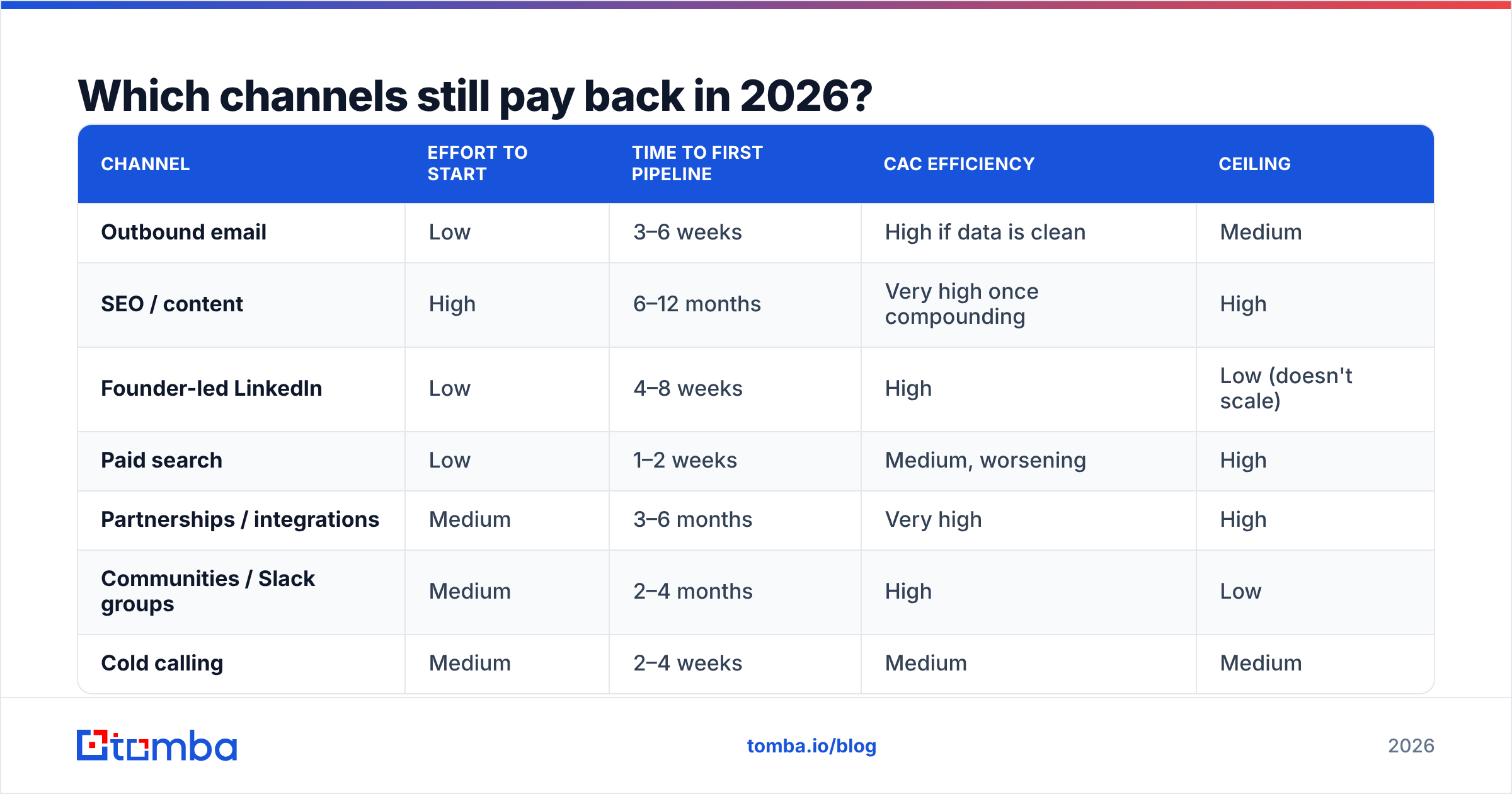
Which channels still pay back in 2026?#
Channel performance diverged hard. Here's the honest state of play, ranked by CAC efficiency for a typical $20k-ACV B2B SaaS product.
| Channel | Effort to start | Time to first pipeline | CAC efficiency | Ceiling |
|---|---|---|---|---|
| Outbound email | Low | 3–6 weeks | High if data is clean | Medium |
| SEO / content | High | 6–12 months | Very high once compounding | High |
| Founder-led LinkedIn | Low | 4–8 weeks | High | Low (doesn't scale) |
| Paid search | Low | 1–2 weeks | Medium, worsening | High |
| Partnerships / integrations | Medium | 3–6 months | Very high | High |
| Communities / Slack groups | Medium | 2–4 months | High | Low |
| Cold calling | Medium | 2–4 weeks | Medium | Medium |
| Events / field | High | 3–9 months | Low early | Medium |
Outbound email keeps its top slot for one reason: it's the only channel where you control both targeting and volume on day one. The catch is that its efficiency is entirely downstream of data quality. Send to a list with 18% invalid addresses and your bounce rate torches domain reputation within two weeks — after which every channel that touches your domain degrades, including your product's transactional email.
That's why email verification belongs in the GTM plan, not the ops backlog. Bounce rate above 3% is where mailbox providers start throttling; above 5% you're rebuilding sender reputation for a quarter. If you're unsure of your current standing, sender reputation is worth understanding before you scale send volume, not after.
Partnerships deserve more attention than they get. Integration-led distribution — listing in the HubSpot, Salesforce, or Slack marketplaces — puts you in front of buyers already spending money in your category. It's slow to build and nearly free to maintain. G2's category data is a reasonable way to identify which adjacent tools your ICP already runs.

How do you sequence the first 12 months?#
Sequencing beats simultaneity. Running six channels at 20% effort produces six sets of inconclusive data.
Months 1–3: prove one motion. Pick the motion your ACV and time-to-value indicate. Build a list of 300 accounts that match your ICP tightly. Reach them manually — yes, manually. Founder-sent email and founder-made calls. The goal is not pipeline, it's learning which objection repeats.
Months 4–6: instrument and templatize. Turn what worked into templates, a qualification checklist, and a CRM stage definition. Now automate list building. This is where a bulk email finder replaces the manual research that ate your first quarter. Measure reply rate and meeting-set rate by segment, not in aggregate.
Months 7–9: hire against the proven motion. If outbound worked, hire an SDR. If content worked, hire a writer before a rep. Hiring a rep to fix a demand problem is the most expensive mistake in early GTM.
Months 10–12: add the second channel. Only now. And pick one that shares infrastructure with the first — outbound plus LinkedIn shares a contact list; SEO plus paid search shares keyword research.
What metrics should you actually track?#
Five numbers. If you're tracking twenty, you're tracking none.
- CAC payback (months) — fully loaded acquisition cost divided by monthly gross profit per customer. Under 12 months is healthy; under 18 is survivable.
- Net revenue retention — above 100% means growth compounds without new logos. Below 90% means your GTM is filling a leaky bucket.
- Pipeline coverage — 3x quota is the working minimum. Below that, forecasts are fiction.
- Win rate by source — the number that tells you which channel to double. Self-serve-sourced and outbound-sourced deals rarely close at the same rate.
- Time-to-first-value — the product metric with the strongest GTM consequence. Cut it and every downstream conversion rate rises.
Two anti-metrics to ignore: raw MQL count (gameable, and usually gamed) and email open rate (unreliable since Apple's Mail Privacy Protection made pixel tracking noise). Track replies and meetings instead.
For the operating cadence around these, revenue operations is the discipline that keeps definitions consistent across marketing, sales, and finance. Without it, three teams report three different CAC numbers in the same board meeting.
What breaks most B2B SaaS GTM strategies?#
In rough order of frequency:
- ICP too broad. "Any company that uses email" is not a target. Narrow until it feels uncomfortably small, then execute.
- Motion mismatched to price. Selling a $400/year product with a 90-day sales cycle. The math never closes.
- Data decay ignored. B2B contact data degrades roughly 25–30% annually through job changes alone. A list built in January is measurably worse by July.
- Channel hopping. Abandoning outbound in week six because "it didn't work" — before the data quality was ever fixed.
- No handoff definition. Marketing says it delivered 200 leads, sales says it got nothing usable. Both are right, because nobody wrote the definition down.
- Pricing set once. Your first pricing page was a guess. Revisit it at $1M ARR and again at $5M.
How do you keep the contact layer from rotting?#
Treat contact data as infrastructure with a maintenance schedule, the same way you'd treat a database.
A workable cadence:
- Quarterly re-verification of any list older than 90 days. Anything that bounces gets suppressed, not retried.
- Enrichment on entry — when a lead enters the CRM from any source, enrich it immediately with company size, tech stack, and role. Enriching later means reps qualify on incomplete records.
- Catch-all handling policy. Catch-all domains accept everything at SMTP and tell you nothing. Decide whether you send to them, and at what volume, rather than letting each rep decide.
- Job-change monitoring on closed-won contacts. Your champion moving to a new company is the highest-converting lead source most teams never work.
- A single source of truth. One system owns the contact record. Everything else reads from it.
This is unglamorous work, which is exactly why it's a durable advantage. Most competitors won't do it.
Where does Tomba fit in a GTM stack?#
Honestly: in the data layer, not the strategy layer. Tomba doesn't decide your motion or write your positioning. It solves the specific problem of turning an account list into reachable, verified people.
The practical use cases in a GTM build:
- You've defined an ICP and have 400 target domains. Domain search returns the people at each one, by department and seniority.
- You're running product-led sales and see three signups from the same company. You need the VP above them — that's a targeted lookup, not a list purchase.
- You're about to run a 5,000-contact campaign and need bounce rate under 2% before it touches your domain.
Pricing is a free tier at 25 searches/month, $49/mo Starter, $99/mo Growth, $249/mo Pro, with Enterprise custom — full Tomba pricing is public, which matters when you're modeling CAC and don't want a "contact sales" black box in your spreadsheet.
There are credible alternatives worth evaluating alongside it. BookYourData is strong if you want prepaid, pay-as-you-go B2B lists without a subscription commitment — a genuinely different purchasing model that fits teams running periodic campaigns rather than continuous outbound. Apollo bundles data with sequencing if you want one vendor for both. Evaluate on match rate against your ICP, not on aggregate accuracy claims, because match rates vary enormously by geography and company size. Run the same 100 target domains through every tool on your shortlist and count usable results.
What's the fastest way to start?#
Pick one motion. Build one list of 300 ICP-matched accounts. Verify every contact before you send. Run it for six weeks and read the reply data, not the open data.
Then, and only then, add the second channel.
If the bottleneck is that you have the account list but not the people — that's the narrow problem worth solving first. Tomba's Email Finder turns a domain and a name into a verified professional address, with a free tier that covers 25 searches a month so you can test match rates against your own ICP before spending anything. Start with the 50 accounts you most want as customers, see how many reachable contacts you actually get back, and let that number tell you whether your outbound plan is fundable.
Sources worth reading alongside this: Gartner's B2B buying research, HubSpot's sales benchmark reports, and vendor comparisons on G2.
Related guides#
Ready to find emails that actually work?
Join 150,000+ professionals who stopped guessing and started sending. Free credits on signup — no credit card required.
Get the Tomba newsletter
Practical outbound tactics and product updates — once every two weeks.
About the author