Go To Market Strategy For Cloud Services: 2026 Playbook
Cloud GTM fails on segmentation and motion-fit, not on messaging. Here is the 2026 playbook for picking PLG, sales-led, or partner-led motions, sizing your ICP, and building a pipeline engine that survives consumption-based revenue.
TL;DR
- A go to market strategy for cloud services lives or dies on motion-fit: your average contract value dictates whether you run product-led, sales-led, or partner-led — not the other way around.
- Under $5K ACV, human-touch sales loses money. Above $50K ACV, self-serve alone will never reach the buying committee. The $5K–$50K band is where hybrid motions win.
- Consumption pricing breaks classic SaaS metrics. Track net revenue retention and time-to-first-value, not just logo count.
- Cloud buying committees now average 6–10 stakeholders. You need contacts across engineering, finance, and security — a single champion is a single point of failure.
- The bottleneck is almost never creative. It's contact data: stale org charts, unverified emails, and no phone coverage kill more cloud GTM plans than bad positioning.
What is a go to market strategy for cloud services?#
A go to market strategy for cloud services is the documented plan for how you take a hosted, consumption-priced technical product from "it works" to "it has repeatable revenue." It answers five questions in order: who buys it, what problem they're funding, how they find you, who talks to them, and what they pay.
Cloud services differ from packaged software in three ways that break generic GTM templates:
- Revenue is metered, not booked. A signed contract is a ceiling, not a number. Customers who don't ramp usage don't pay you, even mid-contract.
- The buyer is technical, the payer is not. An engineer picks the tool; a finance or procurement lead approves the spend; a security reviewer can veto the whole thing.
- Switching costs compound over time. Month one is easy to churn. Month eighteen, with pipelines and IAM policies wired in, is nearly impossible. Your GTM has to survive the fragile early window.
Miss any of those and you end up with the classic cloud failure pattern: strong signup numbers, flat revenue, and a sales team that can't explain the gap.
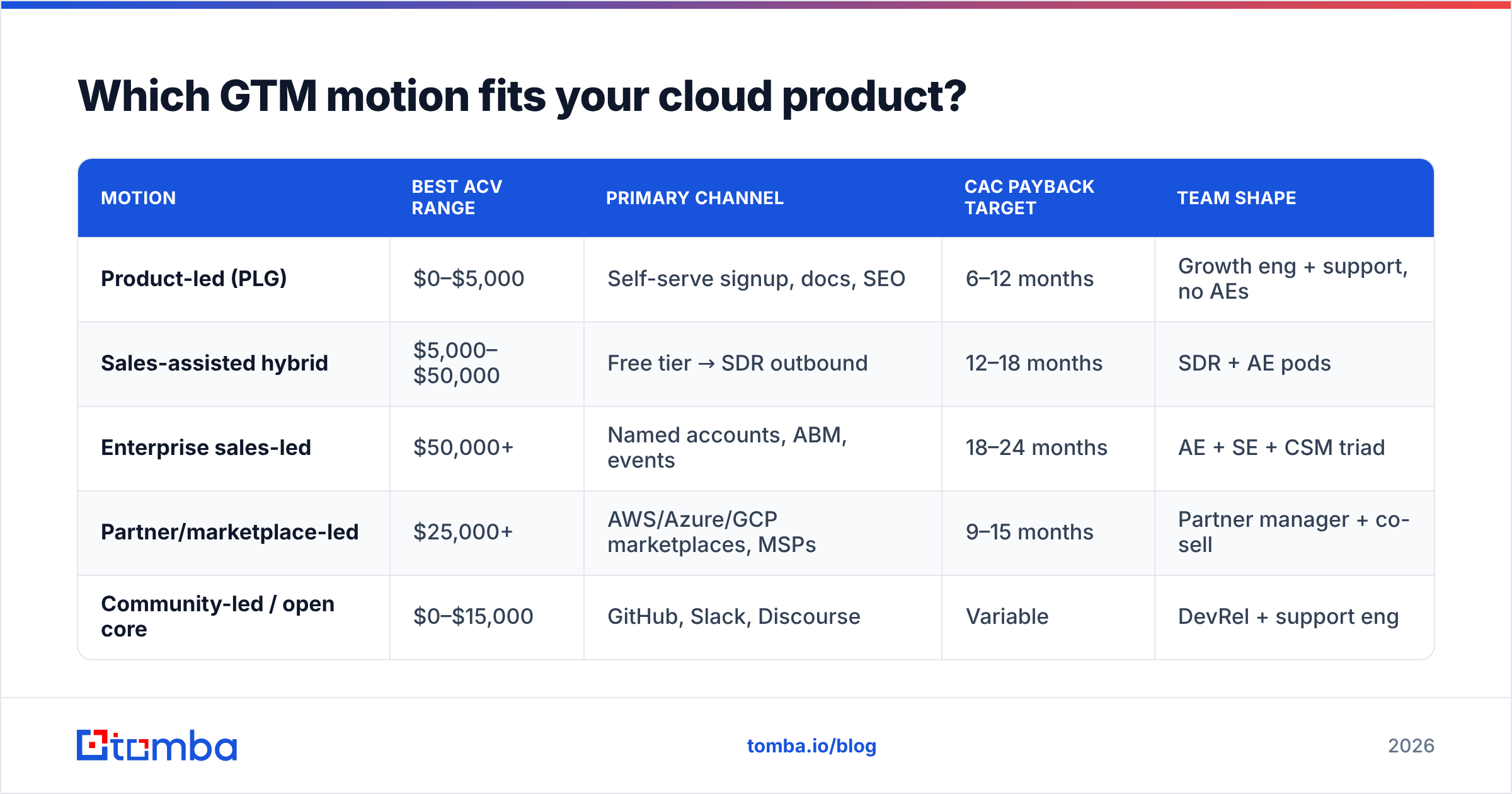
Which GTM motion fits your cloud product?#
Start with ACV. It's the single most predictive input, because it determines how much human time you can spend per account before unit economics collapse.
| Motion | Best ACV range | Primary channel | CAC payback target | Team shape |
|---|---|---|---|---|
| Product-led (PLG) | $0–$5,000 | Self-serve signup, docs, SEO | 6–12 months | Growth eng + support, no AEs |
| Sales-assisted hybrid | $5,000–$50,000 | Free tier → SDR outbound | 12–18 months | SDR + AE pods |
| Enterprise sales-led | $50,000+ | Named accounts, ABM, events | 18–24 months | AE + SE + CSM triad |
| Partner/marketplace-led | $25,000+ | AWS/Azure/GCP marketplaces, MSPs | 9–15 months | Partner manager + co-sell |
| Community-led / open core | $0–$15,000 | GitHub, Slack, Discourse | Variable | DevRel + support eng |
Two rules that fall out of this table:
- Never staff a motion your ACV can't fund. A $2,400/year product cannot support an SDR making 60 dials a day. The math has been run a thousand times and it always loses.
- Marketplace listing is not a motion. Listing on AWS Marketplace gets you procurement plumbing and burn-down of committed spend. It does not generate demand. Treat it as a closing accelerator, not a pipeline source.
How do you define an ICP that actually filters?#
Most cloud ICPs are useless because they're written as demographics ("mid-market SaaS companies in North America") rather than as observable, filterable signals. A working ICP for cloud services has four layers:
- Firmographic floor — Employee count, funding stage, and revenue band. This is the cheapest filter and the least predictive. Use it only to exclude.
- Technographic fit — What's already in the stack. If your product is a Kubernetes cost tool, the account must run Kubernetes. This is verifiable from job posts, DNS records, and public repos.
- Trigger events — A new VP of Infrastructure, a Series B round, a cloud migration announcement, or a published SOC 2. Triggers explain why now, which is the hardest part of any cold message.
- Persona map — The three to five roles who touch the decision. For cloud infra that's typically Platform Engineering, DevOps/SRE, Security, and Finance/FinOps.
Layer four is where most teams stop short. They find one champion, run the whole cycle through them, and lose when that person changes jobs. Build multi-threaded contact coverage from day one — pull the full department with a domain search rather than hunting one name at a time, then confirm each address with an email verifier before it enters sequence.
Why does cloud GTM fail more often than SaaS GTM?#
Because consumption revenue punishes the exact behaviors that classic SaaS rewards.
Failure 1: Optimizing for signups instead of activation. In a seat-based world, a signed contract is revenue. In a metered world, a signup that never hits meaningful usage is a support cost. Your north star should be time-to-first-value — the median hours between account creation and the first genuinely useful action (first query run, first deployment, first alert fired). Cut that number and everything downstream improves.
Failure 2: Ignoring the security gate. For anything touching production data, a security review will happen. If you don't have a trust page, a SOC 2 report or a credible roadmap to one, and clear data-residency answers, your deals stall in month three regardless of how well the demo went. Publish those artifacts before you need them.
Failure 3: Pricing that punishes growth. If a customer's bill triples when their traffic triples but their value doesn't, they will re-architect around you. Tie your pricing metric to a unit the customer already associates with value — not to a unit that's merely convenient for you to measure.
Failure 4: No expansion motion. Cloud NRR above 120% is achievable and is the difference between a company that compounds and one that treadmills. That requires a named owner for expansion, usage alerts routed to a human, and a CSM comp plan that rewards it. See Gartner's research on cloud adoption patterns for how enterprise consumption forecasting is shifting.
What does the cloud GTM stack look like in 2026?#
You need five capabilities. Buy or build them in this order, because each one feeds the next.
- Account intelligence — Firmographic + technographic data to build target lists. Sources: G2 buyer intent, job boards, public cloud configs, review-site activity.
- Contact discovery — Turning a target account into named, reachable humans across the buying committee. This is the layer that fails silently: a 30% bounce rate doesn't announce itself until your sending domain is already damaged.
- Sequencing and orchestration — Multi-channel cadences that mix email, phone, and LinkedIn. The tool matters far less than the list quality feeding it.
- Product analytics — Usage events that flag expansion and churn risk. Without this, your CSMs are guessing.
- Revenue reporting — Consumption forecasting that finance actually trusts. Consumption revenue needs cohort-level ramp curves, not a static ARR number.
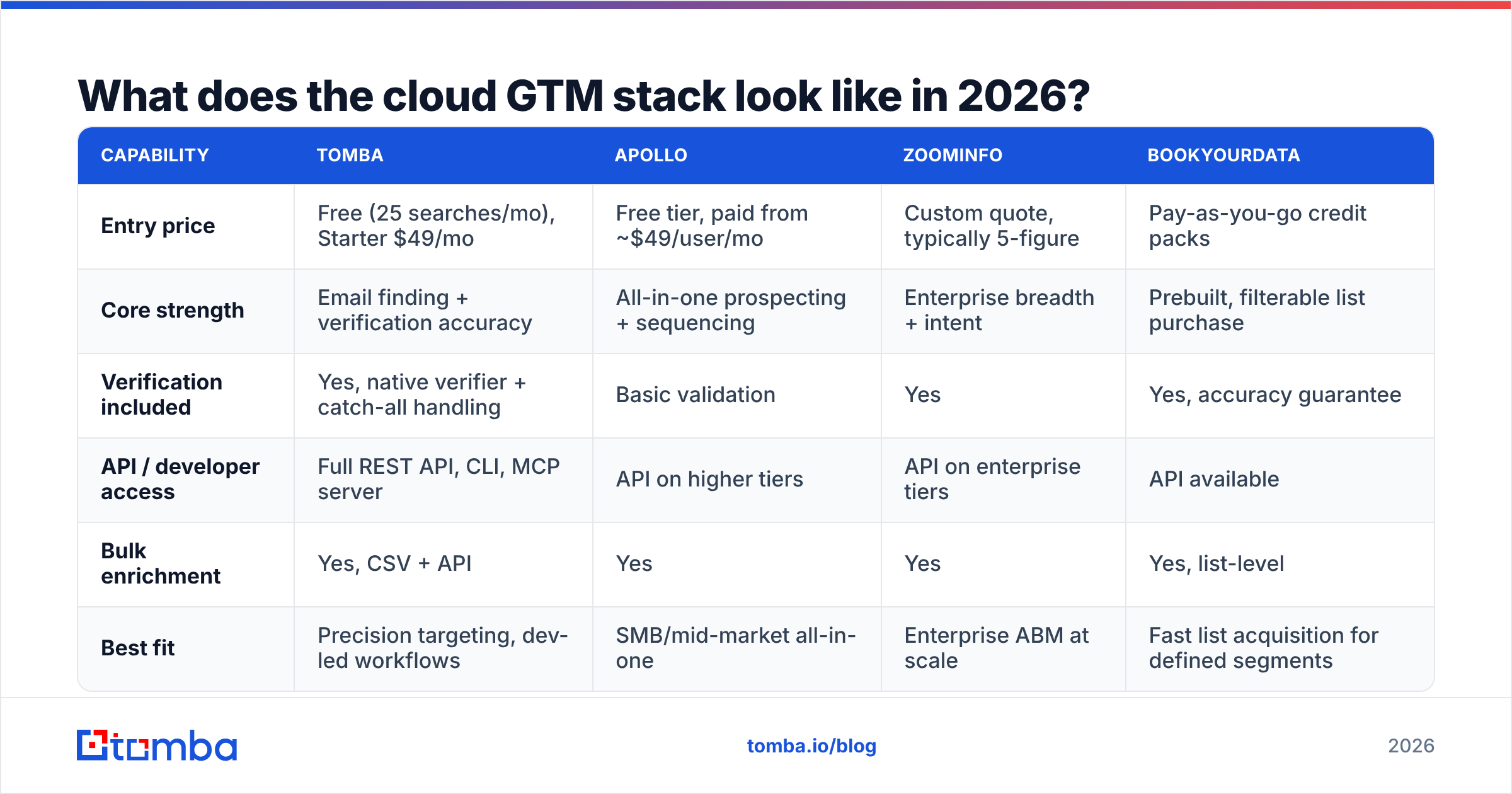
Here's how the main contact-data options compare for a cloud GTM team building the second layer:
| Capability | Tomba | Apollo | ZoomInfo | BookYourData |
|---|---|---|---|---|
| Entry price | Free (25 searches/mo), Starter $49/mo | Free tier, paid from ~$49/user/mo | Custom quote, typically 5-figure | Pay-as-you-go credit packs |
| Core strength | Email finding + verification accuracy | All-in-one prospecting + sequencing | Enterprise breadth + intent | Prebuilt, filterable list purchase |
| Verification included | Yes, native verifier + catch-all handling | Basic validation | Yes | Yes, accuracy guarantee |
| API / developer access | Full REST API, CLI, MCP server | API on higher tiers | API on enterprise tiers | API available |
| Bulk enrichment | Yes, CSV + API | Yes | Yes | Yes, list-level |
| Best fit | Precision targeting, dev-led workflows | SMB/mid-market all-in-one | Enterprise ABM at scale | Fast list acquisition for defined segments |
Different tools solve different problems here. BookYourData is strong when you already know your segment and want a clean, prebuilt list without building an enrichment pipeline. Apollo is the sensible default if you want prospecting and sequencing in one seat. Tomba fits teams who want verified contact data as an input to their own systems — via the Tomba API, a CLI, or a spreadsheet — rather than another UI to live in. If you're evaluating swaps, the Apollo alternative breakdown covers the tradeoffs in detail.
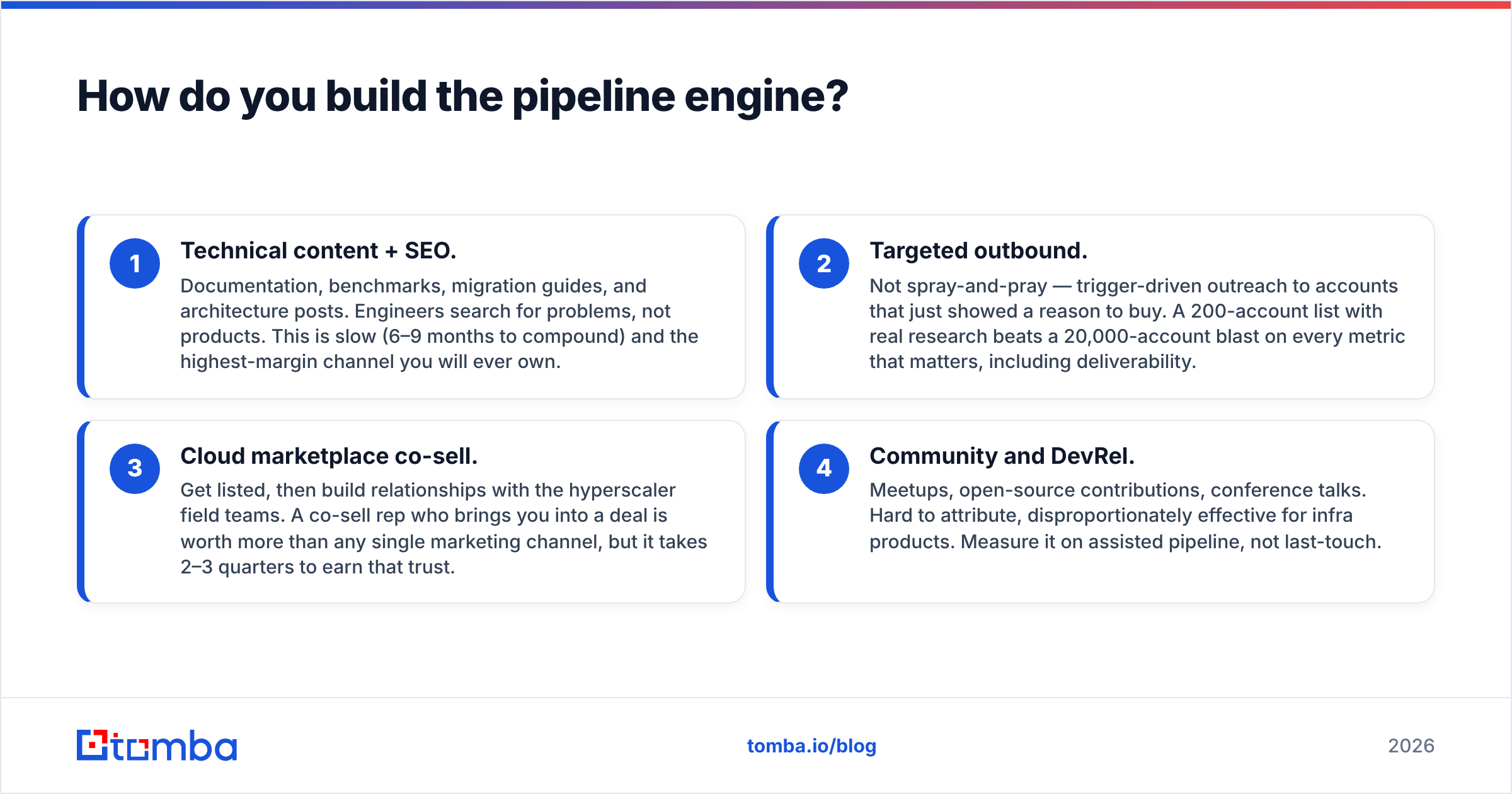
How do you build the pipeline engine?#
Four channels, ranked by how reliably they produce cloud pipeline. Run them in parallel, but resource them in this order.
- Technical content + SEO. Documentation, benchmarks, migration guides, and architecture posts. Engineers search for problems, not products. This is slow (6–9 months to compound) and the highest-margin channel you will ever own.
- Targeted outbound. Not spray-and-pray — trigger-driven outreach to accounts that just showed a reason to buy. A 200-account list with real research beats a 20,000-account blast on every metric that matters, including deliverability.
- Cloud marketplace co-sell. Get listed, then build relationships with the hyperscaler field teams. A co-sell rep who brings you into a deal is worth more than any single marketing channel, but it takes 2–3 quarters to earn that trust.
- Community and DevRel. Meetups, open-source contributions, conference talks. Hard to attribute, disproportionately effective for infra products. Measure it on assisted pipeline, not last-touch.
For outbound specifically, the sequence that works for technical buyers is narrower than generic B2B advice suggests: lead with a specific, verifiable observation about their environment; state one hypothesis about the cost or risk it creates; offer a concrete artifact (benchmark, calculator, teardown) rather than a meeting. Ask for the meeting on touch three, not touch one. If you're building those sequences, the cold email templates library is a reasonable starting scaffold — just rewrite the technical claims to match your actual product.
Phone still works for infra deals when the email thread has stalled. Pull direct dials with a phone finder for the two or three stakeholders who control budget, and keep the call to under ninety seconds.
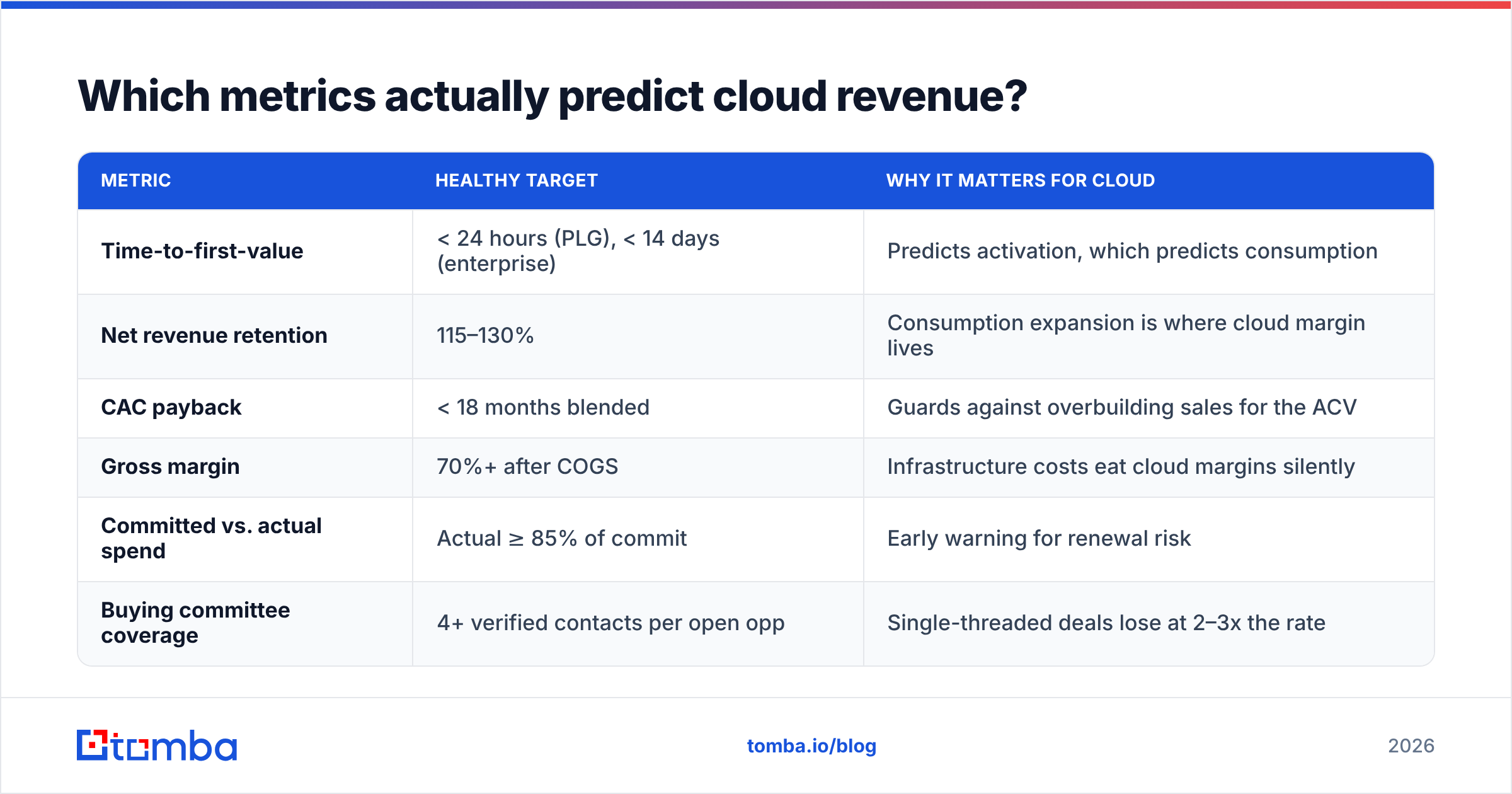
Which metrics actually predict cloud revenue?#
Track these six. Everything else is a subplot.
| Metric | Healthy target | Why it matters for cloud |
|---|---|---|
| Time-to-first-value | < 24 hours (PLG), < 14 days (enterprise) | Predicts activation, which predicts consumption |
| Net revenue retention | 115–130% | Consumption expansion is where cloud margin lives |
| CAC payback | < 18 months blended | Guards against overbuilding sales for the ACV |
| Gross margin | 70%+ after COGS | Infrastructure costs eat cloud margins silently |
| Committed vs. actual spend | Actual ≥ 85% of commit | Early warning for renewal risk |
| Buying committee coverage | 4+ verified contacts per open opp | Single-threaded deals lose at 2–3x the rate |
The last row is the one most teams don't instrument, and it's the cheapest to fix. Before an opportunity moves to stage two, require that the rep has verified contacts for at least four roles in the account. That single gate does more for win rate than most enablement programs, because it makes champion-departure survivable. It also connects directly to revenue operations hygiene — if your CRM contact records are stale, every downstream forecast inherits the error.
What's the 90-day rollout plan?#
Days 1–30: Define and instrument. Write the ICP with all four layers. Pick one primary motion based on ACV. Instrument time-to-first-value in the product. Audit your existing contact database for bounce rate — if it's above 5%, stop sending and clean it first.
Days 31–60: Build the list and the artifacts. Assemble 200–500 target accounts that pass the technographic filter. Enrich to 4+ verified contacts per account. Publish the three artifacts every technical buyer asks for: a security/trust page, a pricing calculator, and one honest competitive comparison. Ship the first four technical content pieces.
Days 61–90: Run and measure. Launch outbound to the first 200 accounts in waves of 50 so you can read the signal. Submit the marketplace listing (it takes weeks to clear review, so start early). Review the six metrics weekly. Kill anything that hasn't produced a qualified conversation by day 90 — but give content the full nine months, because it operates on a different clock.
The discipline that matters here is refusing to run all four channels at half-strength. Pick two, resource them properly, and add the third only when the first two are producing predictably.
Get the contact layer right first#
Every part of a go to market strategy for cloud services depends on reaching the right humans at the right accounts. Positioning, pricing, and content all fail quietly when the contact data underneath them is stale or unverified — you'll blame the messaging when the real problem was a 22% bounce rate and a champion who left nine months ago.
Start there. Use the Tomba Email Finder to build verified, multi-threaded contact coverage across your target accounts — engineering, security, and finance, not just your one friendly champion. The free tier gives you 25 searches a month to test the data quality against accounts you already know, and Tomba pricing starts at $49/mo for Starter when you're ready to scale the list. Get the data layer right, and the rest of the GTM plan stops guessing.
Related guides#
Ready to find emails that actually work?
Join 150,000+ professionals who stopped guessing and started sending. Free credits on signup — no credit card required.
Get the Tomba newsletter
Practical outbound tactics and product updates — once every two weeks.
About the author