Go To Market Strategy for Consulting Services: A 2026 Playbook
Referrals carried your consulting firm to its first million. They will not carry it to the next one. Here is how to build a repeatable go-to-market motion for a services business — niche, offer, channel, list, and proof.
A go to market strategy for consulting services is five decisions, not a marketing plan. This guide walks through each one, then the list work and proof assets that make them pay.
TL;DR
- A go to market strategy for consulting services is not a marketing plan. It is a decision about who you sell to, what outcome you sell, which channel reaches them, and what proof makes them believe you.
- Consulting GTM breaks differently than product GTM: you sell capacity, not licenses, so demand and delivery compete for the same people.
- Pick one motion to be excellent at — referral, outbound, content-led, or partner-led — and treat the other three as support. Firms that run all four at 25% effort rank nowhere in any of them.
- Your target account list is the strategy. A 300-account list with verified decision-maker contacts beats a 30,000-record database you never touch.
- Measure pipeline coverage, proposal win rate, and cost per qualified conversation. Revenue is a lagging indicator that tells you what you did two quarters ago.
What is a go to market strategy for consulting services?#
A go to market strategy for consulting services is the documented answer to five questions: who is the buyer, what problem do you solve for them, what does the engagement look like, how do they find out you exist, and why should they pick you over the three other firms on the shortlist.
That is it. Everything else — the website refresh, the LinkedIn cadence, the webinar series — is execution downstream of those five answers. The general definition of go-to-market strategy applies, but services businesses bend it in three ways.
First, your product is people. When demand spikes, you cannot ship more units. You have to hire, and hiring takes 90 days at best. So consulting GTM has to be throttled on purpose, not maximized.
Second, your buyer is buying a claim about the future, not a demo. There is no free trial for a $180,000 transformation engagement. Trust stands in for the trial. You build trust with proof: case studies, named references, published thinking, and the credibility of the partner in the room.
Third, a committee buys and the budget is gated. Even a mid-size engagement usually involves an economic buyer, a functional sponsor, procurement, and often a skeptic in finance. Your GTM has to reach more than one person at the account.
Why do consulting firms struggle with go-to-market more than SaaS companies?#
Because the thing that got them to $2M actively prevents them from getting to $10M.
Almost every services firm starts the same way: a founder with a network sells work to people who already know them. That is a real GTM motion. It is just an unscalable one. It has zero cost, a near-100% win rate, and a hard ceiling equal to the size of the founder's address book.
The trap is that referral revenue feels like product-market fit. It is not. It is relationship-market fit. When the network runs dry, revenue flattens. The first instinct is usually to "do more marketing" — a website rebuild, a podcast, a newsletter. None of those is a channel decision. Six months later the pipeline is unchanged.
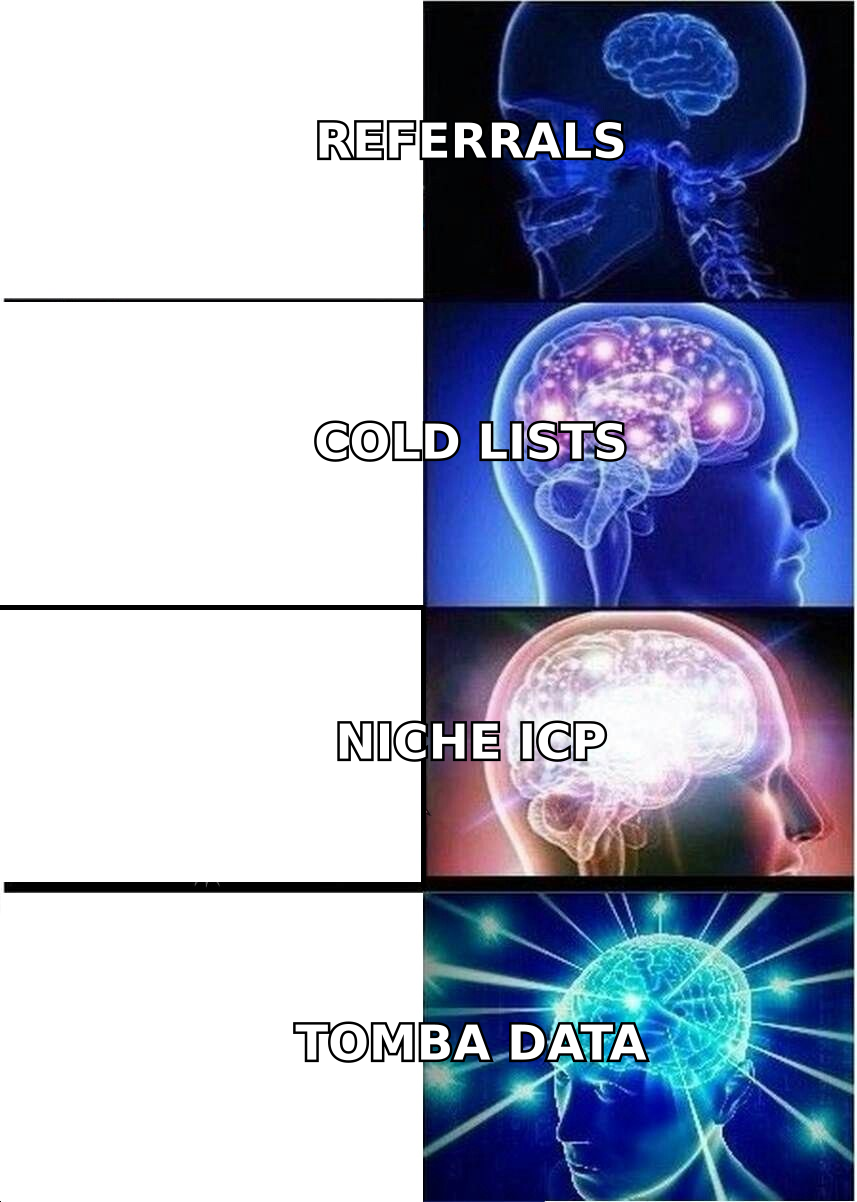
The firms that break through do something less comfortable. They narrow. They pick a vertical or a problem, throw away 80% of the addressable market, and become the obvious call for the remaining 20%. Narrowing feels like shrinking the opportunity. In practice it lifts conversion at every stage. The message finally sounds like it was written for the person reading it.
How do you pick a niche that actually pays?#
Run every candidate niche through six filters before you commit. Most firms skip this part. It is also the part that decides whether the next two years are pleasant or grim.
The first three filters test whether the niche is reachable at all.
- Provable pain with a budget line. The problem must already have money against it somewhere — an existing vendor, an internal team, a failed project. If you have to create the budget category, your sales cycle doubles.
- Reachable decision makers. Can you build a list of the 500–2,000 people who own this problem, with names, titles, companies, and working contact details? If the buyer is hard to spot from the outside, no channel will save you.
- Repeatable delivery. The engagements must resemble each other enough that your second one is 30% cheaper to deliver than your first. Bespoke-every-time is a lifestyle business, not a scalable firm.
The next three test whether it pays.
- Deal size above your effort floor. Say your average engagement is $15,000 and your sales cycle is four months. The math does not work. Either the deal has to grow or the cycle has to shrink.
- Credible right to win. You need at least one story that makes a stranger believe you specifically — a prior role, a case study, a proprietary method. "We are experienced consultants" is not a right to win.
- Room for expansion. Land small, expand large. A niche where the first engagement leads to a second, larger one is worth twice as much as one that produces one-and-done projects.
A niche that clears all six is rare. A niche that clears four is workable. A niche that clears two is a hobby.
Which go-to-market motion fits your consulting firm?#
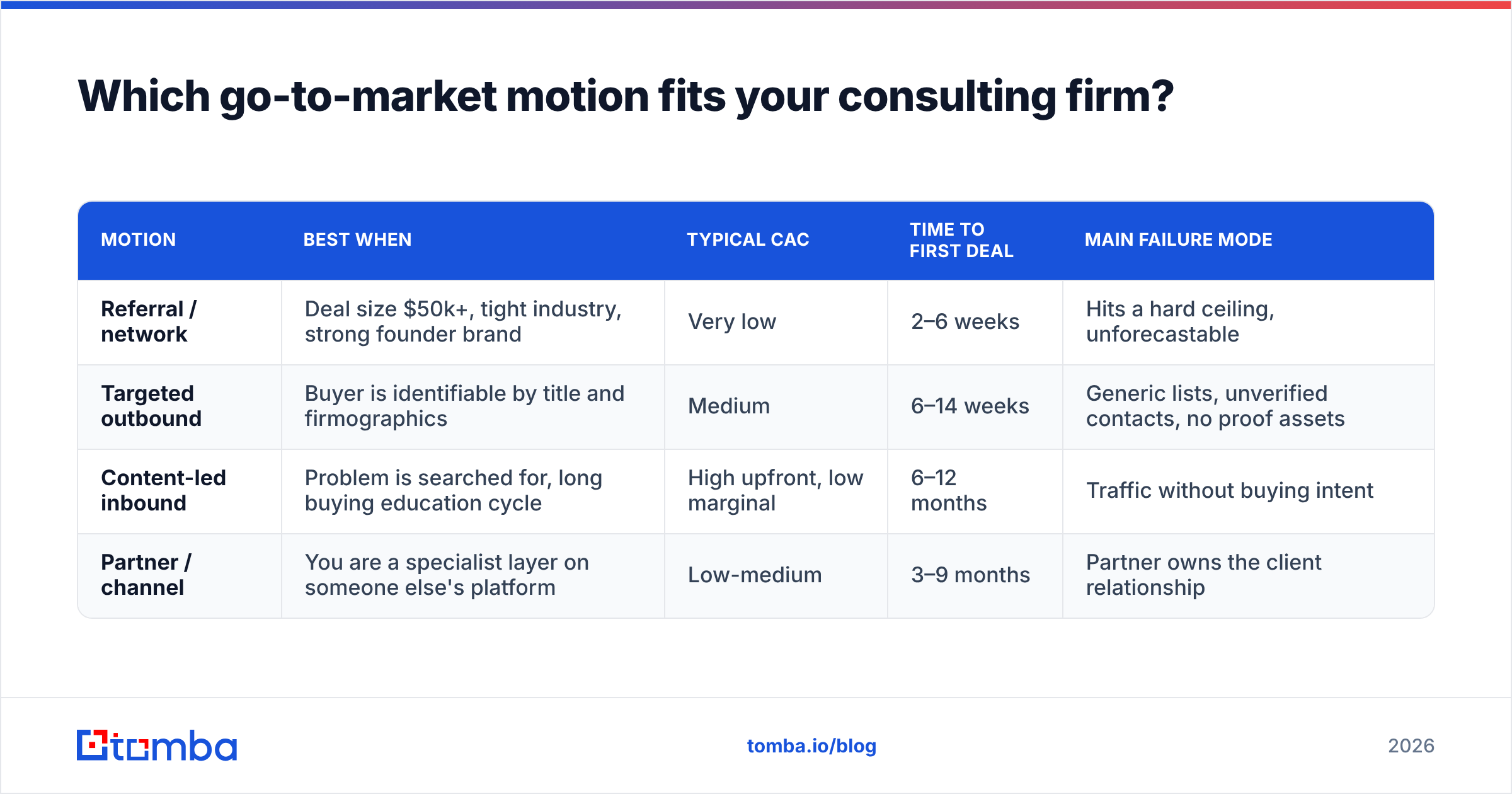
There are four viable motions for a services business. You will eventually use several, but one has to be primary — the one you resource, measure, and improve every week.
| Motion | Best when | Typical CAC | Time to first deal | Main failure mode |
|---|---|---|---|---|
| Referral / network | Deal size $50k+, tight industry, strong founder brand | Very low | 2–6 weeks | Hits a hard ceiling, unforecastable |
| Targeted outbound | Buyer is identifiable by title and firmographics | Medium | 6–14 weeks | Generic lists, unverified contacts, no proof assets |
| Content-led inbound | Problem is searched for, long buying education cycle | High upfront, low marginal | 6–12 months | Traffic without buying intent |
| Partner / channel | You are a specialist layer on someone else's platform | Low-medium | 3–9 months | Partner owns the client relationship |
Most mid-size firms — 10 to 100 people, $2M to $30M in revenue — pick targeted outbound as the primary motion. Content becomes the proof engine that makes the outbound land. That pairing works because you control both the list and the credibility.
Enterprise-focused firms and boutiques with a famous partner should invert it: referral primary, content secondary, outbound reserved for a handful of named accounts. HubSpot's sales research and analyst coverage from Gartner point the same way. Buyers are further along before they talk to anyone. Firms that publish useful thinking get invited to shortlists they never knew existed.
How do you build the target account list?#
This is where a go to market strategy for consulting services stops being a slide and becomes work.
Start with the account list, not the contact list. Define 200–500 companies that match your niche filters: industry, size band, geography, and a trigger. Triggers include new leadership, a funding round, a regulatory deadline, a system migration, or a public job posting for the role your engagement replaces. Triggers matter more than firmographics. A 400-person manufacturer that just hired a VP of Operations is far more likely to buy an operations engagement than an identical company that did not.
Then map the buying committee inside each account. For a typical mid-market services deal you need three to five contacts per company: the economic buyer, the functional sponsor who feels the pain daily, and at least one influencer who will be in the room.
Then find and verify contact details. This step quietly destroys most outbound programs. Purchased lists decay at roughly 25–30% per year. A campaign sent to a stale list burns your sending domain before it produces a single meeting. Use a domain search to pull the contact patterns for each target company. Use an email finder to resolve the names on the buying committee. Then use an email verifier to strip anything that will bounce before it reaches your sequencing tool.
The output should be a spreadsheet — or a CRM view — where every row has a company, a trigger, a named person, a verified email, and a one-line reason you are reaching out. If you cannot fill the last column, delete the row.
What does the offer look like, and how should you price it?#
Consulting GTM fails at the offer stage more often than at the channel stage. "We do strategy consulting" is not an offer. "A six-week operating model diagnostic for 200–800 person manufacturers, fixed fee, with a board-ready roadmap on day 42" is an offer.
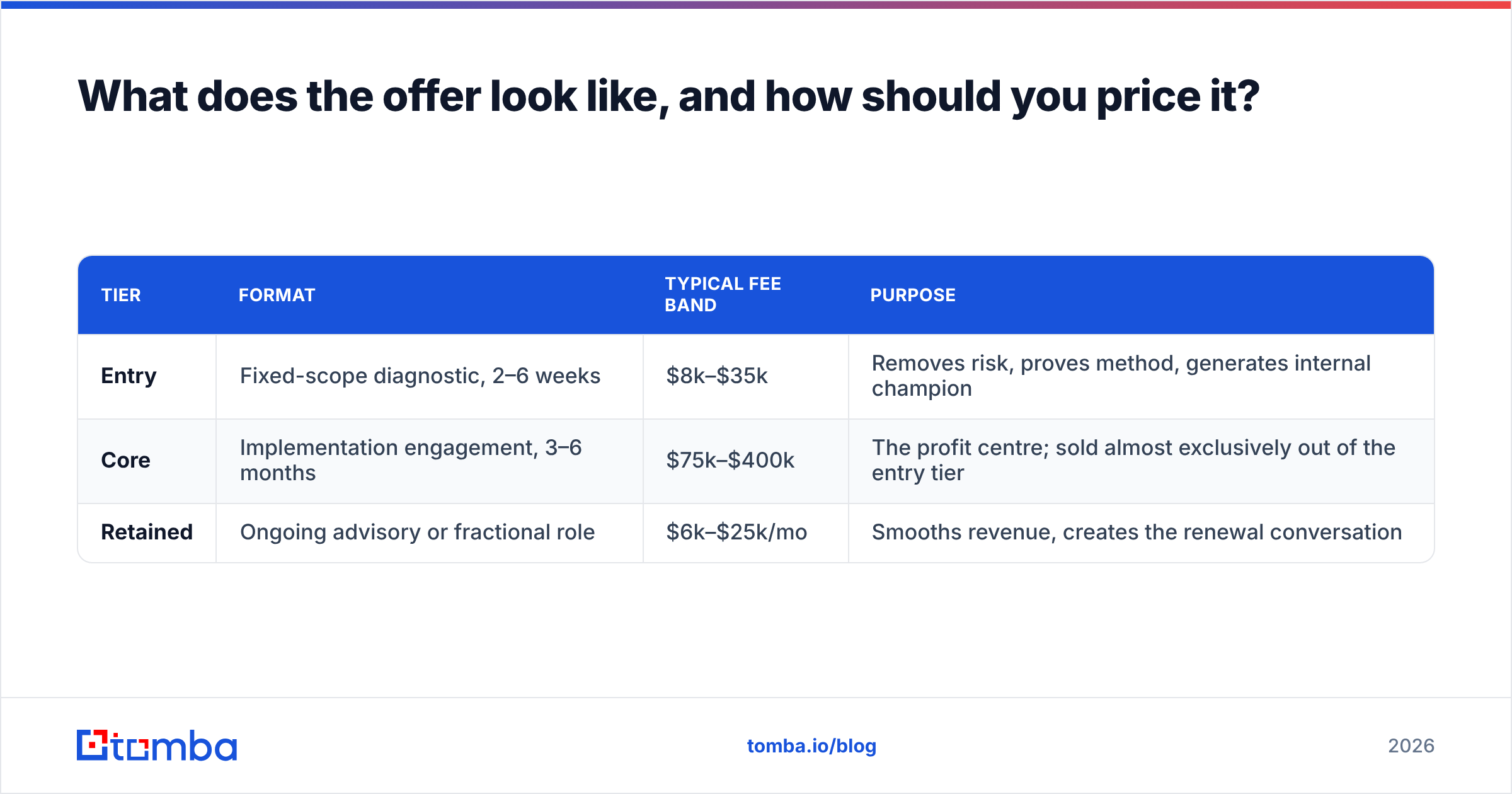
Build a three-tier ladder so the buyer can enter at low risk and expand.
| Tier | Format | Typical fee band | Purpose |
|---|---|---|---|
| Entry | Fixed-scope diagnostic, 2–6 weeks | $8k–$35k | Removes risk, proves method, generates internal champion |
| Core | Implementation engagement, 3–6 months | $75k–$400k | The profit centre; sold almost exclusively out of the entry tier |
| Retained | Ongoing advisory or fractional role | $6k–$25k/mo | Smooths revenue, creates the renewal conversation |
The entry tier is a GTM instrument, not a profit centre. Price it to be an easy yes for a sponsor with discretionary budget. Then design it so the natural next step is the core engagement. Firms that only sell the core engagement are asking a stranger for six figures on the strength of a proposal document. That is a low-probability ask.
Fixed fees beat time-and-materials for the entry tier every time. The buyer is not trying to purchase hours. They are trying to bound their risk.
How do you turn proof into pipeline?#
Proof is the currency of services GTM. Four assets do almost all the work:
- A named case study with a number in the headline. Not "improved efficiency" — "cut order-to-cash from 41 days to 26 in one quarter." Anonymize the client if you must, but keep the number.
- A published point of view. One substantive piece per quarter that takes a position your competitors would not risk taking. This is what makes a cold email answerable.
- A repeatable diagnostic framework with a name. Buyers remember methods. Methods survive the partner leaving the room.
- Three reference clients who will take a call. Ask before you need them, not during a procurement scramble.
Feed these into the outbound motion rather than running them as separate campaigns. The best consulting outbound is a short email. It names the trigger, states the point of view in one line, and offers the diagnostic — not a "quick chat."

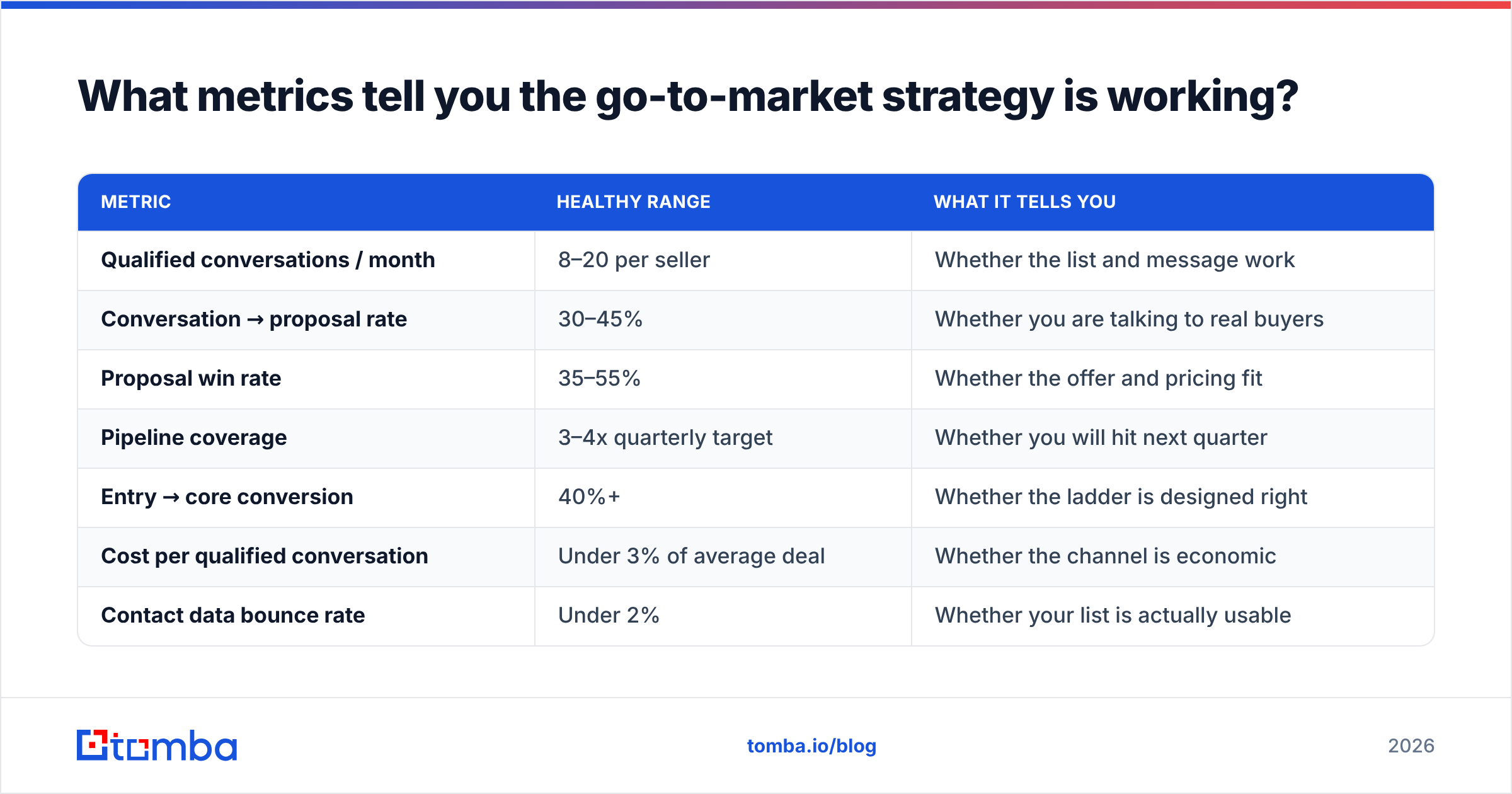
What metrics tell you the go-to-market strategy is working?#
Revenue lags GTM changes by two to three quarters in a services business. If you steer on revenue alone, you will always be correcting for something you did six months ago. Track the leading set instead.
| Metric | Healthy range | What it tells you |
|---|---|---|
| Qualified conversations / month | 8–20 per seller | Whether the list and message work |
| Conversation → proposal rate | 30–45% | Whether you are talking to real buyers |
| Proposal win rate | 35–55% | Whether the offer and pricing fit |
| Pipeline coverage | 3–4x quarterly target | Whether you will hit next quarter |
| Entry → core conversion | 40%+ | Whether the ladder is designed right |
| Cost per qualified conversation | Under 3% of average deal | Whether the channel is economic |
| Contact data bounce rate | Under 2% | Whether your list is actually usable |
That last row is unglamorous and non-negotiable. A bounce rate above 3–4% hurts your sending reputation. That quietly suppresses deliverability for every later campaign, including the ones to warm accounts. Verify before you send, not after you get burned.
What does the tooling stack look like?#
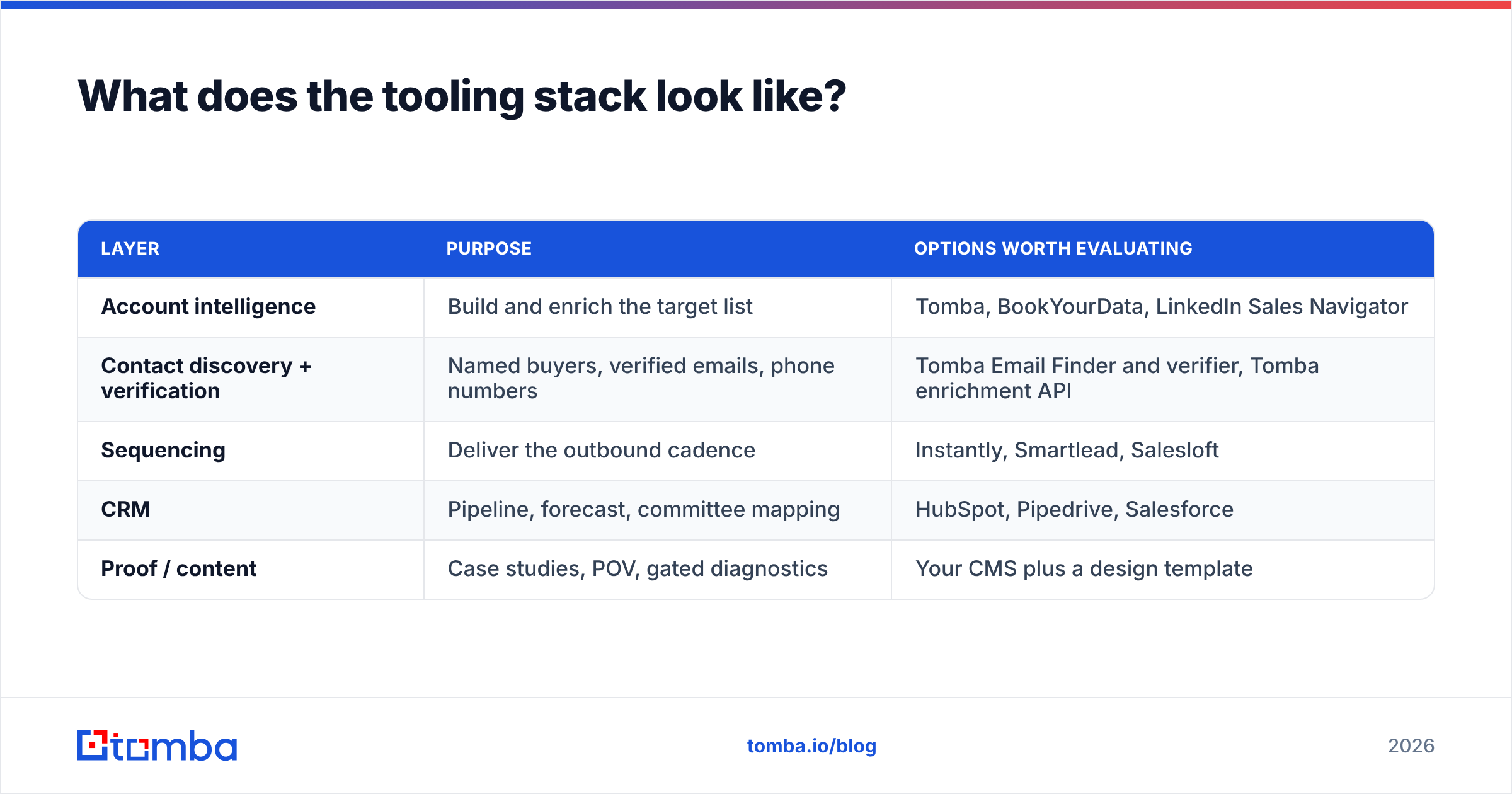
You need less software than vendors would like you to believe. Five categories cover a consulting GTM motion end to end.
| Layer | Purpose | Options worth evaluating |
|---|---|---|
| Account intelligence | Build and enrich the target list | Tomba, BookYourData, LinkedIn Sales Navigator |
| Contact discovery + verification | Named buyers, verified emails, phone numbers | Tomba Email Finder and verifier, Tomba enrichment API |
| Sequencing | Deliver the outbound cadence | Instantly, Smartlead, Salesloft |
| CRM | Pipeline, forecast, committee mapping | HubSpot, Pipedrive, Salesforce |
| Proof / content | Case studies, POV, gated diagnostics | Your CMS plus a design template |
For consulting firms, the account intelligence and verification layers deserve more attention than the sequencing layer. You are sending hundreds of emails a month, not hundreds of thousands. Precision beats volume by a wide margin. BookYourData is a solid choice when you want a pre-built list for a broad vertical. Tomba fits better when you already know the 300 companies you care about and need verified contacts inside those accounts. Compare both against your own niche before you commit. Vendor-neutral reviews on G2 are a reasonable start, but nothing beats testing 50 records against your real target list.
Check Tomba pricing against your monthly contact volume rather than your headcount. A 20-person firm running 300 verified contacts a month does not need an enterprise seat model.
What are the most common consulting GTM mistakes?#
Running four motions at once. Splitting effort across referral, outbound, content, and events guarantees mediocrity in all four. Pick one, get it to work, then add the second.
Selling capability instead of outcome. Buyers do not purchase "change management expertise." They purchase a specific business result on a specific date.
Letting delivery starve sales. The classic services death spiral: win work, stop selling, finish work, empty pipeline, discount to fill it, repeat. Protect selling time the way you protect billable time — a fixed number of hours per week, on the calendar, non-negotiable.
Buying volume data for a precision problem. A 50,000-record list is worse than useless for a firm doing 12 deals a year. It creates the illusion of activity while your reply rate collapses.
No trigger in the message. "I saw you're hiring a VP of Supply Chain" beats "I wanted to introduce our firm" by an order of magnitude. One of them proves you did work before you asked for time.
Where should you start this quarter?#
Do these four things in order, over about six weeks. Write the niche definition and run it through the six filters. Build a 250-account target list with triggers. Find and verify the buying committee inside each account. Ship one proof asset — a case study with a number in the headline — and wire it into a short outbound cadence.
That sequence is a go to market strategy for consulting services in its smallest usable form. It is deliberately narrow. It is also the only version of this work that gives you a forecastable pipeline within a quarter, instead of a strategy document you revisit next year.
When you get to step three, the bottleneck is always the same. You have company names, and you need real people with working email addresses. That is the job the Tomba Email Finder was built for: resolve named decision makers at your target accounts and verify before you send. Start with the free tier at 25 searches a month and test your list against your niche before you commit to anything larger.
Related guides#
Ready to find emails that actually work?
Join 150,000+ professionals who stopped guessing and started sending. Free credits on signup — no credit card required.
Get the Tomba newsletter
Practical outbound tactics and product updates — once every two weeks.
About the author